How Law Firms Track Billable Hours: Increments, Codes and Compliance

Law firms bill time in tenths of an hour: six minutes is 0.1. Each entry carries a matter number, a timekeeper, the time, and a description of the work. Firms acting for corporate clients and insurers add UTBMS task codes and submit invoices in the LEDES format. The ABA Model Rules require the fee to be reasonable and the basis for it to be communicated to the client — and say nothing at all about rounding, which is where most of the trouble starts.
Key takeaways
- Six minutes is 0.1 hours. The scale runs 1–6 minutes to 0.1 through 55–60 minutes to 1.0, and every band is exactly one tenth — no repeating decimals.
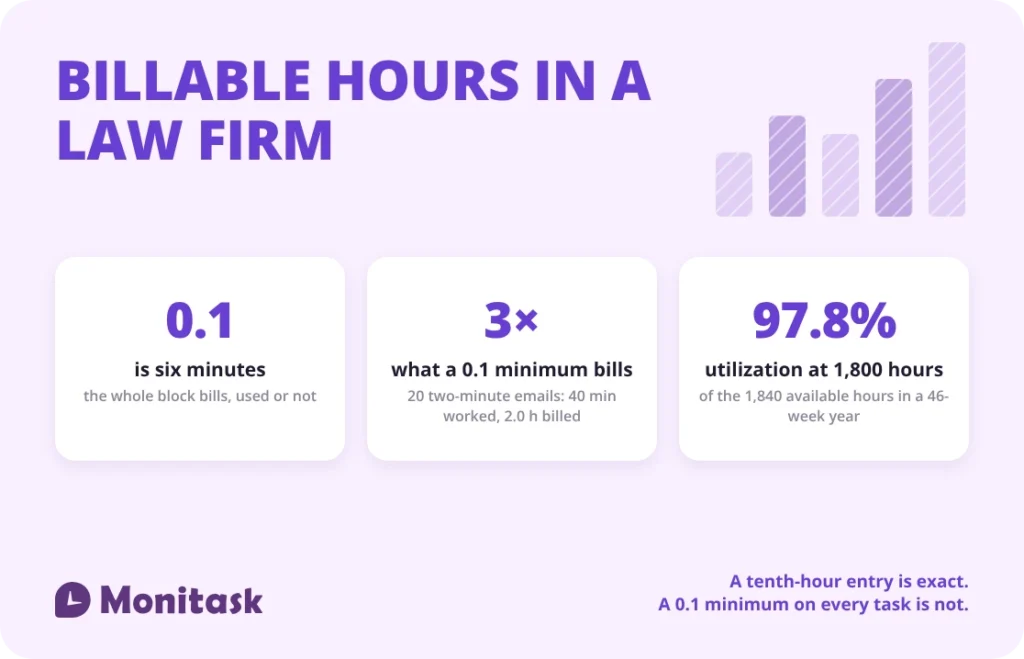
- Rounding every two-minute task up to 0.1 bills three times the time worked. Twenty such emails in a day bill 2.0 hours against 40 minutes of work. Repeat it daily and it is $122,665.90 and 306.7 invented hours a year.
- Block billing — several tasks in one entry — is prohibited by most outside counsel guidelines and is a standard basis for reducing a bill, because an entry that cannot be examined cannot be approved in full.
- UTBMS task codes and LEDES invoices are mandatory for most corporate and insurance work. A file that fails validation is rejected and never posts as an invoice.
- A target of 1,800 billable hours is 39.1 billable hours a week, which takes about 55.9 hours of work. Measured the way every other profession measures utilization — against available hours rather than hours worked — it is 97.8%.
How do law firms bill time?
Law firms bill in tenths of an hour. Six minutes of work is 0.1 hours, eighteen minutes is 0.3, and a full hour is 1.0. The convention exists because legal work arrives in short pieces: a three-minute call, a seven-minute email, a twenty-minute document review.
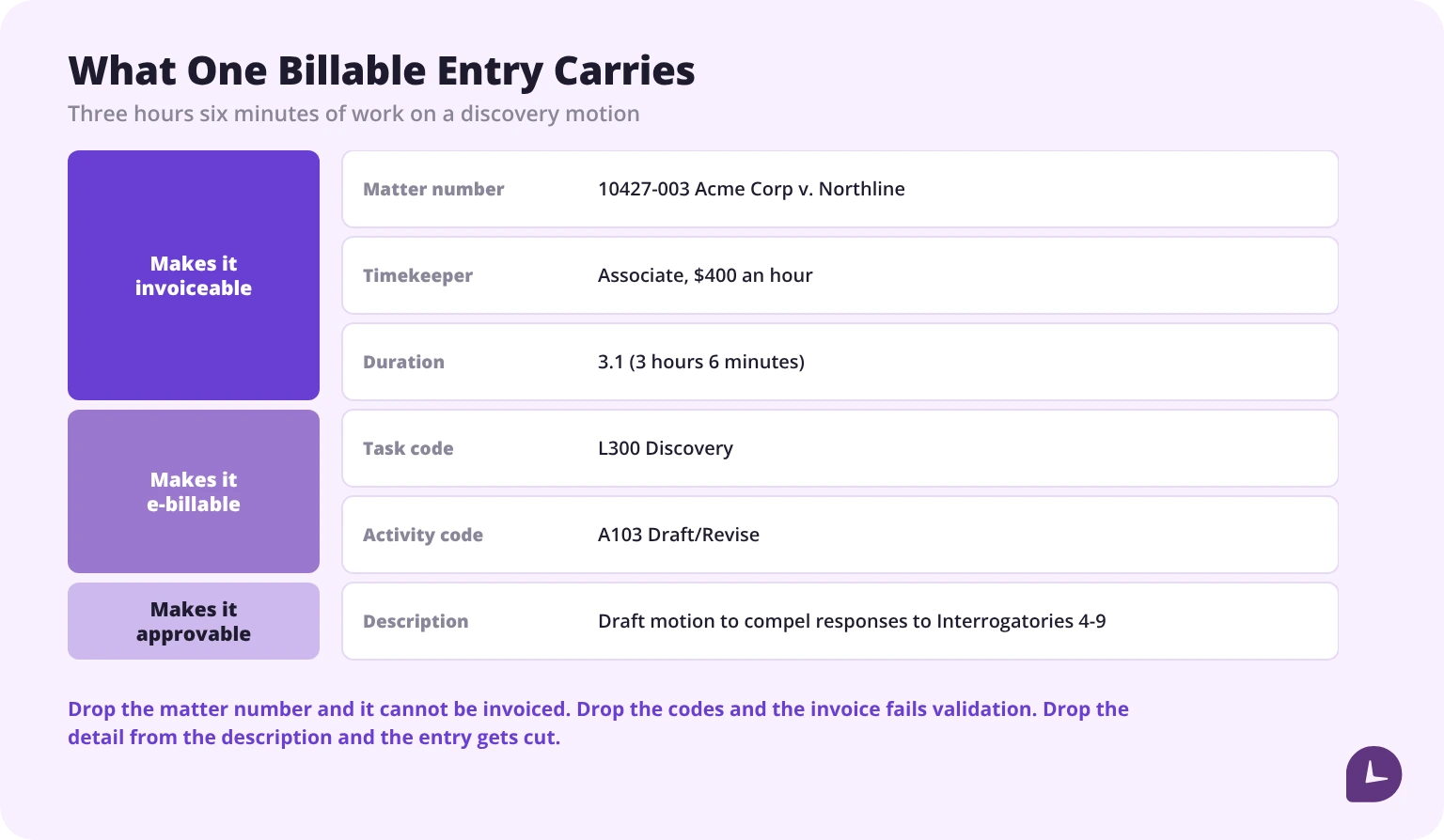
Each time entry needs four things before it can be invoiced at all:
- The matter number. Time without a matter cannot be billed to anyone.
- The timekeeper. Rates differ by seniority, and the rate attaches to the person, not to the task.
- The duration, in tenths.
- A description of what was done, specific enough that a client can see what they are paying for.
Firms working for corporate clients and insurers add two more — a UTBMS task code and an activity code — covered below.
The quarter-hour increment still exists in some practices. It bills a two-minute call at 0.25 hours, which is 15 minutes, and that is difficult to defend line by line when a client reviews the bill.
Tenth-of-an-hour conversion chart
| Minutes worked | Billed |
|---|---|
| 1 – 6 | 0.1 |
| 7 – 12 | 0.2 |
| 13 – 18 | 0.3 |
| 19 – 24 | 0.4 |
| 25 – 30 | 0.5 |
| 31 – 36 | 0.6 |
| 37 – 42 | 0.7 |
| 43 – 48 | 0.8 |
| 49 – 54 | 0.9 |
| 55 – 60 | 1.0 |
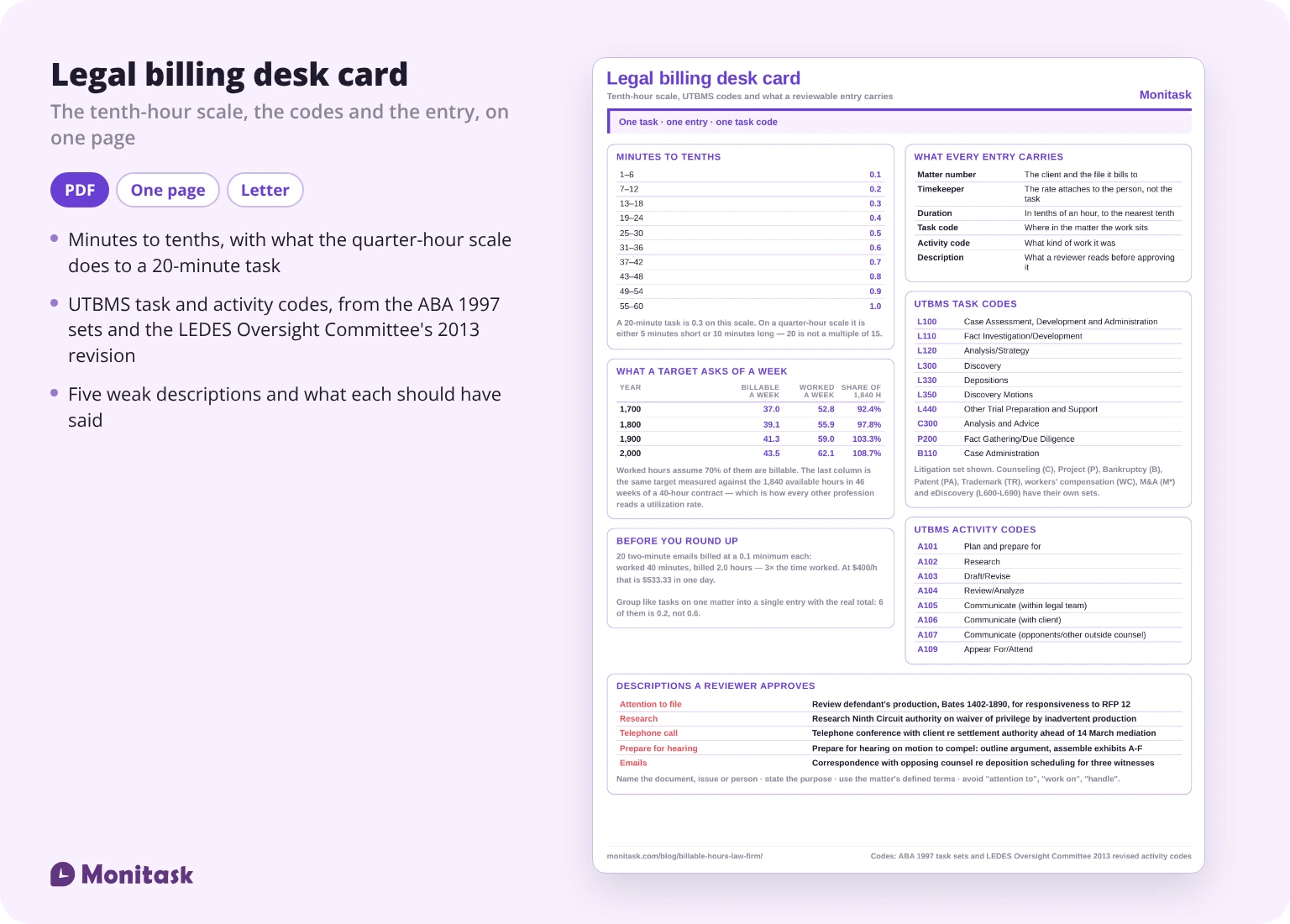
The tenth-hour scale is exact: each six-minute block is precisely one tenth of an hour, with no repeating decimals. The quarter-hour scale is not. A 20-minute task is 0.3 on the tenth scale and has no clean representation on the quarter scale at all — 20 is not a multiple of 15, so the entry is either 5 minutes short at 0.25 or 10 minutes long at 0.50. That is why professional services settled on tenths. The full conversion is on the desk card below, along with the codes and the entry checklist.
What does the ABA require about fees?
Two documents govern how recorded time becomes a fee.
ABA Model Rule 1.5(a) opens: “A lawyer shall not make an agreement for, charge, or collect an unreasonable fee or an unreasonable amount for expenses.” The rule then lists eight factors for assessing reasonableness. In summary, they are:
- The time and labor required, the novelty and difficulty of the questions, and the skill needed to do the work properly.
- Whether taking the matter will preclude other employment, if that is apparent to the client.
- The fee customarily charged in the locality for similar legal services.
- The amount involved and the results obtained.
- The time limitations imposed by the client or by the circumstances.
- The nature and length of the professional relationship with the client.
- The experience, reputation and ability of the lawyer or lawyers doing the work.
- Whether the fee is fixed or contingent.
Rule 1.5(b) requires the lawyer to communicate the scope of the representation and the basis or rate of the fee and expenses, preferably in writing, before or within a reasonable time after beginning the representation — and to communicate any later change to that basis or rate. The exception is a regularly represented client being charged on the same basis as before.
Formal Opinion 93-379, issued by the ABA Standing Committee on Ethics and Professional Responsibility on 6 December 1993, addresses billing for professional fees, disbursements and other expenses, billing for more time than was actually spent included. The ABA sells rather than publishes the text, but state bars have adopted it wholesale — the Alabama State Bar incorporated it in full in 1994 — and other bars have restated its principle in their own published opinions. The Alaska Bar Association puts it plainly: “The lawyer who has agreed to bill a client on the basis of hours expended cannot ethically bill the client for more than the actual time spent.”
Here is what neither document says. Neither Rule 1.5 nor Opinion 93-379 sets a minimum billing increment, endorses one, or says anything about rounding. There is no rule that makes 0.1 a floor and no rule that forbids it. What the rules require is that the resulting fee be reasonable and that the client was told the basis for it. Every rounding question in this article is a question about those two things, not about a billing rule that exists somewhere.
Model Rules are a model. Each jurisdiction adopts its own version, and the adopted text governs. Check the rule as enacted in the states where the firm practises.
Does rounding up every small task overbill the client?
It can, and the arithmetic is worth seeing.
Rounding to the nearest tenth is standard practice. Rounding every small task up to a minimum of 0.1 is a different thing, and the gap compounds quickly.
Twenty two-minute emails in one day:
| Time actually worked | 20 × 2 minutes = 40 minutes |
| Billed at 0.1 per email | 20 × 0.1 = 2.0 hours, or 120 minutes |
| Ratio | 3× the time worked |
| Billed at $400 per hour | $800.00 |
| Value of the time actually worked | $266.67 |
| Difference | $533.33 in one day |
No individual entry looks wrong. The 0.1 on a two-minute email is the smallest unit the system allows. It is the accumulation that creates the exposure: five days a week across 46 working weeks is $122,665.90 from one timekeeper, and 306.7 hours that appear against a billable target without anyone having worked them. That is the first thing a client-side bill review finds, and it is the number that turns a billing habit into a Rule 1.5(a) problem.
The practical answer is to group small like tasks on the same matter into one entry carrying the actual total time. Six two-minute emails to the same client on the same matter become one 0.2 entry describing the exchange, not six 0.1 entries totalling 0.6. That is not block billing — the tasks are of the same type on the same matter, which outside counsel guidelines generally permit and often require.
Where a firm does apply a 0.1 minimum per task, it belongs in the engagement letter under Rule 1.5(b), not in the billing system only. The rules do not prohibit the practice. They do require the client to have been told about it.
What is block billing and why do clients reject it?
Block billing puts several distinct tasks into a single entry with one combined time.
| Entry | |
|---|---|
| Block billed | “Review documents, draft motion, call with client, correspondence re discovery — 6.5” |
| Itemized | “Review documents produced by defendant in response to RFP 12–18 — 2.3” “Draft motion to compel responses to Interrogatories 4–9 — 3.1” “Telephone conference with client re motion strategy — 0.6” “Correspondence with opposing counsel re discovery schedule — 0.5” |
Both total 6.5 hours, and at $400 an hour both are $2,600. Only the second lets a client see what each task cost, and that is the whole objection: a block entry cannot be assessed for reasonableness, which is exactly what Rule 1.5(a) asks a fee to withstand. A routine 20% cut on an entry that cannot be examined takes $520 off that one line.
Three consequences follow in practice:
- Most outside counsel guidelines prohibit it outright, usually with a maximum time per entry — commonly 0.5 to 3.0 hours — above which the entry must be split.
- It is a standard basis for reduction in fee disputes and in court-supervised fee applications, because an entry that cannot be examined cannot be approved in full.
- E-billing systems reject it at the file level. An entry carrying several task codes, or one code for work that plainly spans several, fails validation, and a file that fails validation does not post as an invoice.
The rule that avoids all three: one task, one entry, one task code.
What are UTBMS codes and the LEDES format?
Corporate clients and insurers do not accept narrative invoices. They require time coded to a standard taxonomy and delivered as a structured file.
UTBMS — the Uniform Task-Based Management System — is that taxonomy. The original code sets came out of a joint effort by the ABA Section of Litigation, the American Corporate Counsel Association (now the Association of Corporate Counsel), and a group of corporate clients and law firms, coordinated and supported by Price Waterhouse LLP, and were released in 1997. They are maintained today by the LEDES Oversight Committee, which has ratified new sets steadily since:
- 2007 — Revised Project codes
- 2009 — Patent and Trademark codes
- 2011 — eDiscovery codes
- 2013 — revised Activity and Expense codes
- 2015 — governance, risk and compliance codes
- 2016 — mergers and acquisitions codes
- 2023 — IP patent prosecution codes
LEDES — the Legal Electronic Data Exchange Standard — is the invoice file format that carries the coded time to the client’s e-billing system. Several versions are published: LEDES 98B, LEDES 98BI, LEDES 2000 and the XML e-billing formats 2.0, 2.1 and 2.2. The LEDES Oversight Committee describes LEDES 98B as the most widely used e-billing standard in the legal industry in the US.
Task codes by practice area
Each task code is a letter for the practice area plus three digits. Codes sharing a letter and first digit belong to the same phase of the matter.
| Set | Covers | Examples |
|---|---|---|
| L | Litigation | L100 Case Assessment, Development and Administration · L110 Fact Investigation/Development · L300 Discovery · L330 Depositions |
| C | Counseling | C200 Researching Law · C300 Analysis and Advice |
| P | Project | P200 Fact Gathering/Due Diligence · P500 Negotiation/Revision/Responses |
| B | Bankruptcy | B110 Case Administration · B320 Plan and Disclosure Statement (including Business Plan) |
| PA | Patent | PA200 Patent Investigation and Analysis |
| TR | Trademark | TR300 Domestic Trademark Application Preparation |
Those are not the only sets. There are also workers’ compensation (WC), mergers and acquisitions, governance-risk-and-compliance and eDiscovery sets, the last of which extends the litigation letter into L600–L690.
Activity codes
Activity codes describe what the timekeeper did, independently of the task, and carry an A prefix. The ABA’s original 1997 set has 11 of them, A101 to A111. The LEDES Oversight Committee’s 2013 revision, which is the current set, has 28 and is the one shown here.
| Code | Activity |
|---|---|
| A101 | Plan and prepare for |
| A102 | Research |
| A103 | Draft/Revise |
| A104 | Review/Analyze |
| A105 | Communicate (within legal team) |
| A106 | Communicate (with client) |
| A107 | Communicate (opponents/other outside counsel) |
| A109 | Appear For/Attend |
| A110 | Manage Data/Files/Documentation |
| A112 | Billable Travel Time |
The communicate codes are where entries go wrong. A106 is communication with the client. Correspondence with opposing counsel is A107, not A106, and the 2013 revision renamed it to say so explicitly. Two more were renamed in the same revision: A105 became “Communicate (within legal team)” and A110 became “Manage Data/Files/Documentation”. A cheat sheet printed from the 1997 set will quietly mis-code every one of these.
A complete entry therefore carries both: a task code for where in the matter the work sits, and an activity code for what kind of work it was. Drafting a motion in discovery is L300 / A103.
Expense codes
Expenses use their own set, independent of task and activity. The original ABA series used E100 codes (24 of them); the 2013 revision introduced the X100 series (68 codes), lettered X specifically to distinguish them from the originals. Both are still published.
| Code | Expense | Replaces |
|---|---|---|
| X111 | Online Legal Research | E106 Online research |
| X116 | Meals | E111 Meals |
| X117 | Court and Governmental Agency Fees | E112 Court fees |
The numbering does not line up, which is the trap: E116 is “Trial transcripts”, not the predecessor of X116. Twenty-nine of the 68 X codes map back to an E code; the other thirty-nine are new.
Firms apply UTBMS coding only for clients who require it, which in practice means most corporate and insurance work and almost no consumer work. The current code sets are published in full by the LEDES Oversight Committee; the examples above are the structure, not the whole list.
What do outside counsel guidelines usually require?
Outside counsel guidelines, or OCGs, are the client’s rules for how the firm may staff and bill the work. They override the firm’s normal practice, and non-compliance usually means the entry is cut rather than queried.
| Area | Typical requirement |
|---|---|
| Increment | Tenths of an hour; quarter-hour billing frequently prohibited |
| Entry length | A maximum per entry, commonly 0.5 to 3.0 hours, above which the task must be split |
| Block billing | Prohibited |
| Task coding | UTBMS task and activity codes mandatory, matched to the work |
| Invoice format | LEDES, submitted through a named e-billing platform |
| Staffing | Approval required for partner time on routine tasks; limits on the number of timekeepers per matter |
| Internal conferences | Often non-billable, or limited to a stated number of participants |
| Administrative time | Non-billable: billing, file organisation, timekeeping itself |
| Travel | Frequently billable at a reduced rate, or non-billable |
| Research | Sometimes requires prior approval above a threshold |
| Rate changes | Advance written notice, often 60 to 90 days |
| Deadlines | Invoices rejected after a submission window, commonly 60 to 90 days from the work |
Read the guidelines before the first entry on a new corporate matter, not at invoicing. Most of these requirements change how time is recorded, not how it is billed, and recorded time cannot be reconstructed to fit a rule discovered a month later.
How do you write a billing description that survives review?
The description is what a reviewer assesses. Vague entries get cut, and the cut is rarely negotiated.
| Weak | Why it fails | Rewritten |
|---|---|---|
| “Attention to file — 2.5” | Describes nothing | L110 / A104 — Review and analyze defendant’s document production, Bates 1402–1890, for responsiveness to RFP 12 — 2.5 |
| “Research — 3.0” | No subject, no purpose | L120 / A102 — Research Ninth Circuit authority on waiver of privilege by inadvertent production — 3.0 |
| “Telephone call — 0.4” | No participant, no subject | L160 / A106 — Telephone conference with client re settlement authority ahead of 14 March mediation — 0.4 |
| “Prepare for hearing — 4.0” | No hearing identified | L350 / A101 — Prepare for hearing on motion to compel: outline argument, assemble exhibits A–F — 4.0 |
| “Emails — 1.2” | A block entry in miniature | L330 / A107 — Correspondence with opposing counsel re deposition scheduling for three witnesses — 1.2 |
Four rules produce entries that pass:
- Name the document, the issue, or the person. “Review contract” is a category; “review the indemnity provisions in the draft MSA” is work.
- State the purpose. A reviewer approves work that advances the matter, and the purpose is what shows it did.
- Use the client’s vocabulary. The matter’s defined terms, exhibit numbers and party names, not internal shorthand.
- Avoid pure process verbs. “Attention to”, “work on” and “handle” describe nothing and are the most commonly cut phrasings.
What is a realistic annual billable hour target?
Targets are quoted annually, which hides what they mean weekly.
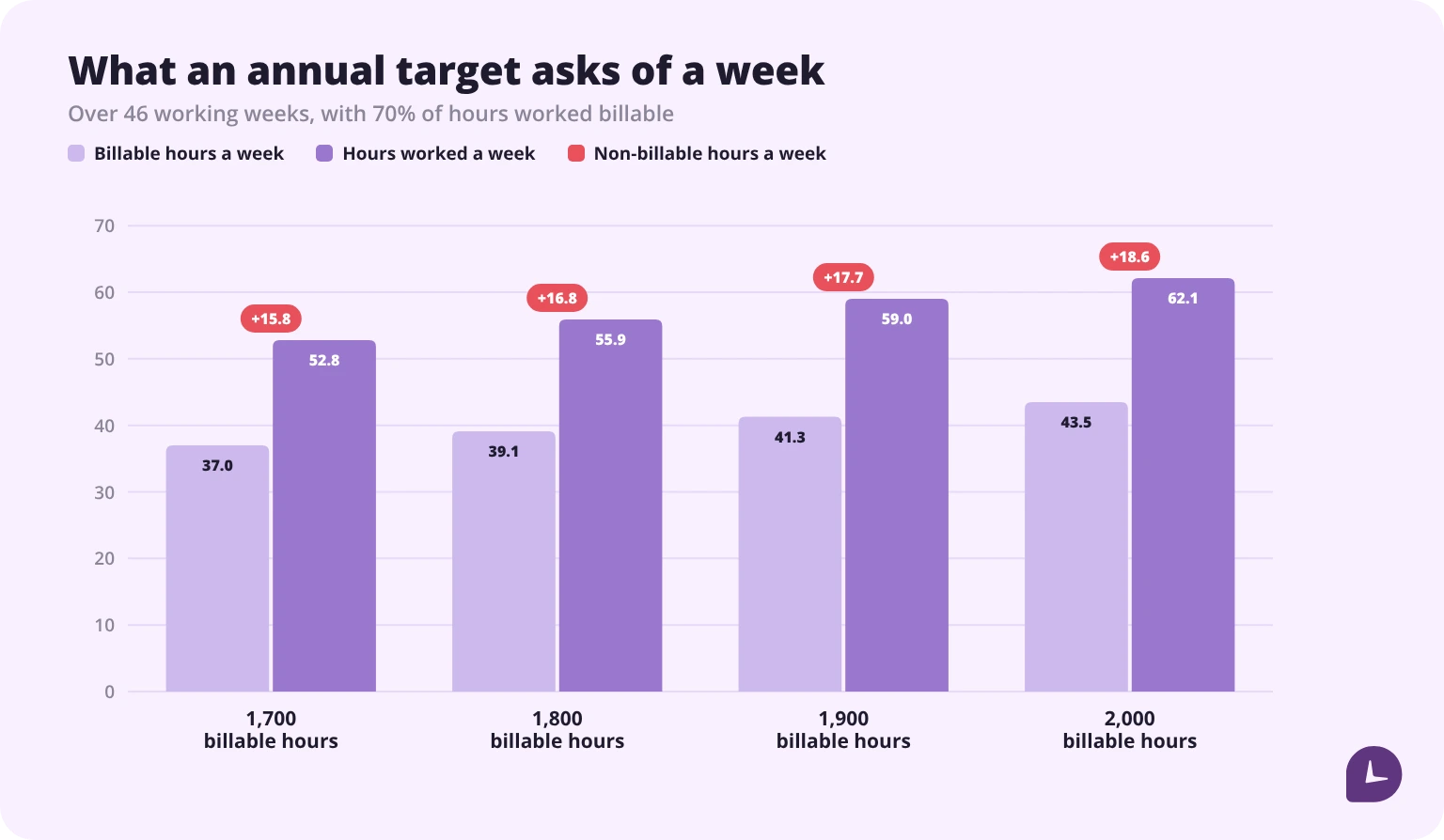
| Annual target | Per month | Per week over 46 working weeks | Hours worked a week at 70% utilization | Non-billable hours a week |
|---|---|---|---|---|
| 1,700 | 141.7 | 37.0 | 52.8 | 15.8 |
| 1,800 | 150.0 | 39.1 | 55.9 | 16.8 |
| 1,900 | 158.3 | 41.3 | 59.0 | 17.7 |
| 2,000 | 166.7 | 43.5 | 62.1 | 18.6 |
The last two columns are the ones that matter and the ones rarely stated. Billing 39.1 hours in a week requires working closer to 55.9, because business development, internal meetings, training, billing and administration are not billable — 16.8 hours a week of them. A firm quoting 1,800 hours is describing a 55.9-hour week.
The column nobody prints
That fourth column quietly changes what utilization means. Dividing a target by 70% makes the denominator hours actually worked, so a lawyer who works 55.9 hours and bills 39.1 counts as 70% utilized. Every other professional-services firm measures utilization against available hours: contracted hours less leave.
46 working weeks of a 40-hour contract is 1,840 available hours — a 2,080-hour year less six weeks of leave. On that denominator the same four targets read very differently:
| Annual target | As a share of 1,840 available hours | Hours that must be worked |
|---|---|---|
| 1,700 | 92.4% | 2,428.6 |
| 1,800 | 97.8% | 2,571.4 |
| 1,900 | 103.3% — more hours than the year contains | 2,714.3 |
| 2,000 | 108.7% — more hours than the year contains | 2,857.1 |
Billing 1,800 hours out of 1,840 available ones is 97.8% utilization. A consulting firm running at 70% of available hours bills 1,288 hours a year — 512 short of the law firm’s number. And 1,900 and 2,000 are not demanding targets on this measure but arithmetically impossible ones: there are not that many available hours in the year. The only way to reach either is to work past the contract, which is what 55.9 hours a week means. Over 46 weeks that is 2,571.4 hours, 491.4 more than a 2,080-hour year — the equivalent of 12.3 extra 40-hour weeks. The same arithmetic applies to any professional-services target; the utilization rate is the formula underneath it.
What the published numbers actually say
A handful of organisations publish figures worth citing, and they do not measure the same thing.
NALP has the only systematic survey of stated requirements. In its 2015 data the average annual billable-hour requirement was 1,892 hours overall and 1,930 at firms of 701 or more lawyers. The distribution matters more than the average: at those largest firms only 7.1% of offices stated 1,800 hours, while 34.7% stated 1,900. At firms of 51 to 100 lawyers, 37.9% stated 1,800. The full reported range across all firms ran from 1,400 to 2,400 hours. So 1,800 is a common requirement, but it is not the large-firm standard — at large firms it is the exception.
Hours actually worked are a different number again. NALP’s last published figures, for 2014, put associate billable hours at 1,806 overall, 1,873 at the largest firms and 1,752 in the 101–250 band — where the figure had fallen from 1,757 the year before. NALP appears to have stopped publishing the series after that, so anyone quoting an average annual billable-hours figure in the present tense is quoting 2014.
Clio’s 2025 Legal Trends Report measures the day rather than the year: a utilization rate of 38%, or 3.0 billable hours captured out of an eight-hour day, with 88% of that invoiced and 93% collected. Clio’s data is platform usage and skews heavily to solo and small firms, so it is not a large-firm benchmark — but 3.0 hours a day over the same 230 working days is about 690 billable hours a year, which is our arithmetic rather than Clio’s and is a long way from any of the targets above.
Bloomberg Law’s attorney workload survey found respondents working 48 hours a week and billing 36 in 2024 — which is 75% of hours worked, so the 70% the table above assumes is, if anything, generous.
Figures that circulate without a publisher are not worth repeating. Most of the annual averages quoted on vendor pages trace back either to those 2014 NALP tables or to nothing at all, and no organisation currently publishes an absolute average annual billable-hours figure for US lawyers — Thomson Reuters, which tracks the market most closely, reports productivity only as a percentage change and has deliberately retired the hours-per-lawyer metric.
At the demanding end, King & Spalding was reported in August 2025 to require 2,400 “productive” hours a year of which at least 1,950 must be billable client work — 450 hours of credited non-billable time, and 81.3% billable on its own definition. At the other end, the New York State Bar Association’s Task Force on Attorney Well-Being recommended in a report adopted on 30 October 2021 that firms cap billable-hour requirements at 1,800 hours. The same number is a floor at one firm and a ceiling in the other’s recommendation.
Which activities are billable?
| Usually billable | Usually non-billable | Depends on the engagement |
|---|---|---|
| Legal research on the matter | Business development and marketing | Travel — often at a reduced rate |
| Drafting and revising documents | Billing, invoicing, collections | Internal conferences — limited or excluded by many OCGs |
| Court appearances, hearings, depositions, mediations | Internal firm meetings and administration | File organisation beyond the substantive work |
| Correspondence and calls on the matter | CLE and training | Supervising or training a junior on the matter |
| Reviewing the file before a call or hearing | Timekeeping and timesheet review | Research above an approval threshold |
| Client status updates on the matter | Recruiting | Secretarial and paralegal work, by rate and by client rule |
| Negotiation and settlement work | Pro bono, in revenue terms | Document production logistics |
The third column is where the money is lost. Each item is genuinely billable under some engagements and prohibited under others, which means the classification has to come from the engagement letter and the client’s guidelines, not from habit. Give each of these its own code so the write-off is measured rather than invisible. What counts as non-billable across professional services generally, and how much of it is normal, is covered in our guide to non-billable hours.
How do you capture time without losing entries?
Lost time is not a billing problem; it is a recording problem. Entries reconstructed at the end of the week lose the short tasks first, and short tasks are most of a legal day.
| Practice | What it prevents |
|---|---|
| Enter time as the task ends, not at day end | Short calls and emails disappearing entirely |
| Keep the matter number required at entry | Time landing in a general bucket that cannot be invoiced |
| Record non-billable time too | Write-offs becoming invisible and utilization becoming meaningless |
| Write the description at entry, not at invoicing | Vague entries written weeks later from a calendar |
| Apply task and activity codes at entry | E-billing rejection after the work is done |
| Review unposted time weekly | A month-end scramble that finds only the large items |
| Lock entries once invoiced | Discrepancies between the bill and the record |
| Keep an edit trail | An entry that cannot be defended when a client challenges it |
A firm that records time daily and codes it at entry has a second advantage that only shows up at the end of the year: its utilization figures mean something, because the non-billable hours are in the record rather than missing from it. Recording only billable time makes every lawyer look 100% utilized, which is the one number that is certainly wrong. The same applies to any timesheet, legal or not — see online timesheets.
Monitask records time against matters and task codes as the work happens, keeps an approval trail, and exports it for billing.
See time tracking for lawyers
Sources
- ABA Model Rules of Professional Conduct, Rule 1.5: Fees
- ABA Standing Committee on Ethics and Professional Responsibility, Formal Opinion 93-379, 6 December 1993 — adopted in full by the Alabama State Bar, Formal Opinion RO 94-02
- Alaska Bar Association Ethics Opinion 96-4, Billing Two Clients for the Same Hours
- LEDES Oversight Committee — UTBMS code sets
- LEDES Oversight Committee — LEDES formats
- ABA Section of Litigation — UTBMS litigation, counseling, project and bankruptcy code sets
- NALP, “Update on Associate Hours Worked”, NALP Bulletin, May 2016
- NALP, “Number of Associate Hours Worked Increases at Largest Firms”, NALP Bulletin, February 2012
- NALP, “Billable Hour Requirements at Law Firms”, NALP Bulletin, May 2006
- Clio, 2025 Legal Trends Report
- Bloomberg Law, Attorney Workload and Hours Survey
FAQ
What is six-minute increment billing?
Six-minute increment billing records time in tenths of an hour: 1–6 minutes is 0.1, 7–12 minutes is 0.2, and so on to 55–60 minutes as 1.0. Each block is exactly one tenth of an hour, with no repeating decimals, which is why it is the professional-services standard.
Is it ethical to round a two-minute call up to 0.1 hours?
Neither ABA Model Rule 1.5 nor Formal Opinion 93-379 sets or forbids a minimum increment. What they require is a reasonable fee and a basis the client was told about. The practical problem is accumulation: 20 two-minute emails billed at 0.1 each bill 2.0 hours against 40 minutes of work, 3× the time spent. Grouping like tasks on one matter into a single entry with the real total avoids it, and a per-task minimum belongs in the engagement letter.
What is block billing?
Block billing combines several distinct tasks into one entry with a single combined time, such as “review documents, draft motion, call client — 6.5”. Most outside counsel guidelines prohibit it, because an entry covering several tasks cannot be assessed for reasonableness, and it is a standard basis for reducing a bill.
What are UTBMS codes?
UTBMS codes are a standard taxonomy for categorising legal work, released in 1997 by the ABA Section of Litigation with the American Corporate Counsel Association and maintained since by the LEDES Oversight Committee. Task codes carry a practice-area letter and three digits, such as L300 for discovery; activity codes carry an A prefix, such as A103 for draft/revise.
What is LEDES billing?
LEDES — the Legal Electronic Data Exchange Standard — is the structured invoice format used to submit UTBMS-coded time to a client’s e-billing platform. Corporate clients and insurers generally require it, and a file that fails its validation is rejected and never posts as an invoice. LEDES 98B is the most widely used version in the US.
What do outside counsel guidelines require?
Typically: tenth-hour increments, a maximum time per entry, a prohibition on block billing, mandatory UTBMS coding, LEDES submission through a named platform, staffing approvals, limits on internal conferences, non-billable administrative time, and an invoice submission deadline of around 60 to 90 days.
What does ABA Model Rule 1.5 say about fees?
Rule 1.5(a) prohibits an unreasonable fee and lists 8 factors for assessing reasonableness, including the time and labor required, the customary local fee, the amount involved and the results obtained, and whether the fee is fixed or contingent. Rule 1.5(b) requires the basis or rate of the fee to be communicated to the client, preferably in writing. Neither paragraph addresses rounding or minimum increments.
How many billable hours is 1,800 a year?
About 150.0 hours a month, or 39.1 hours a week across 46 working weeks. At 70% of hours worked that takes roughly 55.9 hours a week. Measured against available hours instead — 1,840 in a 46-week year on a 40-hour contract — 1,800 billable hours is 97.8% utilization.
How do you write a good billing description?
Name the document, issue or person, state the purpose, use the matter’s defined terms, and avoid process verbs such as “attention to” or “work on”. “Review contract — 2.5” is a category; “review indemnity provisions in the draft MSA for conflict with the parent guarantee — 2.5” is work a reviewer can approve.