Monitask blog

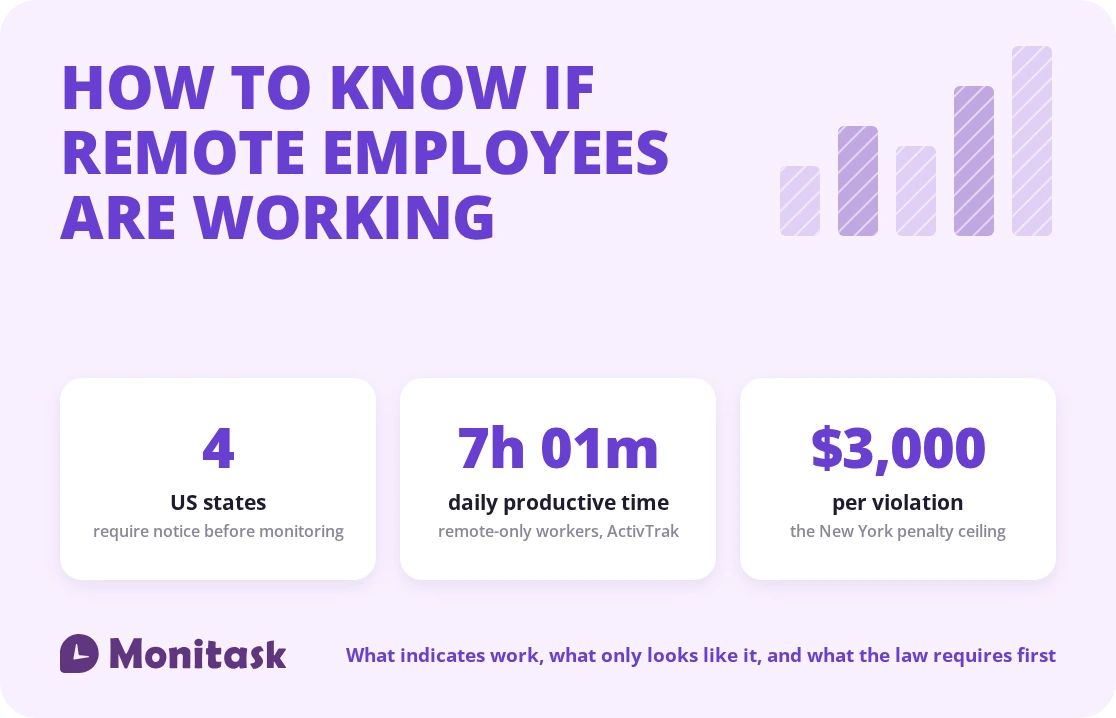
Remote work monitoring facts: four US states require notice, remote-only workers log 7 hours 1 minute of daily productive time, New York penalties reach $3,000

How to Know If Remote Employees Are Working

The honest answer is that you cannot know whether someone is working by watching them, and remote work did not create that problem. It removed the illusion that solved it. In an office, presence stood in for productivity. Take the office away and the substitute disappears, leaving a question that was always there. Two things…
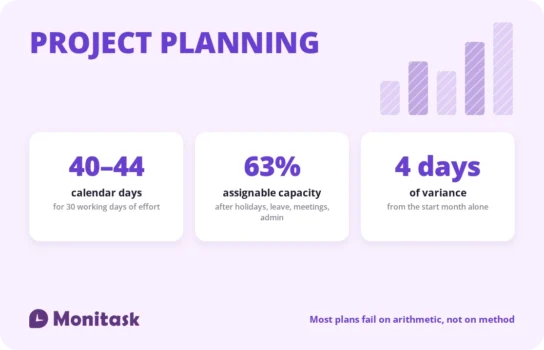
Project planning essentials: 30 days of work takes 40 to 44 calendar days, and about 70% of a paid day is assignable

Project Planning: Building a Schedule That Survives Contact With the Calendar

Every guide to project planning describes the same sequence: define objectives, identify stakeholders, build a work breakdown structure, estimate, schedule, add a risk register. That sequence is correct and it is not where projects go wrong. Projects go wrong in the conversion between effort and time. A team agrees a piece of work is 30…

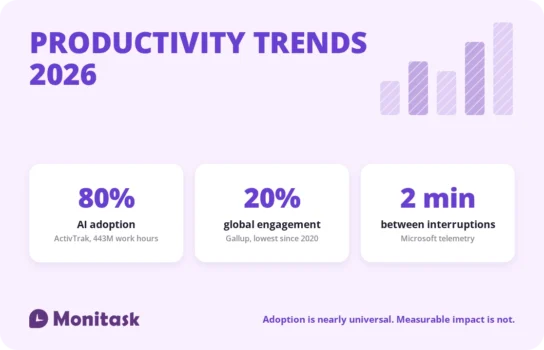
Productivity trends 2026: 80% AI adoption, 20% global engagement, two minutes between interruptions

Productivity Trends 2026: What the Data Actually Shows

The defining productivity story of 2026 is not that AI arrived. It is that AI arrived almost everywhere and the results have not shown up on the balance sheet. Adoption is close to universal. Behavioural data from ActivTrak covering 443 million work hours across 1,111 companies puts AI adoption at 80%. Yet a National Bureau…

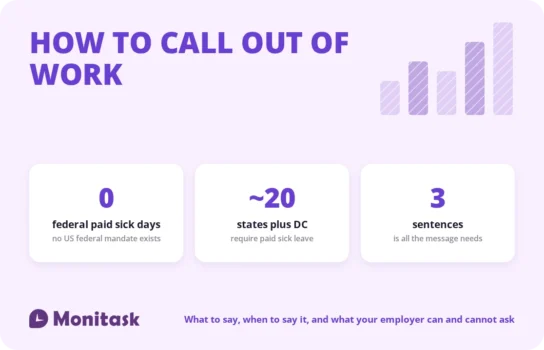
How to call out of work: no federal paid sick day mandate, around 20 states plus DC require paid sick leave, three sentences is enough

How to Call Out of Work: What to Say, When to Say It, and What You’re Owed

Calling out of work takes three sentences: you are not able to work, roughly how long you expect to be out, and anything urgent that needs handing over. You do not owe your employer a symptom list, and you do not need to apologise. What most articles on this leave out is the half that…


Daily work schedule template essentials: 14 days standard notice, 11 US jurisdictions, and two included templates

Daily Schedule Template: Free Excel Shift Roster and Hourly Planner

A daily schedule template does one of two things depending on who is using it. A manager uses it to put the right number of people on shift at the right hours. An individual uses it to block out a day by the hour. The template below covers both, in one Excel file. The manager…


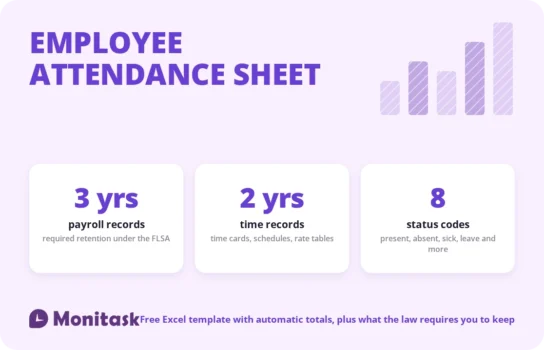
Employee attendance sheet essentials: three-year payroll retention, two-year time record retention and eight status codes

Attendance Sheet: Free Excel Template, Status Codes, and Retention Rules

An attendance sheet records who worked, who was absent, and why, day by day. It sits underneath payroll, absence management and any dispute about hours, which is why the format matters more than it looks. The template below is free, works in Excel and Google Sheets, and totals itself. It also carries the part most…

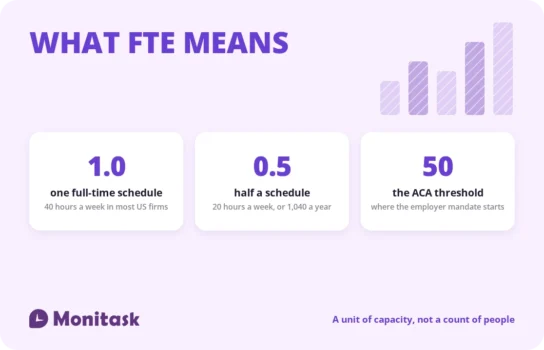
FTE meaning explained: 1.0 FTE is one full-time schedule, 0.5 is half, and 50 FTE is the ACA employer threshold

FTE Meaning: What Full-Time Equivalent Is, and the Two Ways to Calculate It

FTE stands for full-time equivalent. It is a unit of work capacity: 1.0 FTE is one person working a full-time schedule, and everything else is expressed as a fraction of that. Two people at 20 hours a week each come to 1.0 FTE in a company where full-time means 40. The formula is one line:…

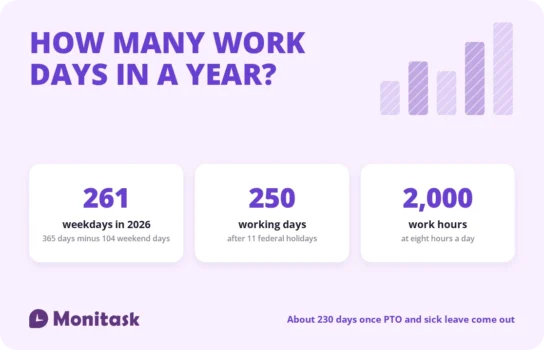
How many work days in a year: 261 weekdays, 250 working days and 2,000 work hours in 2026

How Many Work Days in a Year? 2026 Figures, Monthly Tables, and How to Calculate Your Own

2026 contains 261 weekdays and 250 working days. The first number is every Monday through Friday. The second removes the 11 US federal holidays. At eight hours a day, 250 working days come to 2,000 work hours. Neither figure is the one you should plan with. Once you subtract typical paid leave and sick days,…

Try Monitask

Track employee productivity and simplify work with them

Start Your 10-Day Trial
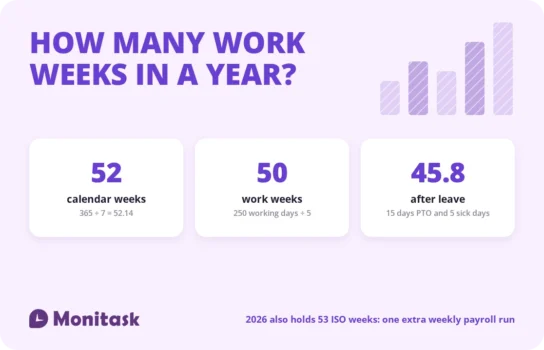
How many work weeks in a year: 52 calendar weeks, 50 work weeks and about 46 after typical leave

How Many Work Weeks in a Year? The 2026 Answer, and Why This Year Has 53

A calendar year holds 52 weeks. A full-time employee works about 50 work weeks once federal holidays come out, and closer to 46 once typical paid leave and sick days are deducted. There is also a fourth answer that catches payroll teams off guard. Under ISO 8601, 2026 has 53 weeks. For anyone running a…

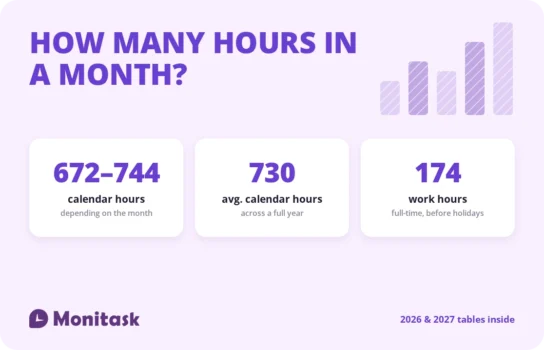
How many hours are in a month: 672 to 744 calendar hours and about 174 work hours

How Many Hours in a Month? Calendar Hours, Work Hours, and 2026 Tables

A calendar month holds between 672 and 744 hours. February in a common year is the shortest at 672. The seven 31-day months each hold 744. Averaged across a full year, a month runs 730 hours. Work hours are a different figure. A full-time employee on a 40-hour week logs 160 to 184 work hours…


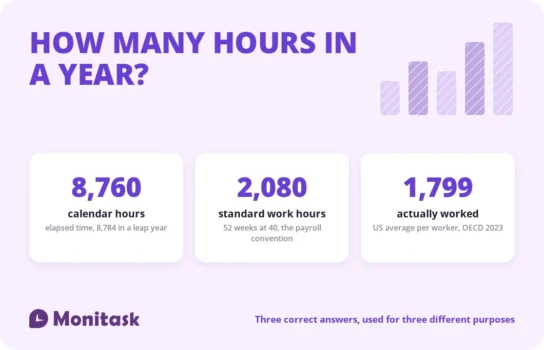
Hours in a year: 8,760 calendar hours, 2,080 standard work hours, and 1,799 actually worked in the US

How Many Hours in a Year? Calendar Hours, Work Hours, and Hours Actually Worked

A year contains 8,760 hours, or 8,784 in a leap year. That is the arithmetic answer and it settles the question only if you were asking about elapsed time. For work, the standard figure is 2,080 hours — 52 weeks at 40 hours. It is the basis for salary-to-hourly conversion, FTE calculations and almost every…

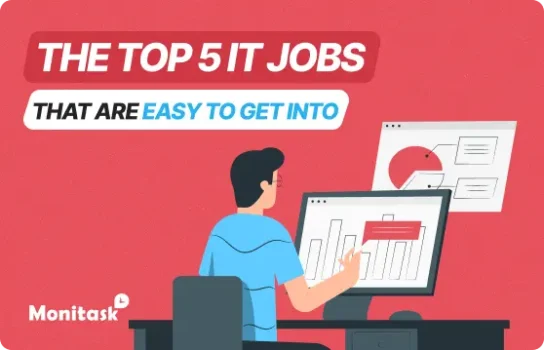
The Top 5 IT Jobs That are Easy to Get Into. Illustration for the Monitask Blog.

The Top 5 IT Jobs That are Easy to Get Into

Getting started in technology does not always require a computer science degree. Many IT jobs without a degree are accessible to candidates who can demonstrate practical skills, relevant certifications, hands-on experience, and a strong understanding of the tools used in the role. Fields such as IT support, systems administration, networking, cybersecurity, and web development often…

10 Ways to Keep Yourself Safe from Layoffs illustration for the Monitask blog

10 Ways to Keep Yourself Safe from Layoffs

Layoffs have become a reality across many industries, affecting companies of all sizes. Economic uncertainty, artificial intelligence, automation, shifting business priorities, and global competition are changing how organizations hire, retain, and manage talent. While no employee can completely eliminate the risk of being laid off, there are practical steps you can take to become more…


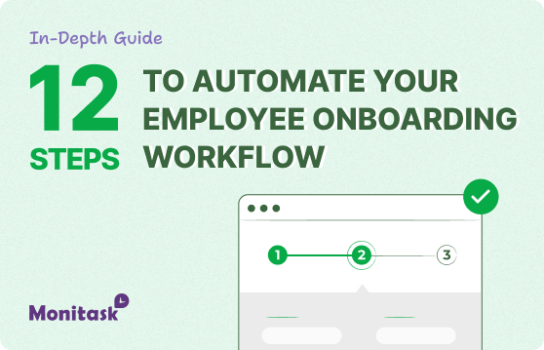
12 steps to automate your employee onboarding workflow. Illustration for the Monitask blog.

In‑Depth Guide: 12 Steps to Automate Your Employee Onboarding Workflow

Manual onboarding is a mess waiting to happen. Documents slip through the cracks, tasks get missed, accounts aren’t ready on day one and the result is a disjointed experience that frustrates HR and underwhelms your new hires. It’s not just inefficient; it’s a bad first impression. Automation changes that. With the right tools, you can…


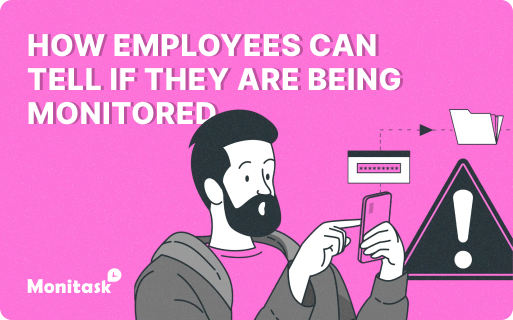
Monitask. Illustration of How Employees Can Tell If They Are Being Monitored?

How Employees Can Tell If They Are Being Monitored

Employee monitoring is becoming a standard practice in many organizations, driven by the growth of remote work and the rise of advanced surveillance tools. These technologies allow employers to track a wide range of activities, from measuring productivity to safeguarding company assets. While the goals may vary, monitoring often sparks concerns about privacy, trust, and…

Monitask. Illustration of How to Handle Multiple Customers at Once

How to Handle Multiple Customers at Once: Practical Strategies

Knowing how to handle multiple customers at the same time is a core skill in today’s customer-facing roles. In retail, hospitality, customer support, sales, and online services, managing overlapping requests is no longer occasional but routine. Customers still expect timely responses, clear communication, and consistent service, even during busy periods. When handled poorly, multitasking leads…

How to Identify Mouse Jigglers Among Your Remote Team?

Employee monitoring software is essential for tracking productivity and ensuring workplace efficiency, especially with remote teams. However, some employees may use tools like mouse jigglers to trick the system into showing them as “active,” even when they are away from their workstations. These devices can undermine your efforts to maintain a productive and secure work…

1 to 20 of 547

Try Monitask now.
First 10 days free

No credit card required

Secret Link