How Many Work Hours Are in a Year?

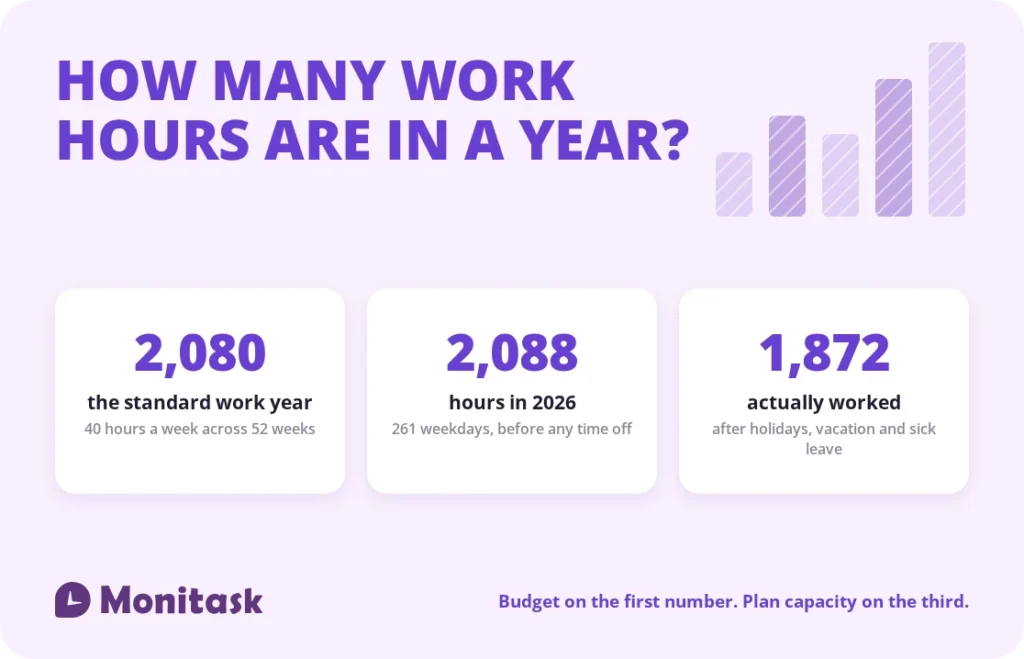
A full-time employee working 40 hours a week logs 2,080 work hours in a standard year. That figure comes from 40 hours x 52 weeks and is what most US employers use for budgeting and salary-to-hourly conversions. The calendar rarely matches it exactly: 2026 has 261 weekdays, which works out to 2,088 hours. Subtract the 11 federal holidays and two weeks of PTO and the real total drops to 1,920 hours, which is the number you should be planning against. Anything more precise than that comes from your own timesheets, not from a formula, so it helps to track hours automatically rather than reconstruct them later.
Key takeaways
- A standard work year is 2,080 hours — 40 hours a week across 52 weeks.
- 2026 has 261 weekdays, or 2,088 hours before any time off comes out.
- The 11 US federal holidays account for 88 hours of paid, non-worked time.
- Real annual hours land between 1,850 and 1,920 once holidays and PTO are deducted.
- Part-time schedules typically total 1,300–1,560 hours a year.
Reliable employee tracking software. Clear visibility and insights into how employees work. Even remotely.
Try Monitask free for 10 days
What Counts as a Work Year?
A work year is the number of hours an employee is expected to work across twelve months. For most US full-time roles that is 2,080 hours: eight hours a day, five days a week, 52 weeks a year. Payroll and finance teams also call this a man-year, and it is the unit used to price headcount, set FTE budgets, and convert salaries into hourly rates.
The figure holds up as an assumption and falls apart as a measurement. It treats every weekday as worked, ignores public holidays, and assumes nobody takes a vacation or calls in sick. Useful for a budget line, misleading for a capacity plan. 2,080 is a planning baseline, not a calendar fact, and the number of weekdays changes every year.
Boost your business productivity
Track performance and streamline teamwork
How Many Working Hours Are in 2026, 2027 and 2028?
2026 has 261 weekdays, which equals 2,088 hours on a 40-hour schedule. Take out the 11 federal holidays and the figure drops to 2,000 hours. The count shifts from year to year because a 365-day year is 52 weeks plus one leftover day, and the weekday that day falls on decides the total.
| Year | Weekdays | Hours at 40 h/week | Minus 11 federal holidays |
|---|---|---|---|
| 2026 | 261 | 2,088 | 2,000 |
| 2027 | 261 | 2,088 | 2,000 |
| 2028 (leap year) | 260 | 2,080 | 2,000 |
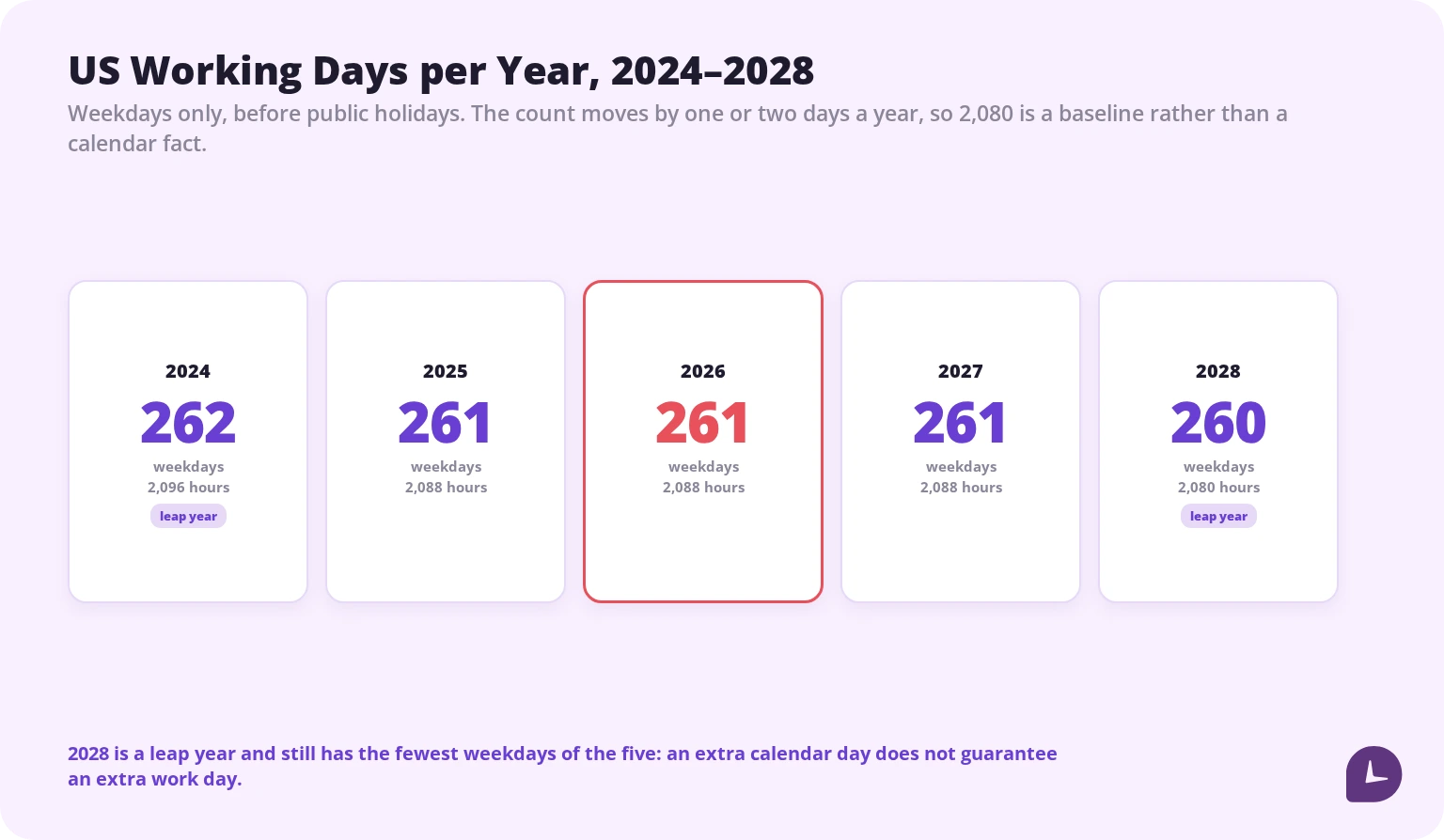
Across any decade the count moves between 260 and 262 working days, so 2,080 works as a planning baseline but rarely matches the calendar exactly. One quirk is worth noting: after federal holidays come out, 2025 through 2028 all land on exactly 2,000 payable hours, because the years that gain a weekday also gain a holiday to spend it on. If you need the hours your team actually logged rather than the hours the calendar allowed, start from real clock-ins; our free timesheet templates cover the manual version.
How Many Work Hours Are in a Month?
There are 173.33 work hours in an average month, which is 2,080 divided by 12. No actual month matches that figure. February 2026 has 20 weekdays and July has 23, so the real spread runs from 152 to 176 payable hours once federal holidays come out. Monthly forecasts built on the average are off by up to three days in either direction.
| Month, 2026 | Weekdays | Federal holidays | Payable hours |
|---|---|---|---|
| January | 22 | 2 | 160 |
| February | 20 | 1 | 152 |
| March | 22 | 0 | 176 |
| April | 22 | 0 | 176 |
| May | 21 | 1 | 160 |
| June | 22 | 1 | 168 |
| July | 23 | 1 | 176 |
| August | 21 | 0 | 168 |
| September | 22 | 1 | 168 |
| October | 22 | 1 | 168 |
| November | 21 | 2 | 152 |
| December | 23 | 1 | 176 |
By quarter the spread narrows: Q1 has 64 weekdays, Q2 has 65, and Q3 and Q4 have 66 each. If you forecast or bill quarterly, those are close enough to treat as equal. If you do it monthly, they are not — February and November each come in three full days short of July.
What Changes the Number of Hours You Actually Work
Four things move the total: the calendar, the contract, the time-off policy, and the role itself. Two people on identical 40-hour contracts can finish the year more than 200 hours apart because one had ten paid holidays and three weeks of leave while the other had five holidays and never took a vacation.
Schedule Flexibility
Compressed schedules, four-day weeks, and flexible start times change how hours are distributed without necessarily changing the annual total. A 9/80 schedule packs 80 hours into nine days and gives back every other Friday: the same 2,080 hours a year, 26 fewer days on site. Rotating patterns like the 2-2-3 schedule or the DuPont schedule average out to roughly full-time across a cycle, but no individual week matches the baseline. Remote and hybrid arrangements do the same thing to the shape of the week rather than its size.
Contract Type
A full-time contract sets an expected weekly minimum, usually 40 hours. Part-time contracts run lower and vary more from month to month. Overtime sits on top of both and is the main reason actual hours run above 2,080 rather than below it — in most hourly roles it is also the only part of the total that carries a legal premium.
Paid Time Off
Vacation, sick leave, parental leave, and public holidays are all paid and none of them are worked. This is the largest single deduction from the baseline: two weeks of vacation plus the 11 federal holidays already removes 168 hours, or about a month of working time. How generous the paid time off policy is has more effect on the annual figure than anything else on this list.
Role and Industry
Salaried professionals in law, consulting, and healthcare routinely log more hours than their contracts state, while hourly roles are capped by scheduling rules and overtime budgets. Industry norms tend to matter more here than individual company policy.
How to Calculate Work Hours in a Year
Multiply weekly hours by 52, then subtract paid time off and holidays converted into hours. Written out, the formula is: (weekly hours x 52) minus [(PTO days + paid holidays) x hours per day]. Four steps get you there.
Step 1. Find your weekly hours
Use the contracted figure if the schedule is stable. If it is not, average four to six recent weeks from real timesheets rather than estimating — self-reported hours tend to be off by several hours a week in both directions. Online timesheets make this a lookup instead of a reconstruction.
Step 2. Multiply by 52
40 x 52 = 2,080. This is the gross figure, before any time off comes out of it.
Step 3. Convert time off into hours
Add up vacation days, sick days, personal days, and paid holidays, then multiply the total by the length of a working day. Ten vacation days and 11 federal holidays at eight hours each comes to 168 hours.
Step 4. Subtract
Gross hours minus time-off hours gives the number of hours actually worked. Run this once a year per role, not per person, unless PTO balances differ widely across the team.
A worked example
Start with the baseline and subtract everything the employee is paid for but does not work.
- 40 hours x 52 weeks = 2,080 hours
- Minus 10 vacation days (80 hours)
- Minus 11 federal holidays (88 hours)
- Minus 5 sick days (40 hours)
- = 1,872 actual working hours
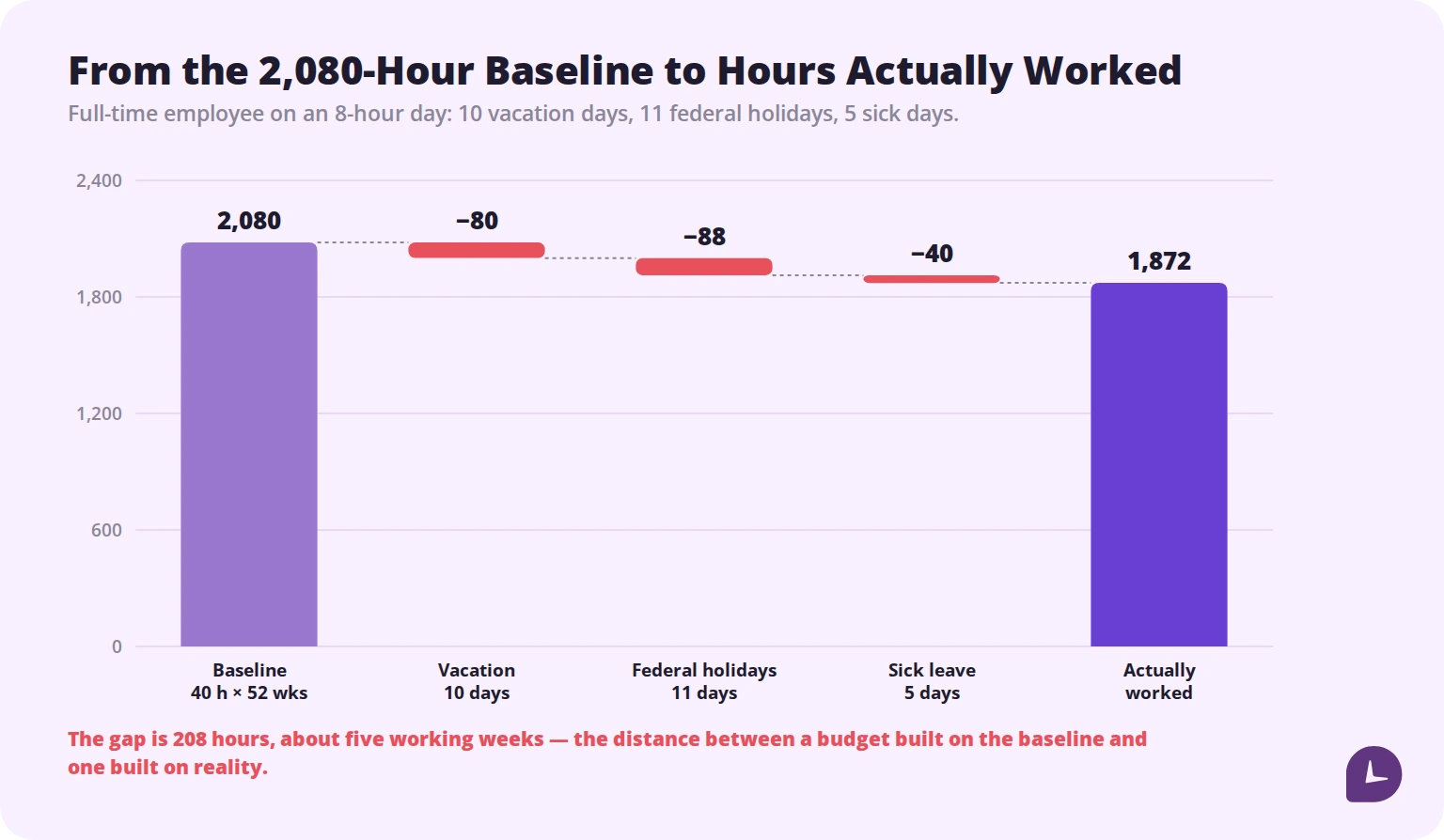
The gap is 208 hours, about five working weeks. That is the difference between a budget built on the baseline and a budget built on reality, and it is why a work hour tracker pays for itself on capacity planning alone.
Full-Time, Part-Time and Contractor Hours Compared
Full-time schedules run about 2,080 hours a year, part-time roles typically land between 1,300 and 1,560, and contractors bill only the hours they log. There is no single legal definition of full-time: the Fair Labor Standards Act does not define it at all, the Affordable Care Act draws the line at 30 hours a week, and the Bureau of Labor Statistics counts 35 hours and up.
| Employment type | Typical week | Annual hours |
|---|---|---|
| Full-time employee | 40 hours | 2,080 (2,088 in 2026) |
| Part-time employee | 25–30 hours | 1,300–1,560 |
| Contractor or freelancer | Varies by contract | Billable hours only, no PTO deduction |
The distinction matters for more than terminology. Benefits eligibility, overtime rules, and how you forecast capacity all hang on which definition applies to the role.
How to Convert Annual Hours Into an Hourly Rate
Divide annual salary by annual hours. A $60,000 salary across 2,080 hours works out to $28.85 an hour. Use the real number of hours rather than the baseline and the same salary spread over 1,872 worked hours becomes $32.05 an hour. The gap matters when you are pricing contract work or comparing two offers with different time-off packages — the full method is in our guide to converting an hourly wage to an annual salary.
Work Hours vs. the Rest of Your Year
A calendar year holds 8,760 hours. A full-time schedule of 2,080 hours takes up about 24% of that, roughly one hour in every four. Take out sleep at eight hours a night and work accounts for closer to 36% of waking time.
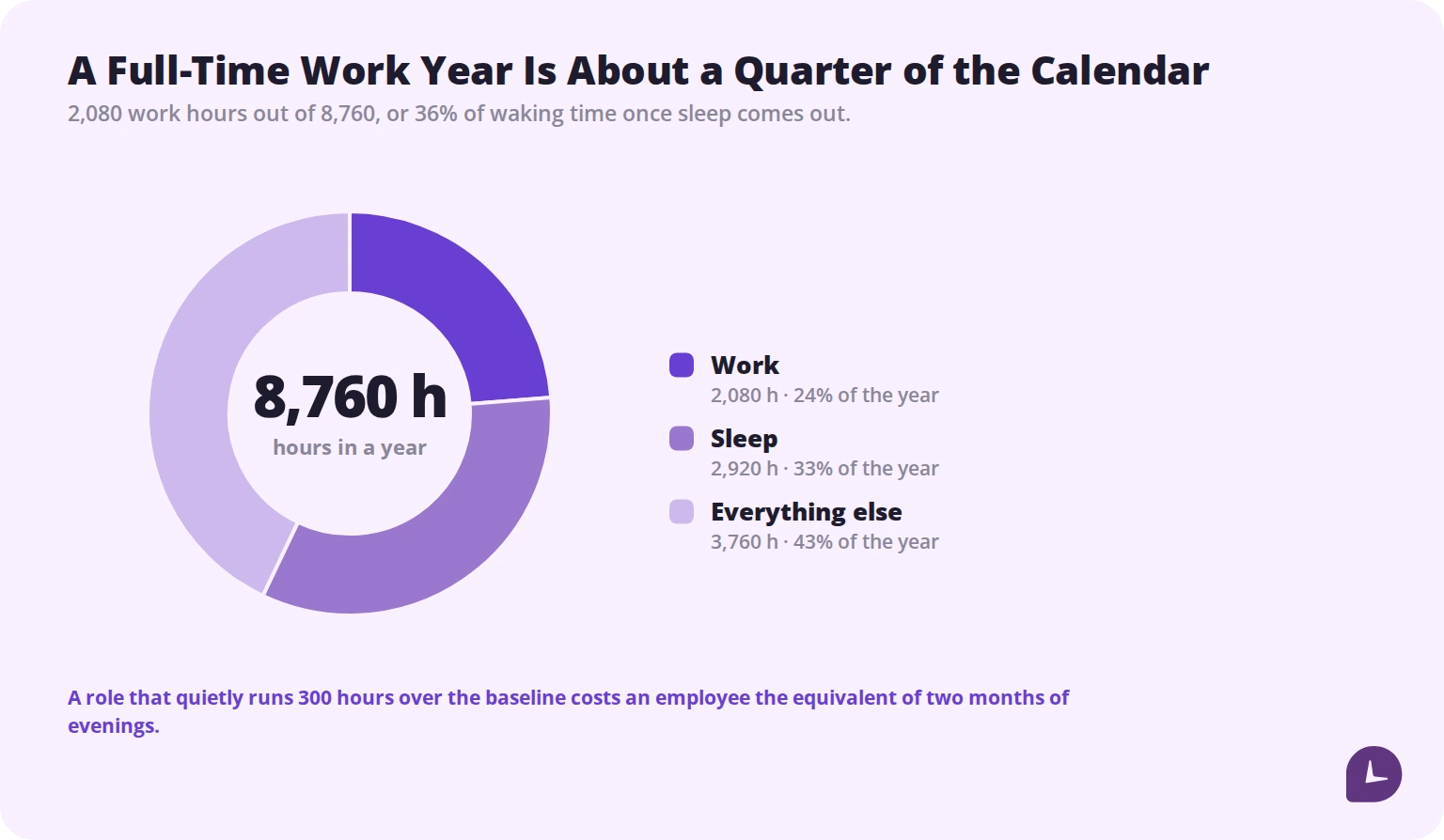
It is a useful number to keep in view. A role that quietly runs 300 hours over the baseline is not costing an employee a rounding error; it is costing them the equivalent of two months of evenings.
Why Your Total Annual Hours Matter
The annual figure is what payroll, budgeting, and compliance all run on. Get it wrong and you underprice projects, miscalculate overtime, and lose the ability to tell genuine overwork apart from an ordinary busy month.
Accurate payroll and overtime
In the US the baseline is the Fair Labor Standards Act, which sets overtime pay at 1.5x the regular rate for hours worked beyond 40 in a workweek. Accurate hour totals are what make that calculation defensible if it is ever audited, and they are the input for every downstream step in the payroll calculation process. Reconstructing the same numbers from memory at year end is how disputes start.
Honest project pricing
If a budget assumes 2,080 available hours per person and the real figure is 1,870, every project quoted against that capacity is short by 10% before anyone starts work. Across a team of ten that is the equivalent of one missing person.
Spotting overwork early
An employee logging 2,400 hours is running about six extra weeks a year. That shows up in the annual total long before it shows up in a performance review or an exit interview, and overwork reliably costs more in output than it adds. The annual number is the cheapest early warning available.
Capacity planning
Knowing the real annual figure per role turns headcount planning into arithmetic. It also tells you whether a gap is a staffing problem or a workflow problem — productivity reporting answers the second question, and hiring only fixes the first.
Boost your business productivity. Track performance and streamline teamwork.
Start Your 10-Day Trial
Key Takeaways
Use 2,080 hours to build the budget and your own timesheet data to run the team. The two numbers are never the same, and the distance between them is where overtime, understaffing, and burnout hide. Before the year starts, settle four things:
- How much paid time off the role carries, in hours rather than days.
- Which public holidays you observe and how many fall on weekdays this year.
- How overtime is authorised and priced.
- Where the hours are recorded, and by whom.
Settle those and the annual total stops being an estimate. Monitask records hours as they happen and reports the yearly figure per person and per project — you can try it on a 10-day free trial with no card required.
Reliable employee tracking software. Clear visibility and insights into how employees work. Even remotely.
Try Monitask free for 10 days
FAQ
How many working days are in 2026?
There are 261 working days in 2026. Every US federal holiday this year falls on a weekday or is observed on one, so 250 working days remain once holidays come out.
How many work hours are in a month?
About 173.33 hours on average, which is 2,080 divided by 12. Individual months in 2026 range from 160 to 184 hours before holidays, or 152 to 176 hours once federal holidays are deducted.
Do federal holidays count as work hours?
They are paid but not worked. Eleven federal holidays at eight hours each add up to 88 hours that come out of the annual working total.
How many hours is part-time per year?
Typically 1,300 to 1,560 hours, based on a 25- to 30-hour week. The Bureau of Labor Statistics treats anything under 35 hours a week as part-time.
Why does the government use 2,087 hours?
It averages working hours across a 28-year cycle so that leap years and shifting weekends even out. Federal pay calculations use that figure instead of the 2,080 baseline.
How do I calculate my own annual hours?
Multiply your weekly hours by 52, then subtract paid time off and holidays converted into hours. A time tracker does this automatically from your actual clock-ins.