How to Track Project Progress: Methods That Give You a Real Number

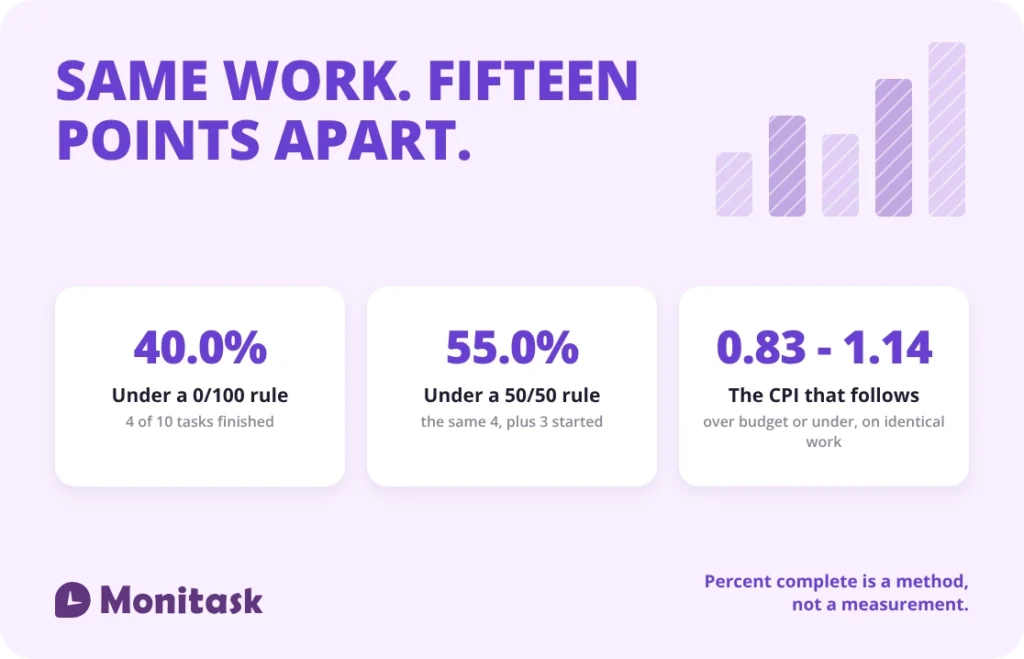
Tracking project progress means producing one defensible number: the percentage of planned work actually finished. That number depends on the method used to credit partially finished work, and the choice changes the answer. A project with four of ten tasks done reads 40% under a 0/100 rule and 55% under a 50/50 rule — the same work, fifteen points apart.
Key takeaways
- Percent complete is a method, not a measurement. Pick one, write it down, and apply it to every project.
- Effort is not progress. Hours spent divided by hours budgeted makes a project that is burning time without delivering look on schedule.
- Fixed-formula methods (0/100, 25/75, 50/50) suit short tasks. Weighted milestones suit long phases. Units completed suit repeatable work.
- The method you choose propagates into cost metrics. The same project reads a CPI of 0.83 or 1.14 depending on the percent-complete rule alone.
- Progress, status and performance are three different questions. Mixing them produces reports that answer none of them.
Progress, status and performance are three different things
These three get used interchangeably in meetings, and the confusion is why progress reports often say nothing.
| Question it answers | Example | Measured by | |
|---|---|---|---|
| Progress | How much of the planned work is done? | 42% of the scope is complete | Percent complete, against a baseline |
| Status | Is anything blocking us right now? | Two tasks blocked on client sign-off | Open blockers, overdue items, risks |
| Performance | Are we delivering at the planned rate and cost? | Running at 84% of planned pace | Indexes and variances against plan |
A report that says “on track, no blockers” has given status and skipped progress. A report that says “we’ve spent 60% of the budget” has given neither — that is an input, not a measure of either.
All three belong in a progress review. The rest of this guide is about the first one, because it is the one nobody defines.
How do you calculate percent complete?
Percent complete = credited work ÷ total planned work
The denominator is settled by the plan. The numerator is the decision: how much credit does a task get when it is started but not finished? Seven established methods answer that differently, and the table below adds one row for the remaining fixed-formula variants.
| Method | How partial work is credited | Best for | Bias it introduces |
|---|---|---|---|
| 0/100 | Nothing until complete | Short tasks, under one reporting period | Understates progress; looks like nothing is happening mid-period |
| 50/50 | Half on start, half on completion | Tasks spanning two periods | Overstates early; a started task looks half done when it may be 5% done |
| 25/75 | A quarter on start | Tasks where setup is a real share of work | Mild early overstatement |
| 20/80, 40/60 | Variants of the same idea, not separate methods | Tuning to how front-loaded the work is | Same direction as the split chosen |
| Weighted milestones | Credit at each defined milestone | Long phases with verifiable checkpoints | Accurate, but only as good as the milestone definitions |
| Units completed | Physical count ÷ total count | Repeatable work: pages, units, installs, tickets | Accurate for uniform units; wrong when units differ in effort |
| Level of effort | Credit accrues with elapsed time | Support, management, ongoing activities | Always on plan by construction; cannot show a problem |
| Apportioned effort | Tracks another task’s progress as a fixed share | QA tied to development, inspection tied to build | Inherits the parent task’s error |
0/100 and the fixed-formula methods
The fixed-formula family removes judgement entirely, which is the point. A task is either not started, started, or done, and the credit follows automatically.
0/100 is the conservative choice and the right default for tasks shorter than one reporting period. If a task starts and finishes inside the same week, crediting it halfway mid-week adds noise without adding information.
50/50 suits work that genuinely spans periods, and its weakness is worth stating: a task credited at 50% on its first day may be 5% done. Across many tasks the errors average out; on a project with few large tasks they do not.
Weighted milestones
For phases measured in months, assign each phase a weight that sums to 100, then credit the weight as milestones pass. This only works where the checkpoints are real, which is why defining project milestones properly has to happen before the first assessment rather than after.
| Phase | Weight | Phase complete | Contribution |
|---|---|---|---|
| Design | 15% | 100% | 15.0 |
| Build | 45% | 60% | 27.0 |
| Test | 25% | 0% | 0.0 |
| Deploy | 15% | 0% | 0.0 |
| Total | 100% | 42.0% |
This is the most defensible method for unequal work, and its accuracy lives entirely in the weights. Set them during planning, before anyone has an interest in the answer.
Units completed
Percent complete = units finished ÷ total units
Where work is genuinely repeatable — 400 pages translated, 120 devices installed, 2,000 records migrated — count the units. It is the only method with no judgement in it at all.
The failure mode is unit variance. If 50 of 100 installs are done but the remaining 50 are the difficult sites, the count says 50% and the truth is less.
Level of effort
Some work has no deliverable to measure: project management, support, coordination. Level of effort credits progress with elapsed schedule, so a six-month activity is 50% complete at month three regardless of what happened.
Use it, and understand what it does: a level-of-effort activity is always exactly on plan. It can never show a variance, so it cannot warn you about anything. Keep these activities as a small share of the total, or a project made mostly of them will report perfect health in every period.
Why effort is not progress
The most common way to produce a percent-complete number is also the least reliable: divide hours spent by hours budgeted.
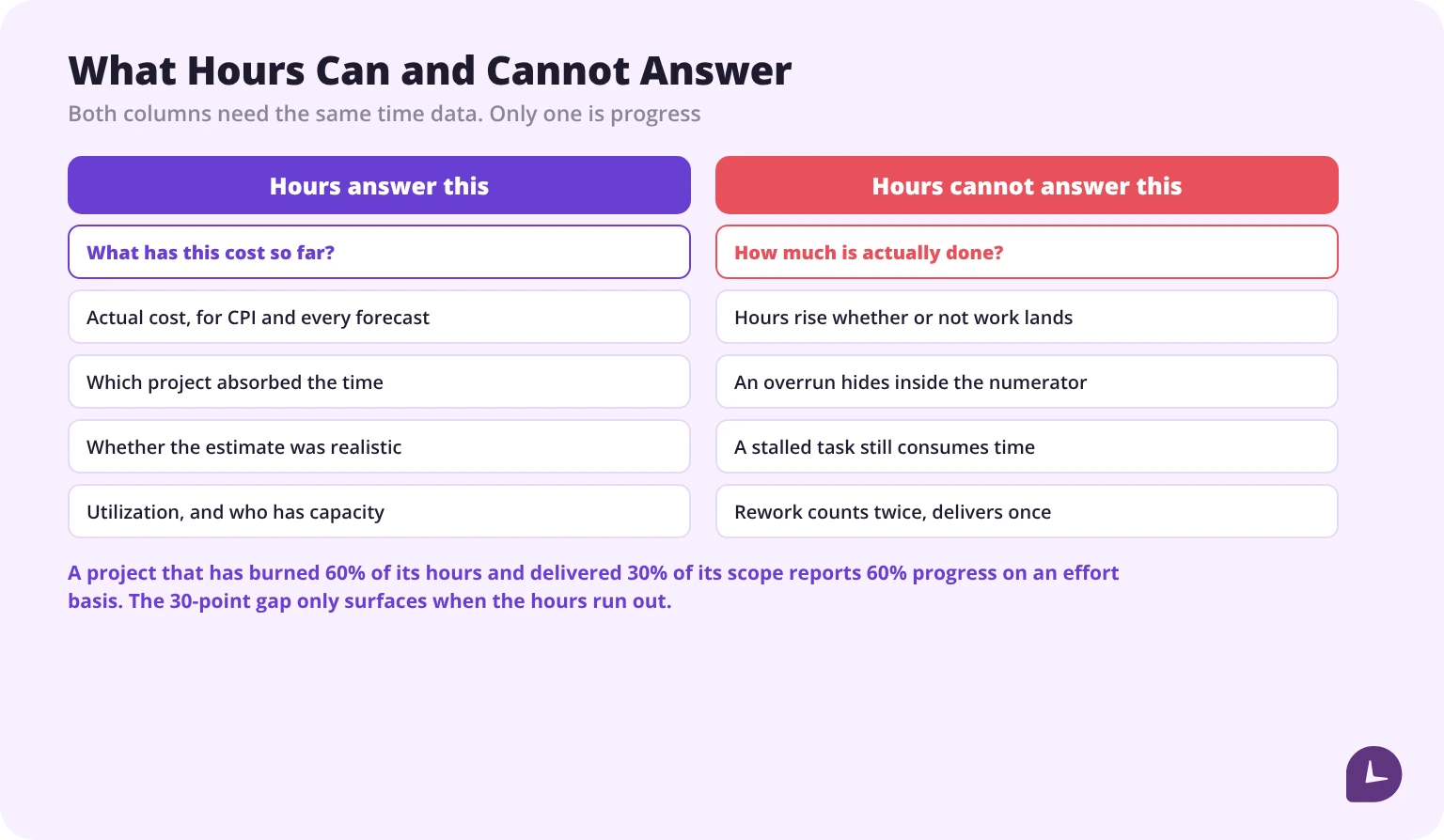
Hours spent ÷ hours budgeted measures consumption, not delivery. It rises whenever anyone works, including when the work produces nothing usable. A project that has burned 60% of its hours and delivered 30% of its scope reports 60% progress, and the shortfall only surfaces when the remaining hours run out.
The failure is structural, not occasional. Effort-based progress cannot report an overrun, because the overrun is in the numerator. Whatever is spent becomes progress.
There is one legitimate use for hours against budget: it is an input to cost metrics, where spend genuinely is the thing being measured — the same hours that feed job costing and every forecast built on it. Keep it there. For progress, measure what has been produced — deliverables accepted, milestones passed, units finished.
The same project, four methods, fifteen points apart
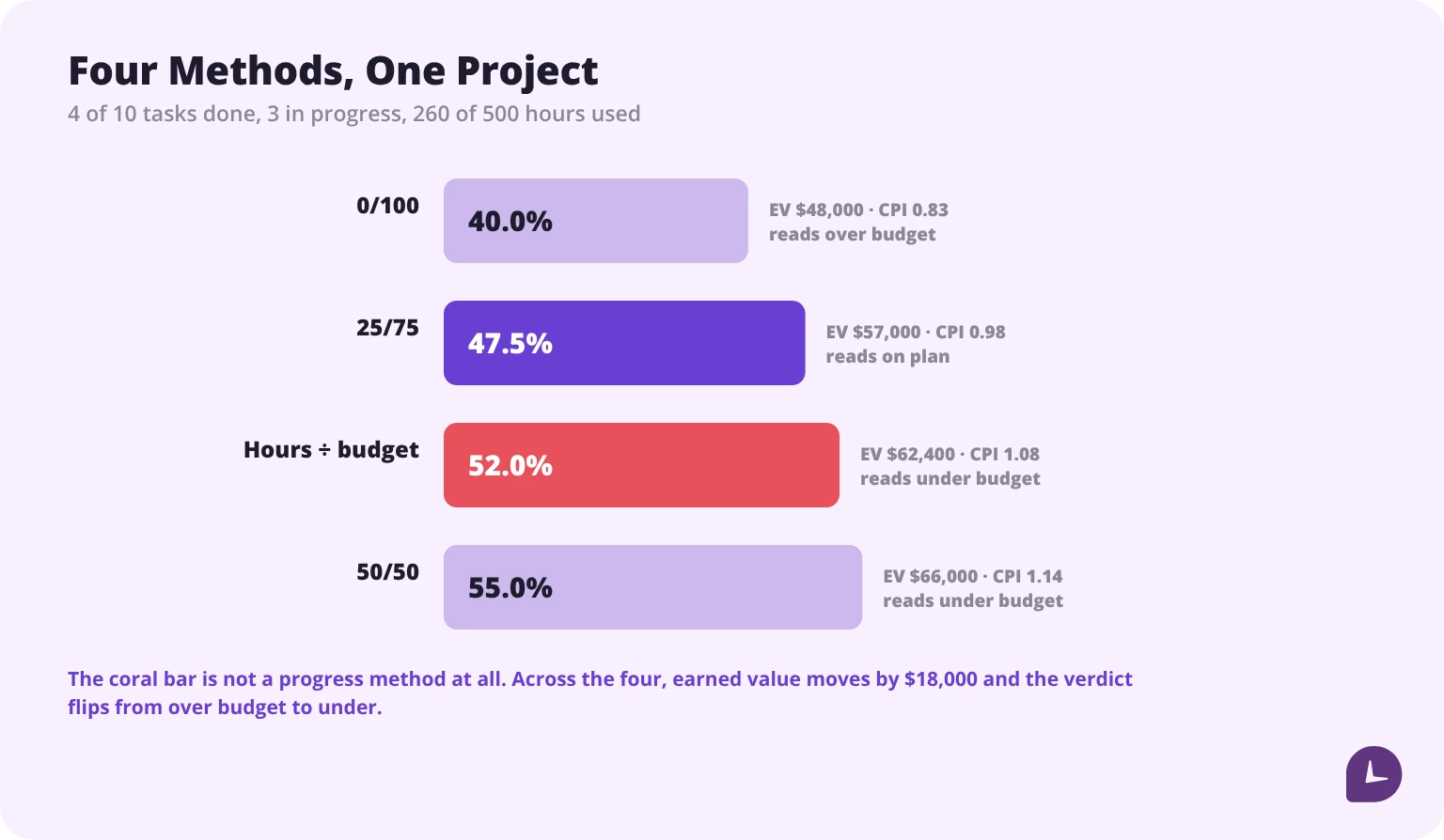
A project of ten tasks of equal weight. Four are complete, three are in progress, three have not started. The team has used 260 of 500 budgeted hours.
| Method | Calculation | Percent complete |
|---|---|---|
| 0/100 | 4 ÷ 10 | 40.0% |
| 25/75 | (4 + 3 × 0.25) ÷ 10 | 47.5% |
| Hours spent ÷ hours budgeted | 260 ÷ 500 | 52.0% |
| 50/50 | (4 + 3 × 0.50) ÷ 10 | 55.0% |
Fifteen points of spread, and nothing about the project changed.
That spread does not stay in the progress column. Percent complete is what turns a budget into earned value, so the method choice flows straight into the cost picture. With a $120,000 budget and $58,000 spent:
| Method | Percent complete | Earned value | CPI | Reads as |
|---|---|---|---|---|
| 0/100 | 40.0% | $48,000 | 0.83 | over budget |
| 25/75 | 47.5% | $57,000 | 0.98 | on plan |
| Hours ÷ budget | 52.0% | $62,400 | 1.08 | under budget |
| 50/50 | 55.0% | $66,000 | 1.14 | under budget |
The same project is over budget or under budget depending only on the percent-complete rule. The gap in reported earned value is $18,000 on identical work.
This is why the method has to be fixed before the project starts and applied unchanged. A method chosen after the first bad report is not a measurement, it is a negotiation.
Which method fits which kind of work?
| Kind of work | Method | Why |
|---|---|---|
| Tasks shorter than one reporting period | 0/100 | Partial credit adds noise, not information |
| Tasks spanning two or three periods | 50/50 or 25/75 | Removes judgement without freezing progress |
| Phases measured in months | Weighted milestones | The only method that handles unequal phases honestly |
| Repeatable, uniform output | Units completed | No judgement involved |
| Support, coordination, management | Level of effort | Nothing to measure; accept that it cannot vary |
| Work dependent on another task | Apportioned effort | Keeps dependent work consistent with its parent |
| Continuous backlog, no fixed scope | Velocity and burndown | Percent complete has no denominator here |
Mixing methods inside one project is normal and correct. A construction project might use units completed for installs, weighted milestones for design and level of effort for site management. What matters is that each work package has one declared method and keeps it.
How do you set up progress tracking in six steps?
- Baseline the scope and schedule. Progress is a comparison, and without a baseline there is nothing to compare against. Freeze it, version it, and change it only through an approved change. A baseline is only as good as the project time estimation underneath it.
- Break the work into packages small enough to assess. A package that takes four months cannot be credited honestly by any method. Aim for packages that finish inside one or two reporting periods.
- Assign a percent-complete method to each package. Use the table above. Record the method next to the package, not in someone’s memory.
- Define what “complete” means for each deliverable. Written down, before work starts. “Design done” means the document is approved by a named person, not that the designer stopped working on it.
- Set the review cadence and the escalation thresholds. Both below.
- Report progress, status and performance separately. Three questions, three sections. Combining them is what makes reports unreadable.
How often should progress be reviewed?
| What | Cadence | Who |
|---|---|---|
| Blockers and overdue items | Daily | Team, in stand-up |
| Task completion and hours | Daily, by entry | Everyone, as work happens |
| Percent complete per work package | Weekly | Package owner assesses, project manager records |
| Progress against baseline, variances | Weekly | Project manager |
| Cost performance | Monthly, at period close | Project manager with finance |
| Baseline and scope changes | As raised | Change control |
| Risk register | Every two weeks | Project manager with owners |
Percent complete is assessed weekly, not continuously, because it is a judgement and judgements made daily turn into noise. Daily entry applies to the raw inputs — task status and hours — not to the assessment built on them.
Running several projects at once multiplies the cadence problem rather than the work, which is its own subject — managing multiple projects covers what changes when the same review has to cover six.
When should progress trigger escalation?
A review that always concludes “we’ll keep an eye on it” is not a control. Thresholds decide in advance what counts as a problem.
| Signal | Watch | Escalate |
|---|---|---|
| Percent complete behind plan | 5–10 points | more than 10 points |
| Schedule performance index | 0.90 – 0.95 | below 0.90 |
| Milestone slipped | 1–5 days | more than 5 days, or two consecutive milestones |
| Same blocker open | 3–5 days | more than 5 days |
| Scope changes this period | 1–2 | 3 or more, or any change above 5% of budget |
| Percent complete unchanged for | one period | two consecutive periods |
| Hours consumed versus progress | 10–20 point gap | more than 20 point gap |
The last two rows catch what the indexes miss. A package whose percent complete has not moved in two periods is stuck whether or not the overall index looks fine. And a 20-point gap between hours consumed and work delivered means the estimate was wrong, which no amount of effort will fix.
Escalate to a named person with a decision to make, not to a wider audience. An escalation without a decision attached is a status update with urgency added.
What do you do when a project stalls?
Four levers exist, and only four. Everything else is a combination of them.
| Lever | What it costs | When it works |
|---|---|---|
| Reduce scope | Deliverables the client expected | Earliest and cheapest, if the scope has low-value items |
| Extend the schedule | The date, and anything depending on it | When the date is softer than the budget |
| Add resources | Budget, plus ramp-up time on the existing team | Only if the work is divisible and early |
| Accept the overrun | Margin | When the relationship is worth more than the project |
Two things to know before pulling one. Adding people late to a late project usually slows it further, because the existing team spends its time on onboarding instead of delivery — the observation is old enough to have a name, Brooks’s law, and it has outlived every tooling change since. And reducing scope requires the client’s agreement, which takes time, so it is the lever that has to be pulled earliest to work at all.
Whichever lever is chosen, re-baseline afterwards. Progress measured against a plan everyone has abandoned produces numbers that nobody believes, which is how projects lose their reporting entirely.
What goes in a progress report?
One page, five sections, same order every time.
- Progress. Percent complete against plan, with the method named. One line per work package.
- Status. Open blockers, overdue items, and what is needed from whom.
- Performance. Variances against baseline for schedule and cost.
- Decisions needed. Each with an owner and a date. If this section is empty, say so explicitly.
- Changes since last report. Scope changes, re-baselines, new risks.
What to leave out: a narrative of activities completed, and any metric with no threshold attached. Both pad the report and neither changes a decision. Where the report is recurring rather than one-off, our guide to measuring your project’s impact covers choosing the handful of measures worth repeating.
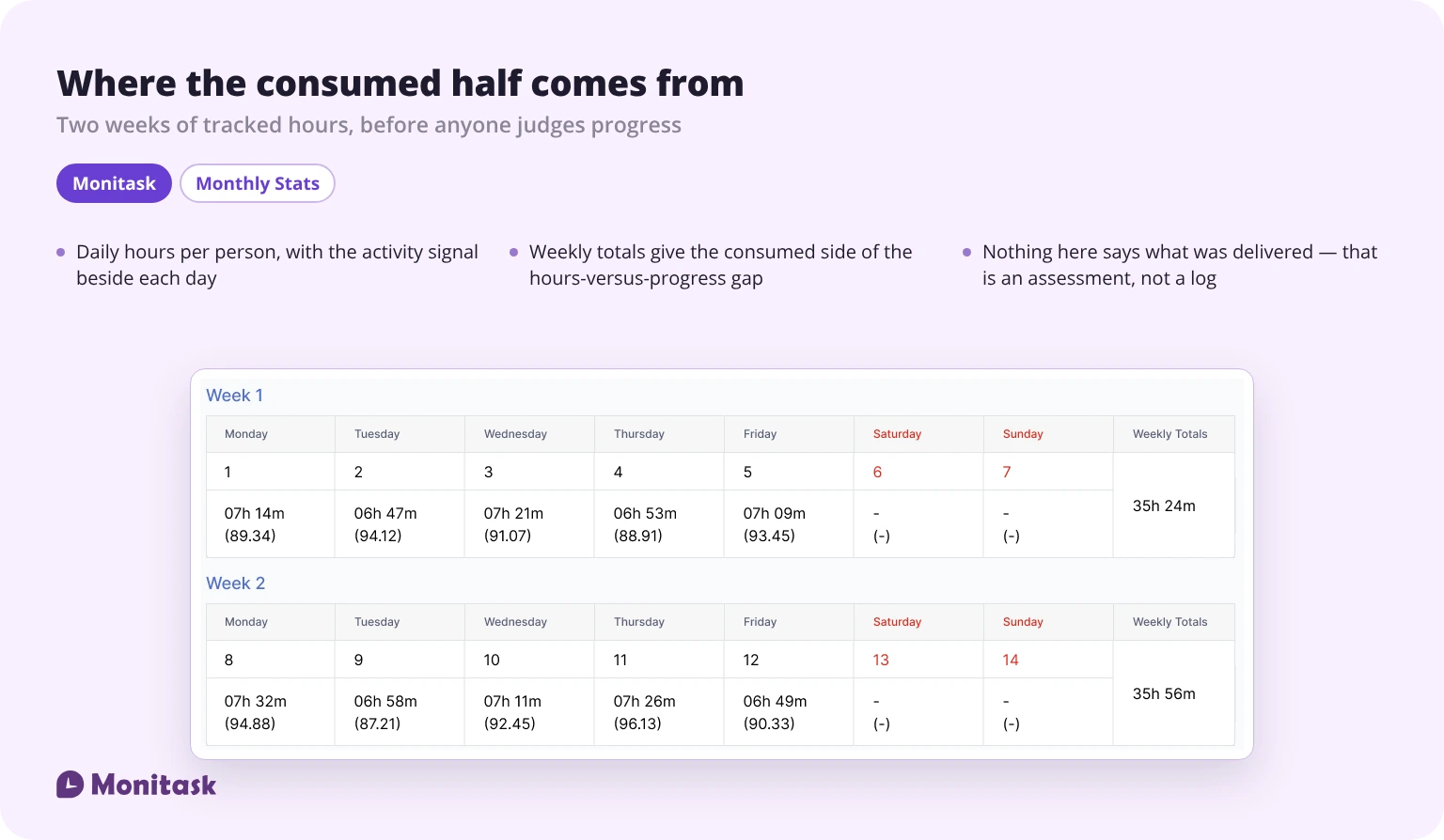
The gap itself is easiest to watch where the two numbers sit side by side — time tracking reports give the consumed half, and the percent-complete assessment gives the other.
FAQ
Why is hours spent divided by hours budgeted a bad measure of progress?
Because it measures consumption rather than delivery. The figure rises whenever anyone works, including on work that produces nothing usable, so a project that has used 60% of its hours and delivered 30% of its scope reports 60% progress. Effort-based progress cannot report an overrun, since the overrun is in the numerator.
What is the 50/50 rule in project management?
The 50/50 rule credits a task with 50% complete as soon as it starts and the remaining 50% when it finishes. It removes judgement from the assessment and suits tasks spanning two reporting periods. Its weakness is early overstatement: a task credited at 50% on day one may be 5% done.
What is the difference between progress, status and performance?
Progress answers how much of the planned work is done. Status answers what is blocking the project right now. Performance answers whether delivery is running at the planned rate and cost. A report saying “on track, no blockers” has given status and omitted progress entirely.
How do you measure progress on a project with no fixed scope?
Percent complete needs a denominator, and a continuous backlog does not have one. Use velocity — points completed per sprint — and a burndown of remaining work instead. The forecast comes from the same logic: current rate projected across the remaining backlog.
How often should project progress be reviewed?
Blockers and task status daily, percent complete weekly, cost performance monthly at period close, and the risk register every two weeks. Percent complete is a judgement rather than a measurement, so assessing it daily produces noise rather than information.
When should a project be escalated?
When percent complete falls more than 10 points behind plan, when the schedule performance index drops below 0.90, when a milestone slips more than five days or two slip consecutively, when a blocker stays open more than five days, or when percent complete has not moved for two consecutive periods.
What are weighted milestones?
Weighted milestones assign each phase a share of the total that sums to 100%, then credit that share as the phase completes. With Design at 15% complete, Build at 45% weight and 60% done, and Test and Deploy not started, overall progress is 42.0%. It is the most defensible method when phases differ in size.
What is level of effort and why is it a problem?
Level of effort credits progress with elapsed time, so a six-month support activity is 50% complete at month three regardless of what happened. It suits work with no deliverable to measure, and it can never show a variance — which means a project made mostly of level-of-effort activities will report perfect health in every period.
What should a project progress report contain?
Five sections: progress against plan with the method named, current status and blockers, performance variances, decisions needed with owners and dates, and changes since the last report. Leave out narratives of completed activities and any metric without a threshold attached.