Job Offer Letter Template — and the Clauses That Decide What You Have Promised

An offer letter states the role, the start date, the pay, the classification, the contingencies and the at-will position. The template is on this page, not behind a form. The clause most letters get wrong is the pay line: writing “an annual salary of $60,000” puts a year into a document you intended to carry no term at all.
What goes in a job offer letter?
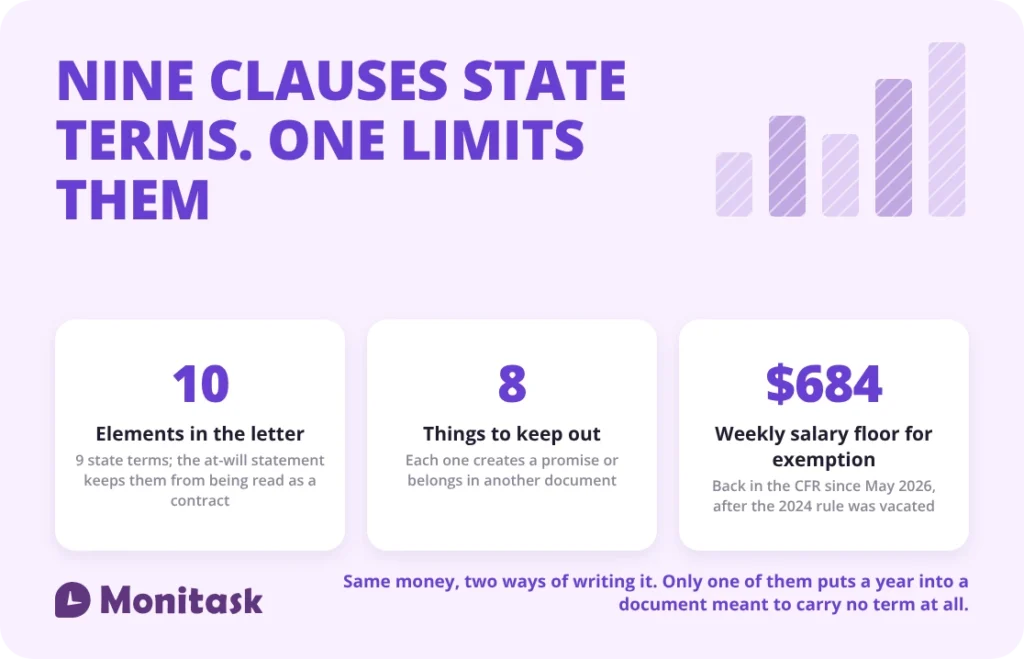
10 elements. 9 are administrative; the tenth is the one that keeps the other nine from being read as a contract.
| # | Element | Keep it to |
|---|---|---|
| 1 | Date and candidate name | Facts |
| 2 | Position and reporting line | Job title, department, who they report to |
| 3 | Start date | A date, not a range |
| 4 | Full-time or part-time, and schedule | Hours, not a promise of hours |
| 5 | Pay, stated per pay period | See the pay section below |
| 6 | FLSA classification | Exempt or non-exempt, stated explicitly |
| 7 | Benefits, by reference | “Subject to the terms of the applicable plan documents” |
| 8 | Contingencies | What the offer depends on, and the deadline |
| 9 | At-will statement | Nothing here promises employment for any period |
| 10 | Acceptance block and expiry | Signature, date, and when the offer lapses |
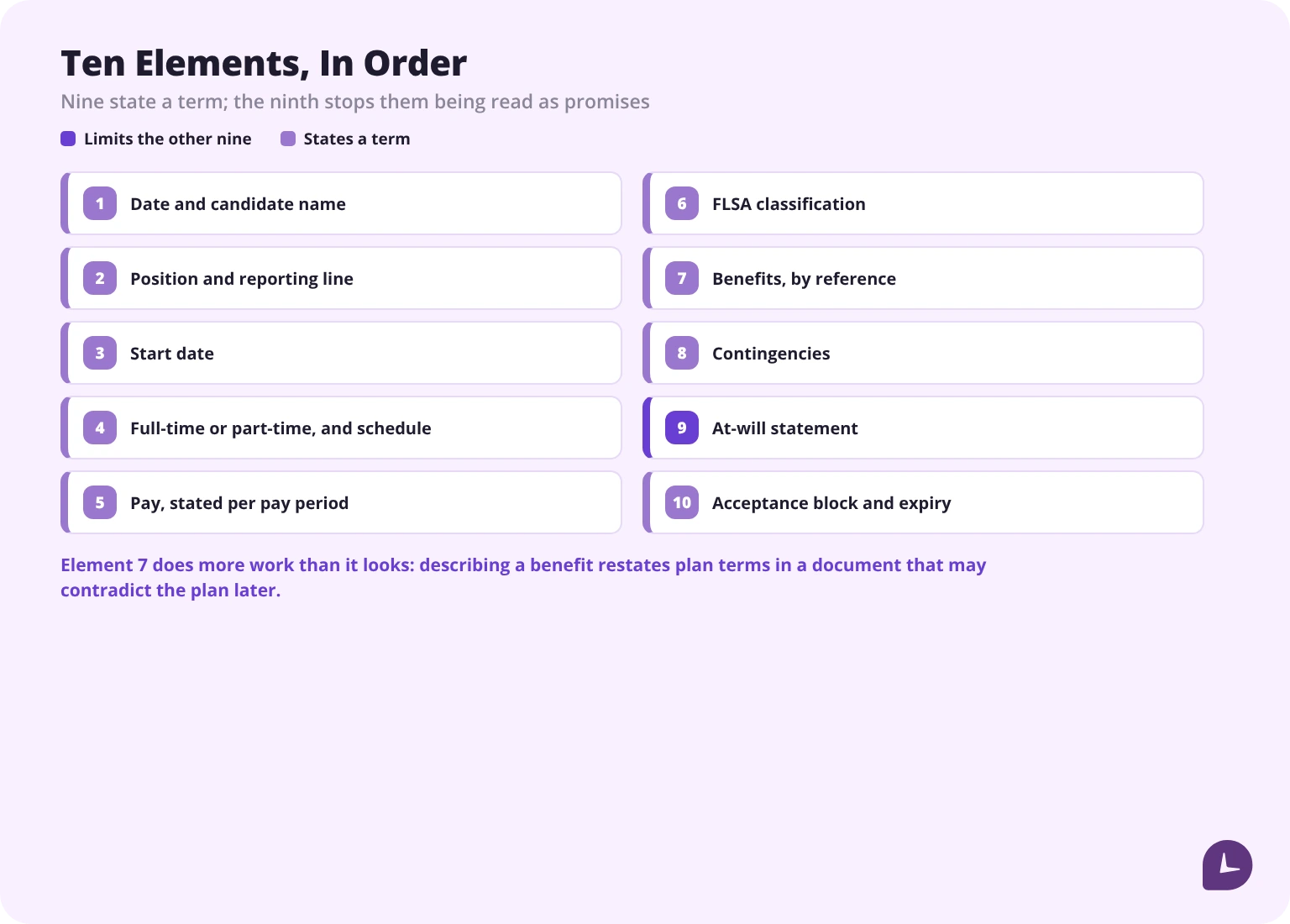
Element 7 does more work than it looks. Describing a benefit in the letter — “four weeks of vacation”, “an annual bonus of 10%” — restates plan terms in a document that may contradict the plan later. Refer to the plan; do not summarize it. If you want the document that does set out terms, that is an employment contract, and it is a different instrument with a different purpose.
The template, plus three variants
Replace every bracketed field. Three clauses below are model language because their wording is the point: the pay line, the classification line and the at-will paragraph.
[Company letterhead]

[Date]

Dear [Candidate name],

We are pleased to offer you the position of [job title] at [company name],
reporting to [manager name, title], in our [department] team. We would like
you to start on [start date].

Position. This is a [full-time / part-time] position. Your regular schedule
is expected to be [hours] per week, [days or shift pattern]. Your work
location is [location / remote / hybrid arrangement].

Compensation. Your pay will be $[amount] per [weekly / biweekly /
semi-monthly] pay period, which is equivalent to $[annual figure] on an
annualized basis. The annualized figure is provided for illustration only
and is not a promise of employment for any period of time. Pay is subject to
applicable withholdings and may be reviewed or changed at the company's
discretion.

Classification. This position is classified as [exempt / non-exempt] under
the Fair Labor Standards Act. [For non-exempt: You will be eligible for
overtime pay for hours worked over 40 in a workweek, in accordance with
applicable law, and you are required to record all time worked.]

Benefits. You will be eligible to participate in the benefit plans
[company name] offers to employees in your classification, subject to the
eligibility requirements and terms of the applicable plan documents, which
the company may change or discontinue at any time.

Contingencies. This offer is contingent on [list: satisfactory completion of
a background check / verification of your eligibility to work in the United
States / satisfactory references / any license or certification required for
the role]. If any contingency is not satisfied, this offer may be withdrawn.

At-will employment. Your employment with [company name] is at will. You may
end your employment at any time, with or without notice and with or without
cause, and [company name] may do the same. Nothing in this letter, in any
company policy, or in any statement by a company representative creates a
contract of employment or a promise of employment for any fixed period. The
at-will nature of your employment may be changed only in a written document
signed by [title of authorized officer].

Acceptance. Please confirm your acceptance by signing and returning this
letter by [date]. This offer expires on that date if not accepted.

We are looking forward to working with you.

[Name], [Title], [Company]

Accepted: [Candidate signature]   Date: [________]
Variant — hourly role. Replace the compensation paragraph, and keep the classification line as non-exempt:
Your pay will be $[rate] per hour, paid [weekly / biweekly]. You will be
paid for all hours worked, and overtime at the applicable rate for hours
worked over 40 in a workweek. You are required to record all time worked.
Variant — internal promotion. Replace the opening. Keep the compensation, classification and at-will paragraphs unchanged:
Effective [date], your position will change to [new title], reporting to
[manager]. All other terms of your employment remain unchanged.
Variant — part-time. State the expected weekly hours and add:
Scheduled hours may vary according to business needs, and this letter does
not guarantee a minimum number of hours.
Is an offer letter legally binding?
The honest answer is that it depends on what the letter says, and a flat “no” is wrong often enough to be dangerous.
An offer letter is not usually intended as an employment contract, and most are drafted to avoid being one. But a document can carry contractual weight through its own wording. At-will employment is a matter of state law and the usual formulation carries its own exception: the Maryland Department of Labor describes it as meaning that, in the absence of an express contract, agreement or policy to the contrary
, employment may end for almost any reason or none. That exception — an express contract, agreement or policy — is the door an offer letter can walk through.
Several things push it that way:
| What the letter does | Effect |
|---|---|
| States a period — annual salary, a one-year term, “first year” anything | Introduces a duration into the document |
| Promises a future event — a review at six months, a guaranteed bonus | Creates something to point at if it does not happen |
| Describes a probationary period as protective | Implies the opposite of at-will after it ends |
| Summarizes benefits instead of referring to plan documents | Creates terms that may contradict the plan |
| Omits an at-will statement | Leaves the reading open |
| Includes an explicit at-will statement with a named authorized officer | Limits all of the above |
So the useful question is not “is it binding” but “what in this letter could be read as a promise?” Everything in the template above is written to answer that: terms stated, promises avoided, at-will stated explicitly.
Why should you think twice about stating an annual salary?
Because the phrase “annual salary” puts a year into a letter whose whole purpose is to avoid committing to a period.
The two framings carry the same money and different implications:
| Wording | What it says about duration |
|---|---|
| “An annual salary of $60,000” | Compensation expressed as a yearly amount |
| “$2,307.69 per biweekly pay period (equivalent to $60,000 annualized, for illustration only and not a promise of employment for any period)” | Compensation per period, with the annual figure marked as a calculation |
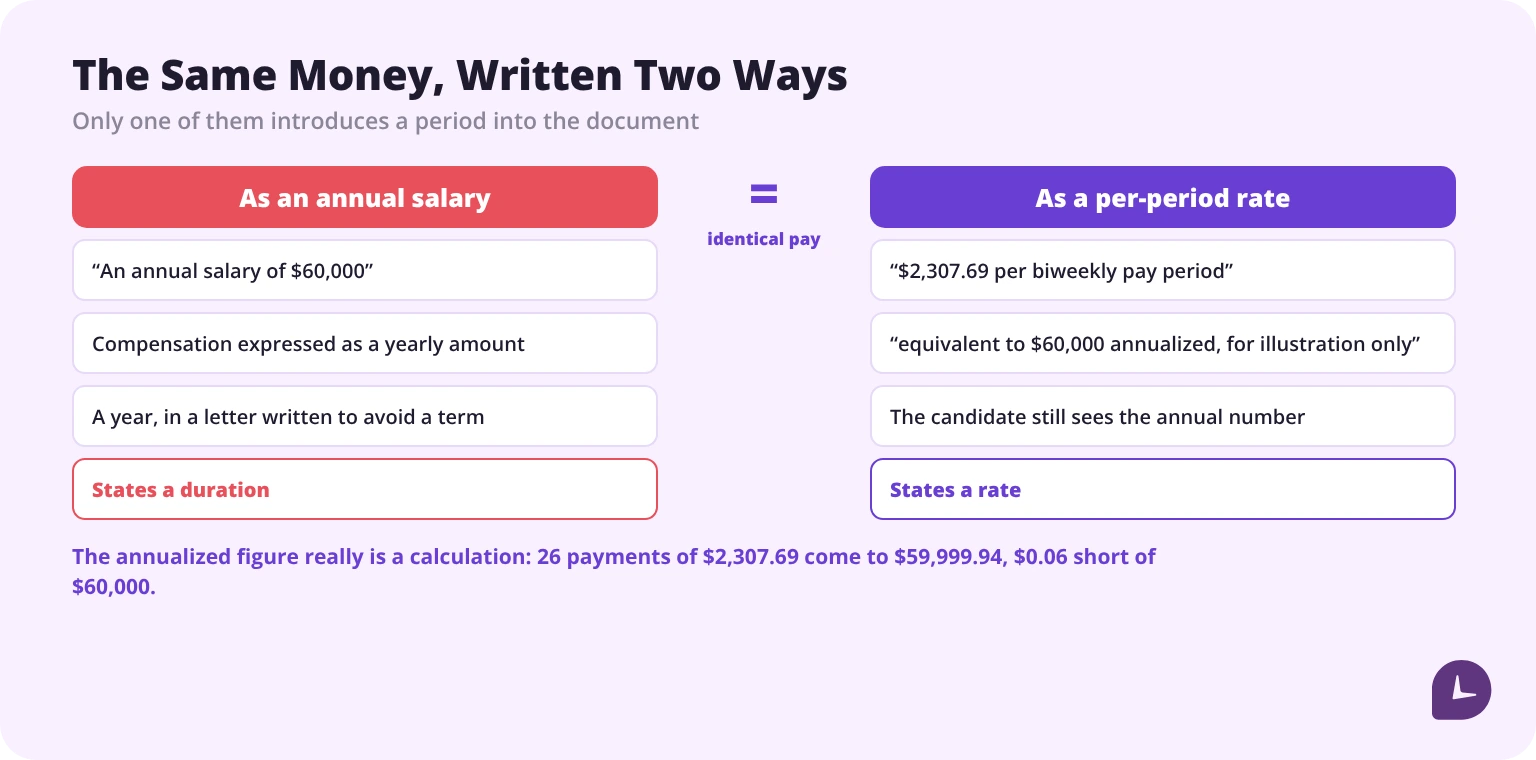
Nobody will refuse an offer over the second version, and candidates still see the annual number. What changes is that the document no longer expresses pay as a yearly commitment.
There is also a small arithmetical reason the second framing is more honest. 26 payments of $2,307.69 come to $59,999.94, which is $0.06 short of $60,000. The per-period figure is what the employee is actually paid; the annual figure really is an illustration, and saying so in the letter is accurate rather than defensive.
A few related pay-line rules:
- State the rate, not the raise. “Reviewed annually” is fine; “increased annually” is a promise.
- Keep bonus language conditional and by reference. “Eligible to participate in the [plan name], subject to its terms” rather than a percentage in the letter.
- Do not restate equity terms. Refer to the plan and the grant agreement.
- Do not mention the candidate’s current or previous pay. It is irrelevant to what you are offering, and several states restrict asking about it or relying on it in the first place.
One distinction worth keeping straight, because template guides routinely blur it. Salary-history bans regulate what you may ask and what you may rely on, not what the letter may say. All three regulate asking about salary history and relying on it. None of them restricts what the offer letter may say. The constraint on the letter’s own content, where there is one, comes from the pay transparency statutes instead. Where a rule does reach the document, it comes from pay transparency law — 4 jurisdictions we checked at source require a pay range in a posting, on request, or both — and those duties attach to the advertisement and the process, not only to this letter. Check the states and cities you hire in; these requirements have been added quickly and differ. If the candidate wants to talk numbers before signing, that is job offer negotiation, and it happens before the letter rather than inside it.
Should the letter say exempt or non-exempt?
Yes — but as good practice rather than because a law says to, and the distinction matters if someone asks you why.
Start with what the regulation actually settles. 29 CFR § 541.2, headed Job titles insufficient, has two sentences: A job title alone is insufficient to establish the exempt status of an employee
, and that the status of any particular employee must be determined on the basis of whether the employee’s salary and duties meet the requirements
of the regulations in that part. That tells you how status is determined. It says nothing about disclosing it.
So naming someone “Manager” or “Coordinator” settles nothing: the classification has to be worked out from pay and actual duties before the letter goes out. The pay half is a fixed number — 29 CFR § 541.600 requires payment on a salary basis at a rate of not less than $684 per week
, which is $35,568 a year, and 29 CFR § 541.601 sets the highly compensated employee test at total annual compensation of at least $107,432
. Those figures are worth stating plainly because they were in doubt for eighteen months: a 2024 rule would have raised them, the United States District Court for the Eastern District of Texas vacated it on 15 November 2024, the appeal was dismissed on 5 May 2026, and the Department then published a technical amendment effective 15 May 2026 removing the 2024 text from the regulation. The amendment removes the 2024 rule’s text and republishes the regulatory text as it stood before that rule took effect. The vacated levels – $844 and then $1,128 a week, with automatic triennial updates – do not appear in the CFR. Our guide to exempt vs non-exempt employees covers the duties half, and the salary basis test covers how the pay has to be delivered.
Now the disclosure question. There is no federal requirement to state FLSA classification in writing to a new hire. The FLSA’s own obligations here are recordkeeping and a poster — employers Employers must display an official poster outlining the provisions of the Act
— and neither reaches the offer letter. Some states do require a written wage notice at hire, and it is worth knowing exactly what they ask for:
| State | Citation | What it must contain | When | Scope |
|---|---|---|---|---|
| New York | Labor Law § 195 | Rate or rates of pay and the basis of them, allowances claimed, the regular pay day, and the employer’s name, address and telephone number | At the time of hiring, with an updated notice within 7 days of a change not shown on the next pay stub | Not limited to non-exempt employees on the face of the guidance |
| California | Labor Code § 2810.5 | Rate or rates of pay and the basis of them, including overtime rates where applicable, allowances claimed, the regular pay day, the employer’s details and its workers’ compensation carrier | At the time of hiring, no later than the first day services are performed | Overtime-exempt employees are excluded from the requirement |
Both notices require the pay rate and its basis. Neither requires the FLSA classification, and California’s does not apply to exempt employees at all – so a state wage notice is not the reason to state classification in the letter.
The reason to state it anyway is practical, not statutory: it closes off a later argument. A non-exempt employee who was told they were “salaried” and therefore not owed overtime has a dispute. One whose letter says non-exempt and requires recording all time worked does not. For non-exempt roles, include that recording line — it is the sentence you will want in writing if hours are ever reconstructed, and the overtime policy it points to is where the detail belongs.
What contingencies belong in the letter?
Only the ones you will actually apply, each with a condition and a consequence.
| Contingency | Why it is in the letter |
|---|---|
| Background check satisfactory to the company | Makes the offer conditional rather than withdrawn later for an unstated reason |
| Verification of eligibility to work in the United States | Required of every employer; stating it avoids a surprise at onboarding |
| Satisfactory references | Only if you really take them, and apply it consistently |
| Required license, certification or credential | Where the role cannot be performed without it |
| Drug test, where lawful and applied consistently | State and local rules differ; do not include it generically |
Three rules. Name the deadline — a contingency with no end date leaves the offer open indefinitely. Apply the list consistently across candidates for the same role, because selective contingencies are a pattern someone can point at. And do not include a contingency you will not enforce, because an unenforced condition is worse than no condition. A written background check policy and a new hire policy are what make “consistently” demonstrable rather than asserted.
On work authorization, the timing is tighter than most letters assume. Form I-9 Section 1 may be completed before the first day of work — Employees may complete Section 1 before the time of hire
— but but not before the employer extends the job offer
. So sending Section 1 when the candidate accepts is the earliest point the law allows; sending it with the offer is too early. Section 2 runs to within three business days from the date of hire
, and that clock starts at the date of hire rather than at acceptance.
What should never go in an offer letter?
8 things. Each either creates a promise you did not intend or puts information in a document where it does not belong.
| Do not include | Why |
|---|---|
| “Permanent”, “career”, “long-term” | Contradicts at-will in one word |
| A guaranteed bonus amount or percentage | Becomes a term; refer to the plan instead |
| A promised raise, promotion or review outcome | A future event you may not deliver |
| A probationary period described as protective | Implies security after it ends |
| Summarized benefit terms | May contradict the plan documents |
| The candidate’s salary history | Restricted in several jurisdictions, and irrelevant |
| Anything about other candidates | Invites a claim from them |
| Any duration other than the start date and the offer expiry | Duration is what you are trying to keep out |
And one positive rule: what the recruiter said on the phone should match the letter. The letter is the record; verbal assurances about raises, bonuses or job security are where the gap opens.
Can you rescind an offer?
Two different situations, and conflating them is a common error in template guides.
Before acceptance. An offer that has not been accepted is generally still an offer, and withdrawing it is ordinarily possible. The practical risks are reputational, and in narrow circumstances a candidate who took irreversible steps in reliance on the offer may have an argument.
After acceptance. Once accepted, the situation changes in character. If the at-will provision is clearly stated, the relationship is at will from the start, which is the point of including it. But withdrawal after acceptance is a decision with exposure that depends on the letter’s wording, the reason, and the state — and the reason matters most.
| Situation | Usual position | What to document |
|---|---|---|
| Contingency not satisfied | The letter already provided for it | Which contingency, the evidence, the date |
| Role eliminated before start | Business decision | The decision and when it was made |
| Candidate misrepresented something material | Depends on materiality | What was stated and how it was checked |
| Reason connected to a protected characteristic or a disclosure | Do not proceed without counsel | Nothing — stop and get advice first |
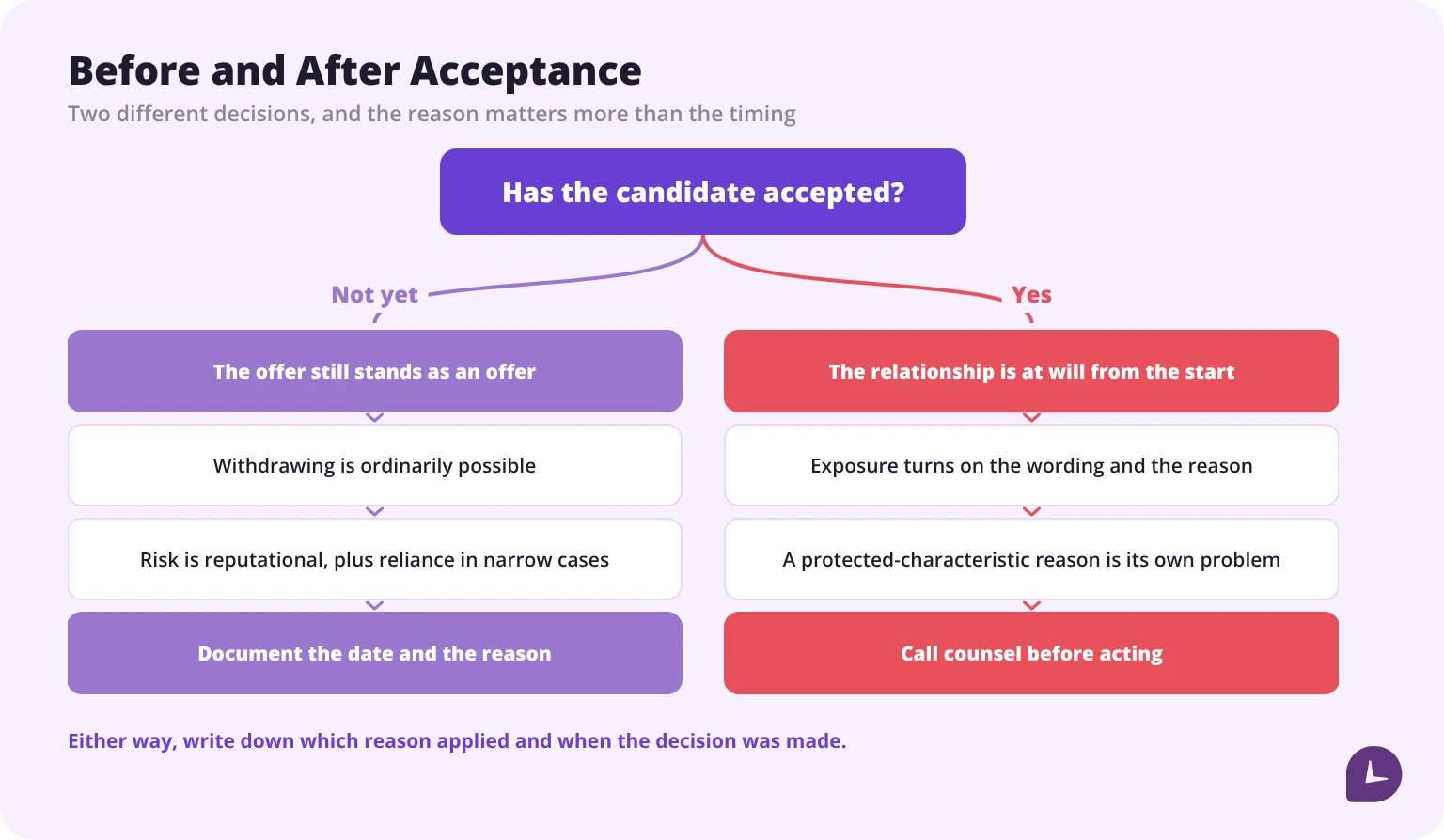
One case has a federal procedure attached, and it is the most common one. If you are not hiring because of something in a background report from a screening company, the Fair Credit Reporting Act sets out what the candidate gets and when. Before you act, the Federal Trade Commission’s guidance for employers says you must give the person a notice that includes a copy of the consumer report you relied on to make your decision
and a copy of A Summary of Your Rights Under the Fair Credit Reporting Act
— the point being, in the agency’s words, that it Giving the person the notice in advance gives the person the opportunity to review the report
and tell you if it is wrong. After you act, the notice must include the name, address, and phone number of the consumer reporting company that supplied the report
, a statement that the company that supplied the report did not make the decision
about the hiring decision, a notice of the person’s right to dispute the accuracy or completeness of any information
, and the right to get an additional free report from the company if the person asks
within 60 days. The FTC states no required waiting period between the two notices; any specific number of days you have seen is industry practice.
For every other reason on that table, a quick call with employment counsel is cheaper than the alternative.
What a template cannot settle
Your classification. Whether a role is exempt turns on pay and duties, not on the template’s blank. That determination happens before the letter.
Your state and city rules. Pay-range disclosure, salary-history restrictions, drug-testing limits and final-pay rules differ by jurisdiction and change. A national template cannot know where you hire, and the sample of jurisdictions in this article is a sample rather than a survey.
What your recruiters promise. The template controls the document, not the conversation. If offers are discussed verbally before the letter, the briefing matters as much as the wording.
The schedule, hours and overtime records the classification line commits you to, from the first day rather than from the first dispute.
Browse Monitask's HR policy and form templates
This article provides an offer letter structure and model wording for three clauses, and summarizes the federal rules on exempt status, work authorization timing and adverse action after a background check. It is not legal advice. Whether a letter is read as a contract is a question of state law, and pay-range disclosure, salary-history and drug-testing rules differ by jurisdiction. The model wording here is a starting point for review by employment counsel, not a document to adopt as written.
Sources
- 29 CFR § 541.2, Job titles insufficient. Both sentences read at source on eCFR. Verified 12 November 2026.
- 29 CFR § 541.600 and 29 CFR § 541.601. The current salary level and highly compensated employee test, read at source on eCFR and cross-checked against the Wage and Hour Division’s own fact sheet. Verified 12 November 2026.
- 91 FR 27833, Final rule; technical amendment, effective 15 May 2026. The document that removed the 2024 rule’s text from the regulation, and which records the 15 November 2024 vacatur in Texas v. U.S. Department of Labor and the dismissal of the appeal on 5 May 2026. Verified 12 November 2026.
- U.S. Citizenship and Immigration Services, I-9 Central, Who Must Complete Form I-9. The Section 1 and Section 2 timing, quoted verbatim. Verified 12 November 2026.
- Federal Trade Commission, Using Consumer Reports: What Employers Need to Know and Background Checks: What Employers Need to Know. The pre-adverse and adverse action requirements, quoted verbatim. The agency’s own reference list cites Section 604(b), 15 U.S.C. § 1681b(b), and Section 615(a), 15 U.S.C. § 1681m(a). Verified 12 November 2026.
- State wage notices at hire: New York, Labor Law § 195, and California, Labor Code § 2810.5, each read on the state labor department’s own guidance. Verified 12 November 2026.
- Pay transparency, read at source on each state’s own agency site as a sample rather than a survey:
- Colorado, C.R.S. § 8-5-201 — Every job opportunity posting.
- California, Labor Code § 432.3 — On request by an applicant, and in postings for employers with 15 or more employees.
- New York, Labor Law § 194-b — Advertisements for a job, promotion or transfer.
- Washington, Ch. 49.58 RCW — Postings, for employers with 15 or more employees.
- Salary history restrictions, read at source for New York, California, Washington. Each regulates inquiry into and reliance on salary history; none restricts the offer letter’s content. Verified 12 November 2026.
- At-will employment as described by the Maryland Department of Labor and the Oregon Bureau of Labor and Industries. No federal or state government page addressing offer letters as such could be found. Verified 12 November 2026.
FAQ
Is a job offer letter a contract?
Not usually by intention, but its wording decides. Stating a period, promising a future raise or bonus, describing a probationary period as protective, or restating benefit terms all push a letter toward being read as a contract. An explicit at-will statement that only a named officer can change is the counterweight. At-will itself is state law, and the standard formulation carries an exception for in the absence of an express contract, agreement or policy to the contrary
— which is exactly what a loosely drafted letter can become.
Does the offer letter have to say exempt or non-exempt?
No federal law requires it. New York and California require a written wage notice at hire, but those ask for the pay rate and its basis rather than the FLSA classification, and California’s does not apply to exempt employees at all. State it anyway: a non-exempt employee who was told they were “salaried” has an argument that one whose letter said non-exempt does not.
What is the current salary threshold for an exempt employee?
on a salary basis at a rate of not less than $684 per week
, which is $35,568 a year, with the highly compensated employee test at total annual compensation of at least $107,432
. The 2024 rule that would have raised these was vacated in November 2024, the appeal was dismissed in May 2026, and the Department republished the earlier figures in the regulation that same month. Salary is only half the test; the duties have to qualify too.
Can you withdraw a job offer after someone accepts?
It depends on the letter, the reason and the state. A clearly stated at-will provision means the relationship is at will from the start. A failed contingency the letter provided for is a different situation from a withdrawal connected to a protected characteristic or to something the candidate disclosed. If the reason involves a background report, the Fair Credit Reporting Act’s pre-adverse and adverse action notices apply.
When should a new hire complete Form I-9?
Section 1 may be done before the first day of work but but not before the employer extends the job offer
, so sending it at acceptance is the earliest lawful point. The employer completes Section 2 to within three business days from the date of hire
.