Service Contract Act: What You Pay, What You Keep, and What You Do Not Have to Send

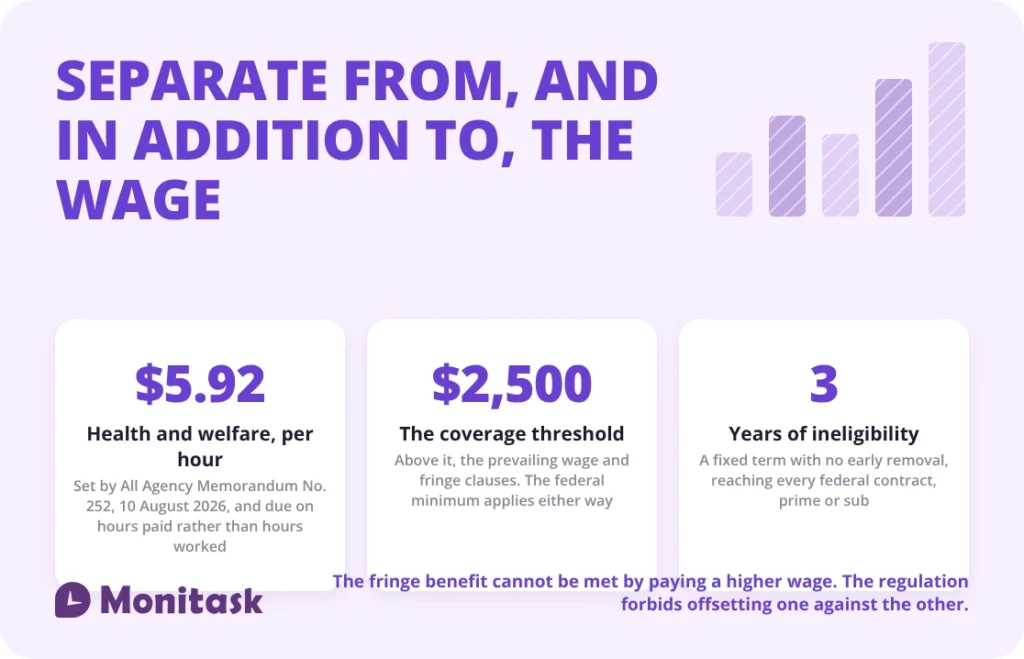
the McNamara-O’Hara Service Contract Act of 1965 sets a wage floor and a fringe benefit floor on federal service contracts over $2,500. The fringe is separate from and in addition to the wage, and cannot be met by paying more wages. The current health and welfare rate is $5.92 an hour, due on hours paid rather than hours worked. And unlike construction work, there is no weekly certified payroll to submit — only records to keep and produce.
What is the Service Contract Act?
The mcnamara-o’hara service contract act of 1965, codified at 41 U.S.C. ch. 67 — sections 41 U.S.C. 6701 to 6707 — and implemented by 29 C.F.R. part 4 and the contract clause at FAR 52.222-41. The Department of Labor describes it as requiring contractors and subcontractors performing services on prime contracts requires contractors and subcontractors performing services on prime contracts in excess of $2,500
to pay covered workers no less than the wage rates and fringe benefits found prevailing in the locality
. Our labor laws page covers where it sits among the others.
A naming point worth getting right. The recodified chapter is not captioned “Service Contract Act” — its caption is SERVICE CONTRACT LABOR STANDARDS, and the contract clause follows the codified name as Service Contract Labor Standards. The Department still uses the older name throughout its own material, so both are correct in their place. One oddity follows from this: the Department never cites the United States Code in its own guidance, referring instead to the Act’s internal section numbers and to part 4. If you are matching a citation between a Department page and a contract clause, that is why they look unrelated.
Coverage, from the statute. 41 U.S.C. 6702(a) applies the chapter to a contract that involves an amount exceeding $2,500; and has as its principal purpose the furnishing of services in the United States through the use of service employees
.
Which contracts does it reach, and what applies below the threshold?
Two floors, and the relationship between them is stated wrongly in most employer guides.
| Contract value | What applies |
|---|---|
| Any amount | The minimum wage under section 6(a)(1) of the Fair Labor Standards Act |
| Over $2,500 | Additionally, the prevailing wage, the fringe benefit obligation, and the labour standards clauses |
The federal minimum is not a sub-threshold rule. 29 C.F.R. 4.2 is captioned Payment of minimum wage specified in section 6(a)(1) of the Fair Labor Standards Act of 1938 under all service contracts and provides that regardless of contract amount, no contractor or subcontractor performing work under any Federal contract
whose principal purpose is to furnish services through service employees shall pay any employees engaged in such work less than the minimum wage specified in section 6(a)(1) of the Fair Labor Standards Act of 1938, as amended
. Note the phrase: regardless of contract amount. The section never mentions $2,500.
The practical result is the one most guides describe — a contract at or below $2,500 has the federal minimum as its only wage floor — but the regulation does not reach it by making the minimum a sub-threshold rule, and a compliance document should not say it does.
There is no employee-count exemption. The safety and health term applies without regard to headcount. The only employee-count figure in the whole chapter is at 41 U.S.C. 6707(f), where Congress directed that the Secretary shall at least make the determinations for contracts under which more than 5 service employees are to be employed
. That is a floor on the Department’s own duty to issue wage determinations. It is not a contractor exemption, and treating it as one is a mistake worth naming because it circulates.
Construction is excluded by statute, not by practice. 41 U.S.C. 6702(b) exempts from the chapter a contract of the Federal Government or the District of Columbia for the construction, alteration, or repair
of public buildings or public works. That is what makes the Davis-Bacon boundary a legal line.
How does it differ from Davis-Bacon and DCAA?
Three regimes that overlap in the artefact — a timesheet — and diverge in purpose, in who audits, and in whether anything has to be sent anywhere.
| Service Contract Act | Davis-Bacon | DCAA | |
|---|---|---|---|
| What work | Services | Construction, alteration or repair | Cost accounting on government contracts |
| Threshold | Over $2,500 | Over $2,000 | Cost-reimbursable contracts |
| Who sets the rate | A wage determination | A wage determination | Not a wage regime at all |
| Weekly payroll submission | No | Yes, with a signed certification | No, but labour charging is audited |
| Records | Keep 3 years from completion, produce on request | Submit weekly and keep 3 years | Keep for audit |
| Who audits | The Wage and Hour Division | The Wage and Hour Division and the agency | The Defense Contract Audit Agency |
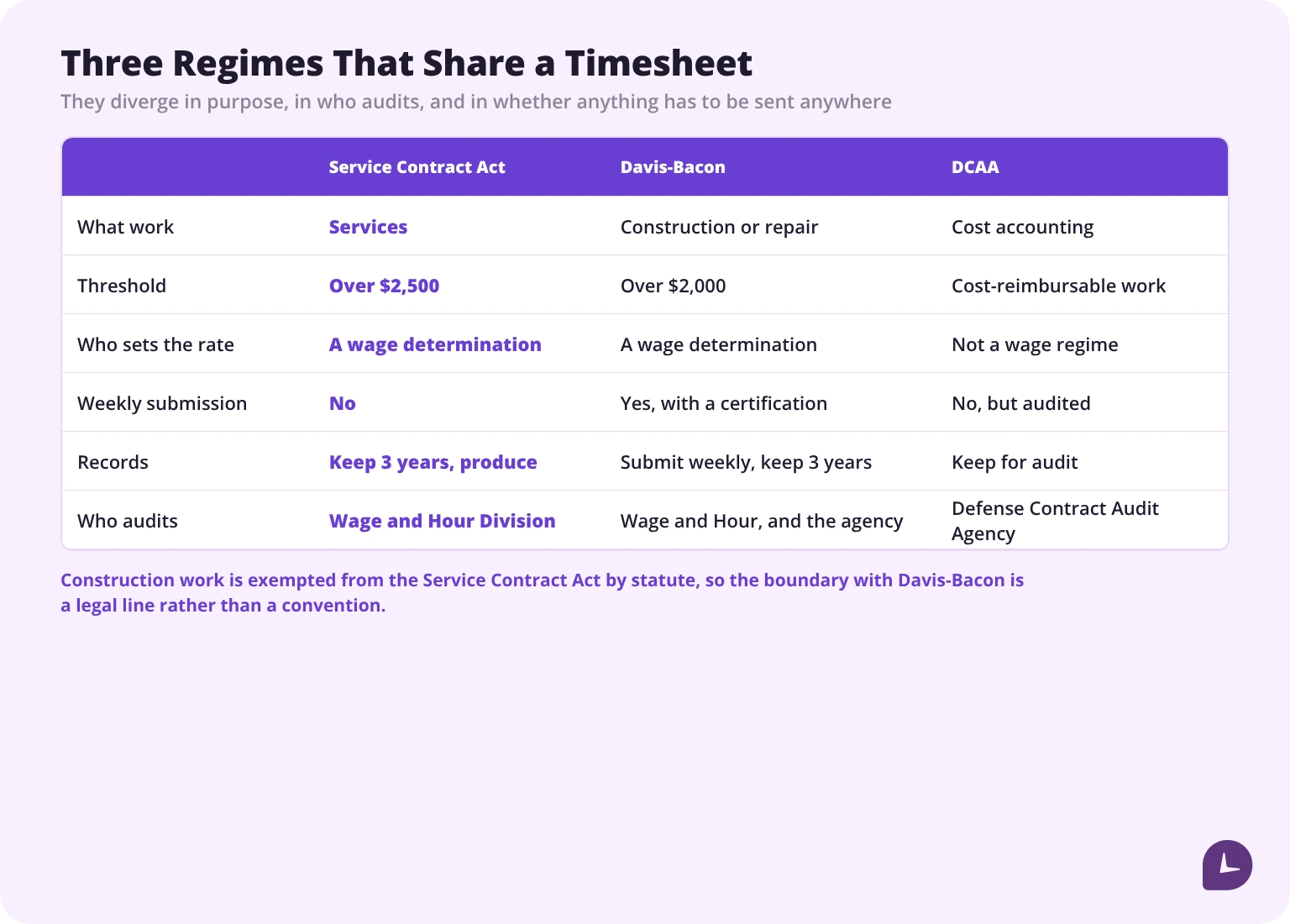
Note the thresholds, which guides transpose constantly. Davis-Bacon is over $2,000; the Service Contract Act is over $2,500.
And note what DCAA is not. DCAA timekeeping is a cost-accounting and labor-charging regime, so that labour costs charged to a cost-reimbursable contract are verifiable, allowable and properly distributed. The Act’s recordkeeping is a labour-standards regime, so that the Wage and Hour Division can verify that each employee received the correct classification, wage and fringe benefit. They converge in exactly one place — accurately identifying contract versus non-contract hours satisfies both, and failing to does damage under both. In a labour evaluation the auditor’s questions run to the timesheet itself — The auditor will ask the employee for a copy of their timesheet
, and the reconciliation runs to the labor distribution for the pay period floor checked
. What is not true, in either direction, is that compliance with one satisfies the other: the fields the Act requires have no audit analogue.
What must you pay?
Two separate obligations, and the second cannot be satisfied with the first.
41 U.S.C. 6703 requires every covered contract to contain a provision shall contain a provision specifying the minimum wage to be paid to each class of service employee
, and a provision shall contain a provision specifying the fringe benefits to be provided to each class of service employee
. The fringe benefits enumerated include medical or hospital care, pensions on retirement or death
and continue from there; our employee benefits page covers what the categories are in practice, and paid holidays the component that varies most between determinations.
The contract clause at 29 C.F.R. 4.6(b)(1) carries it through: service employees shall be paid not less than the minimum monetary wages
and shall be furnished fringe benefits in accordance with the wages and fringe benefits determined by the Secretary of Labor
.
The successorship rule, which the usual summaries skip. 41 U.S.C. 6707(c)(1): Under a contract which succeeds a contract subject to this chapter, and under which substantially the same services are furnished
, the contractor may not pay a service employee less than the wages and fringe benefits
the employee would have received under the predecessor contract — including any prospective increases in wages and fringe benefits provided for in a collective-bargaining agreement
obtained through arm’s-length negotiation. If you are taking over a contract from an incumbent with a collective agreement, that agreement sets your floor, not the published determination.
There is an escape hatch at 41 U.S.C. 6707(c)(2), but it is a hearing rather than a decision you make: the rule does not apply where the Secretary finds after a hearing that wages and fringe benefits under the predecessor contract are substantially at variance
with those prevailing in the locality. The procedure is at 29 C.F.R. 4.10.
Can fringe benefits be paid in cash?
Yes, and this is where most of the money goes wrong.
29 C.F.R. 4.177(c)(1) provides that Fringe benefit obligations may be discharged by paying to the employee on his regular payday
, in addition to the monetary wage required
, a cash amount per hour in lieu of the specified fringe benefits provided such amount is equivalent to the cost of the fringe benefits required
. Three phrases there do the work: on his regular payday, in addition to the monetary wage, and equivalent to the cost.
You cannot offset one against the other. 29 C.F.R. 4.177(a) makes the fringe obligation one that provides for fringe benefits that are separate from and in addition to the monetary compensation
, and states that the Act does not authorize any part of the monetary wage required by section 2(a)(1) to be offset by the fringe benefit payments or equivalents
. So an employer paying well above the determination’s monetary wage has not thereby met the fringe obligation, and cannot back-credit the excess against it. This is the single most common structural error on service contracts, and it is expensive because it compounds every pay period.
Combinations are allowed. 29 C.F.R. 4.177(b): a fringe obligation stated as a cash amount may be discharged by furnishing any combination of ‘bona fide’ fringe benefits costing an equal amount
. Benefits, cash, or any mix that costs the required amount.
The current health and welfare rate is $5.92 an hour. All Agency Memorandum No. 252, 10 August 2026, states that the prevailing health and welfare fringe benefit will increase to a rate of $5.92 per hour
. For reference, the prior rates were $5.55 in 2025, $5.36 in 2024 — so a guide quoting either is out of date.
And it is due on hours paid, not hours worked. 29 C.F.R. 4.175(a)(1) covers determinations that specify a fixed payment per hour on behalf of each service employee
, and provides that such payments are due for all hours paid for, including paid vacation, sick leave, and holiday hours
, up to a maximum of 40 hours per week and 2,080 hours per year on each contract
.
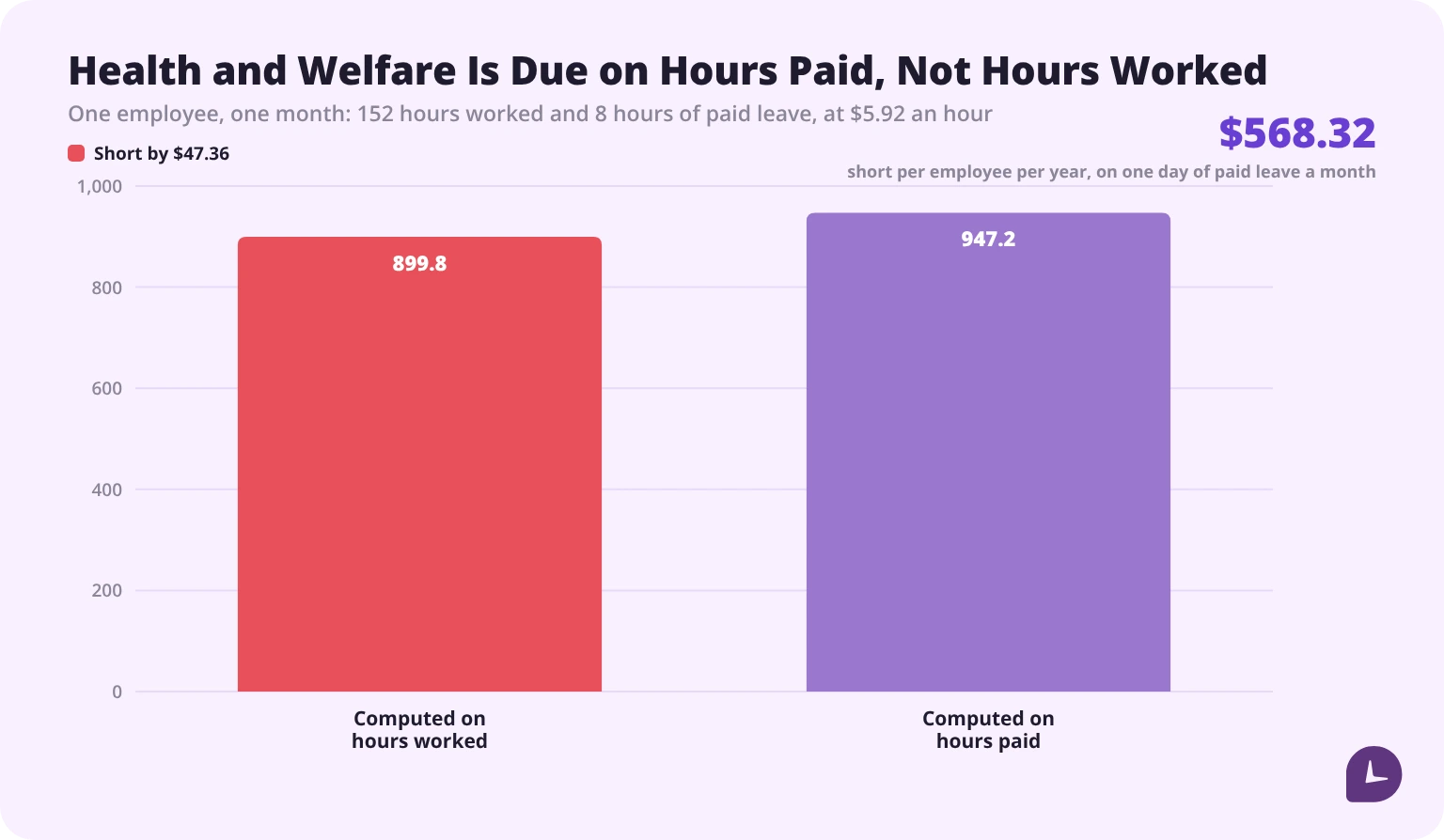
The arithmetic is unforgiving. An employee with 152 hours worked and 8 hours of paid leave in a month has 160 hours paid. At $5.92 that is $947.20 rather than $899.84 — $47.36 short in one month, $568.32 over a year, per employee. The cap keeps it bounded: at 2,080 hours a year the per-employee ceiling is $12,313.60 on each contract.
Fixed cost means per employee, not per plan. 29 C.F.R. 4.175(a)(1) provides that the amount of the employer’s contribution on behalf of each individual employee governs
, and the Department states it plainly: The employer cannot average the cost across all employees
. A plan costing the right amount in aggregate does not discharge the obligation if one employee’s contribution falls short.
Average-cost determinations work differently. 29 C.F.R. 4.175(b) covers determinations expressed in terms of average cost, where the firm’s total contributions for all service employees enrolled in the plan must average at least
the determination’s requirement per hour per service employee, and where contributions fall short then the firm must make up the deficiency by making cash equivalent payments
or equivalent benefits to the employees in the plan. Which method your determination uses is the first thing to establish, because the two produce different answers and different reconciliation duties.
What if a job class is not in the wage determination?
You conform it, and the timing matters more than the paperwork.
29 C.F.R. 4.6(b)(2) requires that Such conforming procedure shall be initiated by the contractor prior to the performance of contract work
. The report then goes to the contracting officer no later than 30 days after such unlisted class of employees performs any contract work
. The standard is to classify the unlisted class so as to provide a reasonable relationship (i.e., appropriate level of skill comparison)
to those already listed.
The request goes on Standard Form 1444, Request For Authorization of Additional Classification and Rate — the full name is worth using, because “the conformance form” is ambiguous. Current practice routes it through sam.gov. It must include information regarding the agreement or disagreement of the authorized representative
of the employees, which means the employee side’s position travels with the request whether or not they agree.
What happens then. The Wage and Hour Division will approve, modify, or disapprove the action
, or render a final determination in the event of disagreement within 30 days of receipt
. So disagreement is not a disputes-clause matter in the first instance: the Division decides.
Two consequences worth planning around.
The rate is retroactive to the date such class of employees commenced contract work
. You will owe the conformed rate from the day that class started work, not from the day the determination arrives — so a proposed rate that the Division modifies upward creates back pay, and the exposure grows the longer the request sits.
And the employees have to be told: Each affected employee shall be furnished by the contractor with a written copy of such determination
, or it is posted as part of the wage determination.
A timesheet approval process that surfaces an unrecognised job code in week one rather than month three is what keeps that retroactive window short.
What records must you keep, and is there a certified payroll?
Keep, maintain, produce. There is nothing to submit.
29 C.F.R. 4.6(g) requires that the contractor shall make and maintain for 3 years from the completion of the work records
and shall make them available for inspection and transcription by authorized representatives
of the Wage and Hour Division. 3 years from completion of the work, not from the date of the record — a drafting error common enough in retention policies to be worth naming.
The 9 fields:
- Name, address and Social Security number of each employee
- The correct work classification or classifications
- The rate or rates of monetary wages paid and fringe benefits provided
- The rate or rates of any fringe benefit payments made in lieu of benefits
- Total daily and weekly compensation of each employee
- The number of daily and weekly hours worked by each employee
- Any deductions, rebates or refunds from the total compensation
- A list of wages and fringe benefits for any conformed classes
- Any list of the predecessor contractor’s employees furnished to you
Two of those have no counterpart in an ordinary payroll register: the rate of any cash payments made in lieu of benefits, and the list of conformed classes. Payroll deductions are recorded here too, and the obligation is backed by a sanction — failure to make, maintain or make available the records is itself a violation, and the contractor The contractor shall permit authorized representatives of the Wage and Hour Division to conduct interviews
with employees at the worksite.
There is no weekly certified payroll under this Act, and it is worth being precise about how that is established, because no Department page says so in terms. It follows from the contrast between two regulatory texts. The Act’s duty, at 29 C.F.R. 4.6(g), is to make, maintain and make available. The Davis-Bacon duty, at 29 C.F.R. 5.5(a)(3)(ii), is that The contractor shall submit weekly for each week in which any contract work is performed a copy of all payrolls
, with a signed statement of compliance. The contract clauses mirror the same split: the Davis-Bacon clause FAR 52.222-8 is titled Payrolls and Basic Records and requires submission; the service clause stops at make, maintain and make available.
One qualification, so nobody concludes their agency is acting without authority: an individual contract or agency may impose payroll submission by its own terms. That is a contract requirement rather than a requirement of this Act, and it is perfectly valid.
How do you handle mixed contract and non-contract work?
By segregating the hours, because the alternative is a presumption that costs money.
29 C.F.R. 4.169, captioned Wage payments – work subject to different rates, provides that where an employee works in different capacities in a workweek and two or more rates apply, the employee must be paid the highest of such rates for all hours worked in the workweek
unless it appears from the employer’s records or other affirmative proof which of such hours were included in the periods spent in each class of work
. And then the sentence that reaches beyond the contract: The rule is the same where such an employee is employed for a portion of the workweek in work not subject to the Act
, where a lower rate would otherwise be proper, if the employer segregated the time by records or other affirmative proof.
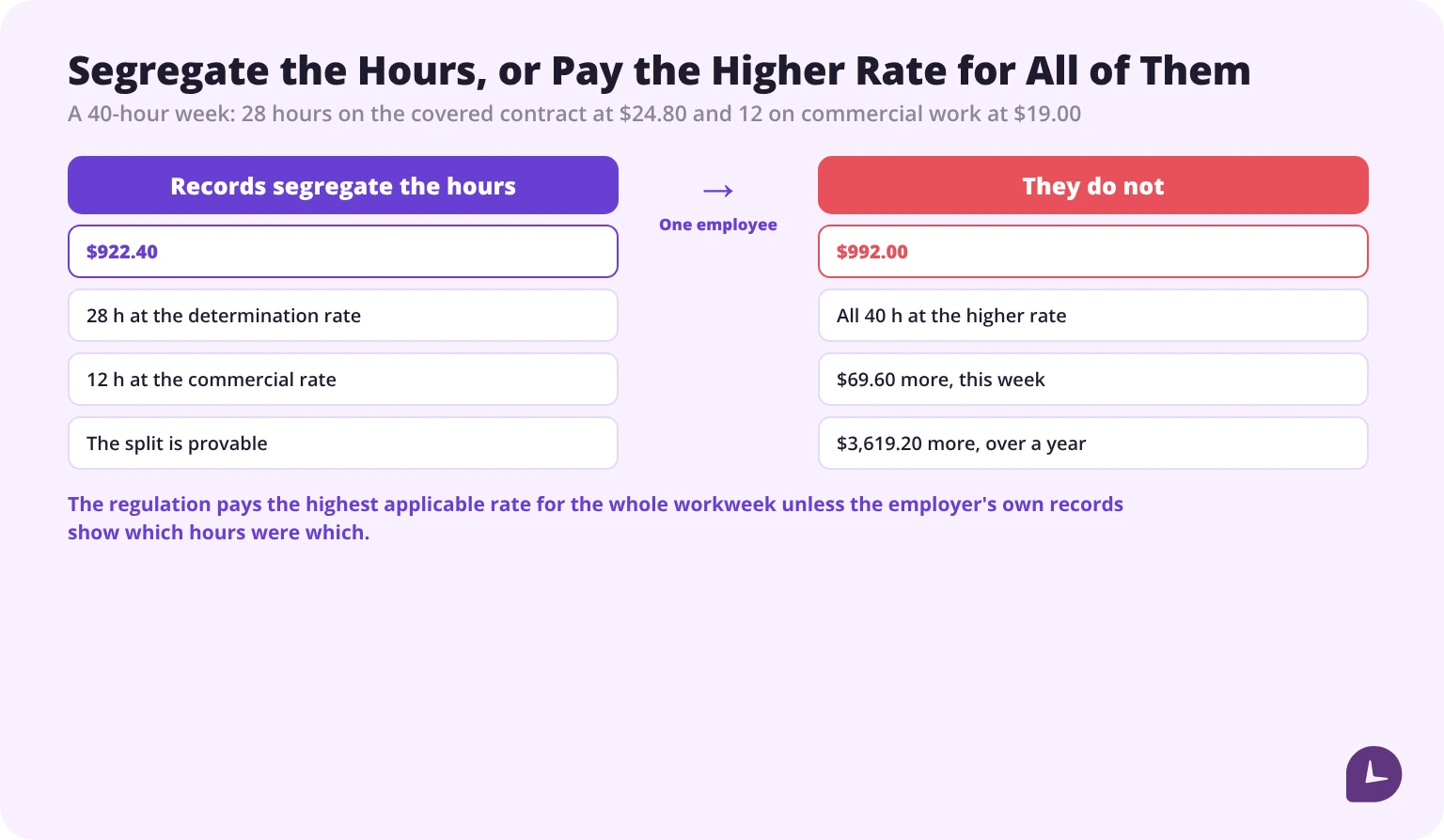
The arithmetic, on one employee in one week. 28 hours on the covered contract at $24.80 and 12 hours of commercial work at $19.00 is $922.40 where the records show the split. Where they do not, the higher rate applies to all 40 hours: $992.00. That is $69.60 a week, $3,619.20 a year, for one person — and the money is the smaller problem, because the same gap is what an investigator finds first.
The segregation duty itself sits at 29 C.F.R. 4.179. Note the section number: 29 C.F.R. 4.169 is the different-rates rule quoted above and is often cited for segregation by mistake.
What this needs is time captured against the contract at the point of entry rather than allocated afterwards — a timesheet specification. Monitask’s time clock software captures hours by employee and by contract, which is the shape this rule requires; for the sectors where mixed work is the norm, our BPO and staffing agency pages cover the operational side.
Does the Act require overtime?
No, and the point is worth stating plainly because the question is asked constantly.
29 C.F.R. 4.180, captioned Overtime pay – in general, opens: The Act does not provide for compensation of covered employees at premium rates for overtime hours of work
. It then acknowledges that other Federal laws may require such compensation to be paid to employees working on or in connection with contracts subject to the Act
, which is where the overtime obligation actually comes from.
Two sources, with different reach. The Fair Labor Standards Act covers service employees generally. The Contract Work Hours and Safety Standards Act applies For prime contracts in excess of $100,000
and reaches laborers and mechanics, including guards and watchmen
— not all service employees. A guide saying the second requires overtime for everyone on a contract over $100,000 overstates it; the first is what covers the rest.
The fringe amount is excluded from the regular rate, and this is where employers lose money in the other direction. 41 U.S.C. 6707(e) provides that the regular or basic hourly rate of such an employee shall not include any fringe benefit payments computed hereunder
that are excluded from the regular rate under the Fair Labor Standards Act. 29 C.F.R. 4.182 extends that to the cash route: equivalent fringe benefits and cash payments furnished in lieu of the specified benefits may be excluded from the regular or basic rate
. Paying health and welfare in cash does not drag it into the regular rate.
The arithmetic: at a monetary wage of $22.40 with 5 overtime hours, the half-time premium is $56.00. Add the $5.92 fringe into the rate, as payroll systems routinely do when it is paid in cash, and you get $70.80 — $14.80 too much, every week, for every employee on overtime.
What notice must employees get?
Two obligations, and one of them is an either-or that people miss.
29 C.F.R. 4.6(e) requires the contractor to shall notify each service employee commencing work on this contract
of the required minimum monetary wage and fringe benefits, or shall post the wage determination attached to this contract
. That is an alternative: individually notify each employee, or post the determination.
The poster is not an alternative. The poster provided by the Department of Labor (Publication WH 1313) shall be posted in a prominent and accessible place at the worksite
— publication WH 1313, which the Department’s own fact sheet titles Notice to Employees Working on Government Contracts. Note that it covers more than this Act: the Walsh-Healey Public Contracts Act as well, so calling it “the SCA poster” is the Department’s shorthand and slightly understates its scope. Our labor law posters page covers the general posting framework.
The sanction is explicit: Failure to comply with this requirement is a violation of section 2(a)(4) of the Act and of this contract
.
The commencing-work notice belongs in the onboarding pack rather than in a general posting, because it is owed to each employee at the point they start on the contract, not at the point they are hired.
What happens when you get it wrong?
Four consequences, escalating, and the last one is the one that ends businesses.
Liability for the underpayment. 41 U.S.C. 6705(a): a responsible party is liable for an amount equal to the sum of any deduction, rebate, refund, or underpayment of compensation
due the employees.
Withholding, and it reaches other contracts. 41 U.S.C. 6705(b)(1) provides that sums may be withheld from accrued payments due on the contract or on any other contract between the same contractor
and the Federal Government. Read that twice — withholding is not confined to the contract on which the violation occurred. Where the withheld amounts are insufficient, the Federal Government may bring action against the contractor, subcontractor, or any sureties
.
Cancellation. 41 U.S.C. 6705(c): the agency may cancel the contract on written notice to the original contractor
.
Ineligibility for 3 years. The statute at 41 U.S.C. 6706 is captioned Three-year prohibition on new contracts in case of violation, and provides that a Federal Government contract may not be awarded to a person or firm named on the list
until 3 years have elapsed from the date of publication of the list
. The regulation at 29 C.F.R. 4.188 is wider than employer guides usually convey, in three ways:
- It reaches every federal contract.
No contract of the United States or the District of Columbia (whether or not subject to the Act) shall be awarded
to a listed firm. Not just service contracts. - It reaches both roles. The prohibition
applies to the contractor in its capacity as either a prime contractor or a subcontractor
. - There is no early removal. Because the Act contains no provision authorising it,
the Secretary is without authority to accomplish such removal (other than in situations involving mistake or legal error)
. And for a repeat violator,a new, three-year debarment term will commence with the republication of such names on the list
.
That third point is the one most often got wrong. The “unusual circumstances” test operates at the point of the decision, not as a later petition for release. 29 C.F.R. 4.188(b) notes that The term unusual circumstances is not defined in the Act
, places the burden of establishing the existence of unusual circumstances
on the violator, and excludes from the concept circumstances that commonly occur where violations are found, such as negligent or willful disregard
of the requirements. Relief cannot be in order at all where conduct is willful, deliberate or of an aggravated nature
or where there is a history of similar violations. Where it is available, 4 things must all be present before the discretionary factors are even reached: a good compliance history, cooperation in the investigation, repayment of moneys due, sufficient assurances of future compliance.
One procedural point. Under 29 C.F.R. 4.6(r), Disputes concerning labor standards
are resolved under 29 C.F.R. parts 4, 6 and 8, not the contract Disputes clause. Guides get this wrong often enough to be worth a line.
What changed recently?
One revocation that removes a figure from most existing guidance, and one survivor.
The federal contractor minimum wage order was revoked. Executive Order 14236, 14 March 2025, revoked, among other items, Executive Order 14026 of April 27, 2021
— that being Increasing the Minimum Wage for Federal Contractors. The Department states that it is no longer enforcing Executive Order 14026 or the implementing rule (29 CFR part 23)
and will take steps to rescind the implementing rule. If a compliance guide still quotes the Executive Order 14026 contractor minimum wage, that figure is no longer being enforced.
The older order survives. Executive Order 13658 and 29 C.F.R. part 10 were not revoked and continue to be updated: beginning May 11, 2026, the Executive Order 13658 minimum wage rate will increase to $13.65 per hour for non-tipped employees
, with $9.55 for tipped employees.
Nothing else moved. The Federal Register Wage and Hour Division indexes for 2025 and 2026 carry no substantive amendment to 29 C.F.R. part 4. The two 2025 entries are Paperwork Reduction Act information-collection renewals, not changes to obligations. So the regulatory content of this article needs no revision beyond the health and welfare rate and the revoked order — which is a useful thing to know when deciding how much of an older internal guide to rewrite.
The 9 most common Service Contract Act failures
| Failure | Why it is wrong | The fix |
|---|---|---|
| Paying the fringe amount as a higher wage and calling it done | The fringe obligation is separate from and in addition to the monetary wage, and the wage cannot be offset against it | Pay the wage, then pay the fringe or its cash equivalent on top |
| Paying health and welfare only on hours worked | Where the determination is a fixed amount per hour, it is due on all hours paid for, including paid leave | Base the calculation on hours paid, capped at 40 a week and 2,080 a year per contract |
| Averaging a fixed-cost contribution across the workforce | The employer’s contribution for each individual employee is what governs | Compute per employee, not per plan |
| Starting work in an unlisted classification without a conformance | The process must be initiated before the work is performed, and the rate is retroactive to the day that class started | Initiate before the work; submit within 30 days |
| Treating silence on a conformance as agreement | The Division issues a final determination; the contractor’s proposed rate is a proposal | Track the request and the determination |
| Not segregating covered from non-covered hours | Without records or other affirmative proof, the higher rate applies to the whole workweek | Capture the split at the point of entry, by contract |
| Including the fringe amount in the overtime regular rate | Overstates the premium; bona fide fringe payments and cash equivalents are excluded from the regular rate | Compute overtime on the monetary wage |
| Submitting weekly certified payroll because a construction job required it | Transmits full names and Social Security numbers that nothing requires you to send | Keep and produce on request, unless your contract says otherwise |
| Setting retention from the record date | The clock runs from completion of the work, which on a multi-year contract is much later | Set disposal from completion, for payroll and time records alike |
The first three are the expensive ones, and they are all the same mistake in different clothes: treating the fringe benefit as a component of pay rather than as a separate obligation with its own base, its own per-employee test and its own cash rules. Our payroll mistakes page covers the general category; these are the contract-specific versions.
Hours captured against the contract at the point of entry, which is what the segregation rule actually requires.
See Monitask's time clock software
Sources
Every document below was read directly, at the publisher’s own site, on 12 November 2026. Regulation text comes from the eCFR part-level page for 29 C.F.R. part 4 and the govinfo CFR XML.
41 U.S.C. ch. 67, sections 41 U.S.C. 6701 to 6707, on govinfo:41 U.S.C. 6702(a)and41 U.S.C. 6702(b)for coverage and the construction exemption,41 U.S.C. 6703for the required contract terms,41 U.S.C. 6707(c)(1)and41 U.S.C. 6707(c)(2)for successorship and substantial variance,41 U.S.C. 6707(f)for the five-employee provision,41 U.S.C. 6707(e)for the overtime exclusion,41 U.S.C. 6705(a)to41 U.S.C. 6705(c)for liability, withholding and cancellation, and41 U.S.C. 6706for the 3-year prohibition.29 C.F.R. part 4—29 C.F.R. 4.2for the minimum wage regardless of contract amount,29 C.F.R. 4.6(b)(1)for the pay clause,29 C.F.R. 4.6(b)(2)for conformance,29 C.F.R. 4.6(e)for notice and the poster,29 C.F.R. 4.6(g)for records,4.6(i)for withholding in the clause,29 C.F.R. 4.6(r)for disputes,29 C.F.R. 4.175(a)(1)and29 C.F.R. 4.175(b)for fixed and average cost,29 C.F.R. 4.177(c)(1),29 C.F.R. 4.177(a)and29 C.F.R. 4.177(b)for cash equivalents,29 C.F.R. 4.179and29 C.F.R. 4.169for mixed work,29 C.F.R. 4.180and29 C.F.R. 4.182for overtime, and29 C.F.R. 4.188for ineligibility.FAR 52.222-41, Service Contract Labor Standards, andFAR 52.222-8, Payrolls and Basic Records, on acquisition.gov — the two clauses whose contrast establishes that this Act carries no submission duty.- Wage and Hour Division fact sheets and guidance on dol.gov for the Department’s own descriptions, the poster title, and the no-averaging rule.
- All Agency Memorandum No. 252, 10 August 2026, via the official All Agency Memorandum index, for the $5.92 health and welfare rate, with All Agency Memorandum No. 250 and All Agency Memorandum No. 246 for the prior years.
- Executive Order 14236 and the Department’s statement on its effect; Executive Order 13658 and its current rate.
- Federal Register Wage and Hour Division indexes for 2025 and 2026, establishing that no substantive amendment to part 4 was published in either year.
- the Defense Contract Audit Agency’s labor evaluation material, for what a labour evaluation examines.
- Open items:
- The health and welfare memorandum itself could not be opened. The $5.92 aggregate rate and its date come from the official All Agency Memorandum index. The memorandum’s own document returned an error, so three things it may contain are not stated here: the Hawaii rate, any separately published average-cost rate, the memorandum’s applicability instructions – the last of which is operationally the most important sentence in any such memorandum.
- Average-cost health and welfare is not described on an hours basis. The regulation for fixed-cost determinations says payments are due for all hours paid for; the average-cost paragraph does not repeat that language and no primary source was found stating that average-cost benefits are computed on hours worked only. Nothing is asserted either way.
- The status of the nondisplacement rule was not confirmed. 29 C.F.R. part 9, implementing Executive Order 14055 on nondisplacement of qualified workers under service contracts, is squarely a service-contract obligation and a plausible casualty of the same revoking order. The Department’s page for it returned an error and the Federal Register indexes show no activity. The article does not rely on it.
- The Davis-Bacon subparagraph letter is cited generally. The quoted weekly-submission text comes from the 2023 annual edition of 29 C.F.R. 5.5, which predates the 2023 final rule’s effective date. The substance is unchanged but the subparagraph designation may have moved, so the citation is given at the paragraph level.
- No Department statement says the Act requires no payroll submission. That conclusion rests on the contrast between the two regulatory texts and the two contract clauses, which is stronger authority than a summary page – but it is an inference from the texts rather than a quotation, and the article says so.
FAQ
Do I have to submit certified payroll under the Service Contract Act?
No. The duty is to make and maintain records for 3 years from completion of the work and make them available for inspection. Weekly submission with a signed statement of compliance is a Davis-Bacon requirement. Your individual contract or agency may require submission by its own terms, which is a contract requirement rather than one of this Act.
Can I pay the fringe benefit as extra wages?
You can pay it in cash, but it must be on top of the monetary wage and equivalent to the cost of the required benefits. What you cannot do is pay a higher wage and treat the excess as satisfying the fringe obligation — the regulation forbids offsetting the monetary wage against the fringe payments.
What is the current health and welfare rate?
$5.92 per hour, set by All Agency Memorandum No. 252 of 10 August 2026. It was $5.55 in 2025 and $5.36 in 2024. Where the determination states a fixed hourly amount, it is due on all hours paid for including paid leave, capped at 40 hours a week and 2,080 a year on each contract.
What do I do if a role is not in the wage determination?
Start the conformance before the work is performed, and submit Standard Form 1444 to the contracting officer within 30 days of that class performing contract work. The Division approves, modifies or disapproves within 30 days of receipt, and the resulting rate is retroactive to the day that class started.
How long must Service Contract Act records be kept?
3 years from completion of the work — not from the date of the record, which on a multi-year contract is a materially different date.
Does the Act require overtime pay?
No. The regulation says so in terms. Overtime comes from the Fair Labor Standards Act, and on prime contracts over $100,000 from the Contract Work Hours and Safety Standards Act — which reaches laborers and mechanics including guards and watchmen rather than all service employees. Bona fide fringe payments, including cash paid in lieu, are excluded from the regular rate.
What is the penalty for non-compliance?
Liability for the underpayment, withholding from this contract or any other with the same contractor, cancellation, and ineligibility for federal contracts for 3 years. The 3 years is a fixed term: there is no mechanism to come off the list early.