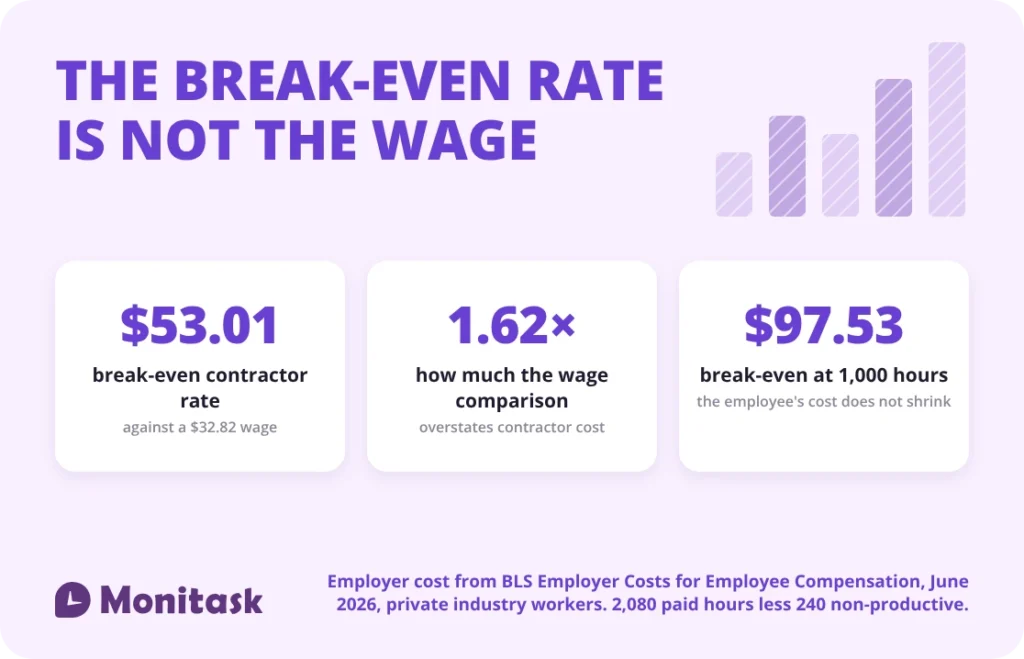
Contractor time tracking records hours against work rather than against a schedule. The distinction matters beyond bookkeeping: the IRS asks whether a business controls “or has the right to control what the worker does and how the worker does his or her job,” so a system that sets a contractor’s hours is itself a factor. And the rate at which a contractor stops being cheaper than an employee is $53.01, not the $32.82 an employee earns.
> This is not legal or tax advice. Worker status depends on the whole relationship, and the IRS states that no single factor decides it. Nothing here determines the status of any particular worker — that is a question for counsel or a tax adviser. Sources were checked on 22 October 2026.
Key takeaways
- The IRS test turns on the right to control, not only its use: “The business does not have to actually direct or control the way the work is done – as long as the employer has the right to direct and control the work.”
- Track hours against work and deliverables, not against clock-in and clock-out windows.
- An invoice that locks its underlying time entries behaves like a contractor record; an editable timesheet behaves like an employee record.
- The break-even contractor rate is $53.01/hour against a $32.82-an-hour employee — comparing with the wage rate overstates contractor cost 1.62×.
- At 1,000 hours of need rather than 1,840, the break-even rises to $97.53/hour.
Which kind of contractor does this cover?
The word covers two unrelated situations, and most guidance on the subject does not say which one it means.
| Independent contractor | Construction contractor | |
|---|---|---|
| Who it is | A person or one-person business engaged for work, paid against an invoice | A company engaged to deliver construction work, employing its own crew |
| Who records the hours | The contractor, for their own billing | The contractor’s supervisors, for their own payroll |
| Why hours are tracked | To support an invoice and a project budget | To run payroll, cost jobs and meet site requirements |
| Whose employees are involved | None — that is the point | The contractor’s, not the client’s |
| The risk being managed | Whether the relationship is really employment | Labour cost against the bid |
This page is about the first: tracking the time of a person engaged as a contractor rather than employed. The second is a different problem — a construction company tracking its own crew is doing employee time tracking, and the fact that its client calls it a contractor changes nothing about the workers’ status.
If you are a construction business tracking crews across sites, the relevant questions are cost codes, overtime and job costing rather than anything in the next section, and a construction timesheet is the right starting point. The one place the two overlap is covered further down.
Can tracking hours affect a contractor’s status?
It is one of the factors weighed, and how the system is configured determines which way it weighs. Under the IRS’s common law rules, “Facts that provide evidence of the degree of control and independence fall into three categories:”
| Category | The question the IRS asks |
|---|---|
| Behavioral control | “Does the company control or have the right to control what the worker does and how the worker does his or her job?” |
| Financial control | “Are the business aspects of the worker’s job controlled by the payer?” |
| Type of relationship | “Are there written contracts or employee type benefits (that is, pension plan, insurance, vacation pay, etc.)? Will the relationship continue and is the work performed a key aspect of the business?” |
The phrase that matters is “or have the right to control.” The test reaches the ability, not only its exercise, and the IRS says so in terms on its behavioral control page: “The business does not have to actually direct or control the way the work is done – as long as the employer has the right to direct and control the work.”
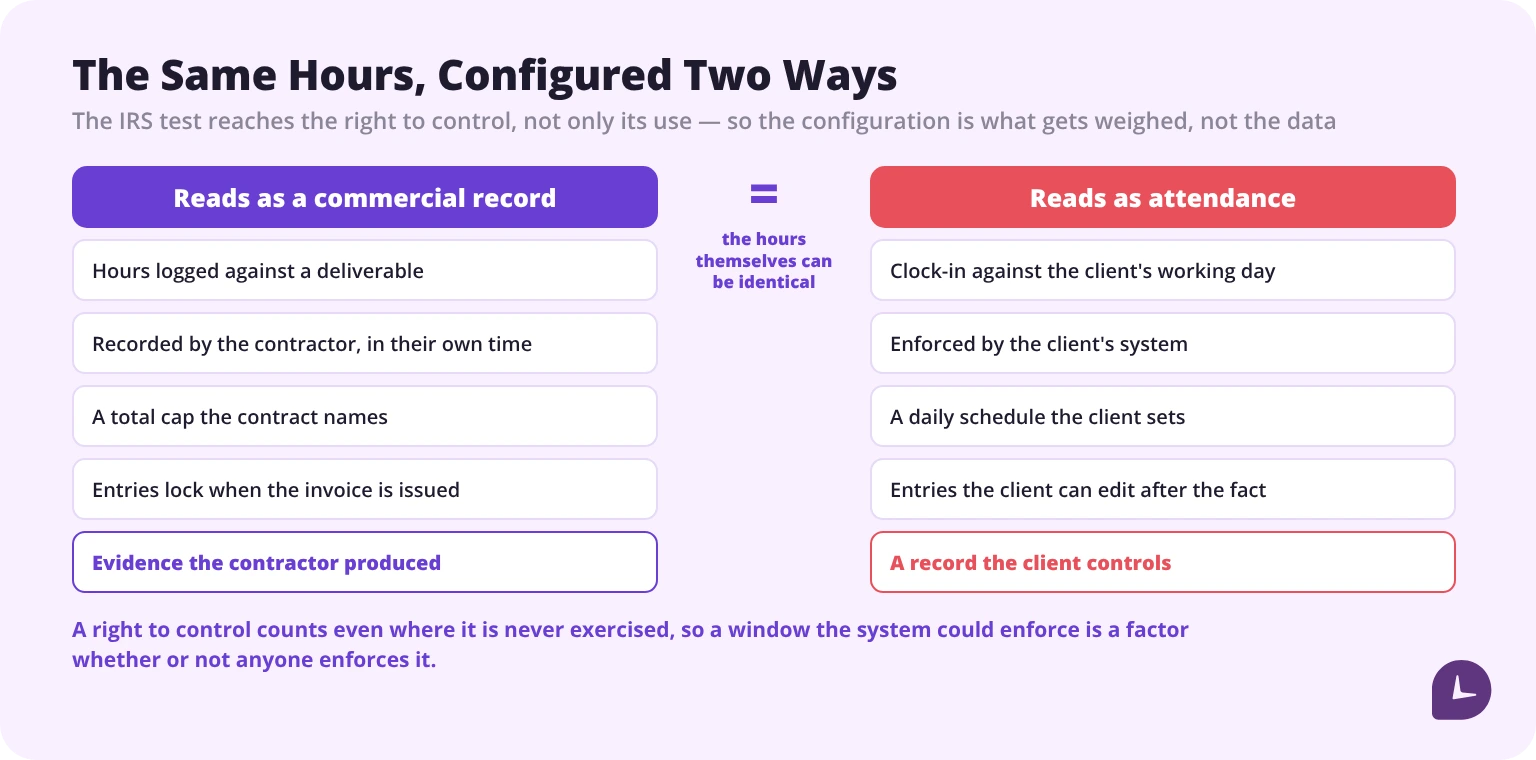
That is the sentence to hold on to when configuring anything. A system in which the client sets the contractor’s working hours, requires a clock-in at the start of a day, sends schedule reminders or refuses entries outside a defined window establishes a right to control when and how the work is done — whether or not anyone ever enforces it. The window nobody polices is still a window the client could police.
Equally important is what the IRS says about weighing. “Businesses must weigh all these factors when determining whether a worker is an employee or independent contractor.” “There is no “magic” or set number of factors that “makes” the worker an employee or an independent contractor and no one factor stands alone in making this determination.” “Also, factors which are relevant in one situation may not be relevant in another.” “The keys are to look at the entire relationship and consider the extent of the right to direct and control the worker.” And: “Finally, document each of the factors used in coming up with the determination.”
So tracking hours neither settles the question nor avoids it. Hours recorded against deliverables, by the contractor, supporting an invoice, look like a commercial record. The same hours recorded against a client-imposed schedule, enforced by the client’s system, look like attendance. The data can be nearly identical; the configuration is what differs, and the configuration is what gets weighed.
Where it genuinely is not clear, the IRS names a mechanism rather than leaving you to guess. “If it is still unclear whether a worker is an employee or an independent contractor, you may consider submitting a Form SS-8, Determination of Worker Status for Purposes of Federal Employment Taxes and Income Tax Withholding with the IRS.” It may be filed by either the business or the worker, and a determination may take at least six months — which is a reason to decide and document at engagement rather than to rely on it. The determination for any particular worker is a legal and tax question, not a software one; an independent contractor versus employee checklist covers the rest of the relationship. What follows is how to keep the time-tracking side from arguing against you.
What should you track, and what should you not?
Track the work. Do not track the day.
| Track this | Not this |
|---|---|
| Hours against a project, phase or deliverable | Clock-in and clock-out against the client’s schedule |
| Deliverables and their acceptance | Presence during a required window |
| Cumulative hours against an agreed cap | Breaks |
| Hours mapped to contract line items | Location, unless the engagement is for on-site work |
| The contractor’s own confirmation of their hours | Application and keystroke activity |
| Invoice date and the period it covers | Adherence to the client’s internal shift pattern |
Three of these deserve a note.
Breaks. A contractor’s breaks are not the client’s business, and recording them implies they are. Where a tool records breaks by default, turning that off is a configuration decision worth making deliberately.
Location. If the engagement is for work at a named site, location is part of the deliverable and recording it is ordinary. If the engagement is for a result and the contractor works wherever they choose, location data serves no purpose the contract names.
Caps rather than schedules. A total-hours limit is a commercial term — it says how much the client will pay for. A daily schedule is a direction about how the work gets done. They control the same spend and sit very differently against the behavioral factor.
Timesheet or invoice?
This is a decision rather than a feature, and it is the clearest signal in the whole arrangement.
| Timesheet | Invoice | |
|---|---|---|
| Who produces it | The client, or the client’s system | The contractor |
| What it records | Hours worked | An amount claimed |
| When it can be edited | Until the period is approved | Until it is issued; not after |
| What it resembles | A record of working time — an attribute of employment | A settlement between two businesses |
| What it feeds | Payroll | Accounts payable |
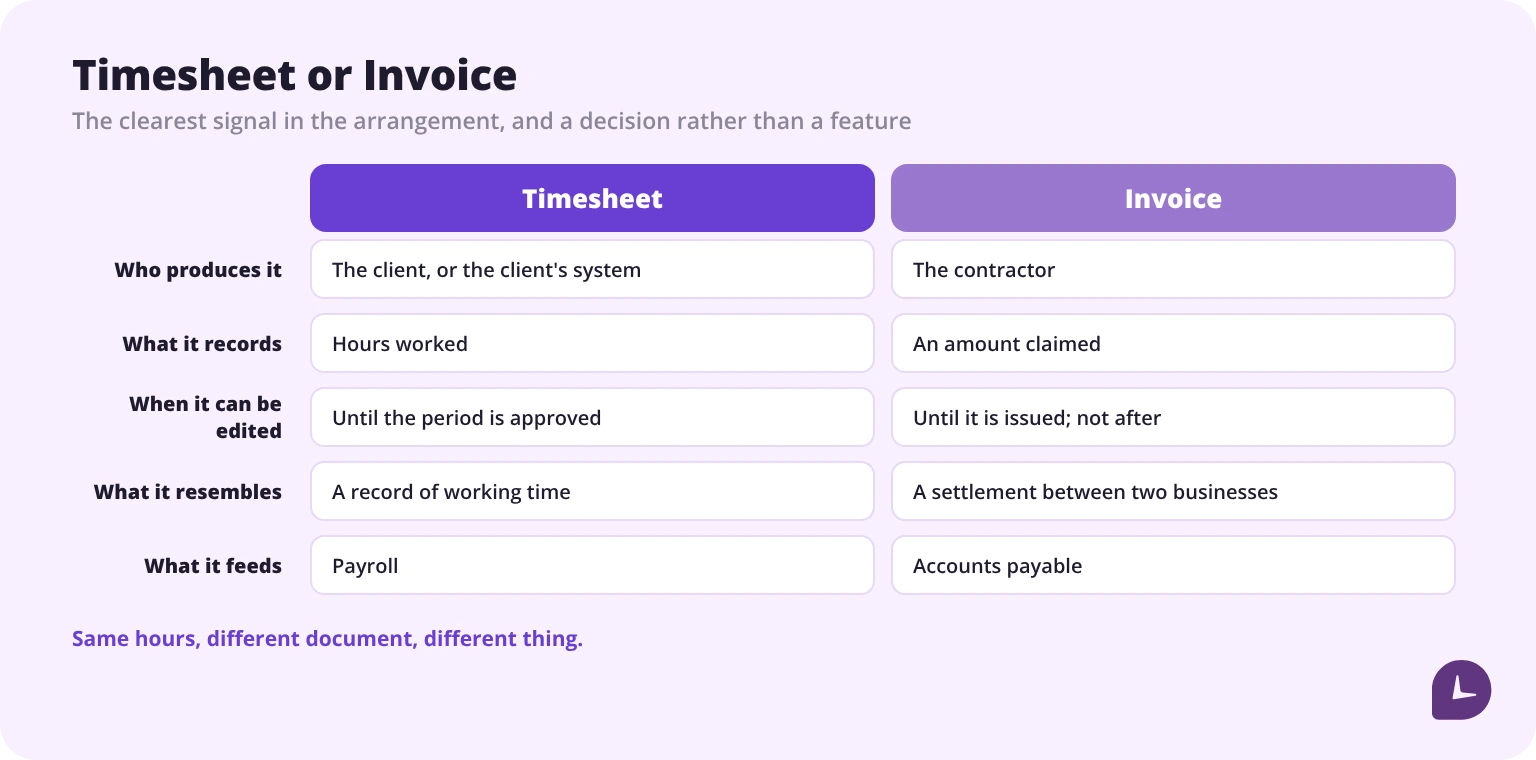
The arrangement that fits a contractor relationship is straightforward: the contractor logs their own hours, builds an invoice from them, and the underlying time entries lock when the invoice is issued. Changing them requires cancelling or declining the invoice. The hours then exist as support for a commercial document rather than as a timesheet the client maintains.
That locking behaviour does more than tidy the records. An editable running timesheet owned by the client is a record the client controls; a locked set of entries attached to an issued invoice is evidence the contractor produced. Same hours, different document, different thing.
What does a contractor actually cost?
More than their rate suggests when compared with an employee’s wage, and less than it suggests when compared with an employee’s full cost. Both comparisons are made constantly and only one of them is right.
Start with what an employee costs. Per the Bureau of Labor Statistics, Employer Costs for Employee Compensation — June 2026 (USDL-26-1494), released 9 September 2026: “Total employer compensation costs for private industry workers averaged $46.89 per hour worked in June 2026. Wages and salaries averaged $32.82 and accounted for 70.0 percent of employer costs, while benefit costs averaged $14.07 and accounted for the remaining 30.0 percent.”
| Total employer cost per hour worked | $46.89 |
| Of which wages and salaries | $32.82 (70.0%) |
| Of which benefits | $14.07 (30.0%) |
| Burden multiplier | 1.4287 |
Those are private industry workers, which is the right series for most readers of this page. If you are comparing against a public-sector post the numbers differ substantially: civilian workers averaged $49.46 per hour worked in the same release, and state and local government workers $66.45. Substitute and the method below is unchanged.
Now convert that to a cost per productive hour. Assuming a 2,080-hour year with 15 days of paid leave, 10 holidays and 5 sick days:
| Paid hours per year | 2,080 |
| Non-productive hours (30 days) | 240 |
| Productive hours | 1,840 |
| Full annual employee cost | $97,531.20 |
| Cost per paid hour | $46.89 |
| Cost per productive hour | $53.01 |
| Premium over the paid-hour figure | +$6.12, or +13.0% |
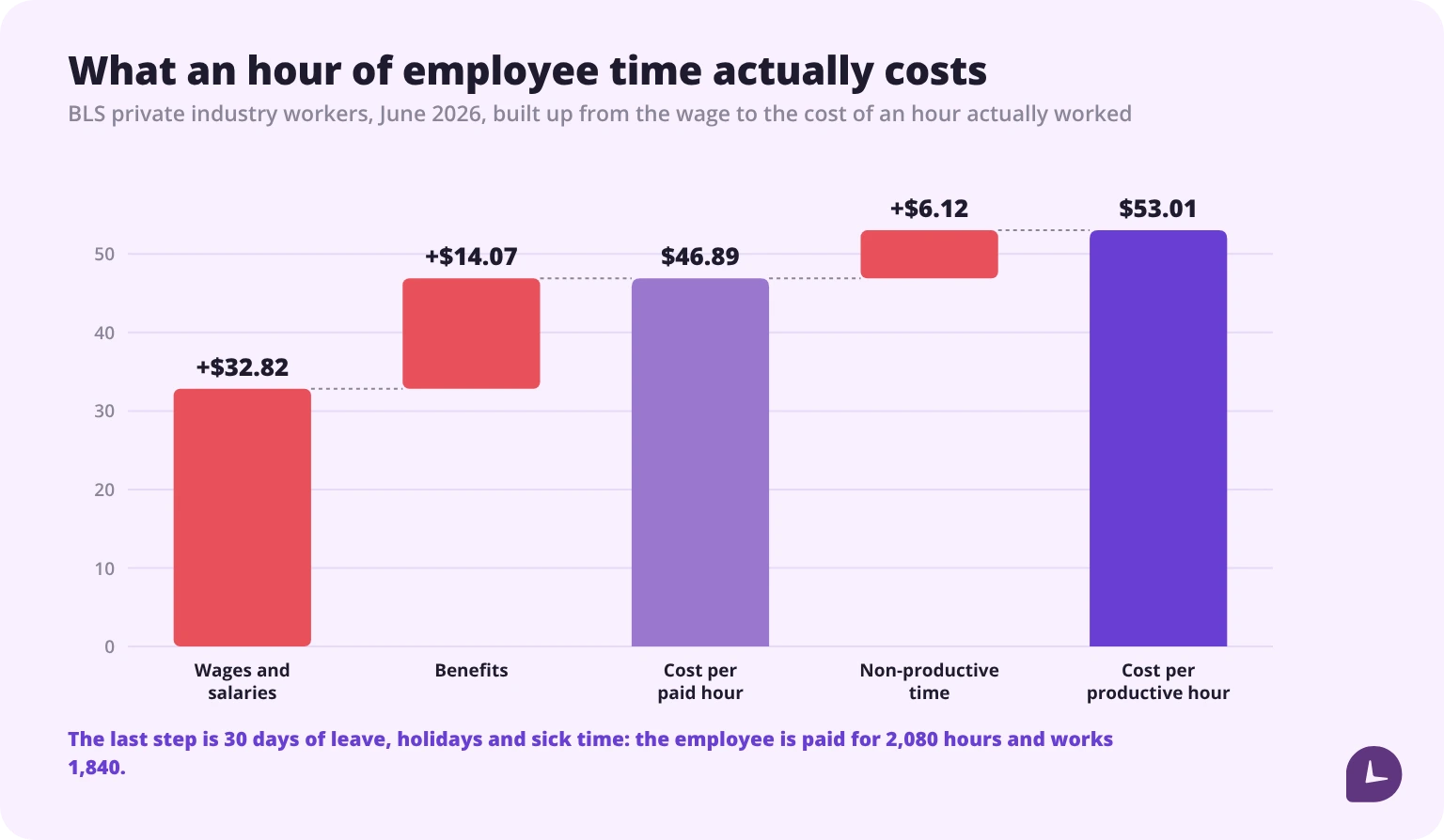
$53.01 is the break-even. A contractor costs less than the employee below that rate and more above it.
| Contractor rate | Cost for 1,840 hours | Against the employee |
|---|---|---|
| $40.00 | $73,600.00 | $23,931.20 cheaper |
| $45.00 | $82,800.00 | $14,731.20 cheaper |
| $50.00 | $92,000.00 | $5,531.20 cheaper |
| $53.01 | $97,538.40 | break-even |
| $55.00 | $101,200.00 | +$3,668.80 more |
| $60.00 | $110,400.00 | +$12,868.80 more |
| $75.00 | $138,000.00 | +$40,468.80 more |
Here is the error the table corrects. A contractor’s rate is routinely set against an employee’s wage — $32.82 in this data — which makes a $50.00 contractor look 52% more expensive when they are in fact $5,531.20 cheaper over the year. Comparing against the wage rate rather than the cost per productive hour overstates contractor cost by 1.62×, and rules out rates that are actually favourable.
The BLS figures above are national averages; the 2,080 hours and 30 days off are assumptions. Substitute your own and the method holds. If the engagement is a single person billing by the hour, freelancer time tracking is the shape this usually takes in practice.
How does the answer change with the hours you need?
Substantially, and in the direction most people do not expect. An employee costs the full annual amount whether or not there is a full year of work for them, so the break-even rate rises as the required hours fall.
| Hours of work actually needed | Break-even contractor rate |
|---|---|
| 1,840 | $53.01 |
| 1,400 | $69.67 |
| 1,000 | $97.53 |
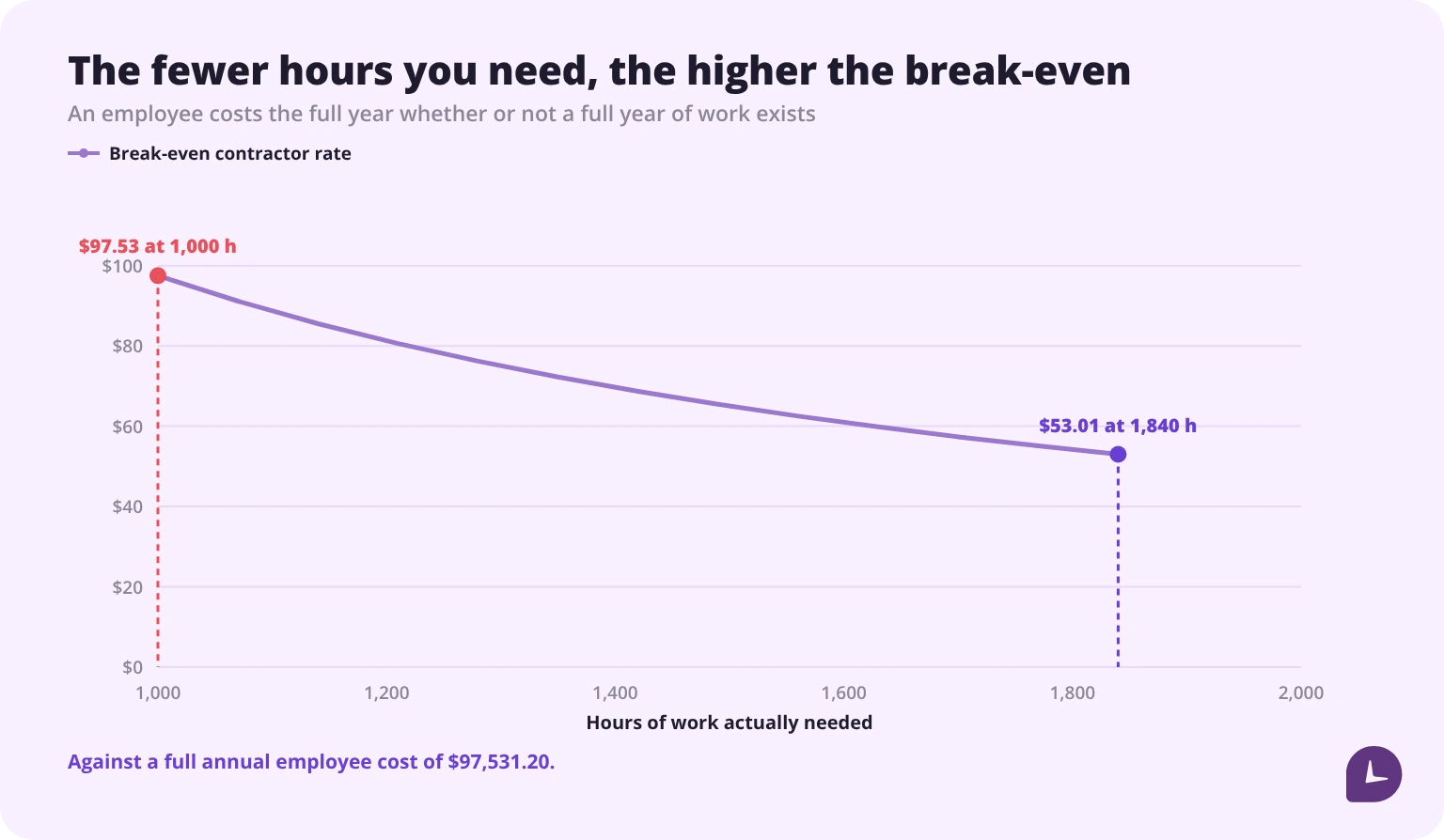
At 1,000 hours of need, a contractor at nearly $100.00 an hour costs the same as a full-time employee, because the employee’s cost does not shrink to match the available work.
This reframes the question. “Contractor or employee” is usually argued as a comparison of rates, and the rate is the less important half. The decisive variable is how many hours of work exist, and a high contractor rate for part-year work is frequently cheaper than a modest salary for a full-time post with eight months of work in it.
Two caveats keep this honest. Capacity has a value beyond hours delivered — an employee available at short notice is worth something a contract engagement may not provide. And this arithmetic says nothing about status: a worker is an employee or a contractor on the facts of the relationship, not on which is cheaper.
Who approves a contractor’s hours?
| Role | What they do | What they should not do |
|---|---|---|
| Contractor | Records their own hours, issues the invoice | — |
| Client’s project owner | Accepts or disputes the invoice and the deliverable | Edit the contractor’s hours |
| Client’s accounts payable | Pays against the accepted invoice | Approve hours as a timesheet |
| Client’s HR | Not involved | Anything — HR involvement in contractor hours is itself a signal |
The approval question answers differently for a contractor than for an employee, and the difference is the whole point. An employee’s hours are approved; a contractor’s invoice is accepted or disputed. A client who edits a contractor’s recorded hours has produced a record the contractor did not make and has acted as the author of their working time.
Where the hours look wrong, the route is to dispute the invoice and say why, not to amend the underlying entries. That keeps the exchange commercial: two parties disagreeing about an amount, resolved by a corrected invoice.
The last row is worth stating plainly. Routing contractor hours through the client’s HR function, onto the client’s approval workflow, alongside employee timesheets, makes the contractor look administratively like staff. Accounts payable is the right destination, and the rest of managing contractors remotely follows the same principle: agree the outcome, not the working day.
What about the contractor’s own workers?
This is where the two senses of the word meet. A construction or services contractor employing its own crew runs ordinary employee time tracking for them — the client is not their employer, and the client’s system usually should not be recording their individual hours at all.
| What the client needs | What the client does not need |
|---|---|
| Total hours delivered against the contract | Individual crew members’ clock-in times |
| Hours by phase or cost code, where the contract prices that way | Break records for the contractor’s staff |
| Site access records, where site rules require them | The contractor’s internal schedules |
| Certification that site requirements were met | The contractor’s payroll data |
Where a client does require individual-level hour records from a contractor’s workforce — common on government and regulated work — that requirement should come from the contract and be met by the contractor’s own system, with the output supplied to the client. The client collecting that data directly, in the client’s own system, starts to look like directing the contractor’s workers.
Which records should you keep?
| Record | Why |
|---|---|
| The written agreement, with its scope and rate | The type-of-relationship factor turns partly on it |
| Invoices as issued, with their periods | The primary commercial record |
| Time entries supporting each invoice, as locked at issue | Evidence the contractor produced |
| Deliverables and their acceptance | Shows the engagement was for a result |
| The classification decision and what it rested on | The IRS asks you to document the factors you relied on |
| Any disputed invoice and its resolution | Demonstrates an arm’s-length exchange |
The second-to-last row is often missing entirely, and it is the one the IRS asks for by name: “Finally, document each of the factors used in coming up with the determination.” A determination made at engagement and written down is a different position from one reconstructed afterwards.
Payment records sit alongside these rather than inside them. A contractor paid $600 or more in a calendar year generally receives a Form 1099, and how you pay independent contractors is a separate question from how you record their hours — though the two records should agree.
Monitask records hours against projects and tasks and reports them by person and period, so a contractor's hours support an invoice instead of sitting in a client-maintained timesheet.
See time tracking for contractor workforces
Sources
- “Independent contractor (self-employed) or employee?” Internal Revenue Service. https://www.irs.gov/businesses/small-businesses-self-employed/independent-contractor-self-employed-or-employee
- “Behavioral control.” Internal Revenue Service. https://www.irs.gov/businesses/small-businesses-self-employed/behavioral-control
- “Financial control.” Internal Revenue Service. https://www.irs.gov/businesses/small-businesses-self-employed/financial-control
- “Type of relationship.” Internal Revenue Service. https://www.irs.gov/businesses/small-businesses-self-employed/type-of-relationship
- “About Form SS-8, Determination of Worker Status for Purposes of Federal Employment Taxes and Income Tax Withholding.” Internal Revenue Service. https://www.irs.gov/forms-pubs/about-form-ss-8
- “Employer Costs for Employee Compensation — June 2026.” U.S. Bureau of Labor Statistics, USDL-26-1494, released 9 September 2026. https://www.bls.gov/news.release/ecec.nr0.htm
All sources checked 22 October 2026. BLS figures are for private industry workers, June 2026.
FAQ
Can tracking a contractor's hours make them an employee?
Tracking alone does not decide status, but it is one of the factors weighed. The IRS asks whether a business controls “or has the right to control what the worker does and how the worker does his or her job,” and its behavioral control page states: “The business does not have to actually direct or control the way the work is done – as long as the employer has the right to direct and control the work.” So a system that sets a contractor’s working hours or requires a clock-in against the client’s schedule establishes such a right whether or not it is enforced. The IRS also says that “no one factor stands alone in making this determination.” Status is a question for counsel or a tax adviser.
What should you track for an independent contractor?
Hours against projects, phases and deliverables; cumulative hours against any agreed cap; the contractor’s own confirmation of those hours; and the invoice date and the period it covers. Not clock-in and clock-out against the client’s working day, not breaks, not application or keystroke activity, and not location unless the engagement is for work at a named site.
Should a contractor fill in a timesheet or send an invoice?
An invoice, with the time entries behind it locking when the invoice is issued. An editable running timesheet owned by the client is a record the client controls; a locked set of entries attached to an issued invoice is evidence the contractor produced. The hours can be identical — the document and who controls it are what differ.
What is the break-even rate between a contractor and an employee?
On BLS figures for private industry workers (June 2026), an employee costs $46.89 per hour worked, or $97,531.20 over a 2,080-hour year. Take out 30 days of leave, holidays and sick time and 1,840 productive hours remain, so the cost per productive hour is $53.01. That is the break-even: a contractor below it is cheaper, above it dearer.
Why is comparing a contractor's rate to an employee's wage wrong?
Because the wage is roughly 1.4287 times smaller than what the employee actually costs per hour worked. Comparing a rate against $32.82 rather than $53.01 overstates contractor cost by 1.62×. A contractor at $50.00 an hour looks 52% more expensive than the wage and is in fact $5,531.20 cheaper over a year.
Does the break-even change if I do not need a full year of work?
Substantially, because an employee costs the full annual amount whether or not the work exists to fill it. At 1,840 hours the break-even is $53.01; at 1,400 hours it is $69.67; at 1,000 hours it is $97.53. For part-year work a high contractor rate is frequently cheaper than a modest salary.
Who should approve a contractor's hours?
Nobody, in the sense that applies to an employee. The contractor records their own hours and issues an invoice; the client’s project owner accepts or disputes it. Where the hours look wrong, dispute the invoice and say why rather than editing the entries — a client who amends a contractor’s recorded hours has authored a record the contractor did not make. Accounts payable is the right destination, not HR.
Should a client track the hours of a contractor's own employees?
Generally no. A services or construction contractor runs employee time tracking for its own crew, and the client is not their employer. The client needs total hours delivered against the contract, hours by phase or cost code where the contract prices that way, and any site access records site rules require. Where individual-level records are genuinely required, the requirement should come from the contract and be met by the contractor’s own system.
What records should you keep for a contractor engagement?
The written agreement with its scope and rate; invoices as issued with their periods; the time entries supporting each invoice, as locked at issue; deliverables and their acceptance; any disputed invoice and its resolution; and the classification decision with what it rested on. The IRS’s own instruction is to “document each of the factors used in coming up with the determination.”
What if I cannot tell whether someone is a contractor or an employee?
The IRS provides Form SS-8, *Determination of Worker Status for Purposes of Federal Employment Taxes and Income Tax Withholding*. It may be filed by either the business or the worker, and a determination may take at least six months, so it is not a way to resolve a question mid-engagement. The practical course is to decide at engagement against the three categories, document what the decision rested on, and take advice where it is close.