An employee write-up form is a written record of a performance or conduct issue, the policy it breached, what has to change, and by when. It is also called a written warning or a disciplinary action form. Its real function is evidentiary: if the employment relationship ends badly, this document is what shows the decision was consistent and documented. Below is a form you can copy, a filled-in example, and the phrases that turn a defensible write-up into a liability.
Key takeaways
- A write-up describes observable behaviour and its impact, not attitude or character.
- Every write-up should answer four questions: what happened, which standard it missed, what changes, and what happens if it does not.
- Subjective language is the most common defect. “Bad attitude” is not documentation; “interrupted two colleagues in the 4 March review after being asked to hold questions” is.
- A signature confirms receipt, not agreement. If the employee refuses, note the refusal and give them a copy anyway.
- There is no universal number of write-ups before termination. Serious misconduct can justify skipping the sequence entirely.
Reliable employee tracking software. Clear visibility and insights into how employees work. Even remotely.
Try Now
When to Issue a Write-Up, and When Not To
A write-up is the formal step after informal correction has failed, or the first step when the conduct is serious enough to skip informal correction. It is one stage of progressive discipline. Use it when there is a specific incident or documented pattern, a standard that was not met, and a change you can state clearly.
Situations that warrant one
- A company policy or safety rule was broken.
- Performance has stayed below a stated standard after coaching, and a performance improvement plan is the natural next step.
- Attendance problems have continued past a verbal warning, measured against a written attendance policy.
- Conduct toward colleagues, clients or the public fell below expectations, including insubordination.
- Previous verbal warnings produced no change.
Situations that do not
- The expectation was never stated. If the standard is not in a policy, a job description or a documented conversation, the write-up documents your omission rather than their failure.
- It is a first minor incident. A conversation costs nothing and usually works. A formal document for a single late arrival looks disproportionate in hindsight, which is where these get read.
- The absence or behaviour may be legally protected. Anything touching protected leave, disability accommodation, protected time off or a recent complaint needs review before it is written down, not after.
- You are angry. Anything written in the first hour will read badly in month six.
Check before you write
- Has the expectation been communicated, and can you show where?
- Is there a specific incident or a documented pattern, with dates?
- Has anyone else done the same thing without consequence?
- Is this the step your own disciplinary policy calls for?
- Have you spoken to the employee about it before?
A “no” to the third question is the one that causes trouble. Inconsistent enforcement is what turns a justified write-up into evidence of something else.
Boost your business productivity
Track performance and streamline teamwork
The Write-Up Form Template
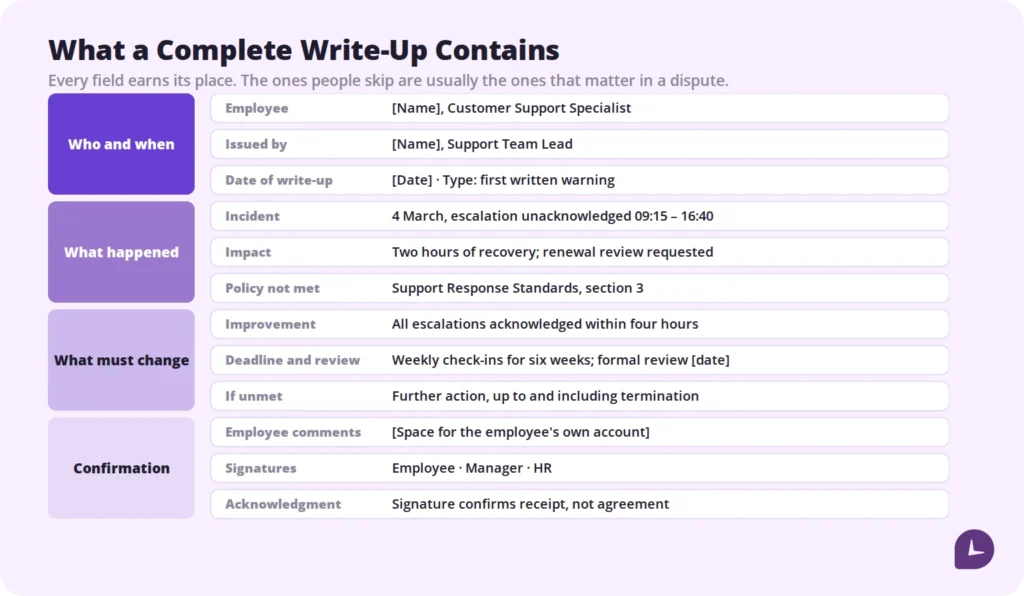
Copy this structure directly, or start from our free company forms and policies. Every field earns its place — the ones people skip are usually the ones that matter in a dispute.
| Field | What goes in it |
|---|---|
| Employee name, job title, department | Identification for the personnel file |
| Manager name and title | Who is issuing the warning |
| Date of write-up | When the document was issued |
| Date, time and location of incident | Including whether it was remote, on-site or at a client |
| Type of warning | Verbal (documented), first written, final written |
| Description of the incident | Observable facts only: what happened, who was present, what was said or done |
| Impact | What it cost — a missed deadline, a client complaint, a safety exposure, work redone by someone else |
| Policy or standard not met | Cite the specific policy and where the employee acknowledged it |
| Prior discussions or warnings | Dates and outcomes of previous conversations on this issue |
| Support already provided | Coaching, training or resources given, to show the process was corrective |
| Required improvement | What “resolved” looks like, stated so that a third party could verify it |
| Deadline and review date | When it must be met and when it will be reviewed |
| Consequence of no improvement | Stated plainly, including termination where that is the next step |
| Employee comments | Space for the employee’s own account |
| Signatures and date | Employee, manager, HR representative |
| Acknowledgment wording | A line confirming the signature means receipt, not agreement |
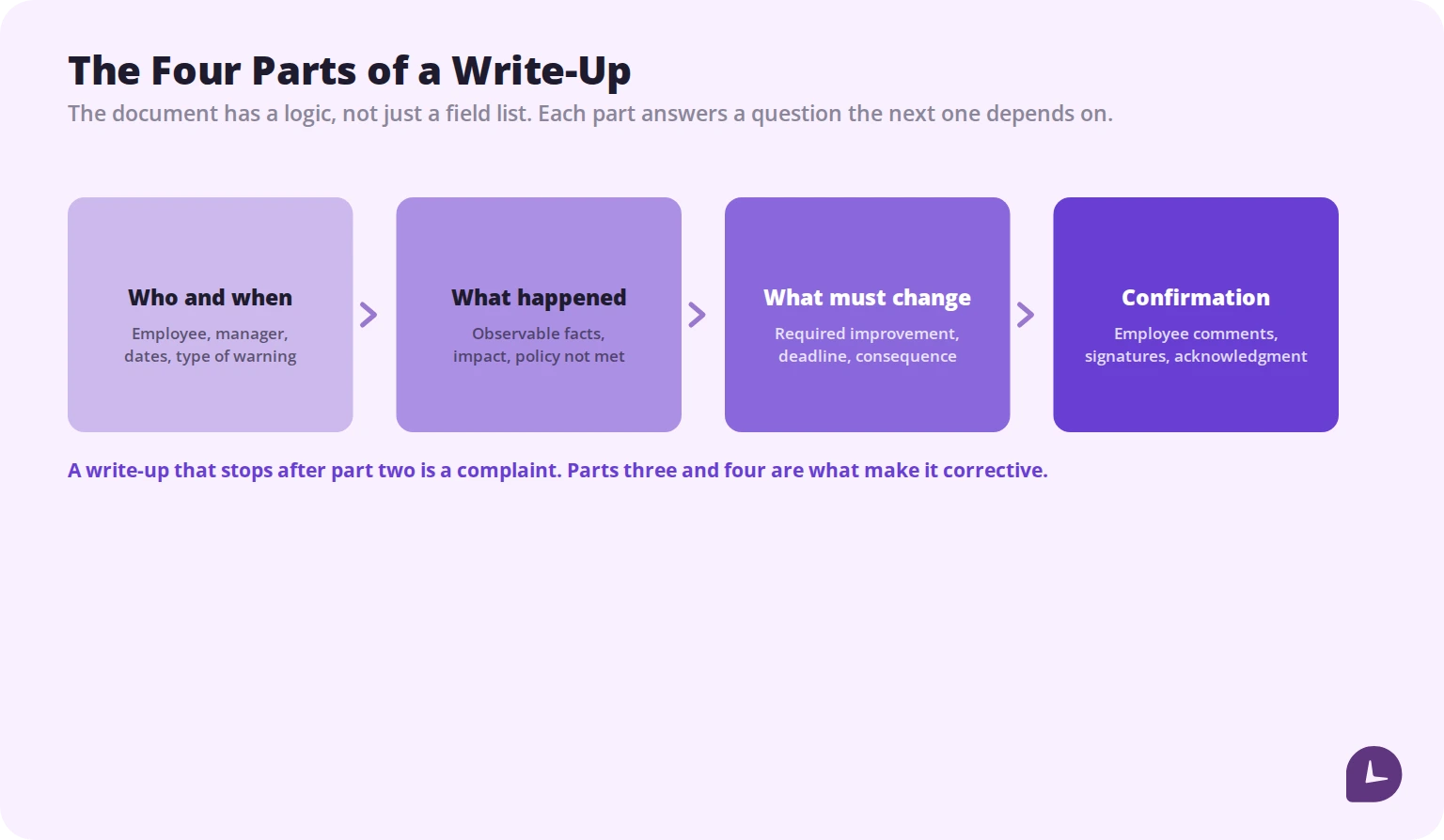
The last row is worth including verbatim. Without it, employees who disagree with the content often refuse to sign at all, which makes a straightforward process adversarial.
The Filled-In Example
The template above tells you which boxes exist. This shows what goes in the one people get stuck on.
Employee: [Name], Customer Support Specialist, Support
Issued by: [Name], Support Team Lead
Date of write-up: [Date]
Type: First written warning
Incident
On 4 March, a customer escalation assigned at 09:15 remained unacknowledged until 16:40, past the four-hour response commitment in our support policy. The customer contacted the account manager directly and described the delay as the second in a month. On 18 February, a similar escalation was acknowledged after six hours.
Impact
The account manager spent approximately two hours recovering the relationship. The customer has asked for a review of the support arrangement at renewal.
Policy
Support Response Standards, section 3, acknowledged at onboarding on [date]. The standard is a four-hour acknowledgment for escalated tickets during business hours.
Prior discussions
Discussed informally on 19 February following the previous instance. Queue-triage workflow reviewed together on 21 February.
Required improvement
All escalated tickets acknowledged within four hours during business hours, with no exceptions, from the date of this warning. Where a ticket cannot be actioned within that window, an acknowledgment and expected timeline must still be sent.
Review
Weekly check-ins for six weeks. Formal review on [date].
If this continues
Failure to meet this standard may result in further disciplinary action, up to and including termination.
Acknowledgment
My signature confirms that I have received this document and that its contents have been discussed with me. It does not indicate that I agree with them.
Notice what the description does: dates, times, a named standard, a measurable gap, and a consequence someone else could verify. Notice what it avoids: any claim about why the employee behaved that way.
Maximize productivity of your business.
Start Your 10-Day Trial
What Not to Write
Most weak write-ups fail in the same way — they describe a judgement instead of a behaviour. A judgement cannot be verified, disproved or improved, which makes it useless as documentation and risky as evidence.
| Do not write | Write instead |
|---|---|
| “Has a bad attitude” | “Responded to the assignment on 4 March with ‘that’s not my job’ in front of two colleagues” |
| “Is always late” | “Arrived after the shift start on 3, 11 and 19 March, by 25, 40 and 15 minutes” |
| “Doesn’t seem motivated” | “Completed 6 of 14 assigned tickets in the two weeks to 20 March, against a team average of 12” |
| “Is difficult to work with” | “Two team members reported being spoken over in the 12 March planning meeting” |
| “Seems to have personal problems” | Nothing. This is not documentable and may touch protected information |
| “Has been unwell a lot” | Nothing. Medical and leave matters go to HR before they go in writing |
| “Everyone knows he does this” | “Observed by [name] on [date]” — or leave it out |
| “This is unacceptable and must stop” | “The required standard is X. From [date], all Y must meet it” |
| “If this happens again you will be fired” | “Further incidents may result in additional disciplinary action, up to and including termination” |
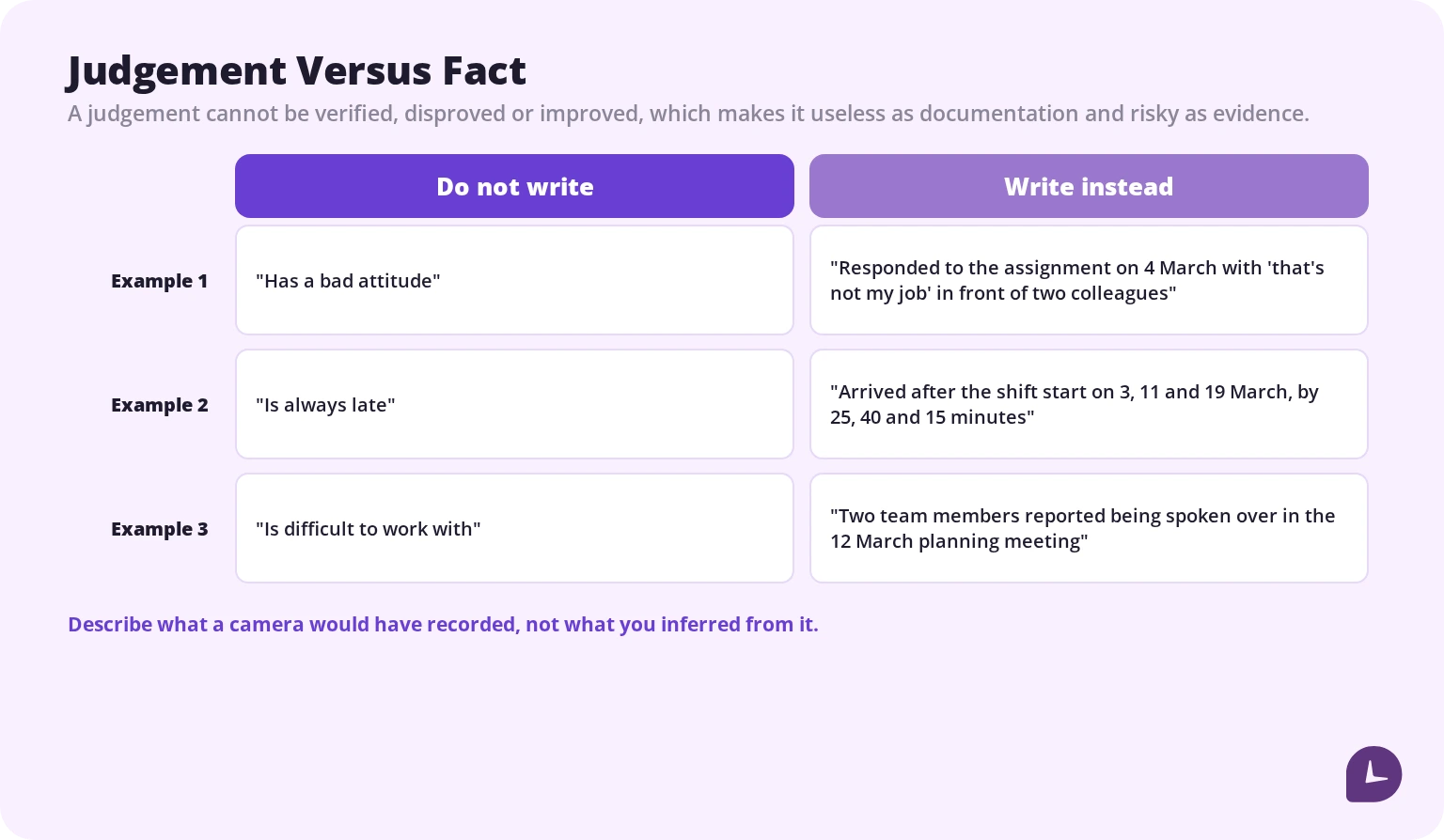
Two rules cover most cases. Describe what a camera would have recorded, not what you inferred from it. And never speculate about cause — the moment a document guesses at someone’s health, home life or state of mind, it stops being a performance record.
Delivering the Write-Up
The conversation matters as much as the document, and the most common mistake is treating the meeting as a formality for collecting a signature.
- In person or on video, never by email alone. Send the document afterwards, not instead.
- Have a second person present where your policy allows — usually HR or another manager. It protects both sides’ account of what was said.
- State the issue in two sentences, then stop talking. The pause is uncomfortable and necessary.
- Ask for their account and write it down. If they raise something you did not know, the write-up may need to change. A process that cannot absorb new information is not a process.
- Confirm the improvement and the date out loud, so there is no ambiguity about what was agreed.
- Give them a copy before they leave.
If the Employee Refuses to Sign
This is the most common complication and it is less serious than it feels. A signature confirms receipt, not agreement, and an employee cannot invalidate a warning by declining to sign it.
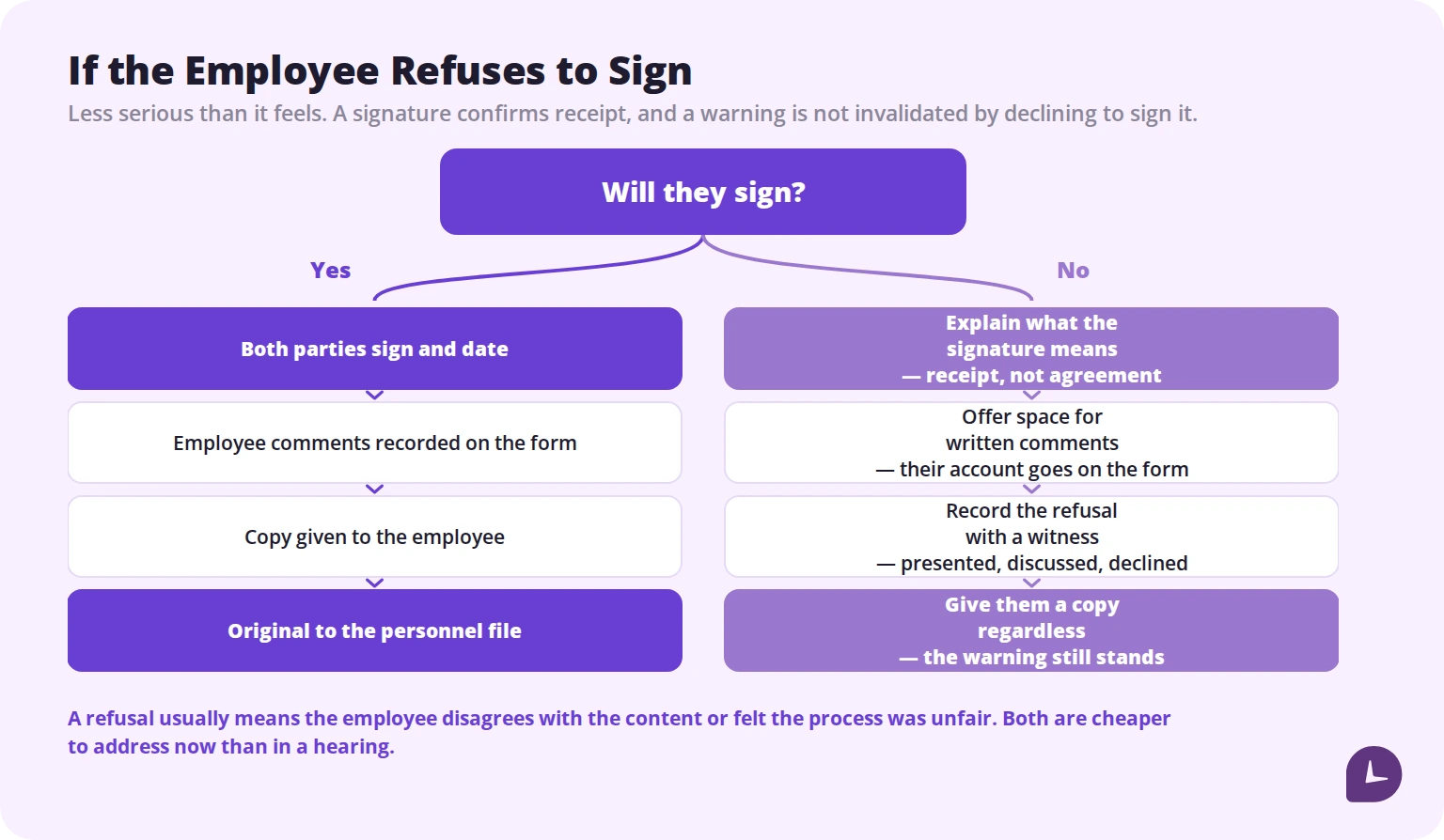
The sequence: explain that signing acknowledges receipt only and that they can add written comments. If they still decline, note on the form that the document was presented and discussed, that the employee declined to sign, and the date. Have the witness sign that note. Give the employee a copy regardless and file the original.
A refusal is worth noticing rather than dismissing. It usually means the employee disagrees with the content or feels the process was unfair, and both are cheaper to address now than in a hearing.
Write-Ups on Remote Teams
Documenting an issue you did not personally witness changes what the write-up has to contain. Three differences matter.
Evidence replaces observation. In an office, “I saw it” is the record. Remotely the record is what the systems captured: timestamps, message history, ticket logs, attendance data. Reference the specific artefact and its date rather than describing an impression.
Response time replaces presence. “Late” and “absent” have to be redefined against something agreed in advance — an accepted meeting, a stated availability window, a response commitment. Writing someone up against an office-hours standard they were never given does not survive review.
Monitoring data is evidence only if it was disclosed. Activity records, attendance tracking and screenshots can support a write-up when monitoring was disclosed in advance, applied to the whole team, and consistent with your written policy. Data collected selectively about one person after concerns arose reads as pretext rather than proof, whatever it shows.
One caution worth stating plainly: low activity scores are not misconduct. They are a prompt to ask a question, not a fact to put in a disciplinary document.
Storage and What Happens Next
- File it in the personnel record, not in a manager’s folder, alongside your other employee performance logs. A document nobody can find when it is needed did not serve its purpose.
- Restrict access to HR and the relevant manager.
- Keep it for the period your jurisdiction requires. Both indefinite retention and early disposal cause problems.
- Hold the review meeting you scheduled. A warning with a review date that passes unremarked signals the standard was not serious.
- Document the improvement too. If the issue is resolved, a short note saying so belongs in the same file. Records that only ever contain the negatives are read exactly that way.
- Check the pattern, not just the person. If several people are being written up for the same policy, the policy is the more likely problem.
Key Takeaways
A write-up is a factual record, not a verdict. Describe what happened and its impact, cite the standard, state what must change and by when, and stay out of motive entirely. A document that a stranger could read in a year and find reasonable is a document that works — and if the sequence does reach its end, the employee termination guide covers what follows.
The part that most often fails is the evidence behind it — dates, hours and timestamps reconstructed from memory weeks later. Monitask records attendance, hours and project time automatically, so the record exists before the conversation needs it. Try it on a 10-day free trial, no card required.
> This article is general information about US workplace documentation practice, not legal advice. Disciplinary requirements vary by state, by contract and by collective bargaining agreement. Have an employment attorney review your disciplinary forms and process before use.
Reliable employee tracking software. Clear visibility and insights into how employees work. Even remotely.
Try Monitask free for 10 days
Frequently Asked Questions
What should be included in a write-up?
Employee and manager details, the date and location of the incident, an objective description of what happened, its impact, the policy breached, prior discussions, the required improvement with a deadline, the consequence of no improvement, space for the employee’s comments, and signatures.
How do I write up an employee?
Describe observable behaviour with dates rather than judgements about attitude. Name the standard and where the employee acknowledged it. State what must change in terms a third party could verify, set a review date, and state the consequence plainly. Avoid speculating about why the person behaved as they did.
What if the employee refuses to sign?
The warning stands. Explain that signing confirms receipt rather than agreement and offer space for written comments. If they still decline, note on the form that it was presented and discussed and that the employee declined to sign, have a witness sign that note, and give the employee a copy anyway.
How many write-ups before termination?
There is no universal number. It depends on your disciplinary policy, the severity of the issue and the employee’s history. Many policies use a sequence of verbal, written and final written warnings, but serious misconduct can justify skipping the sequence entirely.
Does a write-up go on a permanent record?
It goes in the personnel file and stays for the retention period your policy and jurisdiction require. It does not follow the employee to another employer, but it is part of the internal record used in later decisions.
Can you write up a remote employee?
Yes, with the same requirements plus one: the standard has to have been agreed in advance and be measurable remotely — an accepted meeting, an availability window, a response commitment. Reference specific timestamps and logs rather than impressions.
Can an employee dispute a write-up?
They should be able to. A defensible process gives the employee space to record their account on the form and a route to raise a disagreement with HR. If new information emerges, the write-up should be amended rather than defended.