Employee Email Monitoring: The Legal Line Between Stored and In Transit

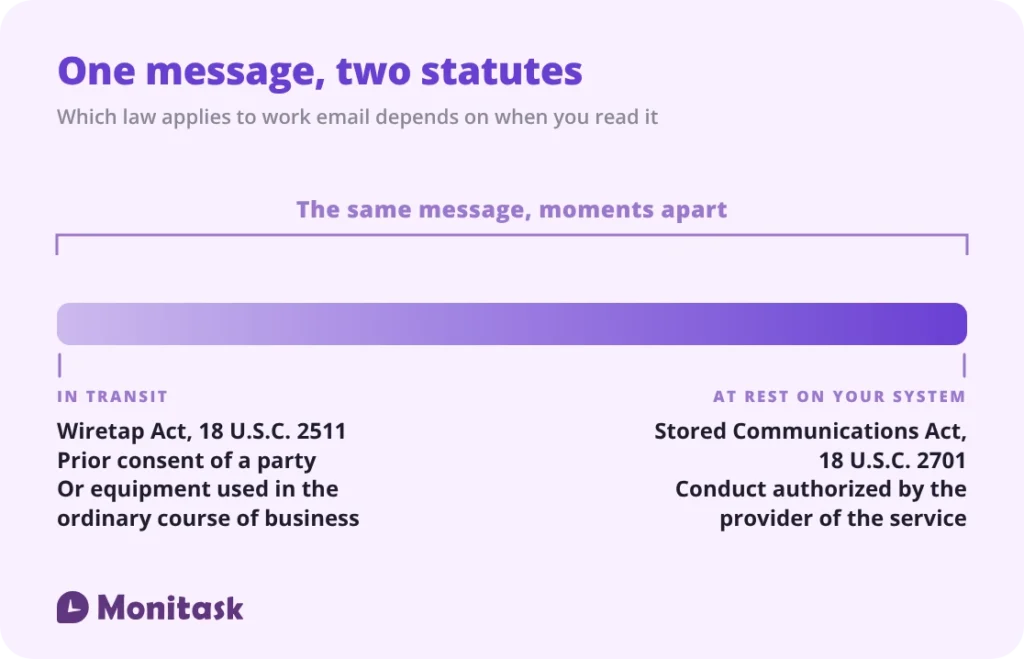

Monitoring company email is generally lawful in the United States, but the answer splits in two. Reading messages stored on your own mail system rests on a different statute from intercepting them in transit, and the second needs either a party’s prior consent or equipment used in the ordinary course of your business. On top of that, 4 states require notice before you start, and their duties differ far more than their penalties do.
What is employee email monitoring?
Employee email monitoring is any systematic review of work email by the employer: scanning for data leaving the organization, keyword and attachment rules, archiving and retention, volume and response-time reporting, or reading individual messages during an investigation.
It is worth separating from the things it is often bundled with. Screenshots, application and website logs, keystroke capture and idle-time scoring are user activity monitoring — they tell you what a person did on a device, not what was in their mail. Several vendor guides describe a product’s screenshot and URL features under an email-monitoring heading; those features do not read email, and the legal analysis for them is not the one on this page.
Is monitoring employee email legal?
In the United States, monitoring email on an employer-provided account is generally permitted, and the federal statutes that govern it are different laws with different conditions. Most guidance names the Electronic Communications Privacy Act and stops there, which is why the usual answer — “it’s a grey area” — is less useful than it looks.
The practical answer has three layers:
| Layer | What it governs | What it requires of you |
|---|---|---|
| Wiretap Act, 18 U.S.C. § 2511 | Intercepting a communication while it is being transmitted | Prior consent of a party — or equipment outside the statutory definition of an intercepting device |
| Stored Communications Act, 18 U.S.C. § 2701 | Accessing a communication held in electronic storage | That the access is conduct the provider of the service authorized |
| State notice statutes | Telling employees that monitoring happens | Written notice, and in some states acknowledgement, posting or an annual repeat |
Each layer can be satisfied. The mistake is assuming one answer covers all three.
Why does “in transit” versus “stored” change the answer?
Because the two acts are separate chapters of the federal code, and which one you are in decides what you have to do.
Intercepting in transit. The Wiretap Act makes it an offence to intentionally intercepts, endeavors to intercept
any wire, oral or electronic communication. Its consent exception at § 2511(2)(d) is the one employers usually rely on: it is not unlawful for a person not acting under color of law
to intercept where that person is a party, or where one of the parties to the communication has given prior consent
— unless the interception is for the purpose of committing any criminal or tortious act
in violation of the Constitution or any law.
Two words do the work. Prior — consent obtained after you began does not cure what you already did. And one of the parties — your employee is a party to their own mail, so their consent can satisfy the exception even though the person on the other end never agreed. Note the gateway condition too: the exception runs only to a person not acting under color of law.
The route most guides leave out. Consent is not the only way an employer sits outside the Wiretap Act, and it is the narrower way. An acquisition is only an interception if it is made through an “electronic, mechanical, or other device”, and § 2510(5) defines that term to exclude telephone or telegraph equipment, and its components, furnished by a communications provider and used in the ordinary course of its business
. The phrase appears 4 times in that one subsection. Where it applies, the conduct is not an interception at all, so the consent exception never has to be reached. How far courts have taken that language is contested and beyond what the statute itself settles — but an employer whose position rests on consent alone is standing on the narrower of two textual grounds.
Accessing what is stored. The Stored Communications Act reaches whoever intentionally accesses without authorization a facility
through which an electronic communication service is provided, and thereby obtains, alters, or prevents authorized access
to a communication while it is in electronic storage in such system
. Its first exception covers conduct authorized
by the person or entity providing a wire or electronic communications service
.
Read that exception precisely, because the loose version of it is wrong in two ways. It exempts conduct the provider authorized, not conduct the provider performs — reaching the familiar conclusion that an employer may read its own mail store takes the extra step that an entity can authorize its own access. And the provider is the provider of that service: an employer running its own mail system is in a different position from one whose mail is a hosted product bought from a vendor. The offence is also bounded by “electronic storage”, which § 2510(17) defines narrowly — temporary storage incidental to transmission, and storage by the service for purposes of backup protection of such communication
.
One more point of hygiene. The familiar rule that acquiring a stored message is not an “interception” is a judicial construction, not something either statute says. Pub. L. 107-56, the USA PATRIOT Act, struck “and such term includes any electronic storage of such communication” from the definition of wire communication at § 2510(1) and put no exclusion in its place. If a policy or a vendor page tells you the statute draws that line, it does not.
What follows practically:
| Activity | Which statute is in play | What you need |
|---|---|---|
| Reading mail in the company mailbox or archive | Stored Communications Act | Access authorized by the provider of the service, to material in electronic storage |
| Keyword and attachment rules applied as mail flows | Wiretap Act | Prior consent of a party, or equipment outside the device definition |
| Retrieving deleted mail from your own archive | Stored Communications Act | Same as reading stored mail |
| Capturing messages on the device as they are typed or sent | Wiretap Act | Prior consent |
| Reading a personal webmail account the employee opened at work | Both can be implicated | Do not do this without counsel; see below |
The exceptions are narrower than they sound. Being the provider of the service covers access to the system; it is not a general license to do anything with the content. Retention, disclosure outside the company and use in a disciplinary process raise their own questions, and § 2701(c) exempts you from § 2701 only.
Which states require you to give notice?
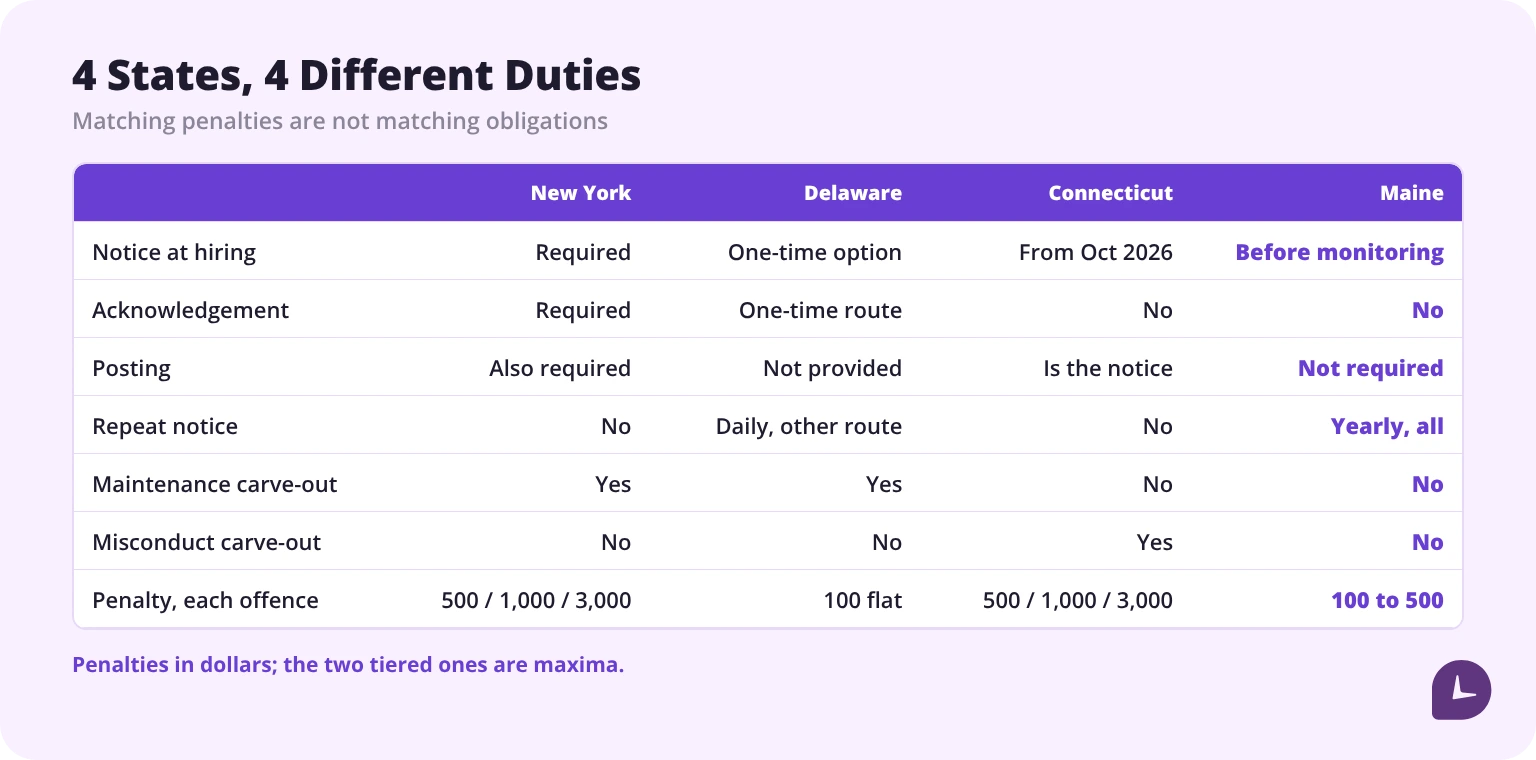
Federal law sets the floor. Four states have general electronic-monitoring notice statutes in force, and the usual two-state summary is out of date: Delaware has had one for years, and Maine’s took effect on 29 July 2026.
| State | Citation | What the notice duty is | Posting | Penalty |
|---|---|---|---|---|
| New York | N.Y. Civil Rights Law § 52-c | Prior written notice upon hiring, acknowledged by the employee in writing or electronically | Required in addition to the individual notice | Up to $500, $1,000 and $3,000 for the first, second and subsequent offences |
| Delaware | 19 Del. C. § 705 | Either an electronic notice on each day the employee uses employer-provided email or internet, or a one-time notice the employee acknowledges. A choice, not both | Not provided for | A flat $100 for each violation |
| Connecticut | Conn. Gen. Stat. § 31-48d | Prior written notice stating the types of monitoring and the specific locations on the premises where it may occur, plus a plain-language written statement before employment begins for anyone hired on or after 1 October 2026 | Required – and posting is itself the prior written notice | Up to $500, $1,000 and $3,000 for the first, second and subsequent offences |
| Maine | 26 M.R.S. § 620-A | Notice before monitoring begins, disclosure to candidates during the interview, and written notice at least once per calendar year to all current employees | Not required | Not less than $100 and not more than $500 for each violation |
New York is the most demanding at the point of hire. The employer shall give prior written notice upon hiring
to employees subject to electronic monitoring, the notice must be acknowledged by the employee either in writing or electronically
, and — the word matters — Each employer shall also post the notice of electronic monitoring
in a conspicuous place. Posting is additive, not an alternative. Enforcement is by the Attorney General, and the figures are maxima.
Delaware offers a choice rather than a stack. An employer satisfies § 705 either by giving electronic notice at least once during each day the employee accesses
employer-provided email or internet, or by giving a one-time notice the employee acknowledges. Only the second route carries the acknowledgement. The penalty is a civil penalty of $100 for each such violation
— a flat amount, not a ceiling, and the only one of the four enforced by a claim in court rather than by an agency.
Connecticut was rewritten in 2026 and most summaries have not caught up. Public Act 26-73 took effect on 1 October 2026. The prior written notice must now state the types of monitoring and the specific locations on the employer’s premises where such monitoring may occur
, and the same specific locations must appear in the posting. The famous sentence survives — Such posting shall constitute such prior written notice
— so in Connecticut a correct poster still discharges the duty. What is new is a second duty it does not discharge: every employee hired on or after 1 October 2026 gets a plain language statement in writing
before starting work, describing the activities that may be monitored without notice. The specific-location requirement itself has an exception, for airport premises and where the employer has reasonable grounds to monitor for security and employee safety.
Connecticut also keeps the misconduct exception: where the employer has reasonable grounds to believe employees are engaged in conduct that violates the law, violates the legal rights of the employer or the employer’s employees
, or creates a hostile workplace, and monitoring may produce evidence of it, notice can wait. Both limbs are required. And The provisions of this section shall not apply to a criminal investigation
, though information obtained that way may still be used in a disciplinary proceeding.
Maine is the newest and the one most likely to catch an employer out, because it is not shaped like the others. Its term is “employer surveillance”, not electronic monitoring. An employer may not use it unless the employer notifies the employee before beginning the use of employer surveillance
. It must inform a prospective employee during the employment interview process
that it monitors. And it must give written notice at least once per calendar year to all current employees
— all of them, not only the monitored ones, and by calendar year, so notifying in December 2026 and again in January 2028 misses 2027. Posting does nothing. There is no system-maintenance exception and no misconduct exception; the carve-outs are written into the definition instead, for security and safety cameras and for GPS or safety devices on employer-owned vehicles, with a separate exception for settings where personal care services are provided. The fine is not less than $100 and not more than $500 for each violation
.
The trap. New York and Connecticut carry identical penalty ladders — $500, $1,000 and $3,000 as maxima — so it is easy to assume identical obligations. They share almost none. In Connecticut a posted notice is the notice; in New York a poster is one of three requirements. Delaware’s penalty is a flat $100 per violation with no ladder at all, and Maine’s runs from $100 to $500. An employer that put up one poster in all four states has complied in one of them.
Two states are routinely added to lists like this and do not belong. New Jersey’s statute covers tracking devices in vehicles only — the enrolled bill’s electronic-communications provision was struck before enactment, which is probably why the error circulates. California’s AB 1221 was held in Assembly Appropriations and was not enacted.
Other states impose adjacent requirements through wiretap and privacy law, and the picture changes. Check the states you actually employ people in rather than relying on a national summary, including this one; the count above is of general notice statutes we confirmed at source, not a claim that no other state has anything. Our guide to employee monitoring laws covers the wider picture.
Can you monitor an employee’s personal email?
Treat this as a different question with a different answer, and do not let a tool blur the line.
A company mailbox on a company system is the employer’s to review. A personal webmail account — reached through a browser on a company laptop, or on a personal phone on the company network — belongs to the employee and sits on someone else’s service. You are not the provider of that service, so the exception discussed above does not reach you.
Two situations where people get this wrong:
Credentials captured incidentally. A keystroke logger or session recorder running on a work device may capture a personal account’s password or message content without anyone intending it. Capability is not authorization, and “the tool collected it automatically” is not a defense. Maine’s statute is worth noting here even outside Maine: it gives employees the right to decline an employer surveillance application on their own personal device, which is a useful test of whether your BYOD rules have a route to say no.
Personal mail in a company mailbox. Employees send personal messages from work accounts. Those sit on your system, but reading them is still worth a policy rule and a reason, not a browse.
The workable position: monitor the systems you provide, say so in writing, exclude personal accounts from collection by configuration rather than by promise, and get counsel involved before any targeted review of an individual.
What does email monitoring actually capture?
Vendors describe very different things using the same phrase. Knowing which you are buying matters for both the legal analysis and whether it answers your question.
| What is collected | Typical purpose | Reveals content? |
|---|---|---|
| Metadata only | Sender, recipient, time, subject, size | No |
| Keyword and attachment rules | Data loss prevention, compliance | Only on a match |
| Full archiving | Retention, litigation hold, regulated industries | Yes, all of it |
| Targeted review of one mailbox | Investigation | Yes |
| Device-level capture | Keystrokes and screen, outside email entirely | Incidentally, and indiscriminately |
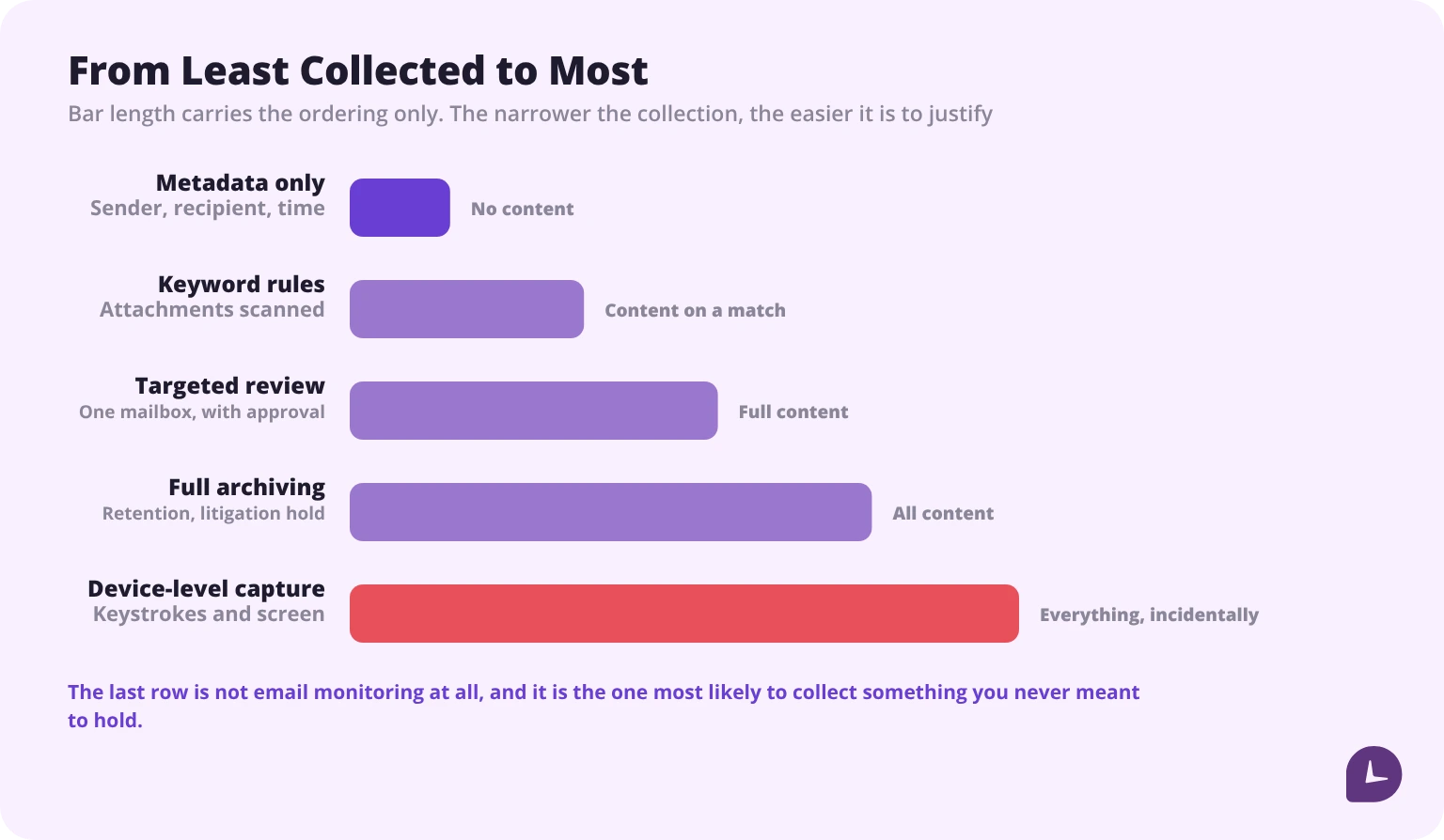
The last row is the one to be careful with, because it is the least targeted and the most likely to collect things you never meant to hold — including personal account content. It is also not email monitoring: screen and device monitoring is a separate decision with a separate justification, and bundling the two is how policies end up indefensible. Attachment and keyword rules sit closer to insider threat detection than to mail review, and are usually easier to defend because the collection is conditional.
Metadata alone answers more questions than people expect: whether a departing employee suddenly mailed attachments to a personal address, which inboxes are drowning, where response times fall apart. It also carries the least risk. The narrower the collection, the shorter the argument you have to make for it.
What should an email monitoring policy contain?
7 sections. Anything less and the practice is decided by whoever configured the tool.
| Section | The question it settles |
|---|---|
| Scope | Which accounts and devices are covered, and which are explicitly not |
| What is collected | Metadata, matches, full content – stated plainly, not as “activity” |
| Purpose | Why each category is collected, and what it will not be used for |
| Access | Who can see it, who approves a targeted review, and how that is logged |
| Retention | How long it is kept and what deletes it |
| Notice and acknowledgement | How employees are told, and how acknowledgement is recorded |
| Investigations | What triggers a review of an individual, and who signs off |
The two most often missing are access control — a surprising number of deployments let any administrator read any mailbox with no record — and retention, because an archive kept indefinitely becomes a liability in every future dispute.
If you already have an internet usage policy, this belongs beside it rather than inside it: the notice duties above attach to monitoring, and a reader needs to find them without reading an acceptable-use document first.
What to do before you switch it on
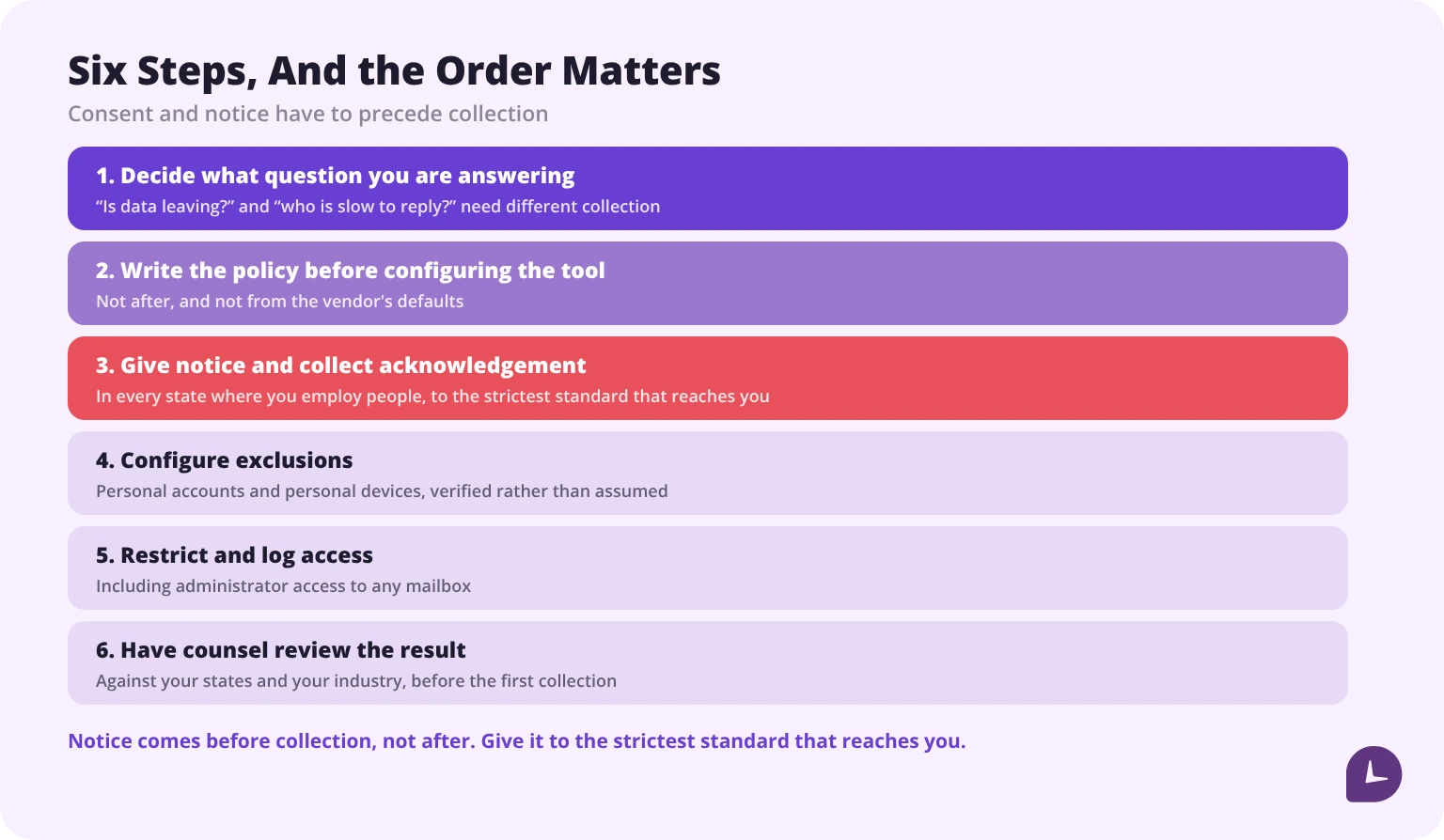
6 steps, in order. The order matters because consent and notice have to precede collection.
- Decide what question you are answering. “Is data leaving?” and “who is slow to reply?” need different collection.
- Write the policy before configuring the tool. Not after, and not from the vendor’s defaults.
- Give notice and collect acknowledgement. In every state where you employ people, to the strictest standard that reaches you.
- Configure exclusions. Personal accounts and personal devices, verified rather than assumed.
- Restrict and log access. Including administrator access to any mailbox.
- Have counsel review the result. Against your states and your industry, before the first collection.
Transparent activity monitoring, with the collection scoped and the notice written before anything is switched on.
See what Monitask collects, and what it does not
This article explains the federal and state provisions that apply to monitoring work email in the United States and quotes them directly. It is not legal advice and does not tell you whether a particular monitoring program is lawful — that depends on your jurisdictions, your industry and how the monitoring is configured. State requirements differ and change; Connecticut’s were rewritten in 2026 and Maine’s are new. Have employment counsel review your policy and configuration before you begin collecting, and consult counsel before any targeted review of an individual’s mailbox.
Sources
- 18 U.S.C. § 2511 — Interception and disclosure of wire, oral, or electronic communications prohibited. Subsections (1)(a) and (2)(d) read at source in the U.S. Code via GovInfo. Verified 12 November 2026.
- 18 U.S.C. § 2510 — Definitions. Subsection (5), the “electronic, mechanical, or other device” definition carrying the ordinary-course-of-business language, and subsection (17), “electronic storage”, read at source via GovInfo. Verified 12 November 2026.
- 18 U.S.C. § 2701 — Unlawful access to stored communications. Subsections (a) and (c) read at source via GovInfo. Verified 12 November 2026.
- N.Y. Civil Rights Law § 52-c — Notice of electronic monitoring. Notice, acknowledgement, posting and penalty provisions read on the New York State Senate’s text of the law. Verified 12 November 2026.
- 19 Del. C. § 705 — Notice of monitoring of telephone transmissions, electronic mail and internet usage. Read on the official Delaware Code site. Verified 12 November 2026.
- Conn. Gen. Stat. § 31-48d, as amended by Public Act 26-73, effective 1 October 2026. Read on the General Assembly’s text of the act, not the chapter page, which still serves the superseded section. Verified 12 November 2026.
- 26 M.R.S. § 620-A — Employer surveillance, enacted as LD 61, Public Law 2025, chapter 524. Read on the Maine Legislature’s statute page; the effective date is derived from the chaptered law carrying no stated effective date and the Legislature’s own end-of-session report. Verified 12 November 2026.
FAQ
Do I have to tell employees their email is monitored?
Under federal law there is no general notice requirement, but 4 states impose one and they are not interchangeable. New York wants prior written notice on hiring, an acknowledgement and a posting. Connecticut wants prior written notice naming the specific locations, and there a conspicuous posting itself Such posting shall constitute such prior written notice
. Delaware offers a choice between daily electronic notice and a one-time acknowledged notice. Maine wants notice before monitoring starts, a disclosure at interview, and a written notice to every current employee once per calendar year.
What is the difference between intercepting and reading stored email?
Interception happens while the message is in transmission and falls under the Wiretap Act, 18 U.S.C. § 2511. A message held in a mailbox or archive is in electronic storage and falls under the Stored Communications Act, 18 U.S.C. § 2701, where conduct the provider of the service authorized is excepted. Most corporate mail review is the second, not the first. Note that the line between them is drawn by the courts: neither statute states it.
Can my employer read my personal Gmail at work?
Your employer does not provide that service, so the provider exception does not reach them. A personal webmail account is a different legal question from your work mailbox, and an employer wanting to look at one should be taking legal advice rather than relying on a monitoring policy.
Does employee consent have to be in writing?
The Wiretap Act’s exception requires prior consent and does not prescribe a form. The state statutes do prescribe forms, and they differ: New York requires a notice acknowledged by the employee either in writing or electronically
, Delaware requires an acknowledgement only on its one-time route, and Connecticut and Maine require no acknowledgement at all. In practice a written, acknowledged record is what you can produce later.
Is monitoring metadata safer than reading content?
It collects less, so it is easier to justify and creates less exposure, and it answers many of the questions employers actually have — external sharing, volume, response times. It does not tell you what was said, which is why investigations end up needing a narrower, approved review instead.