Employee monitoring is lawful across the United States. That is the correct starting point and it is where most guides stop, which is why employers get caught out by the second half.
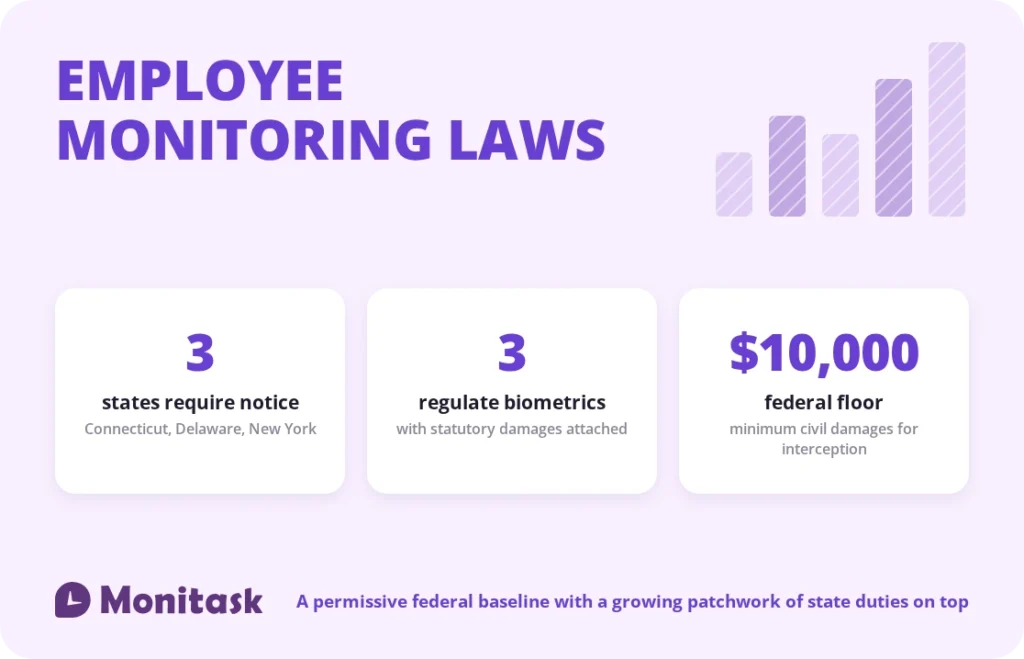
Federal law permits an employer to monitor its own systems for a legitimate business reason. Four states add a duty to give prior written notice, three regulate biometric identifiers, and a separate set of rules governs audio recording, video, GPS and how monitoring data is later used.
Getting layer one right does not clear layers two, three and four, and that is where nearly every failure happens.
The four layers
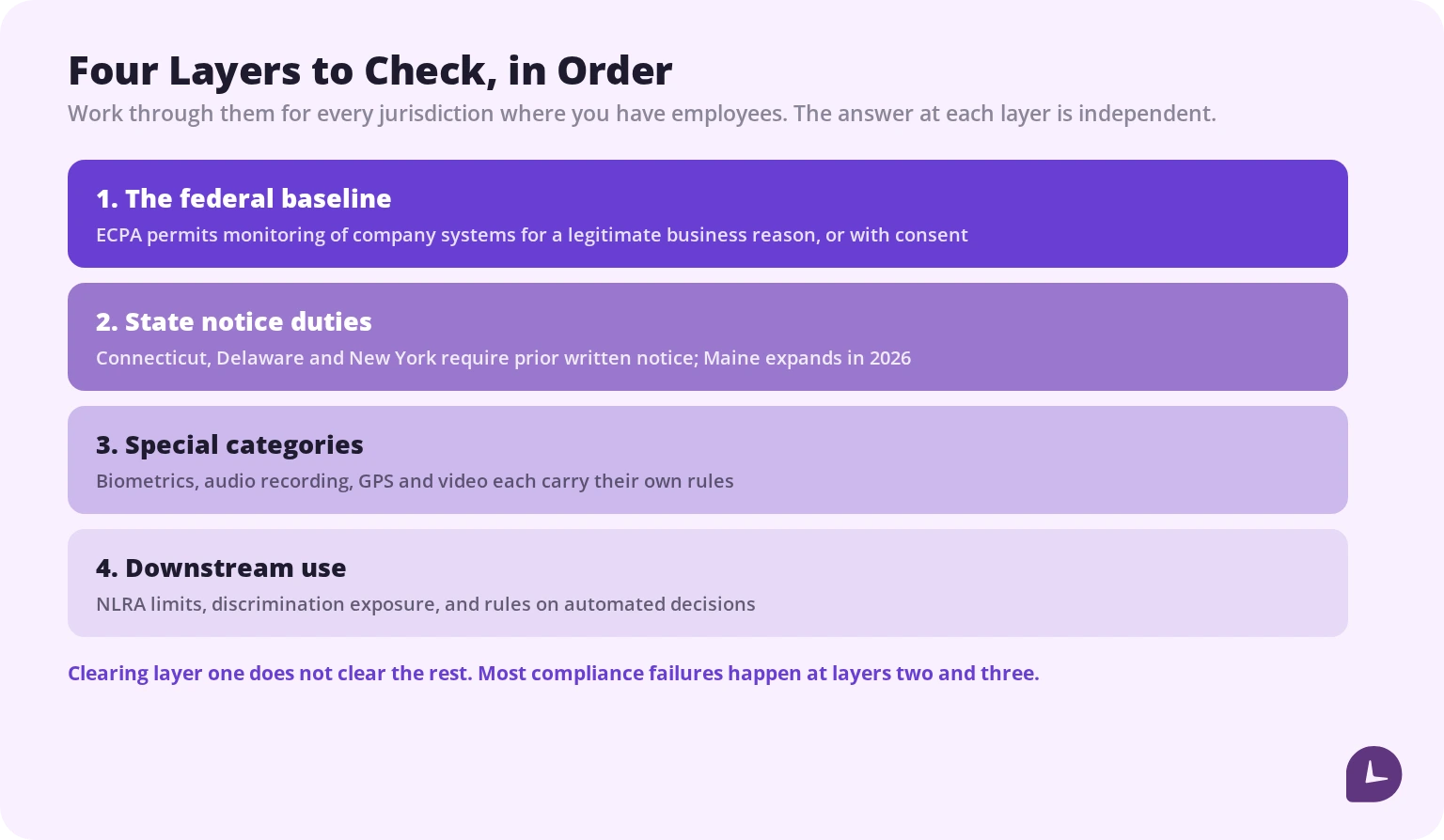
Work through them in sequence for every jurisdiction where you have employees. The answer at each layer is independent of the others.
Layer 1: The federal baseline
The Electronic Communications Privacy Act of 1986 is the governing federal statute. It has two relevant parts: Title I, the Wiretap Act, prohibits intercepting wire, oral or electronic communications in transit; Title II, the Stored Communications Act, protects communications held in electronic storage.
Two exceptions do most of the work in workplace monitoring:
The business use exception. The Wiretap Act excludes equipment used in the ordinary course of business, which covers monitoring for a legitimate reason such as security, quality assurance, policy compliance or protection of trade secrets. Courts read it narrowly: it covers business communications, not personal ones once their personal nature is clear. For stored communications on its own systems, an employer usually relies instead on the Stored Communications Act’s exception for the provider of the service.
The consent exception. Monitoring is permitted where at least one party to the communication has consented. Federal law is a one-party consent regime.
In practice, a written monitoring policy that employees acknowledge is the strongest evidence of consent and supports the business-use argument, which is why the policy matters more than any technical control.
Two things federal law does not do:
It does not require notice. That duty comes from state law where it exists at all.
It does not give private-sector employees Fourth Amendment protection. Constitutional search protections apply to government action. For a private employer the analysis is mostly statutory and contractual, but not entirely: state common-law privacy claims such as intrusion upon seclusion still apply, and California’s constitutional right of privacy reaches private employers as well.
Layer 2: States with a notice duty
Four states impose a dedicated electronic monitoring notice requirement.
| State | What is required | Penalty |
|---|---|---|
| New York | Written or electronic notice on hire, employee acknowledgment, plus a notice posted in a conspicuous place readily available to employees | $500, $1,000 and $3,000 for successive violations, enforced by the Attorney General |
| Connecticut | Prior written notice of the types of monitoring and the specific locations where it may occur, a notice posted in those locations, and, for employees hired on or after October 1, 2026, a plain-language statement of the prohibited conduct that may be monitored without prior notice. Scope reaches information collected by any means other than direct observation | $500, $1,000 and $3,000 for successive violations, enforced by the Labor Commissioner |
| Delaware | Either daily electronic notice when the employee accesses monitored systems, or one-time notice with documented acknowledgment | $100 per violation |
| Maine | Notice before monitoring begins, written notice to current employees at least once a year, and disclosure to job applicants during the interview process | $100 to $500 per violation, enforced by the Maine Department of Labor |
Connecticut changed on October 1, 2026. Public Act 26-73 repealed and replaced the 1998 statute, adding the location disclosure, the location-based posting and the new-hire statement above. An employer does not have to disclose specific locations where it has reasonable grounds to monitor for security and employee safety. The existing exception survives: monitoring without prior notice is permitted where the employer has reasonable grounds to believe employees are breaking the law, violating legal rights or creating a hostile work environment, and that monitoring may produce evidence of it.
Maine’s law took effect in July 2026 and goes further than notice. It prohibits audiovisual monitoring in an employee’s home, personal vehicle or property unless the job duties require it, and it lets employees decline to install data-collection apps on their personal devices. Security cameras and GPS on employer-provided vehicles fall outside it.
The employee’s work location governs. A company headquartered anywhere follows New York’s rule for its New York employees. For distributed teams this is the rule that matters most. For staff who never enter an office, employers commonly post the notice on an intranet, but none of these statutes expressly says an intranet posting is enough, and Connecticut now ties posting to the places where monitoring occurs. Confirm the approach with counsel for each state.
Layer 3: Special categories
Certain kinds of monitoring have their own rules regardless of the general notice position.
Biometrics. Illinois, Texas and Washington have dedicated biometric privacy statutes, and Colorado’s privacy law has added biometric obligations that reach employers. Illinois’ BIPA is the significant one because it provides a private right of action with statutory damages of $1,000 for negligent and $5,000 for reckless or intentional violations, plus fees, with no proof of harm required. A 2024 amendment limits repeated collection of the same identifier by the same method to a single recovery per person. In April 2026 the Seventh Circuit held that the amendment applies retroactively to pending cases, but that is a federal court’s prediction of Illinois law: most Illinois state trial courts have held the opposite, and the Illinois Supreme Court has not yet decided the question. Compliance obligations were not changed. This applies if your monitoring includes facial recognition or fingerprint login, not only if you run a biometric time clock. See our biometric time clock guide.
Audio recording. Federal law is one-party consent. Many states require all-party consent, and California is the significant one. Recording a call or a meeting where any participant is in an all-party state generally needs everyone’s consent, though courts differ on which state’s law applies to cross-border calls. Violations can carry criminal exposure in addition to civil claims.
Video. Generally permitted in work areas with notice. Prohibited in areas with a reasonable expectation of privacy: restrooms, changing areas, and in Connecticut also employee lounges and areas designed for employees’ health or personal comfort. In Maine, audiovisual monitoring in an employee’s home is barred unless the job requires it.
GPS and vehicle tracking. Generally lawful on company vehicles with notice. Tracking a personal vehicle, or tracking outside working hours, is a materially different question and several states restrict it; Maine bars audiovisual monitoring in a personal vehicle unless the job requires it.
Social media credentials. Employers cannot require employees to hand over personal social media passwords in a substantial number of states, including California and New York.
Layer 4: How the data is used
Collecting lawfully is not the end of the analysis. What you do with the data creates its own exposure.
The NLRA. Surveillance directed at protected concerted activity — employees discussing wages, conditions or organizing — is unlawful, and this applies to non-union workplaces too. Monitoring that is lawful in general becomes unlawful when it is pointed at that activity, or when it is newly introduced in response to it.
Discrimination exposure. Monitoring data used in discipline or termination becomes evidence. If activity scores correlate with a protected characteristic, for instance because a disability accommodation produces a different work pattern, the data supports the claim rather than the defense.
Automated decisions. Where monitoring data feeds performance scoring or termination decisions, rules are no longer only proposals. Illinois has amended its Human Rights Act to cover employers’ use of AI in employment decisions, and California’s privacy regulator has adopted rules on automated decision-making technology that include risk assessments and notice. More bills are introduced every session, and this is the most active area of legislative movement right now. Check current requirements and compliance dates for each state where you employ people.
Retention. Data kept beyond its purpose is a liability with no benefit. Recordings and screenshots of employee screens contain whatever was on them, including customer data and credentials, which puts them inside your breach notification obligations.
Personal devices and BYOD
Monitoring a personal device carries substantially more risk than monitoring company equipment.
The business use exception is weaker because the employer does not own the device, and the employee’s expectation of privacy is stronger. The practical answer is separate, explicit, written consent scoped narrowly to work applications, with a clear statement of what is not accessible.
In Maine this is now a statutory point, not just good practice: employees may decline to install data-collection apps on their personal devices, so a BYOD program there needs a workable alternative for people who say no.
Containerization, where work applications sit in a managed partition and everything else is out of scope, is the cleaner architecture and the easier position to defend.
What the penalties look like
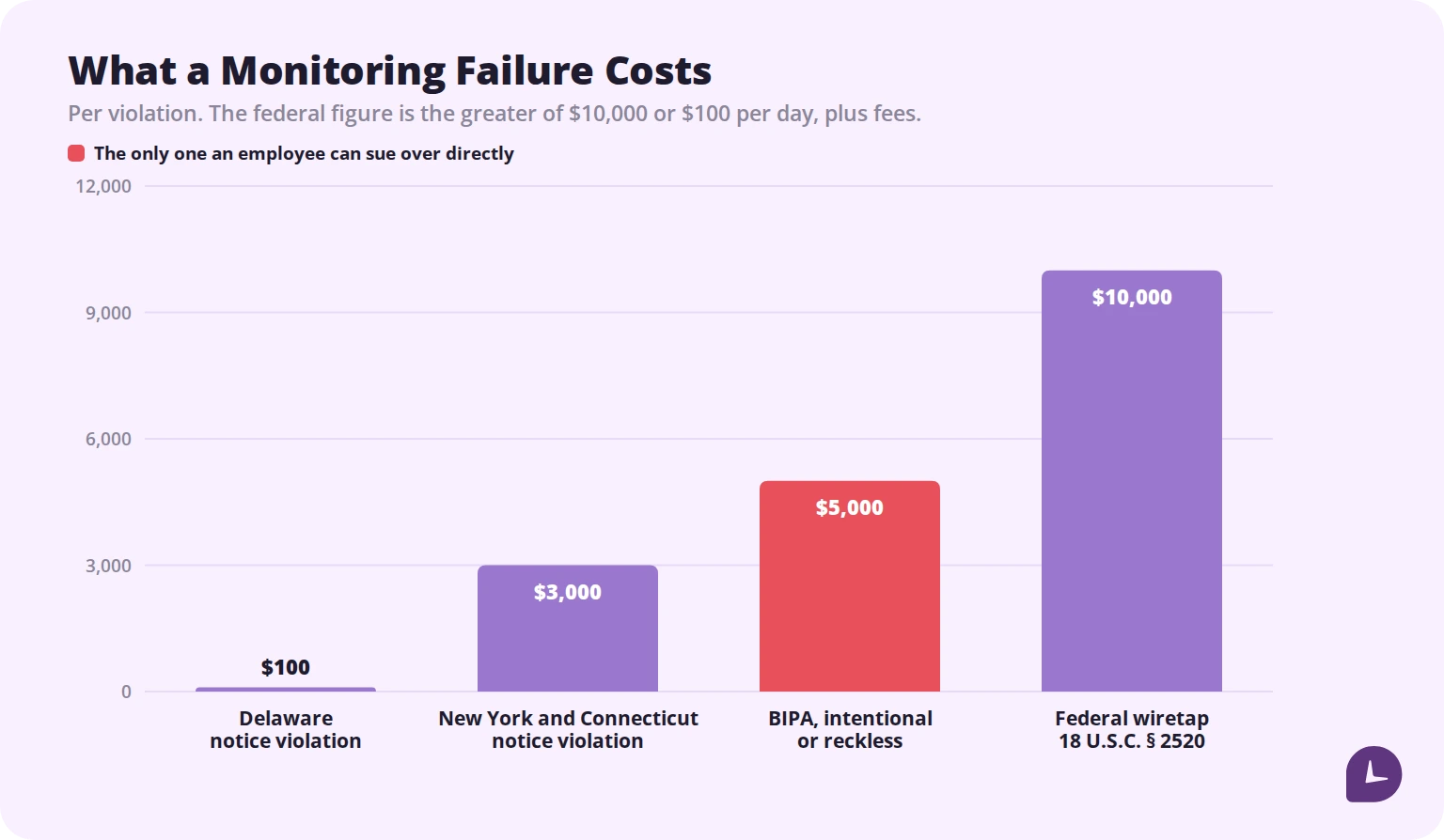
Under 18 U.S.C. § 2520, a person whose communications were unlawfully intercepted can sue for civil damages of the greater of $100 per day of violation or $10,000, plus punitive damages and attorneys’ fees.
State notice violations run from $100 in Delaware and $100 to $500 in Maine up to $3,000 in New York and Connecticut, generally per violation. In each of these states a regulator decides whether to act.
The number that behaves differently is BIPA. Unlike the notice statutes, it lets the employee bring the claim directly, and the class of potential plaintiffs is every enrolled employee. California’s all-party recording law also gives individuals a civil claim.
What published guides get wrong
Worth flagging, because this area attracts confidently wrong compliance content.
California AB 1221. Numerous published guides describe this workplace surveillance bill as effective from January 2026 and list California among the states with a notice duty. It never became law. The bill passed two Assembly committees in 2025, stalled in Appropriations, and died at the end of January 2026 under the Legislature’s two-year deadline. California has no dedicated electronic monitoring notice statute.
Colorado. Several guides list Colorado as a notice state. The Colorado Privacy Act is a consumer data statute, and it generally exempts employee and applicant data. Its biometric provisions are a partial exception, but it is not an electronic monitoring notice law and does not belong in the same category as Connecticut, Delaware, Maine and New York.
Consumer privacy laws and employee data. Most state privacy statutes, including Virginia’s and Colorado’s, exempt employee data. California is the exception — for businesses that meet its thresholds, its consumer privacy regime applies to employee and applicant data, which gives California employees access, deletion and disclosure rights that employees elsewhere do not have. That is a real and frequently missed obligation, and it is separate from the AB 1221 question above.
The general lesson for this topic: legislative sessions produce far more bills than laws, and compliance content is written faster than it is corrected. Check the statute, not the summary.
Monitoring employees outside the US
Materially stricter. Under the GDPR, monitoring is processing of personal data and requires a lawful basis. Consent is generally weak in employment because the power imbalance makes it hard to argue it was freely given, so legitimate interests with a documented balancing assessment is the usual route. A data protection impact assessment is normally expected before deployment, and continuous or covert monitoring is difficult to justify.
In Germany and several other jurisdictions, works councils have co-determination rights over the introduction of technical systems capable of monitoring employees. That is not an advisory step; without the council’s agreement, or a decision from a conciliation board, the rollout cannot go ahead.
Our GDPR guide covers this in detail.
A compliance checklist
Write the policy. What is monitored, by what means, for what purpose, who can access it, how long it is kept.
State what is not monitored. Explicitly. Ambiguity is read as the worst case.
Deliver it before monitoring starts, and capture acknowledgment in writing or electronically. Notice is required in Connecticut, Delaware, Maine and New York, and acknowledgment in New York and Delaware; it is advisable everywhere because it is the best evidence of consent under federal law.
Name the locations in Connecticut. Say where on the premises monitoring may occur, post the notice there, and give new hires the plain-language statement required since October 1, 2026.
Repeat it annually in Maine, and tell applicants about monitoring during the interview process.
Post it where remote staff will see it. An intranet posting is the common approach for people who never enter an office; confirm with counsel that it meets each state’s posting rule.
Map your states. Every state where an employee works, not just where the company sits.
Scope to the purpose. Deep capture on privileged users is defensible; the same capture across everyone is not.
Set retention and delete on schedule.
Restrict and log access to the monitoring data itself.
Review annually. This area is moving faster than any other part of employment law right now.
This is general information rather than legal advice. Confirm requirements with counsel for every jurisdiction in which you employ people.
What the statistics do and do not show
A note on the numbers that circulate in this area, since they are frequently cited without qualification.
Most published employee monitoring statistics come from vendor surveys of employers, which have obvious incentives and self-selected samples. Figures such as “X% of large employers now monitor staff” typically count any monitoring of any kind, including basic network security logging that nobody would describe as surveillance.
Two findings that are better grounded and more useful:
Microsoft’s 2022 Work Trend Index found 85% of leaders said hybrid work made it hard to be confident their employees were productive, while 87% of employees reported that they were. Microsoft named the gap productivity paranoia, and it explains the demand for monitoring better than any adoption statistic does.
Behavioral data from ActivTrak’s 2026 State of the Workplace report, covering 443 million work hours across 1,111 organizations from 2023 to 2025, puts average productive time at 6 hours 36 minutes a day, up 5% over the period. ActivTrak’s previous report found remote workers more productive than hybrid or in-office workers. ActivTrak sells monitoring software, so the usual caution applies, but this is measured behavior rather than opinion, and it does not support the premise that distance means idleness.
The practical reading: the driver of monitoring adoption is a visibility gap, not an evidenced productivity problem. Solving a visibility gap needs the lightest instrument that closes it.
How Monitask helps
Monitask is designed to keep the compliance picture simple rather than an exercise in configuration.
Tracking starts when an employee clocks in and stops when they clock out. Keystrokes are never recorded. There is no continuous session capture, and employees can see what is recorded about them, including the last screenshot taken.

- No biometric identifiers collected, so BIPA’s biometric rules are not triggered by the software itself.
- No keystroke logging, removing the highest-risk layer of capture.
- Employee-visible data, which supports the transparency that notice statutes are built around.
- Nothing runs outside clocked-in time, which answers the most common objection before it is raised.
Screenshots and activity data are still electronic monitoring, so the notice duties in Connecticut, Delaware, Maine and New York apply whichever tool you use. The written policy and the acknowledgment are yours to produce. No software makes that step unnecessary.
See how it works: Monitask computer monitoring.
Sources
- Electronic Communications Privacy Act, 18 U.S.C. §§ 2510–2523 — Title I interception prohibition, Title II stored communications, and the business use, provider and consent exceptions.
- 18 U.S.C. § 2520 — private civil action; damages of the greater of $100 per day or $10,000, plus punitive damages and fees.
- New York Civil Rights Law § 52-c — notice on hire, acknowledgment, posted notice and escalating penalties.
- Connecticut General Statutes § 31-48d, as amended by Public Act 26-73 (effective October 1, 2026) — prior written notice of types and locations, posting where monitoring occurs, new-hire statement, and the reasonable-grounds exception.
- Connecticut General Statutes § 31-48b — prohibition on electronic surveillance in areas for employees’ health or personal comfort.
- Delaware Code Title 19 § 705 — daily notice or one-time notice with acknowledgment.
- Maine Public Law chapter 524 (LD 61), An Act to Regulate Employer Surveillance to Protect Workers (effective July 2026) — prior and annual notice, applicant disclosure, limits on audiovisual monitoring, personal-device rights.
- California Assembly Bill 1221 (2025–2026 session), legislative history — died January 31, 2026.
- Illinois Biometric Information Privacy Act, 740 ILCS 14, as amended by Public Act 103-0769 — consent, retention, destruction and statutory damages.
- Clay v. Union Pacific Railroad Co. (7th Cir. April 1, 2026) — retroactivity of the 2024 BIPA amendment.
- National Labor Relations Act — protection of concerted activity against surveillance.
- Microsoft, Work Trend Index (2022) — the 85% and 87% figures behind productivity paranoia.
- ActivTrak, State of the Workplace 2026 — behavioral data across 443 million work hours.
Related reading
- User Activity Monitoring
- Biometric Time Clock
- GDPR Requirements for Employee Monitoring
- How to Know If Remote Employees Are Working
- How to Monitor Your Employees Ethically
- Is Stealth Monitoring Ethical?
Reliable employee tracking software. Clear visibility and insights into how employees work. Even remotely.
Try Monitask free for 10 days
FAQ
Do employers have to tell employees they are being monitored?
Federal law does not require it. Connecticut, Delaware, Maine and New York do. New York and Delaware also require acknowledgment, and Maine requires the notice to be repeated every year.
Which states require notice before employee monitoring?
Connecticut, Delaware, Maine and New York. Maine’s law took effect in July 2026, and Connecticut expanded its requirements on October 1, 2026. Guides that list Colorado or California in this group are generally citing a consumer privacy law or a bill that did not pass.
What are the penalties for monitoring without notice?
$100 per violation in Delaware, $100 to $500 in Maine, and up to $3,000 in New York and Connecticut, enforced by state regulators. Separately, unlawful interception under the federal Wiretap Act, which is not a notice statute, carries the greater of $100 a day or $10,000 plus fees in a private lawsuit.
Can employers record phone calls at work?
Federal law allows it with one party’s consent. Many states require all-party consent, and California is the significant one, so calls involving participants there generally need everyone’s agreement.
Can employers monitor personal devices?
It is much riskier. The business use exception is weaker because the employer does not own the device, and in Maine employees can refuse to install monitoring apps on personal devices. Separate written consent scoped to work applications, or a containerized work profile, is the defensible approach.
Can employers monitor employees discussing pay or working conditions?
No. Surveillance aimed at protected concerted activity violates the NLRA, and this applies in non-union workplaces as well.
Is keystroke logging legal?
Generally yes on company systems with proper notice, but it is the highest-risk form of capture. It records passwords and personal content, which makes it a significant liability even where lawful.
Do employees have rights to see monitoring data about them?
In California, employee data falls under the state’s consumer privacy regime for businesses that meet its thresholds, so access and deletion rights apply. Most other state privacy laws exempt employee data. In the EU and UK, subject access rights apply throughout.
How often should a monitoring policy be reviewed?
Annually at minimum. This is currently the fastest-moving area of employment law, with new statutes taking effect and multiple bills introduced each legislative session.