
The honest answer is that you cannot know whether someone is working by watching them, and remote work did not create that problem. It removed the illusion that solved it. In an office, presence stood in for productivity. Take the office away and the substitute disappears, leaving a question that was always there.
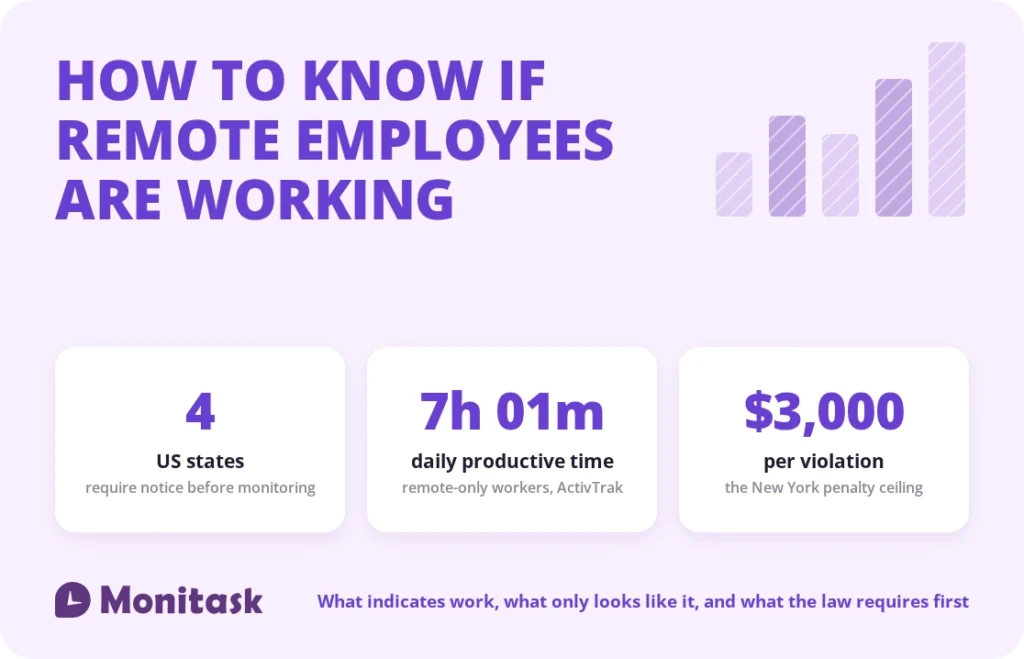
Two things follow. The signals most monitoring tools sell are weak proxies that a determined employee defeats in minutes. And in four US states you are legally required to tell employees before you monitor them at all, with penalties up to $3,000 per violation.
This guide covers what is worth measuring, what is not, and what you must disclose.
Where the question comes from
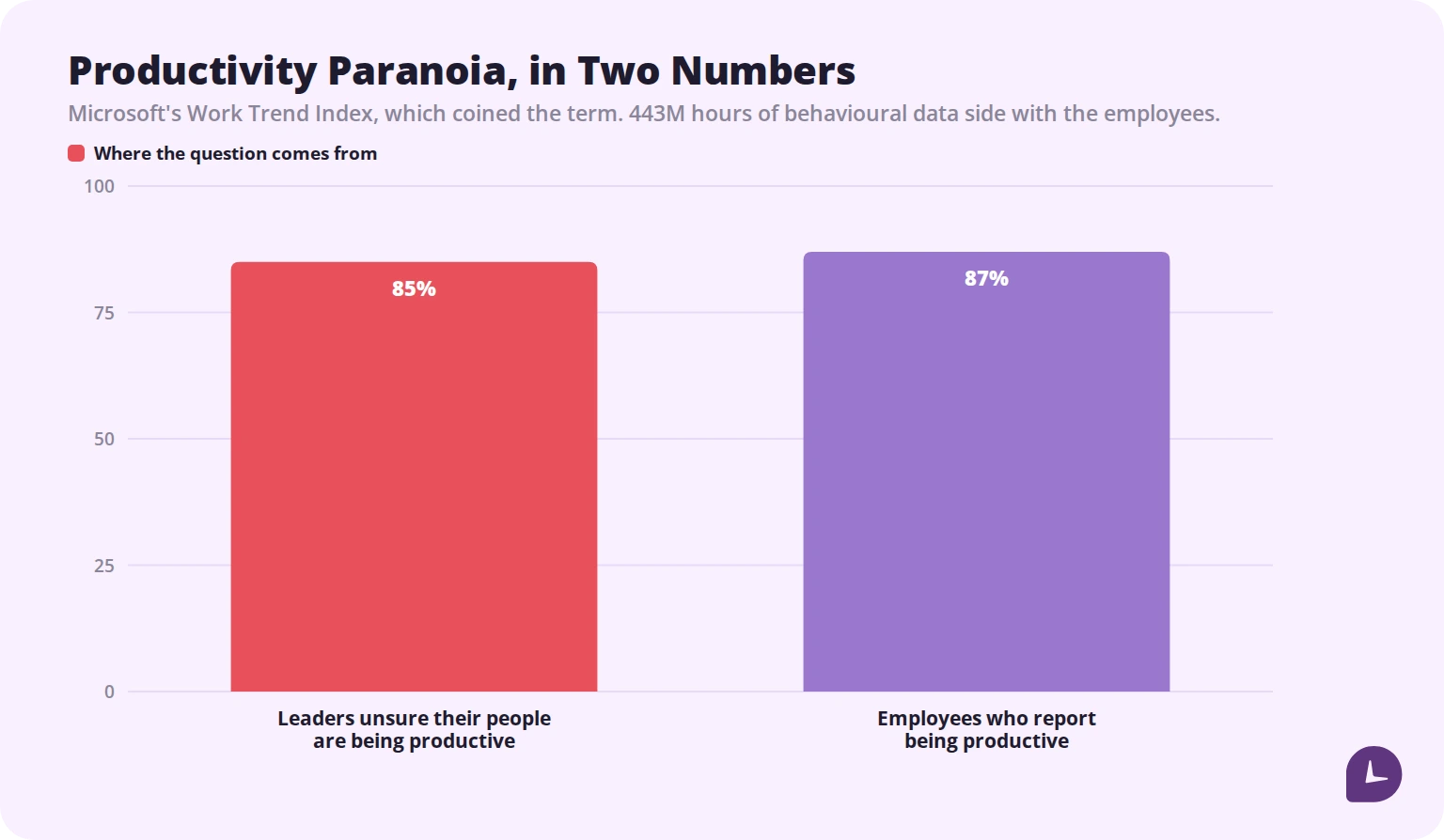
Microsoft’s Work Trend Index found that 85% of leaders said the shift to hybrid work made it hard to have confidence their employees were being productive, while 87% of employees reported that they were productive. Microsoft called the gap productivity paranoia, and the name stuck because it describes the situation precisely: both groups are looking at the same work and only one of them can see it.
Behavioural data does not support the suspicion. ActivTrak’s 2026 dataset, covering 443 million work hours, found remote-only workers logging the highest daily productive time of any group at 7 hours 1 minute, with office-only workers ahead on focus efficiency at 64%. Neither model dominates, and neither supports the assumption that distance means idleness.
That does not mean nothing is wrong when output falls. It means the problem is rarely the one managers reach for first.
Signals ranked by what they are worth
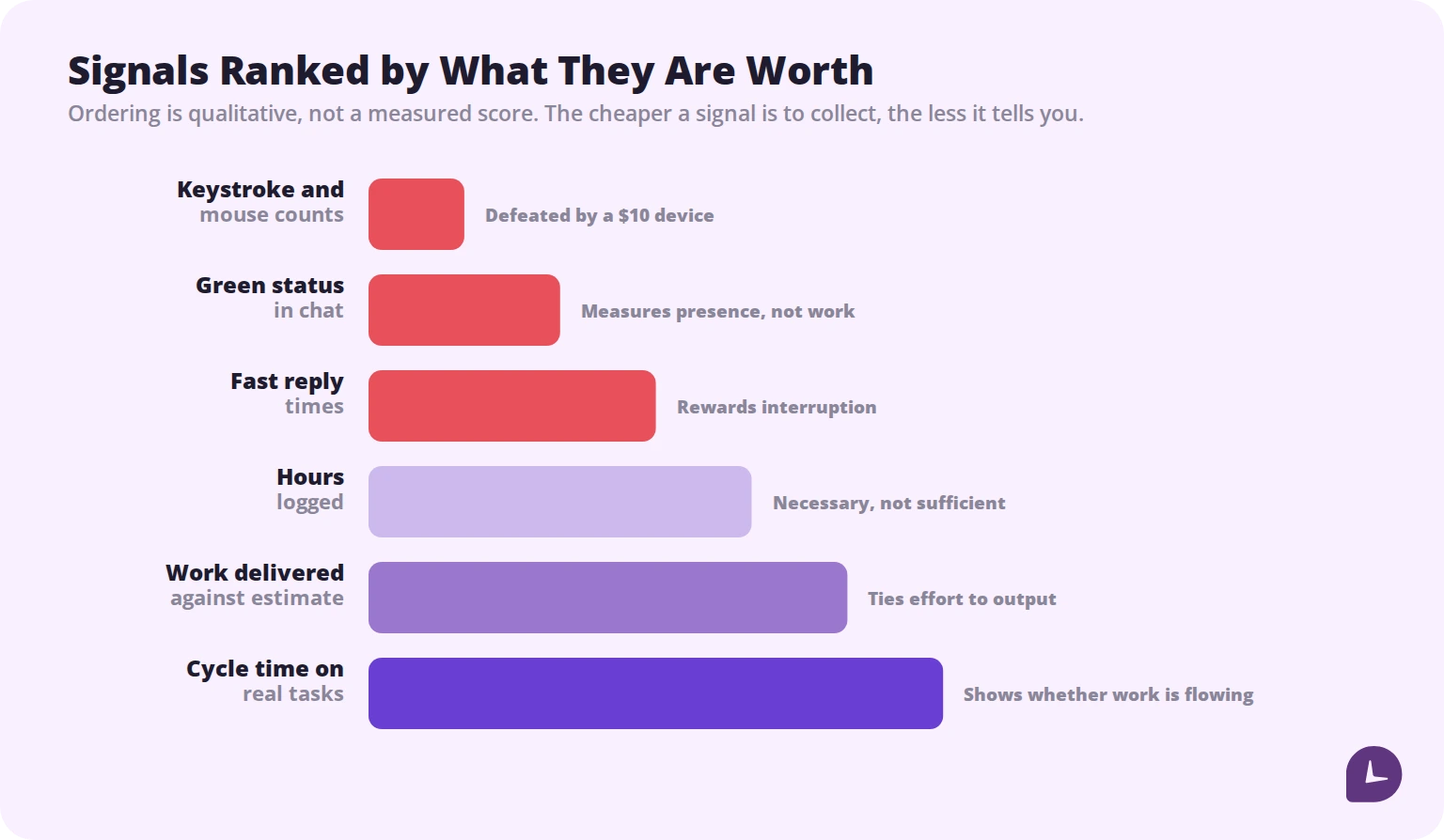
| Signal | What it actually tells you |
|---|---|
| Keystroke and mouse counts | Almost nothing. Defeated by a device costing ten dollars |
| Green status in chat | That an application is open |
| Fast reply times | That someone is interruptible, which is not the same as productive |
| Hours logged | Necessary for payroll and billing. Not sufficient for performance |
| Work delivered against estimate | Whether effort is converting into output |
| Cycle time on real tasks | Whether work is flowing or stuck, and where |
The pattern is consistent: the cheaper a signal is to collect, the less it tells you. Keystroke counts are trivially available and nearly worthless. Cycle time takes work to define and answers the actual question.
Why activity metrics fail
Three reasons, and they compound.
They are trivially gamed. A mouse jiggler is a physical device that costs about ten dollars and keeps a cursor moving indefinitely. Any activity-based metric it defeats was never measuring work. If your monitoring approach can be beaten by hardware from a marketplace, it is measuring compliance with the monitoring, not effort.
They measure the wrong kind of work. Reading a specification, thinking through an architecture, and preparing for a difficult conversation all register as idle. The most valuable hour of a senior person’s week frequently produces the lowest activity score of it.
They change behaviour, and not for the better. Once people know an activity number is being watched, they optimise it. Mouse movement goes up. Deep work goes down. You have not made anyone more productive; you have taught them what to perform.
There is also a reputational cost. Surveillance signals distrust, and distrust is expensive in ways that do not appear on a dashboard until someone resigns.
What to measure instead
Four things, in order of usefulness.
Delivered output against agreed expectations. What was supposed to be done this week, what was done. This requires the harder management work of defining expectations clearly, which is exactly why the question gets asked instead.
Cycle time. How long a typical unit of work takes from start to finish. A rise in cycle time is a real signal, and it points at process problems as often as at people.
Estimate against actual. Recorded time compared with what was planned. Consistent overruns in one area indicate an unclear brief, a dependency, or a skills gap. All are fixable; none look like laziness.
Recorded hours, for the questions hours answer. Payroll, client billing, capacity planning and overtime compliance all need accurate hours. Hours are a legitimate and necessary measurement. They just are not a performance measurement.
The distinction that matters: measure the work, not the worker. Every metric above is a property of the work. Keystroke counts are a property of the person.
The notice laws you have to follow
Whatever you decide to monitor, disclosure is not optional everywhere.
There is no comprehensive federal law requiring employers to disclose monitoring of company equipment. Four states have their own requirements, and they differ.
| State | Requirement |
|---|---|
| New York | Written or electronic notice on hire, employee acknowledgment required, plus a conspicuously posted notice. Penalties of $500, $1,000 and $3,000 for first, second and subsequent violations, enforced by the Attorney General |
| Connecticut | Prior written notice of the types of monitoring, plus a conspicuously posted notice. Penalties from $500 to $3,000, enforced by the labour commissioner. Covers information collected by any means other than direct observation, a broader scope than the others |
| Delaware | Either a daily electronic notice each time an employee accesses monitored systems, or a one-time written notice with documented acknowledgment. Civil penalties of $100 per violation |
| Maine | A broader surveillance law taking effect in summer 2026 |
Connecticut’s law includes a narrow exception permitting monitoring without prior notice where the employer has reasonable grounds to believe employees are breaking the law, violating legal rights, or creating a hostile work environment.
Three practical points for distributed teams.
The employee’s location governs, not the company’s. A Texas company with an employee in New York follows New York’s rule.
A policy nobody signed proves nothing. Where acknowledgment is required, capture it and store it retrievably. This is where compliance most often fails.
For remote teams, the posted notice can live on an intranet. A notice on an office wall does not reach people who are never in the office.
Even where notice is not required, providing it is the safer course, because it helps establish consent under federal wiretap law and it removes the worst-case scenario in which employees discover monitoring by accident.
This is general information rather than legal advice. Confirm requirements for every state where you employ people.
Monitoring employees outside the US
For employees in the EU and UK, the framework is different and stricter. Monitoring is processing of personal data under the GDPR, which means you need a lawful basis, a documented necessity and proportionality assessment, and transparency to the individual. Consent is generally a weak basis in the employment context, because the power imbalance makes it hard to argue it was freely given.
Continuous or covert monitoring is difficult to justify under that framework. Our guide to GDPR requirements for employee monitoring covers the detail.
Signs of a real problem
Set aside activity scores. The indicators worth attention are behavioural and they are visible without any monitoring software.
Deliverables slipping without early warning. The slip matters less than the silence before it.
Unresponsiveness that is new. Someone consistently reachable who is now not, with no explanation. This is a signal about the person, and it points as often to burnout or a personal crisis as to disengagement.
Withdrawal from discussion. Presence at meetings without participation is a stronger signal than absence from them.
Quality decline in familiar work. A capable person doing worse at something they used to do well is rarely a motivation problem.
Hours rising while output falls. This is the burnout signature, and it is the one activity monitoring systematically misreads as a good result.
What to do when output drops
Ask before you investigate. Most causes are mundane: an unclear brief, a blocked dependency, a personal situation, an under-resourced task. A direct conversation resolves more of these than any dashboard.
Check whether it is one person or a pattern. If three people slowed in the same month, the cause is not three simultaneous motivation failures. Look at the process, the tooling, or what changed upstream.
Make expectations explicit. A large share of remote performance problems are expectation problems. What does a good week look like in this role, specifically.
Structure the follow-up. A defined goal, a date, and a scheduled check-in. Our guides to motivating an underperforming employee and remote work accountability go further.
Escalate to surveillance last, if at all. It is the most expensive option in trust and the least informative in data.
Boost your business productivity
Track performance and streamline teamwork
Common mistakes
Treating presence as productivity. Green status means an app is open.
Buying keystroke logging. It measures compliance with monitoring, not work, and it is defeated by a ten-dollar device.
Monitoring without notice. Illegal in four states, and corrosive everywhere else.
Comparing activity scores between roles. A developer and a support agent generate completely different activity profiles doing their jobs well.
Reading rising hours as commitment. Combined with falling output it is the clearest burnout indicator there is.
Asking the question instead of setting expectations. “Are they working?” is usually a symptom of never having defined what the work is.
How Monitask helps
Monitask is built on the premise that visibility and surveillance are different things. Tracking starts when the employee clocks in and stops when they clock out. Nothing runs in the background, and the keys pressed are never recorded.
- Time by project and task answers where effort went, which is the measurement that supports estimates and billing.
- Screenshots are optional and visible to the employee, who can see the last one taken. Sensitive content can be blurred.
- Activity levels are reported without keystroke logging, so the tool measures engagement with work rather than transcribing it.
- Mouse jiggler detection exists because activity metrics are gameable, and knowing when they have been gamed is more useful than trusting them.
The design principle throughout is that the employee can see what the manager sees. Anything that fails that test is surveillance.
See how it works: Monitask remote employee monitoring.
Sources
- Microsoft, Work Trend Index — the 85% and 87% figures behind the term productivity paranoia.
- ActivTrak, State of the Workplace 2026 — behavioural data across 443 million work hours, including daily productive time by work location.
- New York Civil Rights Law В§ 52-c — notice on hire, acknowledgment, posted notice, and escalating penalties enforced by the Attorney General.
- Connecticut General Statutes В§ 31-48d — prior written notice and posted notice, with penalties from $500 to $3,000.
- Delaware Code Title 19 В§ 705 — daily notice or one-time notice with acknowledgment, $100 per violation.
Related reading
- How to Monitor Employees Without Being Overly Intrusive
- How to Monitor Your Employees Ethically
- GDPR Requirements for Employee Monitoring
- How to Identify Mouse Jigglers Among Your Remote Team
- Remote Work Accountability: How to Keep Your Team on Track
- Is Stealth Monitoring Ethical? The Difference Between Stealth and Regular
FAQ
Can employers legally monitor remote employees?
Generally yes on company-owned equipment, but four states require notice first. New York, Connecticut and Delaware have longstanding notice laws, and Maine’s broader surveillance law takes effect in summer 2026.
Do I have to tell employees they are being monitored?
In New York, Connecticut, Delaware and Maine, yes. New York and Delaware also require acknowledgment. Elsewhere it is not federally required but strongly advisable.
What are the penalties for monitoring without notice?
New York applies $500, $1,000 and $3,000 for first, second and subsequent violations. Connecticut ranges from $500 to $3,000. Delaware sets $100 per violation.
Are remote employees less productive?
Behavioural data does not support that. ActivTrak’s 2026 dataset shows remote-only workers logging the highest daily productive time at 7 hours 1 minute, while office-only workers lead on focus efficiency.
What is productivity paranoia?
The gap Microsoft identified between 85% of leaders doubting their employees are productive and 87% of employees reporting that they are. It reflects a lack of visibility rather than a lack of work.
Do mouse jigglers defeat monitoring software?
They defeat activity-based metrics, which is a reason not to rely on those metrics. Some tools, including Monitask, detect the pattern rather than trusting the score.
What should I do if a remote employee's output drops?
Ask them first. Check whether it is one person or a pattern. Clarify expectations, agree a specific goal with a date, and schedule the follow-up.
Is keystroke logging legal?
It varies by state, and where it is legal it is usually a poor tool. It measures compliance with monitoring rather than productive work, and it carries a significant trust cost.