Employment Verification Letter: The Template, the Limits, and the Statute That Does Not Apply to You

An employment verification letter states facts a third party needs: that the person works for you, their title, their dates, and sometimes their pay. The template is below. So is the thing most guides leave to your lawyer — when you answer a request about your own employee from your own records, you are not a consumer reporting agency and the letter is not a consumer report. The statute says so twice, in two independent places, and knowing that changes how you handle every request on this page.
What is an employment verification letter?
A short factual statement, on company letterhead, signed by someone authorised to speak for the employer, confirming an employment relationship to a named third party. The glossary definition of a verification of employment covers the concept; this page is the document.
The requester is almost always one of 5, and they want different things:
| Who asks | What they are deciding | What they actually want confirmed |
|---|---|---|
| Mortgage lender or loan underwriter | Whether income is stable enough to support the loan | Dates, position, base pay, overtime and bonus history, probability of continued employment |
| Landlord or property manager | Whether rent is affordable and the job is real | Current employment, position, gross pay, start date |
| Immigration or visa processing | Whether the job and the sponsorship match the filing | Position, duties, salary, dates, work location |
| Prospective employer | Whether the resume is accurate | Dates and job title, sometimes eligibility for rehire |
| Government benefit or subsidy programme | Whether the applicant meets an income test | Current employment and gross pay for a stated period |
That table is the first reason generic templates fail. A letter written for a landlord does not contain what an underwriter needs, and a letter written for an underwriter discloses more than a landlord should ever receive.
It is not the government process with a similar name. Employment eligibility verification — the Form I-9 process, its list of acceptable documents, and E-Verify — concerns a new hire’s authorisation to work in the United States, lives in your own records, and is never sent to a lender or a landlord. If a requester asks for “employment verification,” they mean this letter. If a new hire asks about it, they mean the I-9.
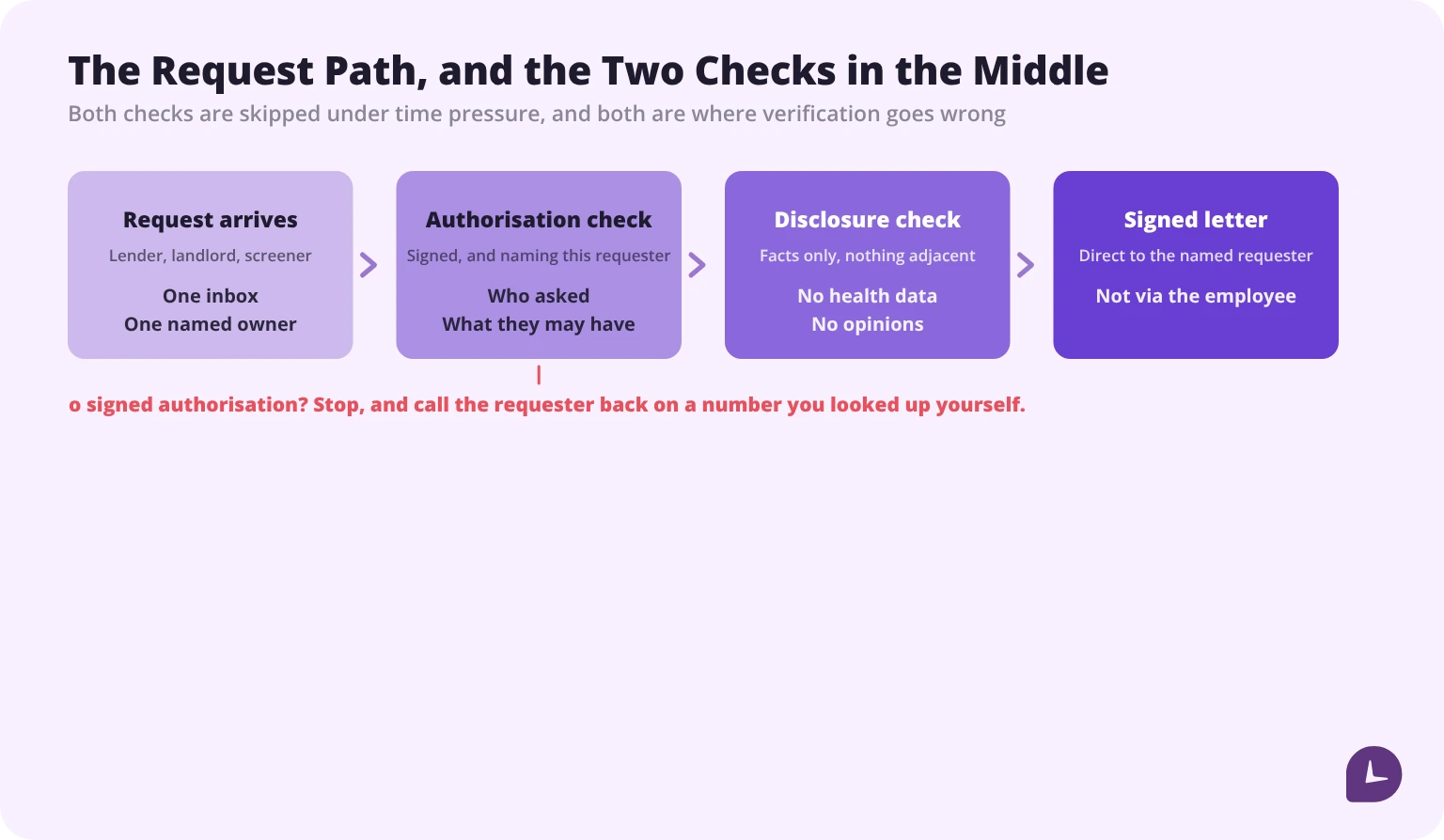
The two checks in the middle are the whole job. Everything else is typing.
What goes in an employment verification letter?
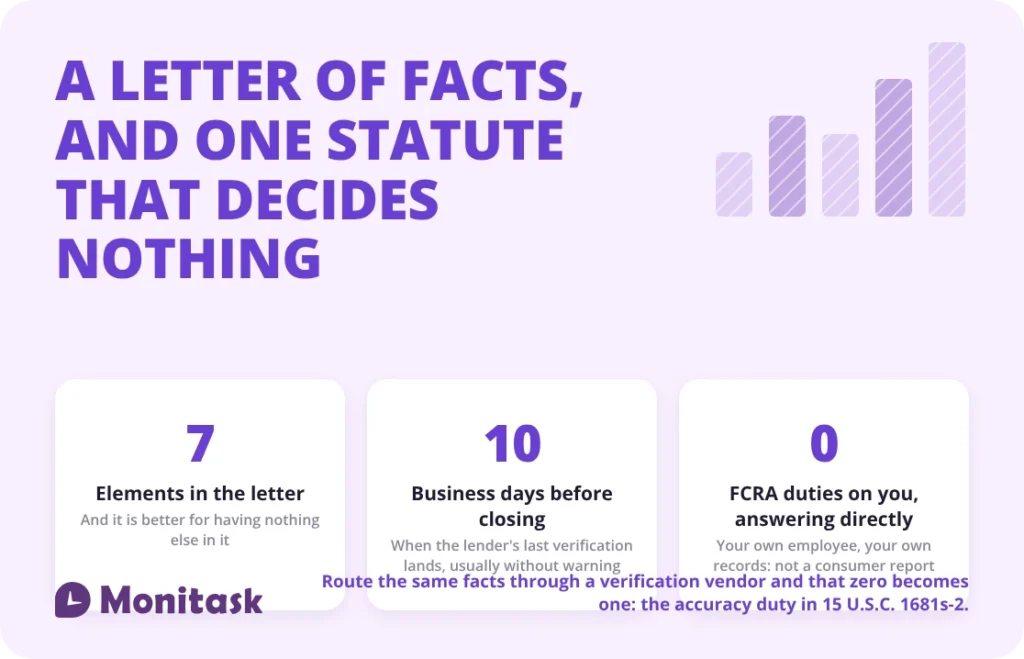
7 elements, and the letter is better for having nothing else in it.
| Element | What it looks like | Why it matters |
|---|---|---|
| Letterhead and date | Legal entity name, address, phone, letter date | The requester has to be able to call back and confirm the letter is real |
| Named addressee | The requesting organisation by name, not “To Whom It May Concern” | A named addressee is harder to reuse for a purpose the employee did not authorise |
| Employee identification | Full legal name, job title, department | Matches the name on the application being reviewed |
| Employment status | Current or former, full-time or part-time, exempt or non-exempt | “Employed” alone does not answer the question an underwriter is asking |
| Dates | Start date, and end date if the person has left | The single most requested fact |
| Compensation, only if authorised | Gross base pay with the period stated; hourly rate with average hours if paid hourly | The most sensitive fact in the letter and the one employees least expect you to send |
| Signature block | Name, title, direct phone, an offer to confirm | The requester will often call; make that easy and route it to one place |
Two details separate a letter that is accepted from one that comes back.
State the pay period. “$78,000” is ambiguous. “$78,000 per year, paid semi-monthly” is not. For an hourly employee, “$29.50 per hour, averaging 38 hours per week over the last 12 months” answers the question the underwriter would otherwise have to ask you twice.
Say what you are not confirming. One closing sentence — that the letter confirms employment and compensation and does not address performance or any future employment — costs nothing and stops the letter being read as a promise.
Employment verification letter template
Copy this, replace the bracketed fields, and delete any line the employee has not authorised.
[COMPANY LETTERHEAD]

[Date]

[Requester name]
[Requester organisation]
[Street address]
[City, State ZIP]

Re: Employment verification for [Employee full legal name]

Dear [Requester name]:

At the written request of [Employee full legal name], I am
writing to confirm the following facts regarding their
employment with [Legal entity name].

Employee name:        [Full legal name]
Position:             [Job title]
Department:           [Department]
Employment status:    [Full-time / Part-time], [currently employed /
                       employed from the dates below]
Start date:           [Month DD, YYYY]
End date:             [Month DD, YYYY, or "Not applicable -
                       currently employed"]
Compensation:         [$X per year, paid [frequency]] or
                      [$X per hour, averaging X hours per week]

This letter confirms employment and compensation only. It does
not address job performance and does not constitute a contract
of employment or a guarantee of continued employment.

If you need to confirm the contents of this letter or require
additional information, please contact me directly at
[phone] or [email]. Additional information will be released
only with further written authorisation from the employee.

Sincerely,

[Signature]

[Printed name]
[Title]
[Legal entity name]
[Phone] - [Email]
For a former employee, delete the compensation line unless they have specifically authorised release of their pay at termination, and replace the status line with the dates of employment.
What does the email version look like?
Many requests now arrive by email and most requesters will accept a PDF on letterhead. Some will accept the body of the email itself. Same facts, same restraint:
Subject: Employment verification - [Employee full legal name]

Dear [Requester name]:

At the written request of [Employee full legal name], I confirm
that they [are currently employed by / were employed by]
[Legal entity name] as [Job title], [full-time / part-time],
from [start date] to [end date or "present"].

[Compensation: $X per year, paid [frequency].]

This confirms employment and compensation only and does not
address performance or any future employment.

Please contact me at [phone] if you need to verify this message.

[Printed name], [Title]
[Legal entity name]
Two cautions on the email route. Send it from a company address to the requester’s organisational address, not to a personal one, and never by replying to a free-mail account claiming to be a lender. And attach the signed letter as a PDF when the amount at stake is large: a loan file wants a document, and an email thread is easy to edit.
What must you leave out of the letter?
This is where the real risk lives, and it is the section template sites skip. 9 things, and it is worth being honest about which of them are rules and which are good practice — because only 2 of them have a federal rule behind them.
| Leave out | Authority | Why |
|---|---|---|
| Medical information, disability, or anything health-adjacent | 29 C.F.R. 1630.14 and 29 C.F.R. 1635.9 | Confidentiality is a rule, not a preference, and no exception in either rule covers a lender, a landlord or a prospective employer |
| Family medical history | 29 C.F.R. 1635.9 | Genetic information under GINA, and the GINA rule bites regardless of how you came to hold it |
| Pay, where the employee has not authorised its release | Policy | Nothing federal forbids it, and that is exactly why the authorisation is the control |
| Reason for separation, in an unprompted letter | Policy | Volunteering why someone left turns a factual confirmation into a characterisation you then have to defend |
| Any assessment of performance | Policy | A verification letter is not a reference; one sentence of praise or criticism changes the document’s character |
| Protected characteristics, directly or by implication | Policy | Age, national origin, religion, pregnancy and the rest do not belong in the letter in any form |
| Anything about complaints, investigations or disputes | Policy | Including it invites a retaliation argument you will not win |
| Language suggesting permanent employment | Policy | “Will continue to be employed” and “permanent position” read as promises |
| Opinions, in any form | Policy | If it is not a date, a title, a status or a number, it is an opinion |
The two that are rules. Medical information obtained through the employment-related examinations and inquiries the ADA governs must be collected and maintained on separate forms and in separate medical files
and be treated as a confidential medical record
under 29 C.F.R. 1630.14. The rule admits 3 exceptions, and they are narrow: work restrictions and accommodations to supervisors, emergency treatment needs to first aid and safety personnel, and relevant information to government investigators. A mortgage lender is not among them. A landlord is not among them. A prospective employer is not among them.
Genetic information is governed separately by 42 U.S.C. 2000ff-5 and 29 C.F.R. 1635.9, and the GINA rule is the cleaner citation of the two, because it reaches a covered entity that holds genetic information regardless of how the entity obtained the information
. It does not depend on how the information arrived. Family medical history counts as genetic information, which is exactly the sort of thing that drifts into a chatty letter.
The seven that are policy. They are not weaker for that. Volunteering a reason for separation, a line of praise, or a note about an open dispute costs you something and gains you nothing — but call them what they are rather than implying a statute you cannot cite.
Pay deserves its own paragraph, because the law here is widely misstated. No federal rule restricts an employer from disclosing a current or former employee’s own pay to a third party the employee has authorised. Several jurisdictions restrict what a prospective employer may ask about or rely on regarding salary history, and that is a different rule pointed at a different party. Whether any state restricts what a former employer may disclose is a question we could not resolve at a primary source for this article, and it is listed in Sources rather than guessed at. The practical default stands on its own: release compensation only to requesters who specifically ask for it, and only on written authorisation.
On language that sounds like a promise. “Will continue to be employed” and “permanent position” are the two phrases that turn a factual letter into something a reader can characterise as a commitment. The terms of employment belong in the offer letter, not in a verification letter written two years later.
How does the letter change for a former employee?
The facts narrow and the risk goes up.
| Item | Current employee | Former employee |
|---|---|---|
| Status line | Position, full-time or part-time, currently employed | Dates of employment and the position held |
| Pay | Current gross pay with the period stated, if authorised | Pay at termination, only if specifically authorised |
| Reason for leaving | Not applicable | Do not volunteer it; disclose only on a signed request that asks for it |
| Eligibility for rehire | Not applicable | Answer only if your policy says to, and answer consistently for everyone |
| Who signs | Manager or HR | HR only – a former manager may no longer have accurate records |
The consistency point matters more than it looks. If you confirm rehire eligibility for some former employees and decline for others, the pattern is the evidence. Decide the policy once, write it down, apply it without exception. If your practice is to confirm dates and title and nothing more, say exactly that in the letter and you are finished.
A finding that cuts against the usual advice. Employers are often told that state reference-immunity statutes protect them when they answer questions about a former employee. Two such statutes were read at source for this article:
| State | Citation | Immunity covers disclosure to | Plaintiff must show |
|---|---|---|---|
| Ohio | Ohio Rev. Code 4113.71 | a prospective employer, on request of that employer or the employee | preponderance of the evidence |
| Florida | Fla. Stat. 768.095 | a prospective employer, on request of that employer or the employee | clear and convincing evidence |
Florida’s statute says the employer is immune from civil liability for such disclosure or its consequences
unless it is shown by clear and convincing evidence that the information disclosed
was knowingly false or violated a protected civil right. Ohio’s is structured the same way, failing where the employer disclosed particular information with the knowledge that it was false
or acted in bad faith.
Notice what both of them cover: a disclosure to a prospective employer, on request of that employer or the employee. Neither one reaches a mortgage lender, a landlord, or a benefits programme — which is to say, neither one covers most of the requests this article is about. Where reference immunity exists, it is narrower than the use cases. What protects you when you answer a lender’s form about a departed employee is not an immunity statute. It is the employee’s signature on the request.
Separation-specific language belongs in the termination documents, not here; our termination guide covers that paperwork. The verification letter is deliberately thinner than a reference letter, and the thinness is the point.
What do mortgage lenders actually ask employers for?
This request generates the most back-and-forth, because the lender is usually not asking for a letter at all. They are asking you to complete a standard form.
For conventional loans that form is Form 1005, Request for Verification of Employment. One correction to the version of this that circulates everywhere: it is a Fannie Mae form, carrying Fannie Mae Form 1005 July 96
in its own footer, not a joint Fannie Mae and Freddie Mac publication. Its penalty notice names the VA, the U.S.D.A., FmHA/FHA and HUD/CPD rather than either enterprise, which is a hint at the form’s actual lineage.
| Part | Items | Who completes it | What it asks for |
|---|---|---|---|
| Part I | items 1-8 | Lender, then applicant | Lender fills 1-7 and names itself and the employer; the applicant signs the authorization at item 8 |
| Part II – Verification of Present Employment | items 9-20 | Employer, for a current employee | Date of employment, present position, probability of continued employment, current gross base pay with the period checked, gross earnings by base, overtime, commissions and bonus, whether overtime or bonus is likely to continue, average weekly hours if paid hourly, pay increase dates, and remarks |
| Part III – Verification of Previous Employment | items 21-25 | Employer, for a former employee | Date hired, date terminated, salary or wage at termination by base, overtime, commissions and bonus, reason for leaving, position held |
| Part IV – Authorized Signature | items 26-30 | Employer | Signature, title, date, printed name, phone number |
Three things on this form routinely catch HR teams out.
It must not travel through the applicant. The instructions tell the lender to Forward directly to employer named in item 1
, tell the employer to Please complete either Part II or Part III as applicable
and then to Complete Part IV and return directly to lender named in item 2
, and state that the form is not to be transmitted through the applicant or any other party
. For a first mortgage the lender sends it directly and the borrower may not hand-carry it; for a second mortgage the borrower may carry it to the employer, but it still goes back to the lender directly. If an employee hands you a Form 1005 for a first mortgage, the chain is already wrong.
It asks for the reason for leaving. Part III, item 24. This is the one circumstance where a former employee’s reason for separation is a requested field on a form that employee personally signed at item 8 — which is exactly why you never volunteer it in a letter where no such signature exists.
It asks for average weekly hours. Item 15, for hourly employees. Answering that needs a defensible record of hours worked. If your answer is an estimate, the loan file now contains an estimate with your signature under it.
The form is not the only route, and it is also one of the alternatives. The current Selling Guide section — B3-3.2-01, Standards for Employment and Income Documentation, dated 03/04/2026 — says The lender may use the Request for Verification of Employment (Form 1005) to document employment and income
, and then lists alternative documentation that may be used as long as adequate information is provided
. Form 1005 appears inside that list of alternatives, beside an IRS Wage and Income transcript and a final year-to-date paystub. The recency rule is specific: The most recent paystub must be dated no earlier than 30 days prior to the initial loan application date
. For W-2 forms, IRS W-2 forms must cover the most recent one- or two-year period
, where the most recent W-2 means the one for the calendar year before the current year. Where the lender verifies with the employer directly, the Guide also requires that the lender must have the borrower sign Form 1005
.
If you are working from notes written before 2026, re-check every Selling Guide citation. Chapter B3-3 was restructured: employment documentation moved from B3-3.1-02 to B3-3.2-01, under Section B3-3.2, Requirements for Employment-Related Income. The old URL still resolves and serves the renumbered page, which is what makes the stale citation so easy to repeat.
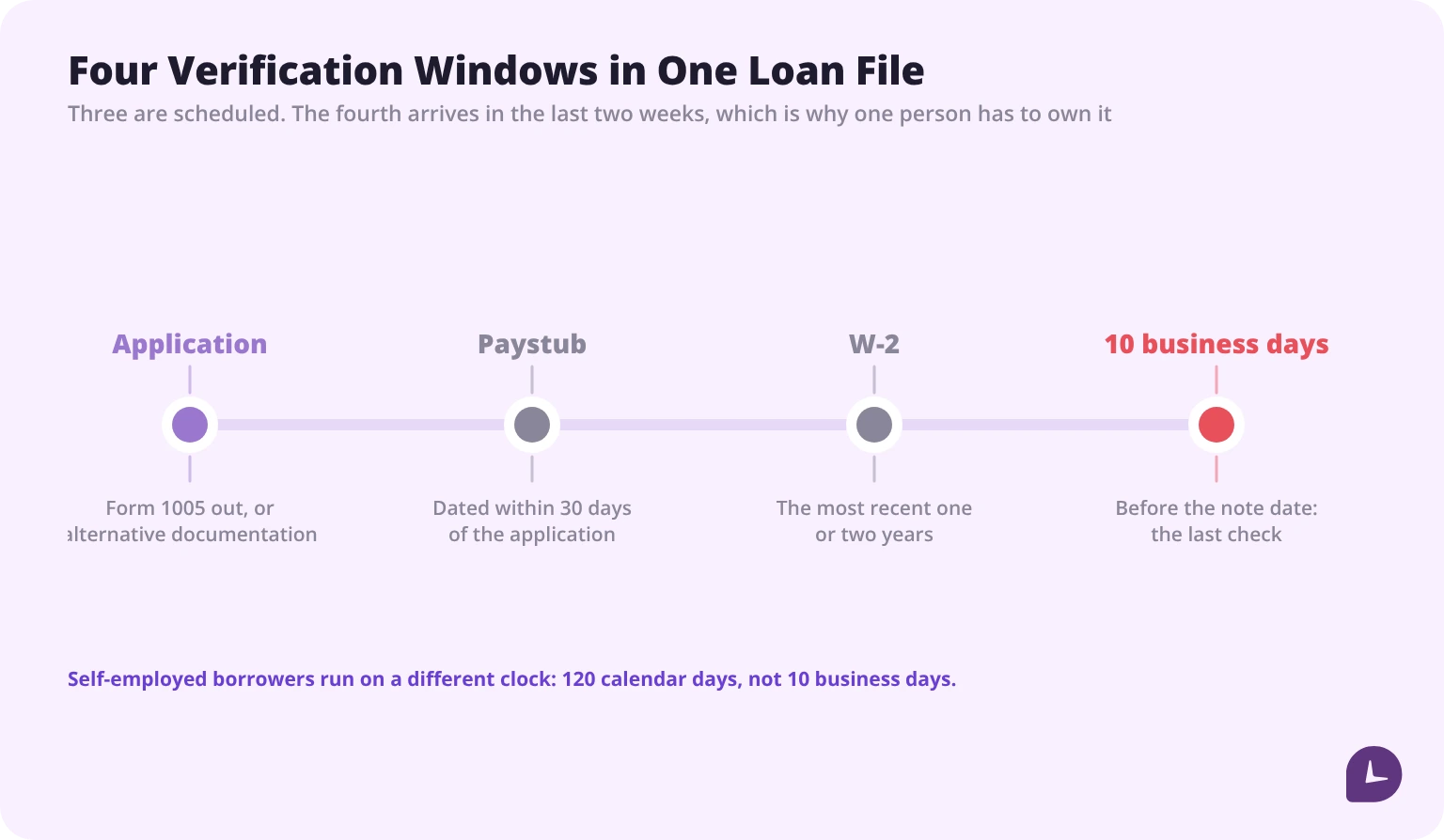
The last check is the one that arrives without warning. For borrowers using employment-related income to qualify
, the lender must verify the borrower’s employment no more than 10 business days on or before the note date
. That is B3-3.1-04, Verbal Verification of Employment, dated 10/07/2026. Three qualifications most summaries drop:
- The qualifier is load-bearing. A different clock governs self-employed borrowers and those using Schedule K-1 income with under 25% ownership: for them
the lender must complete the verbal VOE no more than 120 calendar days on or before the note date
. That is 120 calendar days, not 10 business days, and the documentation must also confirm the business still exists. - The extension has a condition. The lender may go to 15 business days before the note date, but only
when they are relying on documentation dated within 15 business days
reflecting the most recent pay period before the date of that documentation. “15 days” on its own is not the rule. - It is not necessarily a phone call. The verification
may be obtained verbally, in writing, through an employment verification vendor, or by other means acceptable to the lender
. The familiar late call is the common case, not the requirement.
Still, plan for the call. It lands in the last two weeks before closing, often on a direct line someone found online, and it is the single most common reason a verification request becomes urgent. Route those calls to one named person with the employment record in front of them.
Does the FCRA apply when you answer a verification request?
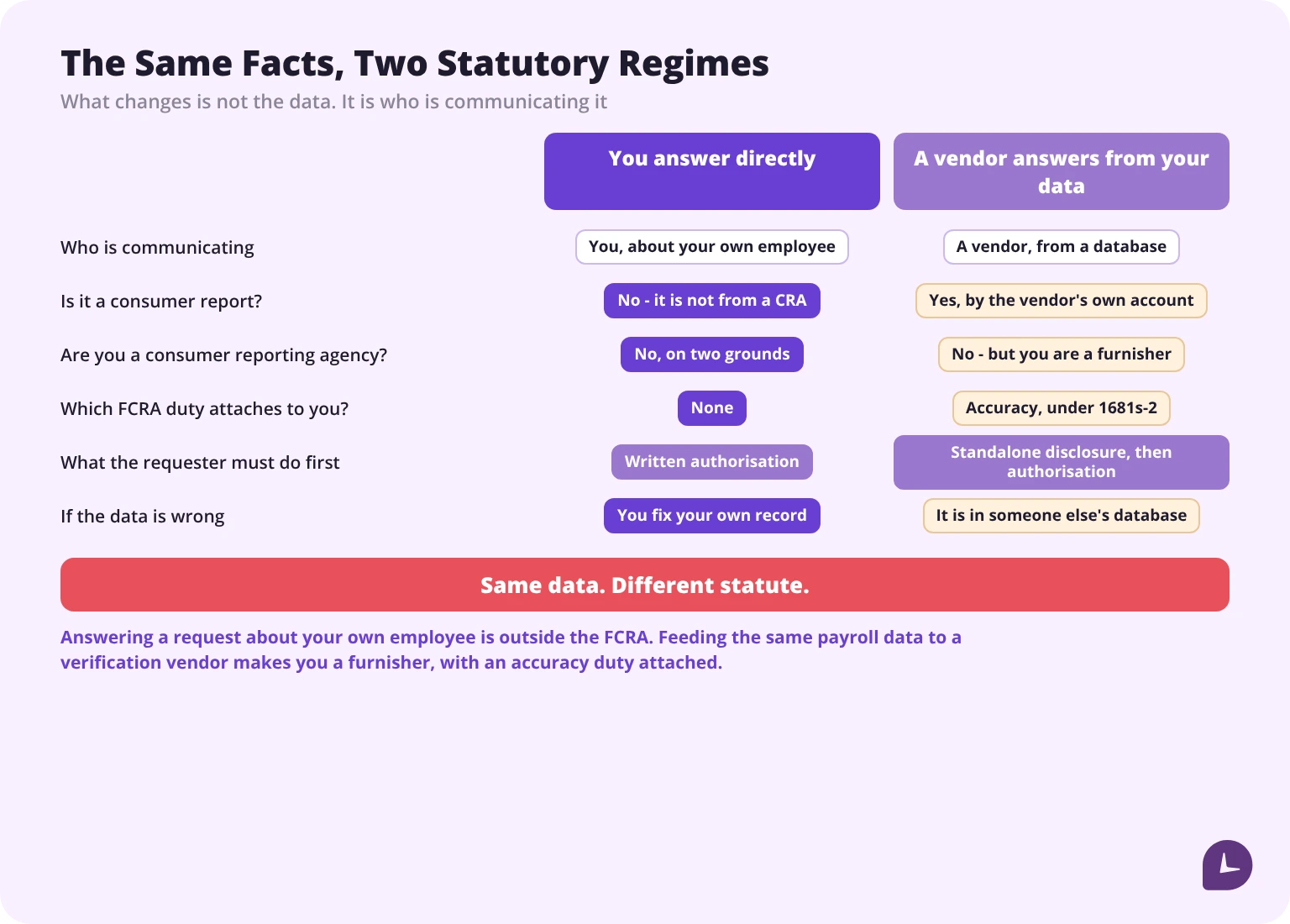
Not when you answer directly about your own employee from your own records. Most guides hedge this to counsel. The statute answers it, on two independent grounds, and the answer is worth having because it tells you where your actual controls are.
Ground one: it is not a consumer report, because you are not a consumer reporting agency. 15 U.S.C. 1681a(d)(1) defines a consumer report as a communication of information by a consumer reporting agency
. If the communicator is not a consumer reporting agency, the communication is not a consumer report, whatever it contains. And 15 U.S.C. 1681a(f) defines such an agency as a person that, for fees or dues or on a cooperative nonprofit basis, regularly engages in whole or in part in the practice of assembling or evaluating consumer credit information or other information on consumers
for the purpose of furnishing consumer reports to third parties. An employer reporting its own records about its own employee, on request and without a fee, meets none of that.
Ground two: the transactions-and-experiences exclusion. Independently of the first ground, 15 U.S.C. 1681a(d)(2)(A)(i) excludes from “consumer report” any report containing information solely as to transactions or experiences between the consumer and the person making the report
. The employment relationship is precisely such a transaction or experience. Dates, title, status and pay drawn from it sit inside the exclusion.
So the FCRA machinery — standalone disclosure, written authorisation, pre-adverse-action notice — attaches to the requester who procures a report from a consumer reporting agency. It does not attach to you for answering. Your control is not the statute. Your control is the employee’s written authorisation, which is why that is the thing to get right.
But there is a duty you can pick up, and it is the one most employers miss. The moment you feed payroll data into a verification vendor’s database, you are not a consumer reporting agency — you are a furnisher. 15 U.S.C. 1681s-2 is headed Responsibilities of furnishers of information to consumer reporting agencies, and its first substantive rule is that a person shall not furnish any information relating to a consumer to any consumer reporting agency
where that person knows or has reasonable cause to believe that the information is inaccurate
.
Over 5 million employers contribute employment and income data to The Work Number alone, contribute employment and income data, directly or through payroll providers
, and the service describes its own output as FCRA-compliant data delivery released to verifiers with a permissible purpose. If your payroll provider pushes data on your behalf, you are in that chain whether or not anyone in HR has thought about it.
| You answer directly | A vendor answers from your data | |
|---|---|---|
| Who is communicating | You, about your own employee | A vendor, from a database |
| Is it a consumer report? | No – 15 U.S.C. 1681a(d)(1) requires a consumer reporting agency | Yes, on the vendor’s own account of its product |
| Are you a consumer reporting agency? | No – you fail every limb of 15 U.S.C. 1681a(f) | Still no – but you are a furnisher |
| Which FCRA duty attaches to you? | None | The accuracy duty in 15 U.S.C. 1681s-2 |
| What the requester must do first | Get the employee’s written authorisation; that is your control | Standalone disclosure and written authorisation under the FCRA |
| If the data is wrong | You correct your own record | The error is in someone else’s database and reaches the loan file before you see it |
The Selling Guide permits the vendor route: The lender may receive employment and income verification directly from a third-party employment verification vendor
, subject to 5 conditions, the last being that the lender understands it will be held accountable for the integrity of the information obtained from this source
. One sentence in that subsection is the one HR should read, because it contradicts the assumption that a vendor arrangement ends your involvement: If necessary, the lender must supplement these verifications by obtaining any missing information from the borrower or their employer
. The request can come back to you anyway, as a gap to fill.
What about verifying someone else’s past employment?
The rules reverse when you are checking a candidate rather than confirming your own employee.
If you telephone the previous employer yourself, you are doing your own reference check and the analysis above applies in reverse — they are answering about their own employee. If you use a background screening company or any other consumer reporting agency to verify employment history, you are procuring a consumer report for employment purposes, and the Fair Credit Reporting Act attaches obligations before you order it and before you act on it. Our background check glossary entry covers the process; the statutory duties are these:
| Stage | What the statute requires |
|---|---|
| Before ordering | a clear and conspicuous disclosure has been made in writing to the consumer, and that disclosure must be in a document that consists solely of the disclosure— the consumer has authorized in writing too |
| Before rejecting the candidate on it | before taking any adverse action based in whole or in part on the report, give the consumer a copy of the reportand a description in writing of the rights of the consumer under this subchapter, as prescribed by the Bureau under section 1681g(c)(3) |
Two details worth holding on to. The phrase in a document that consists solely of the disclosure
is the clause most often broken in practice, because the disclosure gets folded into an application packet or an offer letter alongside other terms. Keep it as its own page with its own signature. And the written description of rights is not something you draft: the statute points at a summary the Bureau prescribes.
Our own background check policy covers the internal process.
How should the request get handled?
Verification is a records problem disguised as a letter-writing problem. 3 decisions remove almost all of the friction.
One owner. All requests to one inbox and one named person. Managers do not answer them and former managers never do. A manager who confirms pay informally on the phone has disclosed compensation without authorisation and left no record that it happened.
One release form. A short authorisation the employee signs, naming the requester, the purpose, and specifically whether pay may be disclosed. The Selling Guide requires the borrower’s signature on Form 1005 itself, which covers that form and nothing else.
One source of record. The letter is only as good as the dates, title, status and hours behind it, and one of those answers is a signed statement about hours worked.
Where each fact has to come from:
| Fact in the letter | Where the answer comes from |
|---|---|
| Start and end dates | Personnel record, not memory |
| Job title and status | Current job record, reflecting the latest change |
| Gross base pay and period | Payroll, with the pay frequency stated |
| Average weekly hours for hourly staff | Time records over a stated period, not an estimate – this is item 15 on Form 1005 and it carries your signature |
| Overtime and bonus history | Payroll by year, matching the periods the form asks for |
That fourth row is where most teams stall. The form asks for average weekly hours and for overtime across several periods, and a signed answer to that needs a time record you can stand behind rather than a reconstruction. Attendance tracking that already holds the hours turns the question into a lookup.
Set a response time and publish it. 2 business days is reasonable and most requesters will accept it if they know in advance. The late verification before closing is the exception, and the reason to have a named person who can answer the same day.
Hours, overtime and the history behind them, already recorded when the form asks for an average.
See Monitask's time clock software
Sources
Every document below was read directly, at the publisher’s own site, on 12 November 2026.
- Form 1005, Request for Verification of Employment — the form itself, served on a government site. Instructions, part and item structure, and the first and second mortgage transmission rules. The form carries the revision date July 1996.
- Fannie Mae Selling Guide B3-3.2-01, Standards for Employment and Income Documentation, 03/04/2026. Documentation standards, paystub recency, W-2 requirements, and third-party verification vendors. Note the renumbering from B3-3.1-02; the superseded URL still resolves.
- Fannie Mae Selling Guide B3-3.1-04, Verbal Verification of Employment, 10/07/2026. The 10-business-day window, the 15-business-day extension and its condition, the 120-calendar-day self-employment rule, and the permitted methods.
- Fair Credit Reporting Act —
15 U.S.C. 1681a(d),1681a(f),1681b(b)(2)(A),1681b(b)(3)(A)and15 U.S.C. 1681s-2, read on govinfo in the United States Code 2024 Edition. - Americans with Disabilities Act —
42 U.S.C. 12112(d)(3)(B)and29 C.F.R. 1630.14; Genetic Information Nondiscrimination Act —42 U.S.C. 2000ff-5and29 C.F.R. 1635.9. Read on govinfo in the CFR annual edition revised as of 1 July 2025. - Reference immunity —
Ohio Rev. Code 4113.71read on the Ohio official code site andFla. Stat. 768.095read on the Florida Legislature’s own site. - The Work Number — the vendor’s own site, for the number of contributing employers, the Data Contributor framing, and the description of its output as FCRA-governed data.
- Personnel and employment records —
29 C.F.R. 1602.14. one year from the making of the record or the personnel action, whichever is later; one year from the date of termination for an involuntary termination. Read on govinfo in the CFR annual edition revised as of 1 July 2025. Verified 12 November 2026. - Payroll records —
29 C.F.R. 516.5. at least three years. Read on govinfo in the CFR annual edition revised as of 1 July 2025. Verified 12 November 2026. - Open items, where a primary source could not be reached:
- Whether Form 1005 has a revision later than July 1996. The form served on fhfa.gov carries a July 1996 revision date and the current Selling Guide actively references it, so it is operative. Fannie Mae’s own forms index returned an error on every path, so a later revision could not be ruled out.
- What Announcements SEL-2026-02 and SEL-2026-09 actually changed. Both are listed on the Selling Guide section pages with their dates, and the October announcement matches the verbal-verification version date, but the announcement documents themselves and the announcements index could not be retrieved, so which one performed the chapter renumbering is unconfirmed.
- Whether any state law restricts an employer from disclosing pay. This is a different question from the salary-history inquiry bans, and it is the one that would bear on a verification letter. One jurisdiction was attempted and both of its official publishers returned errors, so no state is named here in either direction.
- Whether the FCRA text has changed since the 2024 Code edition. The quotations here are from the United States Code 2024 Edition. The language is long-standing, but a later edition and any intervening public law were not checked.
FAQ
Does writing a verification letter make us a consumer reporting agency?
No. 15 U.S.C. 1681a(f) requires a person who regularly assembles or evaluates information on consumers in order to furnish consumer reports to third parties, for fees or on a cooperative nonprofit basis. An employer answering about its own employee does none of that. Separately, 15 U.S.C. 1681a(d)(2)(A)(i) excludes a report containing information solely as to transactions or experiences between the consumer and the person making the report. Either ground is enough on its own.
We send payroll data to a verification service. Does that change anything?
Yes. You are then a furnisher of information to a consumer reporting agency, and 15 U.S.C. 1681s-2 forbids furnishing information you know or have reasonable cause to believe is inaccurate. The practical consequence is that the accuracy of what the vendor holds is partly your problem, and errors in it reach a loan file before anyone asks you.
Can we disclose salary in the letter?
Only when the employee has authorised it in writing, and ideally only to requesters who need it — lenders, landlords, income-tested programmes. State the figure with its pay period. For a prospective employer, the safer default is to omit it.
Who should sign the letter?
Someone with access to the authoritative record and the authority to speak for the entity, which normally means HR. A direct manager may sign for a current employee if your policy allows it. Managers should never answer requests about former employees, because they no longer have the records.
Does a state reference-immunity statute protect us?
Where one exists, it may — but read what it covers. Both statutes examined for this article protect a disclosure made to a prospective employer on request. Neither extends to a mortgage lender, a landlord or a benefits programme, which is where most verification requests come from. Treat the employee’s written authorisation, not an immunity statute, as the thing standing between you and a complaint.
What should we do if a request looks suspicious?
Call the requesting organisation on a number you looked up independently, not one supplied in the request. A verification letter contains employment dates, employer identity and sometimes pay — exactly the set of facts an identity-theft attempt wants. A request with no signed authorisation from the employee is reason enough to stop.