Overworking Symptoms: How to Tell If You’re Working Too Much

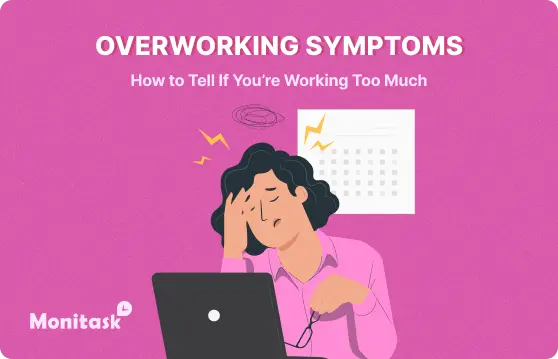
Overworking means working beyond what you can sustain — in hours, in intensity, or in the mental space work takes up when you are not doing it. The signs show up in three places: the body, concentration, and behaviour. The harder question is not whether you have them, because most people do during a bad month. It is whether this is a bad month or a pattern, and that is a question you can answer with data rather than guesswork.
Key takeaways
- The WHO and ILO identify 55 hours a week as the threshold above which health risk rises measurably.
- Research on working hours finds that output stops rising in proportion to hours somewhere around 50 a week.
- Overworking is not burnout. Overworking is the input; burnout is a state that can follow prolonged, unresolved work stress.
- A hard month has an end date you can name. If you cannot name one, it is a pattern.
- Persistent physical symptoms are a reason to see a doctor, not to read another article about productivity.
Reliable employee tracking software. Clear visibility and insights into how employees work. Even remotely.
Try Now
How Many Hours Is Too Many?
There is no single number that applies to everyone, but there are two reference points worth knowing.
| Reference point | What it says |
|---|---|
| WHO and ILO, 2021 | Working 55 hours or more a week is associated with higher risk of stroke and ischaemic heart disease. Their analysis attributed 745,000 deaths in 2016 to long working hours, a 29% rise since 2000 |
| Research on working hours | Output per hour falls as weekly hours rise past roughly 50. Beyond about 55, additional hours produce little additional finished work |
Two caveats matter. These are population-level findings, not a personal threshold — individual tolerance varies with the work, the control you have over it, and what else is happening in your life. And hours are only one input. Twenty hours of work you cannot influence, on a deadline you did not agree to, can cost more than fifty hours of work you chose.
The practical version: if you are regularly past 50 hours, the hours themselves are worth examining. Below that, look at intensity and control instead. For context on what a standard year actually contains, see how many work hours are in a year.
Boost your business productivity
Track performance and streamline teamwork
The Signs, in Three Groups
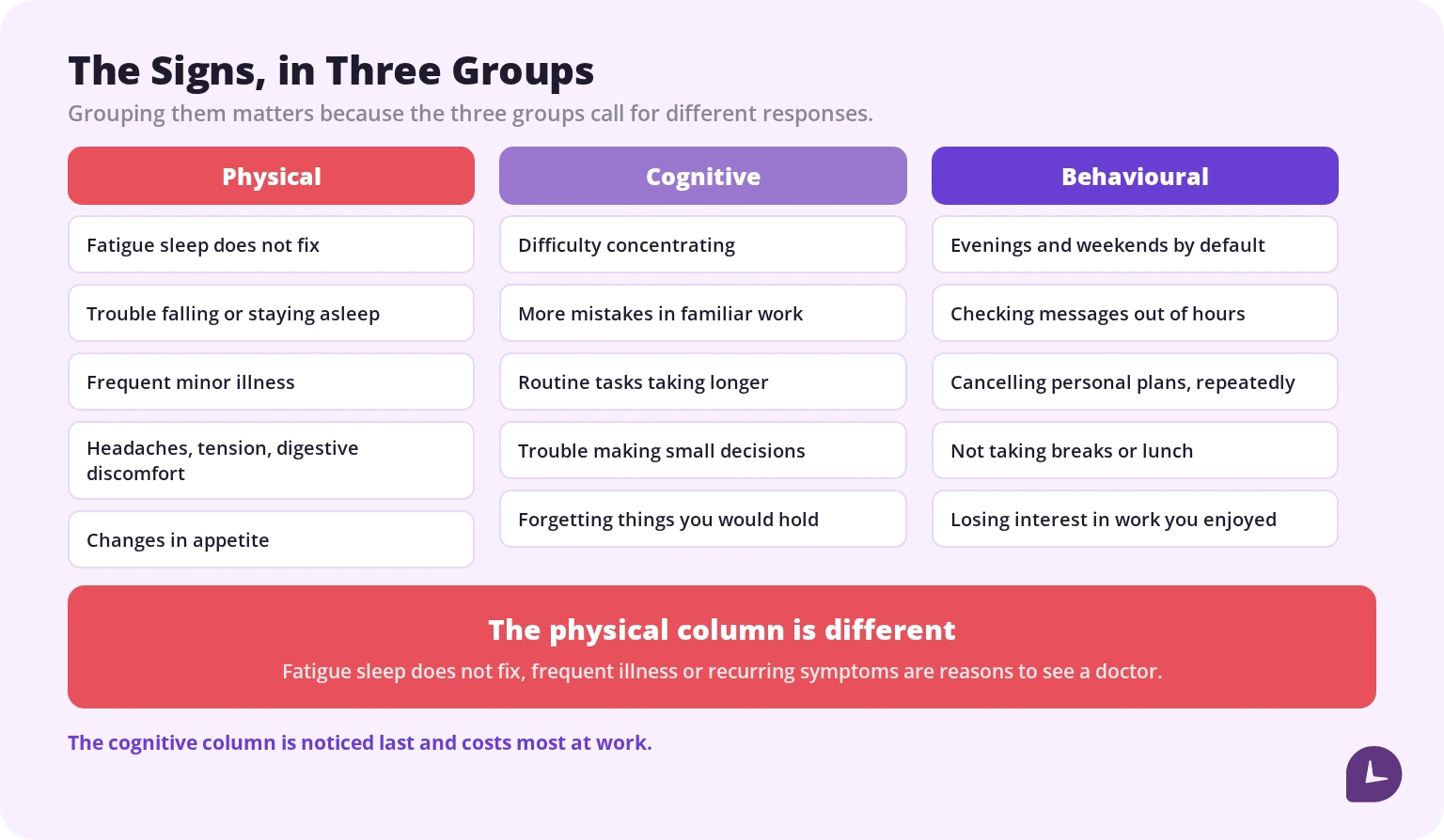
Grouping them matters because the three groups call for different responses.
| Physical | Cognitive | Behavioural |
|---|---|---|
| Persistent fatigue that sleep does not fix | Difficulty concentrating on one task | Working evenings and weekends as the default |
| Trouble falling or staying asleep | More mistakes than usual in familiar work | Checking messages outside working hours |
| Frequent minor illness | Taking longer over routine tasks | Cancelling personal plans for work, repeatedly |
| Headaches, tension, digestive discomfort | Trouble making small decisions | Not taking breaks or lunch |
| Changes in appetite | Forgetting things you would normally hold | Losing interest in work you used to enjoy |
The physical column is the one to act on differently. Fatigue that sleep does not fix, frequent illness, or recurring physical symptoms are reasons to see a doctor. They have causes other than overwork, and an article about working hours is not the place to diagnose them.
The cognitive column is the one people notice last and the one that costs most at work. It is also self-reinforcing: slower work creates more hours, and more hours make the work slower.
Is This a Hard Month or a Pattern?
This is the question the symptom lists do not answer, and it is the one that determines what to do. Everyone has periods of intense work, and a launch, a quarter-end or a colleague’s absence produces most of the signs above. That is not the same as overworking.
| A hard period | A pattern | |
|---|---|---|
| End date | You can name it | You cannot, or it keeps moving |
| Cause | A specific, identifiable event | “It is always like this” |
| Recovery | You expect to catch up afterwards | The last quiet period did not help much |
| Your reaction | Tiring but you can see the point | Resentment, or numbness |
| How long | Weeks | Months, or you have stopped counting |
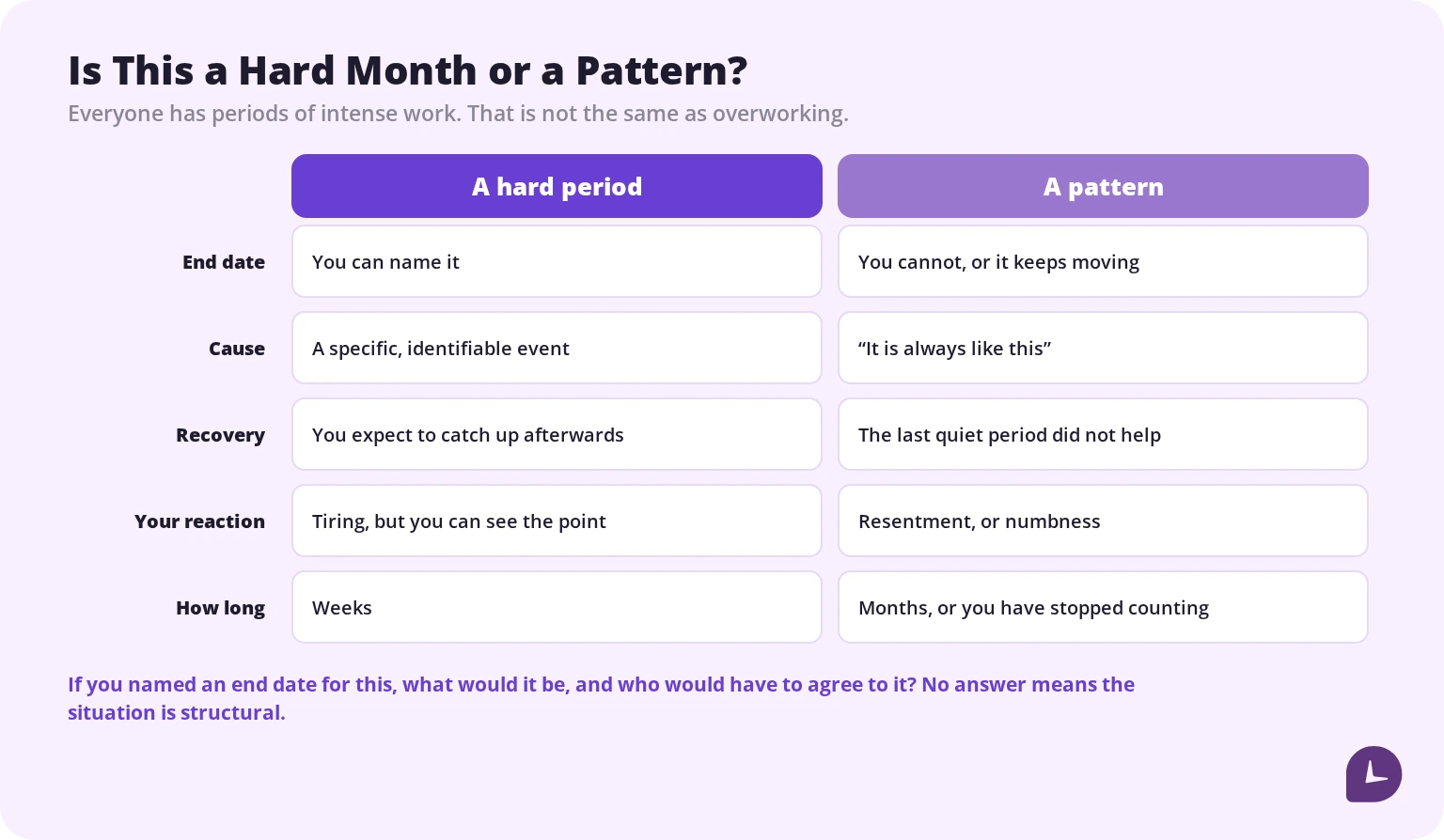
Two questions cut through it faster than any list. When did you last finish a week feeling caught up? And if you named an end date for this, what would it be, and who would have to agree to it? If the second question has no answer, the situation is structural rather than temporary, and structural situations do not resolve by working harder through them.
Overworking Is Not Burnout
The two get used interchangeably and they are different things.
Overworking is an input — too many hours, too much intensity, too little recovery. It is a description of what is happening to your time.
Burnout is a state that can develop from prolonged, unresolved work stress. The World Health Organization classifies it as an occupational phenomenon rather than a medical condition, characterised by exhaustion, mental distance from the job, and reduced effectiveness.
The distinction is practical. Overworking often resolves when the hours change. Burnout typically does not — by that stage a week off tends to produce relief that disappears within days of returning, which is one of the more reliable signals that the problem has moved beyond hours.
Look at Your Actual Hours
Most people cannot accurately say how much they worked last week, and the error usually runs in one direction. Evening work, weekend catch-up, the hour after dinner and the checking of messages on Sunday are exactly the hours that do not get counted, because they do not feel like working.
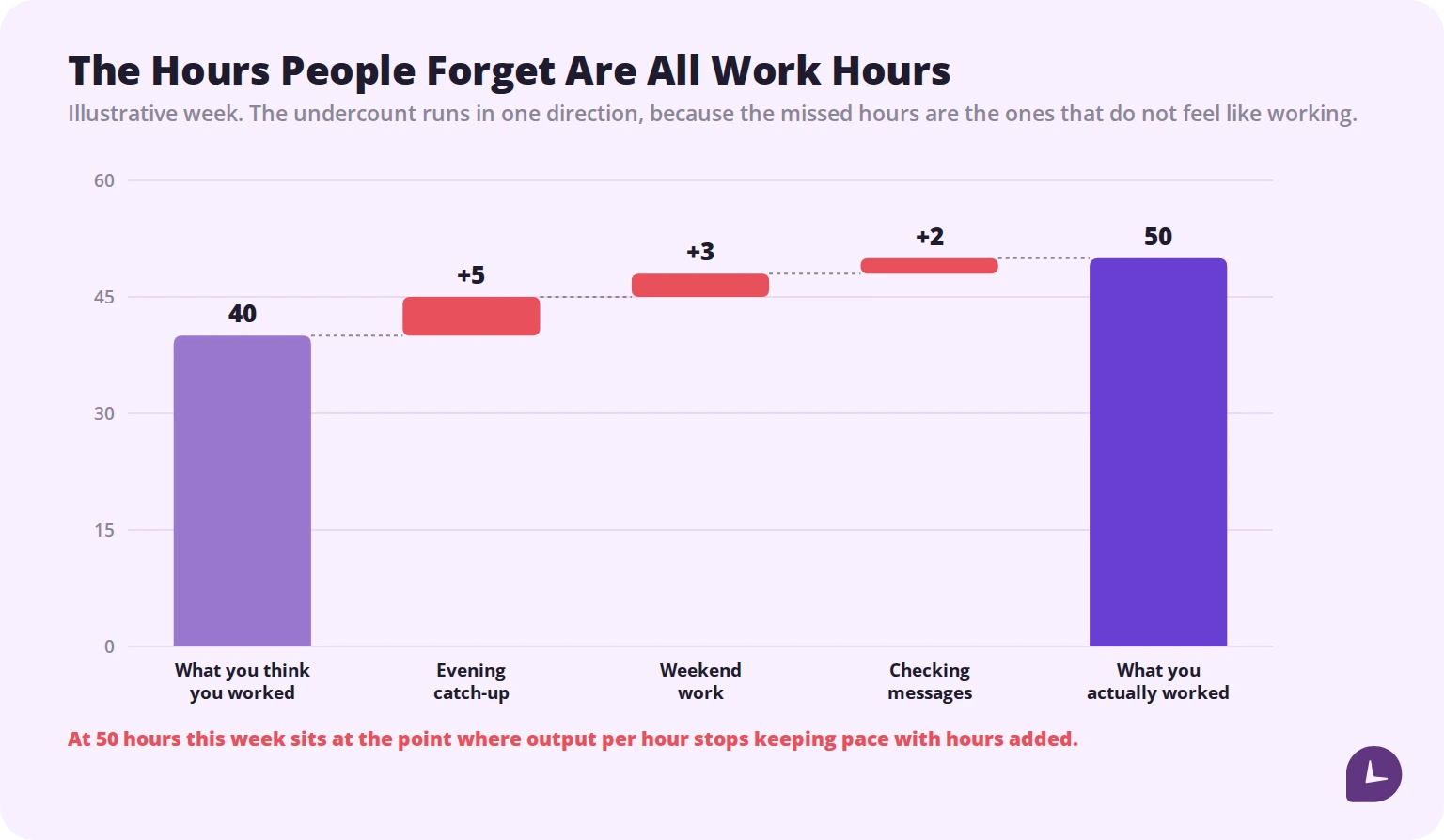
This matters for two reasons. You cannot tell a hard month from a pattern without a few months of data. And a conversation with a manager about workload goes differently when it opens with a number rather than a feeling.
For a week, record when you start, when you stop, and any work outside those hours. By hand is fine. If your employer uses time tracking software, you almost certainly have access to your own records, and looking at them is usually more informative than a week of manual logging.
Three things to look for: the total against what you think it was, how much of it falls outside your stated hours, and whether the pattern is consistent or spiked by a specific event. That third one answers the question in the previous section.
What to Do
In order. The first two cost nothing and do more than the rest combined.
1. Establish the actual number
Covered above. Everything below is harder to do without it.
2. Find out whether the workload or the boundary is the problem
These need different fixes. If the work genuinely does not fit the hours, that is a resourcing conversation and no amount of personal discipline resolves it — it is a question of how to manage employee workload, and it sits with whoever allocates the work. If the work fits but expands to fill every available hour, that is a boundary problem and it is yours to fix.
The test: if you stopped at a fixed time every day for a week, what would actually fail? For a lot of people the honest answer is nothing, which is useful information.
3. Set one boundary and hold it for two weeks
One, not five. A fixed stop time, or no messages after a set hour, or one protected evening. Two weeks is long enough to find out whether the consequences you fear are real. If you are not sure where to start, the practical mechanics of setting boundaries at work are worth reading first.
4. Protect recovery, not just hours
Sleep first, because the cognitive symptoms above are downstream of it. Then breaks during the day — not because breaks are virtuous, but because concentration measurably degrades without them and the lost time comes back as slower work. This is most of how overworking affects productivity: the hours go up and the output does not follow.
5. Talk to your manager
Covered in the next section, because it is the step people avoid and the one that most often changes the situation.
6. If nothing changes, treat it as information
If the workload is structural, the boundaries hold, and the situation does not improve after an honest conversation, the answer may be that the role as constituted does not fit a sustainable week. That is worth knowing sooner rather than after a year of it.
Boost your business productivity.
Start Your 10-Day Trial
Talking to Your Manager
Most managers do not know. This sounds implausible from inside the workload, but the usual case is a manager who sees output arriving on time and concludes the workload is fine — because that is the only signal they have.
Bring numbers, not feelings. “I have averaged 54 hours over the last six weeks” is a fact that can be acted on. “I am overwhelmed” invites reassurance rather than action.
Frame it as capacity, not complaint. “Here is what is on my plate, here is what it takes, here is what I think should move” puts you both on the same side of the problem.
Come with a proposal. Three options that actually work: move a deadline, drop or postpone a piece of work, or get help on a specific part. Ask which they prefer rather than asking them to solve it.
Ask for a decision, not sympathy. End with a specific question: which of these three should I do? A conversation that ends without a decision will need repeating in a month.
One thing worth knowing: if raising workload concerns has previously produced consequences rather than changes, that is information about the environment rather than about you, and it belongs in the last item of the previous section.
When to See a Professional
Some of this is outside what a workload conversation can fix, and beyond what any set of stress management techniques will reach. Speak to a doctor or a mental health professional if:
- Physical symptoms persist for weeks, or you are unsure what is causing them.
- Sleep problems continue after your hours change.
- You feel persistently low, anxious, or detached in a way that does not lift outside work.
- You are using alcohol or other substances to wind down or to keep going.
- Time off produces relief that disappears within days of returning.
None of these means something is wrong with you. They mean the situation has moved past what time management addresses, and there are people whose job is exactly this.
Key Takeaways
Overworking is measurable, and measuring it is the step that makes everything else possible. Establish the real number, work out whether the problem is the workload or the boundary, set one boundary and hold it, and bring numbers to the conversation with your manager.
And separate the health part from the work part. Persistent physical symptoms belong with a doctor. Hours belong in a conversation about capacity. Confusing the two delays both.
If you want the number without a fortnight of manual logging, Monitask records hours and project time automatically, and the report is visible to you as well as to your manager. Try it on a 10-day free trial, no card required.
> This article is general information about workload and working hours. It is not medical advice and does not replace consultation with a qualified professional. If you are experiencing persistent physical or mental health symptoms, speak to a doctor.
Reliable employee tracking software. Clear visibility and insights into how employees work. Even remotely.
Try Monitask free for 10 days
FAQ: Symptoms of Overworking
How many hours a week is too much?
The WHO and ILO identify 55 hours a week as the point above which health risk rises measurably. Research on working hours finds output stops rising in proportion to hours somewhere around 50. Individual tolerance varies, and how much control you have over the work matters as much as the total.
What is the difference between overworking and burnout?
Overworking describes the input — too many hours, too little recovery. Burnout is a state that can develop from prolonged, unresolved work stress, characterised by exhaustion, mental distance from the job and reduced effectiveness. Overworking often resolves when hours change; burnout usually does not.
How do I know if it is just a busy period?
Ask whether you can name an end date and who would have to agree to it. A busy period has a specific cause and a foreseeable end. If the end date does not exist or keeps moving, the situation is structural rather than temporary.
How do I tell my manager I am overworked?
Bring the number of hours rather than a description of how it feels, frame it as a capacity question, and arrive with three options — move a deadline, drop something, or get help with a specific part. Ask which they prefer, so the conversation ends with a decision.
Does working fewer hours mean getting less done?
Not necessarily. Output per hour falls as weekly hours rise, so beyond a certain point additional hours produce little additional finished work. Reducing hours from a very high baseline often costs less output than people expect.
When should I see a doctor about this?
If physical symptoms persist for weeks, sleep problems continue after your hours change, low mood or anxiety does not lift outside work, or time off stops producing lasting relief. These are reasons to speak to a professional rather than to adjust a schedule.