How to Get Your Team to Respect Deadlines

Teams miss deadlines for reasons that are mostly decided before the work starts: the date was announced rather than agreed, the estimate came from the person asking, or nobody mapped what the task was waiting on. The techniques below change when you find out a date is in trouble, which is the only part a manager actually controls. If you are on the receiving end of a date rather than setting it, read how to handle tight deadlines instead.
| Why the date slips | How you can tell | What changes it |
|---|---|---|
| The date was never agreed, only announced | nobody can say who set it or when | agree the date with the person doing the work, in the conversation where it is set |
| Everything is urgent, so nothing is | more than about a third of open work is marked priority | cap what can be urgent at once and make the cap visible |
| The estimate came from the person asking, not the person doing | estimates are round numbers and always shorter than the work | ask for the breakdown, not the date |
| A dependency nobody mapped | the work stalls waiting on an input that was never scheduled | write down what each task is waiting on and who owns it |
| The deadline was known but the risk was not reported | you find out on the due date | ask for the risk early and make reporting it safe |
| Starting is the hard part, not finishing | work begins close to the date and is then rushed | set an interim deliverable, not a reminder |
Why teams miss deadlines
The six causes above have one thing in common: not one of them is about effort. People who miss deadlines are mostly not working less hard than people who hit them. They are working against a date that was wrong when it was set, or towards one they found out about too late to change.
That matters because the obvious management response to a missed deadline is pressure, and pressure addresses a cause that is usually not present. It is also why the same person misses dates on one team and hits them on another.
The one cause worth more than the others is the last: you find out on the due date. A slip you hear about on Tuesday is a scheduling problem with several solutions. The same slip heard about on Friday afternoon has one solution, and it is to tell somebody else their date has moved too. Most of what follows is about moving the conversation from Friday to Tuesday.
A cause that is genuinely about people rather than process is a handoff between two people who are not talking to each other. If the chain keeps breaking at the same join, employees who are not getting along is the problem to solve, not the schedule.
Boost your business productivity
Track performance and streamline teamwork
The psychology of deadlines
Two things are worth knowing here, and one widely repeated third thing is worth not repeating.
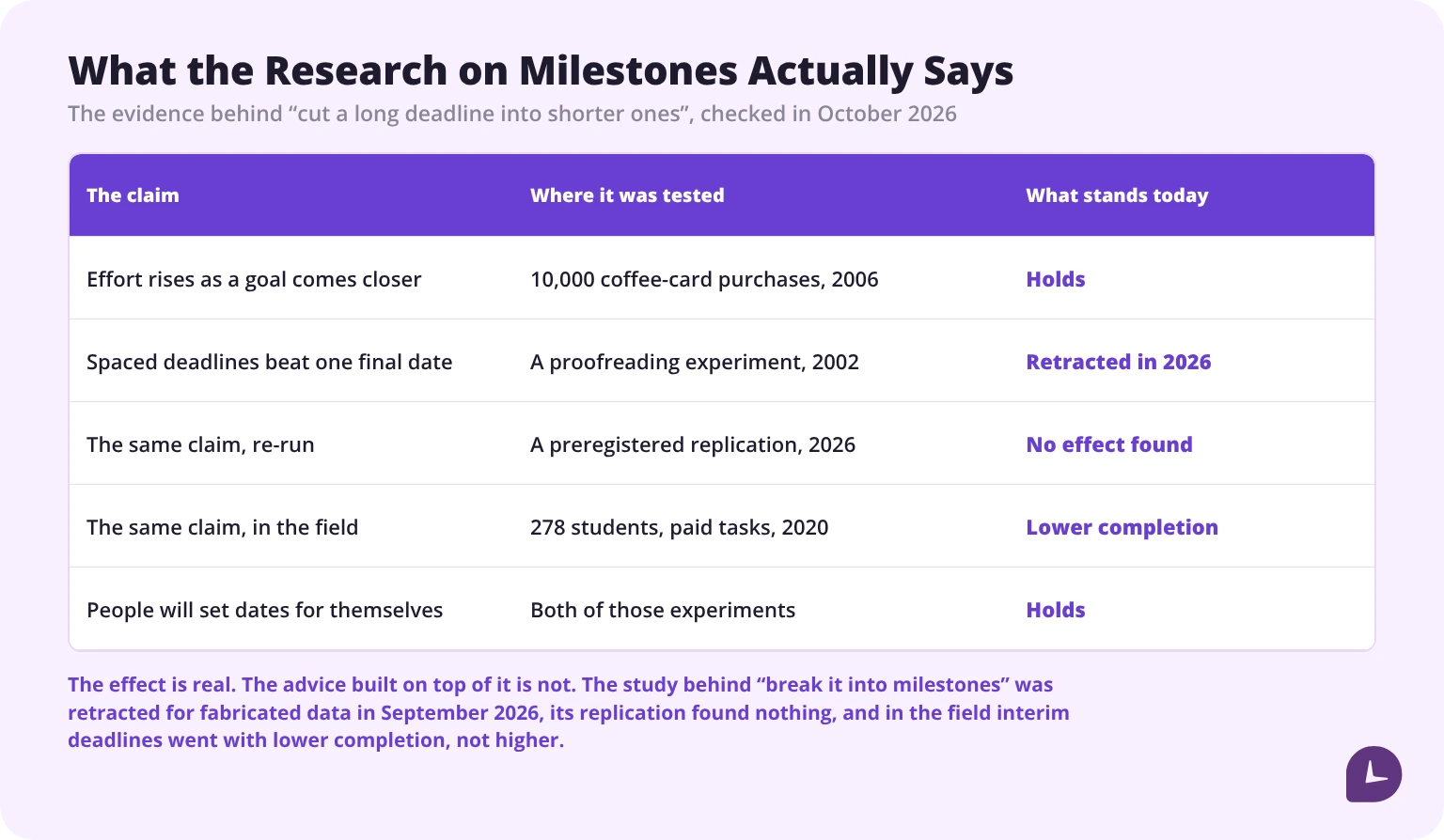
Effort rises as a goal gets closer. This is the goal-gradient effect, and it goes back to Clark Hull’s work on rats running mazes in the early 1930s: they move faster the nearer they get to the food. It has been shown in people too, though in a narrower setting than is usually implied — a study of nearly 10,000 coffee purchases on ten-stamp loyalty cards found customers bought more often the closer they got to the free coffee, completing cards about 16% faster than their own starting rate predicted. A control group holding cards that could not be redeemed slowed down instead, which rules out simple habit.
That is a reward programme, not a deadline. There is no time limit anywhere in that study. Which brings us to the thing not to repeat.
Why “break it into milestones” is not what you were told it was
The standard advice is that long deadlines produce no effort until the end, so you should cut them into intermediate milestones and get several bursts of effort instead of one. For twenty years that advice rested on a single 2002 experiment, cited around 2,200 times, in which evenly spaced deadlines set by the experimenter beat self-imposed ones, which beat a single final date.
That paper was retracted in September 2026. The journal’s notice cites a replication that raised questions about the underlying data, a dataset that could not be confirmed, a forensic analysis questioning the veracity of the findings, and the editor’s lack of confidence in the data. Both authors agreed with the retraction.
The preregistered replication, run on the same task with doubled incentives, found no statistical evidence that performance was influenced by the deadline condition at all — and subjects completed the fewest tasks in the evenly spaced condition. A field experiment with around 278 participants found the same: completion was 47.0% with no intermediate deadline, 40.6% with imposed ones and 36.8% with self-chosen ones.
So do not set milestones to make people work harder, because that is the claim that failed. Set them because a milestone produces something you can look at before the date you care about. That is a smaller claim and it is the one that holds.
One finding in this area does replicate strongly, and it is worth the paragraph: people want deadlines. Between a third and two-thirds of participants voluntarily imposed binding ones on themselves when given the option, and in the lab replication 35 to 37 out of 40 did. The appetite for a date is real. The performance benefit has never been demonstrated. Treat a date as information, not as motivation, and you are on the right side of the evidence.
What to make of “I work better under pressure”
Less than it sounds like, in both directions.
Procrastination does correlate with worse output. The largest review of the subject puts the relationship with academic performance at about −.19 across 41 studies, rising to the mid .20s once measurement artefacts are corrected for, and concludes that procrastination is “procrastination is usually harmful, sometimes harmless, but never helpful”.
But the person who says they work better under pressure is not a recognised type. The scales built to identify “arousal procrastinators” separately from avoidant ones were tested against 4,169 participants in 101 countries and found not to measure distinct things: the arousal scale correlated .86 with the avoidance scale once corrected. And one study of 230 undergraduates that split deliberate from passive delay found the deliberate group scored 3.26 against 3.39 for non-procrastinators and 3.09 for passive ones, with no significant difference from the people who did not delay at all. That study is contested and the sample is small, but it exists, and it does not support treating self-declared pressure-workers as a problem.
The useful conclusion is not about the person. It is that you cannot tell from the outside which kind you have, and arguing about it is a poor use of a Tuesday. Ask for something finished on Wednesday instead and you will know.
One more thing worth knowing, because managers assume the opposite: procrastination is essentially uncorrelated with intelligence, r = .03 across 14 studies — so it is not a proxy for capability.
Set deadlines people can believe
An unbelievable date does not just fail on its own. It teaches the team what your dates mean, and that lesson applies to the next one, which may have been reasonable.
The single most useful change here is to stop asking for a date and start asking for a breakdown. “Can you do this by Friday?” invites a yes. “What are the pieces, and how long is each one?” produces a number you can both look at, and it surfaces the piece neither of you had thought about. If the breakdown comes to nine days and you have five, you have found that out on day one rather than day five.
Watch for round numbers. An estimate of “two weeks” given in under five seconds is usually a guess about how long the thing ought to take, not a calculation of how long it will.
And cap what can be urgent at the same time. When most of the board is marked priority, nothing is ranked, and the person doing the work ends up ranking it for you, by their own criteria, silently. the 1-3-5 rule is a blunt way of forcing that cap: one big thing, three medium, five small, per person per day. The number matters less than the fact that there is one.
Give the context, not just the date
A date on its own is arbitrary, and people treat arbitrary dates arbitrarily. A date with a reason attached is a constraint, and people treat constraints differently — including by telling you when the constraint is about to break.
The context that works is specific and names someone. Not “this is important for the launch” but “the designer has three days booked for this starting Thursday, and if it arrives Friday she is on something else until the following week.” The second version gives the person a reason to tell you on Tuesday that Thursday is at risk.
It also gives them the information needed to make the right call when something has to give. A person who knows what is downstream can decide to ship the rough version on time rather than the polished one late. A person who only has a date will usually choose the opposite, and be surprised that you are not pleased.
Ask the deadline instead of stating it
A small change in a recurring conversation. Instead of reminding someone that the report is due Friday, ask them when it is due.
“Remind me, when are we expecting this one?”
Reminding someone of a date tells them something they already know and tells you nothing. Asking produces an observation, and there are only a few possible answers. They give you the right date, and you have learned they are tracking it. They give you a different date, and you have found a disagreement that would otherwise have surfaced on Friday. They do not know, and you have learned something more useful still. A wrong answer on a Tuesday is worth more than a correct reminder on a Thursday.
On the research, since this technique is often sold with more confidence than it deserves: there is a real and well-studied effect whereby asking people to predict their own future behaviour makes them slightly more likely to do it. A meta-analysis of 116 tests across nearly 55,000 participants puts it at d = 0.24, falling to 0.15 once likely missing studies are accounted for. But it has been tested on health behaviour, blood donation and consumer purchases rather than on work deadlines, and on predictions about the future rather than on recalling a date already agreed. The effect was carried by self-prediction questions; questions about intentions came out statistically indistinguishable from zero. So this is a practice worth adopting because of what it tells you, not because research says it makes people finish things.
Seeing when work actually happens makes the Tuesday conversation easier to start.
See where project time actually goes
Involve the team in setting the date
There is a difference between a date that was agreed and a date that was announced, and the team can always tell which one they have.
In practice this is three small habits rather than a process:
- Set the date in the conversation, not after it. A date that arrives in a calendar invite an hour later was not agreed, whatever was said in the room.
- Write it down immediately, in the same channel the work lives in. Not to catch anyone out. Because two people leave most conversations with slightly different dates, and the cost of finding that out is much lower today than on the due date.
- Ask what would have to be true for the date to hold. The answer is usually a dependency, and you have just mapped it for free.
None of this works if the agreed date is then overridden whenever something else comes up. Agreement that only holds until you change your mind is announcement with extra steps, and it costs more credibility than announcing would have.
Map the dependencies
This is the section that most often changes how a manager plans, because the arithmetic is not what people expect.
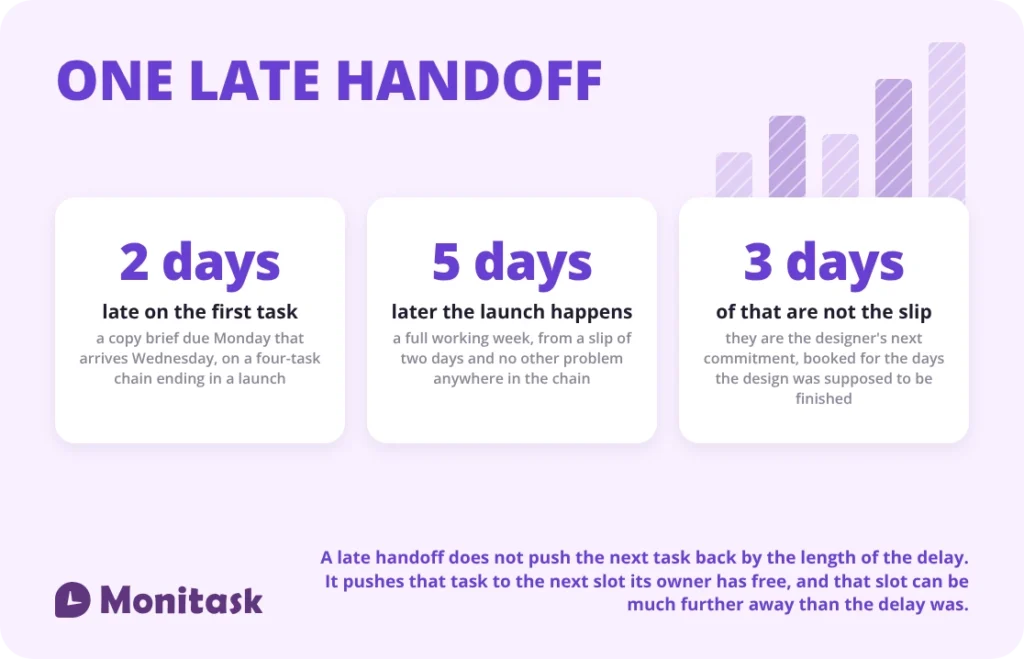
Take a four-task chain ending in a launch. A copy brief is due Monday. Design has three days booked, Tuesday to Thursday. Build takes two days, Friday and Monday. QA and launch is the Tuesday after. The designer, reasonably, has committed the two days after her booked block to another project.
The copy brief arrives two days late, on Wednesday. Nothing else goes wrong anywhere.
The design cannot start Wednesday, because it needs three consecutive days and the next two working days are committed elsewhere. So it starts the following Tuesday. Build follows, then QA. The launch lands five working days late — a full week — from a slip of two days.
Two of those five days are the delay itself. The other three are the designer’s calendar. A late handoff does not shift the next task by the length of the delay; it pushes that task to the next slot its owner has free, and that slot can be much further away than the delay was.
Which gives three practical rules:
- Write down what each task is waiting on and who owns it. Most teams can name the tasks and not the joins. how to write a work plan has a template for this and a worked example.
- Ask for interim deliverables at the joins, not at the end. The point of an interim date is not that it makes anyone work faster. It is that the person downstream finds out on Monday that their Thursday is in trouble.
- Know who is booked and when. The amplification above is entirely a calendar effect. It disappears if the person downstream has slack, and doubles if they are booked solid for a fortnight.
Make renegotiation normal
Most teams have an unwritten rule that you do not ask to move a date. The rule is rarely stated and almost always enforced, and it produces the single worst outcome available: people who know they will miss, saying nothing, until the day.
You can only have one of two things. Either a date is renegotiable when something changes, or you find out about problems at the end. There is no arrangement where dates are sacred and bad news arrives early.
Making renegotiation normal is not the same as making dates soft. The useful version has conditions:
- Raised as soon as it is known, not when the work is due
- Brought with a breakdown, so the new date is an estimate rather than a request
- Brought with options — the full thing later, or a reduced version on time
- Decided once, and then the new date behaves like the old one
A team that has seen a date moved on those terms twice will bring you the third problem early. A team that has seen someone punished for raising one will not bring you anything.
Recognise what gets delivered
Recognition for hitting dates is worth doing and easy to do badly.
The failure mode is rewarding visible effort rather than delivery, which is how teams learn that the way to be appreciated is to be seen struggling at 7pm. The person who scoped the work properly, flagged the risk on Tuesday and delivered on Friday without drama produces no story at all, and is the person you most need to keep.
So recognise the specific thing. Not “thanks for the hard work on this” but “you told me on Tuesday that the API piece was going to be tight, which is why we had three days to deal with it instead of three hours.” That sentence tells everyone listening exactly which behaviour you are paying for.
The same logic runs in reverse, which is why the response to a missed date matters more than the recognition does. A review that lands on a person rather than a process gets you fewer missed deadlines reported, not fewer missed deadlines. There is a longer argument for that in why punishment does not work.
A different problem, and a more common one: you need a date from another department, or from someone at your level, where you cannot simply decide.
Almost everything above still works. What changes is that you have no fallback, so the order matters more.
Lead with what breaks downstream, specifically. Not “we need this by the 14th” but “if this lands after the 14th, the design block on the 15th goes to another project and we ship in April instead of March.” Named consequences travel. A date on its own does not, because the person you are asking has their own dates and no reason to rank yours above them.
Agree the date together rather than proposing one. Ask when they could do it, then say whether that works. This costs you nothing — you were not able to impose a date anyway — and it converts the date from your request into their commitment.
Put it in writing immediately, and make it easy to agree with. A short message the same day: here is what we agreed, here is what it unblocks, tell me if I have it wrong. Not a contract. A record that costs nothing to correct now and a great deal to reconstruct later.
Ask for an interim piece early rather than the whole thing on time. This is the single most effective move available to someone without authority. A draft on the 7th is a smaller ask than the final on the 14th, it is easier to say yes to, and it tells you on the 7th whether the 14th is real.
Escalate last, and bring facts rather than a complaint. When nothing else has worked, go to the shared manager with the dates, what was agreed and when, what is blocked and what it costs. Not with how the conversations felt. An escalation that reads as a complaint about a person makes the next three requests harder; one that reads as a scheduling conflict between two teams is the shared manager’s actual job.
What to do after a missed deadline
The order here matters more than anything in the conversation itself.
Rebuild the plan first. Work out the cause second. They feel like they should happen together and they should not. While the cause is unresolved everyone downstream is blocked on information you could give them in ten minutes: the new date, what it affects and what they should do until then. Settle that, tell the people waiting, and then do the review properly rather than in the middle of a scramble.
Then run the review without looking for someone to blame. Three questions, in this order:
- What specifically got in the way?
- When did it become clear this would not make it?
- Why did that not reach me at the time?
The third question is the one that matters. The gap between question two and the due date is the only part of this you can actually fix. A slip that was visible nine days out and reported on the day is not an execution failure, it is a reporting failure, and the two have completely different remedies. Pressure makes the first kind marginally better and the second kind permanently worse.
Be ready for the answer to question three to be about you. “I thought I could still pull it back” is usually true. “I did not want to be the person bringing bad news again” is also usually true, and tells you something more useful.
Change one thing in the process, and only one. A review that produces five changes produces none, because nobody can tell afterwards which one worked. Pick the change that would have caught this slip earliest, make it, and wait until the next one to find out whether it did.
When the problem is you
Worth asking honestly, because the symptoms are identical from the inside. A team that misses dates because it is badly run looks exactly like a team that misses dates because it is careless.
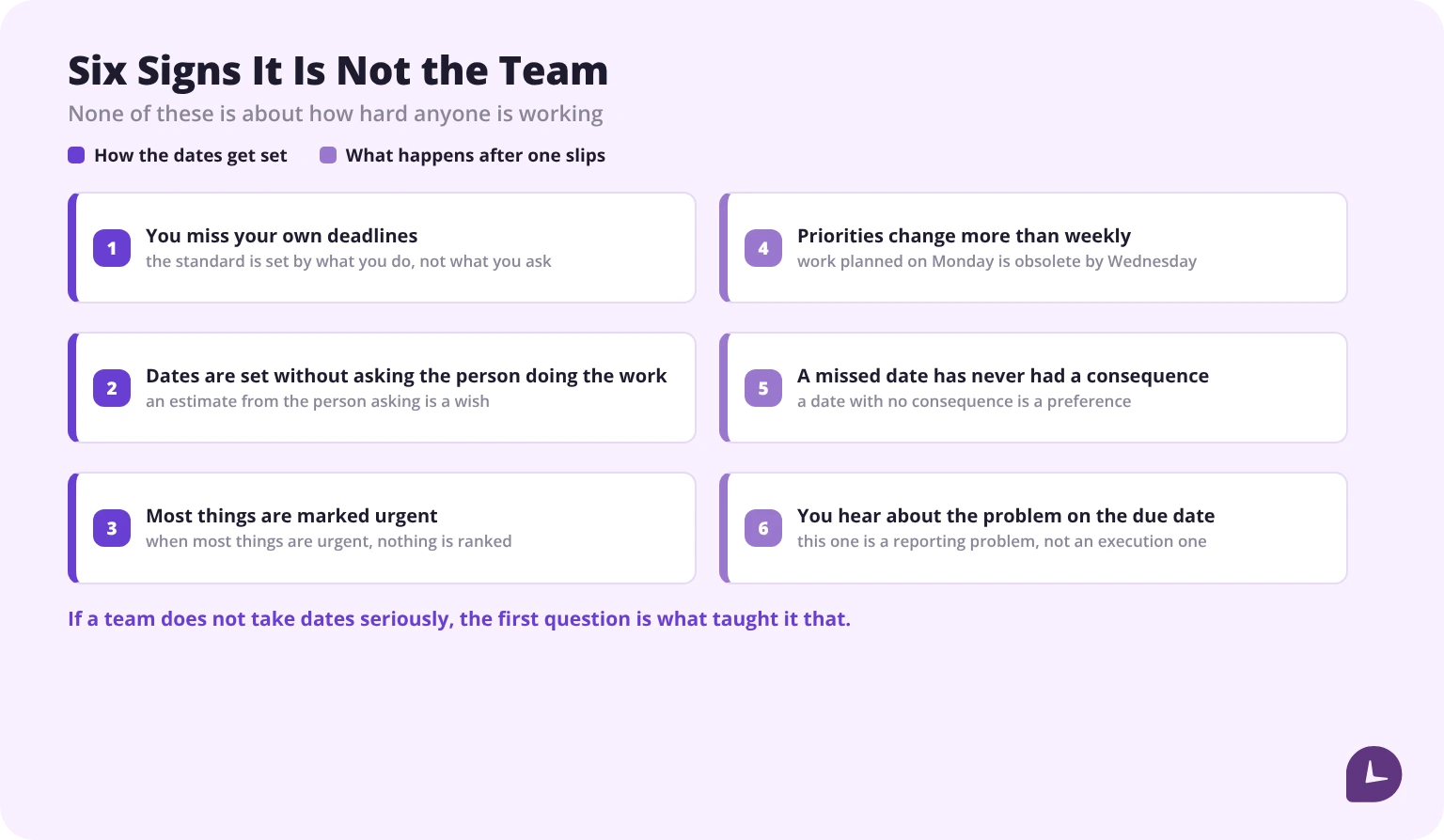
- You miss your own deadlines.
- Priorities change more than weekly.
- Dates are set without asking the person doing the work.
- Most things are marked urgent.
- A missed date has never had a consequence.
- You hear about the problem on the due date.
None of these is about how hard anyone is working, and that is the point. Each one is a decision somebody made, and the person who made most of them is the person reading this.
The last one deserves separating out. If you reliably find out on the due date, the team is not failing to deliver — it is failing to report, and people fail to report for reasons that are almost always rational. Reporting a problem early has to be cheaper than hiding it, and in most teams it is not: the person who flags a risk on Tuesday gets a conversation, and the person who stays quiet has a 40% chance of it working out. Fix that price and the reporting fixes itself.
If a team does not take dates seriously, the first question is what taught it that.
Most of this comes down to knowing on Tuesday what you would otherwise find out on Friday.
Try Monitask free for 10 days
Sources
- Hull, Clark L. (1932), “The Goal-Gradient Hypothesis and Maze Learning,” Psychological Review, 39 (1), 25–43.
- Hull, Clark L. (1934), “The Rats’ Speed of Locomotion Gradient in the Approach to Food,” Journal of Comparative Psychology, 17 (3), 393–422.
- Kivetz, Ran, Oleg Urminsky and Yuhuang Zheng (2006), “The Goal-Gradient Hypothesis Resurrected: Purchase Acceleration, Illusionary Goal Progress, and Customer Retention,” Journal of Marketing Research, 43 (1), 39–58.
- Retraction notice for the 2002 deadline-spacing experiment: Psychological Science, 37 (9), September 2026, doi:10.1177/09567976261488042. The retracted paper itself is deliberately not listed here: a citation line outlives the annotation attached to it.
- Hyndman, Kyle and Alberto Bisin (2026), “Replication of ‘Procrastination, Deadlines, and Performance: Self-Control by Precommitment’,” Psychological Science, doi:10.1177/09567976261460772.
- Bisin, Alberto and Kyle Hyndman (2020), “Present-bias, procrastination and deadlines in a field experiment,” Games and Economic Behavior, 119, 339–357.
- Steel, Piers (2007), “The Nature of Procrastination: A Meta-Analytic and Theoretical Review of Quintessential Self-Regulatory Failure,” Psychological Bulletin, 133 (1), 65–94.
- Steel, Piers (2010), “Arousal, avoidant and decisional procrastinators: Do they exist?” Personality and Individual Differences.
- Chu, Angela Hsin Chun and Jin Nam Choi (2005), “Rethinking Procrastination: Positive Effects of ‘Active’ Procrastination Behavior on Attitudes and Performance,” The Journal of Social Psychology, 145 (3), 245–264.
- Wood, Chantelle, Mark Conner, Eleanor Miles, Tracy Sandberg, Natalie Taylor, Gaston Godin and Paschal Sheeran (2016), “The Impact of Asking Intention or Self-Prediction Questions on Subsequent Behavior: A Meta-Analysis,” Personality and Social Psychology Review, 20 (3), 245–268.
FAQ: Ways to Get Your Team to Respect Deadlines
Why does my team keep missing deadlines?
Almost always one of six things: the date was announced rather than agreed, everything is marked urgent, the estimate came from the person asking rather than the person doing, a dependency was never mapped, the risk was known but not reported, or starting is the hard part. Note that none of them is lack of effort, which is why pressure rarely changes the pattern.
How do I set a deadline that is actually realistic?
Ask for the breakdown instead of the date. “Can you do this by Friday?” invites a yes; “what are the pieces and how long is each?” produces a number you can both examine, and it surfaces the piece neither of you had thought about. If the pieces add up to more time than you have, you have learned that on day one rather than day five.
Should I build buffer time into deadlines?
Yes, but put it where it protects the chain rather than inside each task. Buffer hidden inside individual estimates gets absorbed quietly and teaches you nothing. Buffer held at the end of a sequence, visible to everyone, is the thing you spend when a handoff slips — and watching how fast it gets spent tells you whether your estimates are systematically short.
How do I get someone to take a deadline seriously without being heavy-handed?
Give the date a reason that names a person and a consequence, then ask for something finished before it rather than reminding them about it. “The designer has Thursday booked and loses the slot on Friday” does more than any amount of emphasis, because it gives them a reason to warn you early rather than a reason to feel pressured.
Do interim milestones actually make people work sooner?
The evidence for that specific claim is bad. The 2002 experiment behind it was retracted in September 2026 after questions about the underlying data; the preregistered replication found no effect of deadline condition; and a field experiment found completion was lower with interim deadlines than without. Set milestones anyway, but for a different reason: a milestone produces something you can look at while there is still time to act on it.
What should I do the first time someone misses a deadline?
Rebuild the plan first and tell everyone downstream, because they are blocked on information you can give them in ten minutes. Then ask what got in the way, when it became clear, and why that did not reach you at the time. The gap between the second and third answers is the only part you can fix. Change one thing, not five.
What if the same person misses deadlines repeatedly?
Separate the two possible patterns before responding, because they look identical and need opposite handling. If the dates were unrealistic each time, the problem is the estimating and it is yours. If the dates were sound but the slip was always reported late, the problem is that reporting bad news costs them more than staying quiet. Only the third case — sound dates, early reporting, work still not done — is a performance conversation.
How do I get deadlines met by people who do not report to me?
Lead with what specifically breaks downstream and name it. Agree the date with them rather than proposing one. Confirm it in writing the same day. Ask for an interim piece early rather than the whole thing on time, which is both easier to agree to and more informative. Escalate only after all of that, and bring dates and costs rather than an account of how the conversations went.
Is it my fault if the whole team misses deadlines?
If it is the whole team rather than one person, then usually yes, at least in part — and that is good news, because the things you control are easier to change than other people’s habits. Check whether you miss your own dates, whether priorities move more than weekly, whether dates get set without asking the person doing the work, whether most things are marked urgent, whether a missed date has ever had a consequence, and whether you hear about problems on the due date.