How to Calculate PTO Accrual: The Methods, the Math, and the Records Behind Them

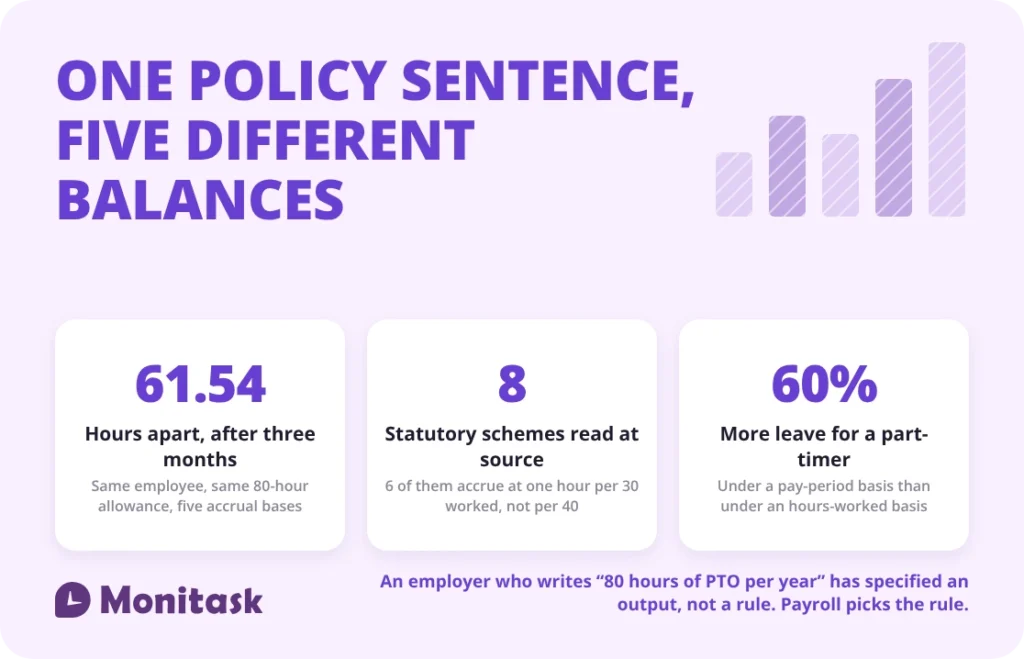
Accrual converts time into a leave balance, and the basis decides the answer. The same 80-hour allowance produces five different balances three months into the year — a spread of 61.54 hours from a policy that reads identically in all five cases. Where leave is statutory the basis is chosen for you, and in 6 of the 8 schemes read for this article it is one hour per 30 worked, not per 40.
What is PTO accrual?
Accrual is the rule that turns elapsed time or hours worked into a paid time off balance. It is a formula rather than a policy decision on its own, and 3 separate choices sit inside it.
| Choice | What it decides | Common answers |
|---|---|---|
| The basis | What accrual is measured against | Hours worked, pay periods elapsed, months elapsed, or nothing at all |
| The rate | How much leave each unit of the basis earns | A fraction of an hour per hour worked, or a fixed amount per period |
| The limits | When accrual stops and what survives the year end | An accrual cap, a use cap, a carryover rule and a payout rule |
An employer who writes “employees receive 80 hours of PTO per year” has answered none of the three. The sentence sounds complete and leaves every practical question open: what is the balance in March, what happens to a part-timer, does overtime earn leave, and what carries into next year.
Start from the federal position, because it is nothing. There is no federal requirement to provide paid leave of any kind. The Department of Labor’s own statement is that The FLSA does not require payment for time not worked, such as vacations, sick leave or federal or other holidays
. Paid leave of any kind is a matter for the employer and the employee, or for state and local law. Nothing in federal law sets an accrual rate, a cap, a carryover rule or a payout duty. So every rule on this page comes either from your own policy or from a state or city statute — never from federal law.
The rest of this page answers those questions in order, with the arithmetic shown.
Which accrual method should you use?
4 are in common use, and they are not interchangeable.
| Method | How it works | Suits | Watch out for |
|---|---|---|---|
| Per hour worked | A fixed fraction of an hour earned for each hour worked | Hourly staff, variable schedules, part-timers, statutory sick leave | Needs reliable hour records; a week not worked earns nothing |
| Per pay period | A fixed amount credited each pay period, regardless of hours | Salaried staff on steady schedules | Over-credits part-timers and anyone on reduced hours |
| Monthly | A fixed amount credited each month | Simple policies, small teams | Mid-month hires and leavers need a proration rule |
| Annual lump sum | The whole allowance granted at once | Policies that favour early availability | Creates immediate liability, and a negative balance you cannot usually recover |
The deciding question is not which is simplest to administer. It is whether the workforce has uniform hours. If everyone works 40 hours a week every week, the four converge and you should choose on administrative grounds. The moment hours vary — part-timers, seasonal staff, anyone on a reduced schedule — the basis stops being a formality and starts deciding who gets how much.
The lump-sum approach has a policy pattern of its own, and unlimited PTO is the case where accrual does not apply at all, which brings its own questions about what is owed on separation.
How do you calculate accrual per hour worked?
Divide the annual allowance by the annual hours, then multiply by hours actually worked.
Setting the rate. An allowance of 80 hours against a full-time year of 2,080 hours:
| Step | Calculation | Result |
|---|---|---|
| Annual allowance | — | 80 hours |
| Full-time annual hours | 40 × 52 | 2,080 hours |
| Accrual rate | 80 ÷ 2,080 | 0.03846 hours of PTO per hour worked |
| Per 40-hour week | 40 × 0.03846 | 1.538 hours |
| Per 80-hour biweekly period | 80 × 0.03846 | 3.077 hours |
Applying it. The balance is always hours worked × the rate:
| Hours worked to date | Calculation | Balance |
|---|---|---|
| 160 (one month, full-time) | 160 × 0.03846 | 6.15 hours |
| 480 (three months, full-time) | 480 × 0.03846 | 18.46 hours |
| 1,040 (half a year, full-time) | 1,040 × 0.03846 | 40.00 hours |
| 1,500 (a part-time year) | 1,500 × 0.03846 | 57.69 hours |
| 2,080 (a full-time year) | 2,080 × 0.03846 | 80.00 hours |
Note the fourth row. A part-timer who works 1,500 hours earns 57.69 hours — not 80, and not some negotiated fraction. The method prorates by itself, which is its main virtue and the reason every statutory scheme uses it.
Our guide to full-time annual hours covers where the 2,080 figure comes from and when a different denominator is the right one.
Why does the same policy produce different balances?
Because the basis changes the answer, and by more than most policies anticipate. One employee, one allowance of 80 hours a year, full-time at 40 hours a week. What is the balance after three months — 480 hours worked, 6 biweekly periods, 6 semi-monthly periods, 3 months elapsed?
| Method | Calculation | Balance after 3 months |
|---|---|---|
| Per hour worked | 480 × 0.03846 | 18.46 hours |
| Per pay period, biweekly (26 periods) | 6 × (80 ÷ 26) | 18.46 hours |
| Per pay period, semi-monthly (24 periods) | 6 × (80 ÷ 24) | 20.00 hours |
| Monthly (12 periods) | 3 × (80 ÷ 12) | 20.00 hours |
| Annual lump sum | granted in full | 80.00 hours |
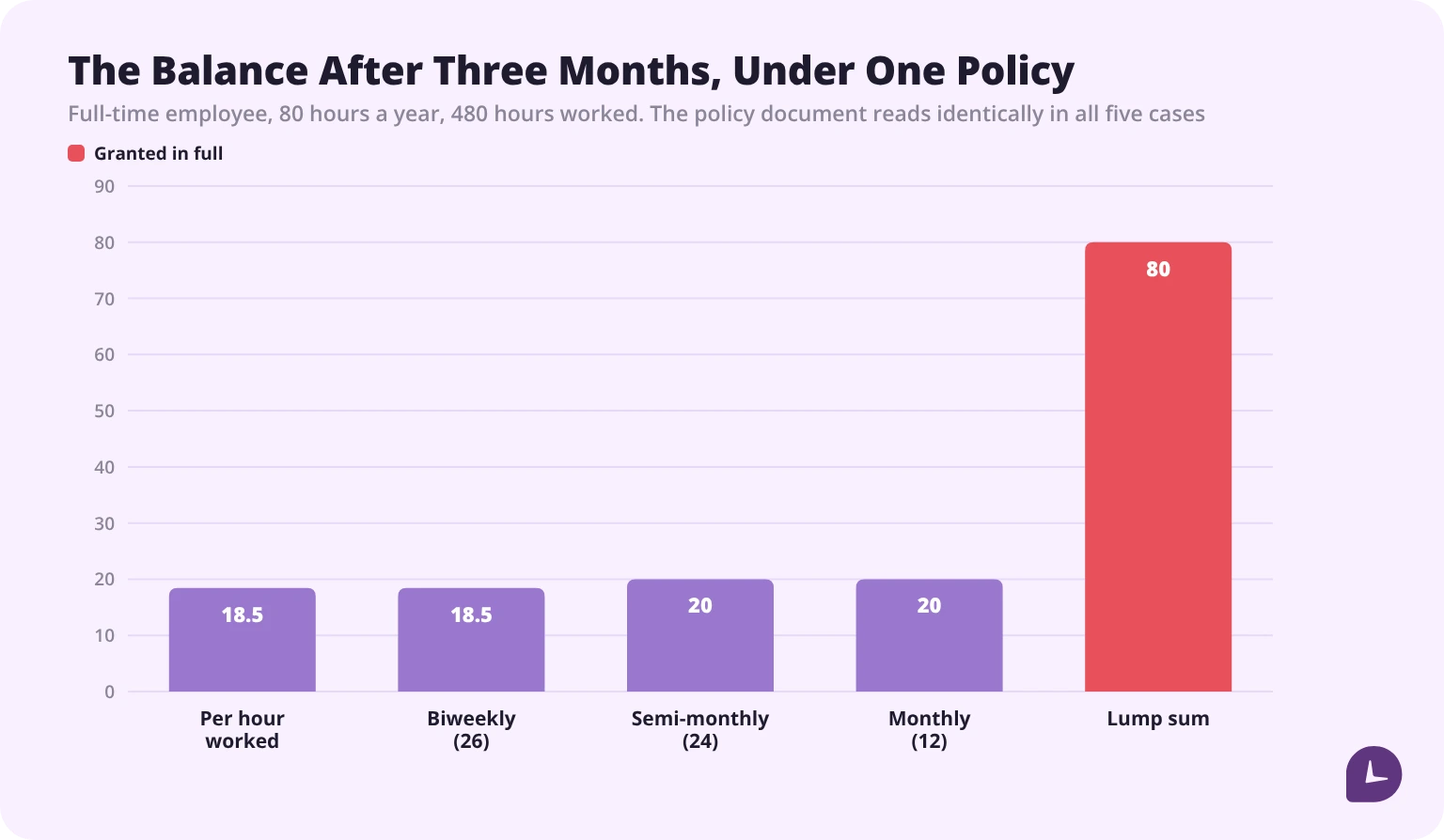
A spread of 61.54 hours between the extremes, from a policy that reads identically in all five cases. The per-hour and biweekly figures coincide here only because a full-time employee works exactly 80 hours per biweekly period — which is precisely the assumption that fails for everyone else.
Now change the employee to a part-timer at 25 hours a week and hold the policy text the same:
| Method | Calculation | Balance after 12 weeks |
|---|---|---|
| Per hour worked (300 hours worked) | 300 × 0.03846 | 11.54 hours |
| Per pay period, biweekly | 6 × (80 ÷ 26) | 18.46 hours |
The pay-period method gives this employee 60% more leave than the hours-worked method, for the same job under the same policy document. Neither figure is wrong. The policy simply never said which one it meant.
That is the real answer to “how does PTO accrual work”: it works however your basis says it works, and if the basis is unstated, your payroll system has chosen one for you.
How does statutory sick leave accrual differ?
Statutory schemes mandate the basis, and the basis they mandate is hours worked. That removes your discretion and adds a records obligation. Sick leave and sick leave pay have their own definitions; what follows is the arithmetic those definitions produce.
8 schemes were read at source for this article, each on the state’s own statute, administrative rule or enforcing agency page.
| Jurisdiction | Accrual | Annual cap | Carryover | Before use |
|---|---|---|---|---|
| Washington | 1 per 40 | None within the accrual year | Balances of 40 hours or less must carry over | 90 calendar days |
| California | 1 per 30 | Use 40 hours or 5 days; accrual 80 hours or 10 days | Accrued time carries over, subject to the accrual cap | 90-day employment period |
| New York | 1 per 30 | 56 hours at 100+ employees; 40 hours at 5-99 | Unused sick leave carries over to the following calendar year | None stated |
| Colorado | 1 per 30 | 48 hours per year | Up to 48 hours rolls over | None – leave is usable immediately on accrual |
| Arizona | 1 per 30 | 40 hours at 15+ employees; 24 hours below 15 | Carries over, or the employer may pay out in lieu | Not confirmed |
| Michigan | 1 per 30 | Use 72 hours; 40 hours for a small business | Carries over to the same limits | 120 calendar days for employees hired after February 2025 |
| Minnesota | 1 per 30 | 48 hours per year | Must carry over; the balance may not exceed 80 hours at any time | None stated |
| Illinois | 1 per 40 | 40 hours per 12-month period | Accrued leave carries over from one year to the next | 90 days |
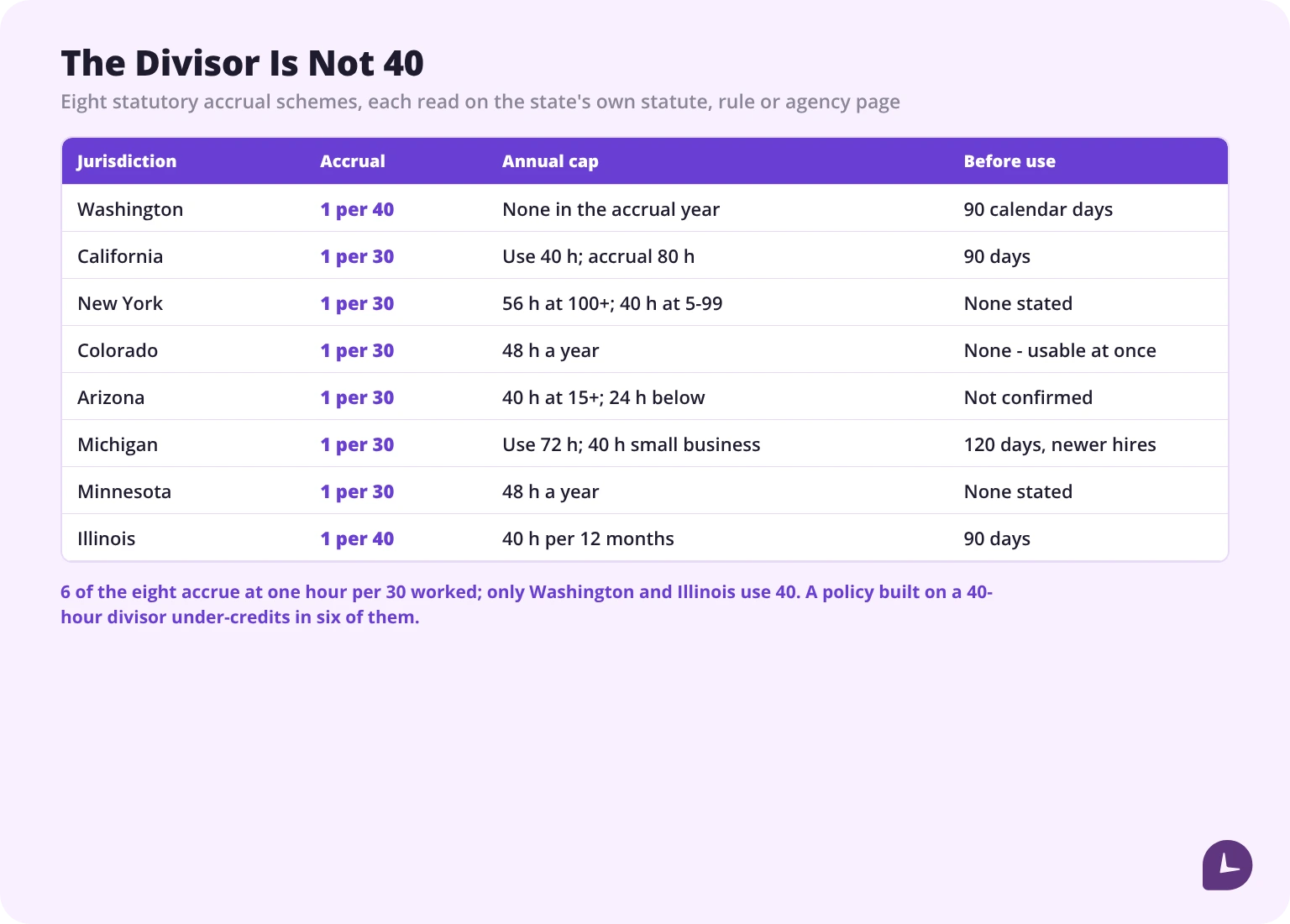
The headline is the divisor. 6 of the 8 accrue at one hour per 30 hours worked; only Washington and Illinois use 40. A policy built on a 40-hour divisor under-credits in six of them. On the same 2280-hour year, a 40-hour divisor yields 57 hours and a 30-hour divisor yields 76 — a gap of 19 hours per employee per year.
The waiting period is not a constant either. New York, Colorado, Minnesota impose none at all — Colorado’s rule is that leave is usable immediately on accrual — while Michigan allows 120 calendar days for employees hired after its 2025 amendment. That is the longest confirmed here, and it is more than four times Colorado’s.
Washington as the worked example, because the Washington State Department of Labor and Industries publishes its minimums plainly:
| Requirement | What the source states |
|---|---|
| Accrual rate | At a minimum, employees must be provided one hour of paid sick leave for every 40 hours worked |
| Which hours count | All hours that an employee works must be counted towards accrual, regardless of how many hours they work in a given week or pay period, including overtime hours |
| Who accrues | Part-time, temporary and seasonal employees too |
| When accrual starts | On a new hire’s first day of work |
| When leave becomes usable | Employees are entitled to use paid sick leave they have accrued once they have reached 90 calendar days of employment |
| Carryover | employees must carry over their accrued, unused paid sick leave balances of 40 hours or less |
| Payout at separation | Cashing out an employee’s paid sick leave is generally not required |
| Rehire | You must reinstate any previously accrued, unused paid sick leave if you rehire an employee within 12 months of their separation— with two conditions below |
| Balance notice | At least once a month, employees must be given a notice that showsthe amount accrued since the last notice, the amount used since the last notice, the current available balance |
| Record retention | all records required under WAC 296-128-010 shall be kept for a period of at least three years |
Five of those rows catch employers out.
Overtime hours earn sick leave. An employee working 2080 regular hours plus 200 overtime hours has worked 2280 hours, so at one per forty they accrue 57 hours rather than 52. The overtime added 5 hours of sick leave. Read the hours rule in full and it is airtight: all hours worked count regardless of how many hours they work in a given week or pay period
, which is the clause that defeats a scheduled-hours or capped-hours accrual setup.
Accrual and eligibility are separate clocks. Accrual runs from day one; use waits for 90 calendar days. An employee at day 60 has a balance they cannot yet spend, and a payroll system showing zero until day 90 is displaying the wrong number.
Rehire reinstates the balance — conditionally, and up to a ceiling. Two qualifications that circulating summaries drop. First, reinstatement attaches to a balance that was not paid out: If you do not provide full reimbursement for an employee’s paid sick leave balance, you may have to reinstate any unpaid balance
if the employee is rehired within 12 months. An employer who cashes out in full does not reinstate. Second, where the separation crosses into a new leave year, the employer is not required to reinstate more than 40 hours
. Neither point is in most published guidance.
The balance notice is a continuous obligation, and its frequency varies. Washington requires it at least monthly and unprompted. Minnesota requires the equivalent every pay period. Colorado’s is on request, generally once a month. “Monthly” is the Washington rule, not the general one.
Records must be kept for 3 years, not for the reinstatement window. And there is a sting if they are not: where the employer fails to keep them, the department may accept the employee’s own records to determine back wages owed
.
When you write the policy itself, our sick leave policy template is the starting shape.
What about employees whose hours are not recorded?
An hours-worked basis needs hours. For exempt salaried employees whose time is not tracked, there are none to multiply. This is the question the circulating advice answers most carelessly, because the honest answer is that it depends entirely on where you are.
Three jurisdictions write the presumption into law, and all three use 40 hours:
| Jurisdiction | Citation | What it provides |
|---|---|---|
| Arizona | A.R.S. 23-372(D)(3) | will be assumed to work 40 hours in each work week |
| Minnesota | Minn. Stat. 181.9446(c) | are deemed to work 40 hours in each workweek |
| Colorado | INFO #6B, citing C.R.S. 8-13.3-403 | accrue leave as if they work 40 hours weekly, even if they work more |
Note which way the presumption cuts. It caps accrual for an exempt employee who works more than 40 hours — Colorado’s wording is explicit that they accrue as if they work 40 hours weekly even if they work more
. It is a ceiling, not a floor. Both Arizona and Minnesota then add the floor: an employee whose normal week is shorter accrues on that shorter week. Minnesota’s wording is that an employee whose normal workweek is less than 40 hours will accrue earned sick and safe time based on the normal workweek
; Arizona’s applies the deeming unless their normal work week is under 40 hours
.
Washington — the jurisdiction worked through above — has no such presumption. Its accrual rule contains no subsection on exempt employees, untracked hours, or deemed hours of any kind; its only “forty hours” is the accrual ratio itself. The agency’s own policy confirms that Other workers may be exempt from the state’s overtime requirements, but still be entitled to paid sick leave
without supplying a figure for them. Accrual there is on hours actually worked, full stop, and the records rule requires hours worked each day and each workweek with no exception for untracked staff.
So “assume a standard workweek” is written into the statute in three places and unsupported in others. Treat it as a jurisdiction question, not a policy preference.
| Option | What it means | Trade-off |
|---|---|---|
| Use a different basis for exempt staff | Per pay period or monthly for exempt, hours-worked for non-exempt | Two rules to administer and explain; the commonest real answer |
| Apply a deemed workweek | Credit exempt staff as though they worked a defined number of hours | Lawful and specified where the statute says so; unsupported where it does not |
| Record hours for exempt staff too | One rule for everybody | Recording hours for exempt employees has its own implications; take advice first |
Whichever you choose, write the assumption into the policy and apply it the same way every period. The failure mode is not choosing wrong — it is choosing silently, so that nobody can reproduce a balance when it is questioned.
How do caps, carryover and payout differ?
These get collapsed into “the cap” constantly, and they do different things at different moments.
| Limit | When it acts | What it does | Typical form |
|---|---|---|---|
| Accrual cap | Continuously | Stops further accrual once the balance reaches a ceiling | A maximum balance, often a multiple of the annual allowance |
| Use cap | Per leave year | Limits how much may be taken, even if more is accrued | A maximum number of hours or days used in a year |
| Carryover | At the year end | Decides how much unused balance survives into the new year | A fixed number of hours, all of it, or none |
| Payout | At separation | Decides whether the unused balance converts to money | Required or discretionary, depending on the leave type and the jurisdiction |
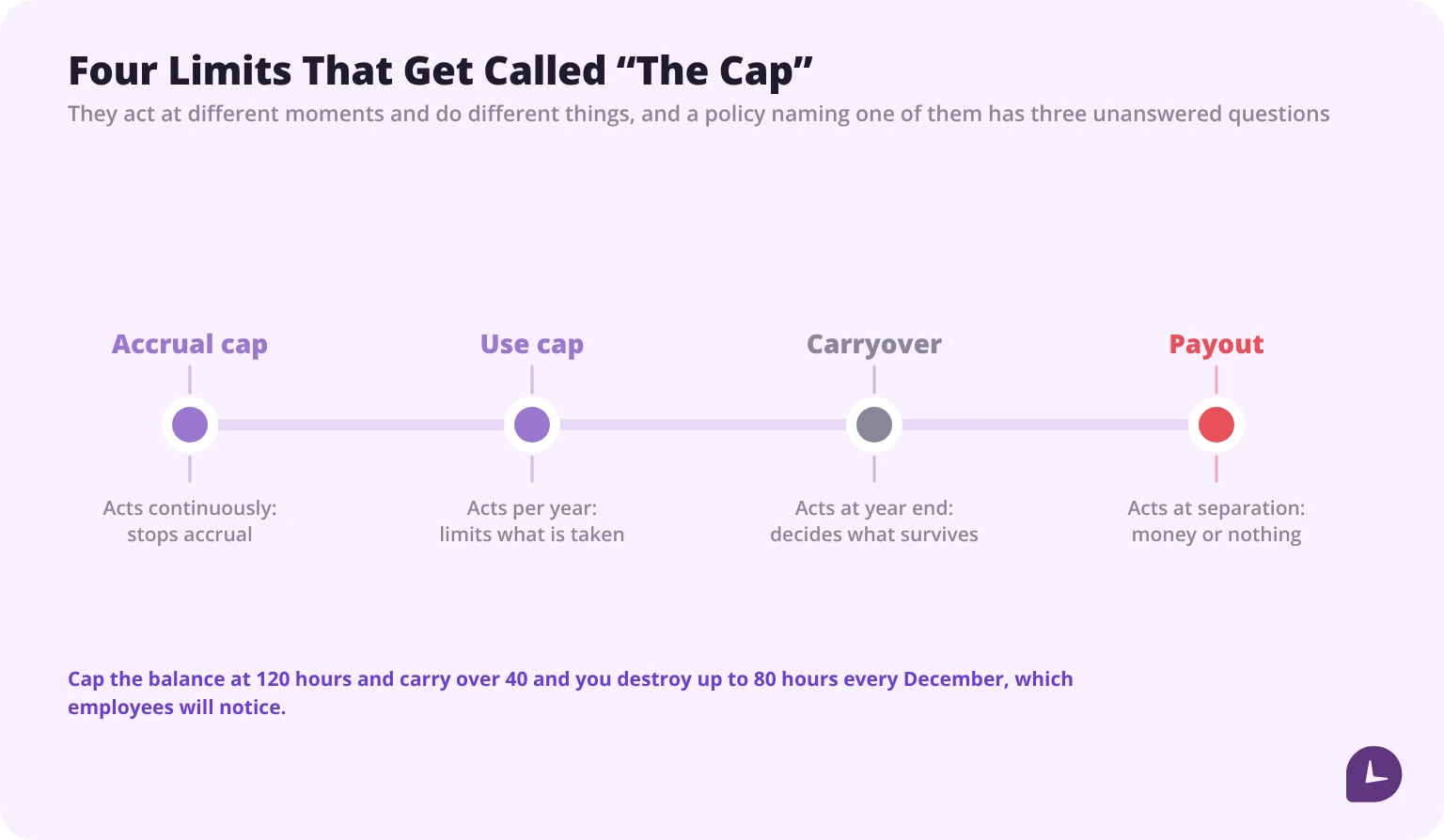
An accrual cap and a carryover limit can contradict each other: a policy capping the balance at 120 hours but carrying over only 40 silently destroys up to 80 hours each December, which employees will notice. A use cap with no accrual cap builds a balance that can only ever be paid out, never taken.
Colorado draws the line more precisely than most policies do, and it is worth borrowing as a drafting rule: An employer may cap how much vacation employees accrue or use, because a cap does not take away vacation already earned. It may not cap how much already-accrued vacation carries over, because that does forfeit earned pay.
The lump-sum method adds a fifth problem. Grant all 80 hours in January and an employee who takes 60 of them and resigns in March has used 41.54 hours more than an hours-worked basis would have earned by then. Whether any of it can be recovered from a final paycheck is a jurisdictional question with a narrow answer. Washington’s rule treats allowing a negative balance as frontloading, and bars deducting the shortfall from final wages absent a specific qualifying agreement. Illinois goes further for its own statutory leave: an employer may not diminish or recoup used or unused frontloaded paid leave benefits
. If you grant up front, you are accepting that exposure deliberately. Price it rather than discovering it — and have any repayment clause reviewed, because deductions from final wages are among the most tightly regulated things an employer can do.
Payout depends on the leave type as much as the jurisdiction, and the sharpest illustration is a single state answering it both ways. In Colorado, earned vacation must be paid out on separation, while unused statutory sick leave need not be paid for unused paid leave
. Same state, same year, two leave types, opposite answers.
Three states were confirmed at source on the vacation side:
| State | Posture | What the source says | Citation |
|---|---|---|---|
| California | Required | Earned vacation time is considered wages; it vests as labour is performed and cannot be forfeited, even on termination. A reasonable accrual cap is permitted; a forfeiture date is not | Labor Code 227.3, per the DLSE |
| Colorado | Required | All vacation pay earned and determinable must be paid on separation, and any term purporting to forfeit it is void | C.R.S. 8-4-101(14)(a)(III) and 8-4-121, per INFO #3E |
| Illinois | Required | The monetary equivalent of all earned vacation must be paid, and a policy may not forfeit earned time at separation – though a use-it-or-lose-it rule during employment is permitted | 820 ILCS 115/5; 56 Ill. Adm. Code 300.520 |
California’s position is the broadest: Under California law, earned vacation time is considered wages
, vesting as labour is performed and incapable of forfeiture even at termination. Colorado voids the clause itself — any term of an agreement that purports to forfeit earned vacation pay is void
. Illinois permits a use-it-or-lose-it rule during employment where the employee had a real opportunity to take the leave, but An employer cannot effectuate a forfeiture of earned vacation by a written employment policy or practice
at separation. Those are three different answers to a question most policies treat as one.
A balance that must be paid out is a liability on the books as it accrues, which is where payroll accrual accounting picks the problem up.
What records does accrual require?
For a per-pay-period policy, almost none: a calendar and a rate. For anything hours-based — which includes every statutory scheme above — the records are the system.
| Record | Why accrual needs it |
|---|---|
| Hours worked, per employee, per period | The multiplicand; nothing else substitutes for it |
| All hours worked, including overtime | Where the statute mandates it, every worked hour accrues, not just scheduled hours |
| Hire date per employee | Drives both the accrual start and the eligibility clock |
| Leave taken, with dates | Needed for the balance, and for a notice that distinguishes used from accrued |
| Running balance by leave type | Sick, vacation and combined PTO may carry different rules; one merged number cannot satisfy them |
| Prior balances at separation | Required to reinstate on a rehire inside the window |
| A notice history | Evidence that the periodic notice obligation was met |
How long to keep them is a figure, not a judgement call, and the federal floor is shorter than the state rules:
| Whose rule | Retention | Citation |
|---|---|---|
| Washington | 3 years | WAC 296-128-020 |
| California | 3 years | per the DLSE |
| Colorado | 2 years | C.R.S. 8-13.3-409(1), per INFO #6B |
| Federal, payroll records | 3 years | 29 C.F.R. 516.5 |
| Federal, the records behind the computation | 2 years | 29 C.F.R. 516.6 |
Washington requires three years and the federal floor guarantees the underlying time cards only two. An employer relying on the federal minimum cannot meet the state rule, and cannot answer a three-year-old dispute from the records federal law makes it keep.
The pattern is the same as every other hours-based obligation: the hours have to exist as a record before the arithmetic can run. Attendance tracking captures hours worked per employee per period with overtime intact, which is the input every hours-based formula needs. Time off requests supply the other half — leave taken, with dates. For the balances themselves, our comparison of PTO tracking software and the PTO management software entry cover the tools built for that side.
The retrospective test is the honest one: if an employee disputes a balance from eight months ago, can you reconstruct it — the hours, the rate in force, the leave taken, the notices sent? If the answer is a summary total, the answer is no.
Setup errors that create liability
| Error | What it produces | The fix |
|---|---|---|
| Stating only the annual total in the policy | Payroll picks a basis by default and nobody knows which | State the basis, the rate and all four limits explicitly |
| Accruing on scheduled hours instead of worked hours | Under-credits every overtime week where worked hours govern | Accrue off actual hours worked |
| Assuming a 40-hour week for exempt staff without checking | Lawful and written into the statute in three jurisdictions, and unsupported in others | Check the rule for each jurisdiction before relying on the assumption |
| Using one basis for everyone with mixed schedules | Over-credits part-timers under a pay-period basis | Match the basis to the workforce, or run two documented rules |
| Merging sick and vacation into one balance where the rules differ | Makes it impossible to apply the statutory rules to the statutory portion | Track leave types separately even under one allowance |
| Showing a zero balance during the eligibility waiting period | Displays the wrong number; accrual and use are separate clocks | Show the accrued balance and the availability date separately |
| Deleting balances at separation | Prevents reinstatement on a rehire inside the window, where the balance was not fully paid out | Retain the records for the statutory retention period, which is longer than the reinstatement window |
| Setting a carryover limit below the accrual cap without saying so | Silently forfeits hours at the year end | Reconcile the two limits and state the result in the policy |
The first row is the one that generates the rest. State the basis, the rate and all four limits in the PTO policy itself, and most of the others cannot happen.
Hours worked per employee per period, with overtime intact — the input every hours-based accrual formula needs.
See Monitask's time clock software
Sources
Every jurisdiction below was read on its own statute, administrative rule or enforcing agency page on 12 November 2026.
- Washington —
RCW 49.46.210; WAC 296-128-620. One hour per 40 worked. None within the accrual year. Balances of 40 hours or less must carry over. Before use: 90 calendar days. Verified 12 November 2026. - California —
Labor Code 246, per the DLSE. One hour per 30 worked. Use 40 hours or 5 days; accrual 80 hours or 10 days. Accrued time carries over, subject to the accrual cap. Before use: 90-day employment period. Verified 12 November 2026. - New York —
Lab. Law 196-b. One hour per 30 worked. 56 hours at 100+ employees; 40 hours at 5-99. Unused sick leave carries over to the following calendar year. Before use: None stated. Verified 12 November 2026. - Colorado —
C.R.S. 8-13.3-403; INFO #6B. One hour per 30 worked. 48 hours per year. Up to 48 hours rolls over. Before use: None – leave is usable immediately on accrual. Verified 12 November 2026. - Arizona —
A.R.S. 23-372. One hour per 30 worked. 40 hours at 15+ employees; 24 hours below 15. Carries over, or the employer may pay out in lieu. Before use: Not confirmed. Verified 12 November 2026. - Michigan —
MCL 408.963. One hour per 30 worked. Use 72 hours; 40 hours for a small business. Carries over to the same limits. Before use: 120 calendar days for employees hired after February 2025. Verified 12 November 2026. - Minnesota —
Minn. Stat. 181.9446. One hour per 30 worked. 48 hours per year. Must carry over; the balance may not exceed 80 hours at any time. Before use: None stated. Verified 12 November 2026. - Illinois —
820 ILCS 192, per the Department of Labor. One hour per 40 worked. 40 hours per 12-month period. Accrued leave carries over from one year to the next. Before use: 90 days. Verified 12 November 2026. - the Washington State Department of Labor and Industries — the paid sick leave minimum requirements page, plus Administrative Policy ES.B.1, revised 4 February 2026 for the reinstatement ceiling and the retention duty, and Administrative Policy ES.D.1, revised 8 September 2025 for the records themselves.
WAC 296-128-020for the 3-year retention period. - Vacation payout — California (
Labor Code 227.3, per the DLSE), Colorado (C.R.S. 8-4-101(14)(a)(III) and 8-4-121, per INFO #3E), Illinois (820 ILCS 115/5; 56 Ill. Adm. Code 300.520), each read on the state’s own agency publication. 4 states attempted; 3 confirmed. - U.S. Department of Labor, on the absence of any federal paid-leave requirement, and
29 C.F.R. part 516on govinfo in the CFR annual edition revised as of 1 July 2025 for the federal retention floor. - Open items, where a primary source could not be reached or is about to change:
- Minnesota’s new rules took effect 6 July 2026. The agency advertises new earned sick and safe time rules from that date and an open rulemaking docket, and does not say on that page what they change. The figures here are the statutory ones; anyone publishing Minnesota figures should re-check.
- Three statutes could not be read at source. California Labor Code 246 and 227.3, and the Illinois Paid Leave for All Workers Act, were all unreachable at their official publishers. Every California and Illinois figure here is taken from the enforcing agency’s own current page instead, which is a primary source but not the statutory text.
- Arizona’s waiting period. The statute as fetched does not state one and the agency FAQ could not be reached, so no waiting period is asserted for Arizona.
- Whether frontloading removes the carryover duty in four of the seven. Illinois, Minnesota and Arizona answer it expressly. Washington, New York, California, Michigan and Colorado do not, on any source reached, and nothing here asserts an answer for them.
- Massachusetts was attempted and dropped. Five official URLs returned errors, so nothing is asserted about Massachusetts in either direction.
Two statutes in the table above — California and Illinois — could not be opened at their official publisher. Their figures come from the enforcing agency’s own current page, which is a primary source but is not the statutory text, and the article says so rather than implying otherwise.
FAQ
Do overtime hours count toward PTO accrual?
Under an hours-worked basis they generally do, because the formula multiplies hours worked. Washington’s rule is that all hours an employee works count toward sick leave accrual, including overtime hours
. Under a pay-period or monthly basis, overtime changes nothing. For a discretionary policy it is your choice — but write it down, because the two answers differ measurably for anyone working overtime regularly.
How do you prorate accrual for a part-time employee?
An hours-worked basis prorates by itself: fewer hours worked, less leave accrued, no separate rule needed. A pay-period basis does not prorate at all unless you add a rule, which is why a part-timer can end up with 60% more leave than an hours-worked basis would give them.
Is one hour per 40 hours worked the standard accrual rate?
No. Of the 8 statutory schemes read for this article, 6 use one hour per 30 hours worked and only 2 use 40. A policy written against a 40-hour divisor will under-credit in most of them.
How do exempt employees accrue when their hours are not tracked?
It depends on the jurisdiction. Arizona, Minnesota and Colorado deem an overtime-exempt employee to work 40 hours a week — a ceiling as well as a floor, since it caps accrual for someone working more. Washington writes no such presumption and requires accrual on hours actually worked. Check before assuming.
When does an employee start accruing, and when can they use it?
Two different dates, and they should be two different fields. In the Washington example accrual begins on the first day of work while use waits for 90 calendar days. New York, Colorado, Minnesota impose no waiting period at all. Michigan permits 120 days for newer hires.
If someone leaves and comes back, does their balance return?
For statutory leave it may be required, with conditions. Washington reinstates accrued unused sick leave on a rehire within 12 months — but only a balance that was not fully paid out, and where the separation crosses a leave year the employer need not reinstate more than 40 hours. The obligation only works if the balance was retained rather than zeroed out at separation.