How to Start Freelancing: A Beginner’s Guide to Your First Client

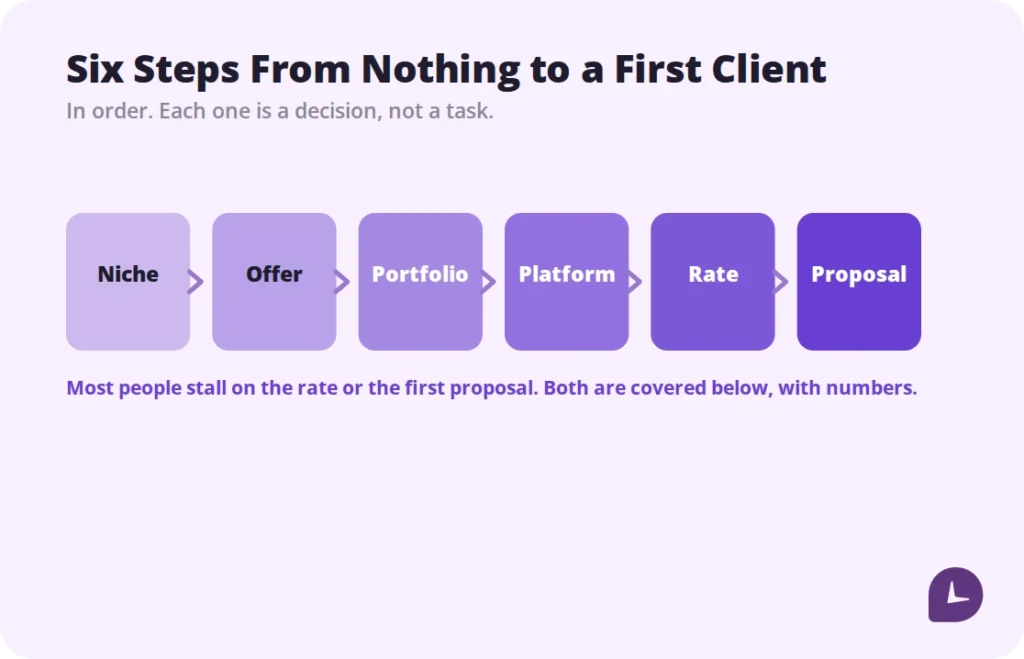
Freelancing means selling a skill as a service to several clients instead of working for one employer. To start: pick one skill with visible demand, build two or three samples even without paid work, set a rate that survives platform fees and tax, and send personalised proposals every day until someone says yes.
Most people who start get stuck on the same two things — pricing and the first client. This guide covers both with actual numbers: what the work pays, what you keep after fees and tax, how long the first client usually takes, and what a proposal needs to contain.
Key takeaways
- One skill, one client type. “I write” loses to “I write onboarding emails for SaaS companies” every time.
- You do not need paid experience to have a portfolio. Two or three samples are enough to compete.
- A $500 job is not $500. After platform fees and tax you keep roughly half, and your rate has to account for that.
- Most beginners who send proposals consistently land a first client in two to six weeks. The variable is consistency, not talent.
- Use a written agreement on anything above a few hundred dollars, including with people you know.
Is Freelancing Right for You?
Freelancing suits people who have a skill someone pays for and can work without daily supervision. The trade is straightforward: you gain control over what you work on and what you charge, and you take on taxes, unpaid admin, and income that varies month to month — especially at the start.
| Employment | Freelancing | |
|---|---|---|
| Income | Fixed, predictable | Variable, no fixed ceiling |
| Tax | Withheld for you | You set aside 25–30% yourself |
| Benefits | Usually included | You arrange and fund them |
| Time off | Paid | Unpaid, and it costs you the work |
| Admin | Handled by the employer | Yours: invoices, contracts, chasing payment |
| What decides your pay | Role and promotion cycle | Skill, positioning and how you sell |
The honest version: the first two or three months are the hardest part for almost everyone. Income is irregular before it is regular, and that stretch is where most people quit.
Boost your business productivity
Track performance and streamline teamwork
Step 1: Pick One Skill and One Kind of Client
The most common beginner mistake is offering everything. Clients do not search for “designer” — they search for “logo designer for coffee brands”. The narrower the offer, the easier it is to be found, to be judged, and to be paid properly.
Three questions get you to a workable niche in one sitting:
- What can I do today that produces a real result for someone, with no further training? Past employment counts.
- Is anyone hiring for it right now? Search the skill on a freelance platform. If jobs are posted this week, that is your answer.
- Can I build three samples of it within a week? If not, the skill is not ready to sell yet.
Three yes answers mean the niche works. It does not have to be the skill you do forever — it has to be the one that gets you a first client. Which skills are actually in demand covers where the hiring volume is right now, and where it is only growing fast.
Then compress it into one sentence you will reuse everywhere: I help [client type] achieve [result] through [service]. That line becomes your profile headline and the first sentence of every proposal.
Step 2: Build a Portfolio With No Clients
You do not need paid work to show proof. You need proof. Clients looking at a sample are asking whether you can do this for them, not who paid you last.
- Spec work. Design a brand for a fictional company, write the article a real site is missing, build a demo of an app that does not exist. Entirely legitimate and widely accepted.
- One free project for someone you know, done properly, in exchange for a written testimonial. Say plainly that you are building a portfolio.
- Rebuild something that exists badly. Redesign a weak page, rewrite a weak article, show before and after. This demonstrates judgement as well as skill.
- Volunteer for an organisation that will let you name them. A real name attached to a sample carries more weight than a fictional one.
Three to five samples, a short bio and contact details is a complete portfolio. A simple page is fine; a custom website can wait until you have ten clients.
Step 3: Set a Rate That Survives Fees and Tax
The rate you name is not the money you keep. Platform commission comes off first, then tax, then unpaid hours you spent finding the work. Beginners who price without accounting for that end up working full weeks for part-time money.
The minimum rate calculation
Take your monthly living costs, multiply by 1.35 to cover self-employment tax, and divide by the hours you can realistically bill in a month. Billable hours are not working hours — expect to bill around half of what you work in the early months.
With $3,000 of monthly costs and 80 billable hours: $3,000 × 1.35 ÷ 80 ≈ $51 per hour as a floor. Set your actual rate 20–30% above the floor to cover slow months and negotiation.
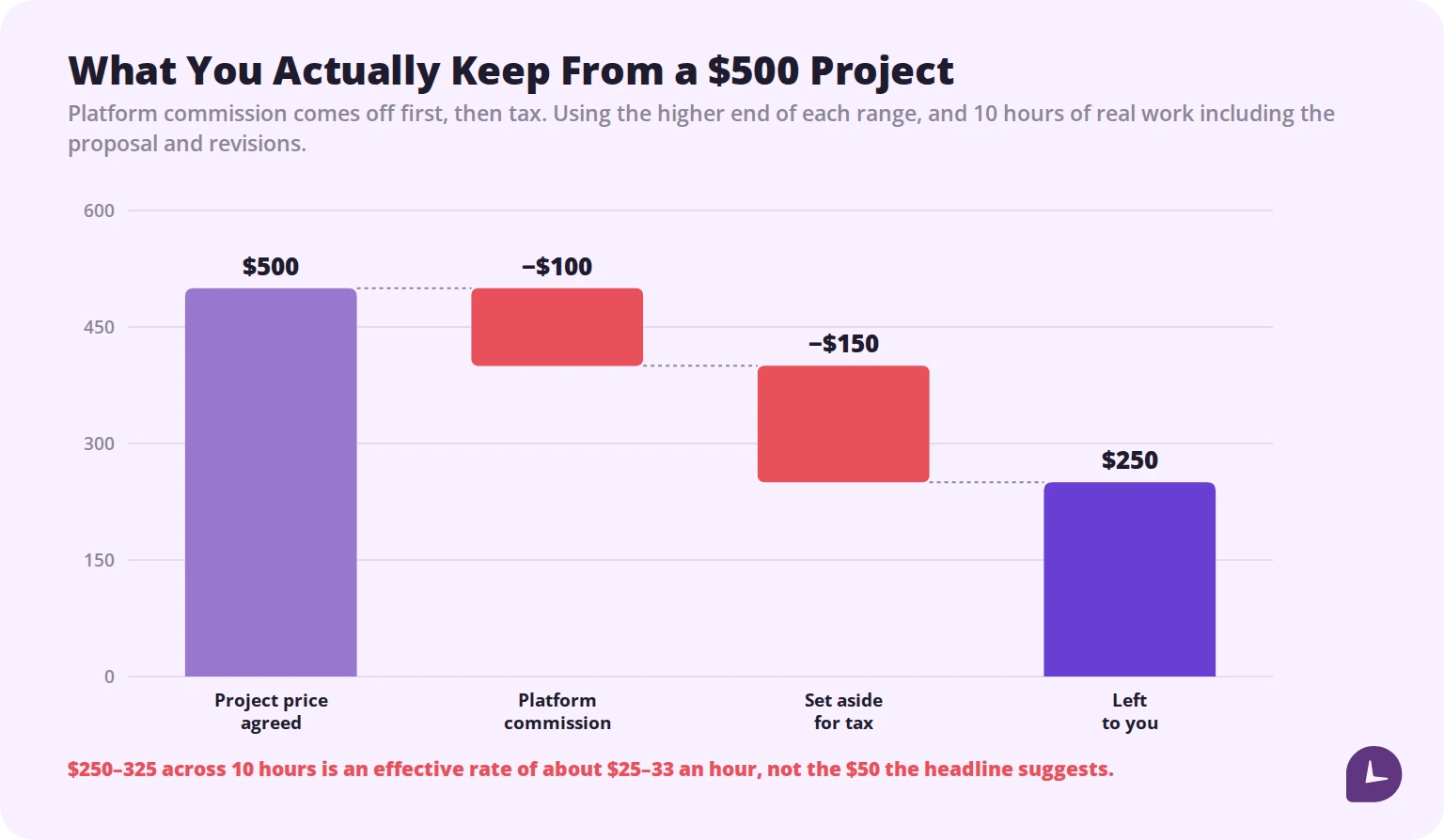
What You Actually Keep From Your First Job
Worth doing once, on paper, before you name a price.
| Line | Amount |
|---|---|
| Project price agreed with client | $500 |
| Platform commission (10–20%) | −$50 to −$100 |
| Set aside for tax (25–30%) | −$125 to −$150 |
| Left to you | ~$250–325 |
| Hours actually spent, including proposal and revisions | 10 |
| Effective hourly rate | ~$25–33 |
Two consequences. A $500 project at ten hours is not a $50-per-hour job, it is closer to $28 — which is why undercutting to win the first client sets a floor you then have to climb back out of. And the hours spent on proposals are real hours; track them, or your effective rate stays invisible.
Step 4: Choose One Platform, Not Five
Platforms are where clients already are, which is why they are the fastest route for someone with no reviews. Scattering across six of them produces six weak profiles. Pick one, spend three months on it, get five reviews, then expand.
| Route | Suits | Commission | Competition |
|---|---|---|---|
| Fiverr | Packaged, well-defined services | ~20% | High |
| Upwork | Tech, writing, marketing; proposal-based | 10–20% | Medium |
| Toptal and similar | Senior specialists, vetted entry | Built in | Low |
| B2B services, consulting | None | Medium | |
| Direct outreach | Any niche, higher rates | None | Low, but slow |
Marketplaces are the fastest start and the most expensive long term. Direct clients are the opposite. Most freelancers use marketplaces to build a reviewed track record, then shift the mix toward direct work as referrals start arriving. If the goal is steady income rather than a portfolio of clients, remote roles that pay well is the other route to the same skills.
Step 5: Land the First Client
With no reviews, the proposal has to do the work the reviews would normally do. That means lowering the client’s perceived risk, not lowering your price.
- Open with their problem, not your background. Name something specific from their brief. This alone puts you ahead of most applicants.
- Attach one relevant sample. One, close to what they asked for. Not a link to everything you have made.
- Give a short plan. Two or three bullets on how you would approach it, tied to their posting.
- Close with one easy question. “Would a short call this week work?” — one question, nothing else.
- Follow up once, three or four days later. Two sentences. Most work is lost to silence after a single message.
Send five to ten of these a day rather than one perfect one a week. Consistency is the variable that decides how long this takes.
How Long the First Client Takes
| Starting point | Typical time to first client |
|---|---|
| Existing skill, network to tell | 1–2 weeks |
| Existing skill, no network | 2–4 weeks |
| Building the skill while pitching | 4–8 weeks |
| Starting the skill from scratch | 2–4 months |
These are observed ranges, not promises. The single biggest factor is how many targeted proposals go out per week — not the quality of the portfolio, and not the niche.
Mistakes That Cost the Most
| Mistake | What happens next |
|---|---|
| Pricing low to win the first client | That rate becomes your anchor; raising it with the same client is harder than finding a new one |
| Working without a written agreement | Scope grows, payment slips, and you have nothing to point at |
| Offering everything to everyone | You are not found in search and not remembered by referrers |
| Not tracking hours on fixed-price work | You never learn your real hourly rate, so the next quote is wrong too |
| Setting nothing aside for tax | The bill arrives as a single sum against money already spent |
| Sending one proposal and waiting | Most replies come after the follow-up, not the first message |
On the fourth row: a fixed-price project still needs its hours recorded. It is the only way to find out whether the price was right, and it is the difference between quoting from experience and quoting from hope.
Setting Up the Business Side
Five things, none of which need a lawyer or an accountant to begin:
- A separate account for freelance income, from the first payment.
- 25–30% of every payment set aside for tax. Move it the day it arrives, not at the end of the month.
- A written agreement for anything above a few hundred dollars: scope, deadline, payment terms, revision count, who owns the work.
- Invoices that state the service, the amount, the due date and how to pay — online timesheets give you the hours to put on them.
- Hours recorded per client and per project. A time tracker built for freelancers does this while you work, so an invoice comes from a record rather than a reconstruction — and you have something concrete when a client questions a total. Try it on a 10-day free trial, no card required.
Key Takeaways
One skill, one client type, three samples. Price from a floor that accounts for fees and tax rather than from what feels modest. Choose one platform and stay on it long enough to get reviews. Send proposals that open with the client’s problem, and follow up once. The first client usually arrives within two to six weeks of consistent effort — and almost never arrives while you are still preparing.
Reliable employee tracking software. Clear visibility and insights into how employees work. Even remotely.
Try Monitask free for 10 days
FAQ
How much should a beginner freelancer charge?
Calculate a floor rather than copying someone else. Monthly living costs × 1.35 for tax, divided by realistic billable hours, gives a minimum; set your rate 20–30% above it. Remember that platform commission and tax together take roughly half of a project price, so the number you name and the number you keep are very different.
How long does it take to get the first freelance client?
Between one week and four months depending on where you start. Someone with an existing skill and a network to tell usually lands work within two weeks; someone learning the skill while pitching should expect one to two months. The strongest predictor is how many targeted proposals go out each week.
Should I use Upwork or Fiverr as a beginner?
Either, but only one to begin with. Fiverr suits packaged services where the client buys a defined deliverable; Upwork suits proposal-based work in tech, writing and marketing. Three months on one platform with five completed jobs is worth more than six half-built profiles.
Do I need to register a business to freelance?
In most countries you can start as a sole trader under your own name with no registration. Requirements vary, and they change as income grows, so treat this as a question for a local accountant once you are earning consistently rather than a reason to delay the first client.
Is freelancing still worth it with AI tools available?
The work has shifted rather than disappeared. Routine, low-context tasks are the ones AI absorbs; work requiring judgement, client context and accountability is not. Freelancers who add AI tools to an existing skill are in a stronger position than either those who ignore them or those who offer only what a tool can do unaided.
How many hours a week does freelancing take at the start?
More than the billable hours suggest. Early on, a large share of the week goes to proposals, portfolio work and admin that nobody pays for — expect to bill roughly half of what you work until you have repeat clients. This is the main reason to track hours from the first project.