

Sourcing, interviewing and onboarding a remote employee is close to the same work as hiring anyone else, done over video. Most guides stop there, and that is why companies get surprised.
The part that actually differs is jurisdictional. Employment law generally follows where the work is performed, not where the company is registered. Hiring one person in a state you have never employed anyone in can trigger payroll tax registration, unemployment insurance, workers’ compensation and a different set of wage, leave and notice rules, all at once.
This guide covers the process briefly and the compliance properly.
The hiring process, step by step
- Decide the geography first. Anywhere in the country, a list of approved states, or a time zone band. This decision drives cost, compliance and the size of your candidate pool, and it is much harder to change afterwards.
- Define the role in outputs. What this person delivers, not what hours they sit.
- Write the posting with the pay range. Required in a growing number of states, and covered below.
- Source. Remote-specific boards, your own network, and employee referrals, which remain the fastest route to hire.
- Screen for written communication. In a distributed team it is the primary interface.
- Interview over video, structured. Same questions, same order, scored independently.
- Test with real work, paid. A short scoped task predicts performance far better than an interview does.
- Make the offer, with the location terms written down. Where they may work from, and what happens if they move.
- Register where you need to before day one. Payroll and insurance registration take time; start before the offer is accepted, not after.
- Onboard deliberately. Nothing about remote onboarding happens by proximity.
Steps one, three, nine and the I-9 requirement are the ones that differ from local hiring. The rest is ordinary recruitment done over video.
Writing a remote job description that filters
Two changes make a remote posting work harder.
State the location terms precisely. “Remote” alone attracts applications you cannot hire. Say whether it is remote within a country, within named states, or within a commutable radius. If the role is hybrid, say how many days and where, because hybrid remote means nothing without specifics.
State the hours expectation. Fully asynchronous, core overlap hours, or a fixed schedule in a named time zone. This single line removes a large share of mismatched applications, and its absence is the most common source of first-month friction.
Beyond that, describe the work in deliverables and name the tools the team actually uses. Candidates screen employers on specificity, and vague remote postings read as an employer that has not thought the arrangement through.
Pay transparency in remote job postings
This catches employers out precisely because the role has no location.
A growing number of states require salary ranges in job postings, including California, Colorado, New York, Washington, Hawaii and Illinois, with thresholds and details differing in each.
The complication for remote roles: a posting can fall under another jurisdiction’s law if the job could be performed there. A fully remote role advertised nationally may be covered by several pay transparency laws simultaneously, even if your company has no presence in those states. New York applies a test based on whether the role reports into New York; California has its own approach to remote-role applicability; Colorado adds a post-selection notification requirement.
The practical answer is to standardise. Build one posting template that always includes the pay range, the benefits summary, and the application instructions, with room for jurisdiction-specific additions. Deciding this once is far cheaper than deciding it per posting, and excluding states from a remote posting to avoid the requirement tends to shrink the candidate pool more than it saves.
What arrives with an out-of-state hire
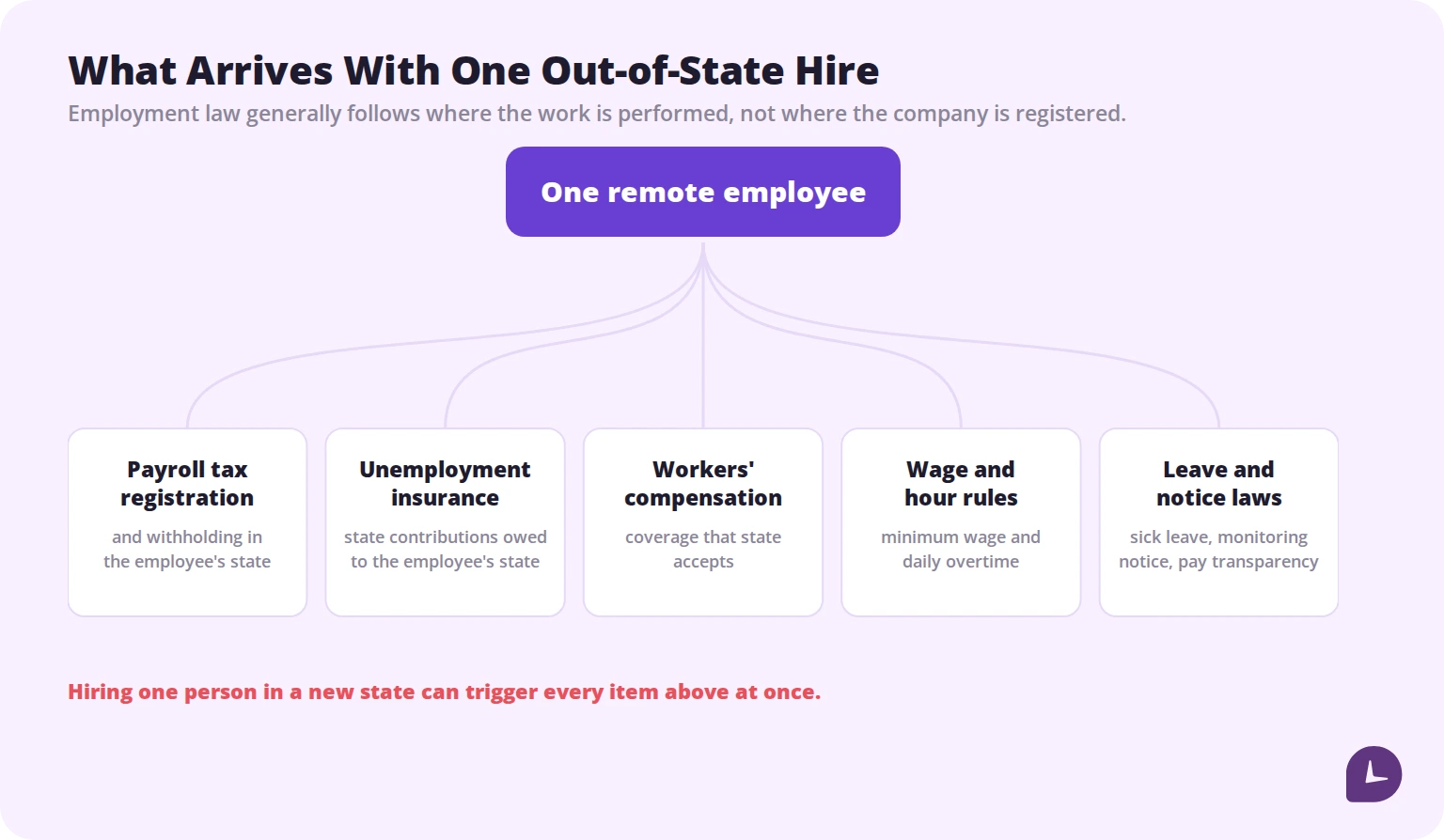
For a US employer hiring across state lines, the obligations that generally follow the employee include:
Payroll tax registration and withholding in the state where the work is performed.
Unemployment insurance. State unemployment contributions are generally owed to the employee’s state.
Workers’ compensation coverage valid in that state. A policy written for one state does not automatically extend.
Wage and hour rules. Minimum wage varies. So does overtime: California applies daily overtime above eight hours regardless of the weekly total, which our overtime calculator covers.
Paid sick leave. Around twenty states plus DC mandate it, with different accrual rates and qualifying reasons. Entitlement follows the employee’s work location.
Monitoring notice. New York, Connecticut and Delaware require notice before electronic monitoring, and New York requires acknowledgment. Maine’s broader law takes effect in summer 2026.
Final pay rules. Deadlines for issuing a final paycheck after termination differ sharply between states, and are a common source of penalties.
There may also be business registration or tax nexus consequences from having an employee in a new state. These are fact-specific questions worth putting to an accountant before the first hire in a new jurisdiction rather than after.
This is general information rather than legal or tax advice.
Interviewing for remote work specifically
Standard interviewing applies. Four additions are worth building in.
Written exercise. Ask for a short written response to a realistic scenario. In a distributed team, writing clearly is the job, not a soft skill attached to it.
Autonomy questions with evidence. Not “are you self-motivated” but “describe the last time you were blocked and nobody noticed. What did you do?” The answer distinguishes people who escalate from people who go quiet.
Async communication check. How do they handle a decision that needs input from three people in different time zones? There are good answers and there are answers that assume a meeting.
A paid, scoped task. Two to four hours, paid at a fair rate, scoped realistically. It is the single strongest predictor available and it also shows the candidate how you work.
What not to over-index on: home office setup, and whether they have prior remote experience. The first is solvable with a stipend and the second screens out capable people for a circumstance.
Form I-9 for someone you will never meet
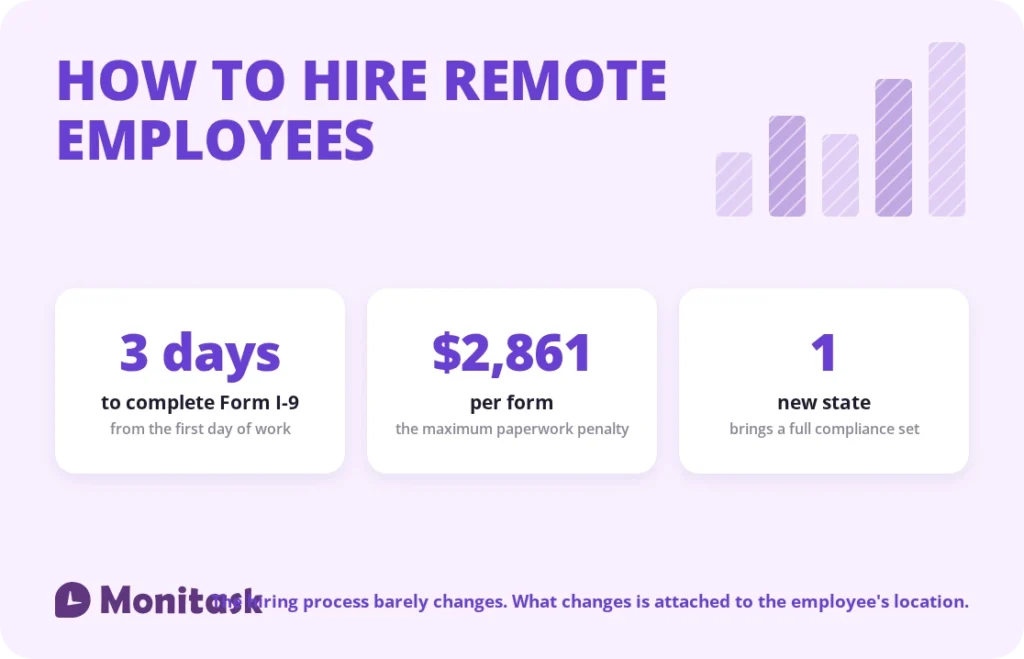
Every US employer must complete Form I-9 for each new hire, with Section 2 completed within three business days of the first day of work for pay. That has always required examining original documents, which is awkward when the employee is 2,000 miles away.
Since August 1, 2023, the Department of Homeland Security has permitted an alternative procedure allowing remote document examination. The conditions are strict:
- The employer must be enrolled in E-Verify and in good standing. Employers not in E-Verify cannot use it, regardless of circumstances.
- The employee transmits copies of documents in advance.
- The employer conducts a live video interaction in which the employee presents the same original documents.
- The employer retains clear copies of every document examined.
- The employer checks the alternative procedure box in Section 2 and creates an E-Verify case.
That last item is not a formality. ICE guidance issued in March 2026 treats a missing alternative-procedure checkbox as a substantive violation, meaning it cannot be corrected after a Notice of Inspection and is immediately finable, at penalties reported between $288 and $2,861 per form.
Two further points. Use of the procedure is optional but must be applied consistently at a hiring site, and employees must be allowed to request in-person examination instead. If you are not in E-Verify, the alternative is an authorised representative examining documents in person on your behalf; a notary can serve in that role, though the seal itself confers no benefit.
Retention: keep the I-9 for three years after hire or one year after termination, whichever is later.
Employee or contractor
Hiring remotely makes contractor arrangements tempting, especially across borders. Misclassification is expensive and the exposure accrues silently.
The distinction turns on the nature of the relationship rather than what the contract calls it: who controls how and when the work is done, whether the work is integral to the business, whether the person serves other clients, and whether the arrangement is open-ended.
If you set someone’s hours, direct their methods, and they work only for you on core business activity, the label on the agreement is unlikely to hold. Our independent contractor vs employee checklist works through the tests.
Boost your business productivity
Track performance and streamline teamwork
Hiring outside the US
Employing someone in another country generally requires a legal entity there, or an employer of record acting as the legal employer on your behalf.
An EOR handles local payroll, statutory benefits and compliance for a fee, usually a percentage of salary or a flat monthly amount per employee. It is the standard route for hiring one or two people in a country where establishing an entity is not justified.
Two things to check before signing: how intellectual property assigns under local law, which varies more than people expect, and what happens if you later want to move the employee onto your own entity.
Onboarding remotely
Nothing about remote onboarding happens by accident, because none of it happens by proximity.
Ship equipment before day one. A first day spent waiting for a laptop sets a tone.
Provide a written first-week plan. Who to meet, what to read, what to have done by Friday. Ambiguity in week one is much more costly remotely.
Assign a buddy who is not the manager. Most of what a new hire needs to ask is too small to take to a manager, and in an office they would ask the person next to them.
Front-load synchronous time, then taper. The relationships that make async work possible are built in the first fortnight.
Set the first deliverable early. Something real and small, finished in week one. It converts a new hire from observer to participant faster than any amount of orientation.
Our guide to remote onboarding has the full sequence.
Common mistakes
Deciding geography after making the offer. The location terms belong in the posting and the offer letter.
Posting a national remote role without a pay range. Several states’ laws may apply regardless of where your company sits.
Registering for payroll after the start date. Registration takes time and the first payroll will not wait.
Using remote I-9 verification without E-Verify enrolment. It is not permitted, and the checkbox error is not curable.
Assuming your home state’s rules travel. They generally do not. The employee’s location governs.
Classifying as a contractor to avoid the above. The exposure compounds until someone challenges it.
Onboarding by sending links. Written plan, assigned buddy, real first deliverable.
How Monitask helps
Once someone is hired in another state, the record of their hours stops being an internal convenience and becomes a compliance artefact. Overtime thresholds, sick leave accrual and wage rules all depend on hours worked, in a jurisdiction whose rules may differ from yours.
Monitask records hours as they happen. Employees clock in when they start and clock out when they stop, so nothing runs in the background without their knowledge.

- Hours by day and by workweek support overtime rules that differ between the states you now employ in.
- Attendance records give payroll a defensible source, which matters more once multiple jurisdictions are involved.
- Project time shows how a new remote hire is ramping, without anyone counting activity.
- Transparent by design, which is the right footing for a first remote hire and a requirement in states with monitoring notice laws.
See how it works: Monitask remote employee monitoring.
Sources
- US Citizenship and Immigration Services, Form I-9 alternative procedure — remote document examination for E-Verify employers, effective August 1, 2023.
- Department of Homeland Security final rule, 8 CFR 274a.2 — conditions for the alternative procedure, including live video examination and document retention.
- ICE enforcement guidance, March 2026 — classification of a missing alternative-procedure checkbox as a substantive violation.
- US Department of Labor, Wages and the Fair Labor Standards Act — federal wage and hour baseline, above which state rules apply.
- State pay transparency statutes in California, Colorado, New York, Washington, Hawaii and Illinois, which differ in thresholds and in how they apply to remote postings.
Related reading
- Hiring Remote Developers
- 6 Ways to Find Good Remote Workers Outside of Upwork
- Remote Onboarding: How to Successfully Onboard a New Employee Remotely
- The Ultimate Independent Contractor vs Employee Checklist
- International Remote Team
- Hybrid Remote Meaning
FAQ
Do I need to register in another state to hire a remote employee there?
Usually yes. Payroll tax withholding, unemployment insurance and workers’ compensation generally follow the employee’s work location, and there may be business registration consequences as well.
Can I complete Form I-9 remotely?
Only if you are enrolled in E-Verify and in good standing. The DHS alternative procedure requires a live video examination of the same original documents, retained copies, and the alternative-procedure box checked in Section 2.
What happens if I forget the I-9 alternative procedure checkbox?
ICE guidance from March 2026 treats it as a substantive violation, which cannot be cured after a Notice of Inspection and is immediately finable, at reported penalties between $288 and $2,861 per form.
Do pay transparency laws apply to remote job postings?
They can, even where your company has no presence, if the role could be performed in a covered jurisdiction. Standardising a posting template that always includes the range is simpler than assessing each posting.
Which state's employment laws apply to a remote employee?
Generally the state where the work is performed, not where the company is headquartered. That governs minimum wage, overtime, sick leave, monitoring notice and final pay rules.
Should I hire remote workers as contractors instead?
Only if the relationship genuinely is a contractor relationship. Misclassification exposure accrues quietly and the contract’s label does not decide the question.
How do I hire someone in another country?
Either establish a legal entity there or use an employer of record, which becomes the legal employer for local payroll and compliance purposes in exchange for a fee.
How long do I have to complete Form I-9?
Section 1 on or before the first day of work, and Section 2 within three business days of the first day of work for pay.