Most overtime calculators multiply your hourly rate by 1.5 and stop there. That answer is wrong whenever a bonus is involved, wrong in states with daily overtime rules, and no help at all with the federal overtime deduction, which applies to only part of what you were paid.
This calculator works on the regular rate of pay, which is the figure federal law actually uses.
Overtime pay calculator
Works out overtime using the regular rate of pay, not just the base hourly rate. Enter one workweek.
Estimate for planning only. Overtime rules vary by state, industry and collective agreement, and tax outcomes depend on your full return. Not legal or tax advice.
How overtime pay is calculated
The federal rule is short. Under the Fair Labor Standards Act, covered non-exempt employees must be paid at least one and a half times their regular rate for hours worked beyond 40 in a workweek. The Department of Labor defines that workweek as a fixed and regularly recurring period of 168 hours
(DOL, Fact Sheet #23).
Three points follow from that definition and each one trips people up.
Overtime is weekly, not daily. Under federal law alone, a 12-hour Monday earns no premium if the week totals 38 hours. Several states override this, covered below.
The week is fixed in advance. An employer picks the start day and hour, and it stays fixed. Shifting the boundary week to week to avoid a premium is not permitted.
Averaging is not allowed. A 30-hour week followed by a 50-hour week owes 10 hours of overtime, not zero. The two-week average of 40 is irrelevant.
Federal law sets no cap on hours for employees aged 16 and over, and requires no premium for weekend, night or holiday work as such.
The regular rate is not your hourly rate
This is where most calculators, and a good number of payroll runs, go wrong.
The regular rate is total weekly earnings divided by total hours worked. If the only compensation is a flat hourly wage, it equals the base rate. But non-discretionary bonuses must be included: production bonuses, attendance bonuses, shift differentials, and anything promised in advance to induce work.
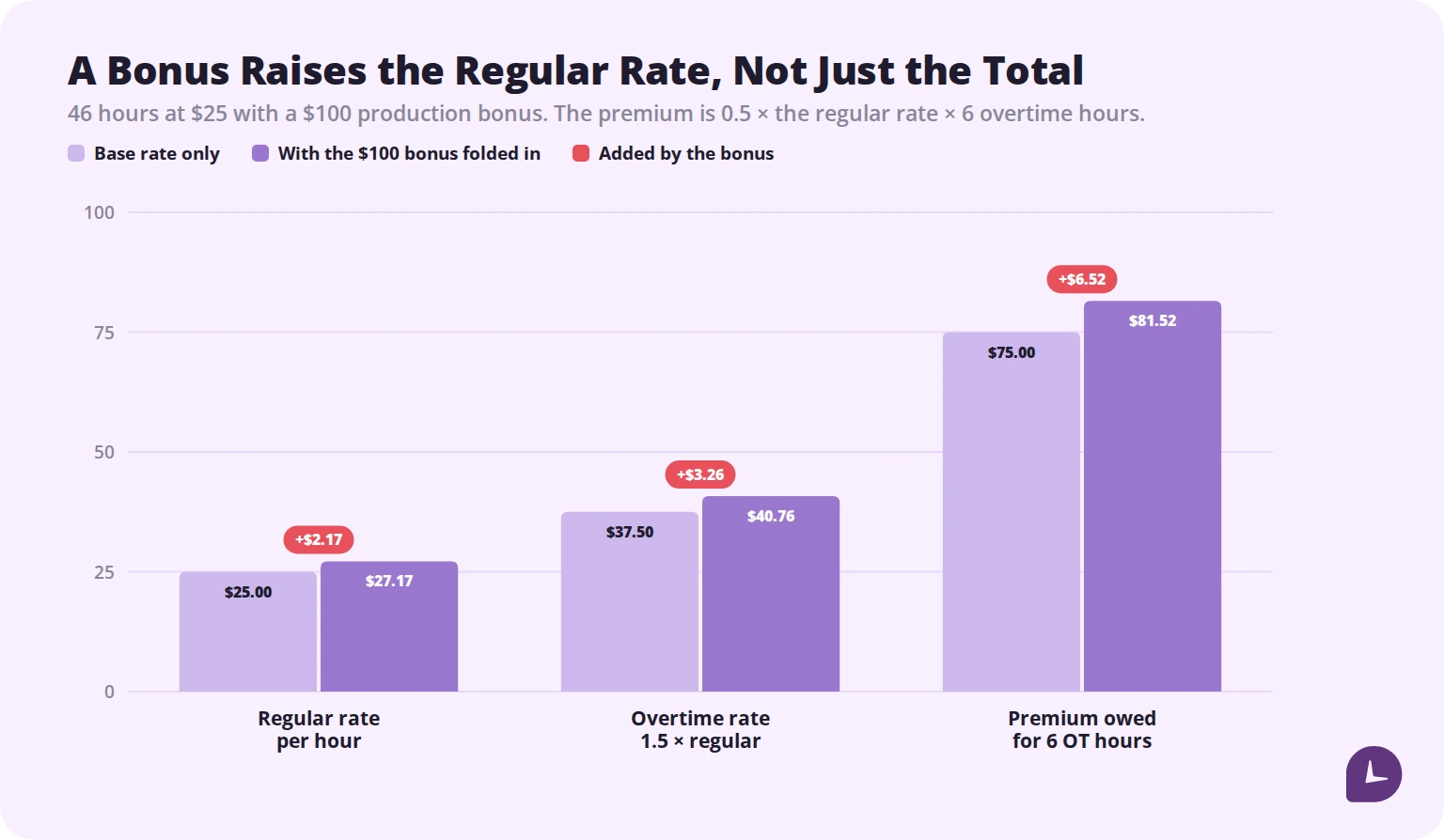
Take 46 hours at $25 with a $100 production bonus:
- Straight-time earnings: (46 × $25) + $100 = $1,250
- Regular rate: $1,250 ÷ 46 = $27.17
- Overtime premium: 0.5 × $27.17 × 6 = $81.52
- Total: $1,331.52
Calculate the premium off the $25 base instead and you pay $75, underpaying by $6.52 for the week. That is $339 a year for one employee, and it compounds into back pay, liquidated damages and interest if audited.
Discretionary bonuses, genuine gifts, and most benefit contributions are excluded. The distinction turns on whether the payment was promised in advance. DOL Fact Sheet #56A sets out what goes in and what stays out.
Time and a half, double time, and what the law requires
| Multiplier | Common name | Required by federal law? |
|---|---|---|
| 1.5x | Time and a half | Yes, over 40 hours a week |
| 2x | Double time | No — state law, contract or policy only |
| 3x | Triple time | No |
Federal law sets a floor, not a ceiling. Double time appears in California’s daily rules, in union agreements, and in employer policy, but nothing federal requires it. The same is true of holiday premiums: a company that pays double on Thanksgiving does so by choice.
Daily overtime states
A handful of states require a premium based on hours in a day, regardless of the weekly total. California has the most detailed regime.
| Hours worked | California rate |
|---|---|
| Up to 8 in a day | Regular rate |
| Over 8, up to 12 in a day | 1.5x |
| Over 12 in a day | 2x |
| First 8 hours on the 7th consecutive day of a workweek | 1.5x |
| Over 8 hours on the 7th consecutive day | 2x |
| Over 40 in a week, not already counted daily | 1.5x |
Alaska, Nevada and Colorado also apply daily thresholds, with different triggers and exceptions. Nevada’s applies only below a wage threshold; Colorado uses a 12-hour daily rule alongside a weekly one.
The interaction matters. An employee working four 10-hour days totals 40 hours, so owes nothing federally, but earns 8 hours of daily overtime in California. Hours already paid as daily overtime are not counted again toward the weekly threshold.
Switch the calculator above to daily mode to model this.
The 2026 overtime tax deduction
The One Big Beautiful Bill Act created a federal income tax deduction for qualified overtime compensation, running for tax years 2025 through 2028. It is widely described as “no tax on overtime,” and that description misleads in four separate ways.
It covers the premium only. The IRS states that you may deduct the pay that exceeds your regular rate. On time-and-a-half, that is the extra half, not the whole overtime paycheck. Six overtime hours at a $27.17 regular rate produce $81.52 of qualified compensation, not $244.
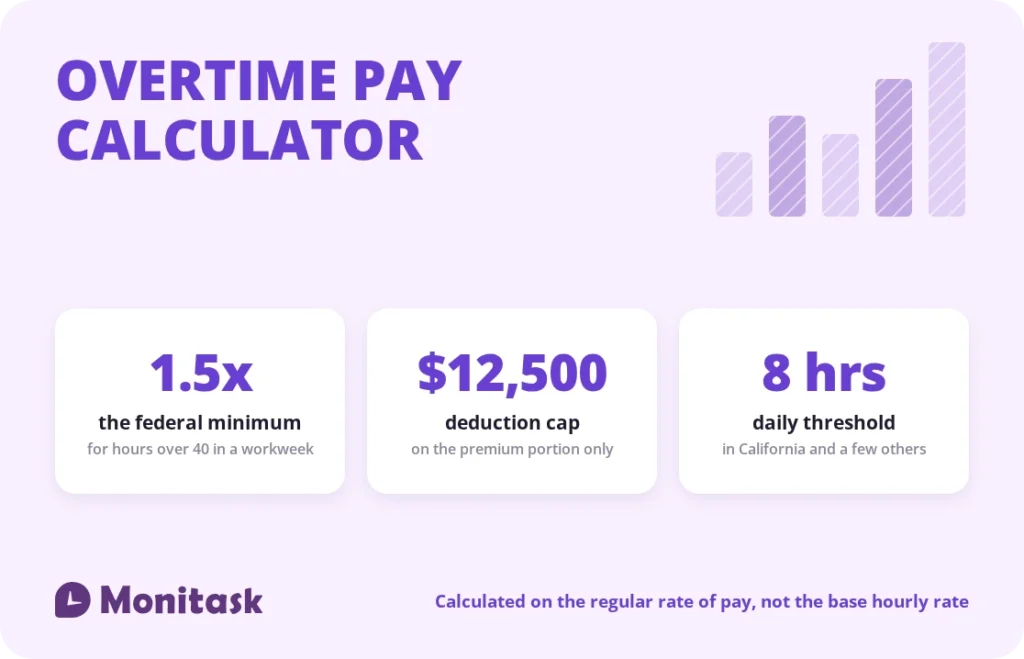
It is capped. Up to $12,500 per return, or $25,000 filing jointly, and it phases out above $150,000 of modified adjusted gross income ($300,000 joint).
FLSA overtime only. Overtime owed under state law or a union agreement but not required by the FLSA does not qualify. California daily overtime on a 38-hour week is a clear example: real overtime pay, not deductible.
Payroll taxes still apply. Social Security and Medicare come out of overtime as normal, and most states still tax it.
For 2025 the IRS waived separate employer reporting, so workers estimated the figure from pay stubs. From 2026 employers must report qualified overtime separately, and it appears in Box 12 of Form W-2 under code TT. The deduction is claimed on Schedule 1-A.
If the reported figure looks wrong, the fix is a corrected W-2 from the employer, not an adjustment on your own return.
Who is exempt from overtime
Overtime rules apply to non-exempt employees. Exemption depends on how someone is paid, how much, and what they actually do, not on job title.
The main white-collar exemptions cover executive, administrative, professional, computer and outside sales roles, and each has its own duties test. Being salaried is not by itself an exemption: a salaried employee whose duties fail the test is non-exempt and owed overtime.
Misclassification is among the most expensive payroll errors there is, because it accrues silently across years. DOL Fact Sheet #17A sets out the duties tests.
Worked examples
Standard week, no bonus. 46 hours at $25.
40 × $25 = $1,000. Premium: 6 × $37.50 = $225. Total $1,225.
With a non-discretionary bonus. 46 hours at $25 plus $100.
Regular rate $27.17. Straight-time $1,250, premium $81.52. Total $1,331.52.
California, long day. 14, 8, 8, 8, 8 across five days at $25.
46 hours. The 14-hour day gives 4 hours at 1.5x and 2 at 2x. Straight-time $1,150, premium $100. Total $1,250.
Two uneven weeks. 30 hours then 50 hours at $25.
Week one: $750. Week two: $1,000 + 10 × $37.50 = $1,375. Total $2,125. Averaging the weeks to 40 each would pay $2,000 and underpay by $125.
What does not count as overtime
Under federal law, none of the following triggers a premium on its own:
- Working a weekend or a night shift
- Working a public holiday
- Working more than 8 hours in a day, outside daily-overtime states
- Paid leave, holiday pay or sick pay inside the week — these are not hours worked, so a week with 8 hours of holiday pay and 36 hours worked totals 36 for overtime purposes
That last one is the most common misunderstanding. Only hours actually worked count toward the 40.
Boost your business productivity
Track performance and streamline teamwork
Common mistakes
Calculating the premium off the base rate when a bonus was paid. The regular rate has to include non-discretionary bonuses.
Averaging hours across two weeks. Each fixed workweek stands alone.
Treating salaried as exempt. Salary is one test of several, and the duties test is the one that usually decides.
Counting paid leave toward the 40-hour threshold. Only hours worked count.
Assuming the whole overtime cheque is tax-free. Only the premium above the regular rate is deductible, capped, and only when the FLSA required it.
Applying federal rules in a daily-overtime state. In California, four 10-hour days generate overtime at 40 total hours.
Reconstructing hours after the fact. Overtime disputes are decided on records. Under the FLSA the employer carries the recordkeeping obligation, and where records are missing an employee’s reasonable estimate can stand.
How Monitask helps
An overtime calculation is only as good as the hours going into it. Estimates reconstructed at the end of a pay period are exactly what gets challenged.
Monitask records hours as they happen. Employees clock in when they start and clock out when they stop, so nothing runs in the background without their knowledge.

- Weekly totals align with the fixed FLSA workweek, so overtime is assessed on the right period instead of a monthly average.
- Automatic timesheets give payroll a contemporaneous record, which is what the recordkeeping obligation actually asks for.
- Overtime visibility surfaces hours approaching 40 during the week, when the cost can still be managed.
- Separate tracking of FLSA overtime supports the qualified-overtime reporting employers now have to provide.
See how it works: Monitask online timesheets.
Sources
- US Department of Labor, Fact Sheet #23: Overtime Pay Requirements of the FLSA — the 40-hour threshold and the fixed workweek.
- US Department of Labor, Fact Sheet #56A: Overview of the Regular Rate of Pay — what is included in and excluded from the regular rate.
- US Department of Labor, Fact Sheet #17A: Exemption for Executive, Administrative, Professional, Computer and Outside Sales Employees — duties tests for exemption.
- Internal Revenue Service, What to know about the No Tax on Overtime deduction — deduction caps, MAGI phase-out and eligibility.
- Internal Revenue Service, FS-2026-13 — updated August 2026 guidance on qualified overtime compensation.
Related reading
- 5 Simple Steps to Correctly Calculate Overtime Pay for Your Employees
- How Many Hours in a Month?
- How Many Pay Periods in a Year?
- Understanding Straight Time Pay: A Complete Guide to Calculation
- The 7-Minute Rule for Payroll: Legal Insights and Practical Tips
- How to Calculate Payroll: A Complete Step-by-Step Guide
FAQ
What is time and a half?
One and a half times the regular rate. At a $20 regular rate, time and a half is $30 an hour.
Is overtime calculated daily or weekly?
Weekly under federal law, on hours over 40 in a fixed seven-day period. California, Alaska, Nevada and Colorado add daily thresholds.
Does a bonus change my overtime rate?
Yes, if it is non-discretionary. Production, attendance and shift bonuses must be included in the regular rate before the premium is calculated.
Is overtime tax free in 2026?
No. A federal deduction covers qualified overtime compensation up to $12,500, or $25,000 jointly, for tax years 2025 through 2028. It applies only to the premium above your regular rate, only to FLSA-required overtime, and phases out above $150,000 MAGI. Social Security and Medicare still apply.
How much of my overtime qualifies for the deduction?
Only the extra half. Six hours at a $27.17 regular rate produce $81.52 of qualified compensation, not the full $244 paid for those hours.
Do salaried employees get overtime?
Some do. Salary alone does not create an exemption; the role must also satisfy a duties test and a salary threshold.
Does paid time off count toward the 40-hour overtime threshold?
No. Only hours actually worked count. A week with 8 hours of holiday pay and 36 hours worked totals 36 for overtime purposes.
Is double time required by law?
Not federally. It appears in California’s daily rules, in union agreements and in employer policy, but no federal rule requires more than 1.5x.
Can an employer refuse to pay overtime that was not approved?
Hours worked must be paid, even if unauthorised. An employer can discipline an employee for breaking a policy on unapproved overtime, but cannot withhold the pay.