
How Many Hours in a Month? Calendar Hours, Work Hours, and 2026 Tables

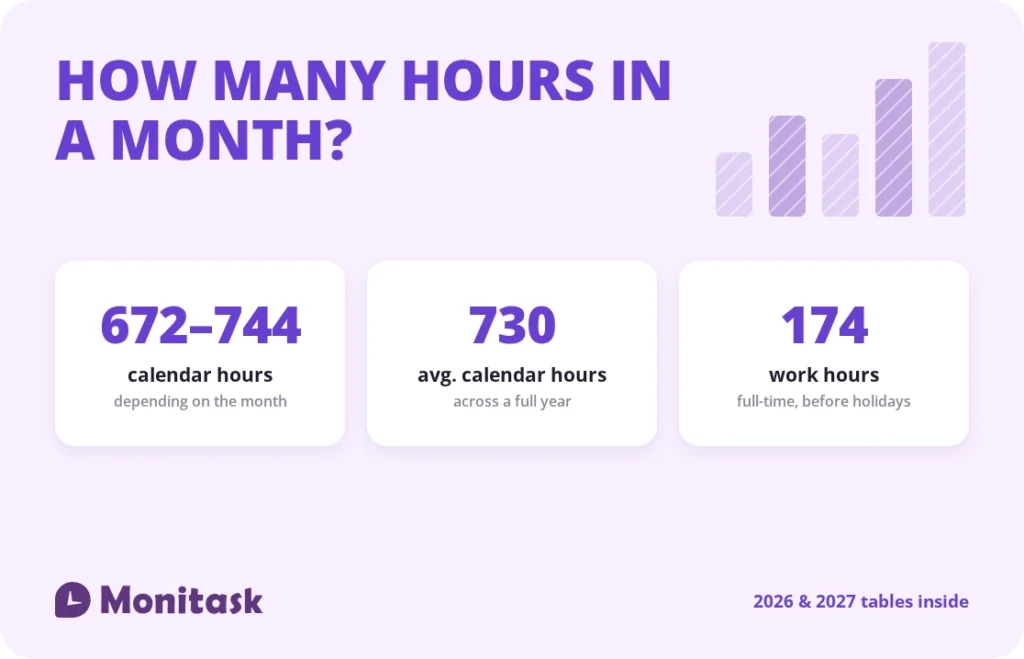
A calendar month holds between 672 and 744 hours. February in a common year is the shortest at 672. The seven 31-day months each hold 744. Averaged across a full year, a month runs 730 hours.
Work hours are a different figure. A full-time employee on a 40-hour week logs 160 to 184 work hours per month, averaging 174. Subtract US federal holidays and the practical average drops to about 167.
Both numbers get called “hours in a month,” which is why payroll disputes start. This guide separates them, gives verified month-by-month tables for 2026 and 2027, and shows which figure belongs in which calculation.
Quick answer
| Question | Answer |
|---|---|
| Hours in a month (calendar) | 672-744; average 730 |
| Hours in the shortest month | 672 (February, common year) |
| Hours in the longest months | 744 (31-day months) |
| Work hours in a month (full-time) | 160-184; average 174 |
| Work hours after US federal holidays | About 167 per month |
| Work days in a month | 20-23; average 21.75 |
| Payroll standard | 173.33 hours |
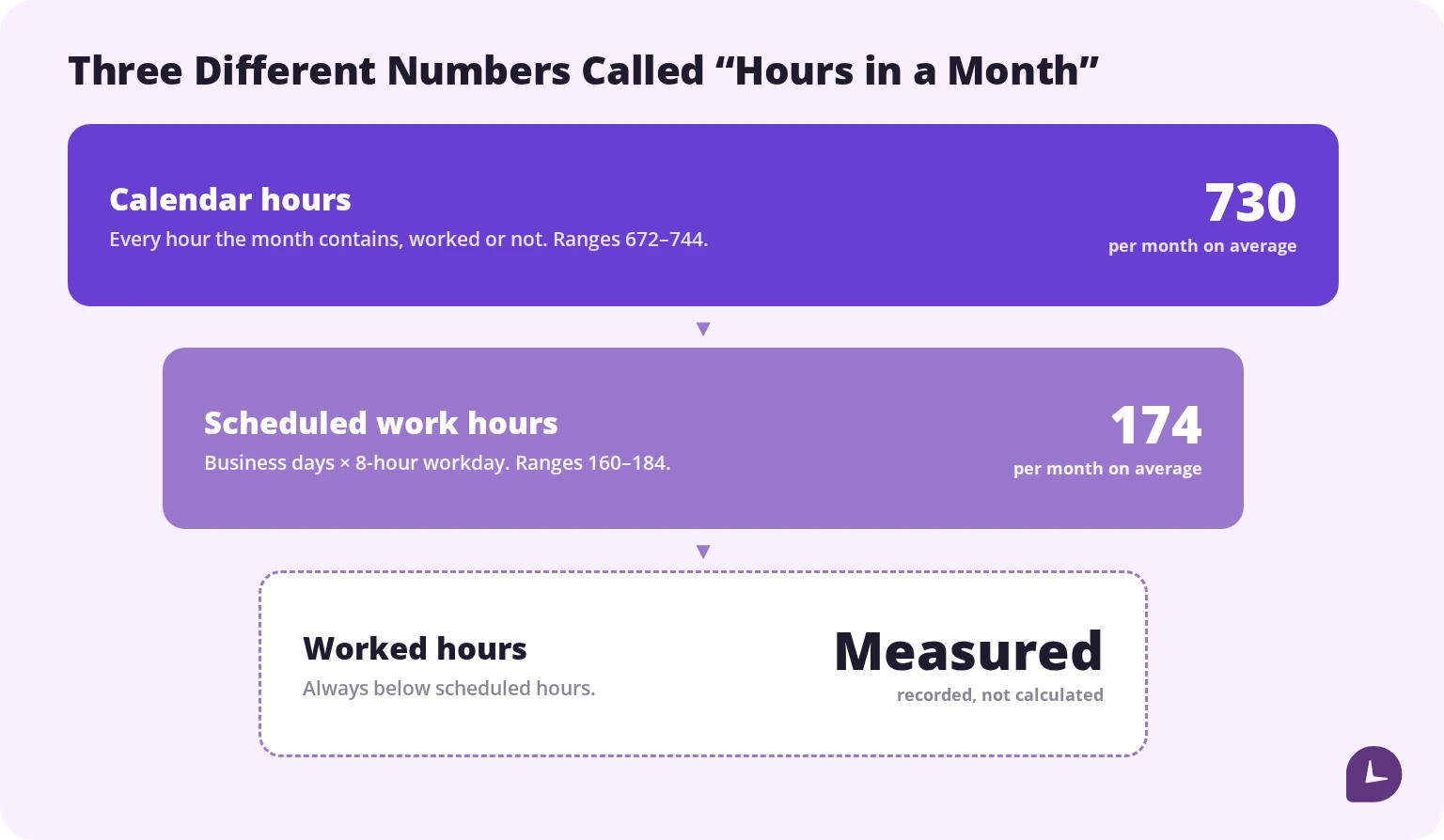
Three terms that get confused:
- Calendar hours — every hour the month contains, worked or not. 672 to 744.
- Scheduled work hours — business days multiplied by the standard workday. 160 to 184.
- Worked hours — time actually recorded against tasks. Always lower than scheduled, and the only one of the three that can be measured rather than calculated.
Total calendar hours in a month
Every day contains 24 hours, so calendar hours depend only on the month’s length.
| Month | Days | Total hours |
|---|---|---|
| January | 31 | 744 |
| February | 28 (29 in leap years) | 672 (696) |
| March | 31 | 744 |
| April | 30 | 720 |
| May | 31 | 744 |
| June | 30 | 720 |
| July | 31 | 744 |
| August | 31 | 744 |
| September | 30 | 720 |
| October | 31 | 744 |
| November | 30 | 720 |
| December | 31 | 744 |
Formula: Total hours = days in the month × 24
A common year holds 8,760 hours (365 × 24). A leap year holds 8,784 hours (366 × 24).
Why the average is sometimes 730 and sometimes 730.56
You will see both figures quoted, and both are correct for different purposes.
730 hours comes from a common year: 8,760 ÷ 12. Use it when you are working inside a specific non-leap year.
730.56 hours comes from the Gregorian mean year of 365.2425 days, which accounts for the fact that 97 of every 400 years are leap years. Multiply 365.2425 by 24 and divide by 12 and you get 730.485, commonly rounded to 730.5 or 730.56 depending on how the intermediate step is rounded.
The difference is roughly half an hour a month. It matters for cloud infrastructure billing and long-horizon financial modeling. It does not matter for payroll, because payroll counts work days, not calendar hours.
Work hours in a month
Work hours count business days only. In a standard Monday-to-Friday schedule at eight hours a day, a month contains 20 to 23 business days, producing 160 to 184 work hours.
Both 2026 and 2027 contain 261 business days and 2,088 work hours, which gives:
- Average business days per month: 21.75
- Average work hours per month: 174
- Average work hours per week: 40
173.33 or 174? Resolving the conflict
Two standards circulate, and mixing them causes real payroll errors.
173.33 hours derives from the 2,080-hour convention: 52 weeks × 40 hours ÷ 12 months. It is the figure embedded in most US payroll systems and in nearly every salary-to-hourly conversion formula. It is stable year to year.
174 hours derives from counting actual business days: 261 days × 8 hours ÷ 12 months. It reflects the real calendar and drifts slightly between years, because a year contains 260, 261, or 262 weekdays depending on how the days fall.
The 2,080-hour convention is an approximation. Fifty-two weeks is 364 days, one day short of a year, which is exactly why the two figures diverge.
Which to use:
- Salary-to-hourly conversion, benefits accrual, FTE math: 2,080 and 173.33. This is the convention regulators, benchmarks, and payroll platforms expect.
- Monthly capacity, project scheduling, staffing: the actual business-day count for that specific month.
- Never: 160 hours as a general standard. That figure comes from 4 weeks × 40 hours and understates a typical month by roughly two work days.
Pick one convention per use case and document it. Inconsistency between the quoting model and the payroll model is where margin quietly disappears.
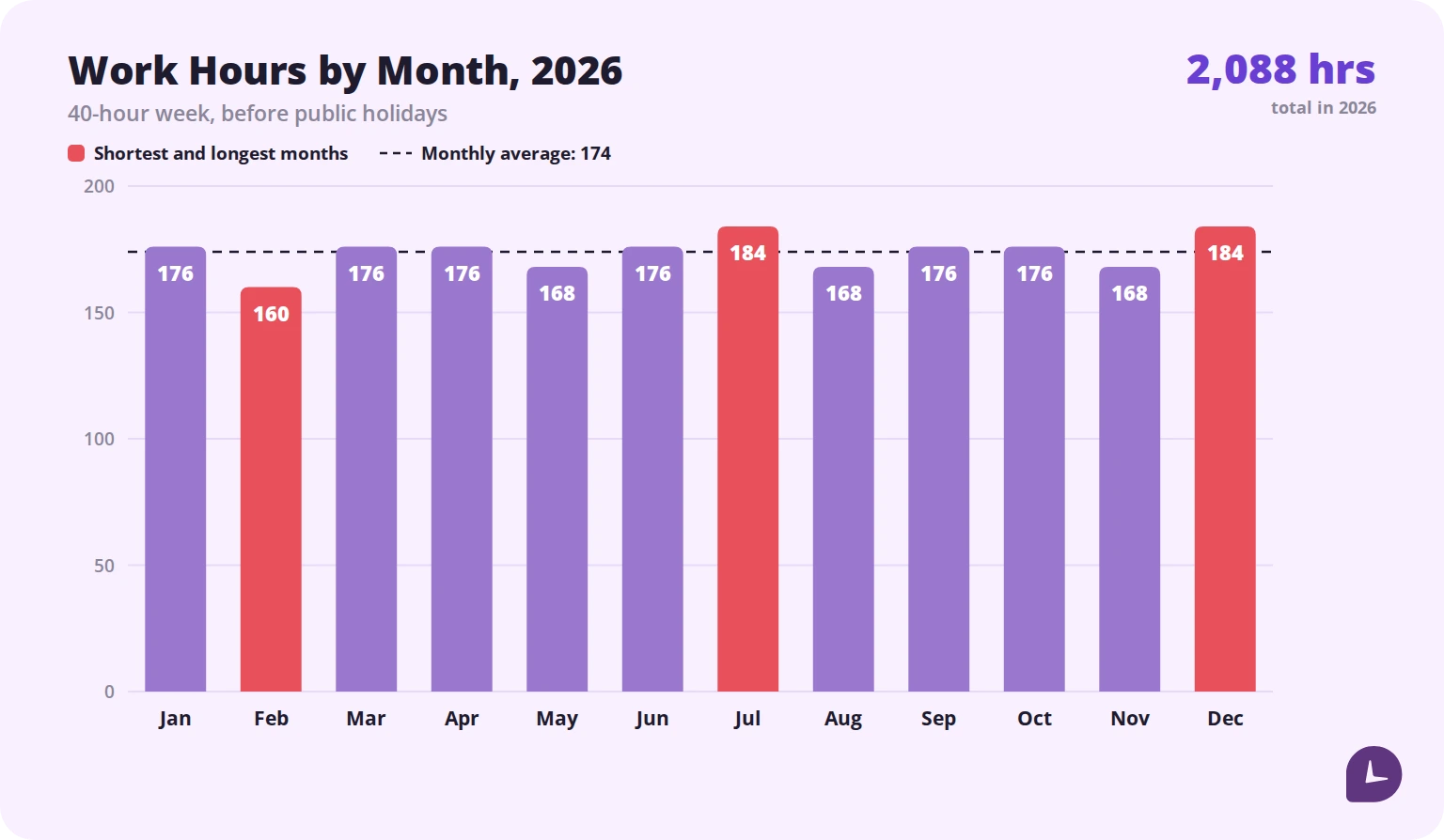
2026 work hours by month
| Month | Days | Calendar hours | Business days | Work hours |
|---|---|---|---|---|
| January | 31 | 744 | 22 | 176 |
| February | 28 | 672 | 20 | 160 |
| March | 31 | 744 | 22 | 176 |
| April | 30 | 720 | 22 | 176 |
| May | 31 | 744 | 21 | 168 |
| June | 30 | 720 | 22 | 176 |
| July | 31 | 744 | 23 | 184 |
| August | 31 | 744 | 21 | 168 |
| September | 30 | 720 | 22 | 176 |
| October | 31 | 744 | 22 | 176 |
| November | 30 | 720 | 21 | 168 |
| December | 31 | 744 | 23 | 184 |
| Total | 365 | 8,760 | 261 | 2,088 |
2027 work hours by month
| Month | Days | Calendar hours | Business days | Work hours |
|---|---|---|---|---|
| January | 31 | 744 | 21 | 168 |
| February | 28 | 672 | 20 | 160 |
| March | 31 | 744 | 23 | 184 |
| April | 30 | 720 | 22 | 176 |
| May | 31 | 744 | 21 | 168 |
| June | 30 | 720 | 22 | 176 |
| July | 31 | 744 | 22 | 176 |
| August | 31 | 744 | 22 | 176 |
| September | 30 | 720 | 22 | 176 |
| October | 31 | 744 | 21 | 168 |
| November | 30 | 720 | 22 | 176 |
| December | 31 | 744 | 23 | 184 |
| Total | 365 | 8,760 | 261 | 2,088 |
The swing is larger than most planning models assume. February 2026 offers 160 work hours; July and December offer 184. That is a 15% difference between the leanest and fullest months, and it is fully predictable a year in advance.
Work hours after US federal holidays
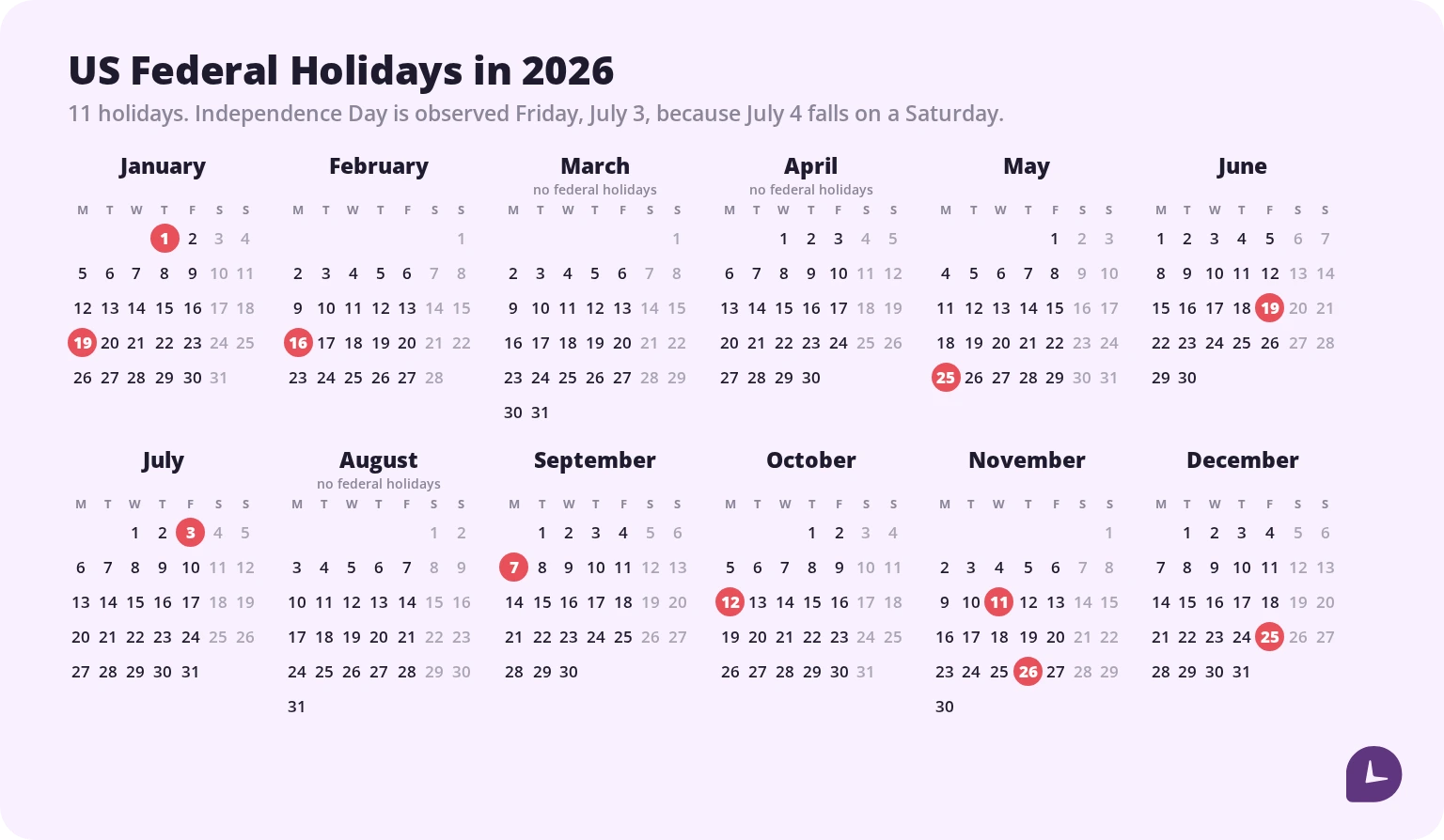
There are 11 federal holidays in 2026. Removing them leaves 250 working days and 2,000 work hours for the year, or an average of about 167 hours per month.
| Month | Business days | Federal holidays | Working days | Work hours |
|---|---|---|---|---|
| January | 22 | 2 — New Year’s Day (Jan 1), MLK Day (Jan 19) | 20 | 160 |
| February | 20 | 1 — Presidents’ Day (Feb 16) | 19 | 152 |
| March | 22 | 0 | 22 | 176 |
| April | 22 | 0 | 22 | 176 |
| May | 21 | 1 — Memorial Day (May 25) | 20 | 160 |
| June | 22 | 1 — Juneteenth (Jun 19) | 21 | 168 |
| July | 23 | 1 — Independence Day observed (Jul 3) | 22 | 176 |
| August | 21 | 0 | 21 | 168 |
| September | 22 | 1 — Labor Day (Sep 7) | 21 | 168 |
| October | 22 | 1 — Columbus Day (Oct 12) | 21 | 168 |
| November | 21 | 2 — Veterans Day (Nov 11), Thanksgiving (Nov 26) | 19 | 152 |
| December | 23 | 1 — Christmas Day (Dec 25) | 22 | 176 |
| Total | 261 | 11 | 250 | 2,000 |
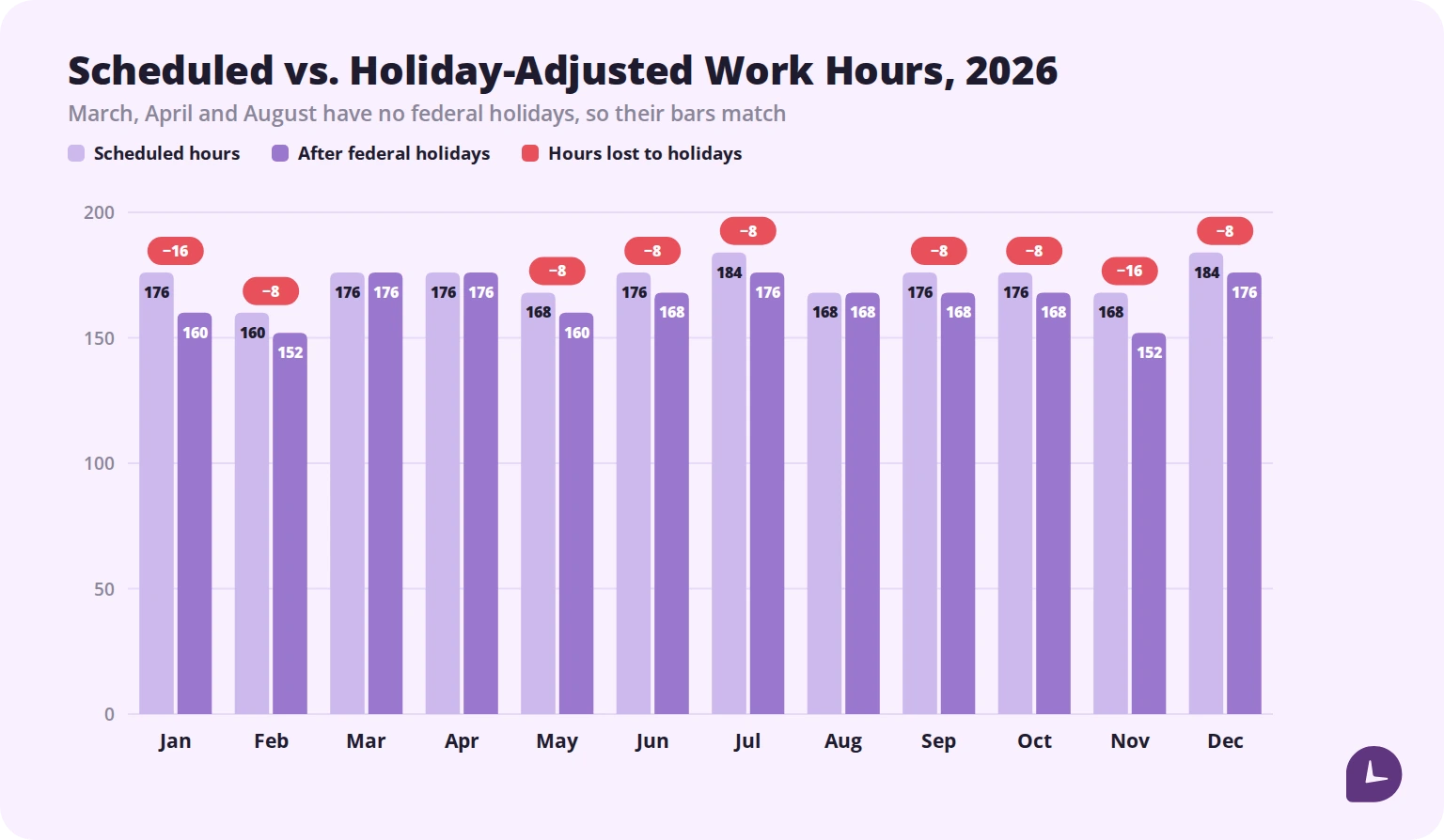
Three details worth flagging.
First, Independence Day falls on Saturday, July 4, 2026. Under 5 U.S.C. 6103, a holiday falling on a Saturday is observed the preceding Friday, so the federal observance moves to Friday, July 3, 2026. Teams that schedule against the calendar date will be short-staffed a day early.
Second, March, April, and August 2026 contain no federal holidays at all. They are the only three months where scheduled and holiday-adjusted hours are identical, which makes them the natural months to load with delivery-heavy work.
Third, the schedule can change. In December 2025, Christmas Eve and December 26 were added as one-off federal holidays by executive order. That addition applied to 2025 only and is not part of the standing schedule published by the US Office of Personnel Management. Verify the current year against OPM before locking a schedule.
Private employers are not obligated to observe federal holidays, and most layer on company closures, floating holidays, and PTO. Treat 2,000 hours as a ceiling rather than a forecast. Once typical vacation and sick leave are removed, actual delivered hours for a US full-time employee usually land well below that.
How leap years change the math
A leap year adds February 29, bringing the year to 366 days and 8,784 calendar hours.
The effect on work hours depends entirely on the day of the week:
- Falls on a weekday: adds one business day, 8 work hours, to February and to the year.
- Falls on a weekend: adds nothing to work hours.
February 2028 is the next leap February. February 29, 2028 falls on a Tuesday, which adds a business day and brings the year to 262 business days and 2,096 work hours. Neither 2026 nor 2027 is a leap year, so both are clean 365-day years.
Three ways to calculate monthly hours
Method 1: Count business days (most accurate)
- Count Mondays through Fridays in the month.
- Subtract company holidays and planned closures.
- Multiply by standard daily hours.
March 2026: 22 business days − 0 holidays = 22 × 8 = 176 hours
In a spreadsheet, NETWORKDAYS(start_date, end_date, holidays) does steps 1 and 2 in one formula.
Method 2: Weekly average (fastest)
Multiply weekly hours by 4.33 (52 ÷ 12).
40 × 4.33 = 173.2 hours
Fine for annual budgets. It erases the real variation between months, so do not use it for scheduling.
Method 3: Annual proration (payroll standard)
Divide annual hours by 12.
2,080 ÷ 12 = 173.33 hours
This is the basis for salary-to-hourly conversion and most benefits calculations.
Part-time, shift, and compressed schedules
The formula stays the same; only the weekly hours change.
| Weekly hours | Monthly average (× 4.33) | Annual (× 52) |
|---|---|---|
| 20 (part-time) | 86.7 | 1,040 |
| 25 | 108.3 | 1,300 |
| 30 | 130.0 | 1,560 |
| 35 | 151.7 | 1,820 |
| 40 (full-time) | 173.3 | 2,080 |
| 45 | 195.0 | 2,340 |
| 48 | 208.0 | 2,496 |
Compressed and rotating schedules break the eight-hour-day assumption entirely. A 9/80 schedule delivers 80 hours across nine days in a two-week cycle. A 2-2-3 rotation averages 42 hours a week across a 14-day cycle, so monthly totals shift depending on where the cycle boundary lands. A DuPont schedule runs on a four-week rotation that never aligns with calendar months.
For any of these, calendar arithmetic gives you an estimate. Only recorded time gives you the actual number.
What this means for payroll
Salary-to-hourly conversion. A $72,000 salary divided by 2,080 hours is $34.62 per hour. Divided by 2,088, it is $34.48. Fourteen cents per hour looks trivial until it is multiplied across 50 employees and a year of overtime premiums.
Overtime is weekly, not monthly. The Fair Labor Standards Act sets the overtime threshold at 40 hours in a workweek for non-exempt employees, paid at not less than one and a half times the regular rate. The Department of Labor is explicit that the statute operates on a weekly cycle, defining the workweek as a fixed and regularly recurring period of 168 hours
(DOL, Fact Sheet #23).
Monthly totals have no standing in that calculation. A 184-hour month spread evenly across four 46-hour weeks generates overtime in every week. The same 184 hours spread as 40, 40, 40, 64 generates overtime in one. Identical monthly total, very different payroll. Anyone building overtime rules off a monthly average is using the wrong unit. See our guide to calculating overtime pay.
Semi-monthly versus biweekly. Semi-monthly payroll issues 24 checks a year, each covering a fixed calendar half-month with a variable number of work days. Biweekly issues 26 checks, each covering exactly 80 hours. The two produce different per-period hour counts even at the same salary, which routinely confuses employees comparing pay stubs. Our breakdown of pay periods covers the trade-offs.
Partial-month proration. When someone starts or leaves mid-month, the prorated amount depends on which denominator you use: calendar days, business days in that specific month, or the flat 173.33. All three give different answers. Write the choice into policy before the first mid-month hire, not after the first dispute.
Capacity planning and utilization
Monthly hours are the denominator in almost every resource calculation, which makes an inaccurate denominator expensive.
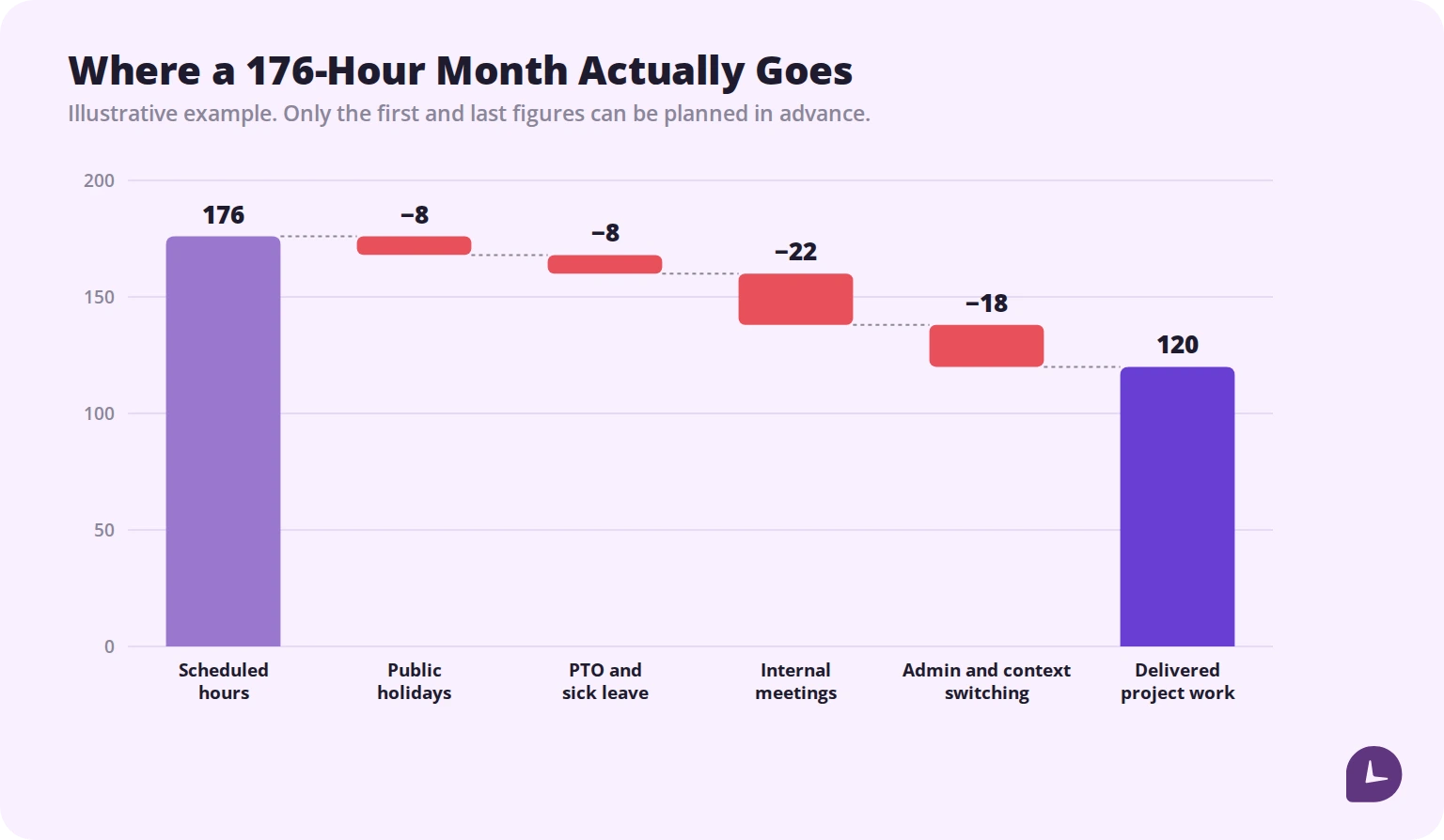
Team capacity. Five full-time employees give roughly 870 hours a month at 174 each. Subtract planned leave, training, onboarding, and internal meetings, and assignable project capacity typically lands 20 to 30% lower. Teams that quote against gross capacity overcommit by default.
Utilization rate. Utilization is billable hours divided by available hours. If the denominator is a flat 174 every month, the metric is wrong in ten months out of twelve. It flatters February and punishes July. Building it off actual business days makes month-over-month comparisons meaningful. See workforce utilization.
Fixed-fee quoting. Agencies that price monthly retainers off a flat capacity assumption lose money in 23-day months and leave capacity idle in 20-day months. Pulling the real business-day count into the estimate removes an entire category of scope problems before the contract is signed.
Boost your business productivity
Track performance and streamline teamwork
Legal limits on working hours
Monthly totals are a planning unit, not a compliance unit. Nearly every jurisdiction regulates daily and weekly hours instead.
In the United States, the FLSA sets no ceiling on hours for employees aged 16 and older. It requires overtime pay above 40 hours in a workweek for non-exempt workers, and it does not require premium pay for weekend or holiday work as such (DOL, Overtime Pay). There is no federal monthly limit of any kind.
In the European Union, the Working Time Directive caps average weekly working time at 48 hours including overtime, requires at least 11 consecutive hours of daily rest, and mandates a weekly rest period. Member states implement it with local variations, and averaging is permitted over a reference period.
The practical implication: a month with 184 scheduled hours is unremarkable under US law but may need a closer look under a 48-hour weekly average if the hours cluster in two weeks rather than spreading across four.
Rules vary by jurisdiction, sector, and collective agreement. This section is general information, not legal advice. Confirm requirements with qualified counsel for your locations.
Common mistakes
Treating 730 and 174 as the same number. One measures elapsed time. The other measures labor availability. They differ by a factor of four.
Using 160 hours as the monthly standard. Four weeks × 40 hours describes a specific short month, not a typical one. Ten of twelve months in 2026 exceed 160 work hours.
Publishing a month-by-month table without naming the year. Business days shift annually. A table labeled only “work hours by month” is guaranteed to be wrong for most years it is read in.
Forgetting holiday observance shifts. July 4, 2026 falls on a Saturday. Teams that schedule against the calendar date rather than the observed date will be short-staffed on Friday, July 3.
Confusing scheduled hours with worked hours. A 176-hour month absorbs meetings, context switching, admin, and interruptions. Scheduled capacity and delivered capacity are different quantities, and only the second one can be measured.
Estimating hours on client invoices. Estimates belong in proposals. Invoices need recorded time, or you are either writing off revenue or billing hours you cannot substantiate if challenged.
How Monitask turns calculated hours into recorded hours
Everything above tells you how many hours a month could contain. None of it tells you where they went.
Monitask records hours as they happen. Employees clock in when they start and clock out when they stop, so nothing runs in the background without their knowledge.

- Automatic timesheets remove manual entry. Monitask’s own analysis puts the loss from manual timesheets at 5 to 10% of billable time, driven by forgotten hours and end-of-week reconstruction from memory.
- Project and task-level tracking shows how a 176-hour month distributed across clients and deliverables, turning capacity from an assumption into a measurement.
- Monthly reports compare recorded hours against scheduled capacity, so a 160-hour February is visible before it becomes a missed deadline.
- Attendance records give payroll a defensible source for hours worked, instead of a spreadsheet rebuilt from memory.
See how it works: Monitask employee time clock software.
Time conversion reference
| Unit | Equals |
|---|---|
| Hour | 60 minutes, 3,600 seconds |
| Day | 24 hours, 1,440 minutes |
| Week | 7 days, 168 hours |
| Month | 28-31 days, 672-744 hours |
| Quarter | 3 months, about 2,190 hours |
| Common year | 365 days, 8,760 hours |
| Leap year | 366 days, 8,784 hours |
| Gregorian mean year | 365.2425 days, 8,765.82 hours |
Sources
- US Office of Personnel Management, Federal Holidays — official annual schedule designated under 5 U.S.C. 6103.
- US Department of Labor, Fact Sheet #23: Overtime Pay Requirements of the FLSA — workweek definition and overtime threshold.
- US Department of Labor, Fact Sheet #22: Hours Worked Under the FLSA — what counts as compensable time, including breaks and training.
- US Department of Labor, Overtime Pay — absence of a statutory ceiling on weekly hours.
Related reading
- How Many Work Hours Are in a Year of Full-Time Work?
- How to Calculate Time Sheets
- How to Calculate Payroll: A Complete Step-by-Step Guide
- Understanding and Calculating Your Labor Costs
- The Benefits of Using a Time Card Calculator
- Unlocking Efficiency: How Automated Timesheets Transform Business Time Management
FAQ
How many work hours are in a month?
160 to 184 for a full-time employee on a 40-hour week, averaging 174 before holidays and about 167 after US federal holidays.
How many work days are in a month?
20 to 23 business days, averaging 21.75 across the year.
Is a month 160 or 173 hours for payroll?
US payroll systems generally use 173.33 hours, from 2,080 annual hours divided by 12. The 160-hour figure describes a short month, not a payroll standard.
How many hours are in a 30-day month?
720 calendar hours. Work hours in a 30-day month range from 168 to 176 depending on how the weekends fall.
How many hours are in a 31-day month?
744 calendar hours, with 168 to 184 work hours.
How many hours are in February?
672 in a common year and 696 in a leap year. February 2026 has 672 calendar hours and 160 work hours.
Which month has the most work hours in 2026?
July and December, at 23 business days and 184 work hours each. After federal holidays, both drop to 176.
Does a lunch break count toward monthly work hours?
Unpaid meal breaks generally do not count as hours worked under the FLSA when the employee is fully relieved of duty. If the employee stays on duty during the break, the time is typically compensable. See [DOL Fact Sheet #22](https://www.dol.gov/agencies/whd/fact-sheets/22-flsa-hours-worked) on what counts as compensable time.
How do you calculate monthly hours for a part-time employee?
Multiply weekly scheduled hours by 4.33, or count the actual scheduled shifts in that month. For irregular schedules, recorded time is the only reliable basis. A [time clock system](/employee-time-clock-software/) removes the guesswork entirely.
Do training hours count toward monthly work hours?
Mandatory training is generally compensable work time under the FLSA and should be recorded and paid.