How Many Pay Periods in a Year? Every Schedule, and the 27th Payday Problem

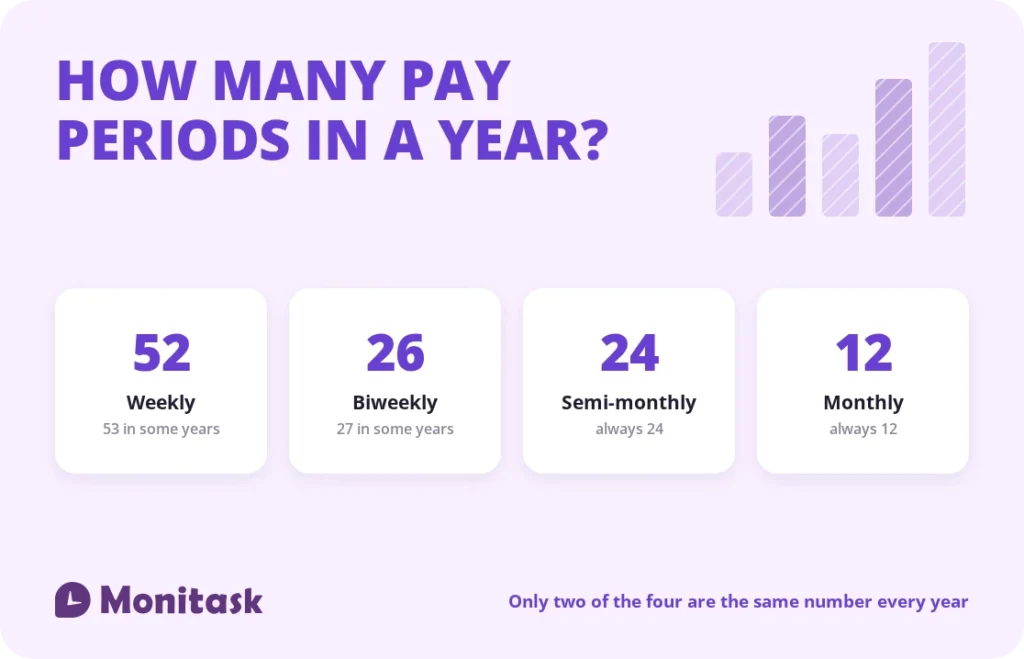
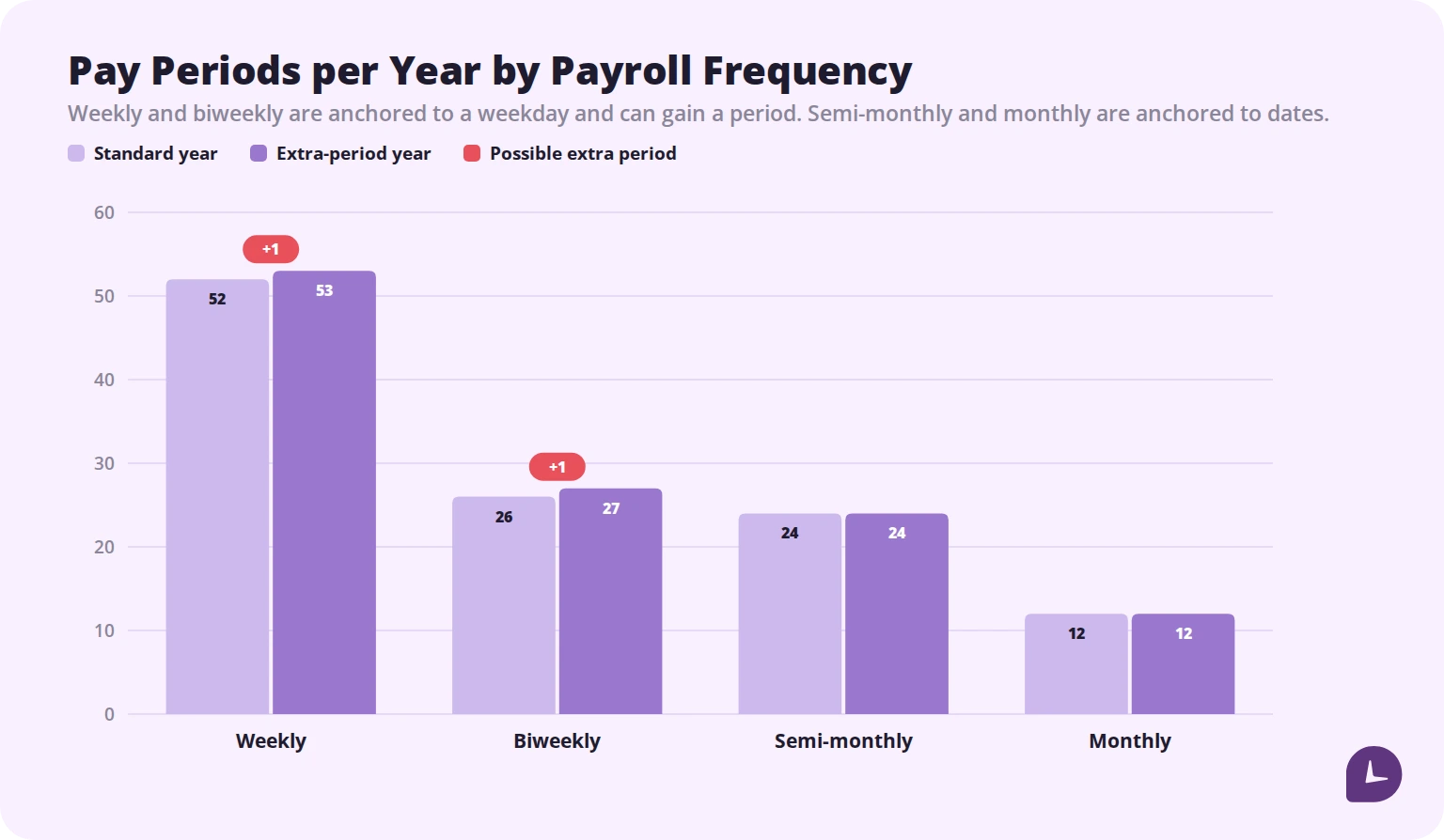
A year holds 52 weekly pay periods, 26 biweekly, 24 semi-monthly, or 12 monthly, depending on the schedule you run.
Two of those figures are fixed and two are not. Semi-monthly and monthly are anchored to calendar dates, so they deliver exactly 24 and 12 every year without exception. Weekly and biweekly are anchored to a day of the week, and because 52 weeks covers only 364 days, they drift. Every 11 to 12 years the drift produces an extra cycle.
For employers whose biweekly paydays fall on Thursdays, 2026 is that year: 27 paydays, not 26. A salary budget built by dividing annual pay by 26 will be short by one full cycle.
Quick answer
| Schedule | Pay periods | Varies? | Period length |
|---|---|---|---|
| Weekly | 52 (53 in some years) | Yes | 7 days |
| Biweekly | 26 (27 in some years) | Yes | 14 days |
| Semi-monthly | 24 | No | About 15 days |
| Monthly | 12 | No | 28-31 days |
The four pay schedules compared
| Weekly | Biweekly | Semi-monthly | Monthly | |
|---|---|---|---|---|
| Periods per year | 52 | 26 | 24 | 12 |
| Payday | Same weekday | Same weekday, alternating | Fixed dates | Fixed date |
| Hours per period (full-time) | 40 | 80 | Varies, about 86.7 | Varies, about 173.3 |
| Overtime calculation | Simple | Simple | Requires care | Requires care |
| Processing cost | Highest | Moderate | Moderate | Lowest |
| Extra-period risk | Yes | Yes | No | No |
The overtime distinction matters more than it looks. The FLSA assesses overtime within a fixed seven-day workweek, so weekly and biweekly periods align cleanly with it. Semi-monthly and monthly periods cut across workweeks, meaning a single workweek can straddle two pay periods and overtime has to be attributed to the correct one.
Weekly: 52 periods, sometimes 53
Weekly payroll runs 52 cycles in most years. Because 52 weeks covers 364 days rather than 365, an extra cycle appears periodically.
Under ISO 8601 week numbering, 2026 is a 53-week year, because January 1 falls on a Thursday. Employers paying weekly on a Thursday schedule will process 53 runs.
Weekly payroll is most common in construction, hospitality, staffing and other hourly-heavy sectors where employees rely on frequent cash flow. It carries the highest processing cost of the four schedules, since every step happens 52 times instead of 12.
Biweekly: 26 periods, sometimes 27
Biweekly is the most widely used schedule in the US. Employees are paid every 14 days, always on the same weekday, which produces 26 cycles in a typical year and 80 hours per cycle for a full-time employee.
The 26 figure holds in most years but not all, and the exception is expensive.
Why the 27th payday happens
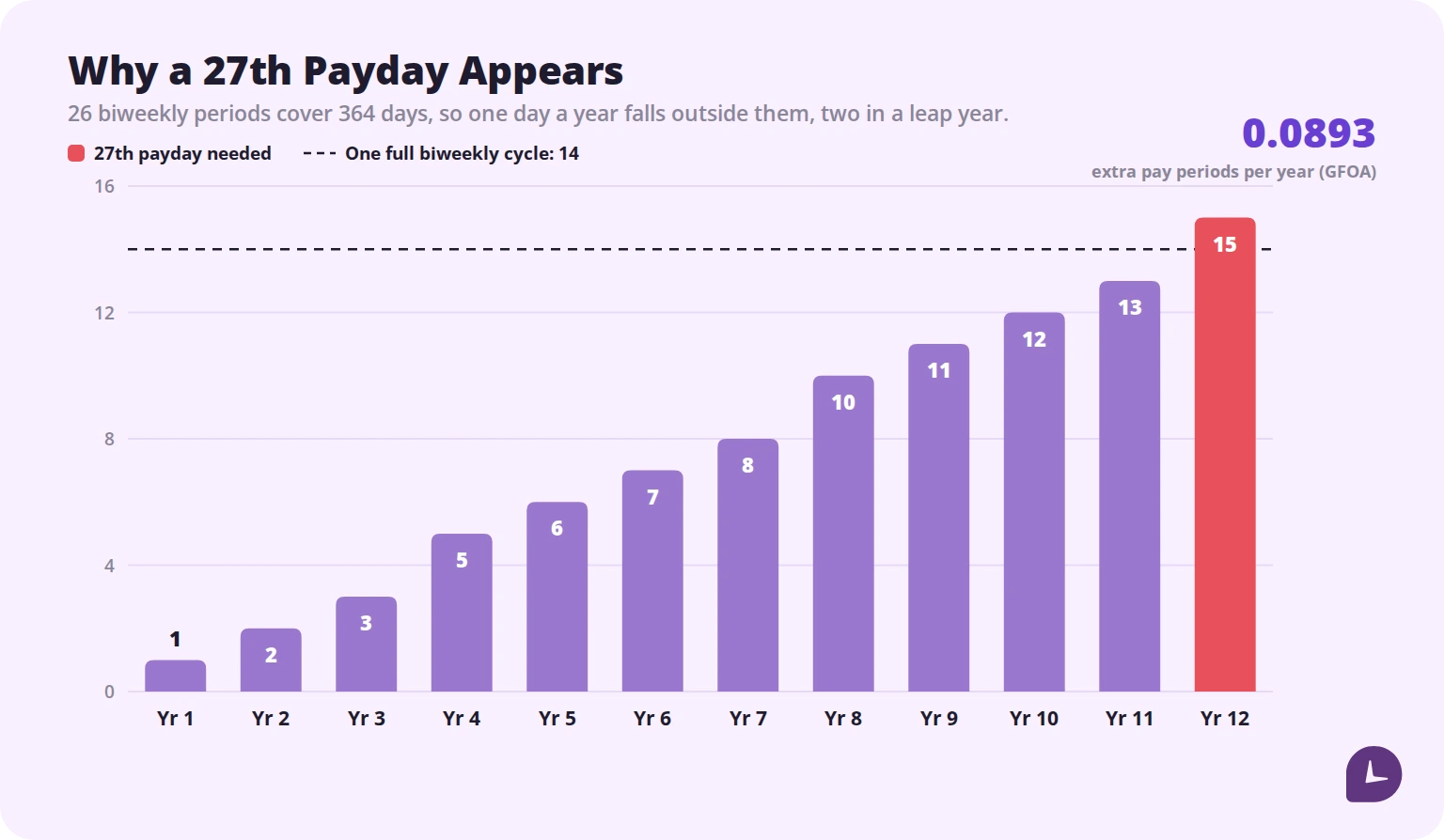
The arithmetic is simple and easy to miss. Twenty-six biweekly periods of 14 days cover 364 days. A calendar year has 365, or 366 in a leap year. So one day every year, two in leap years, sits outside the 26 cycles.
Those days accumulate. After 11 to 12 years the accumulated gap reaches 14 days, and payroll needs an additional biweekly cycle to cover it. The Government Finance Officers Association puts the drift at roughly 0.0893 additional pay periods per year, which is why the 27th payday recurs on an eleven-year average.
Law firm Littler notes that employers who set biweekly salary by dividing annual pay by 26 have been slightly underpaying against the true daily rate for the preceding decade, and that the accumulated difference is what the 27th cheque represents. Their suggested alternative is to multiply annual salary by 14/365, or 14/366 in a leap year, rather than dividing by 26.
Does 2026 have 27 paydays?
It depends entirely on which weekday your paydays fall on. For a biweekly schedule, only one anchor produces 27 cycles in 2026.
| First 2026 payday | Day | Paydays in 2026 | Last payday |
|---|---|---|---|
| January 1 | Thursday | 27 | December 31 |
| January 2 | Friday | 26 | December 18 |
| January 5 | Monday | 26 | December 21 |
| January 6 | Tuesday | 26 | December 22 |
| January 7 | Wednesday | 26 | December 23 |
So a Thursday-payday employer faces 27 runs in 2026, with the 27th landing on December 31. Every other weekday anchor stays at 26 this year.
Worth checking: New Year’s Day is a federal holiday, so many Thursday-payday employers move the January 1 run to December 31, 2025 or January 2, 2026. That shift changes which year absorbs the extra cycle, so confirm the actual processed dates rather than the nominal schedule.
Employers on a Friday anchor are not exempt, only delayed. The same schedule produces 27 paydays in 2027, and again in 2038.
How to handle a 27-payday year
There are two approaches, and the choice needs making before the first run of the year.
Option 1: Absorb the extra period. Keep the per-period amount unchanged and budget for one additional payroll. An employee on $2,000 biweekly costs $54,000 instead of $52,000. Across 100 employees that is $200,000 of unbudgeted expense. This is the simplest approach and the one most US employers take, since it avoids any reduction in employee pay.
Option 2: Recalculate the per-period rate. Divide annual salary by 27 instead of 26 so the annual total holds. A $52,000 salary becomes $1,925.93 per cycle instead of $2,000. This keeps the budget flat but reduces every paycheck, which employees will notice.
If you choose the second option, check notice requirements first. Some states require advance written notice before any reduction in pay, and the timing is not optional.
Three secondary items to check either way:
- Benefit deductions. Premiums calculated per pay period will over-deduct across 27 cycles. Most employers hold deductions on the extra run.
- PTO accrual. Leave that accrues per pay period rather than per hour will over-accrue by one period.
- Annual contribution caps. Retirement contributions set as a per-period amount can hit their limit early.
Three-paycheck months
Twice a year, a biweekly schedule produces three paydays in a single month. In 2026, a Friday-payday employer sees three-paycheck months in January and July. A Thursday-payday employer sees them in January, July and December.
Employees tend to treat these as bonus months. Payroll should treat them as cash-flow events: the month’s payroll cost rises by 50%, and the timing is predictable a year in advance.
Semi-monthly and monthly: always fixed
Semi-monthly payroll runs twice a month on fixed dates, most often the 1st and 15th or the 15th and last day. Because it is anchored to dates rather than weekdays, it delivers exactly 24 periods every year with no drift and no 27th-period problem.
Monthly payroll delivers exactly 12 periods. It is the cheapest to administer and the least common for hourly staff, since a month between paychecks is a long time for anyone managing week-to-week cash flow. Some states restrict it outright.
The trade-off for both: payday lands on a different weekday each cycle, and period lengths vary. A semi-monthly period can run 13 days in February and 16 in July, so hours per period fluctuate even when the schedule does not.
Boost your business productivity
Track performance and streamline teamwork
Semi-monthly vs biweekly
These are the two most confused schedules, and the difference is 2 pay periods a year.
| Semi-monthly | Biweekly | |
|---|---|---|
| Periods | 24 | 26 |
| Per-period pay on $60,000 | $2,500 | $2,307.69 |
| Payday | Fixed dates | Fixed weekday |
| Three-paycheck months | Never | Twice a year |
| Period length | 13-16 days | Always 14 |
| Aligns with FLSA workweek | No | Yes |
Same annual salary, different cheque size, different rhythm. Employees comparing pay stubs across employers routinely conclude they are paid less on biweekly, when the annual figure is identical. Our guide to choosing the right pay period works through the decision in more detail.
State pay frequency requirements
Pay frequency is not entirely the employer’s choice. States set minimum frequencies, and they differ sharply.
New York requires weekly payment for manual workers. Several states mandate at least semi-monthly payment for most employees. Alabama and Florida have no general pay frequency requirement in state law at all. Some states set different rules by industry or employee classification.
Before selecting or changing a schedule, confirm the requirement in every state where you have employees, not just where the company is headquartered. Multi-state employers frequently need different frequencies for different groups.
This is general information rather than legal advice. Verify current requirements with your state labor department or counsel.
Paydays falling on weekends and holidays
When a scheduled payday lands on a weekend or bank holiday, funds cannot settle that day. Standard practice is to move the payday to the preceding business day, so employees are never paid late.
Two consequences worth planning for. First, the earlier payday means the processing deadline moves earlier too, often by two business days. Second, moving a January 1 payday into the previous December shifts it into the prior tax year, which affects W-2 reporting for that pay run.
Common mistakes
Assuming biweekly always means 26. It means 26 in most years and 27 roughly every eleventh. 2026 is that year for Thursday-payday employers.
Believing the extra period only happens in leap years. Several published guides state this. It is wrong. 2026 is not a leap year, yet it carries both a 53rd weekly period and a 27th biweekly period for some schedules.
Confusing biweekly with semi-monthly. 26 versus 24 periods, different per-period amounts, different alignment with overtime rules.
Setting biweekly pay by dividing by 26. It slightly understates the daily rate every year, and the accumulated difference is exactly what the 27th cheque covers.
Forgetting to hold benefit deductions on the extra run. Employees end up over-deducted for premiums they have already fully paid.
Discovering the extra period in December. The date is knowable a year ahead. Handling it in January costs nothing; handling it in December means an unbudgeted expense and a rushed decision.
How Monitask helps
Pay periods define when payroll runs. What it pays out depends on hours, and those need to be recorded rather than reconstructed.
Monitask records hours as they happen. Employees clock in when they start and clock out when they stop, so nothing runs in the background without their knowledge.

- Automatic timesheets close on the period boundary you set, whether that is weekly, biweekly or semi-monthly, so payroll works from a complete record.
- Weekly totals align with the fixed FLSA workweek, which matters most on semi-monthly schedules where a workweek can straddle two pay periods.
- Attendance records give payroll a defensible source for hours worked, rather than a spreadsheet assembled from memory.
- Approval workflows let managers sign off before the run, so corrections happen before the money moves.
See how it works: Monitask online timesheets.
Sources
- Littler, Employers That Pay Biweekly May Have 27 Paydays in 2026 — mechanics of the 27th payday and the 14/365 salary calculation.
- Government Finance Officers Association, The 27th Payroll Period — annual drift figure and eleven-year recurrence.
- US Department of Labor, Fact Sheet #23: Overtime Pay Requirements of the FLSA — the fixed seven-day workweek used for overtime.
- Payday counts by weekday anchor for 2026 through 2040 calculated from the Gregorian calendar.
Related reading
- How Many Work Weeks in a Year?
- How Many Work Days in a Year?
- How Many Hours in a Month?
- How to Calculate Payroll: A Complete Step-by-Step Guide
- The Benefits of Switching to a Digital Payroll Timesheet System
- Timesheets for Payroll
FAQ
How many biweekly pay periods are in a year?
26 in most years. Roughly every eleventh year produces 27, because 26 periods of 14 days cover only 364 of the year’s 365 days.
Does 2026 have 27 pay periods?
For biweekly employers whose paydays fall on Thursdays, yes: 27 paydays with the last on December 31, 2026. Every other weekday anchor produces 26 this year. Friday-payday employers reach 27 in 2027.
How many pay periods are in a year semi-monthly?
Always 24. Semi-monthly payroll is anchored to calendar dates rather than weekdays, so it never gains an extra period.
What is the difference between biweekly and semi-monthly?
Biweekly pays every 14 days for 26 periods a year. Semi-monthly pays twice a month on fixed dates for 24. Annual pay is identical; the per-period amount is not.
Why do some months have three paychecks?
On a biweekly schedule, 26 paydays across 12 months means two months each receive three. In 2026 a Friday-payday employer sees this in January and July.
How do you calculate biweekly pay from an annual salary?
Divide annual salary by 26 for the standard approach. To account for the drift that causes the 27th payday, multiply annual salary by 14/365 instead, or 14/366 in a leap year.
What happens if payday falls on a holiday?
Standard practice is to pay on the preceding business day, which also moves the processing deadline earlier. A payday shifted from January into the prior December moves into the previous tax year.
Can an employer change pay frequency?
Generally yes, subject to state law. Several states require advance written notice, and some restrict how far a payday can move. Check the rules in every state where you employ people.
How many hours are in a biweekly pay period?
80 for a full-time employee on a 40-hour week. Semi-monthly periods average about 86.7 hours but vary by month.