How Many Work Days in a Year? 2026 Figures, Monthly Tables, and How to Calculate Your Own

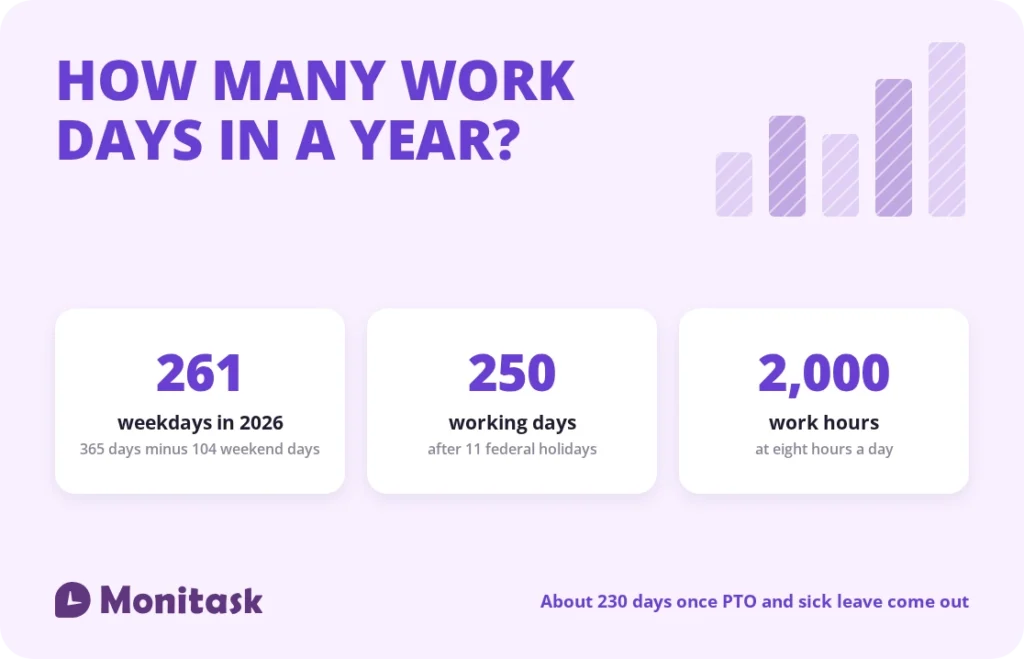
2026 contains 261 weekdays and 250 working days. The first number is every Monday through Friday. The second removes the 11 US federal holidays. At eight hours a day, 250 working days come to 2,000 work hours.
Neither figure is the one you should plan with. Once you subtract typical paid leave and sick days, a full-time US employee is realistically available for around 230 days. The gap between 261 and 230 is a month of capacity that most project plans quietly assume they have.
This guide gives the verified numbers for 2026, the month-by-month breakdown, figures through 2030, and a method for calculating the total that applies to your own schedule.
Quick answer
| Question | 2026 |
|---|---|
| Calendar days | 365 |
| Weekend days | 104 |
| Weekdays | 261 |
| Federal holidays on weekdays | 11 |
| Working days | 250 |
| Work hours at 8 hours a day | 2,000 |
| Average working days per month | 20.8 |
| Realistic days after typical PTO and sick leave | About 230 |
Weekdays, business days, working days
Three terms get used interchangeably in search results, and they do not mean the same thing.
Weekdays are Monday through Friday, holidays included. 2026 has 261.
Business days are weekdays on which commerce operates. In US practice this excludes federal holidays, because banks, courts, and financial markets close. 2026 has 250.
Working days are the days a specific person or company actually works. This is the only figure that varies by employer, and it is the one that belongs in a project plan. It removes company closures, PTO, and sick leave on top of the holidays.
Most articles answering this question stop at the first two. The third is the number that determines whether a deadline is achievable.
The formula and why it has a plus one
The base calculation is simple:
Weekdays = 365 calendar days − 104 weekend days = 261
You will also see it written as 52 × 5 + 1. A year is 52 weeks plus one leftover day, so the five-day workweek gives 260, and the leftover day is added if it lands on a weekday. In 2026 that leftover day falls on a Thursday, so it counts, giving 261.
From there:
Working days = 261 weekdays − 11 federal holidays = 250
The subtraction only applies if your organization actually closes on those days. US federal law does not require private employers to give paid holidays, so a business that stays open runs on 261.
Work days by month in 2026
| Month | Weekdays | Federal holidays | Working days | Work hours |
|---|---|---|---|---|
| January | 22 | 2 | 20 | 160 |
| February | 20 | 1 | 19 | 152 |
| March | 22 | 0 | 22 | 176 |
| April | 22 | 0 | 22 | 176 |
| May | 21 | 1 | 20 | 160 |
| June | 22 | 1 | 21 | 168 |
| July | 23 | 1 | 22 | 176 |
| August | 21 | 0 | 21 | 168 |
| September | 22 | 1 | 21 | 168 |
| October | 22 | 1 | 21 | 168 |
| November | 21 | 2 | 19 | 152 |
| December | 23 | 1 | 22 | 176 |
| Total | 261 | 11 | 250 | 2,000 |
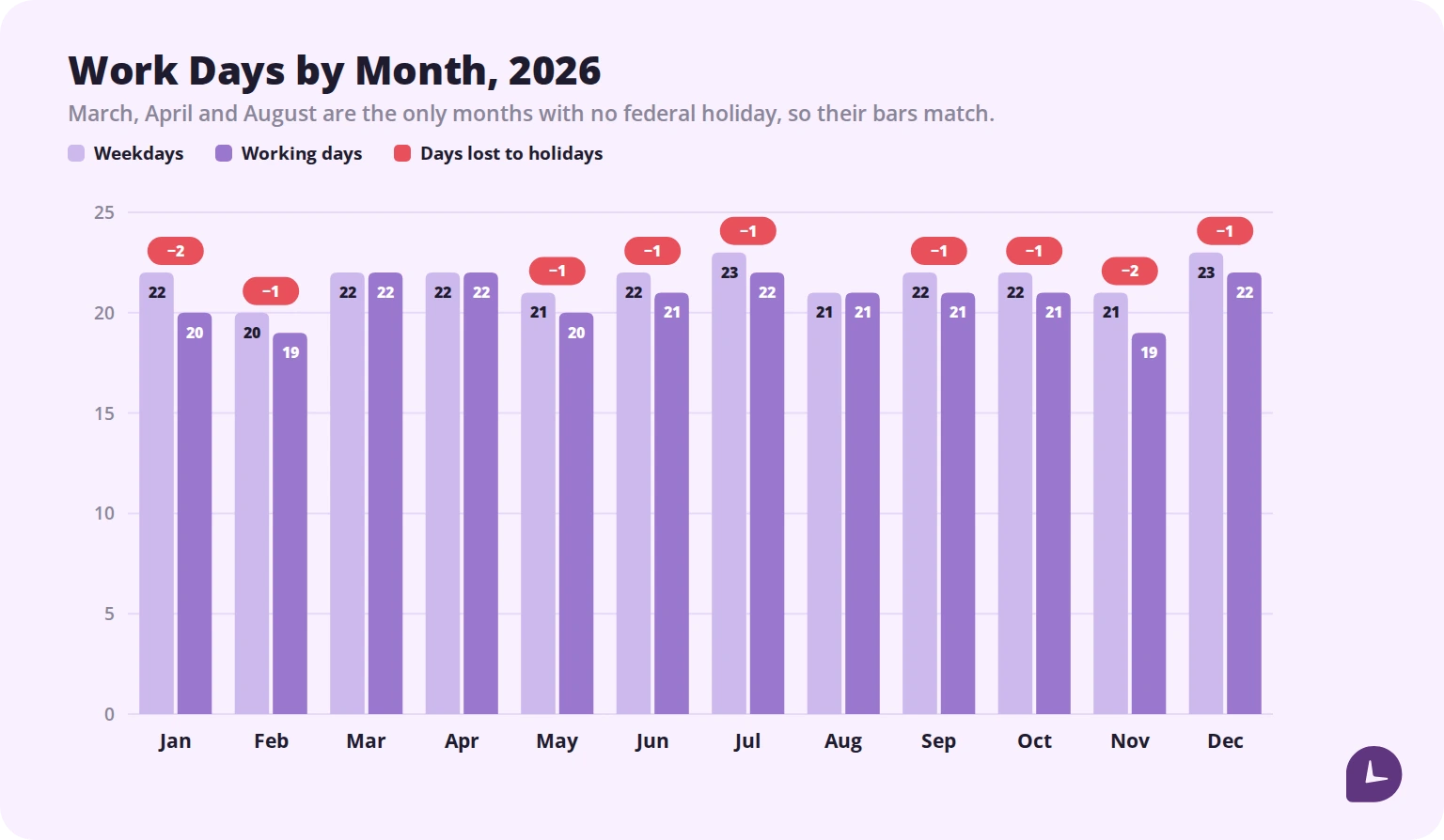
The spread runs from 19 to 22 working days, a difference of three days between the shortest and longest months. Against a 20.8-day average, February and November are 9% short and the strongest months are 6% long.
The 11 federal holidays in 2026
| Holiday | Date | Day |
|---|---|---|
| New Year’s Day | January 1 | Thursday |
| Birthday of Martin Luther King, Jr. | January 19 | Monday |
| Washington’s Birthday | February 16 | Monday |
| Memorial Day | May 25 | Monday |
| Juneteenth National Independence Day | June 19 | Friday |
| Independence Day (observed) | July 3 | Friday |
| Labor Day | September 7 | Monday |
| Columbus Day | October 12 | Monday |
| Veterans Day | November 11 | Wednesday |
| Thanksgiving Day | November 26 | Thursday |
| Christmas Day | December 25 | Friday |
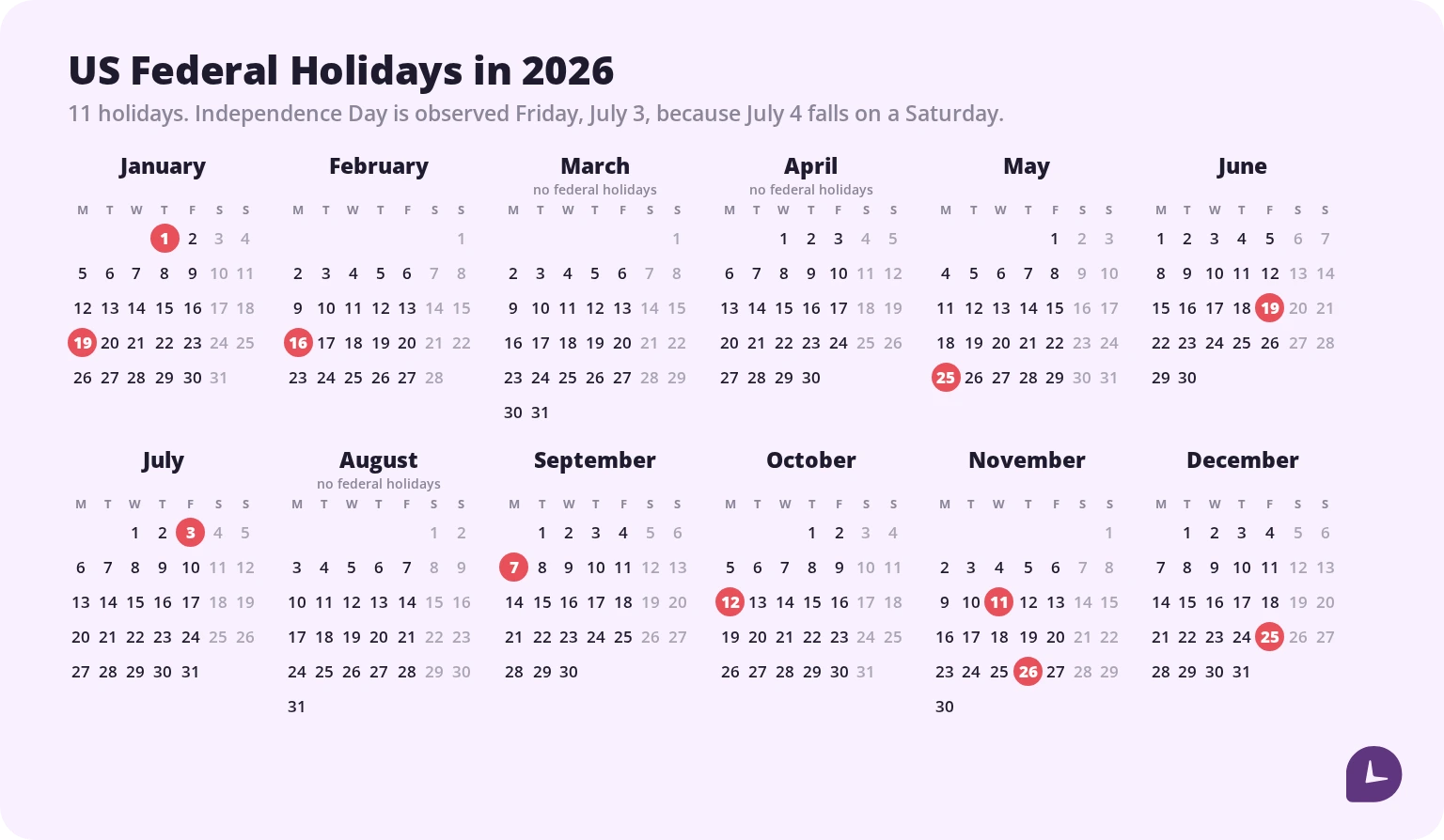
One date on this list is worth checking carefully, because several published 2026 calendars get it wrong. Independence Day falls on Saturday, July 4, 2026. Under 5 U.S.C. 6103, a holiday landing on a Saturday is observed the preceding Friday, so the federal observance is Friday, July 3. Calendars that list July 4 as the day off are giving a date on which federal offices are already closed for the weekend.
Note also that the count is 11, not 10. Juneteenth became a federal holiday in 2021, and sources still working from a 10-holiday assumption produce 251 working days instead of 250.
The schedule can also change year to year. In December 2025, Christmas Eve and December 26 were added as one-off holidays by executive order, applying to that year only. Check the current schedule published by the US Office of Personnel Management before committing to a plan.
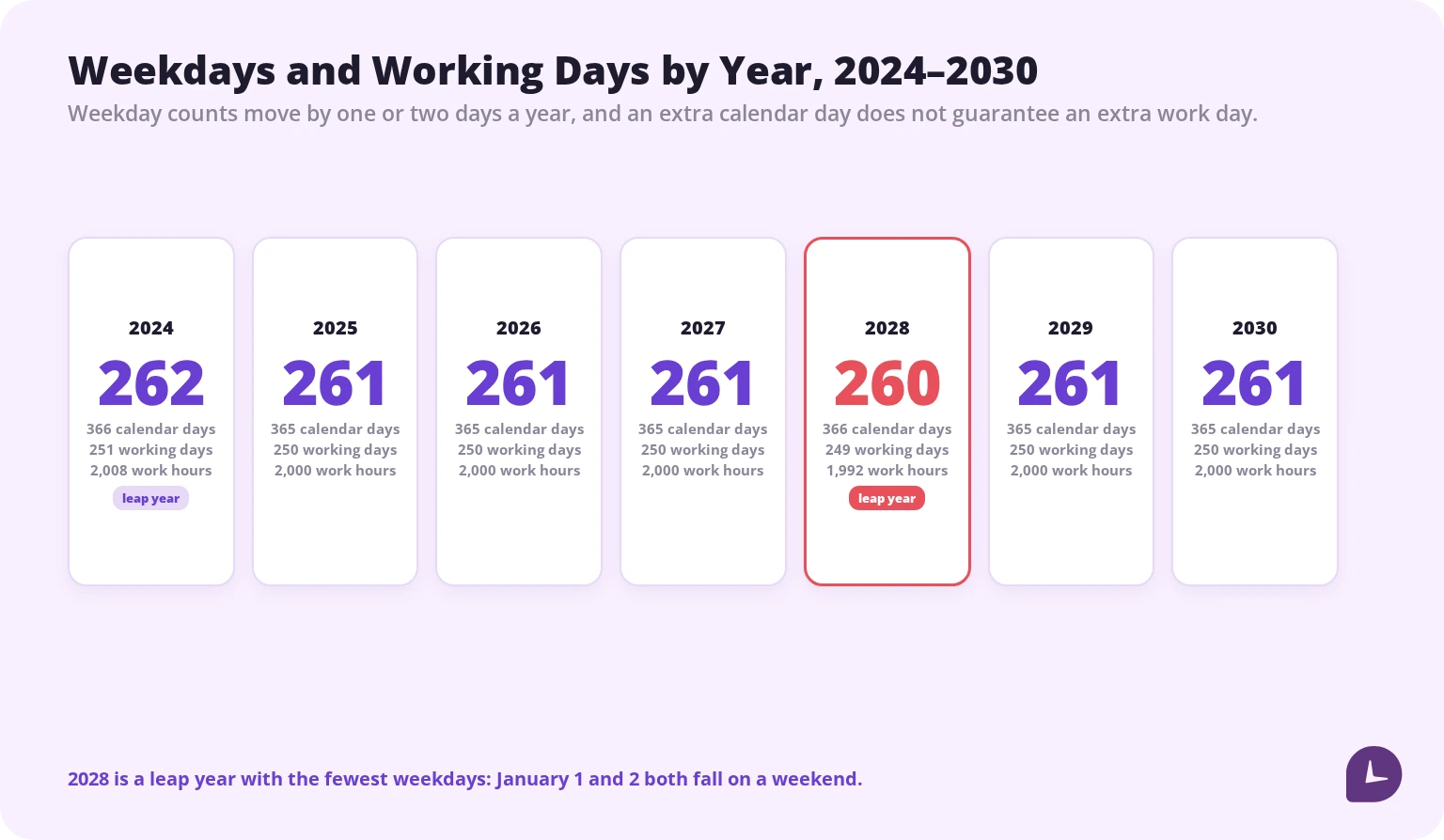
Work days by year through 2030
| Year | Calendar days | Weekdays | Working days | Work hours |
|---|---|---|---|---|
| 2024 | 366 | 262 | 251 | 2,008 |
| 2025 | 365 | 261 | 250 | 2,000 |
| 2026 | 365 | 261 | 250 | 2,000 |
| 2027 | 365 | 261 | 250 | 2,000 |
| 2028 | 366 | 260 | 249 | 1,992 |
| 2029 | 365 | 261 | 250 | 2,000 |
| 2030 | 365 | 261 | 250 | 2,000 |
Why leap years do not always add a work day
A common claim is that a leap year adds an extra work day. It does not, and 2028 proves it.
A leap year has 366 calendar days, which is 52 weeks plus two leftover days. Whether those days count depends entirely on where they fall:
- Both leftover days on weekdays: 262 weekdays. This is 2024.
- One on a weekday, one on a weekend: 261 weekdays.
- Both on weekends: 260 weekdays. This is 2028, which opens on a Saturday.
So 2028 has one more calendar day than 2026 and one fewer weekday. Adding February 29 is not the same as adding a work day. February 29, 2028 does land on a Tuesday and does add a day to February, but the year as a whole still comes out shorter because January 1 and January 2, 2028 both fall on a weekend.
Calculating your own real total
The published figures assume a Monday-to-Friday schedule with all federal holidays observed and no leave taken. Almost nobody works that year. Here is how to get to a number you can plan against.
Step 1. Start from your weekly pattern.
Multiply your working days per week by 52, then add the leftover day if it falls on a day you work. In 2026 the leftover day is a Thursday.
Step 2. Subtract the holidays your company actually observes.
Eleven if you follow the federal schedule. Many employers add floating holidays or close between Christmas and New Year, which pushes it higher.
Step 3. Subtract paid time off.
Use your actual entitlement, not an average.
Step 4. Subtract expected sick days.
Budget a realistic figure rather than assuming zero. Planning on perfect attendance is how a schedule fails in its first quarter.
Worked example, standard five-day schedule:
| Step | Days |
|---|---|
| 52 weeks × 5 days | 260 |
| Plus January 1 (a Thursday) | 261 |
| Minus federal holidays | −11 |
| Minus 15 days PTO | −15 |
| Minus 5 sick days | −5 |
| Available working days | 230 |
That 230 is the number to build a capacity model on. It is 12% below the 261 figure most people quote, which on a year-long project is roughly a lost month.
Non-standard schedules
| Schedule | Days per week | Base days in 2026 | After 11 holidays |
|---|---|---|---|
| Standard five-day | 5 | 261 | 250 |
| Four-day week | 4 | 209 | 198 |
| Compressed 4/10 | 4 | 209 | 198 |
| Six-day week | 6 | 313 | 302 |
| Part-time, three days | 3 | 157 | 146 |
Figures assume the leftover Thursday is a working day. Rotating and shift patterns such as a 2-2-3 rotation or a DuPont schedule do not map onto a weekly pattern at all, and their annual totals have to be counted across the full rotation cycle rather than calculated from a weekly figure.
Converting work days into work hours
Multiply working days by the standard workday:
- 250 days × 8 hours = 2,000 hours
- 250 days × 7.5 hours = 1,875 hours
- 230 days after leave × 8 hours = 1,840 hours
You will also see 2,080 hours quoted as the annual standard. That comes from 52 weeks × 40 hours and ignores holidays entirely. It remains the correct basis for salary-to-hourly conversion and FTE calculations because it is stable year to year, but it overstates actual available time by around 80 hours. Use 2,080 for payroll and the real count for capacity. Our guide to hours in a month covers the distinction in detail.
Why the monthly number matters more than the annual one
The annual total gets quoted; the monthly one determines whether work lands on time.
Scope a project at 30 working days and start it in November. November has 19 working days, December has 22, so you finish in the second week of December. Start the same project in March, which has 22, and you are done inside April. Same effort, same team, a month of difference in the delivery date purely from where it sits on the calendar.
This is invisible in most project tools, which count calendar duration rather than available days. It shows up in three places:
Quarterly targets. Q1 2026 holds 61 working days. Q3 holds 64. A quarterly quota that ignores this asks Q1 to do 5% more per day.
Fixed-fee retainers. A monthly retainer priced on average capacity loses money in 22-day months and leaves capacity idle in 19-day months.
Utilization. Billable hours divided by a flat monthly denominator produces a metric that flatters short months and punishes long ones. Building it from actual working days makes month-over-month comparison meaningful. See workforce utilization.
Boost your business productivity
Track performance and streamline teamwork
Common mistakes
Using 260 as a universal figure. It is the base of the formula, not the answer. 2026 has 261 weekdays and 250 working days.
Counting 10 federal holidays. There have been 11 since Juneteenth was added in 2021. This single error produces 251 instead of 250.
Assuming a leap year adds a work day. 2028 has more calendar days and fewer weekdays than 2026.
Planning against 261. That figure assumes no holidays and no leave. Real availability is closer to 230.
Treating every month as equal. The spread runs 19 to 22 working days, and the difference decides delivery dates.
Applying US figures to other countries. Public holiday counts vary widely, so working-day totals differ even where the weekday count is identical.
How Monitask helps
Working days tell you the capacity a year theoretically holds. They cannot tell you what was done with it.
Monitask records hours as they happen. Employees clock in when they start and clock out when they stop, so nothing runs in the background without their knowledge.

- Attendance tracking shows which of the 250 working days each person was actually available, giving you a real availability figure rather than an assumed one.
- Automatic timesheets remove manual entry. Monitask’s own analysis puts the loss from manual timesheets at 5 to 10% of billable time.
- Project time tracking compares estimated working days against actual ones, so the next estimate is built on evidence.
- Reports surface the gap between scheduled capacity and delivered capacity before a deadline slips.
See how it works: Monitask employee time clock software.
Sources
- US Office of Personnel Management, Federal Holidays — official schedule designated under 5 U.S.C. 6103, including weekend observance rules.
- US Department of Labor, Wages and the Fair Labor Standards Act — federal wage and hour standards, and the absence of a paid-holiday requirement for private employers.
- Weekday and working-day counts for 2024 through 2030 calculated from the Gregorian calendar and cross-checked against the OPM holiday schedule.
Related reading
- How Many Hours in a Month?
- How Many Work Hours Are in a Year of Full-Time Work?
- How to Calculate Time Sheets
- Understanding and Calculating Your Labor Costs
- The Ultimate Guide to Paid Time Off Policies
FAQ
How many working days are in 2026 after holidays?
250, once the 11 federal holidays are removed. If your employer stays open on federal holidays, the figure is 261.
How many work hours are in a year?
2,000 hours for 250 working days at eight hours a day. Payroll systems generally use 2,080 hours, which comes from 52 weeks Г— 40 hours and does not deduct holidays.
Does a leap year have more work days?
Not necessarily. 2024 had 262 weekdays, but 2028 has only 260 because both of its leftover days fall on a weekend. An extra calendar day adds a work day only when it lands on a weekday.
How many working days are in a month on average?
20.8 in 2026, ranging from 19 in February and November to 22 in March, April, July and December.
How many work days are in a year after PTO?
About 230 for a US employee with 15 days of PTO and 5 sick days, starting from 250 working days.
Which month has the fewest working days in 2026?
February and November, at 19 each. February is short by length; November loses two days to Veterans Day and Thanksgiving.
Are federal holidays paid time off?
Not automatically. Federal law does not require private employers to provide paid holidays, so whether the 11 days are paid depends on company policy.
How many working days are in a quarter?
In 2026: 61 in Q1, 63 in Q2, 64 in Q3 and 62 in Q4, after federal holidays.