How Many Work Weeks in a Year? The 2026 Answer, and Why This Year Has 53

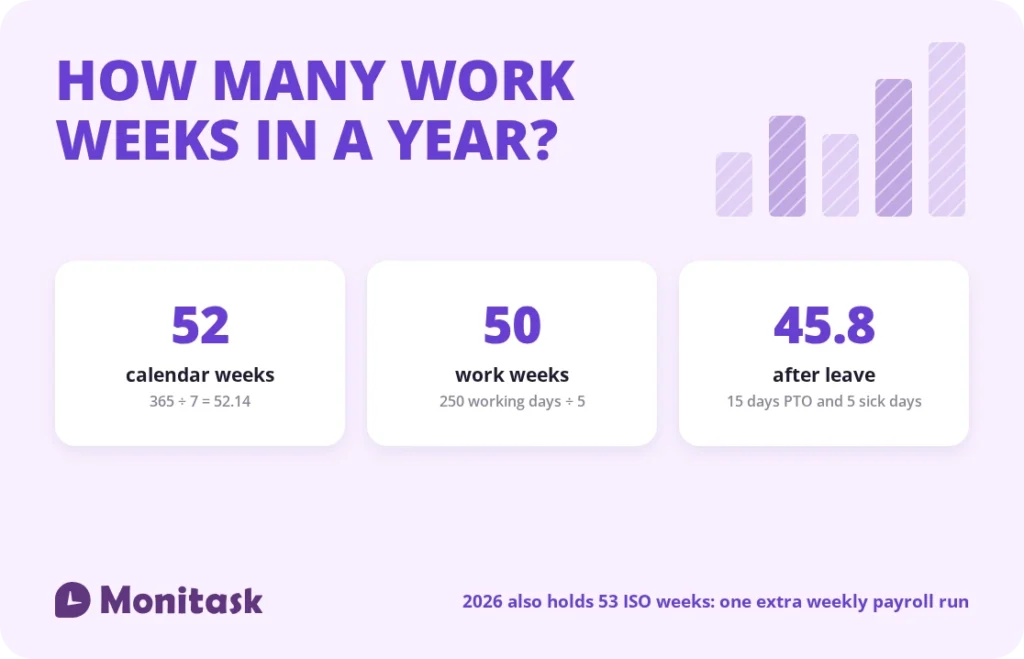
A calendar year holds 52 weeks. A full-time employee works about 50 work weeks once federal holidays come out, and closer to 46 once typical paid leave and sick days are deducted.
There is also a fourth answer that catches payroll teams off guard. Under ISO 8601, 2026 has 53 weeks. For anyone running a weekly pay cycle, that means an extra payroll run this year, and a salary budget built on 52 will come up short.
This guide covers all four figures, the calculation for your own schedule, and what a 53-week year does to payroll.
Quick answer
| Measure | 2026 |
|---|---|
| Calendar weeks | 52 (365 ÷ 7 = 52.14) |
| ISO 8601 weeks | 53 |
| Weekdays | 261 |
| Working days after federal holidays | 250 |
| Work weeks (250 ÷ 5) | 50 |
| Work weeks after 15 days PTO and 5 sick days | About 46 |
| Standard annual hours | 2,080 |
| Hours at 50 work weeks | 2,000 |
Why 52 is only the starting point
Divide 365 by 7 and you get 52.14. The extra fraction is the reason weekday counts shift between years and the reason some years carry a 53rd week.
That 52 is a count of calendar weeks, not work weeks. Three deductions separate the two:
Federal holidays. Eleven in 2026, which is 2.2 weeks at five days per week.
Paid time off. Varies by employer. Fifteen days is a common US benchmark, worth three weeks.
Sick leave. Rarely zero. Five days is a conservative planning figure, worth one week.
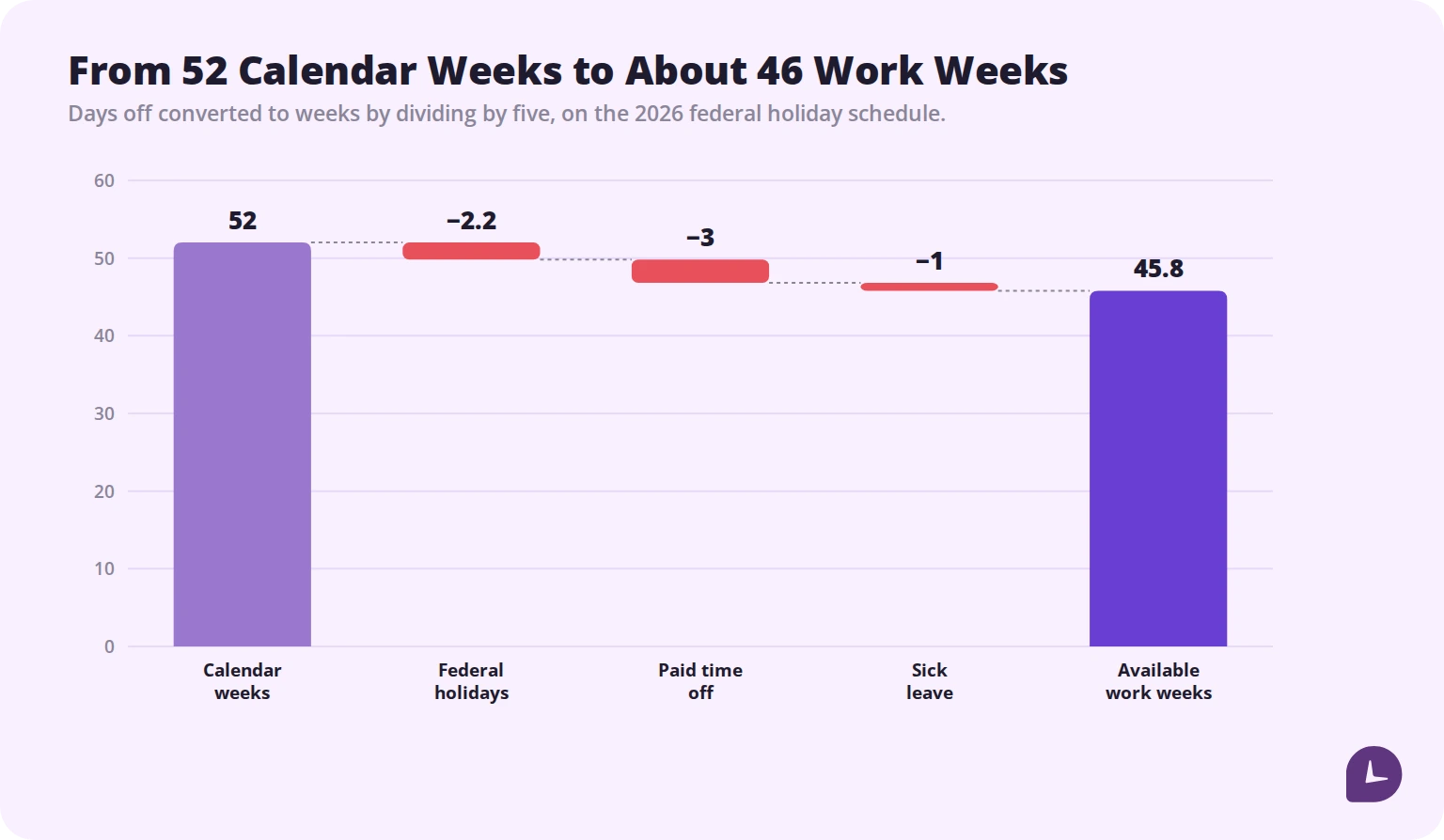
The result is roughly 46 work weeks, six weeks below the number most annual plans are built on. Over a year that gap is a full quarter of a quarter.
What the FLSA means by a workweek
The term has a specific legal meaning that differs from ordinary usage. The US Department of Labor defines a workweek as a fixed and regularly recurring period of 168 hours
, adding that it need not coincide with the calendar week and may begin on any day and hour (DOL, Fact Sheet #23).
Two consequences follow.
Overtime is assessed within that fixed seven-day window, not averaged across a month or a pay period. An employee who works 30 hours one week and 50 the next is owed overtime for the second week, even though the two-week average is 40.
The employer chooses when the workweek starts, but once chosen it must stay fixed. Shifting the boundary to avoid overtime is not permitted.
So “work weeks in a year” has two distinct meanings: how many seven-day compliance periods the year contains, and how many weeks a person actually works. The first is 52 or 53. The second is around 46.
Work weeks in 2026, step by step
| Step | Figure |
|---|---|
| Calendar days | 365 |
| Weekend days | −104 |
| Weekdays | 261 |
| Federal holidays | −11 |
| Working days | 250 |
| Divided by 5 | 50 work weeks |
| 15 days PTO | −3 weeks |
| 5 sick days | −1 week |
| Available work weeks | 46 |
The 50-week figure is the useful one for company-level capacity, because it applies to everyone. The 46-week figure is the one for individual planning, because leave is taken by people, not by teams.
Why 2026 has 53 weeks
Most years contain 52 numbered weeks under ISO 8601, the international standard used by payroll systems, ERP software, and manufacturing schedules. Some contain 53.
A year has 53 ISO weeks when it starts on a Thursday, or when it is a leap year starting on a Wednesday. January 1, 2026 falls on a Thursday, so 2026 is a 53-week year.
| Year | ISO weeks | January 1 |
|---|---|---|
| 2024 | 52 | Monday |
| 2025 | 52 | Wednesday |
| 2026 | 53 | Thursday |
| 2027 | 52 | Friday |
| 2028 | 52 | Saturday |
| 2029 | 52 | Monday |
| 2030 | 52 | Tuesday |
| 2031 | 52 | Wednesday |
| 2032 | 53 | Thursday |
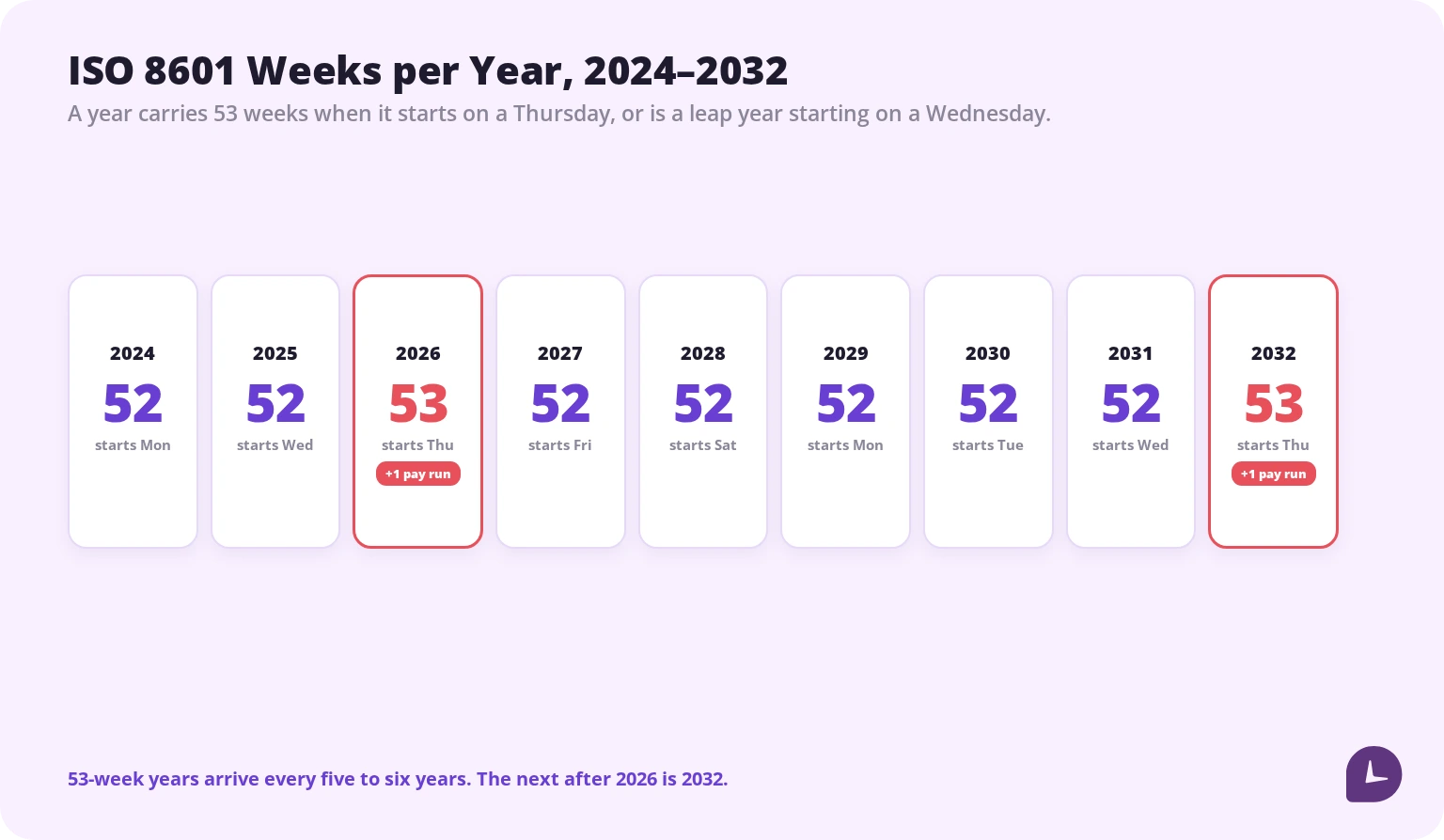
This does not change the number of working days. 2026 still has 261 weekdays and 250 working days. What changes is the number of pay cycles.
What a 53-week year does to payroll
For anyone paid weekly, a 53-week year means 53 paychecks instead of 52. That is a real cost line, and it appears in the budget whether or not anyone planned for it.
Weekly payroll. An employee on $1,000 a week costs $53,000 in 2026, not $52,000. Across 40 such employees that is an unbudgeted $40,000.
Biweekly payroll. The equivalent problem is the 27-pay-period year, which occurs when the calendar produces 27 biweekly cycles instead of 26. It arises on a similar cycle and has the same effect: one extra run.
Salaried staff. Annual salary does not change, but the per-period amount does if the system divides by the number of periods rather than paying a fixed weekly rate. Confirm which method your payroll platform uses before the first run of the year.
Accruals. PTO that accrues per pay period rather than per hour will over-accrue by one period unless the rate is adjusted.
Two ways to handle it: budget for the extra period explicitly, or recalculate the per-period rate so the annual total holds. The first is simpler and is what most US employers do. Whichever you pick, decide before January rather than discovering it in December. Our guide to choosing the right pay period covers the trade-offs between weekly, biweekly and semi-monthly cycles.
Boost your business productivity
Track performance and streamline teamwork
Calculating your own work weeks
Step 1. Start at 52 weeks.
Step 2. Add the days off your employer observes, in days: federal holidays, company closures, floating holidays.
Step 3. Add your PTO entitlement and a realistic sick-day allowance, in days.
Step 4. Divide the total days off by your working days per week.
Step 5. Subtract that from 52.
Example, five-day schedule:
11 holidays + 15 PTO + 5 sick = 31 days off
31 ÷ 5 = 6.2 weeks off
52 − 6.2 = 45.8 work weeks
Example, four-day schedule:
11 holidays + 12 PTO + 4 sick = 27 days off
27 ÷ 4 = 6.75 weeks off
52 − 6.75 = 45.25 work weeks
Note that the four-day worker takes fewer days off yet loses slightly more weeks, because each day represents a larger share of their week. This is the arithmetic behind pro-rating leave for part-time staff, and getting it wrong is a common source of complaints.
Rotating and non-standard schedules
Rotation patterns do not divide neatly by five, so they need their own calculation: divide 52 by the length of the full cycle, then multiply by the number of “on” weeks.
| Pattern | Cycle length | Work weeks per year |
|---|---|---|
| 2 weeks on, 1 week off | 3 weeks | 34.7 |
| 2 weeks on, 2 weeks off | 4 weeks | 26 |
| 3 weeks on, 1 week off | 4 weeks | 39 |
| 4 weeks on, 2 weeks off | 6 weeks | 34.7 |
| 1 week on, 1 week off | 2 weeks | 26 |
These patterns are common in offshore work, mining, and long-haul transport. Shift rotations such as a 2-2-3 schedule or a DuPont schedule operate on a different logic again, distributing hours unevenly across weeks rather than removing whole weeks.
Converting overtime into work weeks
Overtime can be expressed in work-week equivalents, which is a useful framing when arguing for a hire.
Divide total annual overtime hours by standard weekly hours:
- 120 overtime hours ÷ 40 = 3 extra work weeks
- 400 overtime hours ÷ 40 = 10 extra work weeks
- 2,000 overtime hours across a team ÷ 2,080 = roughly one additional full-time employee
That last conversion is the one worth running annually. A team logging 2,000 hours of overtime is carrying an unfunded headcount, usually at a 50% pay premium. Recorded hours make the case; estimates do not.
Common mistakes
Treating 52 as the number of weeks worked. It is the count of calendar weeks. Actual work weeks land near 46.
Missing the 53rd week. 2026 has 53 ISO weeks. Weekly payrolls that budget for 52 will be short one cycle.
Counting 10 federal holidays. There have been 11 since Juneteenth was added in 2021.
Averaging hours across weeks for overtime. The FLSA assesses overtime inside each fixed seven-day workweek. A 30-hour week does not offset a 50-hour week.
Applying the five-day divisor to part-time staff. A day off costs a four-day worker a quarter of a week, not a fifth.
How Monitask helps
Calculating available weeks tells you the capacity a year holds. It says nothing about what happened inside them.
Monitask records hours as they happen. Employees clock in when they start and clock out when they stop, so nothing runs in the background without their knowledge.

- Weekly timesheets align with the fixed workweek the FLSA requires, so overtime is assessed on the right period rather than a monthly average.
- Attendance and absence records turn assumed leave into a measured figure, which is what the 46-week estimate actually depends on.
- Overtime visibility shows the accumulating work-week equivalents before they become a budget problem.
- Project reports compare estimated weeks against delivered ones, so the next plan starts from evidence.
See how it works: Monitask employee time clock software.
Sources
- US Department of Labor, Fact Sheet #23: Overtime Pay Requirements of the FLSA — definition of the workweek as a fixed, recurring 168-hour period.
- US Office of Personnel Management, Federal Holidays — official schedule under 5 U.S.C. 6103.
- ISO 8601 week-numbering rules, under which a year contains 53 weeks when it begins on a Thursday or is a leap year beginning on a Wednesday.
- Weekday, working-day and ISO week counts for 2024 through 2032 calculated from the Gregorian calendar and cross-checked against the OPM holiday schedule.
Related reading
- How Many Work Days in a Year?
- How Many Hours in a Month?
- How Many Work Hours Are in a Year of Full-Time Work?
- Unlocking Payroll Efficiency: Choosing the Right Pay Period
- The Ultimate Guide to Paid Time Off Policies
FAQ
How many weeks are in 2026?
52 calendar weeks, or 53 under ISO 8601 week numbering. 2026 begins on a Thursday, which is what produces the 53rd week.
Why does 2026 have 53 weeks?
A year contains 53 ISO weeks when January 1 falls on a Thursday, or when a leap year begins on a Wednesday. January 1, 2026 is a Thursday.
Does a 53-week year mean an extra paycheck?
For weekly pay cycles, yes. Employees paid weekly receive 53 payments in 2026 rather than 52, and the extra cycle has to be budgeted.
How many working weeks are in a year in the UK?
The calendar figure is the same 52. The deduction differs, because UK statutory leave is 28 days including bank holidays, which works out to roughly 46.4 work weeks.
How do you calculate work weeks in a year?
Add up every day off in days, divide by your working days per week, and subtract the result from 52.
Is a work week always five days?
No. The FLSA defines the workweek as any fixed, recurring 168-hour period, and it does not prescribe how many days within it are worked. Four-day, six-day and rotating patterns are all common.
How many work weeks are in a month?
About 4.33, from 52 divided by 12. In working days it ranges from 3.8 to 4.4 weeks depending on the month.
How many work weeks in a year with 2 weeks on and 1 week off?
34.7. Divide 52 by the three-week cycle to get 17.3 cycles, then multiply by the two weeks worked in each.