
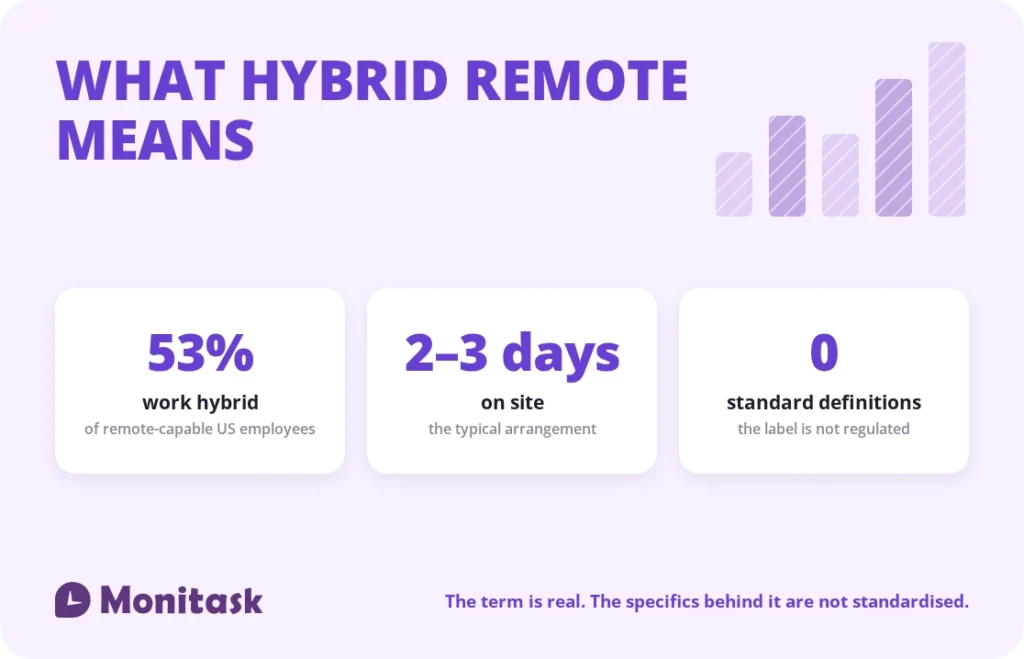

Hybrid remote means an arrangement where an employee works part of their time in an office and part somewhere else, usually home. In most companies that works out to two or three days on site.
That is the definition, and on its own it is almost useless. “Hybrid remote” in a job listing can mean four days in the office and one at home, or two weeks a quarter on site and the rest anywhere in the country. Both are advertised with the same two words. The commute, the flexibility and whether you can move house differ completely.
This guide covers what the term means, the arrangements it conceals, and the specific questions that turn it into something you can evaluate.
The definition
Hybrid remote is a work model in which an employee’s time is divided between a company office and a remote location. It is a category, not a schedule. The category tells you that neither full attendance nor full absence is expected; it tells you nothing about the ratio, who chooses it, or whether it can change.
Three variables define any actual arrangement, and a job ad that omits them has not told you what the role is:
- How many days on site, and whether that is per week, month or quarter.
- Which days, and who decides.
- How far from the office you must live.
Where hybrid remote sits on the spectrum
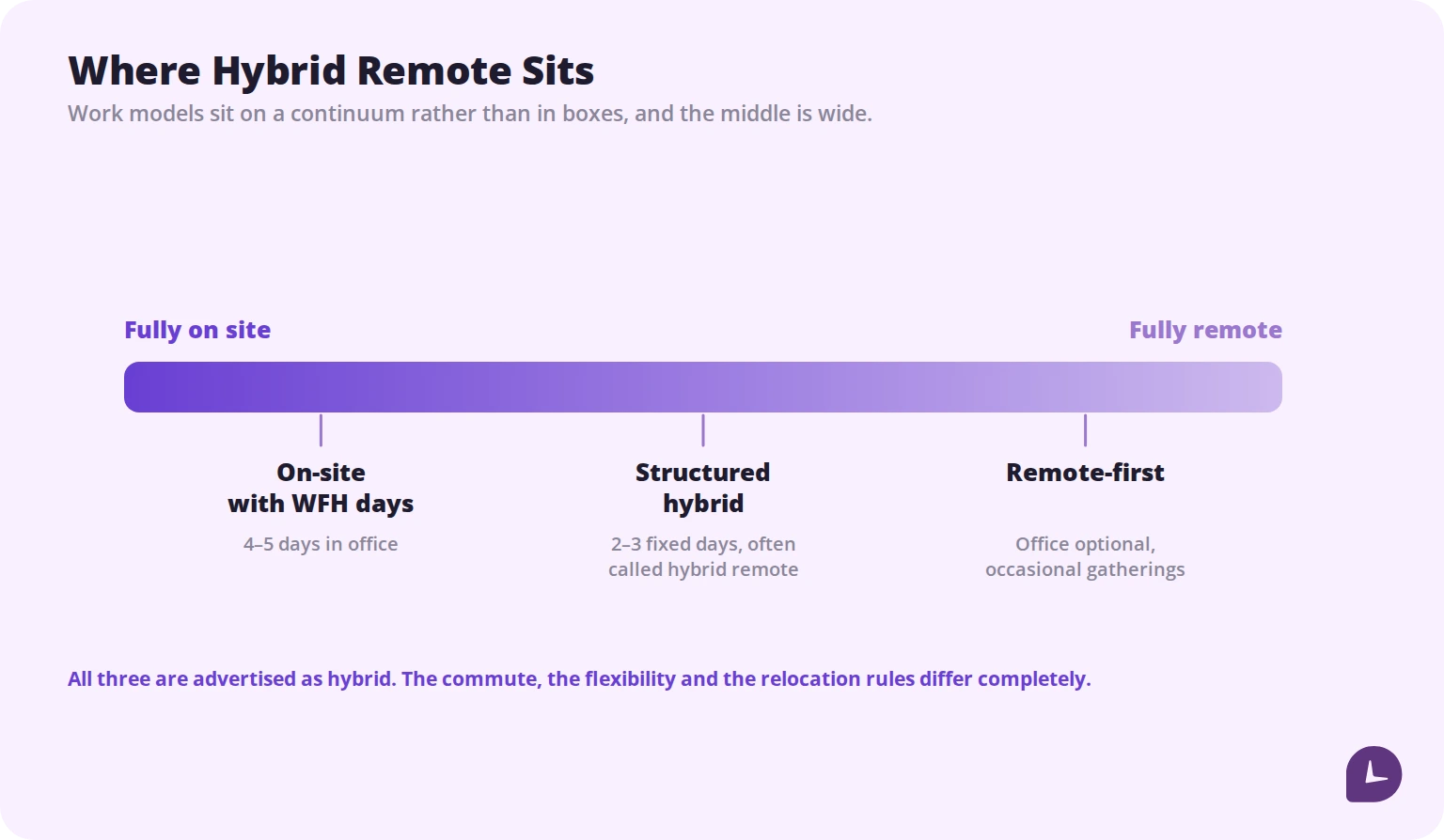
Work models sit on a continuum rather than in boxes. At one end, everyone is in an office every day. At the other, there is no office. Hybrid remote occupies the middle, and the middle is wide.
The important consequence: a role advertised as hybrid can be closer to an office job than to a remote one, or the reverse. The label does not tell you which.
The five arrangements the term covers
Structured hybrid with anchor days. Fixed days on site, the same for everyone or for a team, typically two or three. Predictable, easy to plan around, and the most common form. Collaboration is deliberately concentrated on the shared days.
Flexible hybrid. A required number of days per week or month, with the employee choosing which. More autonomy, but it can produce an office where nobody overlaps, which delivers the commute without the collaboration.
Remote-first with periodic gatherings. Home is the default and the office is occasional: a week a quarter, or a few days a month. Functionally close to remote work, and usually the version that permits living far from the office.
Office-first with work-from-home days. Four days in, one at home. Advertised as hybrid and experienced as an office job with a concession attached.
Cohort or team-based hybrid. Different teams have different schedules, often for space reasons. Worth understanding before accepting, because your experience depends entirely on which cohort you join.
| Term | What it means |
|---|---|
| Hybrid remote | Time split between office and elsewhere |
| Fully remote | No routine office attendance required |
| Remote-first | The company is designed around remote work; an office may exist but is optional |
| Work from home | Working from a residence specifically, rather than anywhere |
| Telecommuting | Older term for the same idea, still used in government and larger institutions |
| Distributed | The company has no headquarters; describes the organisation, not the individual |
| Location-flexible | Usually means you may choose your city, which is a stronger promise than hybrid |
The distinction that matters most in practice is between hybrid remote and remote-first. Hybrid usually implies a commutable radius. Remote-first usually does not. If where you live is part of the decision, that is the difference to establish first. Our comparison of telecommuting and remote work covers the older terminology.
How common is it
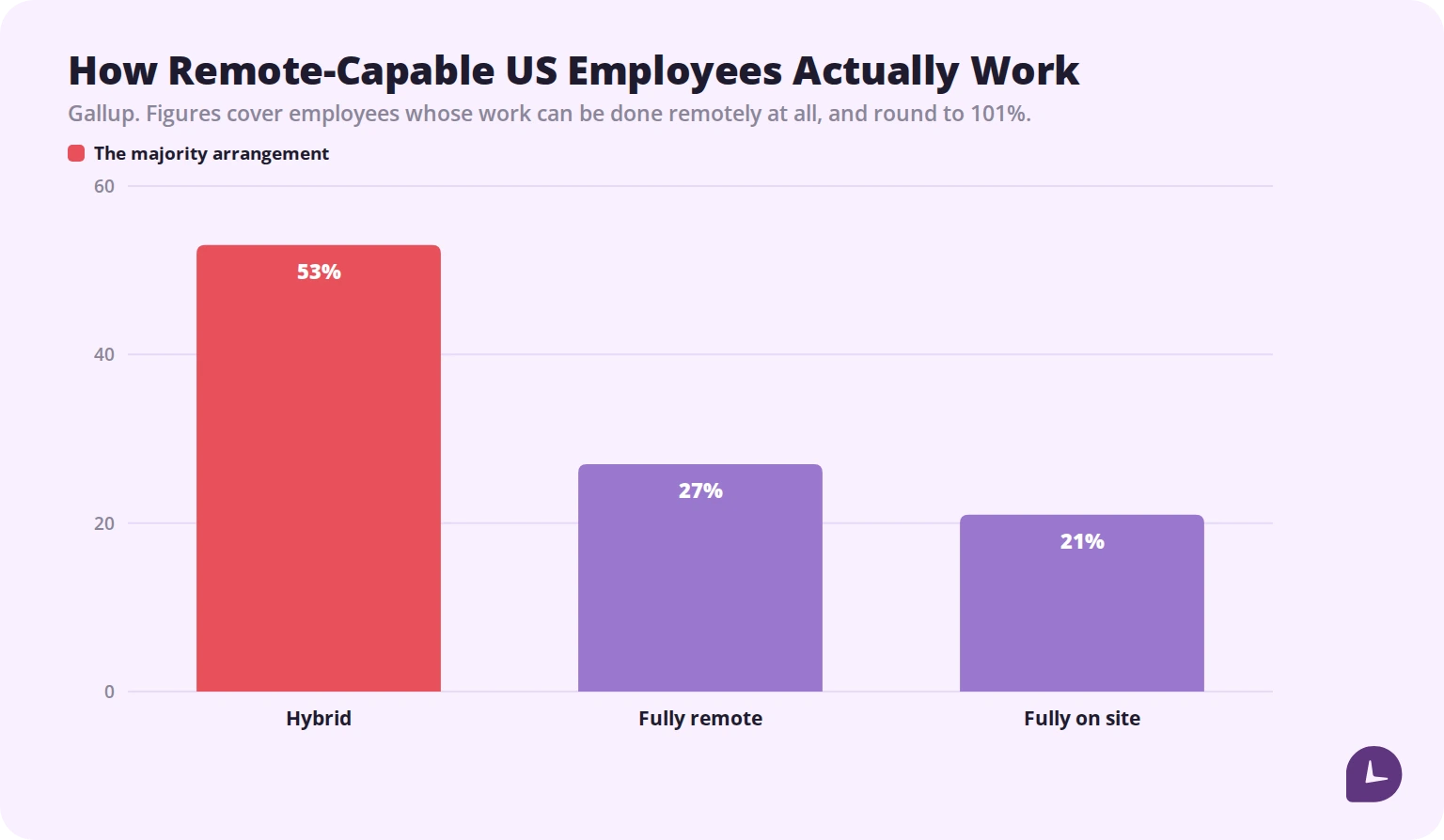
Gallup’s figures put 53% of remote-capable US employees in hybrid arrangements, against 27% fully remote and 21% fully on site. Hybrid is the majority arrangement, not a compromise position.
Note the qualifier. Those percentages describe employees whose work can be done remotely at all, which is a minority of the total workforce. Most jobs cannot be hybrid.
The trend is not one-directional. Full-time in-office mandates among the largest US employers have risen sharply since 2023, even as research continues to find no performance penalty from hybrid schedules. Which way a specific employer is moving is a fair question to ask.
Questions to ask before you accept
Six questions that turn “hybrid” into a description of your actual week.
How many days on site, and is that policy or preference? A stated two days that is really four in practice is a common and avoidable surprise.
Which days, and who chooses? Fixed anchor days and free choice produce very different weeks.
How far can I live from the office? This determines whether the role is compatible with moving, and it is the question most often left unanswered.
Is the arrangement in the contract or in a policy? Policies change without renegotiation. Contracts do not.
What happened the last time the policy changed? Past behaviour predicts future behaviour better than any stated intention.
Do remote days affect progression? Ask how many of the last several promotions went to people on the most on-site schedules. The answer is informative whichever way it goes.
For employers, the reverse is worth noting: candidates are asking these questions, and vague answers are read as instability rather than flexibility.
The split-day trap
One hybrid pattern performs measurably worse than the others, and it is easy to fall into by accident.
Splitting a single day between office and home is the pattern to avoid: a morning at home, a commute at midday, an afternoon in the office. ActivTrak’s 2026 behavioural data, covering 443 million work hours, found that workers who split individual days had the longest workdays and the lowest productive and focused time of any location group.
The reason is straightforward. The commute lands inside the working day rather than at either end, context switches twice, and the day stretches without filling.
Whole days in one place, in whatever ratio, avoid the penalty. If you are designing a hybrid policy, this is the single most useful thing to get right.
What employers should specify
A job ad saying “hybrid” and nothing else costs applications. Four lines fix it:
- The number of days on site and the period they apply to
- Whether days are fixed or chosen, and by whom
- The geographic requirement, stated as a radius or a named location
- Whether the arrangement is contractual or subject to policy change
Two further points that show a policy has actually been thought about. Say what the office days are for, because people who commute to sit on video calls stop believing the policy. And say how meetings work when part of the group is remote, since that single detail determines whether remote days are equal or second-class.
Our guides to hybrid work schedule examples and best practices for a hybrid office go into the design in more depth.
Boost your business productivity
Track performance and streamline teamwork
The tax and employment law question
Rarely mentioned in definitions of hybrid work, and it matters to both sides.
Employment law generally follows where the work is performed, not where the company is based. For a hybrid employee whose home is in a different state from the office, that can mean two states’ rules are potentially relevant to the same job. Sick leave entitlements, monitoring notice requirements and wage rules can all differ between them.
There may also be payroll withholding and business tax consequences for the employer when an employee regularly works from another state. These are real questions with fact-specific answers, and they are worth raising before an arrangement is agreed rather than after.
This is general information rather than legal or tax advice.
Common misunderstandings
That hybrid means part-time. It describes location, not hours. Hybrid roles are usually full-time.
That hybrid means you can live anywhere. It usually implies a commutable distance. Remote-first is the term that generally does not.
That the ratio is standardised. It is not. Two to three days is common, not required.
That the policy is permanent. Unless it is contractual, it can change.
That half-days count as flexibility. They are the worst-performing pattern in the behavioural data.
That hybrid is a compromise nobody wants. It is the majority arrangement among remote-capable US employees.
How Monitask helps
Hybrid arrangements make hours harder to see, because part of the week is unobserved by default. That is a record-keeping problem before it is a trust problem.
Monitask records hours as they happen. Employees clock in when they start and clock out when they stop, so nothing runs in the background without their knowledge, and the record is the same whether the day was worked at home or in the office.

- Consistent hour records across locations, so payroll and billing do not depend on where someone sat.
- Attendance tracking shows whether the actual pattern matches the agreed one, without anyone counting badge swipes.
- Project-level time measures output rather than presence, which is the measurement hybrid arrangements actually need.
- Employee-visible data keeps the arrangement transparent rather than supervisory.
See how it works: Monitask remote employee monitoring.
Sources
- Gallup — share of remote-capable US employees working hybrid, fully remote and fully on site.
- ActivTrak, State of the Workplace 2026 — behavioural data across 443 million work hours, including the finding that split-day hybrid workers record the longest workdays and the lowest productive and focused time.
Related reading
- Hybrid Work Model: The Future of the Workplace
- 10 Hybrid Work Schedule Examples
- Best Practices for a Hybrid Office
- Telecommuting vs Remote Work: What’s the Difference?
- Balancing Flexibility and Efficiency in the Evolving Workplace
- Productivity Trends 2026
FAQ
Is hybrid remote the same as fully remote?
No. Hybrid requires some office attendance and usually implies living within commuting distance. Fully remote does not.
How many days a week is hybrid remote?
Most commonly two or three days on site, though arrangements range from one day at home per week to a few days on site per quarter.
Does hybrid remote mean I can live anywhere?
Usually not. Hybrid generally requires a commutable distance from the office. Remote-first or location-flexible are the terms that typically allow relocation.
What is the difference between hybrid and remote-first?
Hybrid assumes routine office attendance as part of the job. Remote-first treats remote as the default and the office as optional, and usually permits living further away.
Is hybrid remote full-time?
Normally yes. The term describes where the work happens, not how many hours.
What questions should I ask about a hybrid role?
How many days on site and whether that is policy or preference, which days and who chooses, the geographic requirement, whether the arrangement is contractual, what happened last time the policy changed, and whether remote days affect progression.
How common is hybrid work?
Gallup puts 53% of remote-capable US employees in hybrid arrangements, against 27% fully remote and 21% fully on site.
Which hybrid pattern works worst?
Splitting a single day between office and home. ActivTrak’s data shows those workers have the longest workdays and the lowest productive and focused time.