New Hire Paperwork: Every Form, and the Deadline Attached to It

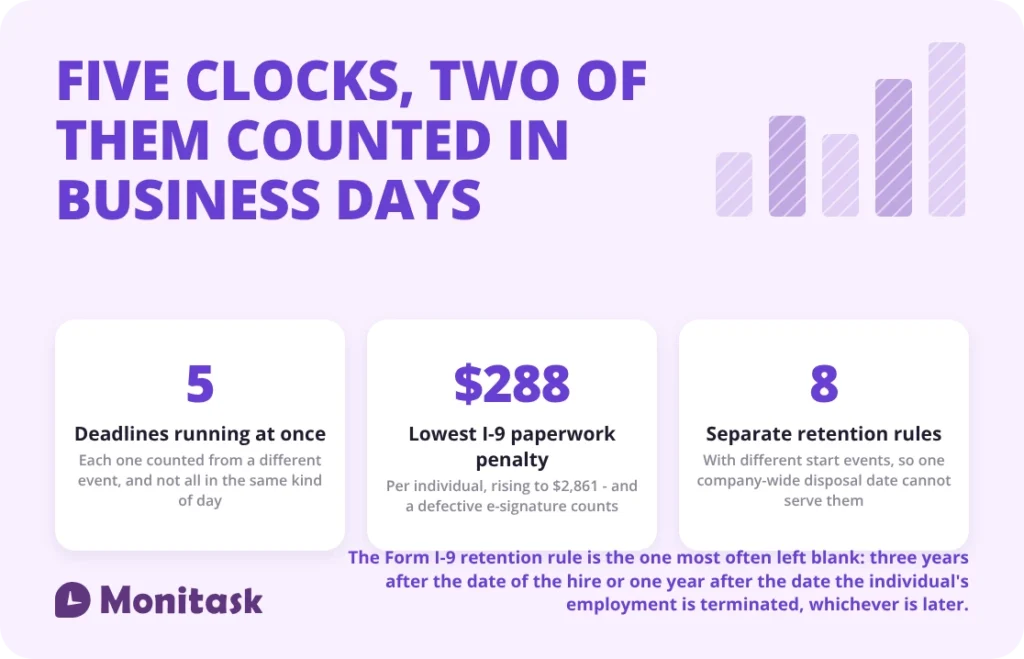
5 deadlines run at once when someone is hired, they start from 5 different events, and two of them are counted in business days while the rest are not. That distinction is the whole article. Also here: the Form I-9 retention rule stated as a figure, the current Form W-4 default (which is not the one most guides still quote), and the penalty amounts actually in force.
What paperwork does a new hire have to complete?
Most lists of new hire paperwork are lists of form names. That is the least useful way to organise it, because the form name tells you nothing about who is obliged, by when, or what happens if it is late.
Organised by obligation instead there are 3 groups, and they behave completely differently.
| Group | Examples | If it is missing |
|---|---|---|
| Federally required | Form I-9 for employment eligibility verification; Form W-4 for federal withholding | An enforcement exposure with its own penalty regime, independent of anything in your handbook |
| State required | A state withholding certificate where one exists; the new hire report to the state directory; state notices at hire | A separate obligation with its own deadline and its own penalty, set per state |
| Company documents | Handbook acknowledgement, direct deposit authorisation, emergency contact, equipment receipt, confidentiality agreement, monitoring acknowledgement | No statutory penalty, but you lose the evidence the document existed to create |
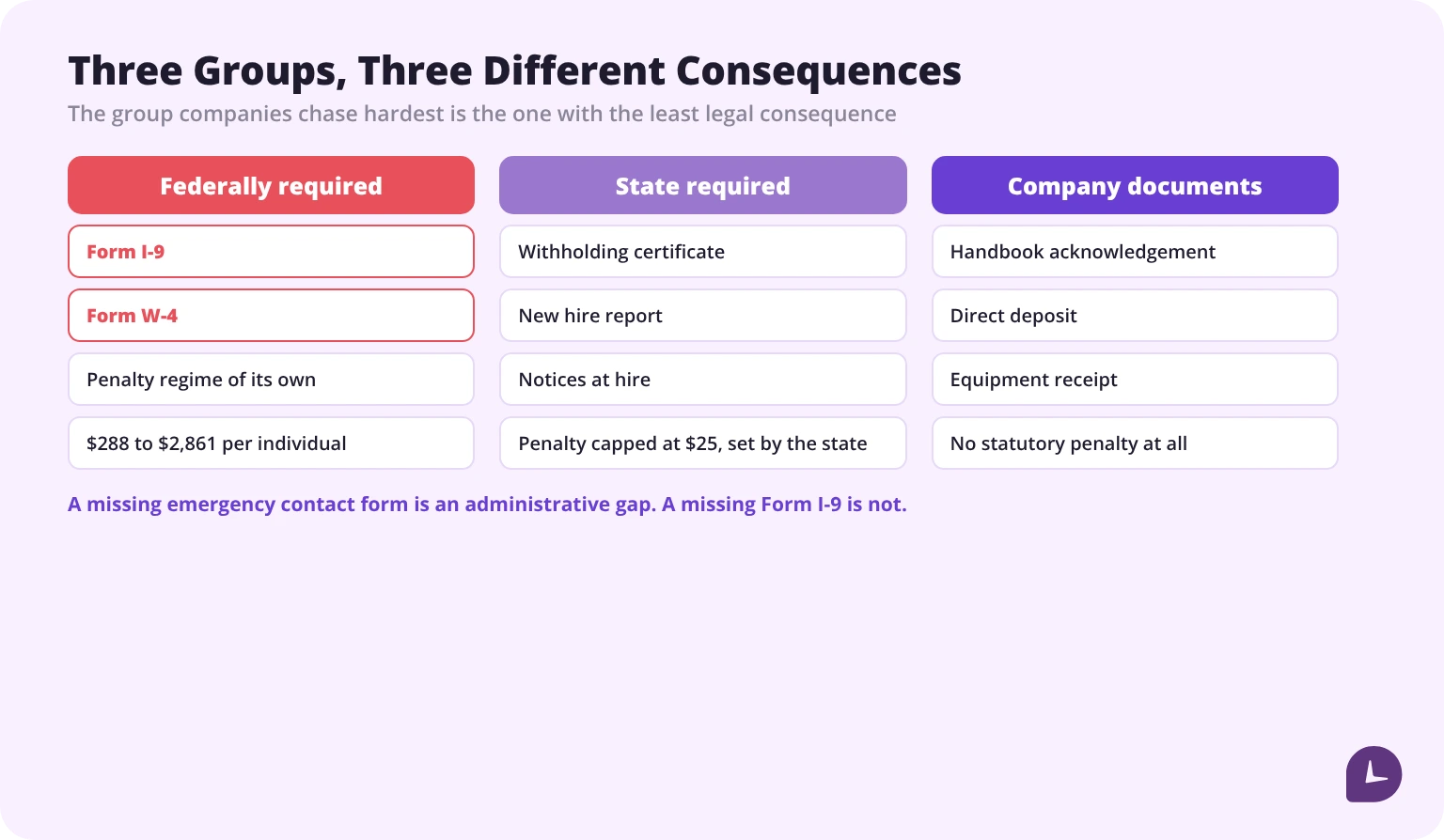
The practical consequence of the split: the third group is the one most companies chase hardest and the one with the least legal consequence, while the first two have deadlines nobody mentions at the kickoff meeting. A missing emergency contact form is an administrative gap. A missing Form I-9 is not.
This page is about the paperwork and its deadlines. The process around it — the onboarding checklist, orientation and the first day itself — is a separate problem with its own pages.
Which forms are legally required and which are yours?
A short inventory, with the role each plays. The glossary pages behind each one cover the form itself; this page is about the sequence and the deadlines.
| Form or document | Group | Purpose | Who completes it |
|---|---|---|---|
| Form I-9, Employment Eligibility Verification | Federal | Establishes identity and authorisation to work in the United States | Employee completes Section 1; employer completes Section 2 |
| Form W-4, Employee’s Withholding Certificate | Federal | Sets federal income tax withholding | Employee |
| State withholding certificate | State, where applicable | Sets state income tax withholding | Employee |
| New hire report to the state directory | State obligation on the employer | Supports child support enforcement and benefit integrity | Employer |
| State notices at hire | State, where applicable | Wage rate, paid sick leave, workers’ compensation and similar notices, depending on the state | Employer issues; often requires an acknowledgement |
| Direct deposit authorisation | Company | Routes net pay | Employee |
| Handbook acknowledgement | Company | Records that policies were received | Employee |
| Monitoring or acceptable use acknowledgement | Company | Records notice of monitoring and device rules where you monitor | Employee |
| Equipment and asset receipt | Company | Records what was issued | Employee |
| Emergency contact and benefits elections | Company | Administration | Employee |
Two notes on that table.
The current Form I-9 edition is 08/01/2023, and no older edition is acceptable. The rule that set it stated that The new edition of the Form I-9 is effective on August 1, 2023
and that No later than November 1, 2023, employers must begin using the August 1, 2023 edition
; the edition on the form’s face expires 05/31/2027. Our page on acceptable documents covers what the employee may present.
E-Verify is not on the list as a form, because it is a system rather than a document and it applies to enrolled employers rather than to all employers. It does carry a deadline of its own, and it is not the same deadline as the I-9’s. Our page on employment eligibility verification covers the distinction; the direct deposit authorisation page covers the one genuinely optional form here.
What are the actual deadlines?
This is the section that distinguishes a compliant onboarding pack from a complete one. 5 clocks run at once, they start from different events, and the kind of day differs.
| What is due | By when | Days | Source |
|---|---|---|---|
| Section 1 of Form I-9 may be completed | Any time after the employee accepts the job offer | — | USCIS. It may not be sent before acceptance |
| Section 1 of Form I-9 must be complete and signed | No later than the employee’s first day of employment | Not a day count | USCIS and 8 C.F.R. 274a.2(b)(1)(i)(A) |
| The employer completes Section 2 | Within three business days of the hire | Business days | USCIS and 8 C.F.R. 274a.2(b)(1)(ii) |
| An E-Verify case is created, for enrolled employers | No later than the third business day after the employee starts work for pay | Business days | E-Verify. Note the trigger differs from the I-9’s |
| The new hire report reaches the state directory | Not later than 20 days after the date the employer hires the employee | Calendar days | 42 U.S.C. 653a(b)(2)(A) |
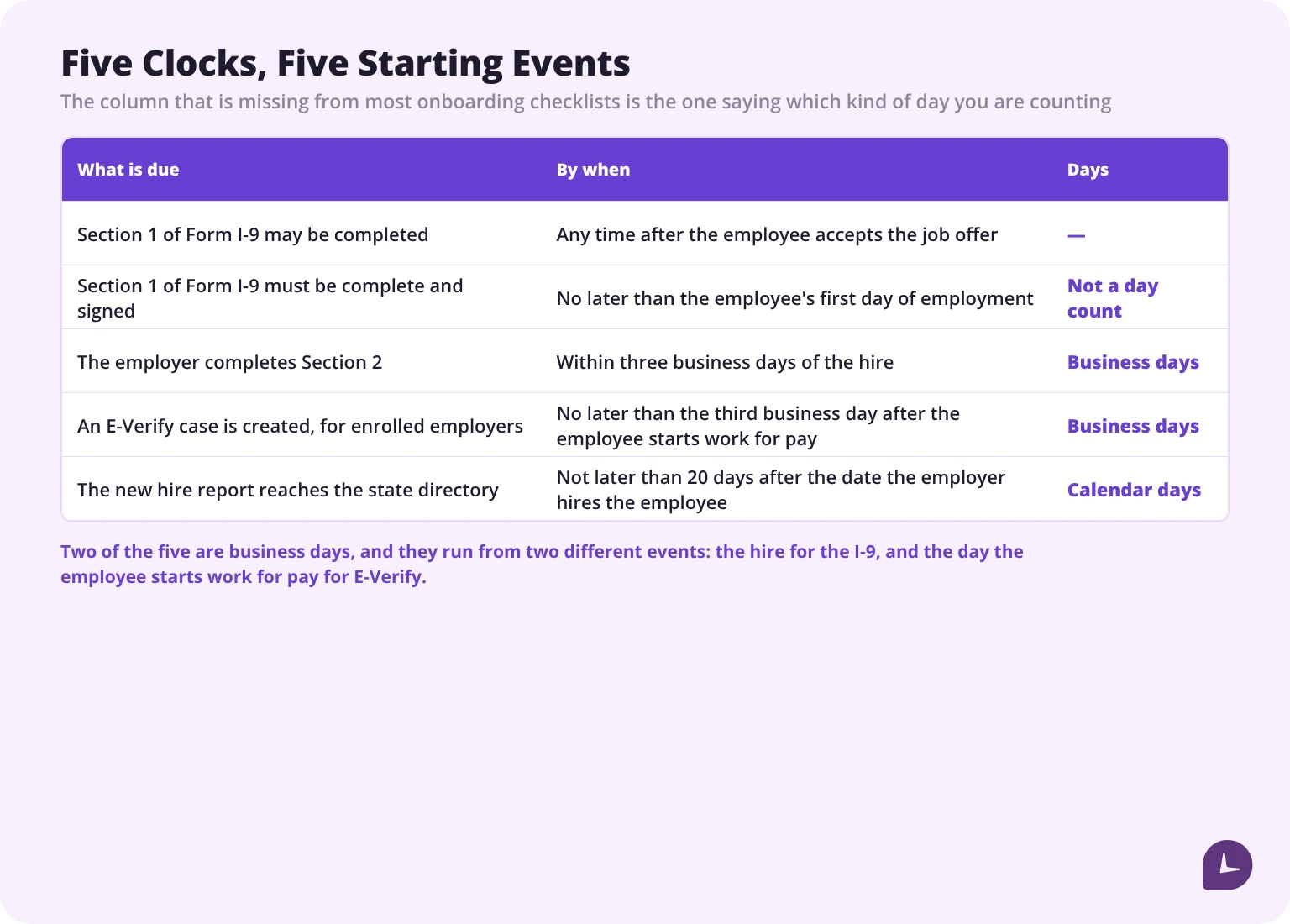
The offer acceptance date matters more than people expect — in both directions. It is the earliest point at which Section 1 may be completed, which means the day-one scramble is avoidable: send Section 1 with the signed offer letter, not with the welcome email. But it is also a floor. USCIS is explicit that You may not ask an individual who has not accepted a job offer to complete Section 1
, so sending it with the offer itself, before acceptance, is its own problem.
The three-business-day clock is the one that gets missed, because it falls in the week when a manager is busy with induction and HR assumes the pack is “in progress.”
And it has one genuine exception the circulating guides omit. Where the hire is for 3 business days or less, the normal sequence collapses. Under 8 C.F.R. 274a.2(b)(1)(iii), an employer hiring for a duration of less than three business days must comply with paragraphs (b)(1)(ii)(A) and (b)(1)(ii)(B) of this section at the time of the hire
— that is, at the time of the hire rather than within three days — and may not accept a receipt in lieu of the required document
. Short engagements are not a relaxed case. They are the strict one.
“Within 20 days” runs from the hire, not from the first day worked and not from the first payroll. This is the single most common error in published guidance, and it is an easy one to make, because the statute uses both dates for different purposes. The deadline is not later than 20 days after the date the employer hires the employee
. The date services were first performed is a required field on the report, not the trigger for it. In a month where someone is hired on the 2nd and the first payroll runs on the 30th, the report is due before payroll has processed them once.
E-Verify’s clock is a fifth one, and it starts somewhere else again. For enrolled employers the case must be created no later than the third business day after the employee starts work for pay
. Note the trigger: the day the employee starts work for pay, which is not necessarily “the hire” the I-9 counts from. Federal contractors subject to FAR 52.222-54 have three more:
| Obligation | Deadline |
|---|---|
| Enrol in E-Verify | Within 30 calendar days of contract award |
| Verify new hires | Within 3 business days after the date of hire |
| Verify employees assigned to the contract | Within 90 calendar days after enrolment or after contract award, or 30 days after assignment, whichever is later |
What must the new hire report to the state contain?
Specific items, set by statute at 42 U.S.C. 653a, in a shape most HR teams have never read. The employer furnishes to the Directory of New Hires of the state in which the newly hired employee works a report containing:
| Item | Detail |
|---|---|
| Employee identification | Name, address and Social Security number |
| The start point | the date services for remuneration were first performed by the employee |
| Employer identification | Name, address and the identifying number assigned under section 6109 of the Internal Revenue Code |
Note the second row, and read it against the deadline above. The statute puts the date services for remuneration were first performed by the employee
on the report as a field, and separately sets the deadline at 20 days after the hire. Two different dates, two different jobs. Collapsing them is how the report goes late.
Electronic filers get a different deadline shape. Employers transmitting magnetically or electronically may report by 2 monthly transmissions (if necessary) not less than 12 days nor more than 16 days apart
. That is a meaningfully different operating rhythm from a per-hire filing, and it is one of the real reasons to move new hire reporting onto an electronic process.
The penalties are smaller than people assume, and that is the trap. The state has the option to set a civil money penalty; where it does, the statute caps it at $25 per failure to meet the requirements of this section with respect to a newly hired employee
, rising to $500 if, under State law, the failure is the result of a conspiracy between the employer and the employee
not to supply the report or to supply a false or incomplete one. These are ceilings on a state-set amount, not federal fines.
$25 per miss is not a deterrent on its own. It becomes one at volume, and the reason to get it right is not the fine: a pattern of unreported hires is a visible systems failure in any audit that looks at onboarding, and it sits next to the I-9 file that does carry real exposure.
Our page on new hire reporting covers the state-by-state mechanics of where and how to file.
What if the employee does not return a W-4?
You do not stop payroll, and you do not guess. There is a default — and it is not the one most guides quote.
The default, stated correctly. Treat the employee as if they had checked “Single or Married filing separately” in Step 1(c) and made no entries in Step 2, Step 3 or Step 4 of the current Form W-4. The familiar phrasing — “single with zero allowances” — describes the pre-2020 form. Allowances have not existed since the form was redesigned, and the IRS page where that phrasing still appears carries it under a heading for the prior form. A guide quoting it is quoting a section that no longer governs.
The W-4 is a request, not a deadline. The instruction is to Ask all new employees to give you a signed Form W-4 when they start work
. There is no statutory moment by which it must be in hand, which is precisely why the default exists. Treating it as a fourth clock, alongside the I-9 and the state report, puts effort in the wrong place.
| Situation | What the employer does |
|---|---|
| No W-4 received, and none on file | Withhold under the default rather than holding pay: Treat the employee as if they had checked “Single or Married filing separately” in Step 1(c) and made no entries in Step 2, Step 3 or Step 4 of the current Form W-4 |
| No W-4 received, but a valid earlier one is on file | Keep withholding under the earlier form. The default applies only where there is no valid form at all |
| An altered form, or one the employee drew up themselves | Treat it as no form. An employer-developed substitute can be valid; an employee-developed one never is |
| A valid W-4 arrives later | Apply it going forward. Reworking prior runs on your own initiative is a practice question, not a rule |
| An IRS lock-in letter arrives | Withhold at the specified rate from the date the letter specifies, which is 60 calendar days after the letter’s date at the earliest |
The second row is the one that reverses the outcome. Any unauthorized change or addition to Form W-4 makes it invalid
— but if a valid earlier form is on file, withholding continues under that one. The default applies only where there is no valid form at all. Falling back to the default for an employee who did file one withholds on the wrong basis.
And there is a split on substitutes. An employer-developed substitute can be valid, provided it must contain language that is identical to the official Form W-4
. An employee-developed one never is: You can’t accept substitute Forms W-4 developed by employees
.
On lock-in letters, the rate applies from the date the letter specifies, which is no sooner than 60 calendar days after the date of the lock-in letter
. The same IRS page still carries a prior-form answer giving 45 days. A reader landing on the wrong half of the page gets a different number.
The point for onboarding design: the W-4 is the one piece of new hire paperwork whose absence has a defined fallback. The I-9 does not. Treat the two differently in your chase-up process, because treating them as one queue means the urgent one waits behind the one that has a default. Our page on the W-4 form covers how to read and process the form itself.
Can new hire paperwork be done electronically?
Largely yes, and the rules are form-specific rather than general. For the I-9 they are also unusually concrete, and falling short of them is itself a violation rather than merely bad practice.
| Element | What the rule requires |
|---|---|
| Form I-9 | Permitted, with named requirements on the system: reasonable controls, indexing and retrieval, readable hardcopies, an audit trail, and an electronic signature that meets three conditions. Falling short is itself a violation |
| Form W-4 | Permitted. The IRS points to its own regulation for electronic systems; the substitute-form rules still apply |
| The new hire report | Expressly contemplated, and it carries its own timing rule of two monthly transmissions 12 to 16 days apart |
| State notices | Some states have delivery and acknowledgement requirements that a portal click may or may not satisfy |
| Company documents | Your choice. What matters is that the acknowledgement is attributable to a person and timestamped |
The I-9 system requirements, named. 8 C.F.R. 274a.2(e) requires Reasonable controls to ensure the integrity, accuracy and reliability of the electronic generation or storage system
, indexing and retrieval, The ability to reproduce legible and readable hardcopies
, high legibility, and no agreement restricting government access. An audit trail is required by name, and the regulation defines it as a record showing who has accessed a computer system and the actions performed within or on the computer system during a given period of time
; the documentation must Establish the authenticity and integrity of the Forms I-9, such as audit trails
. And then the sting: Insufficient or incomplete documentation is a violation of section 274A(a)(1)(B) of the Act
, at 8 C.F.R. 274a.2(f)(2).
Electronic signatures have three conditions. The system must include a method to acknowledge that the attestation to be signed has been read by the signatory
, must Affix the electronic signature at the time of the transaction
, and must Create and preserve a record verifying the identity of the person producing the signature
. Where it does not, the employer is deemed to have not properly completed the Form I-9, in violation of section 274A(a)(1)(B)
under 8 C.F.R. 274a.2(h)(2).
Put those two together and the audit-trail argument stops being best practice. A defective electronic signature or a missing audit trail is a paperwork violation, and paperwork violations carry the penalty range in the next section. More generally, 15 U.S.C. 7001 gives an electronic record the same legal effect as paper where it accurately reflects the information and remains accessible to all persons who are entitled to access by statute, regulation, or rule of law
.
The difference that justifies going paperless is not the paper. It is the evidence: an electronic pack records who completed what and when, which is exactly what 5 deadlines require you to be able to produce. A folder of scanned PDFs proves the document exists and proves nothing about when.
What a portal does not do is change the deadlines. An employee who has not completed Section 1 by their first day has not completed it, whether the blank form is on paper or on a screen.
What does getting it wrong actually cost?
The figures are published and they are not small. These are the amounts set by the Department of Justice civil monetary penalty inflation adjustment published 3 July 2025, effective 3 July 2025, applying to penalties assessed after that date:
| Violation | Minimum | Maximum |
|---|---|---|
| Form I-9 paperwork violation, per individual | $288 | $2,861 |
| Unlawfully employing an unauthorised worker, first order | $716 | $5,724 |
| Unlawfully employing an unauthorised worker, second order | $5,724 | $14,308 |
| Unlawfully employing an unauthorised worker, later orders | $8,586 | $28,619 |
There was no increase for 2026. The Department of Justice stated that its civil monetary penalty amounts will not increase for the 2026 calendar year
, because no cost-of-living adjustment could be produced for 2026. So the 3 July 2025 figures are the current ones.
Do not take these from the published code. Both 28 C.F.R. 85.5 and 8 C.F.R. 274a.10 in the 2025 annual edition still show the pre-July-2025 figures, keyed to penalties assessed after 12 February 2024 — the regulation text lags the adjustment, so a reader checking the obvious place finds the wrong number. And these are the Department of Justice’s amounts; the Department of Homeland Security maintains its own table and adjusts it separately.
The reason this section exists is the previous one. A paperwork violation is not only a missing form: it includes an I-9 whose electronic signature does not meet the three conditions, and an I-9 system whose audit trail cannot be produced. The range above is per individual.
How long do you keep it?
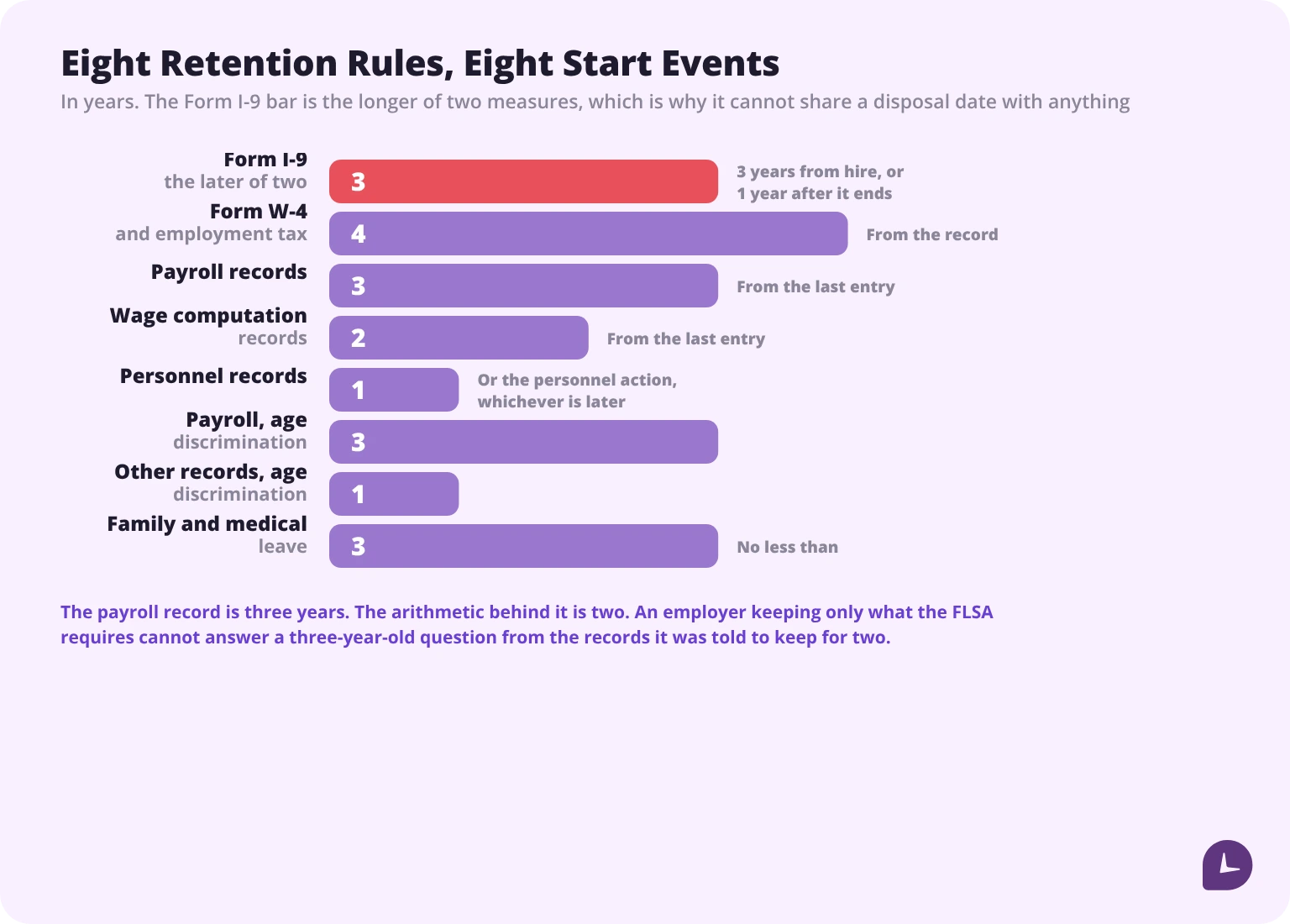
Retention is where new hire paperwork quietly becomes a records problem, and it is where most published guidance goes vague. The periods are figures.
| Document | Retention | Citation |
|---|---|---|
| Form I-9 | Three years from hire, or one year after employment ends, whichever is later | 8 C.F.R. 274a.2(b)(2)(i)(A) |
| Form W-4 and employment tax records | Four years | IRS Publication 15 (2026), section 9, 12 |
| Payroll records | Three years, from the last date of entry | 29 C.F.R. 516.5 |
| The records the wage computation rests on | Two years, from the date of last entry | 29 C.F.R. 516.6 |
| Personnel and employment records | One year from the making of the record or the personnel action, whichever is later; one year from the date of an involuntary termination | 29 C.F.R. 1602.14 |
| Payroll records, age discrimination | Three years | 29 C.F.R. 1627.3(a) |
| Other records, age discrimination | One year from the date of the personnel action | 29 C.F.R. 1627.3(b)(1) |
| Family and medical leave records | No less than three years | 29 C.F.R. 825.500(b) |
The Form W-4 is four years, and the IRS says so plainly: Keep all records of employment taxes for at least 4 years
, expressly including copies of employees’ withholding certificates.
The Form I-9 rule, stated exactly. 8 C.F.R. 274a.2(b)(2)(i)(A) requires retention for three years after the date of the hire or one year after the date the individual’s employment is terminated, whichever is later
. the USCIS Handbook for Employers M-274 supplies a shortcut that is easier to operate:
| If the employee was | Keep the I-9 until |
|---|---|
| Employed under two years | Three years from the First Day of Employment field |
| Employed over two years | One year after they stop working for you |
The FLSA split is the one that catches people. The payroll record is three years. The arithmetic behind it is two. So an employer keeping only what federal wage law requires cannot answer a three-year-old question about a payroll figure from the records it was told to keep for two.
Two structural points, independent of the periods.
Form I-9s are commonly kept separate from the personnel file, and the practical reason is access: an inspection of I-9s should not require handing over a file containing medical, performance and disciplinary material. Worth being precise, though — no rule requires it. It is practice. The requirement that does exist in those terms is for family and medical leave records, which 29 C.F.R. 825.500(g) requires to be maintained as confidential medical records in separate files/records from the usual personnel files
. Our page on the employee file covers what belongs where.
And retention interacts with rehire. A former employee’s dates and status may be needed years later, and an over-aggressive disposal schedule removes the only record that can answer.
What does a remote hire change?
The deadlines do not change. What changes is how you meet them — and on the one point that used to require hedging, there is now a rule.
| Issue | What to settle before the first remote hire |
|---|---|
| Which state’s rules apply | The new hire report goes to the directory of the state in which the employee works, which for a remote employee is where they sit |
| State notices and withholding | Driven by the work location, so a single-state onboarding pack breaks on the first out-of-state hire |
| Examining the documents | The three-business-day deadline is unchanged by distance. The alternative procedure permits remote examination, but only for employers in good standing in E-Verify |
| Day-one access and equipment | Equipment receipts and device acknowledgements matter more, not less, when nobody hands the laptop over in person |
| Getting the person into payroll and the time record | Someone has to exist in the time record before their first week can be paid correctly, and for a remote hire nobody notices if they do not |
Remote examination of documents is permitted, conditionally. the Department of Homeland Security final rule published 25 July 2023 created the alternative procedure for remote examination of documents, effective 1 August 2023. It is available to those employers who are enrolled, and participate in good standing, in E-Verify
and who completed all required E-Verify training
— which means an employer not in E-Verify cannot use it at all, and that is what ties the E-Verify section and the remote section together.
Where it applies, the employer must:
- Examine copies of the documents, front and back.
- Hold a live video interaction with the employee showing the same documents.
- Check the alternative-procedure box on the Form I-9.
- Retain clear and legible copies for the statutory retention period.
- Produce them on audit.
The video step is specified rather than implied: the employer must Conduct a live video interaction with the employee presenting the document(s)
to ensure that the documentation reasonably appears to be genuine and related to the individual
, with the employee transmitting copies first and then displaying the same documents. Copies must be retained for as long as the employee works for the employer
and for the statutory period after that. The procedure is not available for employees already on the books when it was adopted, and reverification does not create a new E-Verify case.
The enabling regulation at 8 C.F.R. 274a.2(b)(1)(ix) only authorises the Secretary to designate procedures — the employer-facing conditions live in the rule, not in the code, which is why reading only the regulation leaves you with nothing to act on.
That last table row is where onboarding meets operations. A new hourly employee has to exist in the time record before their first week can be paid correctly, and for a remote hire nobody notices if they do not. Monitask’s time clock software covers that setup, and our remote team time tracking page covers the distributed case. IT onboarding covers the equipment and access side, and the new hire policy page covers what the pack should contain.
The 9 most common new hire paperwork failures
| Failure | Consequence | The fix |
|---|---|---|
| Sending Section 1 of the I-9 with the welcome email instead of the offer | Creates a day-one deadline you did not need | Send it at offer acceptance, which USCIS permits – but not before |
| Treating “day one” as one deadline | 5 separate clocks get collapsed and the three-business-day one is missed | Track the 5 deadlines as 5 fields, with a business-or-calendar column |
| Chasing company documents before federal forms | The urgent item waits behind the one that has a default | Separate the queues by consequence |
| Holding pay because a W-4 is missing | Creates a wage problem where a withholding default exists | Apply the default and keep chasing the form |
| Applying the default where an earlier valid W-4 exists | Withholds on the wrong basis for an employee who did file one | Check the file before falling back to the default |
| Running the 20-day clock from the first payroll, or from the first day worked | The report can be late before payroll has processed the hire once | Run it from the date of hire; the first-services date is a field on the report, not the trigger |
| Using one onboarding pack across states | State notices and withholding certificates are state-specific | Build the pack per work location, not per company |
| One company-wide disposal date | 8 retention rules with different start events cannot share one date | Set disposal per document type |
| Assuming an e-signature is enough for the I-9 | A defective signature or a missing audit trail is itself a paperwork violation | Check the system against the three signature conditions and the audit-trail requirement |
Four of those are timing failures, and all four are solved by the same thing: tracking the 5 deadlines as 5 fields with a column saying which kind of day each one counts.
A new hire exists in the time record before their first week has to be paid — which for a remote hire is the step nobody notices was skipped.
See Monitask's time clock software
Sources
Every document below was read directly, at the publisher’s own site, on 12 November 2026.
- USCIS I-9 Central and the USCIS Handbook for Employers M-274, for the Section 1 and Section 2 timing, the bar on asking before acceptance, and the retention shortcut.
8 C.F.R. 274a.2, read on govinfo in the CFR annual edition revised as of 1 July 2025: paragraph (b)(1) for the timing and the short-hire exception at8 C.F.R. 274a.2(b)(1)(iii), paragraph (b)(2)(i)(A) for retention, paragraphs (e) to (h) for electronic systems, audit trails and electronic signatures, including8 C.F.R. 274a.2(f)(2)and8 C.F.R. 274a.2(h)(2).- Federal Register document 2023-15532, which set the edition’s effective date, for the 08/01/2023 edition and the date older editions ceased to be acceptable.
- the Department of Homeland Security final rule published 25 July 2023, effective 1 August 2023, for the alternative procedure: eligibility, the live video requirement and the retention duty. Its enabling regulation is
8 C.F.R. 274a.2(b)(1)(ix). - E-Verify, for the third-business-day case deadline, and
FAR 52.222-54on acquisition.gov for the federal contractor deadlines. 42 U.S.C. 653a, read on govinfo and on the Social Security Administration’s own site: subsection (b)(1)(A) for the contents, (b)(2)(A) for the 20-day deadline, (b)(2)(B) for electronic filers, and (d) for the penalty caps.- IRS Publication 15 (2026), section 9 for the withholding default, the invalid-form rule and the substitute-form split, and section 12 for the 4-year employment tax retention period. The IRS withholding compliance pages for the lock-in letter timing — note that the same page still carries a prior-form answer giving a different number.
- the Department of Justice civil monetary penalty inflation adjustment published 3 July 2025, effective 3 July 2025, and the Department of Justice notice published 15 July 2026 confirming no 2026 increase.
- 29 C.F.R. parts 516, 825, 1602 and 1627, read on govinfo in the CFR annual edition revised as of 1 July 2025, for the retention periods and the separate-file requirement at
29 C.F.R. 825.500(g). - Open items, where a primary source could not be reached:
- State E-Verify mandates. Several states require E-Verify use. Every candidate page on the programme’s own site returned an error, so no state is named here and the article asserts nothing about state mandates.
- The electronic Form W-4 regulation. IRS Publication 15 points to
26 C.F.R. 31.3402(f)(5)-1(c)for electronic W-4 systems. That regulation’s text could not be retrieved, so it is cited by number only and nothing is quoted from it. - Whether DHS has made its own post-2024 penalty adjustment. The figures here are the Department of Justice’s. DHS adjusts its own penalty table separately and no 2025 or 2026 DHS adjustment was found, so the amounts are attributed to the Department of Justice rather than presented as the only figures in force.
- Whether a later Form W-4 may be applied retrospectively. The draft advised against reworking prior payroll runs on the employer’s own initiative. No IRS statement to that effect was found, so it is presented as practice rather than as a rule.
One currency note. A Department of Homeland Security final rule took effect 14 October 2026 on the imposition and collection of civil penalties for certain immigration-related violations. It does not touch Form I-9 or unlawful-employment penalties, and it is not cited here — which is worth saying, because it is the kind of item that gets cited in this context by mistake.
FAQ
How long do you have to keep a Form I-9?
Three years from the date of hire, or one year after employment ends, whichever is later. In practice: for someone employed under two years, three years from their first day; for someone employed over two years, one year after they stop.
What withholding applies if a new hire does not file a W-4?
Where there is no valid form on file at all, treat the employee as single or married-filing-separately with no entries in steps 2, 3 or 4. Where an earlier valid W-4 exists, keep withholding under that one. “Single with zero allowances” describes the pre-2020 form and no longer applies.
How long do employers have to report a new hire to the state?
Not later than 20 calendar days after the date the employer hires the employee, and a state may set a shorter limit. The date services were first performed is a field on the report, not the deadline. Employers filing electronically may instead report by two monthly transmissions, 12 to 16 days apart.
What is the penalty for an I-9 paperwork violation?
Between $288 and $2,861 per individual, under the adjustment effective 3 July 2025. There was no increase for 2026. Knowingly employing an unauthorised worker runs from $716 to $28,619 depending on how many prior orders there have been.
Can we examine documents over video?
Only if you are enrolled in and in good standing with E-Verify, have completed its training, and follow the alternative procedure — examine copies front and back, hold a live video interaction with the employee showing the same documents, check the box on the form, and retain the copies. An employer not in E-Verify cannot use it.
Should Form I-9 be stored with the personnel file?
Common practice is to keep them separately, so an inspection does not require producing a file containing medical, performance and disciplinary records. But no rule requires it. The separate-file requirement that does exist in those terms applies to family and medical leave records.
Can we start someone before their paperwork is finished?
The I-9 deadlines assume work has begun, so the question is not whether they can start but whether you are tracking the clocks. The W-4 has a withholding default if it has not arrived. Company documents have no statutory deadline at all.