Pay Equity Audit: What Counts as Pay, Who Gets Compared, and What Explains a Gap

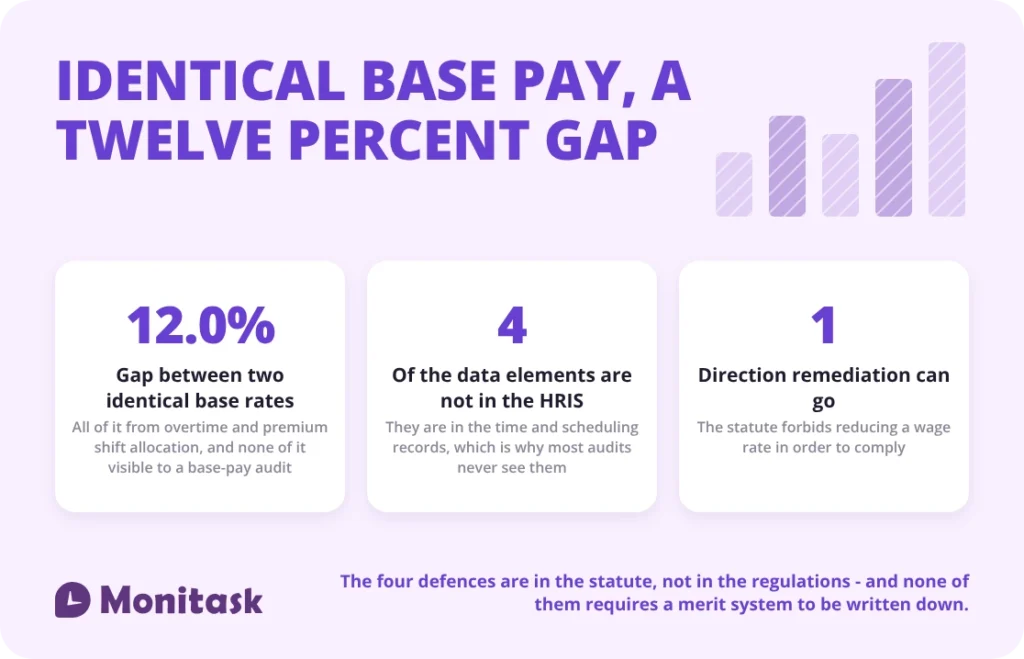
A pay equity audit is only as good as two decisions made before any analysis runs: who gets compared to whom, and what counts as pay. Most audits get the first roughly right and the second badly wrong — two employees on identical base rates can differ by 12.0 percent in total earnings, and a base-pay audit reports a gap of $0. This page covers both decisions, the four defences and where they actually live, and the one direction remediation is permitted to go.
What is a pay equity audit?
A structured comparison of pay among employees doing comparable work, run to find out whether differences exist and whether each difference has an explanation the law accepts.
| A pay review | A pay equity audit |
|---|---|
| Looks at whether rates are competitive | Looks at whether comparable people are paid differently |
| Compares against market data | Compares employees against each other |
| Produces a budget recommendation | Produces a finding on each gap: explained, or not |
It is worth being clear about what an audit is not. It is not a defence in itself — finding and documenting a gap you then fail to address is worse than not having looked. And it is not a market exercise: an employer can be aligned to market on every rate and still have an equal pay problem, because the comparison the law cares about is internal. Our salary range page covers the market side; pay transparency covers the adjacent disclosure regime, which is a different obligation again.
What does the Equal Pay Act actually require?
Equal pay for equal work, with “equal work” defined by four factors rather than by job title. 29 U.S.C. 206(d)(1) prohibits paying one sex less than the other for equal work on jobs the performance of which requires equal skill, effort, and responsibility
and which are performed under similar working conditions
. Our glossary page on the Equal Pay Act covers the statute itself; this page is about building the comparison.
| Factor | What it means for the audit, and where the regulation defines it |
|---|---|
| Equal skill | The skill the job requires, not the skill the incumbent happens to have |
| Equal effort | The physical or mental exertion the job demands |
| Equal responsibility | Accountability, supervision, consequence of error |
| Similar working conditions | Surroundings and hazards, which the regulation breaks into two named subfactors |
Each has a definition worth reading rather than assuming:
- Skill —
29 C.F.R. 1620.15:Skill includes consideration of such factors as experience, training, education, and ability
. Measured by what the job requires, not by what the incumbent happens to have. - Effort —
29 C.F.R. 1620.16:Effort is concerned with the measurement of the physical or mental exertion needed for the performance of a job
, and‘Effort’ encompasses the total requirements of a job
. - Responsibility —
29 C.F.R. 1620.17(a):Responsibility is concerned with the degree of accountability required in the performance of the job
, with emphasis on the importance of the obligation. - Working conditions —
29 C.F.R. 1620.18(a):The term ‘similar working conditions’ encompasses two subfactors: ‘surroundings’ and ‘hazards’
.‘Surroundings’ measure the elements, such as toxic chemicals or fumes, regularly encountered by a worker, their intensity and their frequency
.‘Hazards’ take into account the physical hazards regularly encountered, their frequency and the severity of injury they can cause
.
Two sentences in that last definition do real work in an audit. First, The mere fact that jobs are in different departments of an establishment will not necessarily mean that the jobs are performed under dissimilar working conditions
— so a departmental boundary is not by itself a reason to stop comparing. Second, and more pointedly: The phrase ‘working conditions’ does not encompass shift differentials
. A shift differential does not make the working conditions dissimilar, which means it cannot be used to put two employees into separate comparison groups. It is a pay difference to be explained, not a reason the comparison does not apply.
What counts as “wages” in the comparison?
This is the section that changes most audits, and it rests on one regulation that is unexpectedly specific.
29 C.F.R. 1620.10 provides that the term ‘wages’ generally includes all payments made to [or on behalf of] an employee as remuneration for employment
, irrespective of the time of payment and whether called wages, salary, profit sharing, expense account, monthly minimum, bonus, uniform cleaning allowance, hotel accommodations, use of company car
or some other name. It then adds that Fringe benefits are deemed to be remuneration for employment
.
A small note on those square brackets. “[or on behalf of]” is the regulation’s own bracketed text, not an editorial insertion here. It is quoted as it appears.
And then the sentence almost nobody builds into an audit: premium payments for work on Saturdays, Sundays, holidays, regular days of rest
or other days outside the employee’s regular hours are deemed remuneration for employment and therefore wage payments that must be considered in applying the EPA
, even though not a part of the employee’s ‘regular rate’
.
| In the comparison | Why | Source |
|---|---|---|
| Base wage or salary | The obvious component, and the only one most audits use | 29 C.F.R. 1620.10 |
| Overtime earnings | Remuneration for employment like any other payment | 29 C.F.R. 1620.10 |
| Premium pay for Saturdays, Sundays, holidays and rest days | Named in the regulation, and counted even though it is outside the regular rate | 29 C.F.R. 1620.10 |
| Fringe benefits | Deemed remuneration for employment, and their cost is not a defence | 29 C.F.R. 1620.11 |
| Bonuses, profit sharing and allowances | Listed in the regulation’s own enumeration of forms | 29 C.F.R. 1620.10 |
Read that against how audits are usually run. A compensation team pulls base salary or base hourly rate by job code, runs a regression, finds no significant gap, and reports parity. Premium pay was never in the dataset. But premium payments are wages the regulation says must be considered — which means who gets offered the weekend and holiday shifts is itself a pay equity question, not a scheduling detail outside the analysis.
A worked example. Two employees in the same classification at the same site, both on a base rate of $26 an hour. Identical base pay — a base-rate audit finds a gap of $0.
| Employee A | Employee B | |
|---|---|---|
| Regular hours at $26 | 2,080 → $54,080 | 2,080 → $54,080 |
| Overtime hours at 1.5× ($39) | 160 → $6,240 | 0 → $0 |
| Holiday shift premium at $4 an hour | 64 → $256 | 0 → $0 |
| Total earnings | $60,576 | $54,080 |
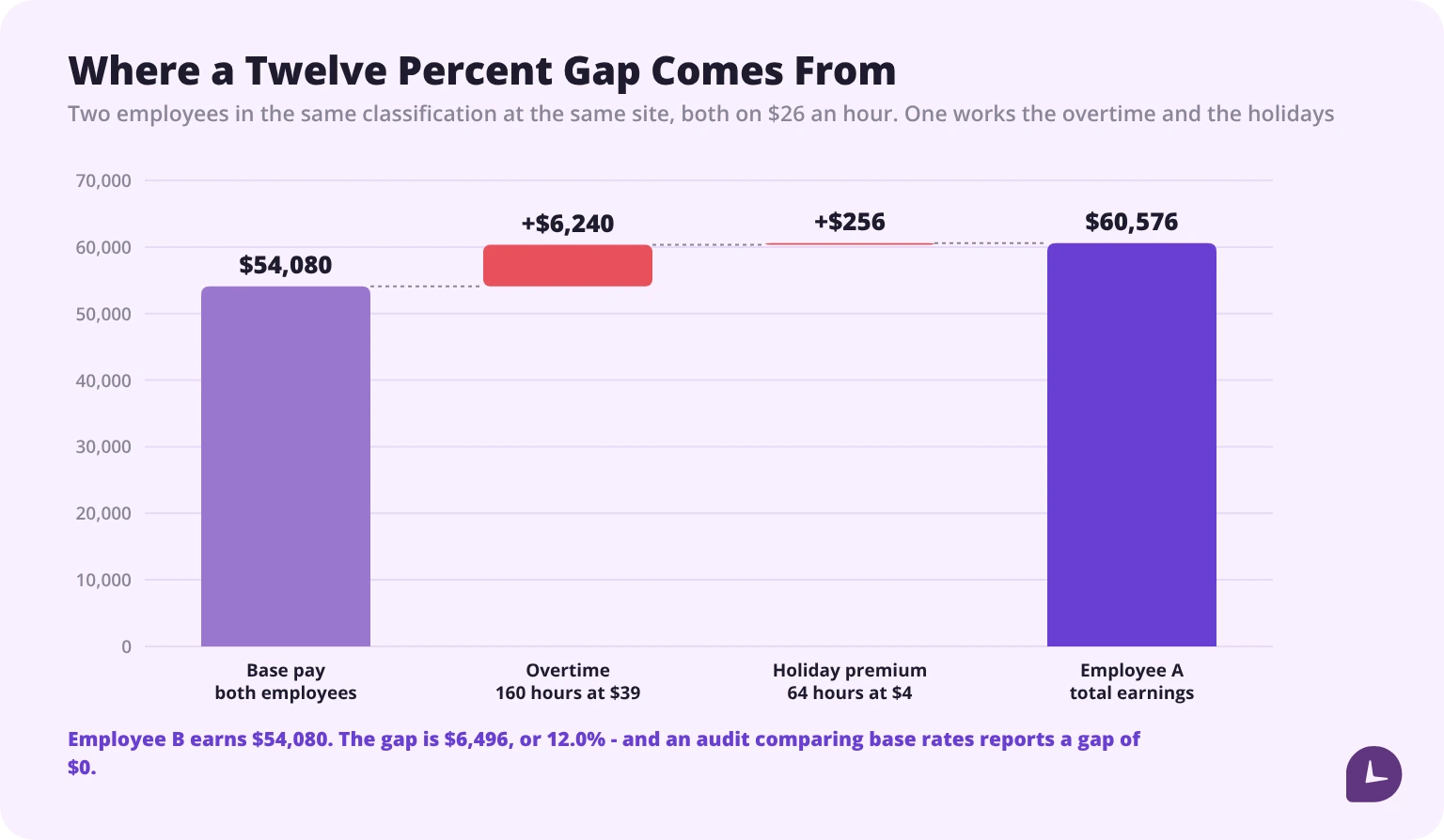
A gap of $6,496, or 12.0 percent, between two people on identical base rates. Every dollar came from the allocation of overtime and premium shifts. If that allocation correlates with sex, the base-rate audit that found parity has missed the exposure entirely. Overtime and paid holidays are not adjacent topics here; they are the dataset.
On fringe benefits, one sentence is worth more than the rest of the section. 29 C.F.R. 1620.11 covers medical, hospital, accident, life insurance and retirement benefits
, profit sharing and bonus plans; leave; and other such concepts
. It makes clear that Differences in the application of fringe benefit plans which are based upon sex-based actuarial studies cannot be justified
as a factor other than sex, and that It is unlawful for an employer to make available benefits for the spouses or families of employees of one gender where the same benefits are not made available
to the opposite gender’s. But the sentence to build into the audit is 29 C.F.R. 1620.11(e): It shall not be a defense under the EPA to a charge of sex discrimination in benefits that the cost of such benefits is greater
with respect to one sex than the other
. Cost is not a defence. Conditions keyed to being the head of household or the principal wage earner are, in the regulation’s word, closely scrutinized
.
Which employees do you compare?
The federal comparison is scoped to the establishment, and “establishment” is both narrower and more flexible than people assume.
29 C.F.R. 1620.9 states the default: the term refers to a distinct physical place of business rather than to an entire business or ‘enterprise’
which may include several separate places of business. Accordingly, each physically separate place of business is ordinarily considered a separate establishment
.
But paragraph (b) is the operative rule, and most summaries omit it. 29 C.F.R. 1620.9(b) provides that in unusual circumstances two or more portions of a business enterprise, even though located in a single physical place of business, may constitute more than one establishment
— where, for example, the portions are physically segregated, engaged in functionally separate operations, and have separate employees and maintain separate records
. And conversely, unusual circumstances may call for two or more distinct physical portions of a business enterprise being treated as a single establishment
.
The three factors that point to aggregating separate sites into one establishment:
- a central administrative unit hires all employees, sets wages and assigns the location of employment.
- employees frequently interchange work locations.
- daily duties are virtually identical and performed under similar working conditions.
Then the backstop: Barring unusual circumstances, however, the term ‘establishment’ will be applied as described in paragraph (a)
.
That three-factor test is the operative employer-facing rule and it is the thing to settle before the analysis runs, because it decides the comparison groups. A multi-site employer with central hiring and wage-setting, staff who move between locations, and identical duties across them is describing the aggregation case — and running site-by-site regressions on that organisation answers a question the regulation does not ask.
Do job titles define comparable work?
No, and the regulation says so under a caption that leaves no room: 29 C.F.R. 1620.13(e) is headed Job content controlling, and provides that Application of the equal pay standard is not dependent on job classifications or titles but depends rather on actual job requirements and performance
.
It goes on to explain why: Job titles are frequently of such a general nature as to provide very little guidance
in determining whether the standard applies, with “clerk”, “stock clerk” and “retail clerk” given as illustrations of the problem.
The audit consequence is concrete. Grouping by job code compares what the system groups and ignores what it separates — and both failures are common in organisations where titles and work have drifted apart over a few reorganisations. Where two codes describe the same work, they belong in the same comparison; where one code covers materially different work, it does not describe a single group.
What are the four permitted explanations for a gap?
Finding a gap is not finding a violation. The statute names four bases on which a differential is permitted — and the first thing to get right is where they live, because the sections usually cited for them are about something else entirely.
They are in the statute, at 29 U.S.C. 206(d)(1)(i) to (iv), numbered in lower-case roman:
| The permitted basis | |
|---|---|
(i) | a seniority system |
(ii) | a merit system |
(iii) | a system which measures earnings by quantity or quality of production |
(iv) | a differential based on any other factor other than sex |
No section of the implementing regulation is headed “seniority”, “merit”, “quantity or quality of production” or “any other factor other than sex”. The sections in that numerical range are these:
| Section | What it is actually about |
|---|---|
29 C.F.R. 1620.19 | Equality of wages – application of the principle |
29 C.F.R. 1620.20 | Pay differentials claimed to be based on extra duties |
29 C.F.R. 1620.21 | Head of household |
29 C.F.R. 1620.22 | Employment cost not a “factor other than sex” |
29 C.F.R. 1620.23 | Collective bargaining agreements not a defense |
They are useful sections — one of them establishes that employment cost is not a factor other than sex, and another that a collective agreement is not a defence — but none of them is the defence itself. The regulation’s one general treatment is at 29 C.F.R. 1620.13(b)(2): where a prima facie violation exists, it is incumbent on the employer to show that the wage differential is justified under one or more of the Act’s four affirmative defenses
. Citing the four defences to regulation sections is a common error, and it is the kind that survives being copied because the numbers look plausible.
Note the word in three of the four: system. A merit system is a defence; a collection of manager decisions that happened to produce a pattern is not obviously one.
What makes a system bona fide, from the EEOC Compliance Manual, Section 10: Compensation Discrimination, issued 5 December 2000, is 5 things:
- It
was not adopted with discriminatory intent
. - It
is an established system containing predetermined criteria for measuring seniority, merit, or productivity
. - It
has been communicated to employees
. - It
has been consistently and even-handedly applied to employees of both sexes
. - It
is in fact the basis for the compensation differential
.
For merit specifically, the system must be a structured procedure in which employees are evaluated at regular intervals
, and a subjective rating should be strictly scrutinized to assure that it is consistently applied
. And in either case it operates as a defense only to the extent that it accounts for the compensation disparity
— a bona fide system explains the part of the gap it accounts for, not the whole gap.
One correction worth making explicitly, because the advice circulates: nothing in the authority requires a merit system to be written. It must be established, with predetermined criteria, communicated to employees, and applied consistently and even-handedly. Those are harder tests than “write it down”, and an unwritten system that meets them is a defence while a written one that nobody applied is not. The recordkeeping obligation is separate, and it is at 29 C.F.R. 1620.32(b), which requires records relating to wage rates, job evaluations, job descriptions, merit systems, seniority systems, collective bargaining agreements, description of practices or other matters
.
A worked example of a gap that is explained. Two employees in the same classification, under a pay schedule that starts the role at $25 an hour and adds $0.50 for each completed year of service.
| Employee C | Employee D | |
|---|---|---|
| Completed years of service | 3 | 9 |
| Schedule calculation | $25 + (3 × $0.50) | $25 + (9 × $0.50) |
| Base rate | $26.50 | $29.50 |
| Difference over 2,080 hours | — | $6,240 |
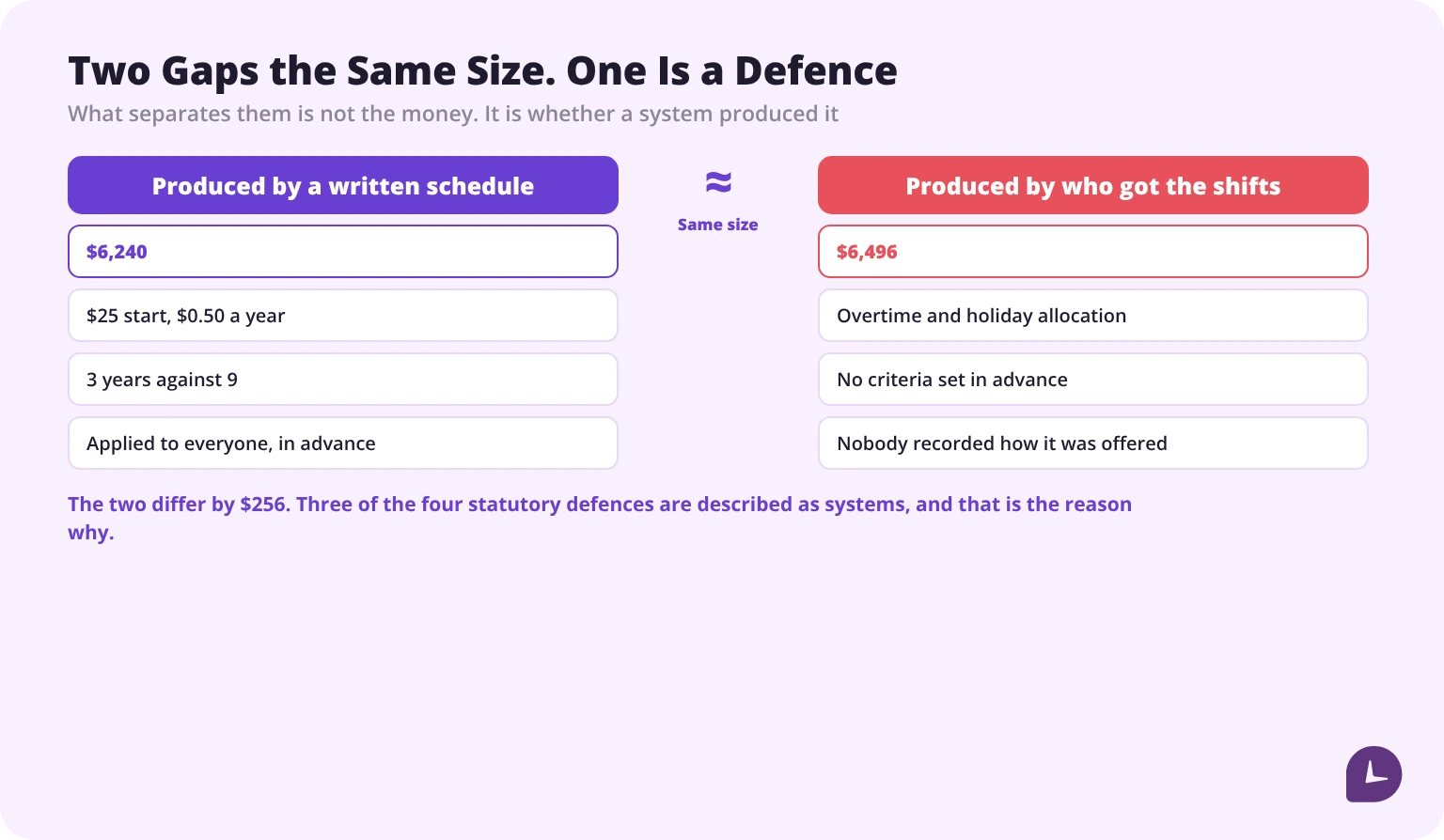
That gap is $6,240 — within $256 of the unexplained gap in the first example. The two are indistinguishable by magnitude. What separates them is that one is produced by a schedule applied to everyone in advance and the other by discretionary shift allocation that nobody recorded. The documentation is the entire difference between a defensible differential and an exposure, which is why three of the four bases are described as systems.
And note where gaps most often originate: at hire. A starting rate set by negotiation, by a candidate’s expectations, or by anchoring on prior pay can seed a differential that every subsequent percentage increase preserves and compounds. An audit that looks only at current rates sees the symptom; looking at starting rates by hire cohort shows the mechanism.
The fourth basis is the broadest and the most contested. It has to be a factor you can state, evidence and show you applied consistently — and several states have narrowed their own versions of it, which is one of the main reasons state law has to be checked separately.
What data do you actually need?
The audit is a data problem before it is an analysis problem, and the dataset is wider than most teams assemble.
| Data element | Why the comparison needs it |
|---|---|
| Base rate or salary, with effective dates | The starting point, and gaps often originate at hire or at a change |
| Hours worked, by employee, by period | Earnings comparisons are meaningless without them for hourly staff |
| Overtime hours and overtime earnings | Premium payments are wages that must be considered |
| Premium shift hours: weekend, holiday, rest day | Named explicitly in the regulation |
| Shift and schedule assignment history | Shows how premium access was allocated, which is the mechanism behind the gap |
| Fringe benefit values and eligibility | Fringe benefits are deemed remuneration, and cost is not a defence |
| Actual job duties, not just job codes | Job content controls; titles do not |
| Establishment or work location | The federal comparison is scoped to it, with an aggregation test |
| Seniority, merit and production records | The evidence for three of the four defences, and the subject of a recordkeeping rule |
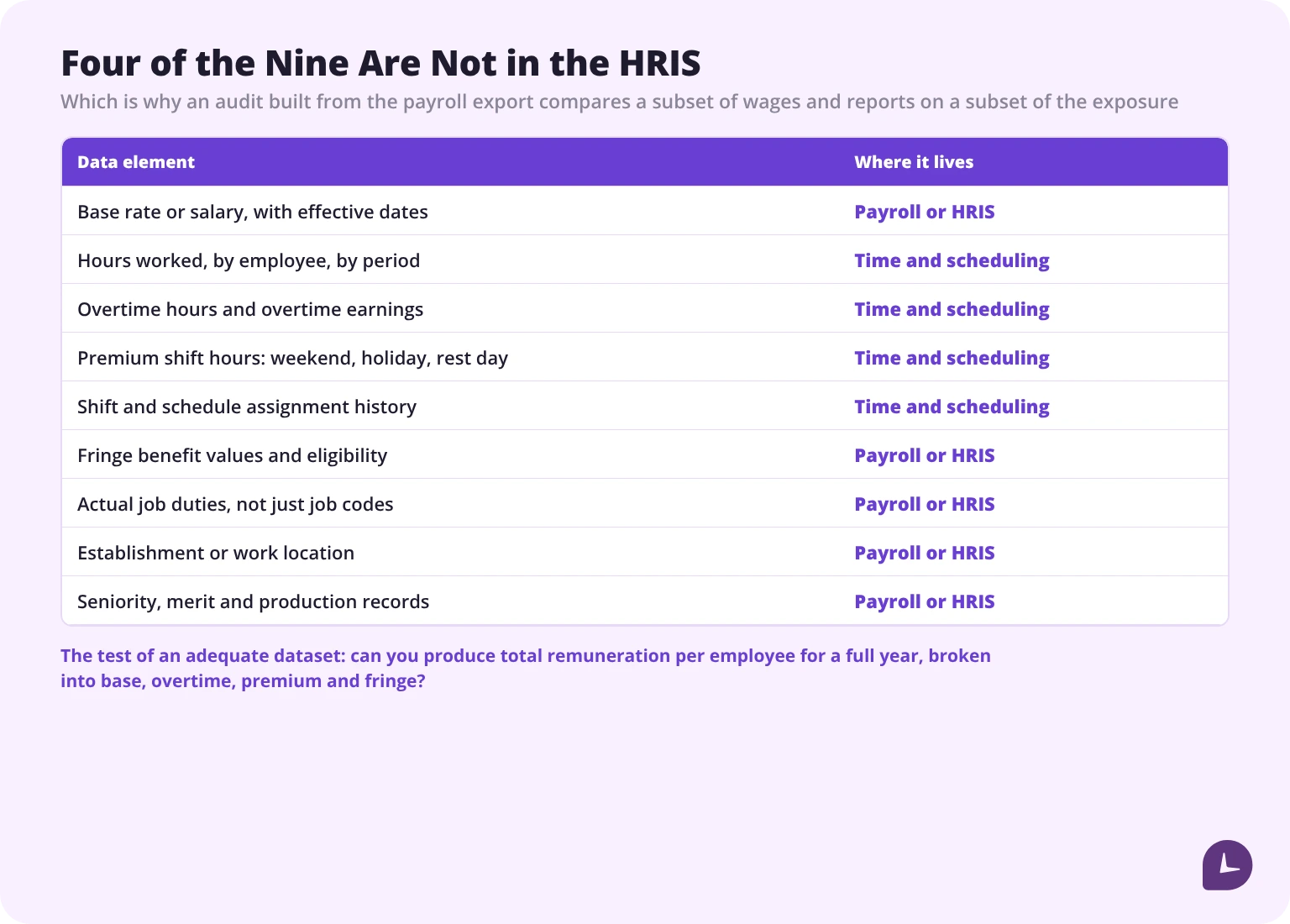
The 4 rows in bold are the ones usually missing, and they are not in the HRIS. They are in the time and scheduling records. Monitask’s time clock software holds hours by employee and period with overtime detail intact, and productivity reporting covers the output side that a production-based defence rests on. Where the components appear for an individual is the pay stub; where they come from, in aggregate, is timesheets for payroll.
The test of whether your dataset is adequate is simple: can you produce total remuneration per employee for a full year, broken into base, overtime, premium and fringe? If not, the audit you run will compare a subset of wages and report on a subset of the exposure.
What do you do when you find a gap?
Explain it, or close it — and there is one thing you cannot do.
The statute contains a proviso that constrains every remediation plan: an employer paying a differential in violation shall not, in order to comply with the provisions of this subsection, reduce the wage rate of any employee
. 29 C.F.R. 1620.25, captioned Equalization of rates, draws out what that forecloses: an employer can come into compliance only by raising the wage rate of the lower paid sex
.
| Option | Available? |
|---|---|
| Document a permitted basis that explains the gap | Yes, where one genuinely exists and is evidenced |
| Raise the lower-paid employee | Yes — and this is the only route the regulation names |
| Lower the higher-paid employee to match | No. The statute forbids reducing a wage rate in order to comply |
| Hire or transfer into the lower-paid job at the lower rate | No. The regulation prohibits an employer from attempting to cure a violation by hiring or transferring employees to perform the previously lower-paid job at the lower rate |
| Let the higher-paid employees leave and not replace them at that rate | No. the departure of the higher paid sex from positions where a violation occurred, leaving only members of the lower paid sex being paid equally among themselves does not cure the EPA violations |
| Freeze the higher-paid employee and let the gap close over time | A judgement call for counsel; it does not reduce a rate but it is not neutral either |
Those middle three rows are worth reading twice, because they close the routes an employer under budget pressure tends to reach for. The regulation anticipated all of them.
Red circling is permitted, but not as a remedy. 29 C.F.R. 1620.26 allows an established rate to be maintained after reassignment to a less demanding job as a genuine factor other than sex — but where a sex-based differential is being paid for equal work, rates of the higher paid employees may not be ‘red circled’ in order to comply with the EPA
.
So remediation costs money upward, always. Closing the $6,496 gap from the first example across 14 affected employees is $90,944, and there is no cheaper direction. That has a planning consequence: an audit run without a remediation budget tends to produce pressure to explain gaps rather than close them, which is the worst possible outcome — it creates a document showing the gap was identified and rationalised.
And the mechanism matters as much as the money. If a 12.0 percent earnings gap came from premium shift allocation rather than base rates, raising base pay does not fix the mechanism — next year’s allocation produces the gap again. Fixing the allocation means changing how premium shifts are offered and recording that they were offered fairly.
On cadence: an audit is worth more annually than once. A single audit produces a snapshot and a remediation bill; a repeated audit on the same methodology shows whether the mechanism was actually fixed, which is the only evidence that the first round worked. Run it at the same point each year, against the same comparison groups, and keep the methodology stable. Changing the model between rounds makes the second result uninterpretable.
How far back does the exposure go?
Further than the limitations period suggests, for two independent reasons.
The period itself is at 29 U.S.C. 255(a): an action may be commenced within two years after the cause of action accrued
, except that a cause of action arising out of a willful violation may be commenced within three years
. So 2 years, or 3 for a wilful violation.
But a continuing differential keeps restarting it. 29 C.F.R. 1620.13(b)(5) provides that The employer’s continued failure to pay the member of the lower paid sex the wage rate paid to the higher paid predecessor constitutes a prima facie continuing violation
, and that it is no defense that the unequal payments began prior to the statutory period
. A gap that opened five years ago and was never closed is not a five-year-old problem that has aged out; it is a current one.
And the Lilly Ledbetter Fair Pay Act of 2009 governs the parallel Title VII clock. The Commission’s description is that each paycheck that delivers discriminatory compensation is a wrong actionable under the federal EEO statutes
, regardless of when the discrimination began
. The charge-filing window runs from the adoption of the decision, from becoming subject to it, or from each time compensation is affected by it. The Act has a retroactive effective date of 28 May 2007.
Which statute applies is a choice the employee gets to make. 29 C.F.R. 1620.27 provides that where both statutes’ jurisdictional requirements are met, any violation of the Equal Pay Act is also a violation of title VII
. The two differ in ways that matter to an audit: under the Equal Pay Act An individual alleging a violation of the EPA may go directly to court
and is not required to file an EEOC charge beforehand
; Title VII reaches race, colour, religion, national origin as well as sex, and — unlike the Equal Pay Act — Title VII, the age and disability statutes do not require the jobs to be substantially equal
.
That last point has a scoping consequence most audits miss. An audit built only around the substantially-equal-work standard answers the Equal Pay Act question and leaves the broader one unexamined.
Is the audit privileged?
Nobody official has said so, and an audit plan that assumes otherwise is assuming something it cannot cite.
No federal agency has issued guidance establishing that a pay self-audit is privileged. Privilege is a question of litigation doctrine, not of agency authority. Neither the regulation nor the EEOC Compliance Manual, Section 10: Compensation Discrimination addresses it. The one official document that ever spoke to the question was the contractor compliance directive on compensation analysis, which remains listed but could not be retrieved, and the index it sits on now carries a banner saying documents are under revision.
So the honest position for a guide is: privilege may well be available, it depends on how the work is structured and who directs it, and that is a conversation to have with counsel before the analysis runs rather than after the results exist. What a guide should not do is state that a self-audit is privileged, because no agency has established it.
What changed for federal contractors and EEO-1 reporting?
Nothing in the substance of the Equal Pay Act. Everything in the overlay around it, and an older internal guide will be wrong in three places.
The federal contractor pay-analysis obligation is gone. Executive Order 14173, 21 January 2025, revoked Executive Order 11246; contractors were told to wind down compliance by 21 April 2025; and Secretary’s Order 03-2025 of 24 January 2025 ordered the compliance office to cease and desist all investigative and enforcement activity under E.O. 11246
. Then the regulations themselves: Rescission of Executive Order 11246 Implementing Regulations, published 21 August 2026 and effective 26 October 2026, rescinds the implementing parts on the stated ground that the revocation of E.O. 11246 is an independent and sufficient reason to rescind those regulations
.
That removes 41 C.F.R. 60-2.17(b)(3), which had required covered contractors to evaluate Compensation system(s) to determine whether there are gender-, race-, or ethnicity-based disparities
. Any guide citing that rule in the present tense is now wrong.
The reporting infrastructure is going the same way. Pay data reporting had already been dropped — the Commission’s own account is that it reverted to requiring only demographic data (Component 1)
in 2020. Now the demographic reporting itself is proposed for removal: Removal of Reporting Requirements, 23 July 2026, proposes to rescind the EEO-1 and related reports because the Commission has preliminarily determined that the reports are inconsistent with equal employment opportunity law and potentially unconstitutional
. No final rule was found, so the requirement appears still to be on the books under an active rescission proposal.
And the enforcement emphasis has shifted. the EEOC National Enforcement Plan, 4 June 2026, prioritises intentional discrimination resulting from broad-based employment policies, programs, or practices
among other categories. It makes no mention of compensation, pay discrimination or the Equal Pay Act. The emphasis on intentional discrimination is itself worth noting in an audit plan, because a statistical pay-gap finding is classically a disparate-impact theory rather than an intentional-discrimination one.
What has not changed is everything else on this page: the statute, the regulation, the Compliance Manual’s criteria and the Ledbetter Act are all untouched. The federal-contractor overlay and the data-reporting infrastructure moved; the underlying obligation did not.
Where audits go wrong
| Failure | Consequence | The fix |
|---|---|---|
| Comparing base pay only | Misses overtime, premium and fringe, which the regulation treats as wages | Build total remuneration per employee |
| Citing the four defences to sections of the regulation | They are in the statute, not in part 1620, and the sections usually named are about something else entirely | Cite 29 U.S.C. 206(d)(1)(i) to (iv) |
| Requiring a merit system to be written | The authority requires it to be established, communicated and consistently applied – not written | Test the system against the five bona fide criteria |
| Grouping by job code | Compares what the system groups and ignores what it separates | Review actual duties where titles and work have drifted |
| Treating one building as one establishment | The regulation splits and aggregates in defined circumstances | Apply the three-factor aggregation test |
| Treating a pattern of manager decisions as a merit system | Three of the four defences require a system | Document the criteria in advance and apply them consistently |
| Auditing without a remediation budget | Creates pressure to rationalise rather than fix | Decide the budget before the analysis runs |
| Fixing base pay when the gap came from shift allocation | The mechanism is untouched and regenerates the gap next year | Fix the allocation and record that it was offered fairly |
| Assuming the audit is privileged | No agency guidance establishes it | Take advice on privilege before the analysis starts |
| Checking federal law only | Several states apply broader standards and narrower defences | Check each state where you employ people |
The first two are the ones that look most like competence. A regression on base pay by job code is a real piece of analysis that produces a confident answer to a question the regulation does not ask — and citing the four defences to sections of the regulation reads as rigour right up to the point someone checks the sections.
Hours, overtime and premium shift allocation by employee — the four data elements an audit needs and payroll does not hold.
See Monitask's time clock software
Sources
Every document below was read directly, at the publisher’s own site, on 12 November 2026. Regulation text comes from the CFR annual edition revised as of 1 July 2025, title 29 volume 4, because eCFR refuses automated retrieval; statutory text from the United States Code 2024 Edition.
29 U.S.C. 206(d)(1)on govinfo — the equal work standard, the four defences at29 U.S.C. 206(d)(1)(i) to (iv), and the proviso against reducing a wage rate.29 U.S.C. 255(a)for the limitations period.29 C.F.R. part 1620—29 C.F.R. 1620.10and29 C.F.R. 1620.11for wages and fringe benefits including29 C.F.R. 1620.11(e);29 C.F.R. 1620.9and29 C.F.R. 1620.9(b)for the establishment and the aggregation test;29 C.F.R. 1620.13(e)for job content;29 C.F.R. 1620.15to29 C.F.R. 1620.18(a)for the four factors;29 C.F.R. 1620.13(b)(2)for the burden and29 C.F.R. 1620.13(b)(5)for continuing violations;29 C.F.R. 1620.25and29 C.F.R. 1620.26for remediation;29 C.F.R. 1620.27for the relationship with Title VII;29 C.F.R. 1620.32(b)for recordkeeping.- the EEOC Compliance Manual, Section 10: Compensation Discrimination, issued 5 December 2000, for the 5 criteria that make a seniority, merit or production system bona fide.
- the Lilly Ledbetter Fair Pay Act of 2009 and the Commission’s notice on it, for the accrual rule and the 28 May 2007 retroactive effective date.
- Executive Order 14173, Ending Illegal Discrimination and Restoring Merit-Based Opportunity, 21 January 2025; Secretary’s Order 03-2025 of 24 January 2025; and Rescission of Executive Order 11246 Implementing Regulations, published 21 August 2026 and effective 26 October 2026, which rescinds
41 C.F.R. 60-2.17(b)(3). - Removal of Reporting Requirements, 23 July 2026, and the EEOC National Enforcement Plan, 4 June 2026.
- Open items:
- Whether a pay self-audit is privileged. Nothing on the Commission’s or the Department’s sites addresses it, and neither part 1620 nor the Compliance Manual mentions privilege. The one official document that spoke to it was a contractor compliance directive, which remains listed but whose own page could not be retrieved, and whose index now carries a banner saying documents are under revision. Nothing is asserted here.
- Whether the EEO-1 removal has been finalised. The proposed rule’s comment period closed in August 2026 and no final rule was found. The requirement appears still to be on the books under an active rescission proposal, and this article describes it that way.
- The regulations were read in an annual edition. eCFR refuses automated retrieval, so part 1620 comes from the annual edition revised as of 1 July 2025 – authority, but an edition rather than the live text.
- Long quotations were reconstructed from fragments. The retrieval tool caps a quotation at roughly 125 characters, so longer passages were assembled from consecutive fragments. Wording is verbatim; the joins should be spot-checked before publication.
- No state pay equity statute is described. Several apply a broader comparison standard and narrow the fourth defence. Nothing here applies to them.
FAQ
Where are the four defences actually found?
In the statute, at 29 U.S.C. 206(d)(1)(i) to (iv) — a seniority system, a merit system, a system measuring earnings by quantity or quality of production, and a differential based on any other factor other than sex. No section of the implementing regulation is headed with any of them; the sections usually cited are about extra duties, head of household, employment cost and collective agreements.
Does a merit system have to be written?
No. It must be established with predetermined criteria, communicated to employees, consistently and even-handedly applied, not adopted with discriminatory intent, and in fact the basis for the differential. A written system nobody applied fails those tests; an unwritten one that meets them is a defence. The separate recordkeeping obligation is at 29 C.F.R. 1620.32(b).
Do we compare employees with the same job title?
No. Job content controls: the standard Application of the equal pay standard is not dependent on job classifications or titles but depends rather on actual job requirements and performance
. Group by what people actually do.
What is an "establishment" for this purpose?
By default a distinct physical place of business. But one building can hold more than one establishment where portions are physically segregated with separate operations, employees and records — and separate buildings can be a single establishment where there is central hiring and wage-setting, employees interchange locations, and duties are virtually identical.
Can we close a gap by reducing the higher-paid employee's pay?
No. The statute forbids reducing a wage rate in order to comply, and the regulation closes the adjacent routes too: you cannot cure it by hiring or transferring into the job at the lower rate, and attrition among the higher-paid group does not cure it either. Remediation goes up.
Why would overtime matter in a pay equity audit?
Because overtime and premium earnings are wages that must be considered, and because they are allocated rather than fixed. Two employees on identical base rates can differ by 12.0 percent in total earnings purely through who was offered the extra shifts. And a shift differential does not put them in different comparison groups — the regulation says working conditions does not encompass shift differentials
.
How far back does the exposure go?
2 years, or 3 for a wilful violation. But a continuing differential is a continuing violation, and it is no defence that the unequal payments began before the statutory period. A gap that was never closed is a current problem, not an aged-out one.