Prevailing Wage: How the Rate Is Calculated, Where It Comes From, and What Binds You

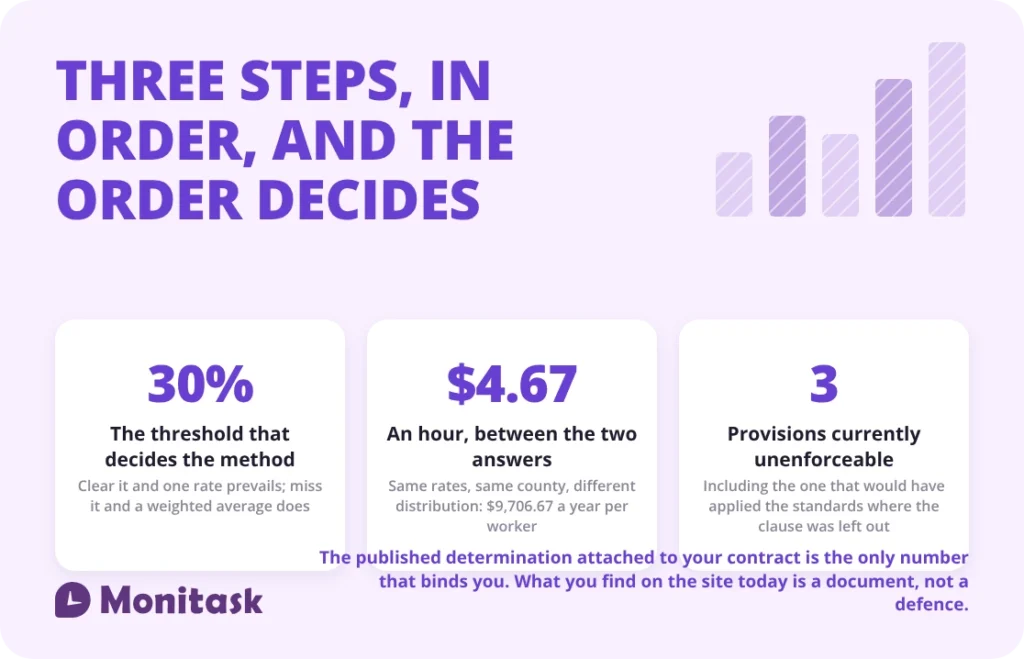
A prevailing wage is produced by a three-step method applied in strict order, and the order is what decides the number: the same four rates in the same county can yield $38.00 or $33.33 depending only on how the workers are distributed. This page covers how that works, the two kinds of determination and their very different timelines, and — importantly — which provisions of the 2023 rule are currently unenforceable, because one of them is the one contractors are most often told to rely on.
What is a prevailing wage?
A rate set by survey for a classification of worker in a geographic area, published as a wage determination, and incorporated into a covered contract. Where it applies, it is a floor — a different and usually much higher floor than the statutory minimum wage, and one that varies by trade, by county and by type of construction. Our labor laws page covers where the obligation sits among the others.
Two things about it catch people immediately.
It is two rates, not one. A determination carries a base hourly rate and a fringe benefit rate, and the obligation is to meet both. Paying the base rate and ignoring the fringe is an underpayment on every covered hour. Our employee benefits page covers what the fringe categories are; the rules for satisfying them in cash are below.
Coverage starts low. On construction work the statute reaches every contract in excess of $2,000
— 40 U.S.C. 3142(a), and note in excess of, not “$2,000 or more”. The service-contract regime starts at $2,500, a figure guides transpose with this one constantly.
How is the prevailing wage calculated?
Three steps, applied in order. 29 C.F.R. 1.2 states them as a sequence, not as alternatives, and each step is reached only where the previous one fails.
| Step | The rule |
|---|---|
| 1 | The wage paid to the majority (more than 50 percent) of the laborers or mechanics in the classification on similar projects in the area during the period in question |
| 2 | If the same wage is not paid to a majority of those employed in the classification, the prevailing wage will be the wage paid to the greatest number, provided that such greatest number constitutes at least 30 percent of those employed |
| 3 | If no wage rate is paid to 30 percent or more of those so employed, the prevailing wage will be the average of the wages paid, weighted by the total employed in the classification |
The middle step is the 2023 restoration, and it is the one most summaries still omit. The Department’s own description is that the Department returns to the definition of ‘prevailing wage’ in 1.2 that it used from 1935 to 1983
. A guide describing the method as “the majority rate, or else an average” is describing the position between 1983 and 2023 and is missing the step that most often decides.
A worked example, with invented numbers. A survey for one classification in one county returns 30 workers:
| Rate | Workers | Share |
|---|---|---|
| $38.00 | 12 | 40.0% |
| $34.50 | 9 | 30.0% |
| $31.00 | 6 | 20.0% |
| $29.00 | 3 | 10.0% |
Step 1 fails: 12 of 30 is 40.0%, not a majority. Step 2 succeeds: the rate paid to the greatest number is $38.00, held by 40.0%, which clears 30 percent. The prevailing wage is $38.00.
Now move four workers and watch the method change. Same four rates, a flatter distribution:
| Rate | Workers | Share |
|---|---|---|
| $38.00 | 8 | 26.7% |
| $34.50 | 8 | 26.7% |
| $31.00 | 7 | 23.3% |
| $29.00 | 7 | 23.3% |
Now the greatest number holds only 26.7%, so no rate reaches the 30 percent floor and step 3 applies. The weighted average is (8 × $38.00 + 8 × $34.50 + 7 × $31.00 + 7 × $29.00) ÷ 30 = $1,000.00 ÷ 30 = $33.33.
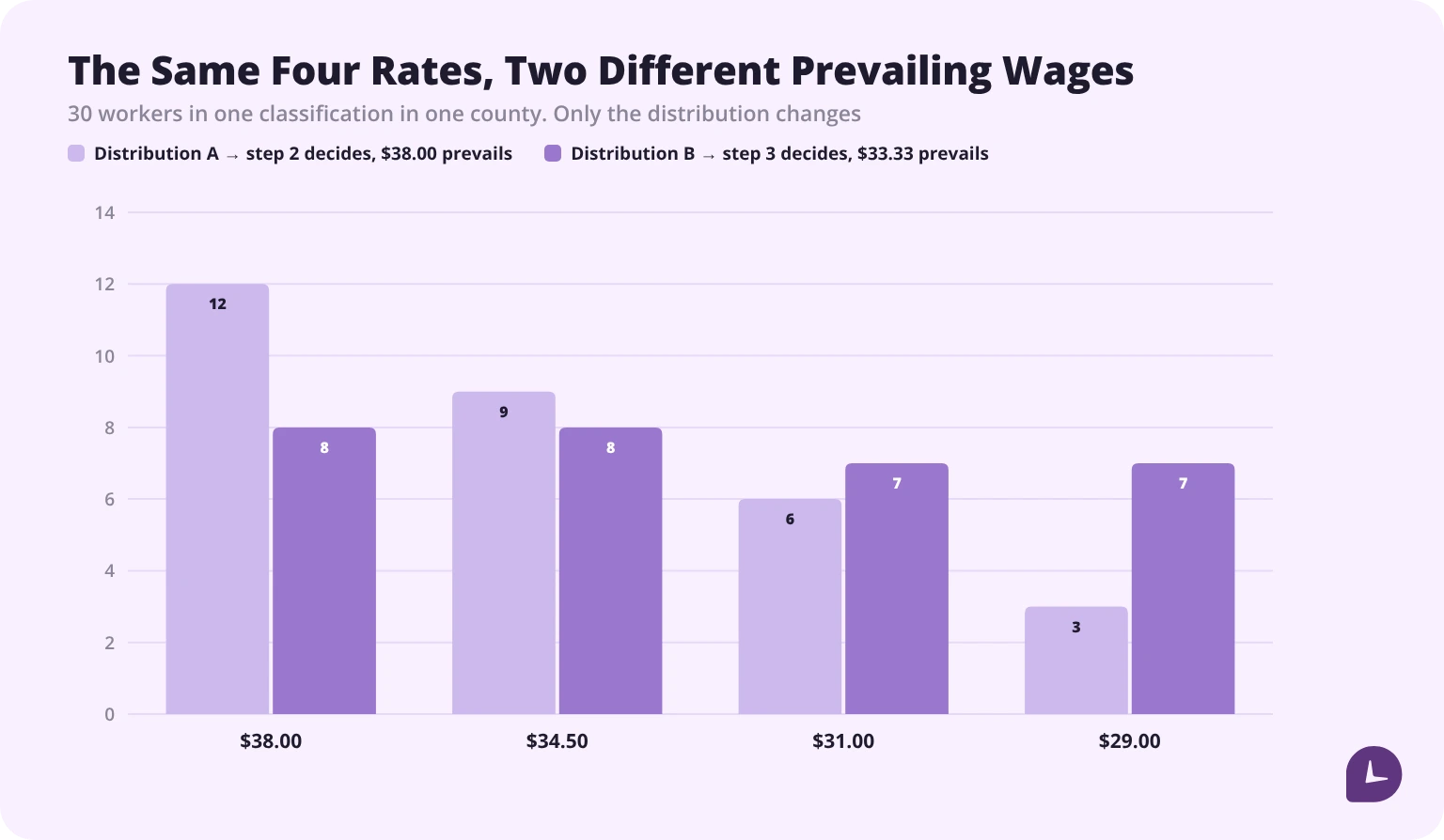
The same four rates in the same county produce $38.00 or $33.33 — $4.67 an hour, $9,706.67 across a 2,080-hour year per worker, $97,066.70 for a crew of 10. That is why the methodology is argued over, and why the published determination is the only number that matters rather than anyone’s sense of the local market.
One arithmetic note, because it bites on certified payrolls too: round once, at the end. Rounding the hourly gap to $4.67 first and multiplying gives $9,713.60 rather than $9,706.67 — a drift of $6.93 a year from nothing but the order of operations.
What does a wage determination actually cover?
Three dimensions, and a determination is specific on all three.
| Dimension | How it works |
|---|---|
| Geography | Wage rates often are calculated and issued on a county basis. Where there is not enough data within a county, the area may be widened |
| Construction type | Federal and federally assisted construction work is broken out into four different types of construction— building, residential, highway, heavy |
| Classification | Each determination lists the classifications with their base and fringe rates |
The construction-type dimension is the one that catches people. Four types means a project can sit on the boundary between two of them, and the applicable determination — and therefore the rates — differs. Settle that with the contracting agency at award, not at the first payroll.
A missing classification is not an accident. Where a classification is absent, the Department’s position is that it is because insufficient information was received
during the survey. It was not excluded on purpose; nobody reported data for it. The remedy is a conformance, below.
How the data gets there, and why it matters to you. The Division sends survey participation letters to contractors it identifies as working in the area during the survey period and directs them to Form WD-10, the Davis-Bacon Survey Form. Critically, Data may be submitted by any contractors and other interested parties possessing responsive information
— so a contractor who received no letter can still participate. Submitted data is verified and reviewed, then tabulated on forms WD-22 and WD-22a before publication.
The implication most contractors never act on: the rates you will be bound by next cycle are set by who responds to the survey this cycle. If your classifications are chronically missing, or the local rates look wrong, the point of intervention is the survey, not the determination.
General or project: which determination are you getting?
Two kinds, with very different timelines, and the distinction is absent from most summaries of this topic.
A general determination is published for an area and a type of construction. 29 C.F.R. 1.5(a): the Department publishes general wage determinations under the Davis-Bacon Act on the DOL-approved website
. Under 29 C.F.R. 1.6, general determinations are published on the DOL-approved website and contain no expiration date
, remaining in effect until revised, superseded or cancelled.
A project determination is specific to a particular project
, under 29 C.F.R. 1.5(b). An agency may request one where the project spans more than one county with workers potentially working in both, where There is no general wage determination in effect for the relevant area and type(s) of construction
, or where All or virtually all of the work on a contract will be performed by a classification that is not listed
in the applicable general determination and award or bid opening has not yet occurred.
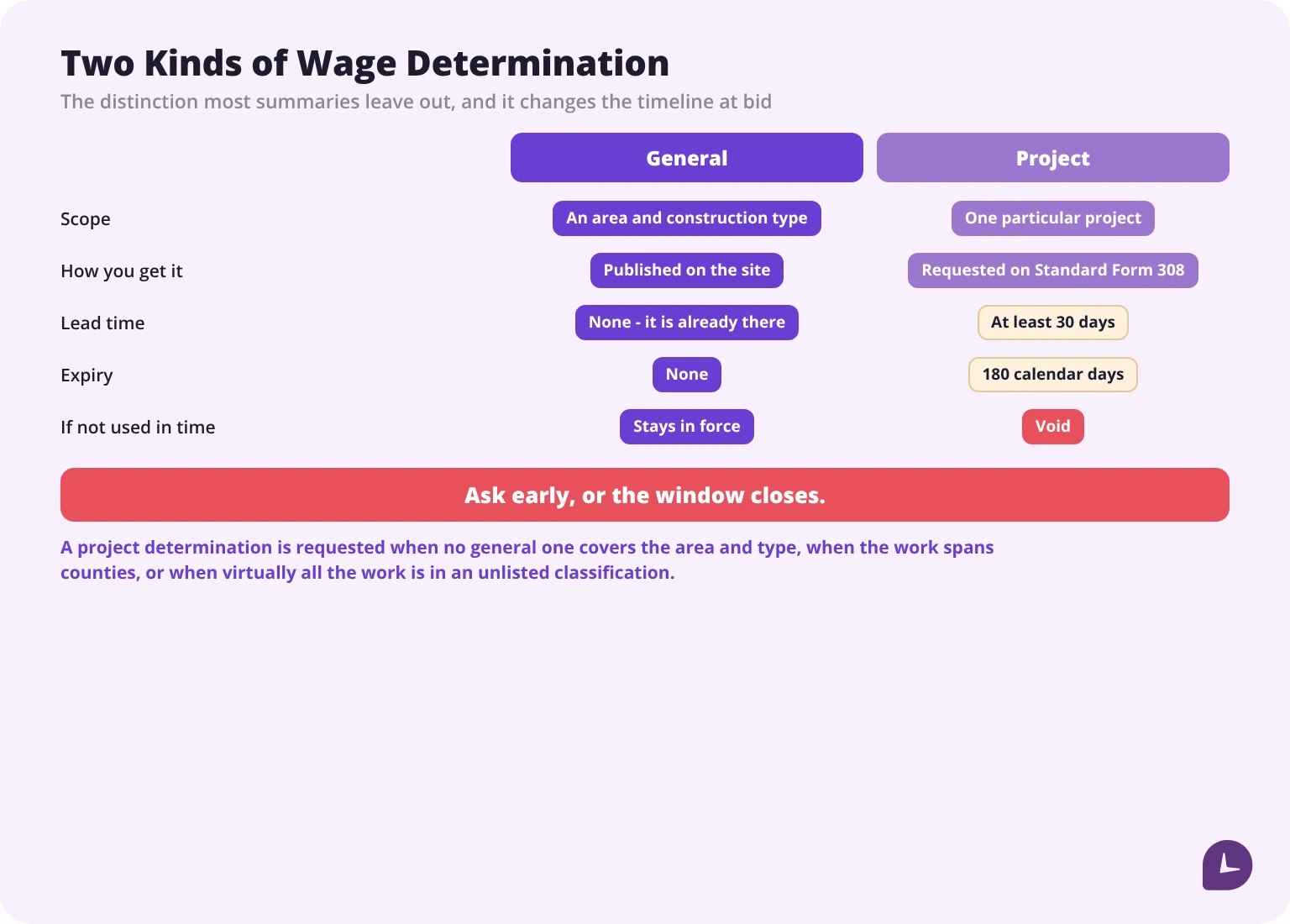
The timeline is the thing to plan around. A project determination is requested on Standard Form 308, processing will take at least 30 days
, and once issued it will be effective for 180 calendar days from the date of such determinations
— void if it is not incorporated within that window. So there is a floor of 30 days before you have one, and a ceiling of 180 days before it expires. A general determination has neither constraint, because it is already published and carries no expiry.
Where do you find the right wage determination?
One place for the published ones, and a different answer for what binds you.
The regulation is deliberately technology-neutral. 29 C.F.R. 1.2 defines the Department of Labor-approved website for wage determinations
as the government website for both Davis-Bacon Act and Service Contract Act wage determinations
, without naming a site. Currently that site is SAM.gov, and the Department states plainly that The website SAM.gov contains copies of all published wage determinations
. The correct phrasing is therefore “the Department-approved website, currently SAM.gov” — worth the precision, because the site has changed before and the regulation is written so it can change again.
| Question | Where the answer comes from |
|---|---|
| What determinations exist? | The Department-approved website, currently SAM.gov |
| Which determination applies to my contract? | The determination attached to or incorporated into your contract |
| Which construction type applies? | The contracting agency’s designation for the project |
| What if the attached determination looks wrong? | Raise it with the contracting officer, in writing, before performance |
The ordering matters. The site tells you what exists; your contract tells you what binds you. A contractor who finds a more favourable determination on the site has found a document, not a defence.
One practical habit: a determination is a dated, versioned document. Keep the exact version incorporated into your contract rather than a link to the current one. Links resolve to whatever is published today, and on a project running past a modification or a new survey, today’s version is not the one that governed the hours you are being asked about.
What if your classification is not listed?
You run a conformance, and 29 C.F.R. 5.5(a)(1)(iii) is stricter than the summaries suggest. All 3 criteria must be met — the regulation joins them with “and”, not “or”:
- The work to be performed by the requested classification is not performed by a classification in the wage determination.
- The classification is used in the area by the construction industry.
- The proposed wage rate, including any bona fide fringe benefits, bears a reasonable relationship to the rates in the wage determination.
And the limit is explicit: the process may not be used to split, subdivide, or otherwise avoid application of classifications listed in the wage determination
. It is not a route to a cheaper rate for work a listed classification already covers.
Three operational points. The request goes on Standard Form 1444, submitted by the contracting agency, not the contractor. The Administrator will approve, modify, or disapprove every additional classification action within 30 days of receipt
, or notifies the agency within the same period that more time is needed. And the one that catches contractors out: Lack of a DOL response within 30 days does not mean that the request has been approved
. Silence is not approval.
Where it shows up first:
| Trigger | Where you notice it |
|---|---|
| A role on site that no listed classification describes | The time record – hours charged under a classification that is not on the determination |
| A new scope added by modification | The modification itself, which may also pull in a newer determination |
| A subcontractor bringing an unmapped function | The subcontractor’s first payroll |
That first row is the operational point. The obligation attaches to the work, not to the paperwork, so the clock starts when the person starts. A timesheet approval process that compares charged classifications against the determination catches it in week one. Nothing else does.
Does it apply if the clause was left out of your contract?
This is the question contractors are most often given a confident answer to, and the confident answer is currently wrong.
What the regulation says. 29 C.F.R. 5.5(e), introduced by the 2023 rule and effective 23 October 2023, provides that the contract clauses and the correct wage determinations will be considered to be a part of every prime contract required by the applicable statutes referenced by 5.1 to include such clauses
, and will be effective by operation of law, whether or not they are included or incorporated by reference into such contract
. Where that happens, the prime contractor must be compensated for any resulting increase in wages in accordance with applicable law
.
What has happened to it. On 24 June 2024, the United States District Court for the Northern District of Texas issued a nationwide preliminary injunction
against three provisions of the rule:
| Provision | What it does |
|---|---|
29 C.F.R. 5.2 | the provision codifying a distinction between material suppliers and contractors or subcontractors |
29 C.F.R. 5.2 | the provision requiring prevailing wages for delivery truck drivers for onsite time that is more than de minimis |
29 C.F.R. 5.5(e) | the provision directing that the standards apply by operation of law where a contracting agency erroneously omitted the clauses from a covered contract |
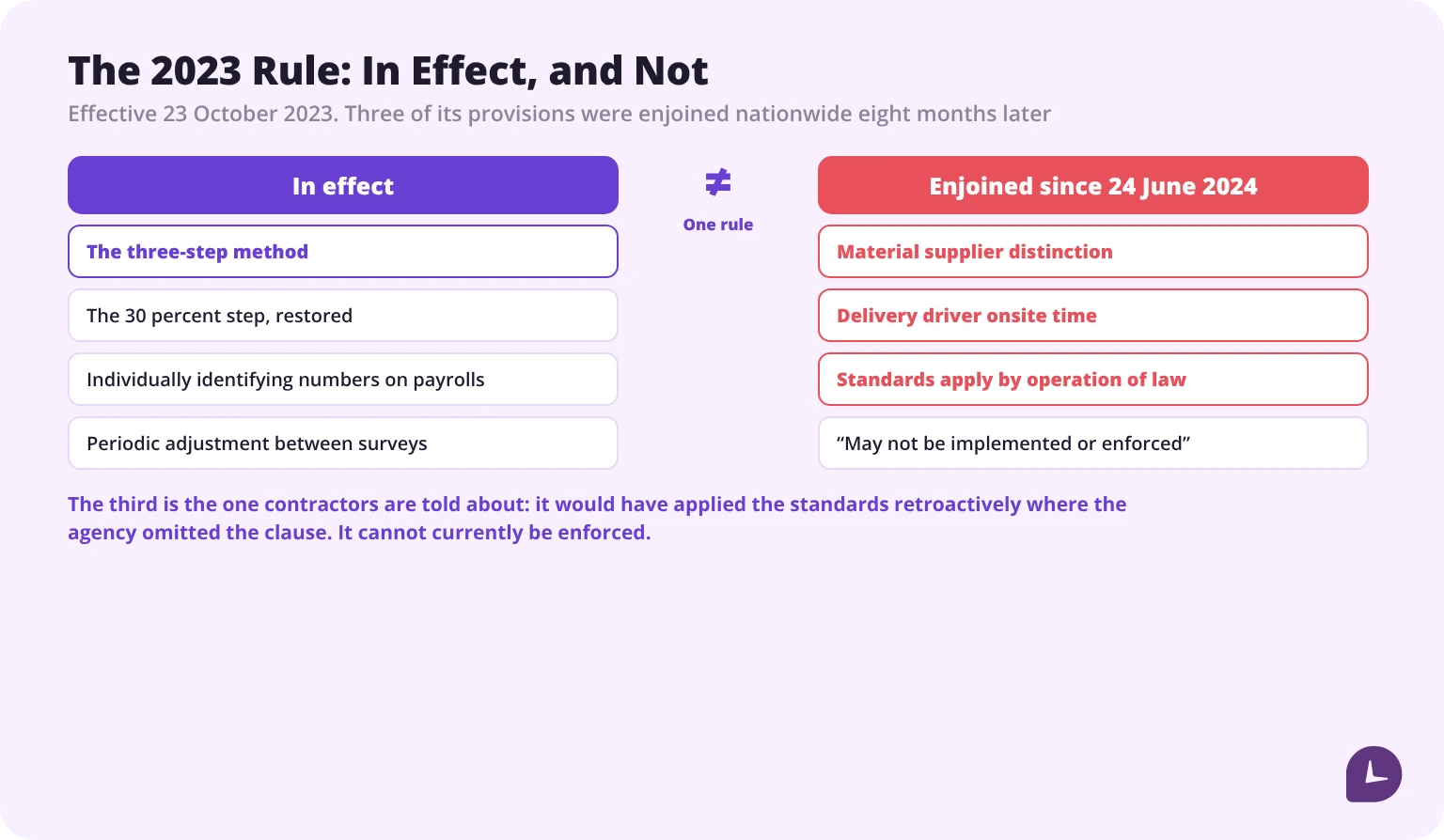
The Department’s own position is that these may not be implemented or enforced at this time
, and that The remainder of the Department’s final rule remains in effect
.
So what should a contractor actually do? Three things follow, and none of them is “relax”.
First, “the clause wasn’t in our contract” is not a compliance strategy either way. The provision that would have closed that gap is enjoined, not repealed, and an injunction is a litigation posture rather than a settled rule. Building a position on its continued unavailability is building on sand.
Second, coverage is still a question to answer at bid, with the answer written down. Whether the work is covered construction, which type it is, and which determination applies are questions with answers; an omitted clause does not change the facts of the project.
Third, raise an apparent omission with the contracting officer in writing. For contracts awarded before the rule’s effective date, omissions were always addressed through the existing post-award modification provisions, and that route does not depend on the enjoined paragraph.
One editorial note, because it matters for how you read other guides. Trade press reports that the enjoined provisions were vacated in mid-2026 after the parties resolved the suit. No government source says so — the Department’s rulemaking page mentions only the 24 June 2024 injunction, and no rule amending or removing them has been published. The practical effect is identical either way, so this article says the provisions cannot currently be enforced and leaves the procedural posture alone. A guide that states either a vacatur or the provision’s operation as settled is stating more than the public record supports.
When does a wage determination change?
Between surveys, and at specific contract moments. Three of the four triggers below have a rule attached that most summaries get backwards.
| Trigger | What happens |
|---|---|
| A new survey | A new general determination is published |
| Periodic adjustment between surveys | Certain non-collectively-bargained rates may be adjusted using Employment Cost Index data. Such rates may be adjusted no more frequently than once every three years, continuing until the next survey |
| A revision before bid opening | a revised wage determination issued at least 10 calendar days before the opening of bids is effective with respect to the solicitation and contract |
| A contract modified to add substantial work or time | The most recent revisions must be incorporated |
The ten-day rule is not what it looks like. 29 C.F.R. 1.6(c)(2)(ii)(A) gives the clean case: a revision issued at least 10 calendar days before bid opening is effective. But read the next sentence, because it reverses the default most people assume. Where a revision is issued less than 10 days before bid opening, it is effective with respect to the solicitation and contract unless the agency finds that there is not a reasonable time still available before bid opening
to notify bidders of the revision — and where the agency does so find, a report of the finding is inserted in the contract file
. So the late revision is effective unless the agency makes and documents that finding. The 10-day line governs whether a report is required, not whether the revision applies. And No such report is required if the revision is issued after bid opening
.
The modification rule is where long-running work gets caught out. Under 29 C.F.R. 1.6(c)(2)(iii)(A), where a contract is changed to add substantial construction work or extra time, including on exercise of an option, the agency must incorporate the most recent revisions. A contract that is extended or expanded does not keep its original determination by default — a current one comes in, and the rates change mid-stream for work the team still thinks of as the same job.
That has a records consequence as well as a payroll one: the rate in force for a given hour depends on the date the hour was worked. A payroll register organised by period, with no classification detail behind it, cannot reconstruct which rate applied when.
How is the fringe rate satisfied?
In benefits, in cash, or in a mix — and the two rules that govern it are cited to the wrong section constantly.
Cash is permitted. 29 C.F.R. 5.31(a) provides that a contractor may discharge their minimum wage obligations for the payment of both straight time wages and fringe benefits by paying in cash
. So the fringe rate can be discharged by paying it out, provided the payroll shows which route was used for each worker. A payroll showing only the cash base rate does not demonstrate that the full prevailing wage was met, even where it was.
Credit for a plan must be annualised. 29 C.F.R. 5.25(c)(1) requires that to annualise the cost of a benefit, a contractor must divide the total cost by the total number of hours worked on both private (non-DBRA) work
and covered work for the period the cost covers. You cannot take the whole annual cost of a benefit against covered hours alone. Exceptions must be requested from and granted by the Administrator.
And overtime is a separate question again. The overtime obligation on covered work comes from the Contract Work Hours and Safety Standards Act at 40 U.S.C. 3702, at a rate not less than one and one-half times the basic rate of pay
, with liquidated damages for failing to pay it — $10 per worker per day in the statute, currently published at $33. A guide quoting the statutory figure understates it by more than threefold.
What does this mean for your time records?
Every obligation on this page resolves into the same 4 fields.
| Field | Why the determination needs it |
|---|---|
| The employee | Who the rate attaches to |
| The day | Which determination was in force for that hour |
| The classification | Which rate on the determination applies |
| The project | Which determination applies at all |
Read that list against the rules above and the reason for each one is specific rather than general. The day matters because a modification can bring in a new determination mid-contract, so two hours on the same job can carry different rates. The classification matters because the rate follows the determination’s classification rather than your job title, and because a classification that is not on the determination is a conformance trigger. The project matters because each covered project has its own determination.
A weekly total by employee satisfies none of it. What this needs is time captured at the level of the day, the worker, the classification and the project — a timesheet specification rather than a payroll one. Our guide to construction timesheets covers the field-capture side.
How prevailing wage interacts with the other federal regimes
One concept, three frameworks, and they are not interchangeable.
| Davis-Bacon and Related Acts | Service Contract Act | DCAA timekeeping | |
|---|---|---|---|
| What it covers | Construction on federally funded or assisted work | Services on federal contracts over $2,500 | Cost accounting on government contracts |
| Threshold | Over $2,000 | Over $2,500 | Cost-reimbursable work |
| How the rate is set | A construction-type determination, four types, usually county-based | A service determination, with a centrally set fringe rate | Not a prevailing wage regime at all |
| What you send | Weekly certified payroll with a certification | Nothing; records are kept and produced on request | Nothing; labour charging is audited |
The sharpest practical difference is the fourth row. Construction work carries a weekly certified payroll with a signed certification; the service regime carries no submission duty at all, only records kept and produced on request. DCAA timekeeping is not a prevailing wage regime in any sense — it is a cost-accounting standard, and compliance with it does not satisfy either of the others.
The 8 failures that recur:
| Failure | Consequence | The fix |
|---|---|---|
| Paying the hourly rate and ignoring the fringe rate | Underpayment on every covered hour | Treat the determination as two rates, and read the cash rule at 29 C.F.R. 5.31(a) |
| Assuming the local market rate is the prevailing rate | The published determination governs, not your sense of the market | Read the determination attached to the contract |
| Treating a missing classification as not applicable | It means nobody reported data for it; a conformance is required | Run the conformance before the class starts work |
| Treating silence on a conformance as approval | The Division issues a determination; your proposed rate is a proposal | Track the request to its determination |
| Relying on the clause not being in the contract | The provision that would have made the standards apply anyway is currently unenforceable – but that is an injunction, not a rule, and coverage is still a question to answer at bid | Determine coverage at bid and document the answer |
| Keeping the original determination through a modification | A modification adding substantial work or time pulls in the most recent revision | Re-check the determination at every modification |
| Never responding to a wage survey | Next cycle’s rates are set by whoever did respond | Submit on Form WD-10; any interested party may |
| Hours recorded without classification or date detail | You cannot apply, reconstruct or defend any of the above | Capture employee, day, classification and project |
Two of those are pay-structure failures, four are classification or determination failures, and two are record failures — and the record failures are what make the others impossible to detect before an audit does it for you.
Hours by employee, by day, by classification and by project — which is the shape every rule on this page turns into.
See Monitask's time clock software
Sources
Every document below was read directly, at the publisher’s own site, on 12 November 2026. Regulation text comes from the govinfo annual edition of 29 C.F.R., title 29 volume 1, 2025, because eCFR refuses automated retrieval.
29 C.F.R. 1.2for the three-step method and the definition of the Department-approved website;29 C.F.R. 1.5(a)and29 C.F.R. 1.5(b)for general and project determinations;29 C.F.R. 1.6for the absence of an expiry on general determinations, the 180-day project validity, the 10-day sealed-bidding rule at29 C.F.R. 1.6(c)(2)(ii)(A), and the modification rule at29 C.F.R. 1.6(c)(2)(iii)(A).29 C.F.R. 5.5(a)(1)(iii)for conformance, its 3 criteria and the 30-day period;29 C.F.R. 5.5(e)for the operation-of-law provision;29 C.F.R. 5.31(a)and29 C.F.R. 5.25(c)(1)for fringe benefits in cash and annualisation.40 U.S.C. 3142(a)for the $2,000 coverage threshold and40 U.S.C. 3702for the overtime standard and liquidated damages, read on govinfo. The current liquidated damages figure comes from the Department’s own published penalty table.- Updating the Davis-Bacon and Related Acts Regulations, 88 FR 57526, published 23 August 2023 and
took effect on October 23, 2023
— the Department describes it asthe first comprehensive regulatory review in nearly 40 years
. Its rulemaking page supplies the 24 June 2024 injunction and the current effect of the three enjoined provisions. - Wage and Hour Division survey and construction pages on dol.gov, for the survey mechanics, Form WD-10 and the tabulation forms, the county basis, the four construction types, the explanation of a missing classification, the periodic adjustment, and the statement that published determinations are on SAM.gov.
- Open items:
- Whether the enjoined provisions have since been vacated. Trade press and a law firm release report a June 2026 vacatur after the parties resolved the suit. No government source says so: the Department’s rulemaking page mentions only the 2024 preliminary injunction, and a Federal Register search found no rule amending or removing the provisions. The practical effect is the same either way, and this article says only that they are not enforceable.
- The current text was read in an annual edition. eCFR refuses automated retrieval, so every regulation here comes from the govinfo annual edition. That edition is authority, but it is an edition rather than the live text.
- Long quotations were reconstructed from fragments. The retrieval tool caps a quotation at roughly 125 characters, so longer passages were assembled from consecutive fragments. Wording is verbatim; the joins should be spot-checked before publication.
- No state prevailing-wage scheme is described. Many states run their own, with different methods, thresholds and filing duties. Nothing here applies to them.
FAQ
How is the prevailing wage determined?
By a three-step method applied in order. The wage paid to a majority prevails; failing that, the wage paid to the greatest number prevails provided that number is at least 30 percent; failing that, a weighted average applies. The middle step was restored in 2023, returning to the method used from 1935 to 1983.
Where can I find the prevailing wage for my project?
Published determinations are on the Department-approved website, currently SAM.gov. But what binds you is the determination attached to or incorporated into your contract, which may not be the one currently published.
What is the difference between a general and a project wage determination?
A general determination covers an area and a construction type and carries no expiry. A project determination is specific to one project, requested on Standard Form 308, takes at least 30 days to process, and is effective for 180 calendar days — void if not incorporated in that window.
What if the classification I need is not on the determination?
Run a conformance. All 3 criteria must be met, the contracting agency submits Standard Form 1444, and the Administrator acts within 30 days. Do not treat silence as approval. Start before the class performs the work, because the obligation attaches to the work rather than to the paperwork.
Can the rules apply if the wage determination was not in my contract?
The provision that would have applied them by operation of law has been under a nationwide injunction since 24 June 2024, and the Department says it cannot currently be enforced. That is a litigation posture rather than a settled rule, so it is not something to build a position on. Determine coverage at bid, document the answer, and raise an apparent omission with the contracting officer in writing.
Do wage determinations change during a contract?
Yes, at specific moments. A modification adding substantial work or extra time pulls in the most recent revisions. Between surveys, certain rates may be adjusted using Employment Cost Index data no more than once every 3 years. Which rate applied to a given hour therefore depends on the date that hour was worked.
Does a revision issued close to bid opening apply?
Usually yes. A revision issued at least 10 calendar days before bid opening is effective. One issued later is also effective unless the agency finds there is not a reasonable time to notify bidders and reports that finding in the contract file. The 10-day line governs whether a report is required, not whether the revision applies.