Qualified Overtime Compensation: What Employers Must Track, Report, and Get Right by 2028

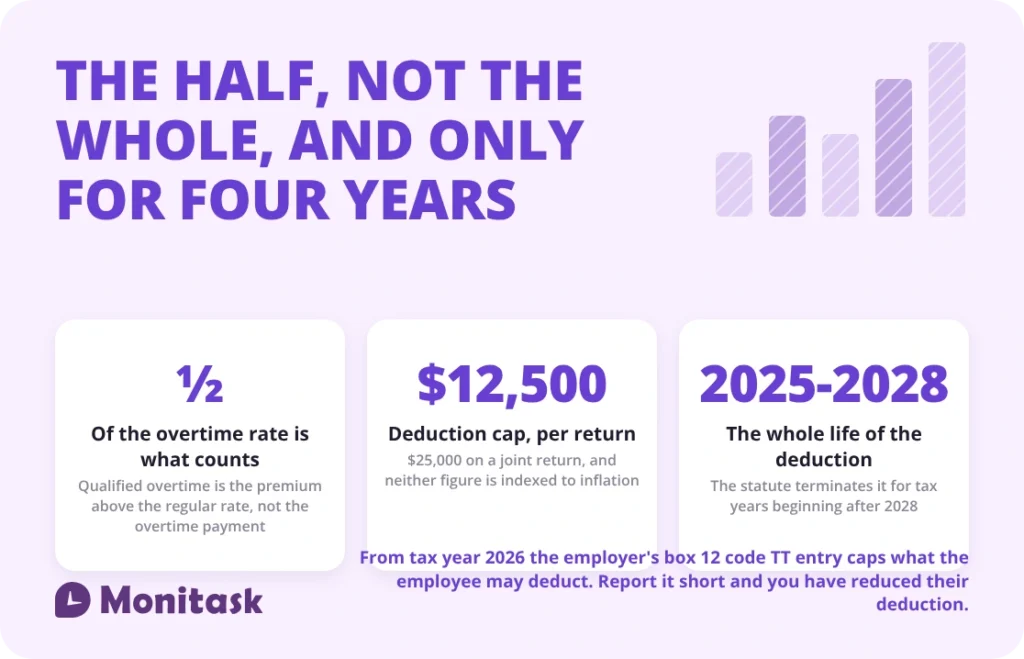
Qualified overtime compensation is the premium portion of FLSA-required overtime — the amount above the employee’s regular rate, not the whole time-and-a-half. Overtime owed only under state law or a contract does not qualify, and exempt employees have none. From tax year 2026 employers report the yearly total in Form W-2 box 12 using code TT, and that entry now caps what the employee is allowed to deduct.
What is qualified overtime compensation?
A tax term, not a payroll term, and the difference is where almost every mistake starts.
The statute is Internal Revenue Code section 225, enacted by Public Law 119-21, section 70202. It defines qualified overtime compensation as overtime compensation paid to an individual required under section 7 of the Fair Labor Standards Act of 1938 that is in excess of the regular rate
at which the individual is employed. The IRS puts the same rule in plainer words: Qualified overtime compensation is the amount of overtime compensation required under 29 USC 207 that is in excess of the employee’s regular rate
.
Two phrases carry all the weight.
“Required under section 7 of the Fair Labor Standards Act.” Only overtime that the FLSA itself compels. Not overtime a state statute compels, not overtime a contract or a collective agreement compels, not overtime an employer pays as a matter of policy.
“In excess of the regular rate.” Not the time-and-a-half. The half. The 2026 W-2 instructions say it with an example of their own: only the “half” portion of “time-and-a-half” compensation would be reported using code TT
.
| What it is | What it is not |
|---|---|
| The premium above the regular rate on FLSA-required overtime hours | The full time-and-a-half payment |
| Computed per workweek and totalled per year | A figure that appears in ordinary payroll output by default |
| An income tax deduction for the employee, claimed on their return | An exemption from payroll tax withholding |
| Reported by the employer, deducted by the employee | Something the employer applies to the paycheck |
Two things the original fanfare left out, and both belong in your planning.
First, the deduction expires. The statute provides that No deduction shall be allowed under this section for any taxable year beginning after December 31, 2028
. It applies to taxable years beginning after December 31, 2024, so the whole life of the provision is tax years 2025 to 2028. The W-2 instructions put the same window as tax years beginning after 2024 and before 2029
. Four years, one of which is already gone.
Second, none of the figures are indexed. There is no cost-of-living adjustment anywhere in section 225 for the caps or the income thresholds — which is notable, because another provision of the same Act is indexed. The dollar amounts below are the amounts for all four years.
And one thing that changes who carries the risk. The statute provides that There shall be allowed as a deduction an amount equal to the qualified overtime compensation received during the taxable year
and included on statements furnished to the individual pursuant to section 6041(d)(4) or 6051(a)(19)
— that is, on the employer’s Form W-2 or Form 1099. From tax year 2026, employees may not consider any amount of qualified overtime compensation in excess of what is reported on Form(s) W-2, box 12, code TT
. Report the figure short and you have reduced your employee’s deduction. They cannot fix it with a substitute form either: Form 4852 does not satisfy the requirement under section 225(a) because it is not furnished pursuant to section 6051(a)(19)
.
Which overtime does not qualify?
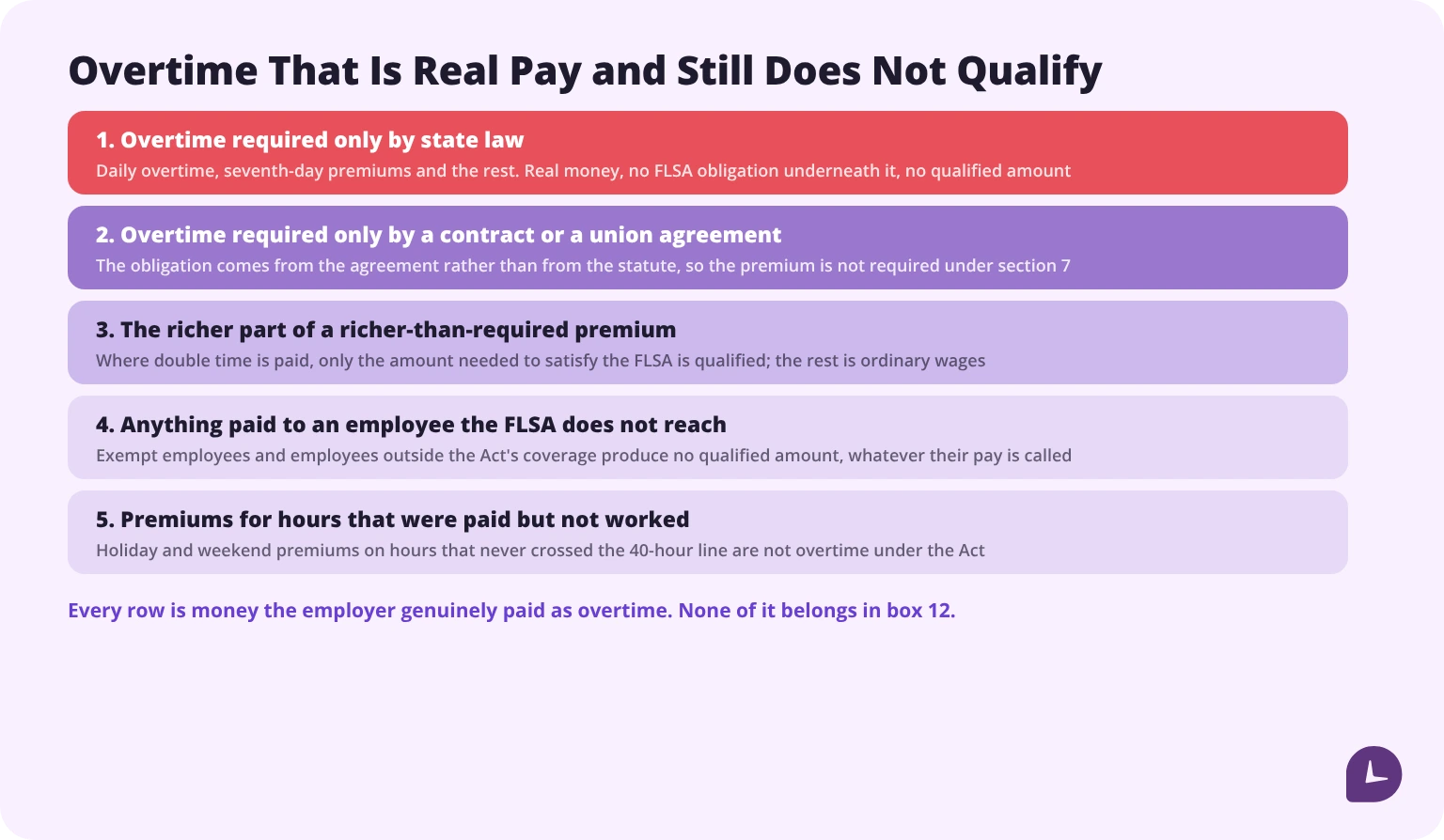
The section to read twice, because the exclusions cover pay that every payroll system already labels “overtime.”
| Pay that is genuinely overtime | Why it produces no qualified amount |
|---|---|
| Overtime required only by state law | Daily overtime, seventh-day premiums and the rest. Real money, no FLSA obligation underneath it, no qualified amount |
| Overtime required only by a contract or a union agreement | The obligation comes from the agreement rather than from the statute, so the premium is not required under section 7 |
| The richer part of a richer-than-required premium | Where double time is paid, only the amount needed to satisfy the FLSA is qualified; the rest is ordinary wages |
| Anything paid to an employee the FLSA does not reach | Exempt employees and employees outside the Act’s coverage produce no qualified amount, whatever their pay is called |
| Premiums for hours that were paid but not worked | Holiday and weekend premiums on hours that never crossed the 40-hour line are not overtime under the Act |
On the exempt point the IRS is categorical: An individual who is ineligible for overtime under the FLSA does not receive qualified overtime compensation regardless of other laws or circumstances
. Note the two-part test it applies — the overtime must be paid to someone it must, among other requirements, be paid to an individual who is both covered by the FLSA and not exempt from the FLSA’s overtime requirement
. Being outside the Act’s coverage is a separate route to zero from being exempt within it, and both end in the same place. Our pages on exempt employees and salaried non-exempt employees cover the classification itself.
For FLSA-eligible employees paid premiums richer than the law requires, the rule is that only the amount minimally necessary to satisfy 29 USC 207 is qualified overtime compensation for purposes of the tax deduction
.
The state-law case catches multi-state employers. Take an employee working 4 nine-hour days — 36 hours for the week. Under a state rule requiring overtime after 8 hours in a day, they are owed a premium on 4 hours. Under the FLSA, 36 is below the 40-hour threshold, so nothing is required. The state premium is real and must be paid. The qualified overtime compensation is zero.
An employer who exports the payroll system’s overtime column into box 12 reports that premium as qualified. It is not.
One carve-out worth knowing if you have tipped staff. Section 225(c)(2) provides that qualified overtime shall not include any qualified tip
, which keeps the same dollar from being claimed under both the tips and the overtime deductions.
How do you calculate the qualifying amount?
The IRS gives the formula outright: FLSA hours over 40 in a workweek, times one-half, times the employee’s FLSA regular rate. It is determined per workweek, not per pay period and not per year. This is the tax figure, which is a different calculation from the pay itself — for the pay, see how to calculate overtime pay and the overtime calculator.
Four worked weeks, from the simple to the one that defeats spreadsheets.
Week 1 — hourly, nothing else. $30.00 an hour, 50 hours.
| Step | Figure |
|---|---|
| Regular rate | $30.00 |
| Overtime hours, over 40 | 10 |
| FLSA-required rate for those hours | 1.5 × $30.00 = $45.00 |
| Total paid for the overtime hours | 10 × $45.00 = $450.00 |
| Straight-time component of those hours | 10 × $30.00 = $300.00 |
| Premium above the regular rate | $150.00 |
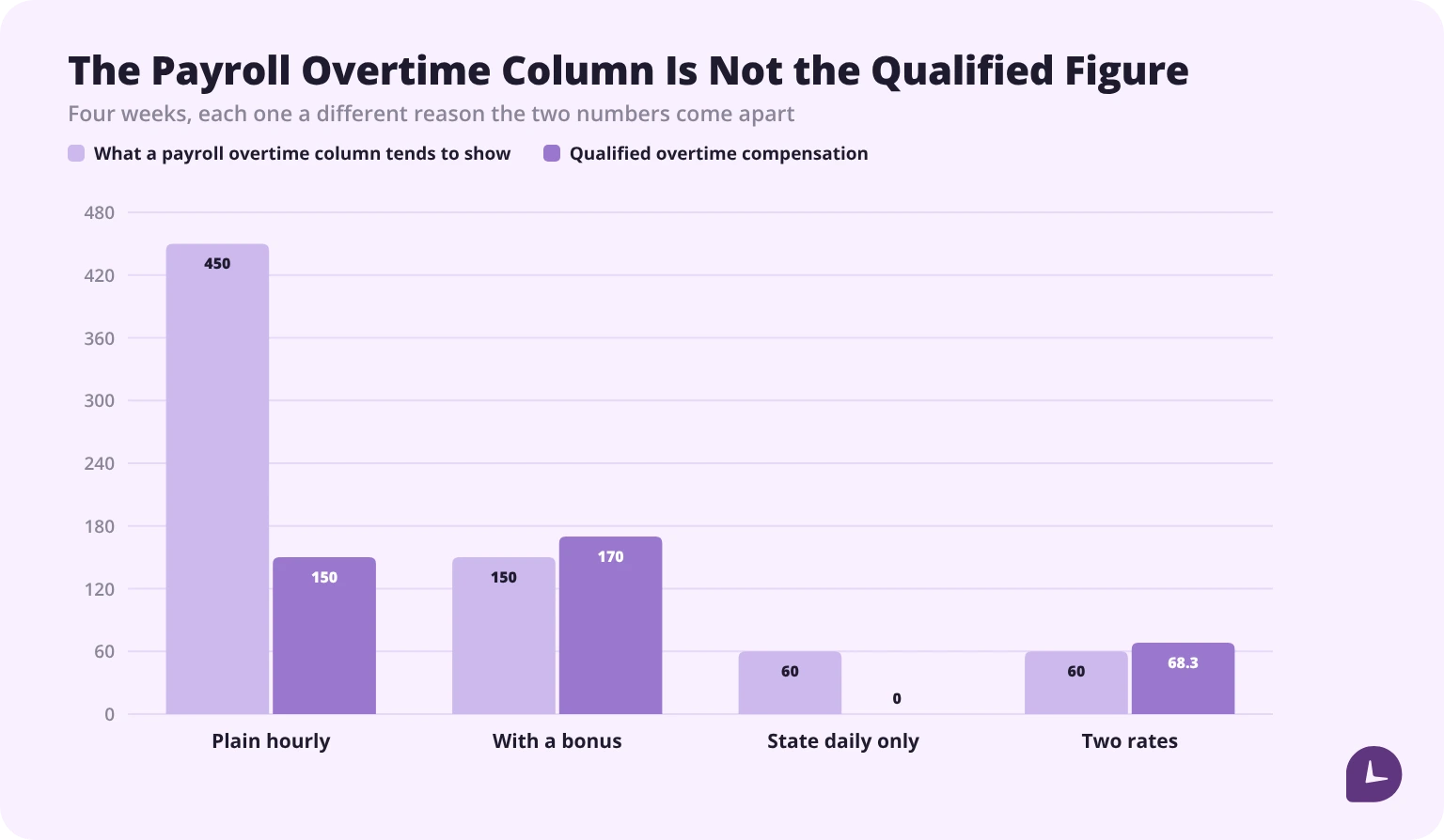
Total weekly pay is $1,650.00. Overtime pay is $450.00. Qualified overtime compensation is $150.00. Report $450.00 and you have overstated by $300.00 in a single week — a factor of 3.0.
Week 2 — hourly plus a nondiscretionary bonus. Same rate and hours, plus a $200.00 production bonus earned that week under an announced plan.
| Step | Figure |
|---|---|
| Straight-time earnings for all hours | 50 × $30.00 = $1,500.00 |
| Plus the nondiscretionary bonus | $200.00 |
| Total straight-time remuneration | $1,700.00 |
| Regular rate | $1,700.00 ÷ 50 = $34.00 |
| Additional half-time premium on the overtime hours | 10 × $17.00 = $170.00 |
| Total weekly pay | $1,870.00 |
The bonus raised the qualified amount from $150.00 to $170.00. An employer computing the premium off the $30.00 base rate reports $150.00 and understates by $20.00 — for one employee, in one week. Across a quarterly incentive plan and a hundred hourly staff, that compounds into a number worth correcting.
Week 3 — state daily overtime, no FLSA overtime. $30.00 an hour, 4 nine-hour days.
| Step | Figure |
|---|---|
| Hours worked in the workweek | 36 |
| FLSA overtime hours, over 40 | 0 |
| State daily-overtime premium actually paid | 4 × $15.00 = $60.00 |
| Qualified overtime compensation | $0.00 |
The $60.00 was owed and must be paid. It is not qualified overtime compensation, because the FLSA required none of it. Our guide to California overtime law covers how daily overtime rules work where they apply.
Week 4 — two rates, one week. $24.00 for 20 hours in one role and $30.00 for 25 hours in another: $1,230.00 of straight time over 45 hours, a blended regular rate of $27.33, a half-time premium of about $13.67 on each of the 5 overtime hours, and $68.33 of qualified overtime compensation.
Whether that lands on $68.33 or $68.35 depends on whether your system rounds the rate before multiplying — a $0.02 difference in one week, which is worth settling once and documenting, because it shows up as a penny-level discrepancy across a year of box 12 totals. Computing the premium against whichever rate the overtime hours happened to fall under gives $60.00 or $75.00 instead: wrong in either direction. Employers who move staff between roles, sites or pay grades mid-week should assume their payroll export is not calculating this correctly until someone has checked.
And the case to hand to your provider. Some employers compute overtime under a provision of section 7 other than the ordinary 40-hour rule — hospital and residential care employees, public-sector fire protection and law enforcement, state and local employees taking compensatory time off. The IRS says for those employees The overtime premium actually paid in compliance with that provision, rather than a calculation of the amount that otherwise would have been paid
under the ordinary rule governs. Where a contract pays above the FLSA requirement, crediting those premiums against the obligation has its own rules at 29 U.S.C. 207(h). Do not compute either from a template.
Why is the regular rate not the same as the hourly wage?
Because the statute says so, and because this is the single biggest source of understated reporting.
29 U.S.C. 207 requires overtime for a workweek longer than forty hours
at a rate not less than one and one-half times the regular rate at which he is employed
. And subsection (e) provides that the regular rate all remuneration for employment paid to, or on behalf of, the employee
, subject to specific exclusions. Pay that is not excluded belongs in the rate, which means the rate can be higher than the posted hourly wage in any week where the employee earned anything extra.
The four exclusions that matter in practice:
| Citation | What it excludes | The statutory words |
|---|---|---|
207(e)(1) | Gifts and special-occasion payments | sums paid as gifts; payments in the nature of gifts made at Christmas time or on other special occasions |
207(e)(2) | Pay for periods when no work is performed | payments made for occasional periods when no work is performed due to vacation, holiday, illness |
207(e)(3)(a) | Truly discretionary bonuses | both the fact that payment is to be made and the amount of the payment are determined at the sole discretion of the employer |
207(e)(5) | Premium pay for hours beyond a daily or weekly standard | extra compensation provided by a premium rate paid for certain hours worked by the employee in any day or workweek |
Read those against what is left and the practical rule falls out: a nondiscretionary bonus raises the regular rate and therefore raises qualified overtime; a discretionary bonus does neither. Whether a bonus is discretionary turns on how the plan is written and communicated, not on what it is called.
Shift differentials, hazard premiums and commissions attributable to the week are all inside the rate, because nothing in the exclusions takes them out.
The two-rate case. As a general rule an employee working two roles at two rates in one week is not treated as having a separate regular rate for each. The Department of Labor states the method: the earnings from all such rates are added together and this total is then divided by the total number of hours worked at all jobs
. Week 4 above is that calculation. The exception is the alternative computation methods named in the previous section, where the premium actually paid under that provision governs instead.
How do you report it?
The mechanism is narrow and specific.
| Item | Rule |
|---|---|
| Form, for employees | Form W-2, box 12, code TT |
| Form, for non-employee payees | Form 1099-MISC box 14, or Form 1099-NEC box 1d |
| First year it applies | 2026 |
| Amount reported | The full qualified overtime paid, even where the employee cannot deduct all of it |
| Correcting an error | File Form W-2c and furnish the corrected form to the employee |
The IRS states the employee rule as: an employer must report the amount of qualified overtime compensation paid to an employee beginning in 2026, on Form W-2 in box 12, using code TT
. For payees who are not employees, payors and employers are required to separately report qualified overtime compensation on Form 1099-MISC (box 14), Form 1099-NEC (box 1d)
, or more commonly on the W-2.
Report the full qualified amount, not the deductible amount. the amount that must be reported on Form W-2, box 12, code TT is the total qualified overtime compensation paid
, which, because of the caps and the phase-out, may not be the amount ultimately deductible by the employee
. An employer trying to be helpful by capping the box 12 figure at $12,500.00 has reported the wrong number.
Overstating does not help the employee either. Where the reported figure is too high, the employee may only consider the actual amount of qualified overtime compensation paid to the employee by the employer
. An overstatement buys nothing and creates a mismatch.
If the number is wrong, the employer must file Form W-2c, Corrected Wage and Tax Statements with SSA and furnish Form W-2c to the employee as soon as possible
.
What did employers have to do for tax year 2025?
Less than most employers feared, and the relief came from two separate notices that are routinely conflated.
For 2025, separate reporting was not required: For 2025, employers aren’t required to report qualified overtime compensation separately on Forms W-2, 1099-NEC, and 1099-MISC
. Underneath that sit two instruments doing different jobs.
Notice 2025-62 is the employer-facing one. It gives relief from the section 6721 and section 6722 penalties for failing to file correct information returns and furnish correct payee statements, and states that This relief applies only for taxable year 2025
. The 2025 forms were never updated for the change.
Notice 2025-69 is addressed to individual taxpayers. It confirms there will be no changes to the 2025 Form W-2, Form 1099-NEC, Form 1099-MISC, or Form 1099-K
and lets an eligible employee treat the separate accounting requirement as satisfied where the overtime is properly reported, even without a separate entry. In other words it relieves the employee of the section 225(a) condition for 2025 — the condition that the amount appear on a furnished W-2 — rather than relieving the employer of a reporting duty.
What employers actually had to do for 2025 was nothing new on the forms: file and furnish complete and correct returns and statements, as before. Employers who could produce the underlying hours and rate detail on request made their employees’ computation possible. That was a service, not a duty.
Where the employee received no statement, the IRS directed them to Schedule 1-A (Form 1040), Part III, No Tax on Overtime, to work the figure out themselves. In practice that meant employees asking payroll for their overtime detail, which is why “where is overtime on my W-2” became a question employers answered for a year in which the answer was that it is not broken out there.
The relief was for 2025 only. no relief is available for tax years after 2025
. From 2026 the box 12 code TT reporting applies, and it caps the employee’s deduction.
What records does this require?
A records obligation before it is a tax obligation. You cannot report a number you cannot derive.
| Fact you must be able to produce | Why the report needs it |
|---|---|
| Hours worked per employee per workweek | Establishes whether and how many FLSA overtime hours arose |
| The defined workweek, consistently applied | The 40-hour test is weekly; a shifting workweek makes the figure unreproducible |
| All straight-time remuneration in that week, including nondiscretionary bonuses, shift differentials and commissions | Needed to compute the regular rate the premium is measured from |
| The FLSA-required premium, separated from other premiums | Only the FLSA-required portion is qualified |
| Exempt or non-exempt classification, with effective dates | Exempt employees produce no qualified amount at all |
| Hours paid but not worked, flagged as such | PTO, holiday and sick hours do not count toward the 40-hour test |
| A running yearly total per employee | Box 12 is an annual figure |
The workweek row is the one people underestimate. The IRS definition is exact: A workweek is a fixed and regularly recurring period of 168 hours – 7 consecutive 24-hour periods
, it may begin on any day and at any hour the employer establishes, and for purposes of overtime there can be no averaging of hours over 2 or more workweeks
. Define it once in your overtime policy and keep it.
Notice what is absent from that list: estimates. Each row is a record, and the first row is the foundation for every other. Attendance tracking that already holds hours by employee and workweek is what turns the box 12 figure into a query rather than a year-end reconstruction. If you round clock entries, the 7-minute rule explains why that rounding reaches the weekly total and therefore the tax figure. The hour-level detail is also what timesheets for payroll and payroll calculation already depend on.
The second-order problem is retrospective. If an employee disputes their box 12 amount, or a correction is needed, you have to reproduce the week in question — the hours, the bonus, the rate — from records that already existed. A payroll summary showing only “overtime: $450.00” cannot do that.
What does the deduction mean for the employee?
Enough to answer the questions you will be asked, and no more — the return is theirs.
| Condition | The rule |
|---|---|
| Maximum annual deduction | Maximum annual deduction is $12,500; $25,000, if you file jointly |
| Phase-out | Deduction phases out if your modified adjusted gross income is over $150,000; $300,000, if you file jointly |
| Itemising | Deduction is available regardless of whether you itemize or take the standard deduction |
| Social Security number | Must have a valid Social Security number— and one one that is valid for employment and that is issued by the SSA before the due date of the employee’s individual income tax return. The statute: No deduction shall be allowed under this section unless the taxpayer includes on the return of tax for the taxable year such individual’s social security number |
| Married filers | If married, you must file jointly. The statute: this section shall apply only if the taxpayer and the taxpayer’s spouse file a joint return for the taxable year |
| Employee-owners | An owner with at least a bona fide 20% equity interest who actively manages the business is generally exempt from the FLSA, and therefore has no qualified overtime |
It is not a payroll tax exemption. The IRS is explicit that overtime compensation is not excludible or exempted from wages for purposes of employment taxes including income tax withholding, social security, and federal unemployment taxes
. The 2026 W-2 instructions close the one gap the fact sheet leaves, inside the code TT entry itself: Overtime compensation is still generally subject to federal income tax withholding and both the employer share and employee share of social security tax and Medicare tax
. So: income tax withholding, both halves of Social Security, both halves of Medicare, and federal unemployment tax all continue to apply to the same dollars. Section 225 is an income tax deduction; it does not touch the definition of wages for employment tax.
But withholding is not immovable, and this is the correction most employer guides still need. The rule is narrower than “nothing changes”: An employer may not reduce withholding on wages to account for the qualified overtime deduction unless the employee furnishes the employer an updated and valid Form W-4
accounting for the expected deduction. The employee can get the cash-flow benefit during the year by filing a new Form W-4 — The 2026 Form W-4 was updated to allow employees to account for the deduction for qualified overtime compensation in step 4(b)
. The Tax Withholding Estimator was updated for the same purpose.
The practical consequence for HR: an employee who does nothing will not see a bigger paycheck, and the benefit arrives when they file. An employee who files a new W-4 using step 4(b) may see one. Saying both things clearly in advance prevents a wave of payroll deduction tickets in the first overtime-heavy month — and keeps you out of the business of advising on someone’s W-4.
How much is the deduction actually worth?
Worth a section of its own, because “phases out at $150,000.00” invites the reader to assume it is gone at $150,000.00, and it is not.
The statute reduces the deduction shall be reduced (but not below zero) by $100 for each $1,000 by which the taxpayer’s modified adjusted gross income exceeds $150,000
— $300,000.00 on a joint return. Schedule 1-A (Form 1040) works it in whole thousands, rounded down. Modified adjusted gross income for this purpose is the adjusted gross income of the taxpayer for the taxable year increased by any amount excluded from gross income under section 911, 931, or 933
.
So the arithmetic is: take the smaller of the qualified overtime and the cap; count the whole thousands of income above the threshold; subtract $100.00 for each; floor at zero. The taper is ten cents per dollar of income above the line.
A single filer with $18,000.00 of qualified overtime and $196,400.00 of modified adjusted gross income: the cap binds at $12,500.00; the excess over the threshold is $46,400.00, which is 46 whole thousands; the reduction is 46 × $100.00 = $4,600.00; the deduction is $7,900.00.
Joint filers with $31,000.00 of qualified overtime and $412,900.00: the cap binds at $25,000.00; the excess is $112,900.00, or 112 whole thousands; the reduction is $11,200.00; the deduction is $13,800.00.
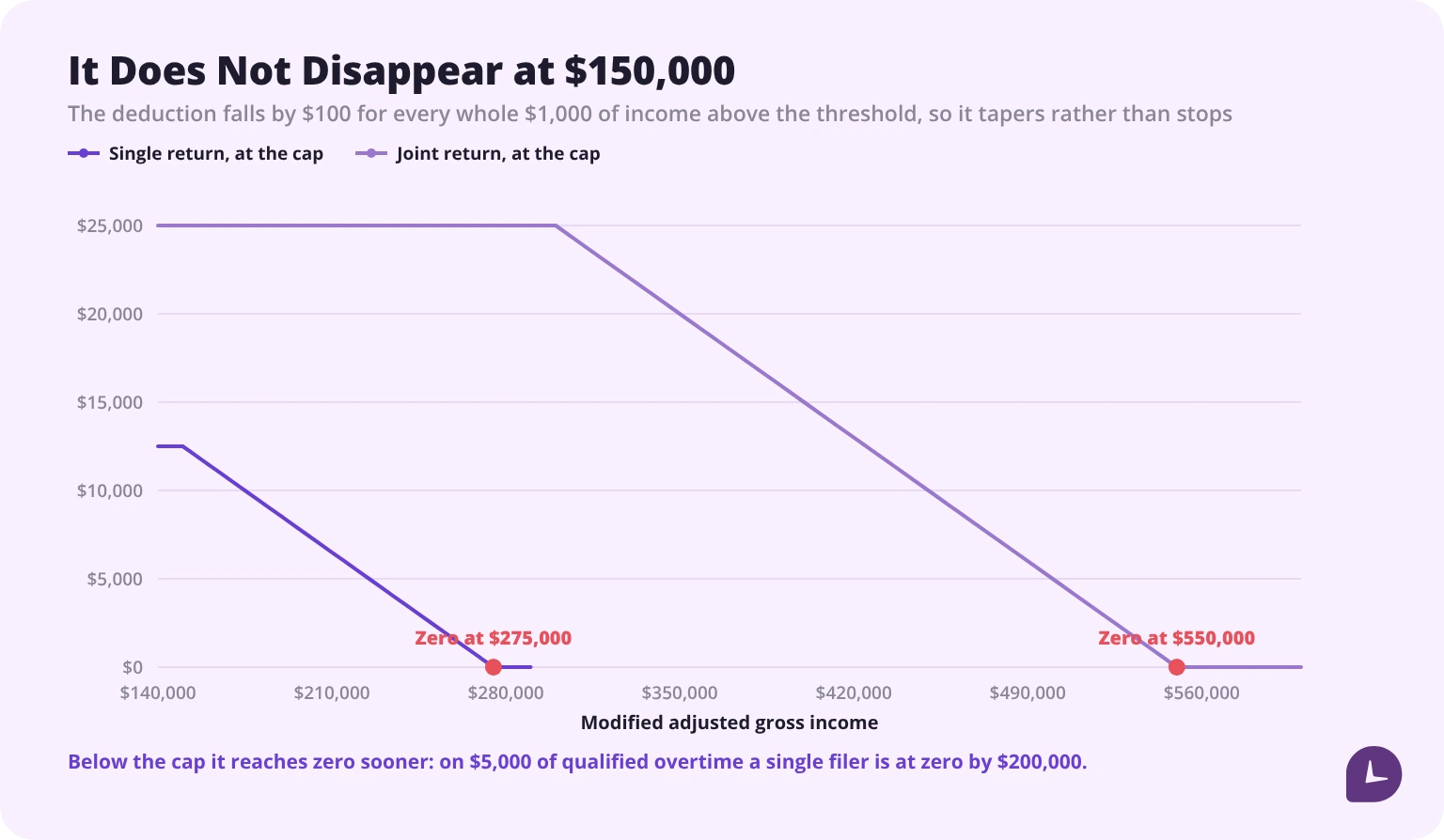
Where it reaches zero depends on how much qualified overtime there is. At the cap, a single filer is at zero at $275,000.00 and joint filers at $550,000.00. Below the cap it gets there sooner: on $5,000.00 of qualified overtime a single filer is at zero by $200,000.00.
None of this changes what you report. The box 12 figure is the full qualified amount regardless of where the employee lands on that line.
Common reporting errors and how to avoid them
| Error | What it produces | The fix |
|---|---|---|
| Reporting the full overtime payment | Overstates by about 3.0× | Report only the premium above the regular rate |
| Computing the premium off the base hourly wage | Understates in any week with a nondiscretionary bonus, differential or commission | Compute the regular rate weekly from all includable remuneration |
| Including state-law or contractual overtime | Overstates, and in some weeks invents a figure where none exists | Test each week against the 40-hour threshold first |
| Reporting amounts for exempt or uncovered employees | Reports an amount that cannot exist | Gate the calculation on FLSA overtime eligibility |
| Counting paid-not-worked hours toward the 40-hour test | Creates phantom overtime hours | Flag those hours and exclude them from the test |
| Capping the box 12 figure at the deduction limit | Reports the wrong number and shifts the error onto the employee’s return | Report the full qualified amount |
| Overstating the box 12 figure to be generous | Buys the employee nothing and creates a mismatch | Report the actual amount paid |
| Using an inconsistent workweek | Makes the figure impossible to reproduce or correct | Define the workweek once and keep it |
Three of those overstate, three understate, and two produce a figure nobody can reproduce. All eight are avoidable at the record level, which is the point of the records section above.
Hours by employee and workweek, with the overtime detail intact, so the box 12 figure is a query rather than a reconstruction.
See Monitask's time clock software
Sources
Every document below was read directly, at the publisher’s own site, on 12 November 2026.
- Internal Revenue Code section 225, as enacted by Public Law 119-21, section 70202. Read as the enacted text of Public Law 119-21, section 70202, on govinfo. Subsections (a), (b), (c), (d), (e) and (g): the definition, the caps, the phase-out, the social security number and joint-filing conditions, and the termination after 2028. The same Act inserted the reporting hooks at
section 6051(a)(19)andsection 6041(d)(4), and added the deduction to the non-itemiser list atsection 63(b)(6). - IRS Fact Sheet FS-2026-13, August 2026, 32 questions and answers, update-stamped 6 August 2026. It supersedes FS-2026-01 of 23 January 2026, which is why anything written early in 2026 should be re-checked.
- 2026 General Instructions for Forms W-2 and W-3, Catalog No. 25979S, 29 January 2026. The code TT entry, the “half” example, and the employment tax position including Medicare.
- Notice 2025-62, Relief from Certain Penalties Related to Information Reporting Required in Connection with No Tax on Tips and Overtime — the employer-side penalty relief for 2025. Notice 2025-69, Guidance for Individual Taxpayers who received Qualified Tips or Qualified Overtime Compensation in 2025 — the individual-side relief. Both read in full.
- Schedule 1-A (Form 1040), Part III, No Tax on Overtime, for the order of operations and the whole-thousands rounding. FS-2026-04 of March 2026 is the IRS’s own explainer for that form.
- IRS newsroom, What to know about the No Tax on Overtime deduction, for the caps, thresholds and conditions as the IRS states them to taxpayers.
29 U.S.C. 207, subsections (a)(1), (e) and (h), read on govinfo in the United States Code 2024 Edition. The most recent amendment to section 207 predates this Act.- DOL Fact Sheet #23 and the Wage and Hour Division’s overtime pages, for the weighted-average method and the hours-worked baseline.
- Open items, where a primary source could not be reached or does not exist yet:
- No Code edition of section 225 exists yet. There is no 2025 annual edition of United States Code title 26 on govinfo, and the 2024 edition predates the Act. Section 225 is quoted here from the enacted text of the public law, which is the same words and an equally primary source, but it is not a Code citation.
- Two regular-rate rules are correct but uncited. That commissions and shift differentials sit inside the regular rate, and that paid-but-unworked hours do not count toward the 40-hour test, both follow from the structure of 29 U.S.C. 207. The regulations that state them expressly, in part 778, could not be retrieved, so no regulation is cited for either.
- No regulations under section 225 have been published. A Federal Register sweep of IRS documents found the tips regulations under section 224 but nothing under section 225. The statute directs the Secretary to issue guidance, so this will change.
- The posted Schedule 1-A is still the 2025 version. Its line 14a keys qualified overtime to Form W-2 box 1, because 2025 had no code TT. A 2026 version will key it to box 12 code TT. Worth re-checking at the next revision.
FAQ
Where does overtime appear on a W-2?
For 2026 and after, qualified overtime compensation appears in box 12 with code TT. It is not a box of its own, and it is not total overtime pay — box 1 wages include the whole overtime payment, while box 12 code TT carries only the qualified premium portion.
Our payroll system has an overtime column. Can we just use that total?
Almost certainly not. That column typically holds the full overtime payment, usually including state-law and contractual premiums, computed against the base rate rather than the regular rate. It is the right starting point and the wrong answer.
Do exempt employees ever have qualified overtime compensation?
No. The IRS says an individual ineligible for overtime under the FLSA does not receive qualified overtime compensation
regardless of other laws or circumstances. The same goes for an employee the Act does not cover at all. Our page on exempt versus non-exempt status covers the classification.
What happens if we report too little?
The employee’s deduction is capped at what you reported. From 2026 they employees may not consider any amount of qualified overtime compensation in excess of what is reported on Form(s) W-2, box 12, code TT
, and a substitute Form 4852 does not cure it. File a Form W-2c.
Does the employee see this in their paycheck?
Only if they file a new Form W-4 using step 4(b) to account for the expected deduction. You may not reduce withholding on your own initiative. Absent a new W-4, the benefit arrives when they file their return.
How long does this last?
Tax years 2025 through 2028. The statute terminates the deduction for any taxable year beginning after 31 December 2028, and none of the dollar figures are indexed in the meantime.