Remote contractor management is the process of classifying, contracting, onboarding, overseeing and offboarding independent professionals who work offsite. The part most guides skip is that how you oversee them is itself a classification question: requiring set hours, installing monitoring software or directing the method of work are all evidence of behavioural control, which is what separates a contractor from an employee.
Contractor or employee: the distinction that decides everything
| Remote employee | Remote contractor | |
|---|---|---|
| On your payroll | Yes | No |
| You withhold taxes | Yes | No |
| Benefits | Usually | No |
| Sets their own hours | No | Yes |
| Uses their own tools | Usually not | Usually yes |
| You direct the method | Yes | No |
| Your relationship | Employer | Client |
The line is control and independence. If you dictate the exact process and the exact hours, you are treating the person as an employee regardless of what the contract says.
Boost your business productivity
Track performance and streamline teamwork
The classification tests, as a checklist
Work through these honestly rather than aspirationally. Our independent contractor vs employee checklist goes through the same ground case by case.
Behavioural control — do you direct how the work is done?
- [ ] Do you set specific working hours?
- [ ] Do you require them to be online or available at set times?
- [ ] Do you dictate the tools or software they must use?
- [ ] Do you provide detailed instructions on method, not just outcome?
- [ ] Do you require attendance at regular internal meetings?
- [ ] Do you monitor their activity during the working day?
Financial control — do they operate as an independent business?
- [ ] Do they invoice you, or do you pay on a schedule like payroll?
- [ ] Do they bear their own business costs?
- [ ] Can they make a profit or a loss on the engagement?
- [ ] Do they work for other clients?
- [ ] Do they provide their own equipment?
The relationship itself:
- [ ] Is there a written agreement defining scope and term?
- [ ] Is the engagement tied to a project rather than open-ended?
- [ ] Do you provide benefits of any kind?
- [ ] Is the work they do a core, permanent function of your business?
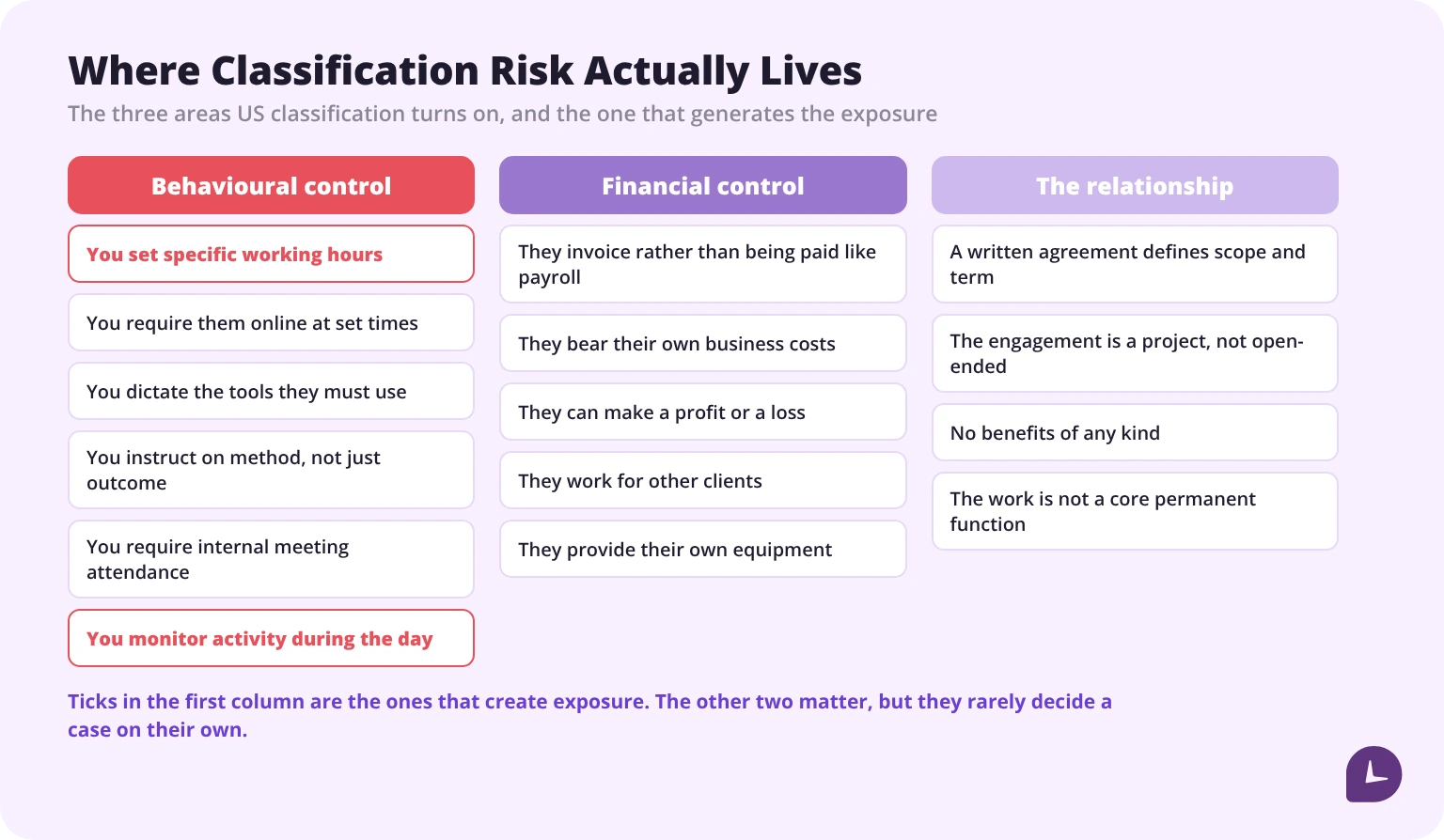
How to read it: ticks in the first block are the ones that create exposure.
This is general information, not legal advice. Classification is fact-specific and varies by jurisdiction.
What misclassification costs
Not a theoretical risk, though the headline numbers are quoted more loosely than they deserve.
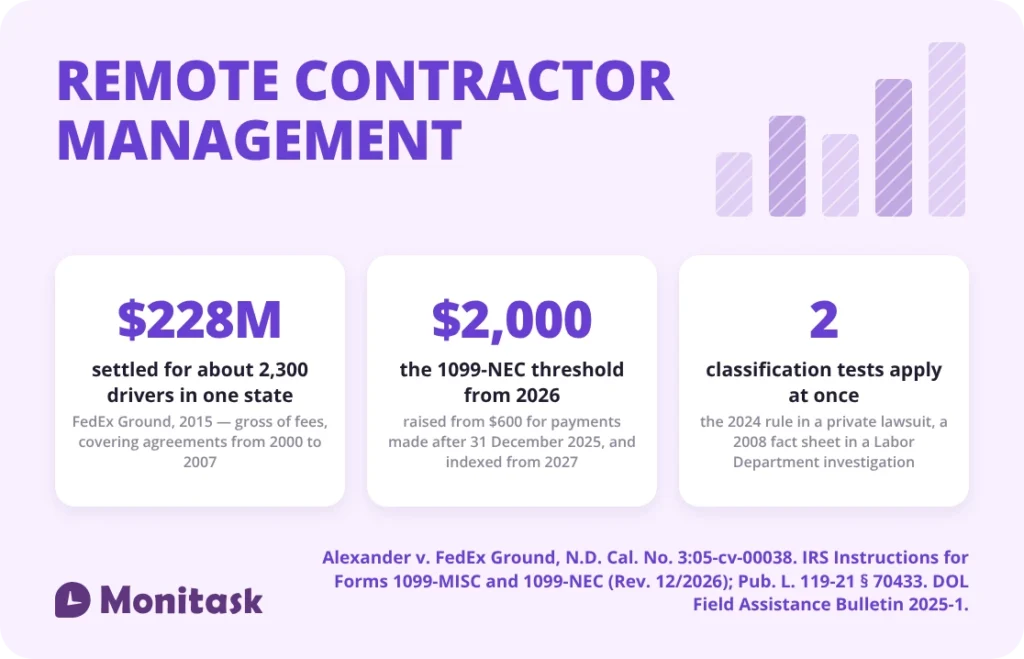
FedEx Ground agreed in 2015 to pay $228 million to settle claims by roughly 2,300 drivers in California, covering operating agreements from 2000 to 2007 (Alexander v. FedEx Ground Package System, Inc., N.D. Cal.). Two things that usually get lost: the figure is gross — attorneys’ fees and claims administration came out of the same fund — and it covered one state. A separate multidistrict settlement dealt with around twenty others, which is why you sometimes see a much larger total attributed to a single case.
Instacart paid $46.5 million in 2022, but it is a different kind of event and worth describing accurately. It resolved an enforcement action brought by the San Diego City Attorney on behalf of the People of California (People v. Maplebear, Inc.), not a workers’ class action: nearly $40 million in restitution plus more than $6 million, to a consumer protection trust fund rather than to workers. Instacart admitted no wrongdoing and no court ruled on whether its shoppers were employees.
How common is it? More contested than the round numbers suggest. The Economic Policy Institute’s review puts it at “between 10 and 20 percent of employers misclassify at least one worker as an independent contractor”. A figure of around 30% circulates more widely, and it does not mean what it is usually taken to mean: it comes from audits conducted in 2003 and 2004 in Michigan alone, and it counts employers who underreported payroll as well as those who misclassified anyone. Audit-based estimates also depend heavily on how a state picks whom to audit, so treat any single figure as an order of magnitude rather than a measurement.
Beyond settlements, the exposure includes back taxes, unpaid overtime, penalties per worker and per violation, and benefit claims.
The contractor agreement: what must be in it
Eight clauses. The first four appear in most agreements; the last four are the ones that get left out and later matter most. There are free company forms and policies to start from rather than drafting cold.
| Clause | What it does |
|---|---|
| Scope of work | Detailed description of services and deliverables |
| Payment terms | Rate, schedule, invoicing process, payment window |
| Term and termination | How either party ends the agreement |
| Independent contractor status | Explicit statement, plus who handles taxes |
| Intellectual property | A work-for-hire or assignment clause. Without it, the contractor may own the code or content they produced for you |
| Confidentiality | NDA covering what they see during the engagement |
| Data protection | Obligation to protect personal data, notify you of breaches, and comply with GDPR, CCPA or equivalent |
| Security requirements | Device, network and access standards — see the section below |
The IP clause is the one to check first. In several jurisdictions, absent an explicit assignment, authorship stays with the creator. A contract that pays for work but does not assign it leaves you licensing your own product.
Onboarding a remote contractor
Contractors are routinely skipped in onboarding, on the reasoning that they are professionals who will work it out. They will — eventually, and at your expense, because the time they spend working out who approves things is time you are paying for. If you are hiring through a marketplace, how to hire freelancers from Upwork covers the selection half of this.
Four steps, in order:
- Sign the agreement and collect tax forms before any work starts. The forms are in the table further down; collecting them later is how a year-end filing deadline becomes a problem.
- Grant role-based access only. Not the shared admin login. Note what was granted — you will need this list at offboarding, and almost nobody writes it down at the point where it is easy.
- Introduce the points of contact. Who approves work, who answers questions, who handles payment queries. Contractors stall on unanswered questions far more than on hard problems, and a stalled contractor is invisible to you in a way a stalled employee is not.
- Hand over the context. Brand guidelines, process notes, project documentation, and which systems are required versus optional. Contractors generally prefer their own tools — be explicit about where that is fine and where it is not.
Note what is not on that list: anything that looks like induction into the team. No required all-hands, no mandatory internal meeting cadence, no company email address. Those are employment signals, and they are easy to add without noticing.
Security when the contractor uses their own device
This is the gap between how contractors actually work and how security policies are written. In a 2022 survey of 258 contractors and freelancers by Talon Cyber Security, 89% were working from personal, unmanaged devices. Talon sells the secure-browser product that answers that problem, so read it as an order of magnitude rather than a measurement — but the direction is not really in dispute, because the alternative would be issuing hardware to everyone you contract with.
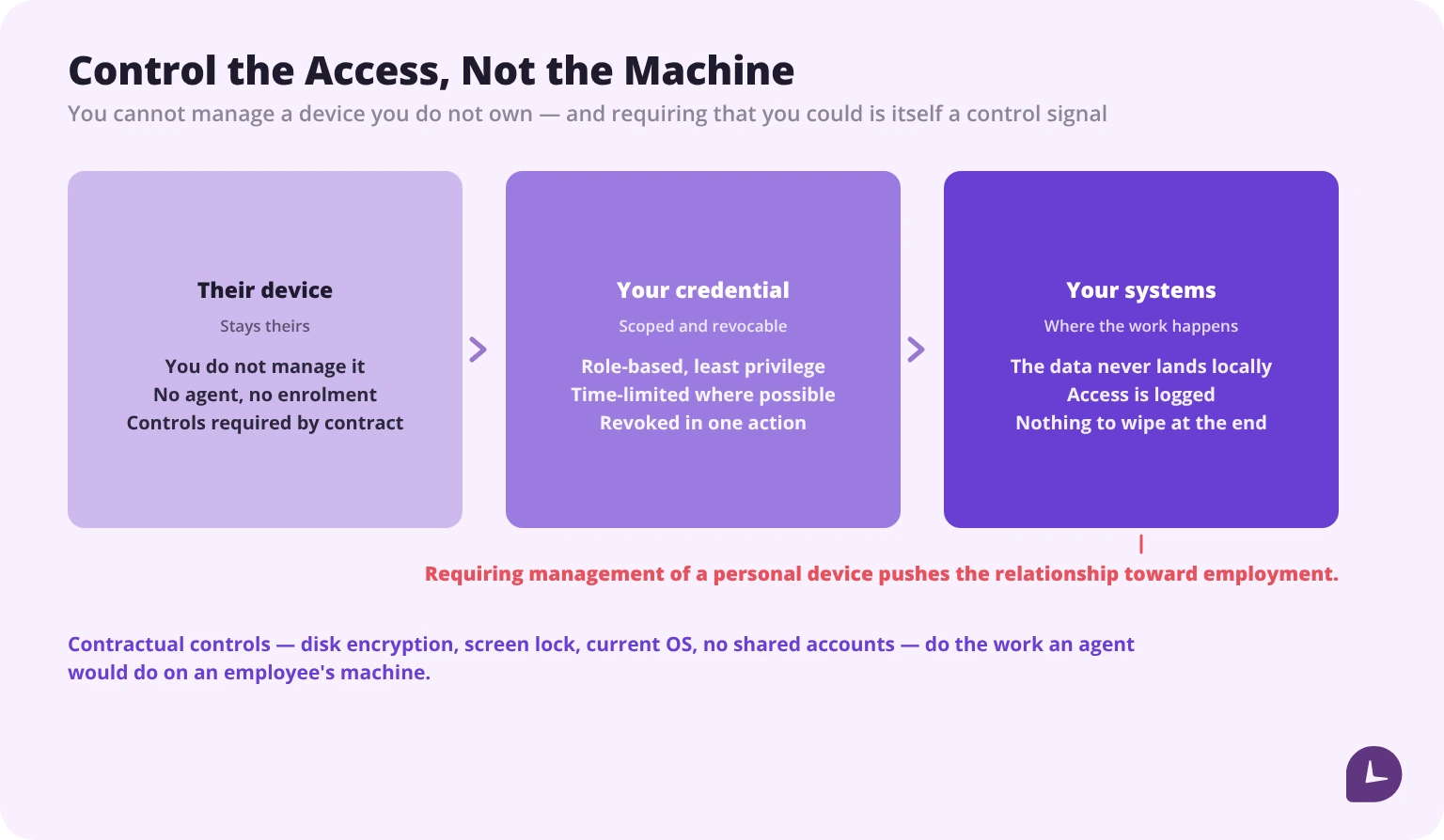
You cannot manage a device you do not own, and requiring management of a personal device pushes the relationship toward employee-like control. What you can do:
- Scope the access, not the device. Role-based permissions, time-limited where possible.
- Require specific controls by contract rather than by agent: disk encryption, screen lock, up-to-date OS, no shared accounts.
- Keep the data in your systems. If work happens in your environment, the personal device holds nothing worth worrying about.
- Use separate credentials that you can revoke in one action.
- Define what happens to local copies at the end of the engagement, in writing.
Setting expectations and communication cadence
Agree before work starts: deliverables and acceptance criteria, deadlines, response-time expectations, where updates happen, and who approves.
Cadence that works without becoming supervision: a weekly check-in or milestone review is usually enough. Daily stand-ups and mandatory presence start looking like employment.
Time zones and cultural differences
Overlap, not availability. Agree a window where both sides are reachable, and treat everything outside it as asynchronous. Requiring a contractor to be online during your business day is both impractical and a behavioural-control signal.
Deadlines in their calendar, not yours. “End of day Friday” means different things eight time zones apart. Use dates and times with an explicit zone.
Holidays differ. A contractor in another country has a different public-holiday calendar, and they are not obliged to follow yours.
How much oversight is too much
This is the section most guides leave out, and the one with actual consequences.
Every guide on this topic advises focusing on outcomes rather than activity. It is framed as management advice. It is also a legal position.
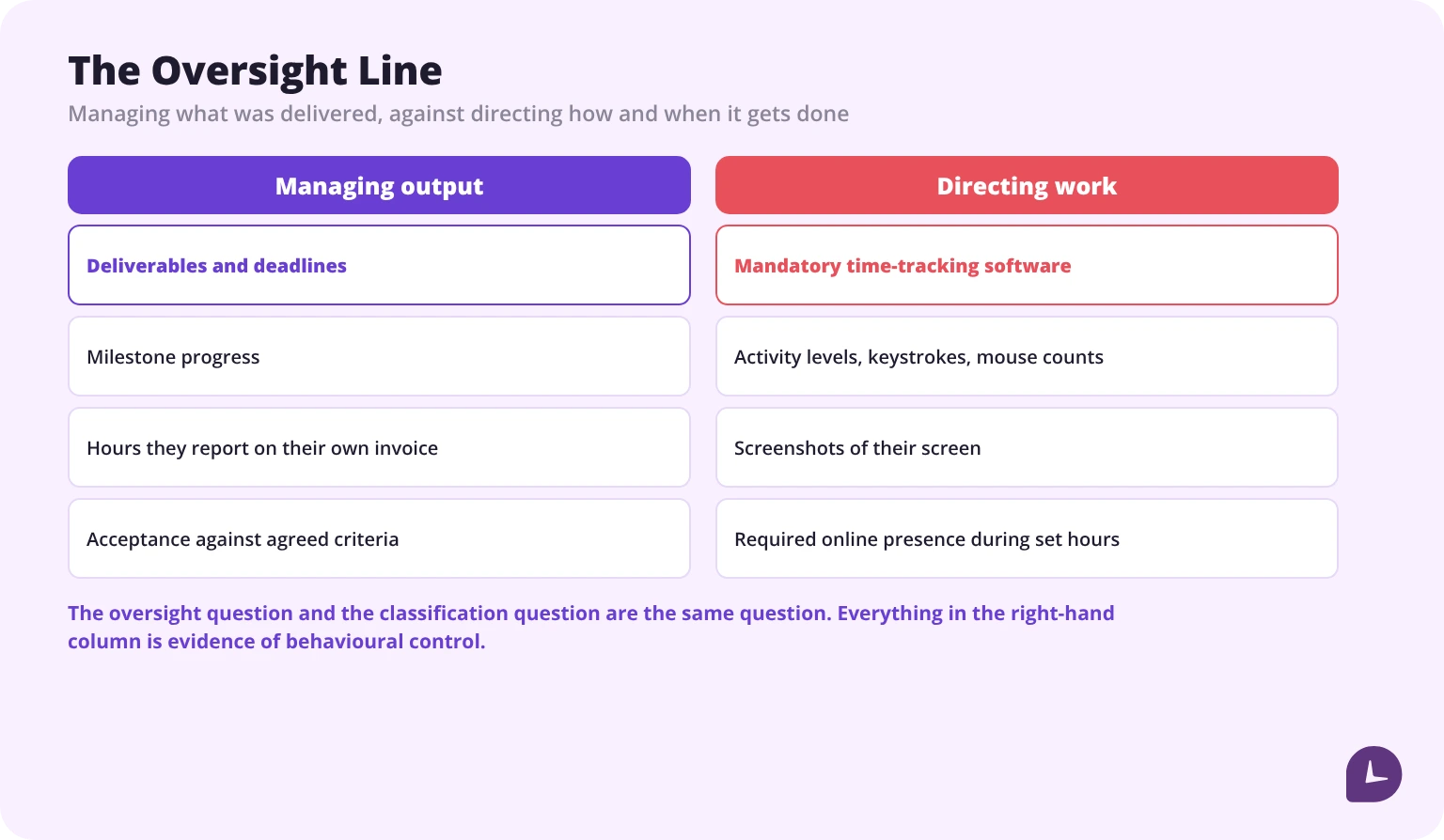
The degree to which you control how and when work is performed is a primary factor in classification. That means the oversight mechanisms you would apply to an employee — mandatory time tracking, activity monitoring, screenshots, required online hours — are evidence of behavioural control when applied to a contractor.
What to track, and what not to
| Appropriate for a contractor | Signals employment | |
|---|---|---|
| Deliverables and deadlines | ✓ | |
| Milestone progress | ✓ | |
| Invoiced hours, self-reported | ✓ | |
| Acceptance against agreed criteria | ✓ | |
| Mandatory time-tracking software | ✗ | |
| Activity levels, keystroke or mouse counts | ✗ | |
| Screenshots of their screen | ✗ | |
| Required online presence during set hours | ✗ | |
| Monitoring agent on their device | ✗ |
A note on our own position. Monitask sells employee monitoring and time tracking software. It is built for employees, and this is the case where we would tell you not to use it. If a contractor’s work needs that level of oversight, the honest question is whether the role is actually a contractor role — and if it is not, the fix is reclassification, not better monitoring.
Where contractors do track time — many do, for their own invoicing — it should be their tool, their record, submitted with the invoice. That is a contractor billing you. An agent you installed and administer is something else.
If the people you are overseeing turn out to be employees, that is a different relationship and a different tool.
See what Monitask does for employee teams
When the relationship drifts toward employment
Classification is not a decision you make once. Engagements change, and they drift in one direction.
Signs the relationship has drifted:
- The contractor has worked exclusively for you for more than a year
- They attend regular internal meetings as a matter of course
- They work set hours that match your business day
- They are paid a fixed amount on a fixed date rather than by invoice against deliverables
- They use a company email address and appear on the org chart
- They have no other clients
- The work they do is a permanent core function, not a project
- Someone on your side directs their day-to-day method
Why it matters: the original contract does not protect you if the working reality has changed. Classification is assessed on the facts of the relationship, not on the label in the agreement.
What to do: re-run the checklist at the top of this page whenever scope, duration or working pattern changes materially, and at least annually for long-running engagements. If the answer has changed, the options are to restore the contractor relationship deliberately — fewer meetings, invoice-based payment, no required hours — or to convert the person to employment, directly or through an employer of record.
Invoicing, payment and taxes
Invoicing. The agreement should state frequency and payment terms — Net 15, Net 30 — before the first invoice. Late payment is the most common contractor complaint and the fastest way to lose good ones. We cover the mechanics in how to pay independent contractors.
Tax forms, US:
| Form | Who | When |
|---|---|---|
| W-9 | US-based contractors | Collect before first payment |
| W-8BEN | Foreign contractors who are individuals | Collect before first payment; valid to the end of the third year after signing |
| W-8BEN-E | Foreign contractors that are entities | Collect before first payment. A foreign company cannot use W-8BEN |
| 1099-NEC | Filed by you | For any contractor paid $2,000 or more in the year |
The threshold changed, and most guidance has not caught up. Nonemployee compensation reporting sat at $600 for decades. Section 70433 of Public Law 119-21, enacted in July 2025, raised it to $2,000 for payments made after 31 December 2025, and the base threshold is indexed for inflation from 2027. The IRS instructions are unambiguous: “Enter nonemployee compensation (NEC) of $2,000 or more.” If you are working from a guide that still says $600, it predates the change.
Paying someone outside the US. The place where the services are performed generally determines the source of the income — “regardless of where the contract was made, or the place of payment, or the residence of the payer.” So a contractor doing all the work abroad generally does not trigger US income tax withholding, whoever signed the contract and wherever the money left from. That is a rule about source, not an automatic exemption: you still collect the documentation and still consider any treaty position.
Paying internationally:
| Method | Speed | Cost | Notes |
|---|---|---|---|
| Bank or wire transfer | Slow | High for cross-border | Direct, widely accepted |
| Online payment platforms | Fast | Moderate | Currency conversion handled |
| Contractor management platforms | Fast | Subscription | Bundles compliance and documentation |
Which classification test actually applies right now
Worth knowing before you rely on any guide written before 2025, including the ones currently ranking for this topic: there is no single federal answer at the moment.
- The Department of Labor’s 2024 rule has not been rescinded. It took effect in March 2024 and still governs private lawsuits brought under the Fair Labor Standards Act.
- But the Department stopped applying it to its own investigations in May 2025. Its Field Assistance Bulletin says the Wage and Hour Division “WHD will no longer apply the 2024 Rule’s analysis when determining employee versus independent contractor status”, and directs investigators to a seven-factor economic-reality analysis from a 2008 fact sheet instead.
- And a replacement is proposed but not final. A notice of proposed rulemaking published in February 2026 (91 FR 9932) would rescind the 2024 analysis and restore an earlier test that treats control and opportunity for profit as the core factors. Comments closed in April 2026. Five legal challenges to the 2024 rule are pending, all stayed.
What this means in practice: two different tests depending on who is asking: the 2024 rule in a private lawsuit, a 2008 fact sheet in a Department investigation, and a proposed replacement pending. The IRS test is separate again, and it is the one that governs tax treatment.
None of this changes what you should actually do, which is the useful part. Every version of every test turns on the same thing — the degree of control, and whether the person is running their own business. A relationship that comes out clean on the checklist above comes out clean under all of them. The tests differ at the margin, and the margin is not where you want to be.
Working across jurisdictions
Every location has its own labour, tax and contract rules, and the rules that apply are those of the contractor’s location, not yours.
The specific risk: several countries apply classification tests stricter than the US federal factors, and a relationship that is clearly contractor-side in one jurisdiction can be reclassified in another. A US company engaging a contractor in a country with strong employment protections may find the arrangement treated as employment regardless of the agreement.
Two routes when this gets complex: engage through an employer of record, which employs the person locally on your behalf, or engage through a contractor management platform that handles local compliance. Both cost money; misclassification costs more.
Offboarding a contractor
No guide in this category covers this, and it is where IP and data problems surface.
Six steps, in order:
- Revoke access the same day, using the list you made at onboarding. Every system, not the obvious ones.
- Confirm the IP handover in writing. Source files, working files, credentials for anything they set up in their own name.
- Require deletion of local copies and get written confirmation, per the clause in the agreement.
- Settle the final invoice and confirm there are no outstanding deliverables.
- Retain the documentation. Agreement, invoices, tax forms and classification assessment. Retention periods vary; three years is a common floor.
- Note what they had access to. If a breach surfaces later, you need to know.
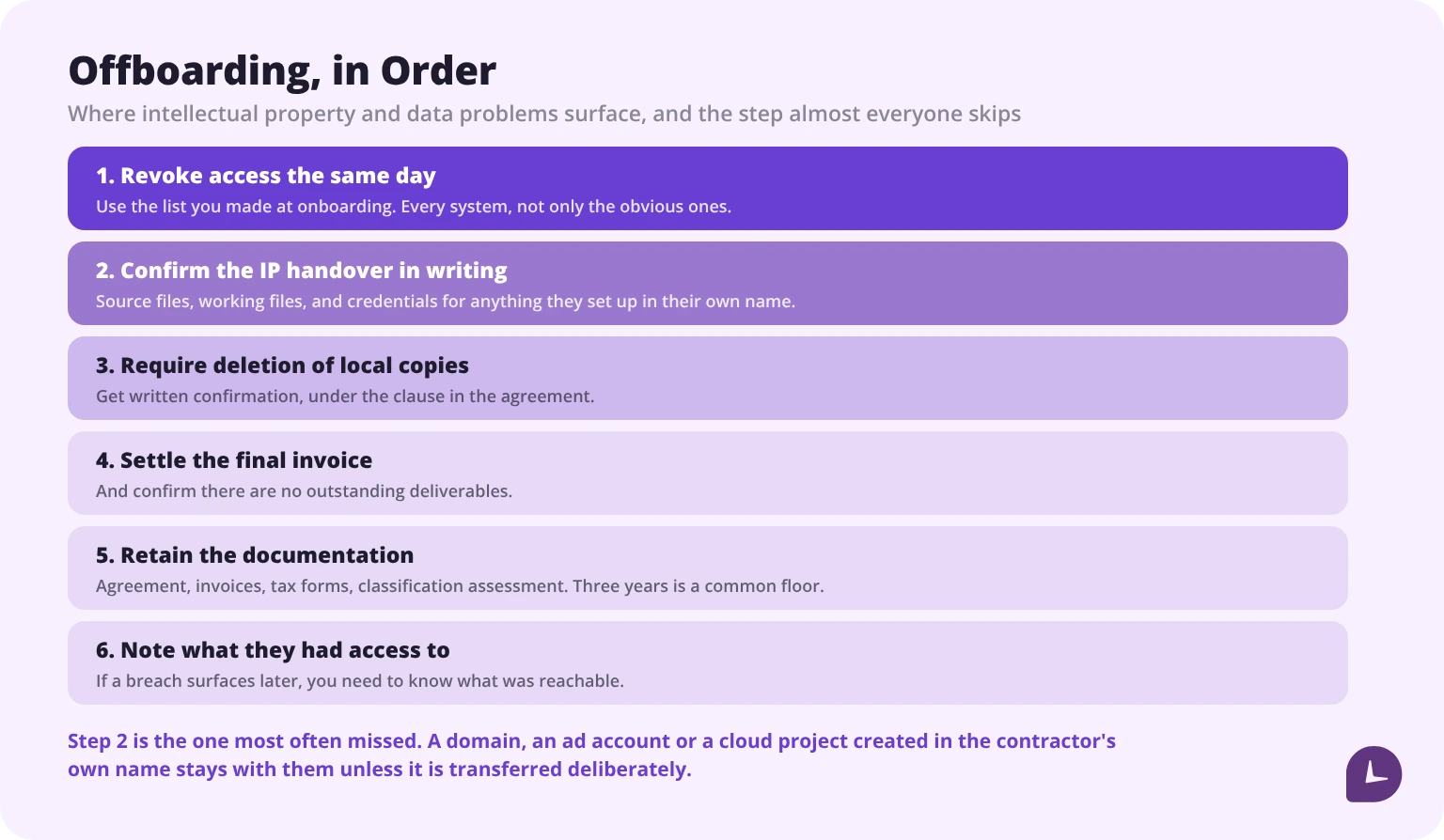
The step most often missed is the second. Credentials created by a contractor in their own name — a domain, an ad account, a cloud project — stay with them unless transferred deliberately.
Case study: a startup’s growth with remote contractors
A fintech startup based in the US scaled its engineering capacity by engaging 10 remote developers in Eastern Europe rather than hiring locally. The work was coordinated through a task tracker, a time-logging tool the contractors ran themselves and submitted with their invoices, and a platform handling contracts and payments.
What made it work is the part worth copying. Nobody on the company’s side directed anyone’s working day. The developers invoiced against deliverables rather than being paid on a payroll cycle, chose their own hours, and used their own equipment and their own time tracking. The company got capacity it could scale up and down; the contractors kept the independence that made them contractors.
That is also why it stayed a contractor arrangement as it grew. The same expansion run the other way — set hours to match head office, a monitoring agent pushed onto personal laptops, a standing internal meeting — would have produced the same output and a very different classification question.
Sources
- IRS, Instructions for Forms 1099-MISC and 1099-NEC (Rev. 12/2026) — the $2,000 nonemployee compensation threshold
- Public Law 119-21 (4 July 2025), section 70433 — the statutory change to the threshold, effective for payments after 31 December 2025
- IRS, Form W-9 (Rev. March 2024); Instructions for Form W-8BEN (Rev. 10/2021); About Form W-8BEN-E
- IRS, Source of Income — Personal Service Income; and Independent contractor (self-employed) or employee?, the three categories of evidence
- US Department of Labor, Field Assistance Bulletin No. 2025-1 (1 May 2025); and the proposed rule at 91 FR 9932 (27 February 2026)
- Alexander v. FedEx Ground Package System, Inc., N.D. Cal. No. 3:05-cv-00038-EMC — settlement terms from FedEx Corporation’s Form 8-K, July 2015
- People v. Maplebear, Inc., San Diego Superior Court No. 37-2019-00048731-CU-MC-CTL — San Diego City Attorney, 10 October 2022
- Françoise Carré, (In)dependent Contractor Misclassification, Economic Policy Institute Briefing Paper #403, 8 June 2015
- Talon Cyber Security, 2022 Third-Party Risk Report, 20 December 2022 — contractors working from unmanaged devices
Monitask is built for employees, not contractors — and the difference is the point of this article.
See what Monitask tracks, and who it is for
FAQ: Remote Contractor Management
What is the biggest risk in managing remote contractors?
Misclassification. Treating a contractor as an employee in practice — set hours, directed method, monitored activity — creates exposure to back taxes, penalties and benefit claims regardless of what the agreement says.
Can I require a contractor to use time tracking software?
You can ask a contractor to report hours with their invoice. Installing and administering a monitoring agent on their device is different: it is evidence of behavioural control and works against contractor classification.
Can I monitor a remote contractor's screen?
It is the wrong tool for the relationship. Screenshot and activity monitoring are built for employees. Applied to a contractor, they are classification evidence — and if the role genuinely needs that oversight, the question is whether it should be an employee role.
Who owns work a remote contractor produces?
Depends on the agreement. Without an explicit work-for-hire or assignment clause, authorship may stay with the contractor in several jurisdictions. Check this clause before the engagement, not after.
What tax forms do I need for a remote contractor?
In the US: W-9 from domestic contractors, W-8BEN from foreign individuals, W-8BEN-E from foreign entities, and a 1099-NEC filed for anyone paid **$2,000 or more** in the year. That threshold rose from $600 for payments made after 31 December 2025, so older guidance understates it.
How much do I have to pay a contractor before I file a 1099-NEC?
$2,000 in the year, for payments made from 2026 onward. The long-standing $600 figure was raised by legislation enacted in July 2025, and the new threshold is indexed for inflation from 2027.
How do I pay an international contractor?
Wire transfer, an online payment platform, or a contractor management platform. The last bundles compliance documentation, which matters as headcount grows. Work performed entirely outside the US generally does not trigger US income tax withholding.
Whose law applies to a remote contractor?
Generally the law of the contractor’s location. Several countries apply stricter classification tests than the US, so an arrangement that is clearly contractor-side at home may not be abroad.
How often should I re-check classification?
Whenever scope, duration or working pattern changes materially, and at least annually for long-running engagements. Relationships drift toward employment over time.
What should offboarding a contractor include?
Revoking every access, transferring IP and any credentials created in their name, confirming deletion of local copies, settling the final invoice, and retaining the documentation.