How to Handle Tight Deadlines Without Burning Out

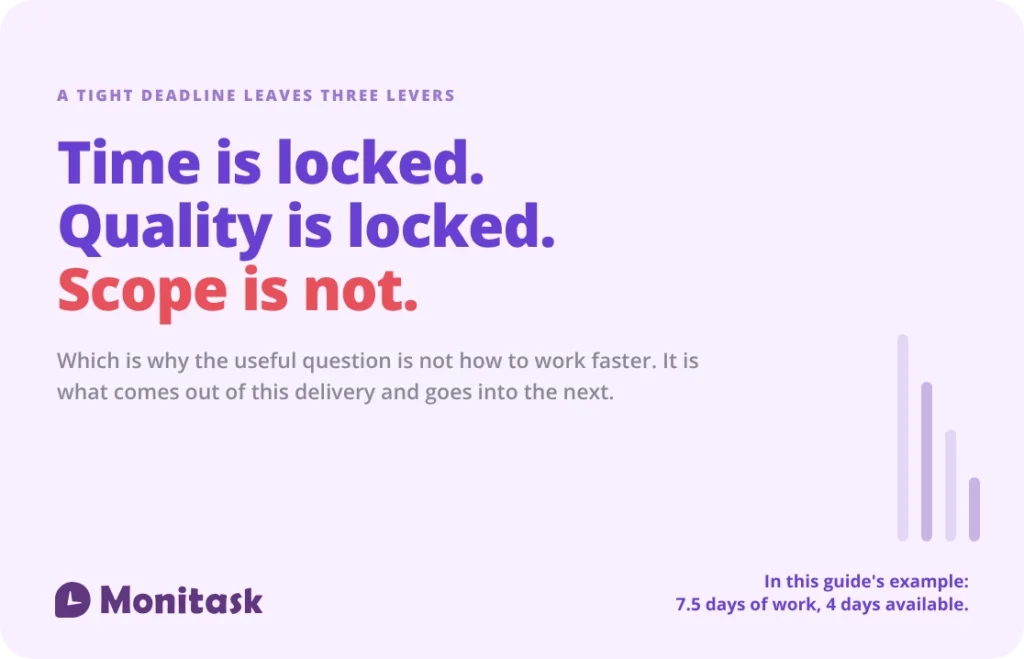
A tight deadline leaves three things you could move: the time, the quality and the scope. The first is fixed by definition and the second is not worth touching, so the work of the next hour is deciding what comes out of this delivery and goes into the next one. Do that before you start, not on the last afternoon when the only option left is working through the night.
In the first hour, before any of the actual work:
- Work backwards from the date, not forwards from today. Not what you can fit in, but what has to be finished each day for the date to hold.
- Find the critical path — the things that must happen before anything else matters.
- Write down what you do not control, and who you need it from.
- Decide what you are not going to do, and say so out loud.
What counts as a tight deadline
A deadline is tight when the work does not fit in the time, and the only way to know that is to measure it. Most people skip the measurement and go straight to feeling rushed, which is why the conversation about the date usually happens too late to be useful.
Here is the example this guide uses throughout. A proposal is due Thursday 17:00. The request arrives Monday 09:00. That is 4 working days.
| What the work actually is | Days |
|---|---|
| Discovery and requirements | 1.5 |
| Draft solution and pricing | 2.5 |
| Internal and legal review | 1.0 |
| Design and assembly | 1.5 |
| Revision buffer | 1.0 |
| Total | 7.5 |
7.5 days of work against 4 available. The gap is 3.5 days, and the estimate is almost twice the time on offer.
That number is the whole point. “This feels rushed” is a mood and invites a reply about priorities. “It is 7.5 days of work and we have 4” is a fact and invites a decision. You cannot produce the second version without spending twenty minutes on the breakdown, which is why the breakdown comes first.
Boost your business productivity
Track performance and streamline teamwork
The first hour: what to do before you start
The strongest instinct under a tight deadline is to start immediately, and it is wrong. An hour spent here is the difference between finding out on Monday that the date cannot hold and finding out on Wednesday night.
Work backwards from the date
Start at the deadline and fill in what has to be true before it, step by step, until you reach today. This is a different exercise from planning forwards and it produces a different answer.
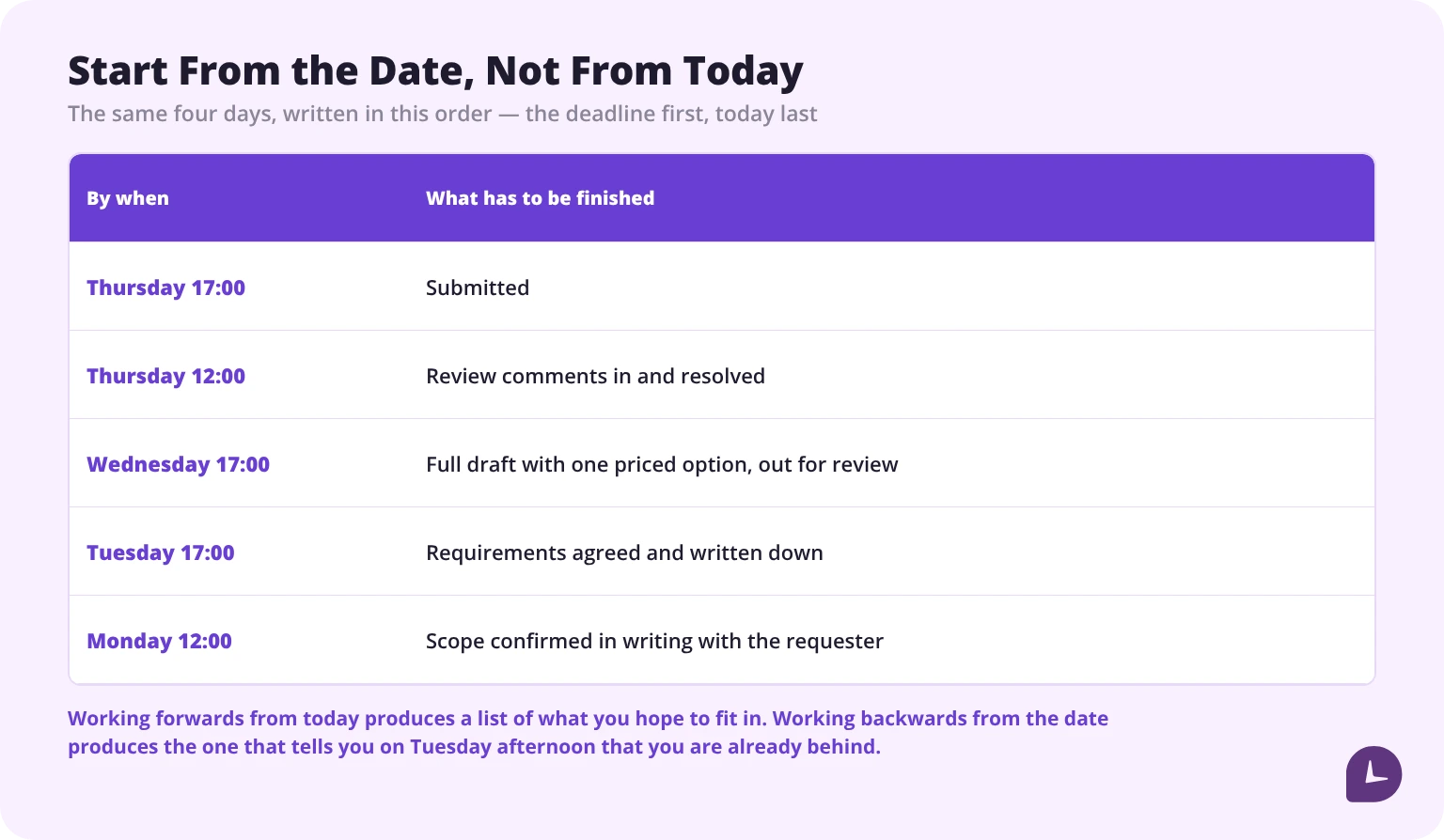
Forwards planning asks what you can get done and always says yes, because you can always get something done. Backwards planning asks what has to be finished by Tuesday evening for Thursday to be possible, and it tells you on Tuesday afternoon that you are already behind — while there is still something to do about it.
If the top of the list cannot be reached from today, you have your answer before you have written a word. how to write a work plan has a template and a worked example if you want the longer version.
Find the critical path
The critical path is the sequence that decides the date. Everything else has slack and can move.
In the example, discovery feeds the draft, the draft feeds both the review and the design, and the design pack cannot start until the draft exists. Review and design can run side by side; discovery and the draft cannot run beside anything. That matters for one specific reason, covered below: it decides what a second person could actually do for you.
Then write down what you do not control. Every item on that list is a date somebody else owns, and each one needs asking for today, not on the day you need it. The review in this example is one working day — if it is requested on Thursday morning it is not one working day, it is however long that person’s queue is.
Once the path is clear, the 1-3-5 rule is a reasonable way to size what is left: one large thing, three medium, five small, per day. The cap matters more than the numbers.
Cut scope, not quality
This is the section that does the most work, and it is missing from almost every practical guide on the subject.
Three levers: time, scope, quality. Time is fixed — that is what makes the deadline tight. Quality is the one people reach for first and should not, because what gets cut is research, checking and revision, and the result is not a faster version of the same thing, it is a worse thing delivered on time. Scope is the only lever that moves without costing you something you cannot get back.
In the example, two genuine scope cuts close the gap:
| Cut | Days saved |
|---|---|
| Deliver as a document rather than a designed pack | 1.5 |
| Price one option rather than three | 1 |
| Drop the revision buffer | 1 |
| Total | 3.5 |
That leaves 4 days of work in 4 days available. It fits exactly, which means it fits only if nothing goes wrong. Say that out loud too. A plan with no slack is a plan that becomes a different conversation the first time a review comes back late, and the person who agreed to it should know that on Monday.
Note what did not get cut: the discovery and the review. Those are the quality. What got cut is how much is in the box.
Then agree it explicitly, in writing, before you start. A scope cut you made silently is not a scope cut, it is a thing you will be asked about on Thursday afternoon. The sentence is simple: by Thursday you get this, and this other part follows a week later. That is not a missed deadline. That is managing the one lever you have.
Deciding what comes out is a prioritisation problem, and how to prioritize tasks covers the methods for it.
How to say a deadline is not achievable
Every guide tells managers to set realistic deadlines. Almost none tells the person who has already been given an unrealistic one what to do about it. Three rules, and then the sentence.
Say it on the first day. The same objection is planning on Monday and an excuse on Thursday. Nothing about the facts changes in between; what changes is that on Monday the person you are telling still has options, and on Thursday they have none. Raising it late is the thing that damages trust, not raising it.
Bring the arithmetic, not the feeling. “This is too fast” can be disagreed with. “Here are the five pieces, here is each estimate, it comes to 7.5 days against 4” can only be engaged with. If your breakdown is wrong, you will find out in that conversation, which is also useful.
Bring options, not a refusal. “I cannot do this” puts the problem back on someone who has fewer facts than you do. Two or three costed alternatives put the decision where it belongs, with the person who gets to choose what matters.
Something like this:
> I have broken the task down. By my estimate it is 7.5 days of work against 4 available. I see three options: deliver a reduced version by Thursday — discovery, the draft with one priced option and the review, delivered as a document rather than a designed pack; deliver the full version by Wednesday midday the following week; or add a second person, which by my estimate buys about 1 day and still leaves us 2.5 days short, so it would need a scope cut as well. Which of those works?
Notice the third option, because it is the one people assume works and usually does not. Adding a person does not divide the work by two. In this example discovery has to finish before the draft can start and the draft has to exist before anything else, so a second person can only take the review and the design pack, which run side by side anyway. The serial total drops from 7.5 days to 6.5 — it buys 1 day against a 3.5-day gap. Even combined with dropping the buffer and pricing one option, it comes to 4.5 days and is still 0.5 short.
Work that out before the meeting rather than during it. “Can we put someone else on it?” is the first thing you will be asked, and “I checked, it buys us about a day” is a much better answer than finding out next Tuesday.
Working the plan: blocking and focus
Once the scope is agreed the problem becomes ordinary, which is itself the relief: there is a plan that fits, and the job is to not lose the time.
Block the critical path first. time blocking is worth more under a tight deadline than at any other time, because the thing that kills a four-day plan is not a four-hour interruption, it is forty ten-minute ones. Put the critical-path work in the calendar as actual blocks before anything else is allowed to claim the time.
Protect the first block of each day. Whatever is on the critical path goes into it. The work that can slip is the work with slack, and you already know which that is.
Ask for the dependencies on day one. The review, the data, the approval: everything you do not control should be requested before you start the work that depends on it, with the date you need it by stated plainly.
Say no to new work by pointing at the plan rather than at yourself. “I am slammed” is a negotiation. “This is due Thursday and here is what is left” is a document.
Protecting the team from burnout
If you are running the delivery rather than only doing it, the sleep-and-hydration advice is not the useful part. Three things matter more.
The overtime is a decision, so make it one. Hours quietly absorbed by whoever is most conscientious are invisible, and invisible costs do not get fixed. If the plan needs a late evening, say which evening and what it buys.
Protect the recovery on the other side. The cost of a crunch is not paid during the crunch, it is paid in the fortnight after it, and a team that goes straight from this delivery into the next one never gets to pay it down. Put the lighter week in the plan before anyone asks for it.
Watch for the person who never raises a problem. They are not the one coping best. They are the one who has learned that raising problems is expensive, and they are the one who will be furthest behind when you eventually find out. overworking symptoms covers what this looks like before it becomes a resignation.
And be honest about which of the two problems you have. A single hard week is survivable and sometimes even good. The same week every month is a different thing with a different fix, and the section after next is about that.
Are tight deadlines good or bad?
Worth one section rather than a whole article, because the honest answer is that it depends on the level and on the kind of work, and the research is more specific than the usual framing suggests.
What a deadline genuinely does. It concentrates attention, it forces prioritisation that would otherwise be avoided, and it makes progress legible. Those are real and they are why deadlines exist.
The one claimed benefit that does not survive checking is the idea that pressure improves creative output. The peer-reviewed finding is an inverted U: creative output peaks at moderate experienced time pressure and falls away at both low and high. And when creativity is split by type, a study of 203 knowledge workers and 41 supervisors found time pressure hampered radical creativity — the genuinely novel work — by undermining how widely people looked for ideas, with only incremental improvement showing the inverted-U pattern.
That is more useful than it first looks, and it is the argument for everything above. If output peaks in the middle of that curve, then once you are past the peak more pressure is costing you work, and the lever that moves you back towards the middle is scope. Not effort.
The diary study people usually cite here — more than 9,000 daily entries from people on creative projects, published in Harvard Business Review rather than a peer-reviewed journal, which is worth knowing — points the same way with a useful distinction. People under high pressure who felt focused and protected described being “on a mission”; people under the same pressure while being pulled in several directions described being “on a treadmill”. The damage in that account comes from fragmented pressure rather than pressure as such, which is why the blocking section matters more than it sounds.
The costs are not in dispute. Less time for research, rushed decisions, less attention to detail, no revision time, and stress that impairs the focus the deadline was supposed to create. That list is the reason the scope lever exists.
Knowing where the hours actually went is what makes the next estimate better than this one.
See where the hours actually went
When tight deadlines are constant
A one-off crunch and a permanent one look identical from inside and need opposite responses.
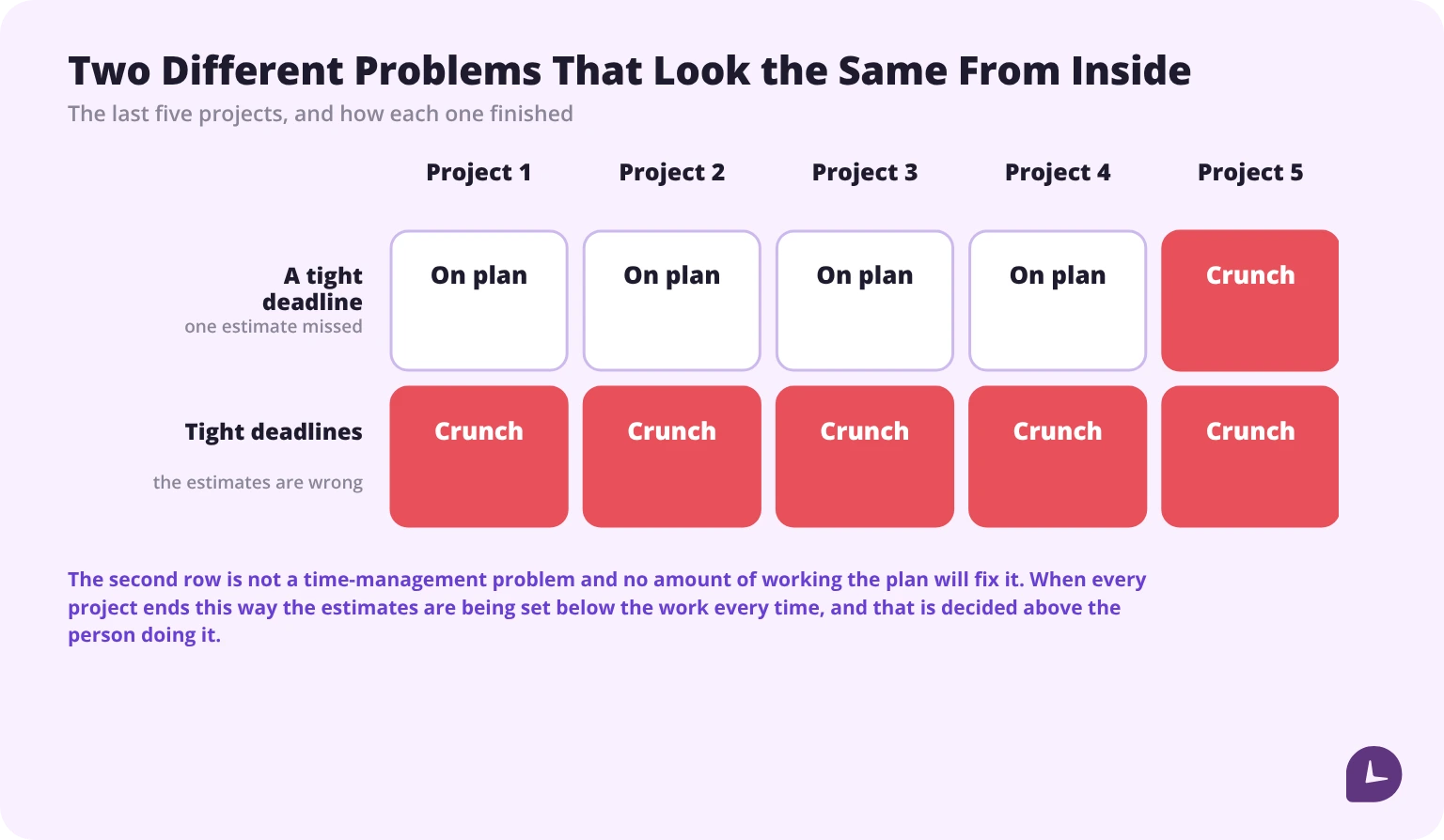
Of your last five projects, how many finished with a crunch? One or two is an estimating miss on those projects and the methods above are the answer. Four or five and the estimates are being set below the work, every time, and that is decided above the person doing it.
The other signs are familiar: estimates always turn out low, overtime has stopped being remarkable, and the quality drop at the end of a project has become predictable enough that people plan around it.
This is not a time-management problem and no amount of working the plan will fix it. It is a planning problem, and it is solved with evidence rather than effort: what the last five projects were estimated at, what they actually took, and the ratio between them. In the example above the ratio is almost twice — 7.5 days of work scheduled into 4. One project like that is an estimating miss. Five is a method.
That number is also the only thing that moves the conversation, because it belongs to whoever sets the dates rather than to whoever works the weekends. Which is the point: this one does not get fixed at your level, and trying to absorb it personally is how a planning defect turns into a health problem.
After delivery: the post-mortem
Half an hour, within a week, while the detail is still available. Four questions.
- Where did the time actually go, and when did the slip become visible? Not who was slow. The gap between when a problem became knowable and when it was raised is the only part worth fixing.
- What did you cut that turned out not to be needed? This is the most valuable question and almost nobody asks it. Scope you dropped and nobody missed was never scope. It should come out of the default next time, not go back in.
- How far off was the estimate? One number: estimated against actual. Keep it. Five of them is the evidence the previous section runs on, and you cannot reconstruct them later.
- What is the one change? One. A review producing five changes produces none, because next time nobody can tell which one worked.
How to answer the interview question
“Tell me about a time you worked to a tight deadline” is asked constantly, and most answers fail the same way: they describe effort. The interviewer is not checking whether you will work hard. They are checking whether you have a method, because someone with a method tells them on Monday and someone without one tells them on Thursday night.
Five parts, in order:
- A specific instance, with the shape of it in one sentence. What, by when, and how much time there actually was. Not “I work well under pressure.”
- What you did first. This is the part that distinguishes the answer: you broke the work down, compared it with the time, and found the critical path. Saying you spent the first hour not working sounds counter-intuitive and is exactly the signal they are listening for.
- Which lever you used. Scope, resources, or a renegotiated date — and why that one. Naming the lever shows you knew there were three.
- The outcome, including what moved. What was delivered on time and what followed later, agreed in advance. A clean “we delivered everything” is less convincing than a specific trade, because interviewers have been on the other side of this.
- What you changed afterwards. One thing. This is the part almost nobody includes and it is the difference between someone who survived a deadline and someone who learns from them.
What not to say: “I just worked late until it was done.” It is the most common answer and it says there was no method, no conversation, and that the same thing will happen again here. If working late genuinely was part of it, put it where it belongs — after the scope conversation, not instead of it.
The estimate you keep from this delivery is what stops the next one being a surprise.
Try Monitask free for 10 days
Sources
- Baer, Markus and Greg R. Oldham (2006), “The curvilinear relation between experienced creative time pressure and creativity: Moderating effects of openness to experience and support for creativity,” Journal of Applied Psychology, 91 (4), 963–970.
- Zhang, Yucheng, Hailin Qu, Frank Walter, Wei Liu and Mo Wang (2023), “A new perspective on time pressure and creativity: Distinguishing employees’ radical versus incremental creativity,” Journal of Organizational Behavior, 44 (9), 1400–1418.
- Amabile, Teresa M., Constance N. Hadley and Steven J. Kramer (2002), “Creativity Under the Gun,” Harvard Business Review, 80 (8), August 2002, 52–61.
- Amabile, T. M., R. Conti, H. Coon, J. Lazenby and M. Herron (1996), “Assessing the work environment for creativity,” Academy of Management Journal, 39 (5), 1154–1184.
- C. Northcote Parkinson, “Parkinson’s Law,” The Economist, November 1955, published anonymously; expanded into Parkinson’s Law: The Pursuit of Progress (1958).
- Brannon, Laura A., Patricia J. Hershberger and Timothy C. Brock (1999), “Timeless demonstrations of Parkinson’s first law,” Psychonomic Bulletin & Review, 6 (1), 148–156.
FAQ
What should I do first when I am given a deadline I cannot meet?
Spend an hour not doing the work. Break it down, compare the total with the time available, work backwards from the date to see what has to be finished each day, and identify the critical path and the things you do not control. Then raise it the same day. An objection on day one is planning; the same objection on the last day is an excuse, and nothing about the facts has changed in between.
How do I tell my manager a deadline is unrealistic?
With the breakdown and two or three options rather than a refusal. Say how many days the work is, how many are available, and then offer the reduced version on time, the full version later, or an extra person with an honest account of what that actually buys. Putting a costed choice in front of someone is a very different conversation from telling them it cannot be done.
Does adding another person to the project help?
Much less than people assume, and you should work out how much before you suggest it. Only the work off the critical path can run in parallel, so in the example a second person takes the review and the design pack, which already overlap. That moves 7.5 days to 6.5 — it buys 1 day against a 3.5-day gap. It usually has to be combined with a scope cut to make any difference.
How do I cut scope without it looking like I failed?
By agreeing it in advance and in writing, which is what makes it scope management rather than a missed deadline. Identify the smallest version that solves the actual problem, move the rest to a named later date, and say the sentence out loud: by Thursday you get this, and this other part follows a week after. A cut you make silently is not a cut, it is something you will be asked about on the day.
Should I just cut quality instead?
No, and the reason is practical rather than moral. What actually gets cut when you rush is research, checking and revision, so what you produce is not a faster version of the same thing, it is a worse thing delivered on time. Scope is the only lever that moves without costing you something you cannot get back, which is why deciding what is not in the box comes before anything else.
Do tight deadlines make people more creative?
Not in the way the claim is usually made. The peer-reviewed finding is an inverted U — creative output peaks at moderate time pressure and falls at both low and high. Split by type, a study of 203 knowledge workers found time pressure hampered genuinely novel work by narrowing how widely people searched for ideas, with only incremental improvement showing the inverted-U pattern. Past the peak, more pressure costs you output.
Is Parkinson's Law real?
Partly, and not in the way it is usually cited. “Work expands to fill the time available” was the opening line of a 1955 *Economist* satire about bureaucratic growth, introduced by its author as a commonplace observation and supported by no evidence at all — his statistics were about the size of the civil service, a different claim. Psychologists did later test it: people told that a later task had been cancelled spent longer on the one in front of them, a result reproduced in two exact replications. So it is a real effect in small lab tasks, not an established law of workplace productivity.
How do I stop every project ending in a crunch?
First establish which problem you have, by counting. If one of your last five projects finished in a rush, that is an estimating miss and the methods in this guide are the fix. If four or five did, the estimates are being set below the work every time, and that is decided above whoever is doing the work. It is solved with evidence — estimated against actual on the last five projects — not with better personal time management.
How should I answer “tell me about a tight deadline” in an interview?
Pick one specific instance and say how much time there actually was. Then: what you did first, which should be breaking the work down rather than starting it; which lever you used, scope or resources or a renegotiated date; what was delivered on time and what was agreed to follow later; and one thing you changed afterwards. Avoid “I worked late until it was done”, which tells the interviewer there was no method and that the same thing will happen again.