

Time management skills are the abilities used to decide what to work on, protect the time to do it, and adjust when circumstances change. Every guide to this subject lists roughly the same nine or ten of them.
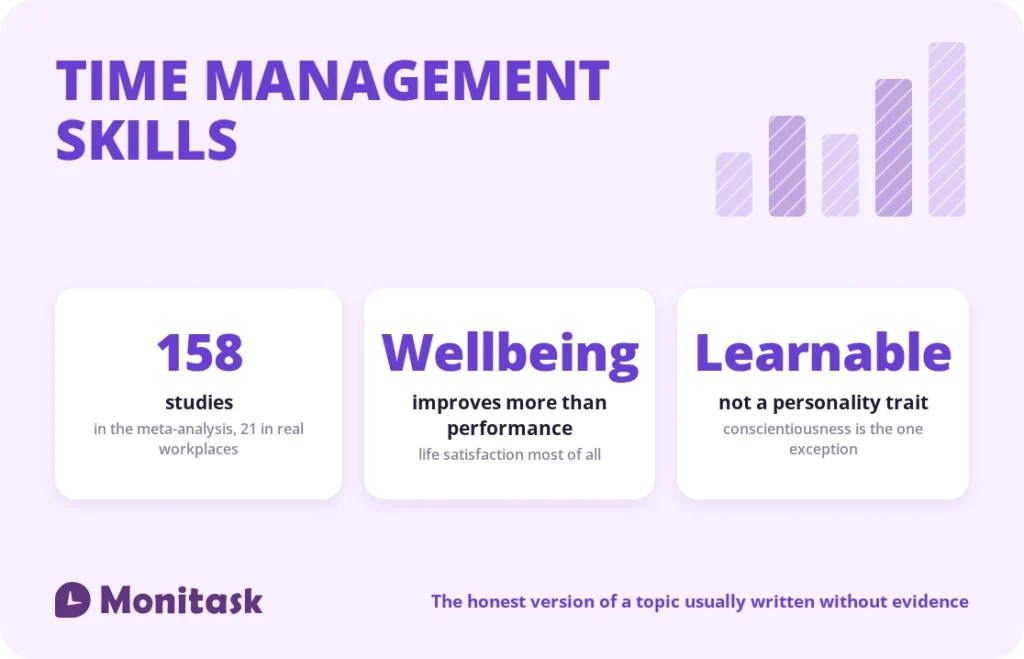
What almost none of them mention is that the question “does any of this work?” has an actual answer. A meta-analysis of 158 studies, including 21 conducted in real workplaces, found that time management is moderately related to job performance and wellbeing — and that it improves wellbeing, particularly life satisfaction, more than it improves performance.
That finding reframes the whole topic. If you are trying to get more done, time management helps modestly. If you are trying to feel less overwhelmed, it helps considerably more. Both are worth having; only one is usually promised.
The same research found that individual differences barely predict time management ability, with conscientiousness the one exception. It is a learnable skill set, not a personality trait.
Quick answer
| Question | Answer |
|---|---|
| What are time management skills? | The abilities to structure, protect and adapt your time |
| The core eight | Prioritisation, planning, estimation, focus management, boundary setting, decision-making, delegation, review |
| Are they learnable? | Yes. Personality explains very little of the variance |
| What do they improve most? | Wellbeing and reduced distress, more than raw output |
| Where should you start? | Diagnosis. The right fix depends on which skill is failing |
| Skills or techniques? | Skills are abilities; the Pomodoro Technique and time blocking are methods for applying them |
What the research actually found
Four findings worth knowing before you invest effort in this.
It works, moderately. Time management shows a moderate positive relationship with job performance, academic achievement and wellbeing, and a moderate negative relationship with distress. “Moderate” is doing real work in that sentence — the effects are genuine and they are not transformative.
Wellbeing benefits more than performance. The researchers note that time management appears to enhance wellbeing, and life satisfaction in particular, to a greater extent than it enhances performance. This directly challenges the way the subject is normally sold.
It is learnable. Individual differences and contextual factors correlate weakly with time management ability, with conscientiousness the notable exception. Nobody is inherently bad at this.
Its value is rising. The link between time management and positive performance reviews has strengthened since the early 1990s, which is consistent with work becoming less structured and more self-directed.
One implication is worth stating plainly. If you are reading this because you feel permanently behind, the realistic outcome is that you will feel meaningfully calmer and somewhat more productive. Guides promising the reverse are describing something the evidence does not support.
Skills, not techniques
The distinction matters because it determines what to fix.
A skill is an ability: prioritisation, estimation, focus management. A technique is a method for applying one: the Eisenhower matrix, the Pomodoro Technique, time blocking, the 1-3-5 rule.
Techniques fail when they are applied to the wrong broken skill. Someone whose problem is that they cannot say no will get nothing from a better task list, because the list was never the constraint. Someone who systematically underestimates will find that time blocking simply relocates the overrun.
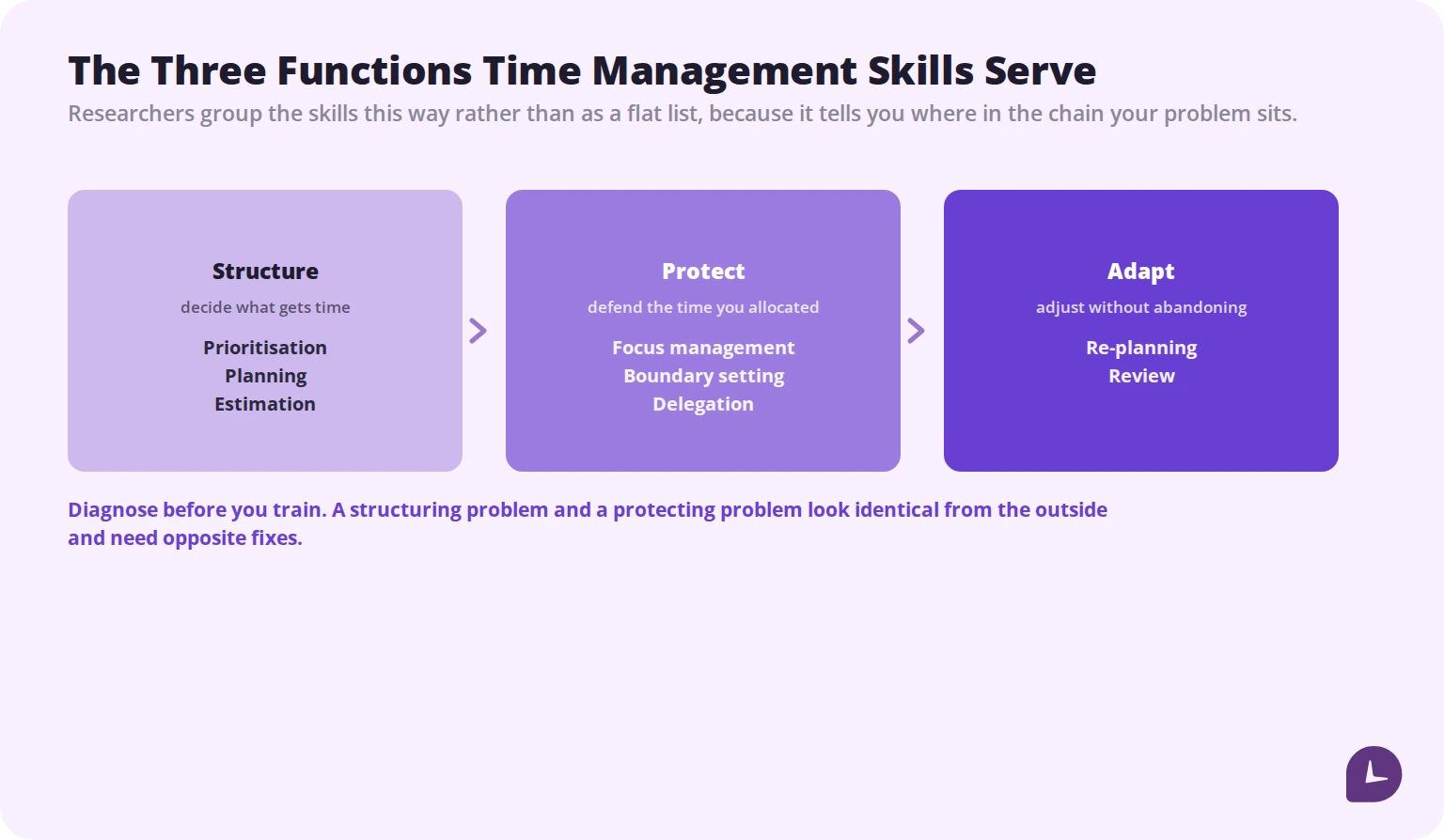
Researchers group the skills into three functions: structuring time, protecting it, and adapting it to changing conditions. That framing is more useful than a list of ten, because it tells you where in the chain your problem sits.
Structure: deciding what gets time
Prioritisation. Deciding what matters, which is harder than it sounds because it requires deciding what does not. The common failure is treating urgency as a proxy for importance, which fills the day with other people’s deadlines. The Eisenhower matrix is the standard method for separating the two; our guide to the time management matrix works through it, and how to prioritise tasks covers the decision itself.
Planning. Turning priorities into a sequence with time attached. A to-do list is not a plan, because it has no capacity constraint: it can hold thirty items for a six-item day and never signal the problem. A plan assigns time and therefore reveals when you have committed to more than exists.
Estimation. Knowing how long things take. Covered separately below, because it is the least trained and most consequential of the three.
Goal setting. Connecting daily work to something longer-term, so that prioritisation has a criterion. Without it, “important” means whatever feels important this morning.
Protect: defending the time you allocated
Focus management. Sustaining attention on one thing. Worth naming precisely: the problem is rarely a shortage of hours and usually a shortage of contiguous hours. Microsoft’s telemetry puts the average interval between interruptions at around two minutes, and no amount of prioritisation survives that. Deep work is the standard framing for the fix, and time blocking is the standard method.
Boundary setting. Declining, deferring and negotiating scope. This is the skill most often mistaken for a personality problem, and it is the one that most reliably determines whether the plan survives contact with other people.
Delegation. Moving work to whoever should hold it. Under-delegation is usually about the cost of explaining rather than trust, which means the fix is documentation rather than willpower.
Managing interruptions. Distinguishing genuine interrupts from things that could have waited, and shaping the environment so fewer arrive. Largely a matter of agreements with colleagues rather than software.
Adapt: changing the plan without abandoning it
The least discussed function and the one that separates people who plan from people whose plans work.
Re-planning. When something urgent arrives, the choice is not between the plan and the interruption. It is deciding which planned item moves. People who lack this skill do not re-plan; they abandon the plan and revert to reacting, which is why one disrupted morning frequently costs the whole day.
Review. Looking back at what actually happened. This is the feedback loop that makes every other skill improve, and it is the one most consistently skipped. Fifteen minutes a week comparing intended against actual will do more than any new technique. A time audit is the structured version.
Recovery. Deliberate rest. Included because sustained attention is a depletable resource, and treating breaks as slack to be eliminated reliably reduces total output.
Diagnosis: which skill is actually broken
Guides prescribe the same nine skills to everyone. The useful move is to work out which one is failing, because the fixes are unrelated.
| Symptom | Likely broken skill | What to fix |
|---|---|---|
| The right work never starts | Prioritisation | Set a criterion for importance, independent of urgency |
| Everything starts, nothing finishes | Focus management | Protect contiguous blocks; reduce work in progress |
| Days end nowhere near the plan | Estimation | Track actual durations for two weeks |
| The plan dies by 10am | Boundary setting | Agree response-time expectations, not availability |
| Constantly busy, output flat | Prioritisation or delegation | Audit where the hours go before adding techniques |
| Fine alone, chaotic with the team | Adaptation | Build re-planning into the day rather than reacting |
| Works long hours, still behind | Estimation plus boundaries | The commitment, not the effort, is the problem |
Two weeks of recorded time answers most of this quickly. Most people are wrong about where their time goes, and consistently so in the same direction: overestimating time on focused work and underestimating time on coordination.
The skill nobody trains: estimation
Estimation is the skill that silently breaks all the others, and it is the one no listicle addresses.
Systematic underestimation of task duration is among the better-documented findings in behavioural research. Kahneman and Tversky named it the planning fallacy: people forecast their own work by imagining it going smoothly, and their predictions cluster near the best case even when they have direct experience of the same work going badly. Knowing about the bias does not correct it.
What does correct it is data. Record intended duration and actual duration for two weeks. Two things emerge:
Your personal multiplier. Most people are wrong by a consistent factor. If your tasks routinely take 1.5 times your estimate, multiplying by 1.5 makes your planning immediately accurate without improving your estimation at all.
Your bad categories. Error is rarely uniform. Most people find one or two task types they systematically underestimate — usually anything involving other people, review cycles, or a dependency they do not control.
This matters more than it appears, because bad estimation looks exactly like bad discipline. A day planned with nine hours of work in eight hours of time will fail regardless of focus, and the person will conclude they lack willpower. The same error at team level is covered in our guide to project planning.
What does not work
Honesty here is more useful than another technique.
Multitasking. Switching between tasks requiring sustained attention degrades performance on both. What feels like parallel work is serial work with a switching cost attached.
Optimising the wrong layer. Reorganising a task list is satisfying and changes nothing if the problem is that you accepted too much work. Time management cannot solve a workload problem, and the most common reason people conclude it “doesn’t work for them” is that they were using it to absorb an unreasonable volume rather than to reduce it.
Planning the whole week in detail. Detail beyond about two days is usually invalidated before it is used, and maintaining it costs more than it returns. Plan the next day or two precisely and the rest in outline.
Scheduling to 100%. A fully allocated day has no capacity to absorb anything unexpected, which guarantees it ends behind. Leave 20–30% unallocated.
Collecting techniques. Trying a new method every fortnight is a way of feeling productive about being unproductive. Pick one per broken skill and run it for a month.
How to improve, in order
Sequence matters, because later steps depend on earlier ones.
1. Measure before changing anything. Two weeks of recorded time. Not a memory of where the time went — the two differ substantially and predictably.
2. Diagnose. Use the table above. Pick the single weakest skill.
3. Fix estimation first if it is on the list. Everything downstream depends on it, and it is fixable with a multiplier in under a month.
4. Apply one technique matched to the broken skill. Time blocking for focus. The Eisenhower matrix for prioritisation. Batching for context switching.
5. Build the review loop. Fifteen minutes weekly, comparing intention against actual. Without this, nothing compounds.
6. Re-measure after a month. If the number has not moved, the diagnosis was wrong. Return to step two rather than adding a second technique.
Most people skip steps one, two and five, which is why step four disappoints.
Demonstrating it in an interview or on a CV
“Strong time management skills” on a CV carries no information, because everyone writes it.
What carries information is a specific situation with a specific outcome. Rather than claiming the skill, describe an occasion when competing deadlines forced a real trade-off, what you decided, on what basis, and what happened. Interviewers are listening for evidence of a criterion, not for evidence of effort.
Three things that land well: an example where you deliberately dropped or deferred something and can explain the reasoning; a process you changed that made a recurring task shorter, with a before and after; and an honest account of a time you got an estimate badly wrong and what you changed afterwards. The third is more persuasive than the first two, because it demonstrates the review loop.
Boost your business productivity
Track performance and streamline teamwork
For managers
Individual time management has a ceiling set by the environment, and past a point the constraint is organisational rather than personal.
Meeting load. Nobody can protect focus time that does not exist in their calendar. If focused blocks are unavailable, that is a scheduling decision the team made, not a discipline failure.
Interruption norms. Whether messages are expected to be answered in two minutes or two hours is a team agreement. Where it is never stated explicitly, everyone assumes the strictest version.
Estimation culture. If estimates are treated as commitments and overruns are penalised, people will pad silently and the organisation loses the data it needs to plan.
Work in progress. Six simultaneous priorities is zero priorities, and no amount of individual skill resolves it.
Training individuals in time management while leaving these unchanged produces frustration, because you have asked people to solve a problem they do not control. Our guide to mastering time management for teams and leaders covers the team-level version.
Common mistakes
Adding a technique before diagnosing the skill. The technique is not the variable.
Relying on memory for where time goes. Recall is systematically wrong, in the flattering direction.
Treating a to-do list as a plan. A list has no capacity constraint; a plan does.
Ignoring estimation. It looks like a discipline problem and it is an arithmetic one.
Using time management to absorb overload. It cannot, and trying is how people conclude it does not work.
Never reviewing. Without the loop, no skill improves.
Expecting a transformation. The evidence supports moderate gains in output and larger gains in how work feels.
How Monitask helps
Every step in this guide starts with measurement, and self-reported time is the least reliable input available. People consistently overestimate focused work and underestimate coordination, in the same direction, which makes recall an unreliable basis for a diagnosis.
Monitask records time as it is spent. Employees clock in when they start and clock out when they stop, so nothing runs in the background without their knowledge, and the record belongs to the person as much as to the manager.

- Time by task and project shows the real distribution, which is the two-week measurement step one asks for.
- Estimated against actual exposes the personal multiplier and the categories you systematically underestimate.
- Application and website reporting makes fragmentation visible, which is the difference between a shortage of hours and a shortage of contiguous ones.
- Weekly and monthly trends provide the review loop that makes each of these skills compound instead of reset.
See how it works: Monitask time tracking software.
Sources
- Aeon, B., Faber, A. and Panaccio, A. (2021), Does time management work? A meta-analysis, PLOS ONE 16(1): e0245066 — 158 primary studies including 21 in workplace settings; moderate relationships with job performance, academic achievement and wellbeing; moderate negative relationship with distress; wellbeing and life satisfaction enhanced more than performance; weak association with individual differences except conscientiousness.
- Aeon, B. and Aguinis, H. — definition of time management as decision-making used to structure, protect and adapt time to changing conditions.
- Kahneman, D. and Tversky, A. — the planning fallacy, the systematic underestimation of task completion time.
- Microsoft, New Future of Work Report — interruption frequency and workday fragmentation drawn from Microsoft 365 telemetry.
Related reading
- Mastering Time Management: A Guide for Teams and Leaders
- Time Management Matrix: Mastering Prioritization
- The Benefits of Time Blocking
- How to Prioritize Tasks
- Time Audit: Where Is Your Time Going?
- What Is Deep Work?
- How to Fight Procrastination
- Project Planning
FAQ
What is the difference between time management skills and techniques?
Skills are abilities; techniques are methods for applying them. Prioritisation is a skill; the Eisenhower matrix is a technique for exercising it.
Does time management actually work?
Yes, moderately. A meta-analysis of 158 studies found moderate relationships with job performance and wellbeing, and a moderate reduction in distress. Notably, it improves wellbeing and life satisfaction more than it improves performance.
Can time management skills be learned?
Yes. The same meta-analysis found individual differences correlate weakly with time management ability, with conscientiousness the only notable exception.
Which time management skill is most important?
Whichever one is currently failing. Estimation is the most commonly broken and the least trained, because bad estimation looks like poor discipline while actually being an arithmetic error.
How do I improve my time management skills?
Measure where your time goes for two weeks, diagnose the weakest skill, apply one technique matched to it, and build a weekly review. Skipping the measurement and the review is why new techniques usually disappoint.
How do I show time management skills on a CV?
With a specific example rather than the phrase itself: competing deadlines, the trade-off you made, the basis for it, and the outcome. An account of an estimate you got wrong and what you changed afterwards is more persuasive than a success story.
Why do time management techniques stop working?
Usually because the technique was matched to the wrong problem, or because it is being used to absorb an unreasonable workload. Time management cannot solve overload; it can only make the trade-offs visible.
Is multitasking a time management skill?
No. Switching between tasks that require sustained attention degrades performance on both and adds a switching cost.
How much of the day should be planned?
Roughly 70–80%. A fully allocated day cannot absorb anything unexpected, which guarantees it ends behind.