Timesheet Errors: What They Cost and Why Review Misses Them

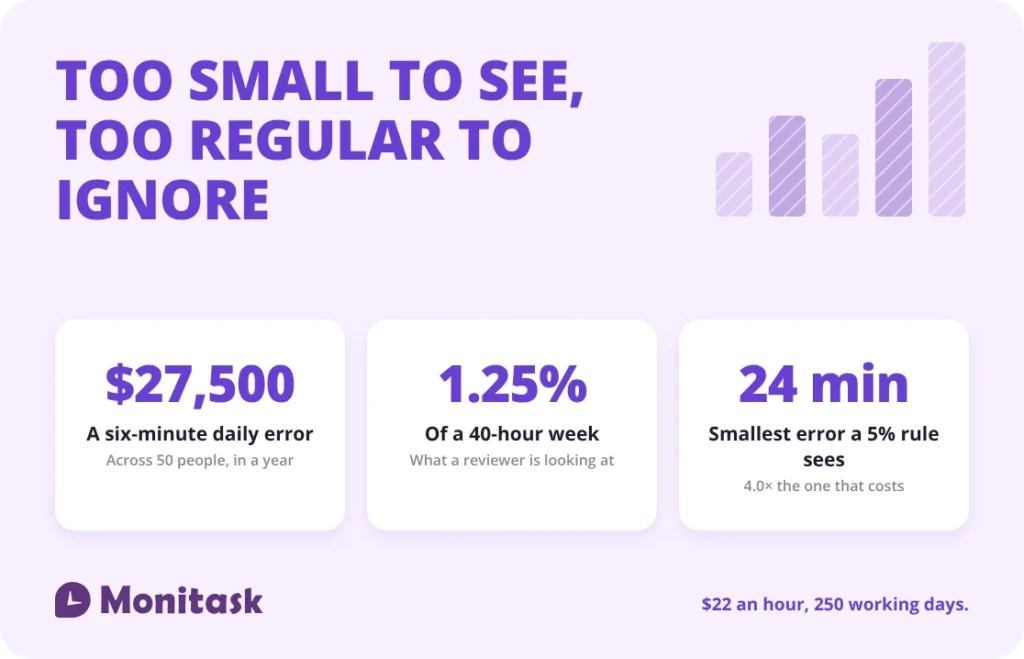
A timesheet error is a difference between hours worked and hours recorded. The expensive ones are small and regular rather than large and rare: 6 minutes a day costs $27,500.00 a year across 50 people at $22.00 an hour, and amounts to 1.25% of a 40-hour week — below the threshold any practical review would flag. Under 29 CFR § 785.11, hours the employer knows or has reason to believe were worked count as hours worked whether or not they were recorded.
> This is not legal advice. The regulations below are quoted as written; whether they apply to a particular situation depends on facts this page cannot know. Check with counsel before changing pay practices. Regulations were checked against primary sources on 22 October 2026.
Key takeaways
- 6 minutes a day = $27,500.00 a year across 50 employees, and 1.25% of a weekly total.
- A 5% exception threshold cannot detect any error smaller than 24 minutes a day — 4 times the error that costs the money.
- A missed punch is not settled by a rule requiring punches: under 29 CFR § 785.13, “The mere promulgation of a rule against such work is not enough.”
- Miscoded hours cost $0.00 in payroll and up to $43,200.00 a year in unbilled work.
- The same 30-minute error is worth $11.00 or $16.50 depending on where the week sits relative to 40 hours.
What counts as a timesheet error?
An error is an unintentional difference between hours worked and hours recorded. That definition carries a boundary worth stating at the outset: deliberate misreporting is a different problem with different remedies, and treating the two together produces controls aimed at dishonesty when the actual cause is a system that makes accurate recording hard.
| Error | What happens | Direction | Who it costs |
|---|---|---|---|
| Missed punch | Clock-in or clock-out not recorded | Usually under-records | Employee |
| Late reconstruction | Hours entered days later from memory | Either way | Both |
| Pre-shift or post-shift work | Setup, handover or closing not captured | Under-records | Employee |
| Interrupted break | Break recorded as taken, work performed during it | Under-records | Employee |
| Duplicate entry | The same shift recorded twice | Over-records | Employer |
| Transposition | 7.5 entered as 5.7, or a date keyed wrong | Either way | Either |
| Wrong cost code | Correct hours, wrong project or task | Neutral in payroll | Employer, in billing |
| Wrong pay attribute | Correct hours, wrong rate or classification | Either way | Either |
| Carry-over across periods | Hours landing in the wrong pay period | Timing only | Both, by timing |
Two properties of this list matter more than its length. Most of these errors under-record rather than over-record, because the common causes — forgetting, reconstructing, working through a break — all remove time rather than add it. And most are small: minutes, not hours. Both properties push in the same direction, which is why the aggregate exposure runs toward unpaid time rather than overpayment.
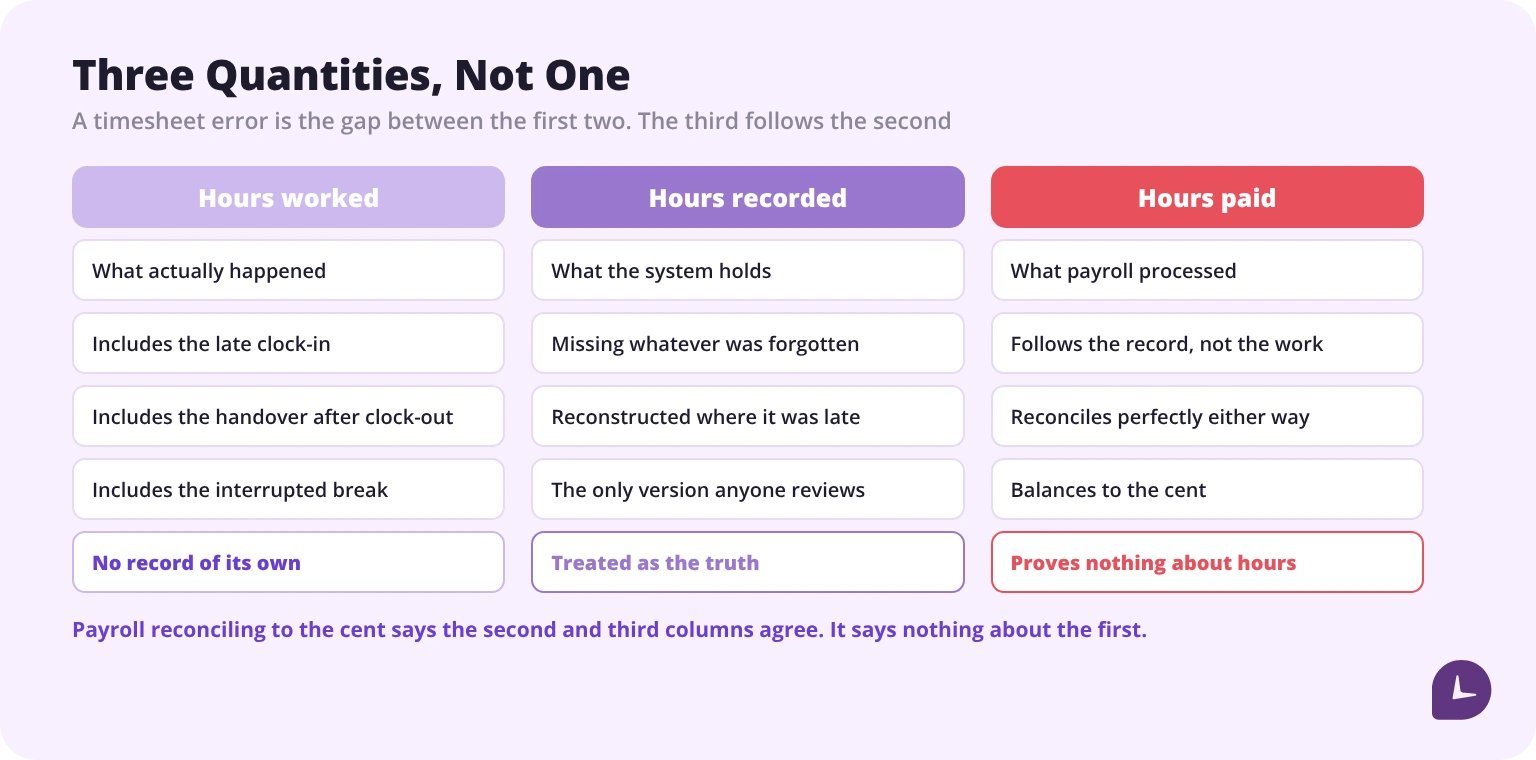
It also helps to separate the three quantities the rest of this page depends on. Hours worked is what happened. Hours recorded is what the timesheet holds. Hours paid follows the record. Payroll reconciling to the cent proves the second and third agree; it says nothing about the first. If you are setting up the record itself, the timesheet templates cover what the fields need to be.
Is a missed punch the employee’s error?
Not in the way it is usually treated. The regulations place the obligation on the employer, and a rule requiring employees to record their time does not discharge it.
| Regulation | What it establishes |
|---|---|
| 29 CFR § 785.11 | Work the employer suffers or permits is work time. The section lists an employee staying on to finish a task, to “correct errors, paste work tickets, prepare time reports or other records” — and then says “The reason is immaterial.” |
| 29 CFR § 785.12 | The same applies away from the premises, including at home: “If the employer knows or has reason to believe that the work is being performed, he must count the time as hours worked.” |
| 29 CFR § 785.13 | Duty of management. “The mere promulgation of a rule against such work is not enough.” Management “cannot sit back and accept the benefits without compensating for them.” |
| 29 CFR § 785.6 | “Employ” is defined by FLSA section 3(g) as “to suffer or permit to work”; the Act itself contains no definition of “work” |
| 29 CFR § 785.8 | “The principles are applicable, even though there may be a custom, contract, or agreement” not to pay for the time — an agreement does not displace the principles |
Read together, these reframe the whole category. An employee who worked and did not record it has produced a defective record, not an absence of worked time. The question an employer faces is not whether the employee followed the recording rule but whether the employer knew or had reason to believe the work happened — and a supervisor who saw the person at their desk, a building access log, an email timestamp or a completed deliverable all speak to that.
Section 785.11 contains a detail that is easy to read past and worth pausing on: among the things it names as work time is an employee staying on to “prepare time reports or other records.” Filling in the timesheet is itself working time. A process that pushes recording to the end of the day, unpaid, is creating the obligation it is trying to document.
The practical consequence is a shift in where effort goes. Reminding people to clock in addresses the symptom; § 785.13 is explicit that a rule alone is not sufficient, and the controls that discharge the obligation are the ones that detect the gap rather than the ones that announce the requirement.
> One citation to handle carefully. 29 CFR § 785.7 is often quoted as though it were a rule that pay is owed for all time an employee is required to be on the premises. It is titled “Judicial construction” and is the Department of Labor summarising case law. Its words are “The workweek ordinarily includes “all the time during which an employee is necessarily required to be on the employer’s premises, on duty or at a prescribed work place”.” — quoting Anderson v. Mt. Clemens Pottery Co., 328 U.S. 680 (1946). The word “ordinarily” is doing real work, and the next sentence adds that “The Portal-to-Portal Act did not change the rule except to provide an exception for preliminary and postliminary activities.” Quoting the phrase without either is how it turns into an absolute entitlement it was never stated as.
What does a six-minute daily error cost?
More than its size suggests, because it recurs. At $22.00 an hour across 250 working days — 261 weekdays in 2026 less the 11 federal holidays:
| Minutes per day | Hours per year | Per employee | Across 50 employees | Across 50, if the hours fall into overtime |
|---|---|---|---|---|
| 3 | 12.5 | $275.00 | $13,750.00 | $20,625.00 |
| 6 | 25.0 | $550.00 | $27,500.00 | $41,250.00 |
| 10 | 41.7 | $916.67 | $45,833.33 | $68,750.00 |
| 15 | 62.5 | $1,375.00 | $68,750.00 | $103,125.00 |
| 30 | 125.0 | $2,750.00 | $137,500.00 | $206,250.00 |
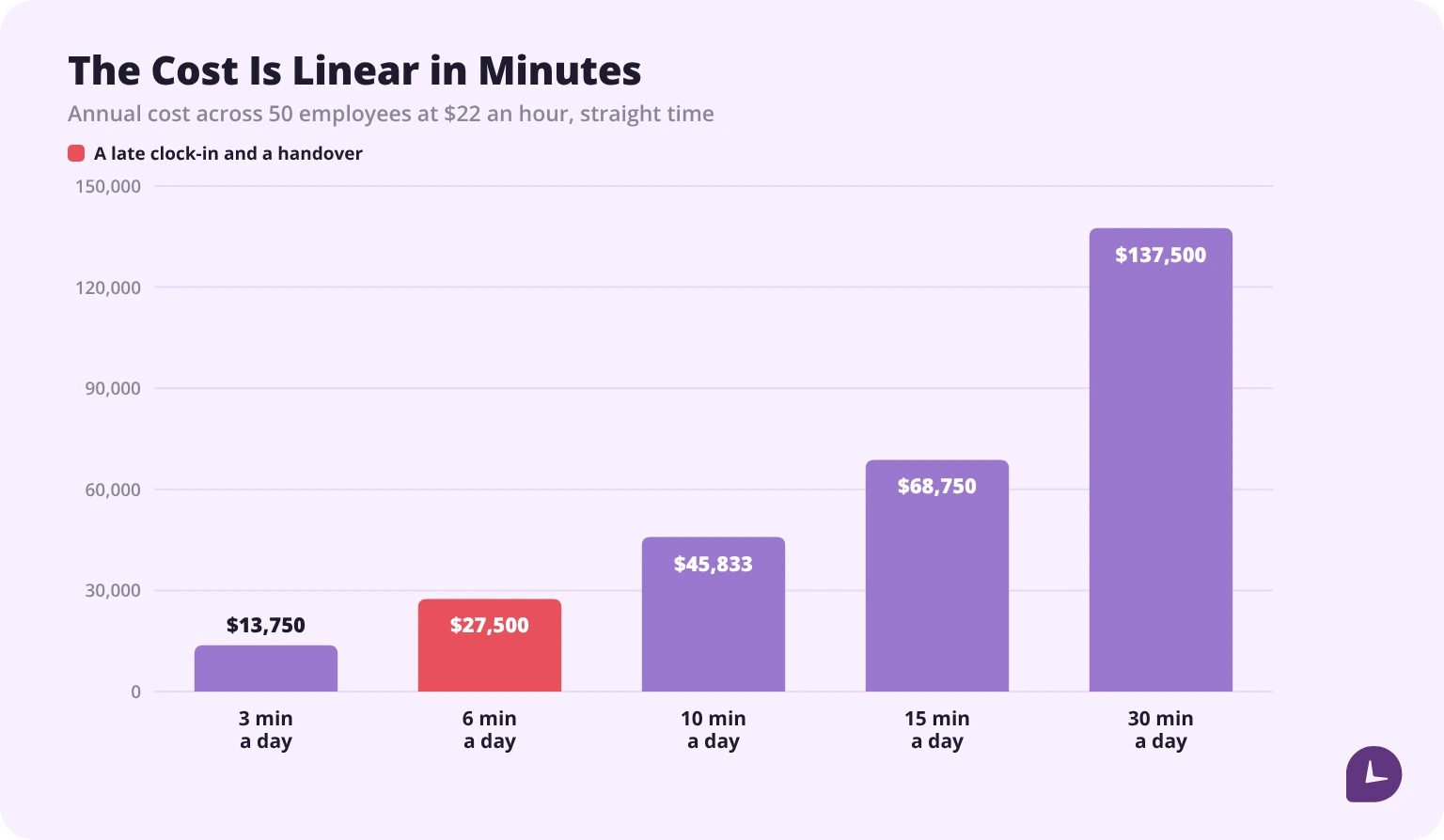
The last column is the worst case: it assumes every unrecorded hour would have fallen into overtime at time and a half. The first assumes none of them would. Neither is what most workforces actually face, and the next section puts a number on where the truth sits.
6 minutes a day is not a careless amount. It is one slightly late clock-in, or a handover conversation after the clock-out, or the two minutes at each end of a break. Nobody notices it on any single day, which is exactly why it persists long enough to reach $27,500.00.
Where does the true cost actually sit?
Between those two columns, and nearer the lower one than most people expect. The figure turns on a single quantity: the share of recovered hours that land above 40, which is not the same as the share of staff who work overtime.
If f is that share, the cost is the straight-time figure multiplied by (1 + 0.5f) — because only the hours crossing the line attract the premium. And f can be worked out from how tightly weekly hours cluster below 40. For weeks spread evenly between a floor and 40, with a weekly error e, only the weeks already within e of the line contribute, which gives f = e ÷ (2 × the spread).
A 6-minute daily error is 0.50 hours a week. So:
| Weekly hours cluster | Share of recovered hours in overtime | Annual cost across 50 |
|---|---|---|
| Straight time only, for comparison | 0% | $27,500.00 |
| 38.0 to 40.0 hours | 12.5% | $29,218.75 |
| 39.0 to 40.0 hours | 25.0% | $30,937.50 |
| 39.5 to 40.0 hours | 50.0% | $34,375.00 |
| Every hour at overtime, for comparison | 100% | $41,250.00 |
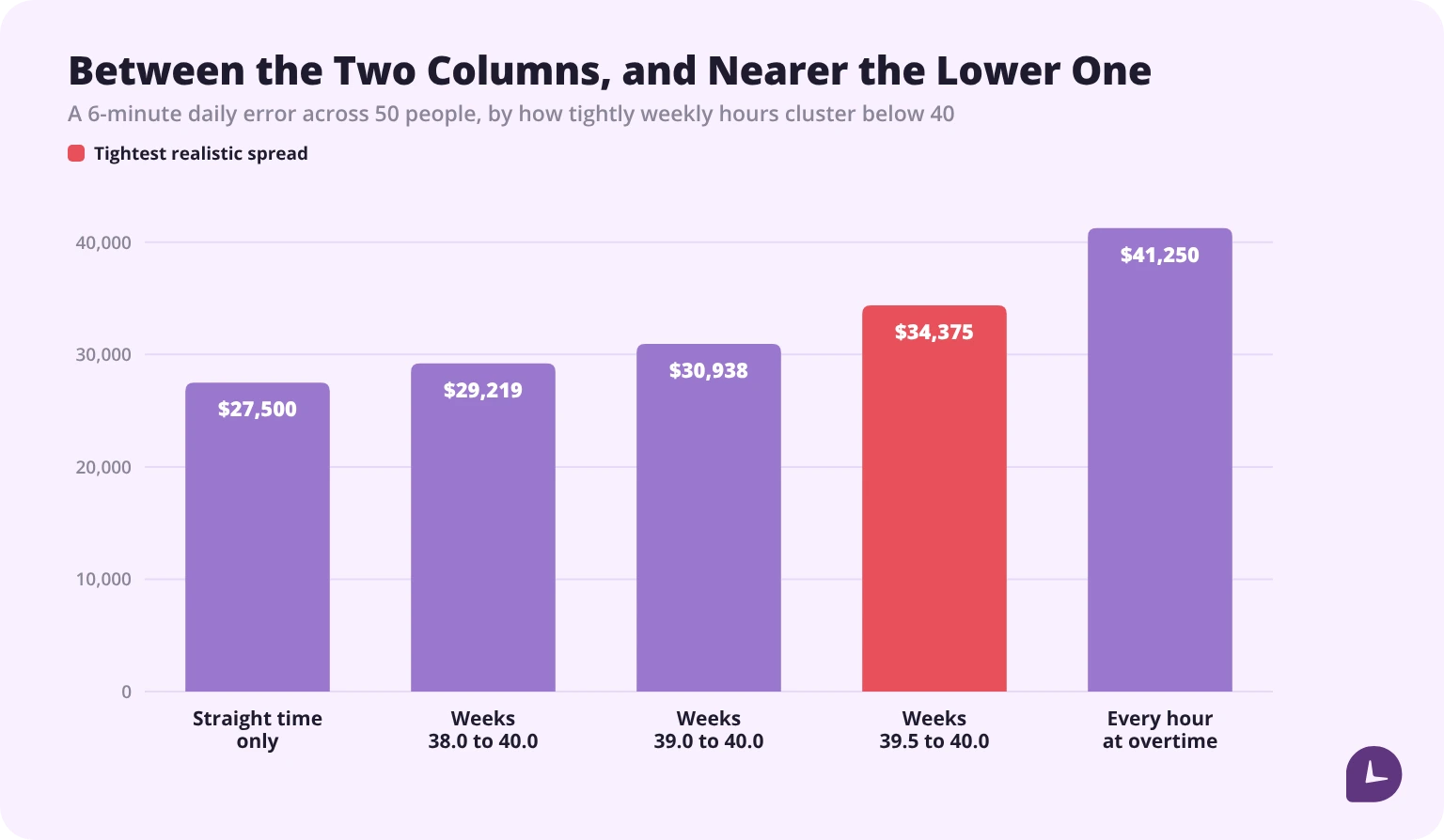
Even the tightest realistic case — every week landing between 39.5 and 40 hours — comes to $34,375.00. Quoting the overtime column as “the cost” overstates that by 20.0%; quoting the straight-time column understates it by the same 20.0%. If you need one number for a business case, the straight-time figure is the defensible one, and the premium is the part you can bound rather than guess.
The model assumes weeks are spread evenly across the band, which no real workforce is exactly. Its use is not precision but direction: it shows that the overtime multiplier moves the answer by tens of per cent, not by the 50% the headline rate suggests, because most recovered minutes never reach the line.
Isn’t six minutes too small to count?
This is the first objection anyone raises, and the regulations answer it directly — in a subpart most discussions of timesheet accuracy never reach. Part 785’s Subpart D is about recording working time, and it contains both the de minimis doctrine and the rounding rules.
Section 785.47 states the doctrine and its limit in the same breath. “An employer may not arbitrarily fail to count as hours worked any part, however small”, and the doctrine reaches only “uncertain and indefinite periods of time involved of a few seconds or minutes duration”.
Both halves matter. Uncertain and indefinite is the test, and a six-minute shortfall that appears every day is neither. It is predictable, it is measurable, and it has a known annual value — which is the opposite of the case the doctrine was framed for. The size of a single instance is not what decides it.
Section 785.48 is the other half, and it is the section that governs rounding. Paragraph (b) permits recording to the nearest 5 minutes, tenth or quarter hour, but frames it as an enforcement accommodation rather than an entitlement: the practice “will be accepted, provided that it is used in such a manner that it will not result, over a period of time, in failure to compensate the employees properly for all the time they have actually worked.” A rounding rule that averages out is within it. One that systematically shortens is not, and the seven-minute rule is only lawful on that condition.
Paragraph (a) is worth quoting in a discussion of error rates, because it anticipates exactly this page’s subject: “Minor differences between the clock records and actual hours worked cannot ordinarily be avoided, but major discrepancies should be discouraged since they raise a doubt as to the accuracy of the records of the hours actually worked.” The regulation does not expect a perfect record. It does treat a large gap as evidence against the record itself.
Two other lines from § 785.48(a) are useful to have in mind. “Time clocks are not required” — the obligation is to the hours, not to any particular instrument. And an employee who voluntarily arrives early or stays late need not be paid for that time “provided, of course, that they do not engage in any work”. The proviso is where pre-shift and post-shift errors live: early clock punching can be disregarded, early working cannot.
Why do the costliest errors escape review?
Because they are too small to clear any threshold a review can practically use. Expressed as a share of a 40-hour week:
| Minutes per day | Minutes per week | Hours per week | Share of a 40-hour week |
|---|---|---|---|
| 3 | 15 | 0.25 | 0.63% |
| 6 | 30 | 0.50 | 1.25% |
| 10 | 50 | 0.83 | 2.08% |
| 15 | 75 | 1.25 | 3.13% |
| 30 | 150 | 2.50 | 6.25% |
| 60 | 300 | 5.00 | 12.50% |
A 6-minute daily error arrives as a weekly total of 39.50 hours instead of 40. Nothing about that figure looks wrong, and a reviewer comparing it against a schedule, a budget or last week sees an ordinary number.
Now run it backwards. A 5% exception threshold on a 40-hour week is 120 minutes a week — 24 minutes a day. Any error smaller than that passes through untouched, however often it repeats.
| Exception threshold | 5% of a 40-hour week |
| In minutes per week | 120 |
| In minutes per day | 24 |
| The error this page is about | 6 minutes — 4× below the floor |
| Its annual cost across 50 people | $27,500.00 |
This is the central problem with the category. The errors that cost the most in aggregate are precisely the ones sitting below any threshold a human review can use, and tightening the threshold does not help — a rule that fires at 1% produces an alert on nearly every timesheet and stops being read. Catching small systematic errors requires comparing the record against an independent signal rather than looking harder at the record itself.
Which errors cost nothing in payroll?
Miscoded hours. The employee worked the hours, recorded the hours and is paid for the hours; only the project or task they were charged to is wrong. It is the one class that never shows up as a payroll mistake, because in payroll terms nothing went wrong.
| Hours charged to the wrong project | 6 |
| Effect on payroll | $0.00 |
| Unbilled to the client at $150.00/hour | $900.00 |
| At 4 occurrences a month | $3,600.00 per month |
| Per year | $43,200.00 |
No check on hours worked will find this, because the hours are correct. It is invisible to payroll reconciliation, to timesheet approval and to any rule that compares recorded hours against scheduled hours. It surfaces only when charged hours are reconciled against what was actually invoiced, project by project — which in most organisations nobody does, because the payroll figure reconciles perfectly.
For a business that bills time, this class is often larger than the payroll-side errors. In this example it is: $43,200.00 against $27,500.00, from four occurrences a month rather than a daily habit. And it is the one most likely to be missing from an error-reduction programme entirely.
Why does the same error cost different amounts?
Because the overtime threshold makes the cost of an hour depend on which hour it is. Thirty minutes of error at $22.00 an hour, with overtime at $33.00:
| Hours recorded | With the error | Pay due | Pay without the error | Difference |
|---|---|---|---|---|
| 38.0 | 38.5 | $847.00 | $836.00 | $11.00 |
| 39.5 | 40.0 | $880.00 | $869.00 | $11.00 |
| 40.0 | 40.5 | $896.50 | $880.00 | $16.50 |
The same half hour is worth $11.00 or $16.50 — half again as much — purely because of where the week already sits. That has a direct consequence for how detection should be designed: controls should be tightest around the 40-hour boundary, where each disputed minute is worth 50% more and where a small recording difference changes the rate applied to it.
It also explains why error cost cannot be estimated from an average hourly rate. A workforce whose weeks cluster just under 40 hours carries a different exposure from one whose weeks cluster at 36, even with identical headcount, rate and error rate — which is the arithmetic the blended figures earlier in this page are built on.
How do you build detection rules that work?
By comparing the timesheet against something that was not derived from the timesheet. Rules that only examine the record inherit its errors.
| Rule | Threshold | Catches |
|---|---|---|
| Recorded hours against scheduled hours, per day | Any difference | Missed punches, duplicate shifts |
| Recorded hours against an independent signal — access log, system login, device activity | Difference above 10 minutes | Small systematic under-recording |
| Shifts with no break recorded | Any shift over the length requiring one | Interrupted or unrecorded breaks |
| Entries created more than 48 hours after the work date | Any occurrence | Reconstruction from memory |
| Identical start and end times repeated across days | 3 or more consecutive identical days | Entries copied rather than recorded |
| Weekly totals between 39.0 and 40.0 hours | Any occurrence, reviewed as a group | Under-recording clustering below the overtime line |
| Edits made after period close | Any occurrence | Changes escaping the normal check |
| One employee’s corrections as a share of all corrections | Above 15% | A person or a workflow failing systematically |
| Hours charged per project against hours invoiced per project | Any difference | Miscoded time |
Three design points make the difference between a rule set that works and one that produces noise. Compare against an independent signal wherever one exists, because that is the only way to see errors smaller than the review threshold. Set each threshold from what the error costs rather than from what looks tidy — the 39.0 to 40.0 band is worth reviewing precisely because of the arithmetic two sections up. And count alerts per reviewer per week: a rule set generating more alerts than anyone can read is the same as no rule set, and the usual failure is adding rules without removing any.
The break rule deserves its own note, because § 785.19 makes it sharper than it looks. A meal period is only unpaid if the employee is completely relieved of duty, and “The employee is not relieved if he is required to perform any duties, whether active or inactive, while eating.” A break recorded as taken, during which a call was answered, is not a break that can be deducted.
How do you correct a closed pay period?
By adding a correcting entry, not by overwriting the original. The reasons are practical as much as regulatory: the original record is the evidence of what was first reported, and once it is overwritten there is nothing to compare an explanation against.
A correction should record five things:
| The original value | What was first recorded |
| The corrected value | What it should have been |
| The work date | Which day the hours belong to, not the date of the correction |
| Who made the change | The person, not a shared account |
| Why | A reason, not a code |
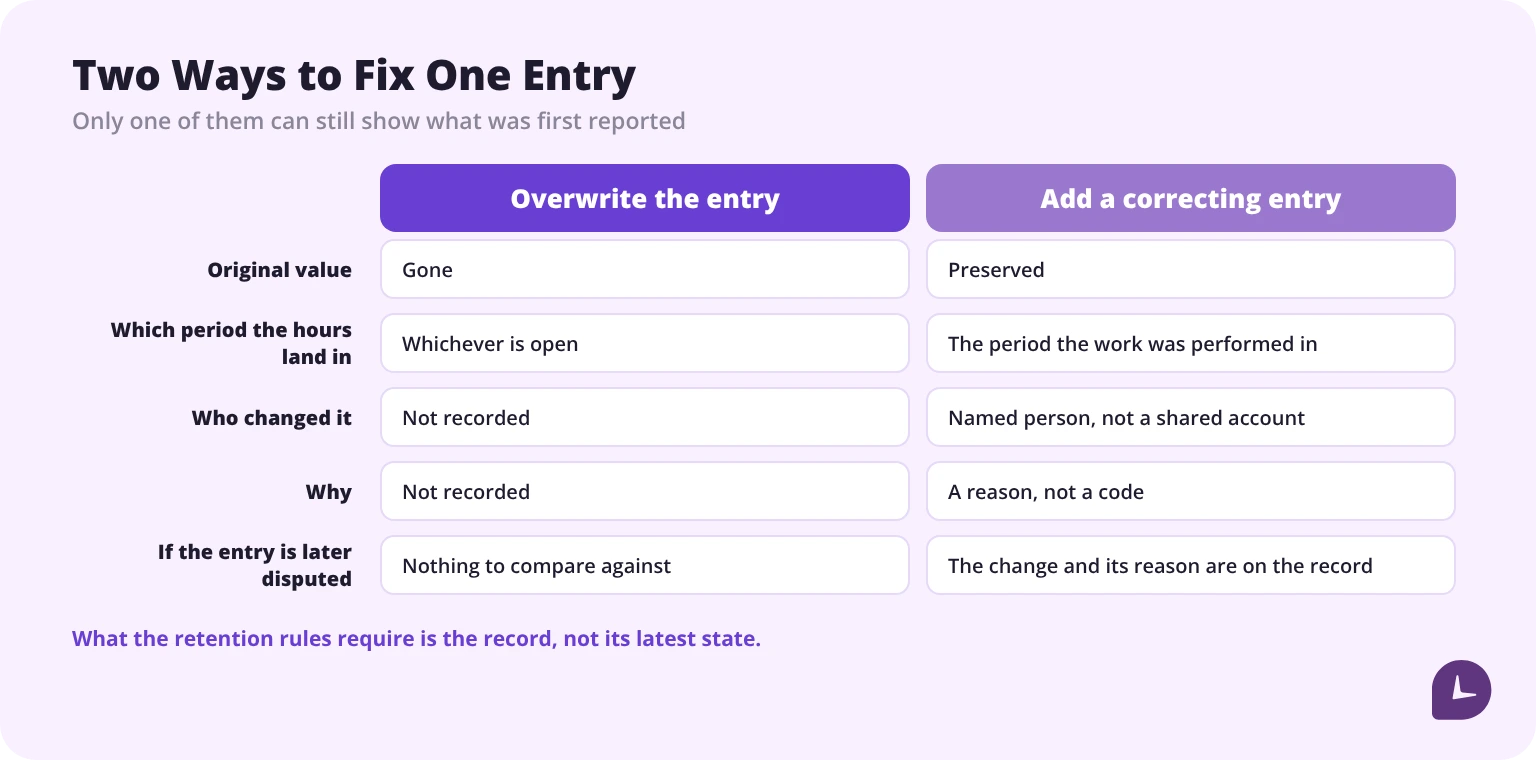
Two further rules keep corrections from creating new problems. Hours belong to the period in which the work was performed, not the period in which the error was found — moving them forward to the current period is simpler to process and misstates both periods, and it changes which week the hours count toward for overtime. And a correction that increases hours should be processed on the same cycle as any other pay item rather than held until a convenient run, since the obligation under § 785.11 attaches to the hours worked, not to the date the record was fixed. Timesheets for payroll covers how that handoff should work.
Where a correction pattern repeats — the same employee, the same shift type, the same day of the week — the correction is treating a symptom. The repetition is the finding.
Which time records must be kept, and for how long?
Part 785 says what counts as hours worked. Part 516 says what has to be written down and kept, and § 785.46 points to it for exactly that reason.
| Record | Citation | Requirement |
|---|---|---|
| Hours worked each workday and total hours each workweek | 29 CFR § 516.2(a)(7) | Must be maintained |
| Total additions to and deductions from wages each period, with the dates, amounts and nature of each | 29 CFR § 516.2(a)(10) | Must be maintained |
| Payroll or other records required by part 516 | 29 CFR § 516.5(a) | At least 3 years from the last date of entry |
| Basic time and earning cards or sheets | 29 CFR § 516.6(a)(1) | At least 2 years from the date of last entry |
| Wage rate tables and piece rate schedules | 29 CFR § 516.6(a)(2) | At least 2 years from their last effective date |
Both periods are floors rather than fixed terms: the regulation says “Each employer shall preserve for at least 3 years:” and, for the shorter group, “Each employer required to maintain records under this part shall preserve for a period of at least 2 years”.
Note what the retention requirement implies for corrections. What must be preserved is the record, not its latest state — so a system that stores only the current value of an entry cannot show what was originally recorded, and the absence of the prior value removes the evidence that the correction was legitimate. Keeping time cards for the longer 3-year period rather than the 2-year minimum avoids spending that 1-year gap holding a payroll record whose underlying hours can no longer be evidenced.
Monitask records hours as they are worked rather than reconstructed afterwards, and keeps an edit history showing the original value, the change, the author and the reason.
See how online timesheets work in Monitask
Sources
- 29 CFR Part 785, Subpart B — Principles for Determination of Hours Worked; §§ 785.6, 785.7, 785.8. U.S. Department of Labor. https://www.ecfr.gov/current/title-29/subtitle-B/chapter-V/subchapter-B/part-785/subpart-B
- 29 CFR Part 785, Subpart C — Application of Principles; §§ 785.11, 785.12, 785.13, 785.19. https://www.ecfr.gov/current/title-29/subtitle-B/chapter-V/subchapter-B/part-785/subpart-C
- 29 CFR Part 785, Subpart D — Recording Working Time; §§ 785.46, 785.47, 785.48. https://www.ecfr.gov/current/title-29/subtitle-B/chapter-V/subchapter-B/part-785/subpart-D
- 29 CFR Part 516 — Records to Be Kept by Employers; §§ 516.2(a)(7), 516.2(a)(10), 516.5(a), 516.6(a)(1), 516.6(a)(2). https://www.ecfr.gov/current/title-29/subtitle-B/chapter-V/subchapter-A/part-516
- Anderson v. Mt. Clemens Pottery Co., 328 U.S. 680 (1946), quoted at 29 CFR § 785.7. https://supreme.justia.com/cases/federal/us/328/680/
All sources checked 22 October 2026. Part 785 carries the source note “26 FR 190, Jan. 11, 1961, unless otherwise noted”; § 785.7 is the only section quoted here that has been amended since, at 76 FR 18859, Apr. 5, 2011.
FAQ
Is a missed punch the employee's fault?
The recording failure is, but the obligation is not discharged by it. Under 29 CFR § 785.11, work the employer suffers or permits is work time and “The reason is immaterial.” Section 785.12 puts the test plainly: “If the employer knows or has reason to believe that the work is being performed, he must count the time as hours worked.” And § 785.13 states that “The mere promulgation of a rule against such work is not enough.”
Is a six-minute daily error de minimis?
Almost certainly not. Section 785.47 says an employer “An employer may not arbitrarily fail to count as hours worked any part, however small”, and confines the doctrine to “uncertain and indefinite periods of time involved of a few seconds or minutes duration”. A shortfall that appears every day is neither uncertain nor indefinite — it is predictable and has a known annual value. The size of one instance is not the test.
What does a small timesheet error actually cost?
At $22.00 an hour across 250 working days, 6 minutes a day is 25.0 hours a year per person — $550.00 each, or $27,500.00 across 50 people at straight time. If weekly hours cluster between 39.5 and 40, where a recovered minute is most likely to attract the overtime premium, it is $34,375.00. Only if every recovered hour fell into overtime would it reach $41,250.00.
Why doesn't timesheet review catch these?
Because they sit below any workable threshold. A 5% exception rule on a 40-hour week cannot see an error smaller than 24 minutes a day, which is 4 times the error that costs the money. Tightening the rule does not fix it — a 1% threshold alerts on nearly every timesheet and stops being read. The only way to see errors below the threshold is to compare the record against a signal that did not come from it.
Can we just round the time instead?
Rounding is permitted, on a condition. Section 785.48(b) accepts recording to the nearest 5 minutes, tenth or quarter hour “provided that it is used in such a manner that it will not result, over a period of time, in failure to compensate the employees properly for all the time they have actually worked.” A rule that averages out over time is within it; one that systematically shortens is not. And the paragraph frames this as an enforcement accommodation, not a right to round.
Which errors are invisible to payroll?
Miscoded hours. The employee worked them, recorded them and was paid for them, so payroll reconciles exactly; only the project charged is wrong. At $150.00 an hour, 6 hours miscoded 4 times a month is $43,200.00 a year of unbilled work and $0.00 of payroll error. It surfaces only when charged hours are reconciled against invoiced hours, project by project.
How should a closed pay period be corrected?
With a correcting entry that preserves the original, not an overwrite. Record the original value, the corrected value, the work date, the person who made the change and the reason. Put the hours in the period the work was performed in, not the period the error was found in, because that is what decides which week they count toward for overtime.
How long do timesheets have to be kept?
Under 29 CFR § 516.6(a)(1), basic time and earning cards or sheets are preserved for at least 2 years from the date of last entry, while § 516.5(a) keeps payroll records for at least 3 years from the last date of entry. Both are floors. Keeping the time records for the longer period avoids a year in which the payroll figure survives but the hours behind it cannot be evidenced.