17 Fireable Offenses: What Justifies Termination and What Gets You Sued

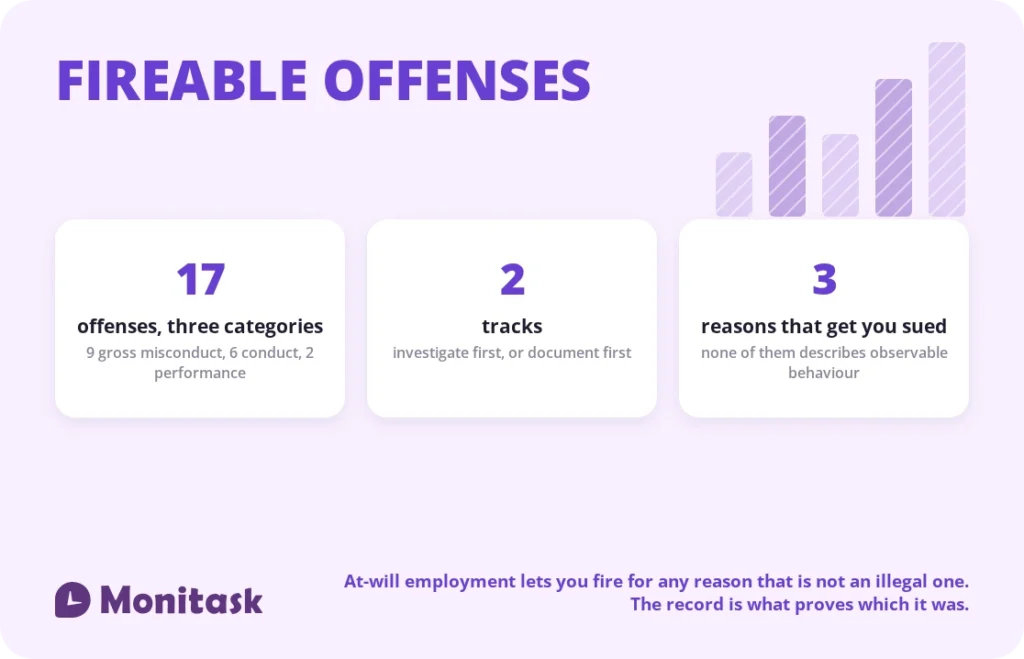
A fireable offense is conduct serious enough to end the employment relationship — but in the US, whether the firing was lawful rarely turns on what the employee did. It turns on whether you documented it, whether you applied the same rule to everyone, and whether the timing looks like retaliation. Below are 17 offenses, split into the ones that justify immediate termination and the ones that require a paper trail first, plus the three vague reasons that generate the most wrongful termination claims.
Key takeaways
- Most US employment is at-will, but four exceptions — discrimination, retaliation, contract, and public policy — make a firing unlawful regardless of what the employee did.
- Gross misconduct such as theft, violence or intoxication usually justifies immediate termination after an investigation, not before one.
- Performance and attendance problems require documented progressive discipline: verbal warning, written warning, improvement plan, termination.
- Retaliation is the most frequently alleged charge filed with the EEOC, and firing someone soon after they complained is treated as evidence of it.
- Inconsistent enforcement is the most common way a legitimate firing turns into a claim.
Reliable employee tracking software. Clear visibility and insights into how employees work. Even remotely.
Try Now
Before the List: What At-Will Employment Does and Does Not Allow
At-will employment means either side can end the relationship at any time, for any reason or no reason. Montana is the only state that departs from this, requiring good cause once an employee finishes a probationary period. Everywhere else the doctrine is the default — and it is narrower than most managers assume.
Four categories of exception turn an otherwise lawful firing into a wrongful termination: discrimination, retaliation, breach of contract, and violation of public policy. Federal law prohibits terminating someone because of race, color, national origin, sex — including pregnancy, gender identity and sexual orientation — religion, age from 40, disability, or genetic information. State law frequently protects more categories than federal law does.
Retaliation deserves separate attention because it is the single most frequently alleged charge filed with the EEOC. Firing an employee days or weeks after they reported harassment, filed a complaint, requested an accommodation, or took protected leave creates circumstantial evidence of a connection, even when your reason is genuine and documented. If any of that has happened recently, the timing alone is a reason to slow down and involve counsel.
One more principle underlies everything below: consistency. Terminating one employee for attendance while quietly tolerating the same pattern in others is how a valid reason becomes a discrimination claim.
Boost your business productivity
Track performance and streamline teamwork
Gross Misconduct: Offenses That Can Justify Immediate Termination
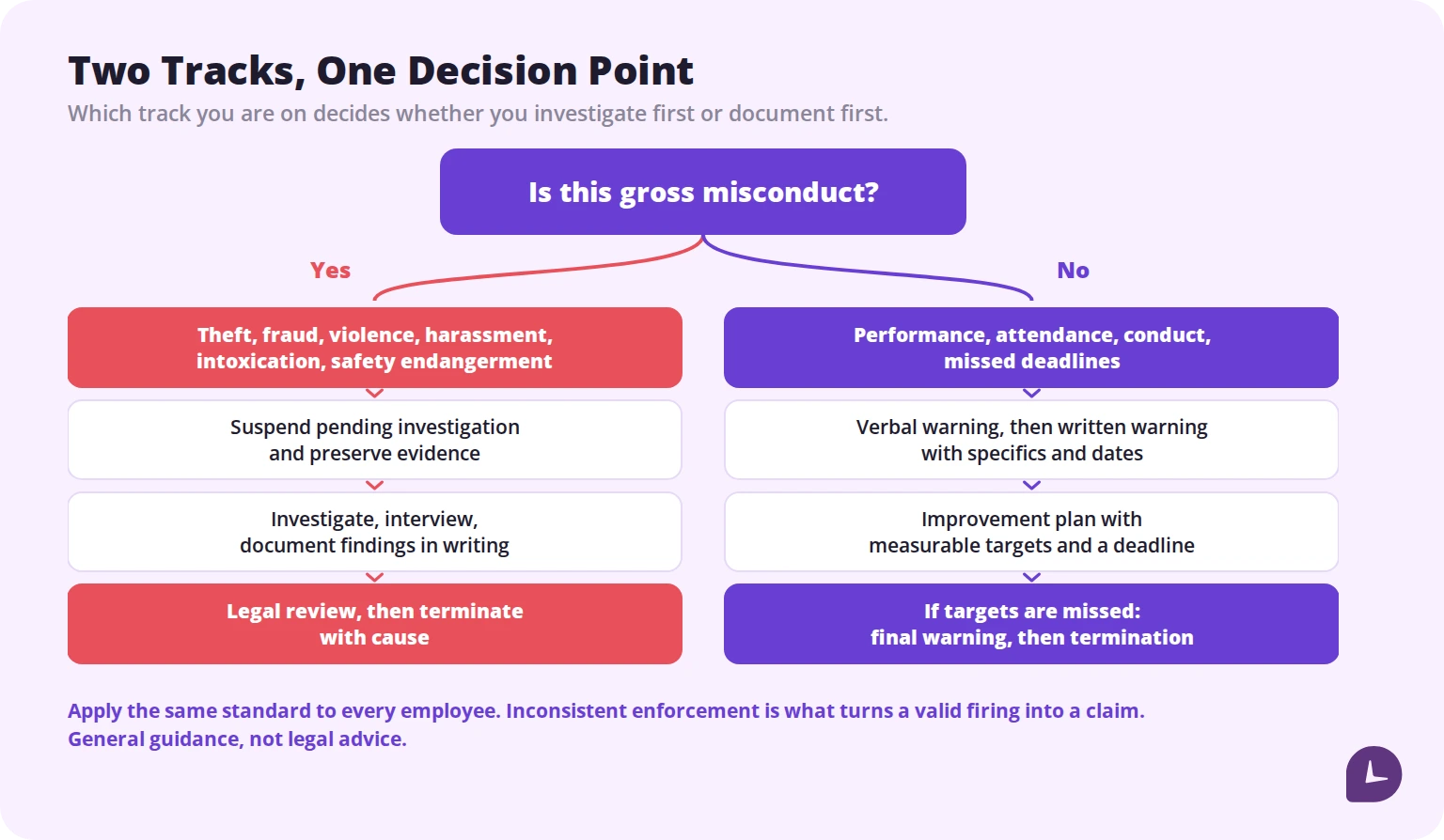
These nine offenses are serious enough that most employers treat them as grounds for termination without progressive discipline. Immediate does not mean instant — it means you suspend, investigate, document, and then act, usually within days rather than weeks.
| # | Offense | Why it qualifies | What to document |
|---|---|---|---|
| 1 | Theft or fraud | Destroys the trust the role depends on and may be criminal | Inventory or financial records, investigation notes, employee’s response |
| 2 | Falsifying records or timesheets | Corrupts payroll, billing and compliance data | Original vs altered records, system logs, dates |
| 3 | Harassment or discrimination | Creates legal liability for the company if left unaddressed | Complaint, investigation file, witness statements, prior reports |
| 4 | Violence or credible threats | Direct risk to the safety of other employees | Incident report, witness accounts, any police involvement |
| 5 | Working under the influence | Impaired judgement creates liability for any resulting harm | Observed behaviour, policy acknowledgement, test results if lawful in your state |
| 6 | Serious safety violations | Endangers coworkers and exposes the company to regulatory penalties | Safety policy, training records, incident report |
| 7 | Breach of confidentiality or trade secrets | Contractual breach with direct commercial damage | NDA, access logs, evidence of disclosure |
| 8 | Undisclosed conflict of interest | Decisions made against the company’s interest | Disclosure policy, evidence of the competing interest |
| 9 | Deliberate destruction or misuse of company property | Intentional damage, not error | Asset records, repair costs, incident report |
Conduct Issues: Offenses That Require a Paper Trail First
These six rarely justify a first-incident termination. They justify it after documented warnings that went unheeded — which is precisely what makes the eventual termination defensible.
| # | Offense | Typical response | What to document |
|---|---|---|---|
| 10 | Insubordination | Verbal then written warning; termination on repetition | The instruction given, the refusal, the context |
| 11 | Attendance and punctuality problems | Written warning against a stated attendance policy | Attendance records, policy acknowledgement, warnings issued |
| 12 | Time theft | Investigation; termination if deliberate and repeated | Timesheet vs system activity records, prior warnings |
| 13 | Repeated policy violations | Progressive discipline against the specific policy | The policy, the acknowledgement, each violation with dates |
| 14 | Misuse of company systems or social media | Warning; termination if confidential or reputational damage | Usage policy, logs, the material in question |
| 15 | Unprofessional conduct toward colleagues or clients | Warning, coaching, termination if it continues | Specific incidents with dates, witnesses, client complaints |
Performance Issues: Offenses That Need an Improvement Plan
Two of the 17 are not misconduct at all. They are capability problems, and firing someone for them without a documented improvement process is the weakest position an employer can be in.
| # | Issue | Typical response | What to document |
|---|---|---|---|
| 16 | Persistent failure to meet performance standards | Performance improvement plan with measurable targets and a deadline | The standard, the gap, the plan, the review dates |
| 17 | Chronic missed deadlines | Written warning, then a plan with specific deliverables | Assigned deadlines, actual delivery dates, impact |
The Three Reasons That Get Employers Sued
Every one of these appears in real termination letters. All three are legally weak because none of them describes observable behaviour.
“Poor attitude”
Attitude is an interpretation, not a fact, and interpretations correlate uncomfortably well with who the manager likes. If the problem is real, it can be stated as behaviour: refused three assigned tasks in June, spoke over colleagues in two documented meetings, told a client the deadline was unrealistic without escalating internally first. Write those. Do not write “bad attitude”.
“Poor communication”
Same problem, and it carries added risk: communication style varies with culture, language, neurodivergence and disability. A termination reason phrased this way invites the question of whether the real objection was to the person rather than the performance. Describe the missed handovers and the unanswered escalations instead.
“Not a culture fit”
The most dangerous of the three. It has no objective content, which means the plaintiff’s lawyer gets to fill it in. If the underlying issue is documented conduct or missed targets, name that instead.
What Defensible Documentation Actually Looks Like
The test is simple: could a stranger reading the file six months later reconstruct what happened and conclude the decision was reasonable? A defensible file contains five things.
- The written policy or standard, and evidence the employee acknowledged it.
- Specific incidents with dates, not summaries of a general pattern.
- Each warning issued, in writing, with the employee’s response recorded.
- Evidence the same standard was applied to comparable employees.
- Objective records — attendance, timesheets, system logs — rather than recollection.
That last point is where most files are weakest. Managers reconstruct attendance and missed deadlines from memory months later, and memory is the first thing challenged. Employee performance logs and automatic time records give you dated evidence that existed before the dispute did, which is worth more than any account written after it started.
A caution on monitoring data: it only supports a termination if the monitoring was disclosed, applied to the whole team rather than one person, and consistent with your written policy. Data collected selectively after you decided to fire someone reads as pretext, not evidence.
Maximize productivity of your business.
Start Your 10-Day Trial
The Termination Meeting
Keep it short and factual. Two people from the company should be present — the manager and an HR representative or second witness. State the decision, the effective date and the reason in one or two sentences, using the documented facts. Do not negotiate, do not soften the message into ambiguity, and do not add reasons you have not documented.
Cover the practicalities in writing: final pay and when it arrives, unused leave, benefits continuation, return of equipment, and any post-employment obligations that survive termination. Final pay deadlines vary by state, and several states require payment on the last day, so confirm your obligation before the meeting rather than after it. Our step-by-step termination guide covers the sequence in more detail.
After the Termination
Revoke system access on the effective date, not the following week — this is the most common gap in offboarding. Recover company property. Preserve the documentation file rather than archiving the employee’s records into oblivion; claims can be filed months after the fact and the file is your defence. Then tell the remaining team something factual and brief. Silence generates worse stories than a plain statement does.
Key Takeaways
Sixteen of these 17 offenses are defensible reasons to end employment. What determines the outcome is not which one you cite but whether you can show a written standard, dated evidence, consistent enforcement, and a decision made for the documented reason rather than around it.
Attendance and hours are the categories where evidence most often falls apart, because they depend on records nobody kept at the time. Monitask logs hours, activity and attendance automatically while employees are clocked in, so the record exists before you need it. Try it on a 10-day free trial, no card required.
This article is general information about US employment practice, not legal advice. Employment law varies by state and by situation. Consult an employment attorney before terminating an employee, particularly where a protected characteristic, a recent complaint, a contract or a leave request may be involved.
Reliable employee tracking software. Clear visibility and insights into how employees work. Even remotely.
Try Monitask free for 10 days
FAQ: Reasons to Fire Someone
Can an employer fire someone immediately?
For gross misconduct, usually yes, though the sequence should be suspend, investigate, document, then terminate. Acting before the investigation is what turns a defensible decision into a contested one.
Is poor attitude a fireable offense?
It can be the underlying cause, but it is a poor reason to state. Attitude is subjective and hard to evidence. Document the specific behaviours instead — refused assignments, missed handovers, incidents with clients — and cite those.
What makes a termination wrongful?
Firing someone for a reason the law prohibits: discrimination based on a protected characteristic, retaliation for protected activity, breach of an employment contract, or a reason that violates public policy such as refusing to break the law or taking jury duty.
Do I have to give a warning before firing someone?
At-will employment does not require one, but for performance and conduct issues warnings are what make the decision defensible later. For gross misconduct, warnings are usually unnecessary and can be inappropriate.
Can monitoring data be used to justify a termination?
It can support one when the monitoring was disclosed in advance, applied across the team, and consistent with your written policy. Data gathered selectively about one employee after the decision was made undermines rather than supports the case.
What should be in the termination file?
The written standard and its acknowledgement, dated incidents, every warning issued and the employee’s response, evidence of consistent enforcement with comparable employees, and objective records such as attendance and timesheets.