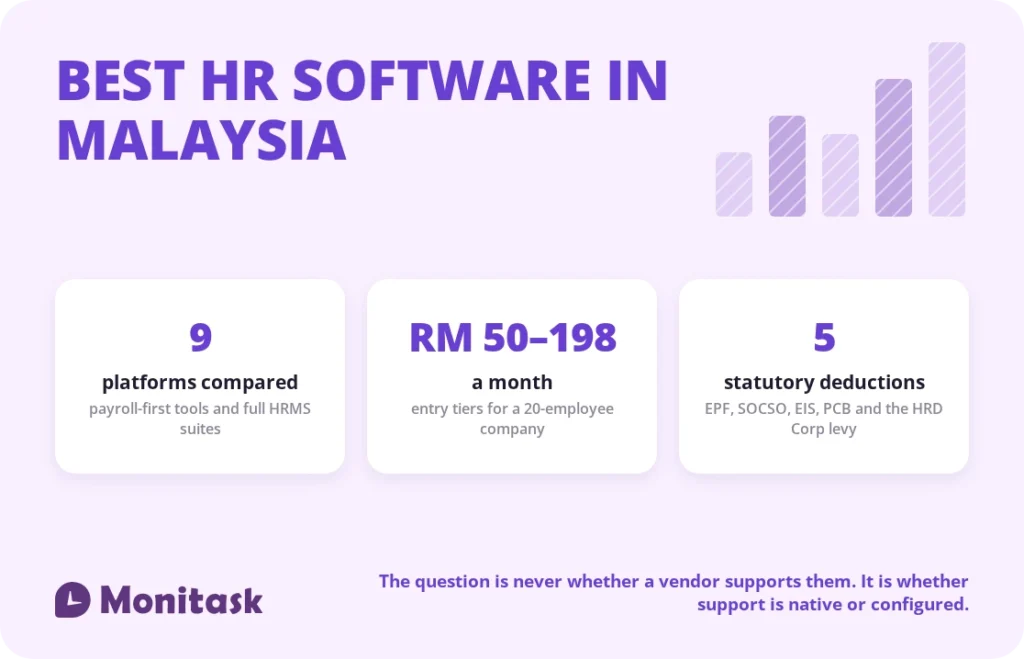
Malaysian HR software lives or dies on one thing: whether it gets EPF, SOCSO, EIS, PCB and the HRD Corp levy right every month without your team chasing circulars. Nine platforms below cover that, at prices running from about RM 50 a month for a small payroll to quote-based enterprise contracts. The shortlist splits cleanly by what you actually need — payroll-first tools for micro teams, full HRMS suites once headcount passes 50, and a separate time tracking layer if your people work remotely or bill by the hour.
Key takeaways
- Payroll-first tools like PayrollPanda and Kakitangan start under RM 100 a month for a small team.
- Full HRMS suites — BrioHR, altHR, Swingvy — make sense from roughly 50 employees up.
- Any platform you shortlist must handle EPF, SOCSO, EIS, PCB and HRD Corp natively, not through manual configuration.
- EA forms, Form E, CP39 and CP8D generation is the feature buyers most often discover they need after signing.
- Time tracking is usually a separate tool: most Malaysian payroll platforms record attendance, not proof of work.
Reliable employee tracking software. Clear visibility and insights into how employees work. Even remotely.
Try Now
The 9 Platforms at a Glance
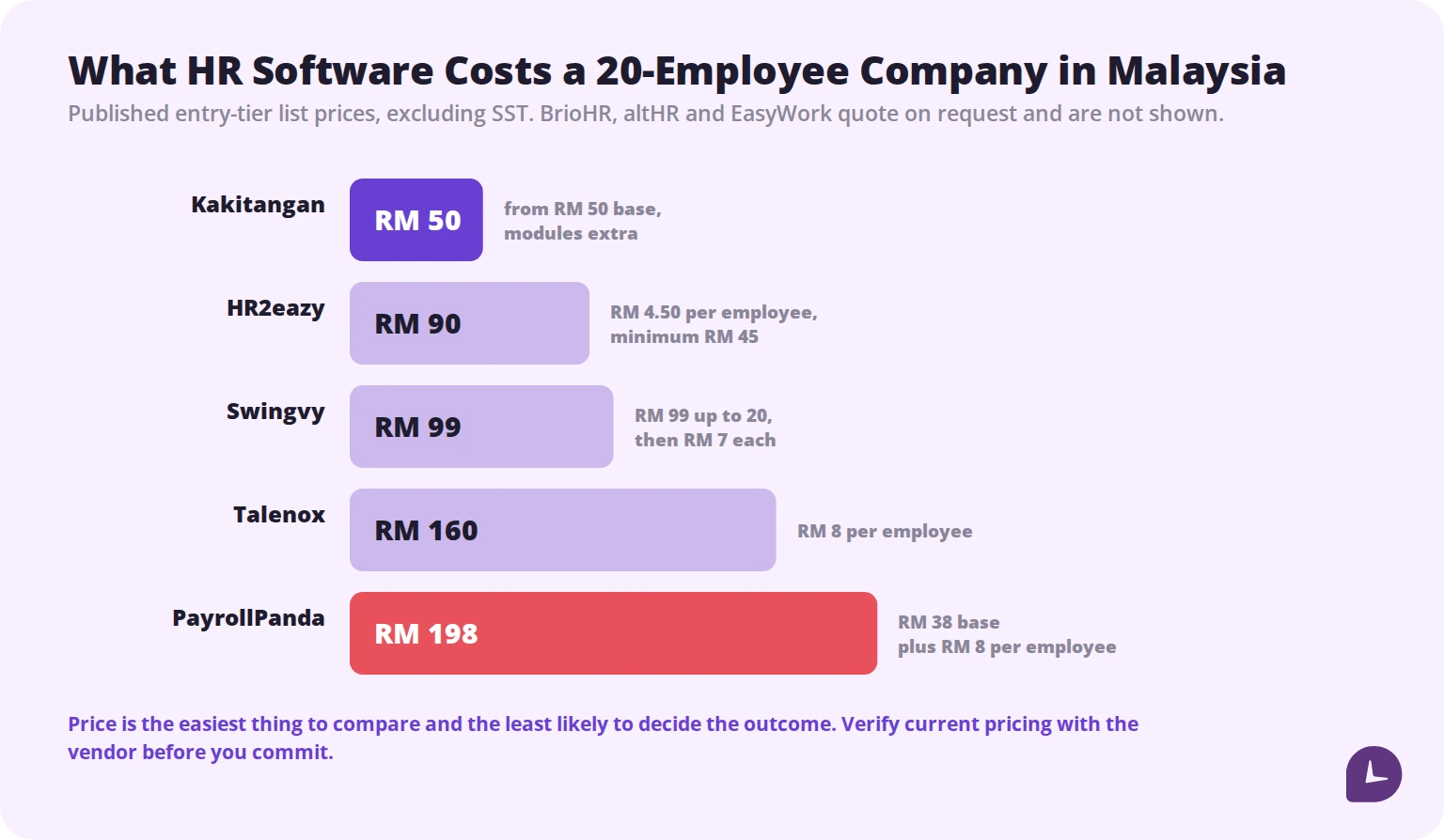
Prices below are published entry tiers, excluding SST. Three vendors quote on request, which in this market usually means pricing scales with modules rather than headcount alone.
| Platform | Best for | Statutory coverage | From |
|---|---|---|---|
| Monitask | Time tracking and proof of work for remote or billable teams | Not a payroll system — pairs with one | USD 6.49 / user / mo |
| PayrollPanda | Micro businesses that want payroll and nothing else | EPF, SOCSO, EIS, PCB, HRD Corp | Free tier, then RM 38 + RM 8 / employee |
| Kakitangan | Local payroll simplicity for small teams | EPF, SOCSO, EIS, PCB, HRD Corp | RM 50 / mo, modules extra |
| Talenox | Finance-led teams running Xero or QuickBooks | EPF, SOCSO, EIS, PCB | RM 8 / employee / mo |
| HR2eazy | SMEs wanting HR and payroll in one low-cost system | EPF, SOCSO, EIS, PCB | RM 4.50 / employee, min RM 45 |
| Swingvy | Small teams that care about interface quality | EPF, SOCSO, EIS, PCB | RM 99 up to 20 employees + RM 7 each |
| EasyWork | Mobile-first attendance, leave and staff rewards | Attendance and leave, payroll via modules | On request |
| altHR | Malaysian SMEs wanting leave plus performance management | EPF, SOCSO, EIS, PCB, HRDF | Free starter plan, 30-day trial |
| BrioHR | Growing SMEs needing the full employee lifecycle | EPF, SOCSO, EIS, PCB, HRD Corp, EA, CP39, Form E, CP8D | On request |
What Malaysian Statutory Compliance Actually Requires
Five deductions have to come out of a Malaysian payroll run correctly: EPF, SOCSO, EIS, PCB and the HRD Corp levy. EIS is set at 0.4% of assumed monthly wages, split evenly between employer and employee. EPF contributions and monthly tax deductions are both due by the 15th of the following month, so a payroll system that files late is a system that costs you penalties.
The question to ask a vendor is not whether they support these, but whether support is native or configured. Native means the contribution tables update automatically when the government revises rates. Configured means somebody on your team applies each LHDN or PERKESO circular by hand — which works right up until the month nobody notices the circular.
Year-end is the second trap. EA forms for employees, Form E for the company, CP39 for monthly submissions and CP8D for the employee listing all have to come out of the same data. Platforms that generate them in one run save days of reconciliation; platforms that do not push that work back into spreadsheets.
Boost your business productivity
Track performance and streamline teamwork
How to Choose HR Software in Malaysia
Work through five questions before you look at a single demo. The answers narrow nine options down to two or three faster than any feature comparison.
1. What is your headcount, and where will it be in two years?
Under 20 employees, a payroll-first tool is enough and a full HRMS is overhead you will not use. Between 20 and 200, the calculation flips: leave approvals, claims and onboarding start costing more admin time than payroll itself. Above 200, or across more than one legal entity, ask specifically about multi-entity payroll — several SME platforms handle it awkwardly.
2. Does leave and attendance feed payroll directly?
Manual import between an attendance system and a payroll system is the single largest source of payroll errors in Malaysia. If the two live in different tools, confirm the integration exists and works both ways before you buy.
3. Are the statutory tables native or configured?
Covered above, and worth asking twice. Vendors answer this question loosely in sales calls.
4. What does year-end look like?
Ask the vendor to show you an EA form and a Form E generated from demo data. If they cannot produce one in the call, your HR team will be producing them by hand every February.
5. Who proves the hours?
Payroll systems record attendance — clock-ins, leave balances, approved overtime. They do not show what was worked on. For agencies billing clients, BPO teams, or anyone managing remote staff, that gap gets filled by a separate employee time tracking tool feeding hours into payroll.
The 9 Best HR Software Platforms in Malaysia
1. Monitask — time tracking and proof of work
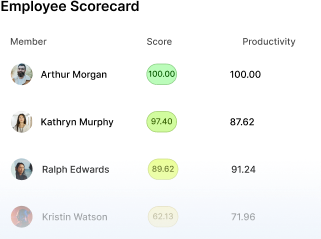
Monitask is not an HRIS and does not calculate payroll. It sits one layer earlier: automatic time tracking, screenshots as proof of work, website and app logging, and productivity scores, all recorded only while an employee is clocked in. For Malaysian agencies, BPO providers and software teams billing clients by the hour, that is the data payroll and invoicing both depend on, and it is exactly what a payroll-first platform does not capture.
Best for: remote, hybrid and billable teams that need defensible hour records.
Key features: automatic online timesheets, proof-of-work screenshots with sensitive-content blurring, app and URL tracking, project and task time, idle detection, mouse jiggler detection, productivity reports per person and project.
Pricing: from USD 6.49 per user per month on annual billing, 10-day free trial, no card required.
Limitation: pair it with a local payroll platform — Monitask does not file EPF, SOCSO or PCB.

2. PayrollPanda — payroll for micro businesses
PayrollPanda, part of Jibble Group, is the cheapest legitimate entry point into compliant Malaysian payroll. It covers EPF, SOCSO, EIS, PCB and HRD Corp, generates CP8A, EA, PCB2(II) and BNCP forms, and connects to major Malaysian banks for salary transfers. Leave management, claims and employee self-service come with it.
Best for: businesses under about 50 employees that want payroll automated and nothing else.
Pricing: free tier for very small teams; paid from RM 38 per month per company plus RM 8 per employee, with roughly 15% off on annual billing.
Limitation: deliberately narrow. Performance management, recruitment and deeper HR modules are not part of the product.
3. Kakitangan — local compliance without complexity
Kakitangan built its reputation on doing Malaysian payroll properly for small businesses. Statutory contributions, e-leave, payslips and employee self-service work the way local HR teams expect, and the setup does not demand a consultant.
Best for: small Malaysian businesses whose main concern is that EPF, SOCSO, EIS and PCB come out right.
Pricing: from RM 50 per month for payroll, with additional modules charged separately.
Limitation: the modular pricing means the real monthly figure depends heavily on which modules you switch on — get a full quote, not the headline price.
4. Talenox — payroll that talks to your accounts
Talenox covers Malaysia, Singapore and Hong Kong, and its strongest card is accounting integration: it is a staff pick in the Xero ecosystem and posts payroll entries straight into Xero or QuickBooks. For finance-led teams that reconcile monthly, that removes a recurring manual step.
Best for: companies where finance, not HR, owns the payroll process.
Pricing: from around RM 8 per employee per month.
Limitation: broader HR depth is lighter than a full HRMS — leave and claims are covered, performance and recruitment are not the focus.
5. HR2eazy — HR and payroll on one low-cost system
HR2eazy targets Malaysian SMEs that want centralised employee records, attendance, leave and payroll without paying enterprise rates. Statutory coverage is aligned to LHDN requirements, and attendance tracking handles shift patterns, late arrivals and overtime.
Best for: SMEs with shift-based or hourly staff and a tight software budget.
Pricing: RM 4.50 per employee per month, minimum RM 45.
Limitation: the interface is functional rather than modern, which matters if you expect employees to self-serve on mobile.
6. Swingvy — the design-forward option
Swingvy packages payroll, leave, claims and benefits behind the cleanest interface in the Malaysian SME segment. Its mobile app is genuinely good, which in practice means employees adopt it without training — the quiet reason HR rollouts succeed or stall.
Best for: teams under 100 people moving off spreadsheets for the first time.
Pricing: from RM 99 per month for up to 20 employees, plus RM 7 per additional employee.
Limitation: depth is traded for polish. Complex payroll rules and multi-entity setups are not its strength.
7. EasyWork — mobile-first attendance and engagement
EasyWork approaches HR from the employee’s phone: clock-ins, leave requests, claims, announcements and a rewards system for recognition. It suits businesses with staff who are rarely at a desk — retail, F&B, field service.
Best for: deskless teams where attendance and engagement matter more than payroll depth.
Pricing: on request, with modular add-ons.
Limitation: payroll is not the core of the product; confirm statutory coverage against your requirements before committing.
8. altHR — leave and performance in one local platform
Backed by CelcomDigi, altHR is a Malaysia-only platform combining leave, claims, attendance, onboarding and an unusually complete performance suite for its price tier: OKRs, KPI tracking, 360-degree feedback and calibration. Data sits in Malaysian data centres, which resolves data residency questions before they are asked.
Best for: Malaysian SMEs of roughly 50 to 500 people that want performance management without a separate tool.
Pricing: free quick-start plan, 30-day trial of the full suite, paid tiers from a Lite package covering up to 10 users.
Limitation: Malaysia only — no Singapore payroll — and there are no pulse surveys or applicant tracking.
9. BrioHR — the full employee lifecycle
BrioHR is the most complete SME-focused suite in this list: payroll, leave, claims, attendance, onboarding and performance in one system, with native EPF, SOCSO, EIS, PCB and HRD Corp handling and EA, CP39, Form E and CP8D generation in a single payroll run. Mobile GPS clock-in, geo-fencing and shift scheduling cover distributed teams.
Best for: growing SMEs past 50 employees that are consolidating several tools into one.
Pricing: on request.
Limitation: breadth costs money and setup time. If you only need payroll, this is more system than you will use.
Which One Fits Your Company
Headcount decides more than feature lists do.
| Company size | Start with | Why |
|---|---|---|
| 1–20 employees | PayrollPanda, Kakitangan | Payroll compliance is the whole job at this size |
| 20–50 employees | Talenox, HR2eazy, Swingvy | Leave and claims start eating admin time |
| 50–200 employees | altHR, BrioHR | Performance, onboarding and reporting become real needs |
| Deskless or shift-based | EasyWork, HR2eazy | Mobile clock-in and shift patterns matter more than modules |
| Remote or billable teams | Monitask alongside any of the above | Payroll records attendance; it does not prove hours worked |
Maximize productivity of your business.
Start Your 10-Day Trial
What to Test in the Demo
Vendors demo what they do well. These four requests surface what they do not.
- Ask them to run a payroll for an employee who joined mid-month, took two days unpaid leave and worked six hours of overtime. Pro-ration is where systems break.
- Ask for an EA form and a Form E generated live from demo data.
- Ask what happens when the government revises a contribution rate — who applies the change, and how fast.
- Ask to export everything. A platform you cannot leave is a platform that can raise prices freely.
Key Takeaways
The right Malaysian HR platform is the cheapest one that handles your statutory obligations natively and still fits your headcount in two years. Below 20 employees that is a payroll-first tool at under RM 100 a month. Past 50 it is a full HRMS, and the cost of the software stops being the deciding factor next to the admin hours it removes.
One gap none of these platforms closes on its own: proving what remote and billable staff actually worked on. Monitask records hours as they happen, with screenshots and activity levels as evidence, and hands clean totals to whichever payroll system you choose. You can try it on a 10-day free trial with no card required.
Reliable employee tracking software. Clear visibility and insights into how employees work. Even remotely.
Try Monitask free for 10 days
Frequently Asked Questions
Which HR software handles EPF, SOCSO, EIS and PCB automatically?
PayrollPanda, Kakitangan, BrioHR, altHR, Talenox, Swingvy and HR2eazy all calculate Malaysian statutory contributions. Confirm whether the contribution tables update automatically when rates change or whether your team applies each circular manually.
Is free HR software good enough for a small Malaysian business?
For a handful of employees, yes. PayrollPanda offers a free tier and altHR a free starter plan, both covering basic compliant payroll or leave. The limits usually appear at around 5 to 10 employees, or when you need claims, performance or reporting.
Do I need separate time tracking software?
If staff work remotely, bill clients by the hour, or work shifts across sites, usually yes. Most Malaysian HR platforms record attendance rather than proof of work, so agencies, BPO providers and software teams tend to run a dedicated time tracker alongside payroll.
Can HR software file EA forms and Form E?
The stronger platforms generate EA, Form E, CP39 and CP8D from the same payroll data. Lighter payroll tools may produce only some of these. Ask for a live demonstration before signing rather than discovering the gap in February.
How long does it take to implement HR software in Malaysia?
A payroll-first tool for a small team can run its first cycle within days. A full HRMS with leave rules, claims policies and historical data migration typically takes several weeks, and most vendors include onboarding support in the contract.