Attendance Point System: How It Works and How to Build One

An attendance point system assigns a numerical value to each unplanned absence, late arrival or early departure. Points accumulate over a rolling window, and defined thresholds trigger progressive discipline up to termination. You will also see these called no-fault attendance policies, because points are applied by formula rather than by manager judgement. The mechanics are simple. The part that creates legal exposure is narrower and more specific: certain absences must never earn a point at all, and most published policies get this wrong.
Key takeaways
- Points are assigned by formula, not by reason. That is what “no-fault” means — it refers to consistency, not to unlimited tolerance.
- Most systems use a rolling window of 6 to 12 months, with points dropping off as they age.
- FMLA leave, ADA accommodations, workers’ compensation absences and state paid sick leave must be excluded from point accrual.
- A 2020 review of 18 major US employers found more than 80% of attendance policies failed to state clearly that qualifying disability-related absences would not earn points.
- The most common failure is not the policy design. It is managers applying it inconsistently.
How an Attendance Point System Works
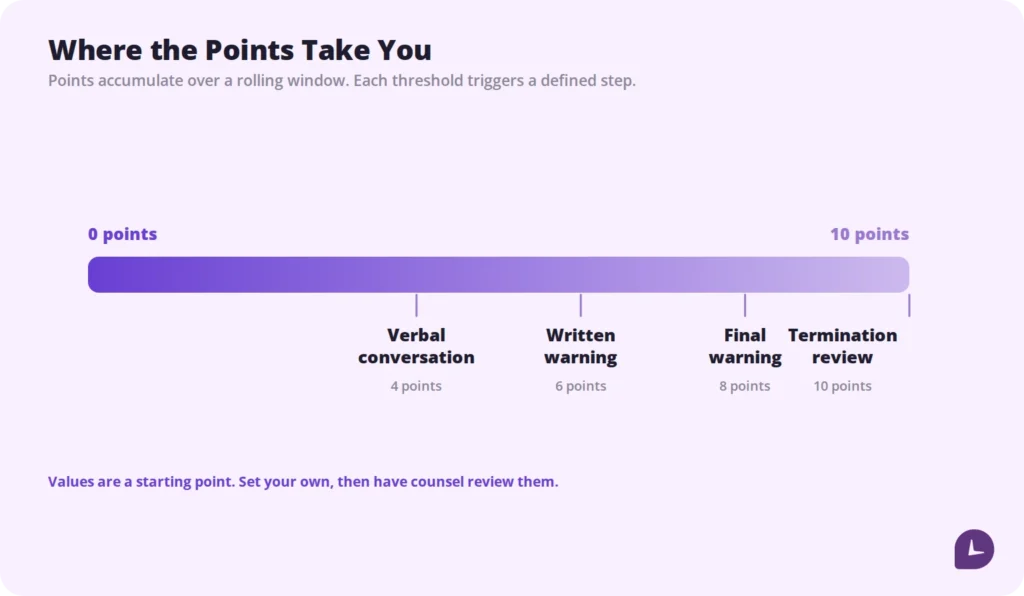
Each attendance event carries a point value set in advance. Points accumulate in the employee’s record over a defined period, usually 6 to 12 rolling months. When the running total crosses a threshold, a specific consequence follows — verbal warning, written warning, final warning, termination. Because the values and thresholds are published, both the employee and the manager can see where the employee stands at any moment.
Four design decisions define any point system:
- Which events earn points — unplanned absence, tardiness, early departure, no-call/no-show.
- What each is worth relative to the others.
- How long points stay on the record, and whether the window is rolling or resets on a fixed date.
- What happens at each threshold.
None of these has an industry standard. Point values, thresholds and reset windows are set by the employer, which is why two policies described by the same name can behave completely differently.
Boost your business productivity
Track performance and streamline teamwork
What Real Companies Assign
Published point systems at large US employers vary more than most people expect. Two of the best-documented sit at opposite ends of the strictness range.
| Amazon | Walmart | Typical SME policy | |
|---|---|---|---|
| Missing part of a shift | 1 point | ½ point for 15 min–2 hours late or leaving early | 1 point |
| Full unplanned absence | 2 points if not called out in advance | 1 point | 2–3 points |
| No-call/no-show | 2 points plus an absence submission infraction | 2 points | 4–5 points |
| Termination threshold | 8 points, or 3 absence infractions, within the window | 5 points | 8–12 points |
| How points clear | Expire 2 months after assignment | Reset to zero after 6 months | Rolling 12 months, or reset after a period of perfect attendance |
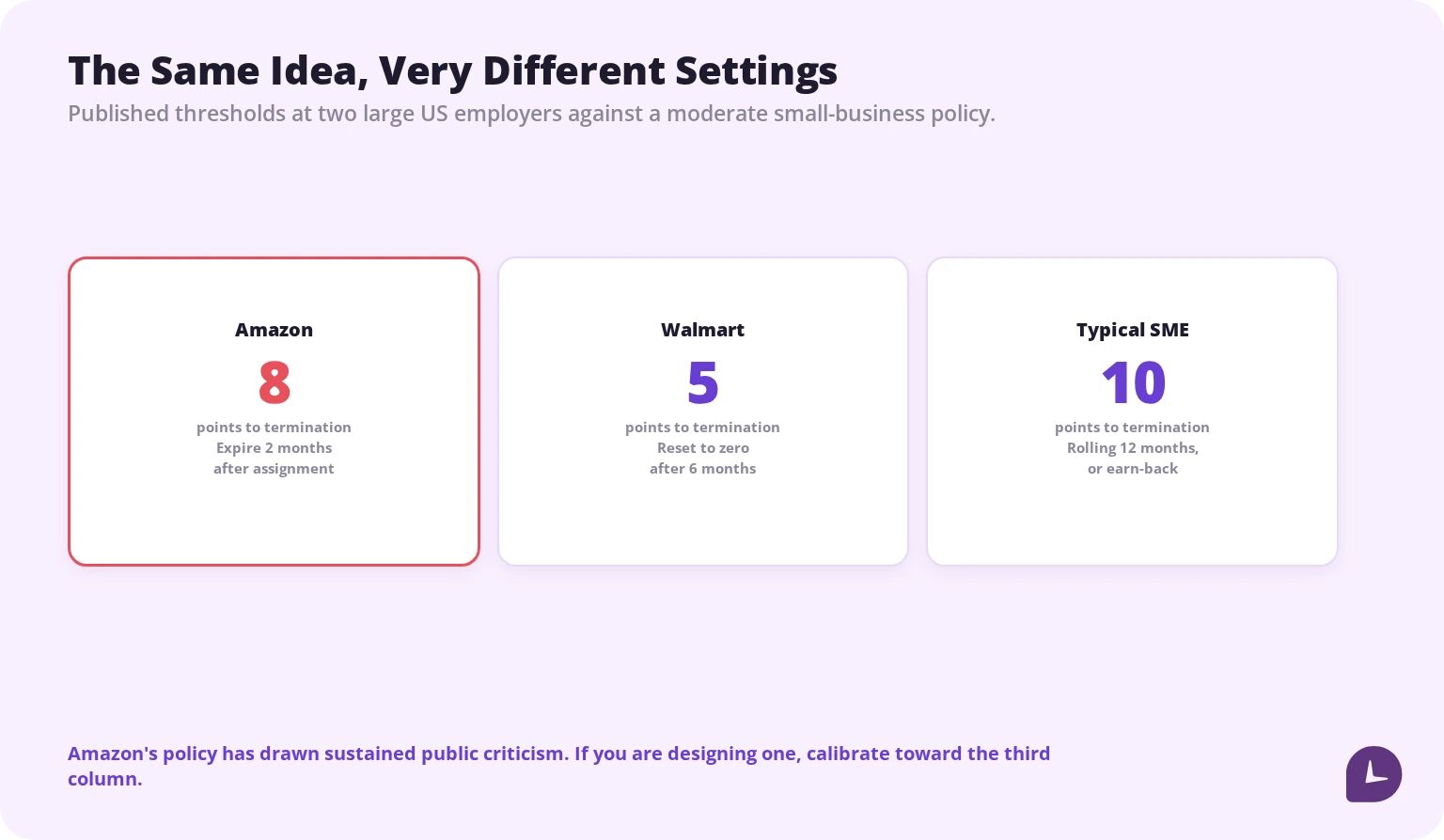
The comparison is useful for one reason: Amazon’s policy has drawn sustained public criticism and congressional attention, and Walmart’s is the more moderate of the two. If you are designing a system from scratch, calibrate toward the right-hand column rather than copying either of the first two.
Get more out of your business.
Start Your 10-Day Trial
A Point System Template You Can Adapt
This is a starting point, not a policy. Adjust the values to your operating reality and have counsel review the final version.
| Attendance event | Points |
|---|---|
| Late by up to 15 minutes | ½ |
| Late by 15 minutes to 2 hours | 1 |
| Leaving early without approval | 1 |
| Unplanned full-shift absence with notice | 2 |
| Unplanned full-shift absence without required notice | 3 |
| No-call/no-show | 4 |
| Points accumulated | Consequence |
|---|---|
| 4 | Verbal conversation, documented |
| 6 | Written warning, recorded on an employee write-up form |
| 8 | Final warning |
| 10 | Termination review |
How to choose your own values
Three questions settle it.
How many unplanned absences in a year are acceptable in this role? Pick the number first, then set the termination threshold so that reaching it requires roughly that many absences plus a margin. If your threshold is hit by an employee having an ordinarily bad quarter, it is set too low.
How much worse is a no-call/no-show than a called-in absence? This ratio drives the whole table. Most employers land between two and three times the value, because the operational damage is in the lack of notice rather than the absence itself.
What is the shortest window you will accept? A short window such as two months forgives quickly but also means chronic patterns never accumulate. A 12-month rolling window catches patterns but can feel punitive. Twelve months rolling is the most common choice.
When Points Reset
Two approaches, and the policy must state which one applies.
Rolling window. Each point expires a fixed period after the date it was assigned, typically 12 months. The employee’s total changes continuously. This is the more common and the more defensible approach, because it ties consequences to recent behaviour.
Fixed reset. All points clear on a set date, usually the calendar or fiscal year. Simpler to administer, but creates a perverse incentive in the final weeks before the reset.
Many employers add an earn-back provision: a defined period of perfect attendance removes points, often one point per month clear or a full reset after two consecutive months. This is worth including. It converts the system from purely punitive into something an employee can actively recover from, which changes how it is received without weakening it.
The Absences That Must Never Earn a Point
This is where point systems create liability, and the failure rate is high. A 2020 review of the attendance policies of 18 major US employers found that more than 80% failed to make clear that employees would not receive points for qualifying disability-related absences, and only 12% acknowledged that an emergency might prevent a worker from following the call-out procedure.
The exposure is not theoretical. In 2011 the EEOC reached a $20 million settlement with Verizon over a no-fault attendance policy that made no exception for absences that should have been accommodated.
| Protected absence | What it covers | What it means for points |
|---|---|---|
| FMLA leave | Serious health condition, birth or placement of a child, care for a family member, military caregiver and exigency leave | No points, including for individual days of intermittent leave |
| ADA accommodation | Time off related to a qualifying disability, where it is a reasonable accommodation | No points; the accommodation analysis comes before the policy |
| Workers’ compensation | Absence from a work-related injury | No points |
| State and local paid sick and safe leave | Varies by jurisdiction; many require protected sick time | No points where the law requires it |
| State family leave laws | For example, the California Family Rights Act covers pregnancy, childbirth and bonding | No points |
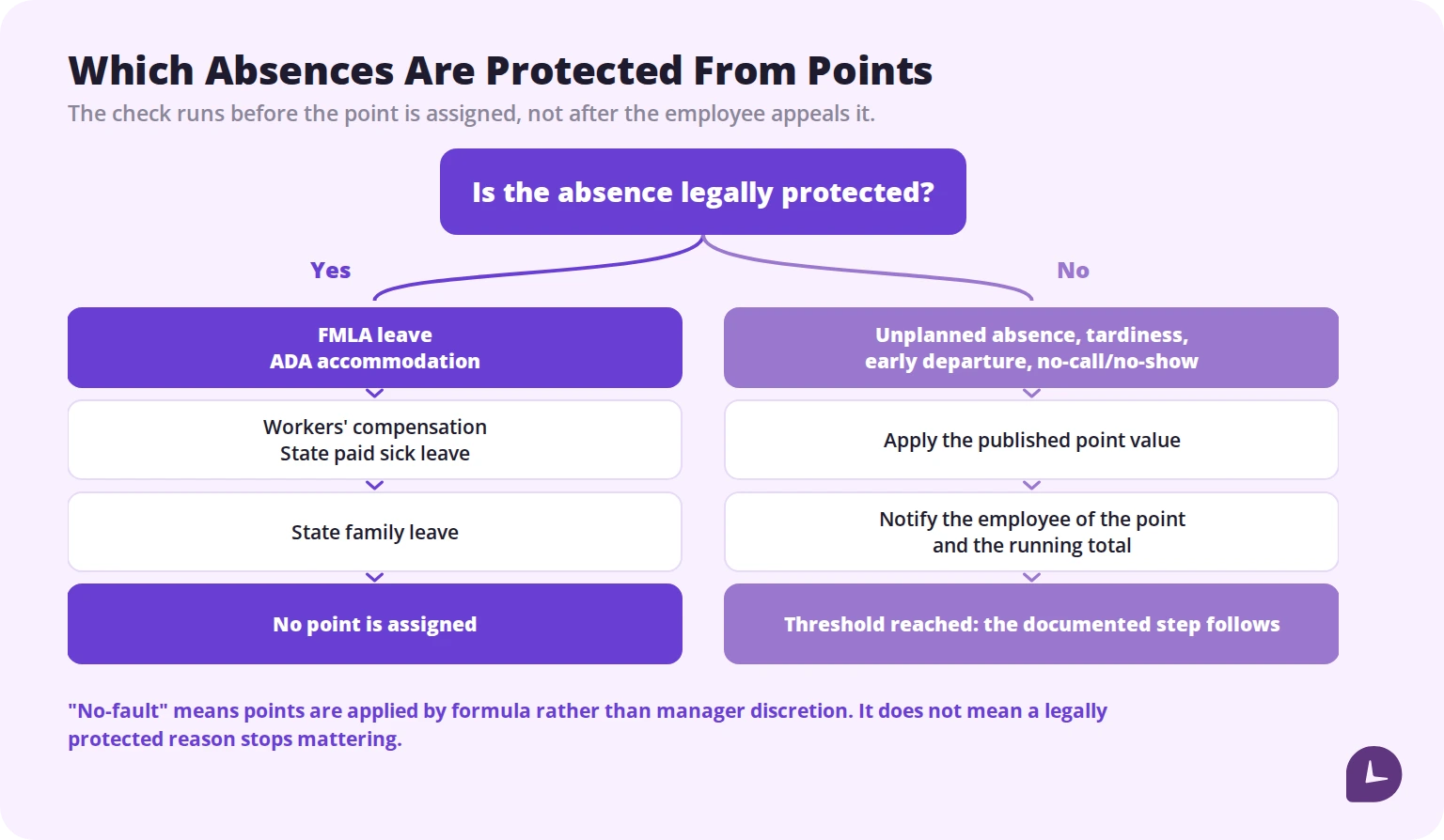
The label “no-fault” causes part of this problem. It means points are applied by formula rather than by manager discretion. It does not mean the reason for an absence is irrelevant when that reason is legally protected. A policy that treats every absence identically is not neutral; it is non-compliant.
Does Your Current Policy Pass?
If you already run a point system, these eight checks take about five minutes and surface most of the common failures.
- Does the written policy name the protected categories explicitly, or does it only say points apply to “unexcused” absences and leave the definition to managers?
- Is there a documented process for an employee to have a point reversed once protected-leave paperwork is filed?
- Does the call-out procedure account for emergencies that prevent someone calling in on time?
- Have managers been trained on the exceptions, not just the point values?
- Are employees notified when a point is assigned, rather than discovering the total at the disciplinary meeting?
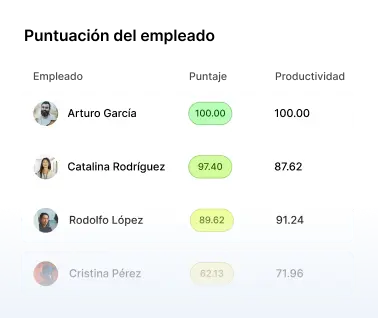
- Can an employee see their current point total on demand?
- Is the reset or expiry rule stated in writing?
- Has the policy been reviewed in the last twelve months against current state leave laws?
A “no” to any of the first four is worth fixing before anything else. Those are the ones that turn a valid termination into a claim.
Attendance Points on Remote and Hybrid Teams
Point systems were built for shift work, where attendance means physical presence at a scheduled time. Most published guidance stops there, which leaves a gap for the large number of employers now running distributed teams.
The concept transfers, but the definition of an attendance event does not. On a remote team, “late” and “absent” have to be redefined against something observable and agreed in advance.
- Scheduled commitments rather than shift start. Missing a meeting the employee had accepted is an attendance event. Starting work at 9:40 instead of 9:00 in a role with no fixed hours is not.
- Availability windows rather than continuous presence. If the role requires overlap hours with a team or with clients, define the window and measure against it. If it does not, there is nothing to measure.
- Notice, not presence. For distributed teams the operationally damaging behaviour is almost always the absence of notice, not the absence itself. Weight your point values accordingly: a no-notice disappearance should cost several times more than a late start.
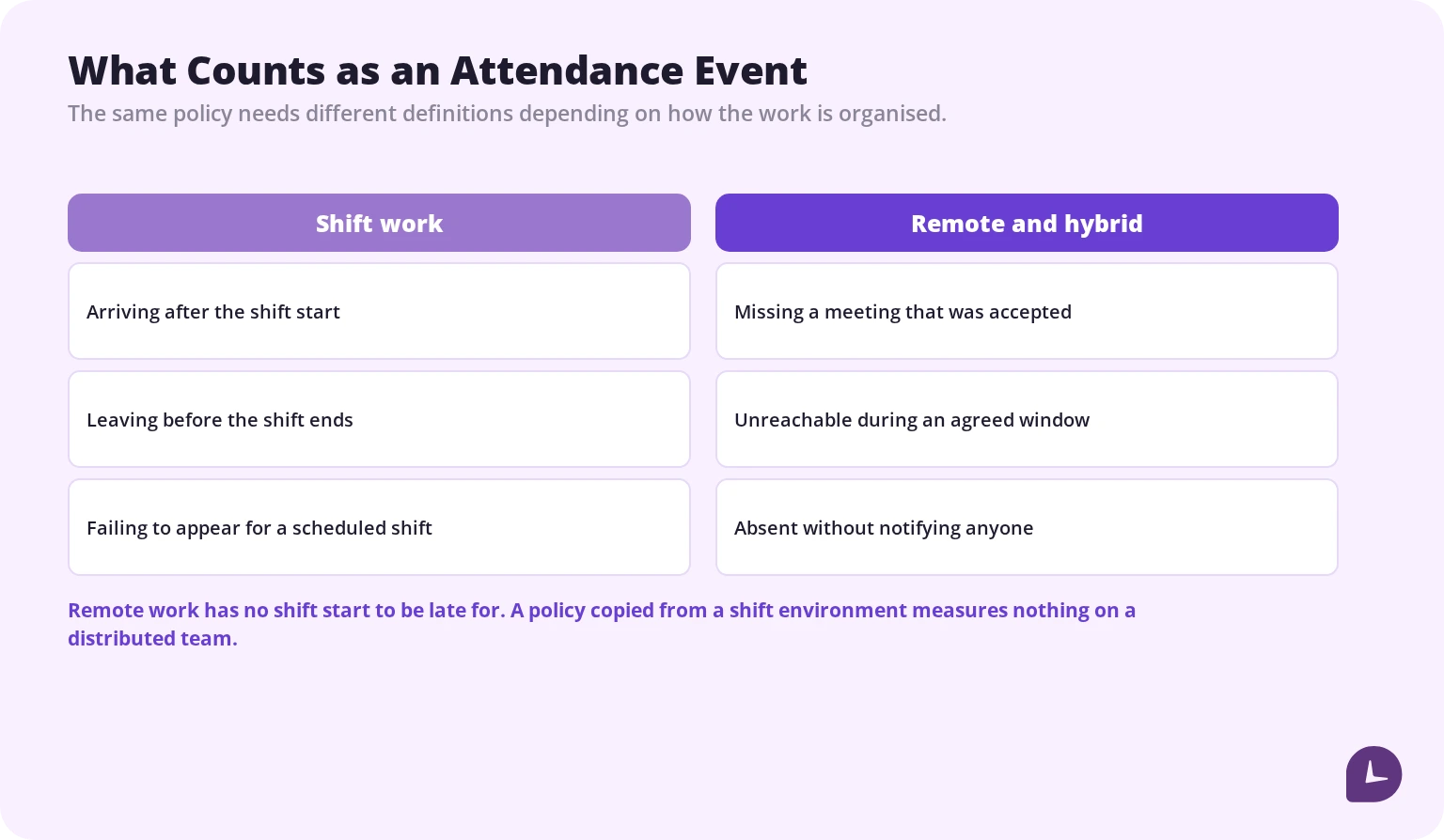
Two cautions specific to remote application. First, do not use activity monitoring as a proxy for attendance — screen activity measures something else entirely, and a policy that assigns disciplinary points for low mouse movement will not survive scrutiny. Second, time zone and flexible-hours arrangements must be written into the policy explicitly, or you will apply an office-hours standard to someone who was told they could work asynchronously.
Where a point system does apply, it needs a clean record of scheduled versus actual start times. Clock-in and clock-out tracking produces that automatically, which removes the reconstruction step that makes remote attendance disputes intractable.
What a Point System Does Well
- Removes discretion. The same event produces the same consequence regardless of who the manager is, which is the entire argument for the approach.
- Creates a defensible record. Timestamped, consistently applied documentation is what a termination decision rests on if it is challenged later.
- Tells employees where they stand. Someone who can see their own total can self-correct. Someone who cannot, finds out at the disciplinary meeting.
- Makes recognition easy. The same data identifies employees with clean records, which is worth acting on — reward the top of the distribution with employee incentives, not just discipline the bottom.
Where It Goes Wrong
- Inconsistent application by managers. The most common source of both legal exposure and employee resentment. A policy that one supervisor enforces strictly and another waives is worse than no policy, because it creates a documented pattern of unequal treatment.
- Presence over contribution. The system measures showing up. It says nothing about what happens afterwards, and an employee who comes in unwell to avoid a point is a net loss on every measure — which is why absenteeism is worth understanding as a behaviour before you price it, and why the true cost of absenteeism is rarely the hours themselves.
- The rigidity problem. Real absences have context — a transit failure, a sick child, a car that would not start. A formula cannot distinguish these, which is the design intent and also the reason employees experience the system as unfair.
- Points assigned without notice. Discovering an accumulated total at a disciplinary meeting turns a reasonable process into an ambush, and it is avoidable.
How to Roll It Out
- Write it before you announce it. The policy needs point values, thresholds, the reset rule, the protected exceptions and the appeal route in a written attendance policy before anyone hears about it. Our free company forms and policies are a usable starting point.
- Have counsel review it against every state you employ in. State leave laws differ and change, and this is the step that is skipped most often.
- Train managers on the exceptions first. They already understand the point values. What they need is the list of absences that must not be pointed and the process for reversing one.
- Announce it with notice, not on the effective date. Give people time to ask questions, and answer the obvious one directly: what happens to absences that already occurred.
- Notify at assignment. Every point should generate a notification to the employee at the time it is assigned.
- Publish current totals. Make each employee’s running total visible to them without having to ask.
- Review annually. Both the legal landscape and your own absence data will have moved.
Key Takeaways
A point system replaces judgement with a formula, and that is its whole value proposition. The formula is straightforward to design. What determines whether it holds up is narrower: whether protected absences are genuinely excluded, whether managers apply it identically, and whether employees can see their own total before it becomes a problem.
Any version of this depends on an accurate record of who was scheduled and who actually started. Monitask captures clock-ins, attendance and hours automatically, and both sides can see the same data. Try it on a 10-day free trial, no card required.
> This article is general information about US attendance practice, not legal advice. Leave protections vary by state and locality and change regularly. Have an employment attorney review your attendance policy before implementing it.
Reliable employee tracking software. Clear visibility and insights into how employees work. Even remotely.
Try Monitask free for 10 days
Frequently Asked Questions
What does "no-fault" actually mean?
That points are applied by formula rather than by manager judgement of whether an excuse was good enough. It does not mean the reason never matters — legally protected absences must still be excluded from point accrual.
How many points before termination?
There is no standard. Published examples range from 5 points at Walmart to 8 at Amazon, and typical mid-sized employers set thresholds between 8 and 12. What matters is that the threshold corresponds to a genuine pattern rather than one bad month.
When do attendance points reset?
Most policies use a 12-month rolling window, so each point expires a year after it was assigned. Some employers reset on a fixed date instead, and many add an earn-back provision that removes points after a period of perfect attendance. The rule must be stated in writing.
Can you give points for FMLA leave?
No. Absences covered by an approved FMLA certification, including individual days of intermittent leave, cannot count toward an attendance point total. Doing so exposes the employer to interference claims.
What absences are protected from attendance points?
FMLA leave, absences requiring an ADA reasonable accommodation, workers’ compensation absences, and time taken under state or local paid sick and safe leave laws. State family leave laws may add more depending on where you employ people.
Do attendance point systems work for remote employees?
They can, but the definition of an attendance event has to change. Missing an accepted meeting or being unavailable during an agreed overlap window is measurable; a flexible start time is not. Do not substitute activity monitoring for attendance measurement.
Can an employee dispute a point?
A defensible policy includes a route to do so, particularly where protected leave applies. Without a documented reversal process, an employee whose FMLA paperwork arrives late has no way to correct a point that should never have been assigned.