Australian HR software is judged on three local requirements before anything else: Single Touch Payroll Phase 2 reporting, modern award interpretation, and superannuation. The third of those changed on 1 July 2026, when Payday Super replaced quarterly contributions with payment on every pay run — a business on weekly payroll went from four super payments a year to more than fifty. Ten platforms below, with pricing, and an honest note on which ones need a separate payroll system to work here at all.
Key takeaways
- Award interpretation is the hardest local requirement and the one global platforms most often handle through a partner rather than natively.
- Employment Hero, ELMO and Rippling bundle native STP Phase 2 payroll; Deputy and Tanda lead on award-driven rostering.
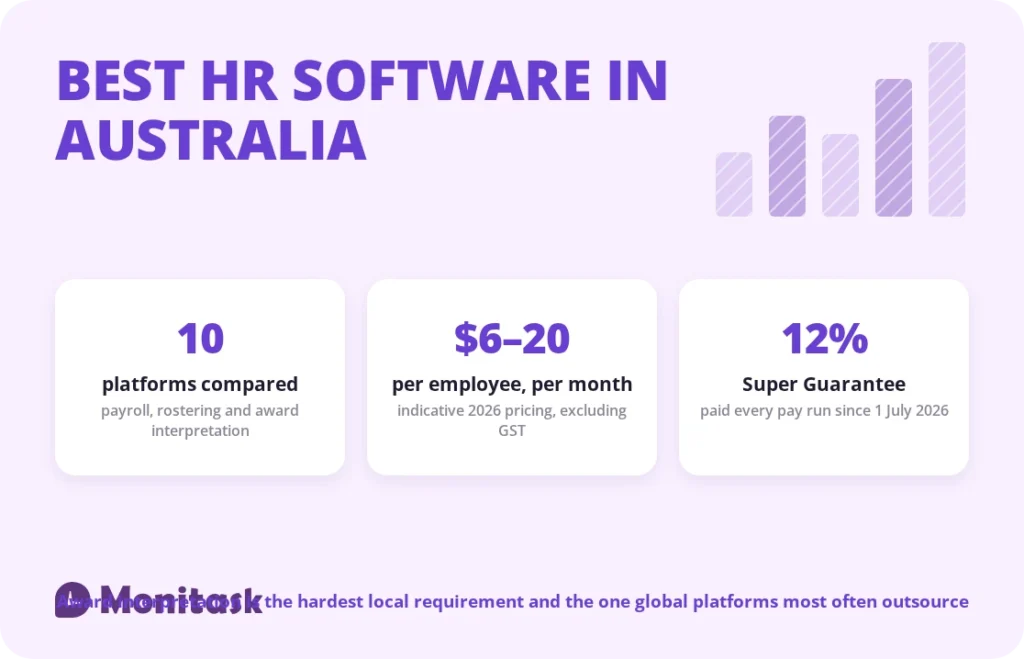
- Indicative 2026 pricing runs roughly $6 to $20 AUD per employee per month for all-in-one HR and payroll, with several vendors quoting rather than publishing.
- Payday Super took effect 1 July 2026 and the Small Business Super Clearing House closed on 30 June 2026 — if your system still assumes quarterly super, it is out of date.
- HR software automates payroll and rostering; it does not interpret an award for a disputed case or advise on dismissal.
Reliable employee tracking software. Clear visibility and insights into how employees work. Even remotely.
Try Now
What Australian Compliance Actually Requires
Four obligations separate a platform that works in Australia from one that merely operates here.
Single Touch Payroll Phase 2
Every pay run must be reported to the ATO on or before payday, with the more detailed breakdown Phase 2 introduced. This is table stakes: any platform running Australian payroll supports it, and any platform that does not is not running Australian payroll.
Modern award interpretation
This is the genuinely hard part. Penalties, allowances, overtime and shift loadings differ by award and change with the roster. A native awards engine applies them automatically; a platform without one leaves the interpretation to whoever builds the pay run, which is where underpayment cases begin. If your team is shift-based, treat award interpretation as the primary selection criterion and everything else as secondary.
Superannuation and Payday Super
The Super Guarantee rate is 12%. Since 1 July 2026, contributions must reach the employee’s fund within days of each payday rather than 28 days after the end of a quarter, and the calculation base changed from Ordinary Time Earnings to Qualifying Earnings. The ATO’s Small Business Super Clearing House closed on 30 June 2026, so employers who used it need a SuperStream-compliant alternative.
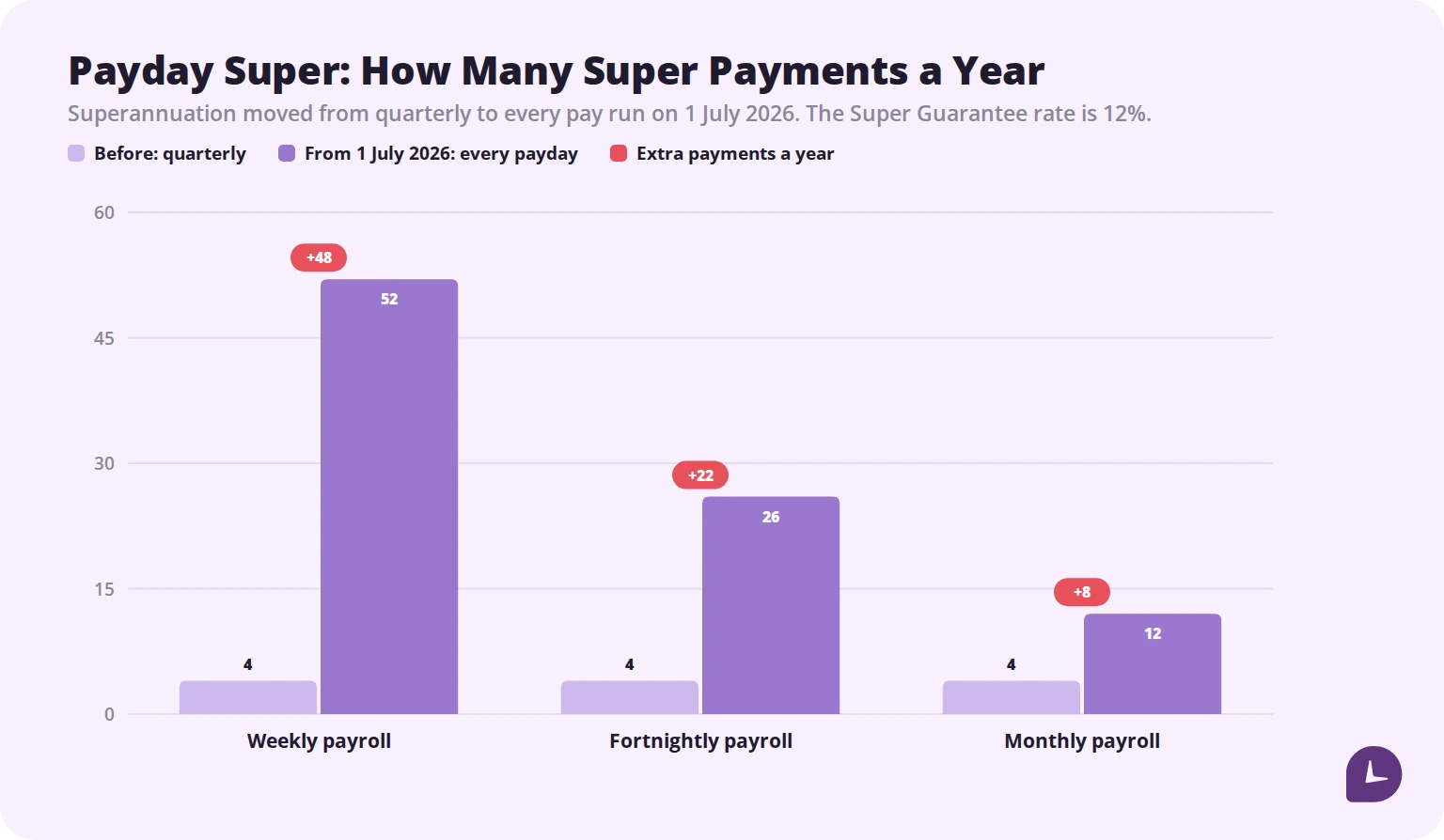
The practical consequence is cash flow, not admin. Super leaves the business every pay run instead of sitting until the quarter closes, and each payment carries its own deadline. Ask any vendor how their system handles the payment leg, not just the calculation.
Local support hours
A payroll question at 9am Sydney time is not helped by a support desk that opens in San Francisco. This sounds minor until the pay run is blocked.
Boost your business productivity
Track performance and streamline teamwork
The 10 Platforms at a Glance
Prices are indicative starting points published in 2026 and exclude GST. Several vendors quote per module rather than publishing a rate.
| Platform | Best for | Native AU payroll | From |
|---|---|---|---|
| Monitask | Time tracking and proof of work for remote or billable teams | No — pairs with a payroll system | USD 6.49 / user / mo |
| Employment Hero | All-in-one Australian HR with payroll in one subscription | Yes, with award interpretation | ~$12 AUD / employee / mo, monthly minimum applies |
| Deputy | Shift-based businesses: rostering and award-driven pay | Integrates with payroll | ~$8.75 AUD / user / mo, $30 / mo minimum |
| ELMO | Mid-to-large ANZ organisations, modular suite | Yes | Quote per module |
| Xero Payroll | Accounting-led small businesses already on Xero | Yes | Included in Xero plans by tier |
| MYOB | Accounting-led businesses on MYOB | Yes | By plan tier |
| foundU | End-to-end rostering, onboarding and payroll in one platform | Yes | Quote |
| Tanda | Workforce management with award compliance focus | Integrates with payroll | ~$4–7 AUD / user / mo |
| Rippling | Global teams needing AU payroll plus IT provisioning | Yes, common awards supported | Quote |
| ADP Workforce Now | Enterprises with complex payroll across 50+ staff | Yes | Quote |
The 10 Platforms in Detail
1. Monitask — time tracking and proof of work
Monitask is not an HRIS and does not run Australian payroll. It sits earlier in the chain: automatic time tracking, proof-of-work screenshots, app and website logging, and productivity reporting, recorded only while an employee is clocked in. For agencies, consultancies and software teams billing by the hour, that is the hour data payroll and client invoices both depend on.
Best for: remote, hybrid and billable teams that need defensible hour records.
Key features: automatic online timesheets, screenshots with sensitive-content blurring, app and URL tracking, project time, idle and mouse jiggler detection, team reports. Runs on Windows, Mac, Linux, iOS, Android and Chromebook. Stealth mode available for company-owned devices.
Pricing: from USD 6.49 per user per month on annual billing; additional screenshot frequency is a paid add-on. 10-day free trial, no card required.
Limitation: pair it with an Australian payroll platform — Monitask does not calculate super or lodge STP.

2. Employment Hero — the Australian all-in-one
Employment Hero is the local heavyweight: an Australian-built platform combining HR, native payroll, award interpretation and STP Phase 2 in one subscription, with Payday Super handled natively rather than through a partner. Its payroll engine is the one many Australian bureaus already know.
Best for: businesses that want HR and compliant payroll under one contract.
Pricing: around $12 AUD per employee per month on self-published figures, with entry plans carrying a monthly minimum. The final number depends heavily on which modules are switched on.
Limitation: support is chat-first without a standing phone line, which reviewers consistently flag as painful during a blocked pay run. Buyers also report features sitting in higher tiers than the sales conversation implied — get the module list in writing.
3. Deputy — rostering and award-driven pay
Deputy is built for shift-based work: rostering, clock-ins, timesheets and award interpretation feeding a payroll system. For hospitality, retail and healthcare, the roster is where compliance is won or lost, and Deputy treats it as the primary object rather than an afterthought.
Best for: shift-based teams where award penalties and overtime are a daily calculation.
Pricing: from around $8.75 AUD per user per month for workforce management, with a $30 monthly minimum.
Limitation: it is not a full HRIS. Onboarding, performance and employee records need another system alongside it.
4. ELMO — the ANZ mid-market suite
ELMO is purpose-built for Australia and New Zealand, which matters for organisations running across both: combined reporting in one place rather than two systems stitched together. Recruitment, onboarding, learning, performance and payroll come as modules you switch on as needed.
Best for: organisations past roughly 200 employees, particularly with trans-Tasman operations.
Pricing: quoted per module and headcount.
Limitation: modular pricing makes the real cost hard to compare until you have a full quote. Ask for the whole bundle priced, not the entry module.
5. Xero Payroll — payroll where the books already are
For small businesses already running Xero, payroll inside the same system removes a reconciliation step entirely. STP Phase 2, super and PAYG are covered, and the accounting side is what most small businesses actually chose Xero for.
Best for: small businesses whose accountant runs Xero.
Pricing: included in Xero plans, with employee limits by tier.
Limitation: award interpretation is basic compared with a dedicated workforce platform. Shift-heavy businesses usually add Deputy or Tanda on top.
6. MYOB — the other accounting-led option
The same logic as Xero for businesses on MYOB: payroll, STP and super handled inside the accounting platform, with the advantage that the data never has to move.
Best for: established small and medium businesses already on MYOB.
Pricing: by plan tier.
Limitation: same as Xero — light on award complexity and thin on HR functions beyond payroll.
7. foundU — rostering to payroll in one system
foundU covers onboarding, rostering, time capture and payroll on a single platform, which removes the integration layer that usually sits between workforce management and pay. Built in Australia for businesses with large casual and shift workforces.
Best for: businesses with high casual headcount and complex rostering.
Pricing: quote based on headcount and modules.
Limitation: a single-platform approach means migration is all-or-nothing rather than incremental.
8. Tanda — workforce management with compliance at the centre
Tanda focuses on getting hours and awards right before they reach payroll: rostering, attendance, and award compliance checks on the pay run.
Best for: shift-based businesses that want an audit trail on award compliance.
Pricing: around $4 to $7 AUD per user per month.
Limitation: pairs with a payroll platform rather than replacing one.
9. Rippling — global operations with Australian payroll
Rippling combines HR, payroll, IT provisioning and device management, and supports the most common modern awards with policies assigned by worker type. For an Australian company with staff overseas, or an overseas company with staff here, it removes the need for parallel systems.
Best for: distributed teams across multiple countries.
Pricing: quoted, module-based.
Limitation: breadth means you pay for scope you may not use, and award coverage should be confirmed against your specific award rather than assumed.
10. ADP Workforce Now — enterprise payroll
ADP handles complex payroll, benefits and compliance reporting at scale, with the process maturity that comes from running payroll for very large employers.
Best for: organisations above roughly 50 employees with complex pay structures.
Pricing: quoted.
Limitation: implementation is a project, not a signup. Small businesses will find it heavy.
Two Platforms Australian Buyers Ask About
BambooHR and Bob both come up constantly in Australian shortlists, and neither runs Australian payroll natively. BambooHR is a strong HR core — records, onboarding, time off, performance — and Bob is the more modern people platform with real strength in engagement and culture tooling. Both require a separate Australian payroll system alongside them.
That is not a disqualification. It is a decision about how many contracts you want. One platform with native payroll means one vendor and one bill; an HR core plus a local payroll partner often means better HR tooling and a working integration to maintain. Decide which trade-off you prefer before you sit through the demos.
Which One Fits Your Business
| Situation | Start with | Why |
|---|---|---|
| Under 20 staff, already on Xero or MYOB | Xero Payroll, MYOB | Payroll where the accounting already lives |
| Shift-based: hospitality, retail, healthcare | Deputy, Tanda, foundU | Award interpretation is the whole problem |
| 20–200 staff wanting one system | Employment Hero | Native payroll and HR in one subscription |
| 200+ staff, ANZ operations | ELMO, ADP Workforce Now | Modular depth and multi-entity handling |
| Teams across several countries | Rippling | One system instead of parallel stacks |
| Remote or billable teams | Monitask alongside any of the above | Payroll records attendance; it does not prove hours |
Maximize productivity of your business.
Start Your 10-Day Trial
What to Test in the Demo
Vendors demo the roster and the dashboard. These four requests surface the rest.
- Run a pay period for a casual on your actual award, with a public holiday, an overtime shift and a late roster change. Award interpretation either holds up here or it does not.
- Ask them to show the Payday Super flow end to end, including how contributions leave the business and what happens if a payment fails.
- Ask what their support hours are in Australian time, and whether there is a phone line.
- Ask what the bill looks like at double your current headcount, with the modules you would realistically add.
Key Takeaways
Pick for the local requirements first. Award interpretation, STP Phase 2 and Payday Super determine whether a platform works in Australia at all; interface quality and feature breadth determine whether you enjoy using it. The order matters, because the second is easy to assess in a demo and the first is not.
One gap sits outside all ten platforms: proving what remote and billable staff actually worked on. Payroll systems record attendance and approved hours. Monitask records the work itself — hours, activity and project time, captured as they happen — and hands clean totals to whichever payroll system you choose. Try it on a 10-day free trial, no card required.
> This article is general information, not legal, tax or financial advice. Product features and pricing change; confirm current details with each vendor. For award interpretation in a specific case, or any dispute, consult a qualified Australian employment adviser.
Reliable employee tracking software. Clear visibility and insights into how employees work. Even remotely.
Try Monitask free for 10 days
Frequently Asked Questions
Which HR software handles award interpretation natively?
Employment Hero, ELMO, foundU, Deputy and Tanda are built around Australian award rules. Global platforms vary: Rippling supports common modern awards, while others rely on a local payroll partner. Test the platform against your specific award rather than the general claim.
What is STP Phase 2 and does every platform support it?
Single Touch Payroll Phase 2 is the ATO’s requirement to report payroll details with each pay run in an expanded breakdown. Any platform running Australian payroll supports it. Platforms without native Australian payroll do not lodge STP at all and need a payroll system alongside them.
How does Payday Super change what I need from HR software?
Super now leaves the business on every pay run rather than quarterly, so the payment leg matters as much as the calculation. Ask how the platform remits contributions, what happens when a payment fails, and what visibility you get before the deadline passes.
Do I need separate time tracking software?
Often yes. Payroll and rostering platforms record scheduled and approved hours. Agencies, consultancies and remote teams billing by the hour usually add a dedicated tracker to capture what was actually worked on, project by project.
Can HR software replace employment law advice?
No. Software automates payroll, rostering and record-keeping. Interpreting an award in a disputed case, assessing dismissal risk or responding to a Fair Work claim requires a qualified adviser.