Employee Handbook Template, Section by Section — and the Rules That Judge It

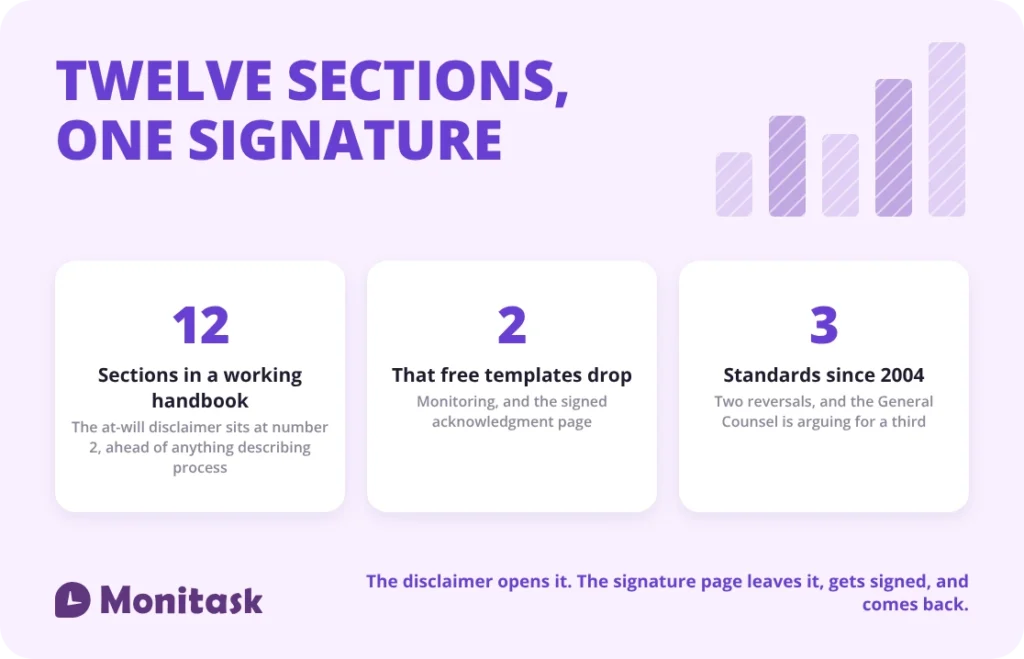
A usable handbook has 12 sections, an at-will disclaimer and a signed acknowledgment. The template is below, section by section. The part most templates leave out is that handbook wording gets judged against a labor-law standard that has been reversed twice since 2004 — and that the Labor Board’s own General Counsel is currently arguing to reverse again. Broad catch-all rules are what fail it, under every version.
What should an employee handbook contain?
12 sections cover a US handbook for a small or mid-sized employer. The order matters less than the completeness, with one exception: the at-will disclaimer belongs near the front, before any policy that describes process.
| # | Section | What it settles |
|---|---|---|
| 1 | Welcome and purpose | That this is not a contract, and what the document is for |
| 2 | At-will employment disclaimer | That employment can end at any time, by either side |
| 3 | Equal employment opportunity | Non-discrimination commitment and who to contact |
| 4 | Anti-harassment and reporting | What is prohibited, how to report, what happens next |
| 5 | Employment classifications | Full-time, part-time, exempt, non-exempt, temporary, contractor |
| 6 | Hours, timekeeping and pay | Schedules, recording time, overtime approval, pay dates |
| 7 | Time off and leave | PTO, holidays, sick leave, statutory leaves, requests |
| 8 | Conduct and performance | Expectations, review process, discipline approach |
| 9 | Technology, systems and monitoring | Acceptable use, who owns what, what is monitored |
| 10 | Health, safety and security | Reporting incidents, emergency procedures, access |
| 11 | Separation | Resignation notice, final pay, return of property, access removal |
| 12 | Acknowledgment | Signature page, detached and retained |
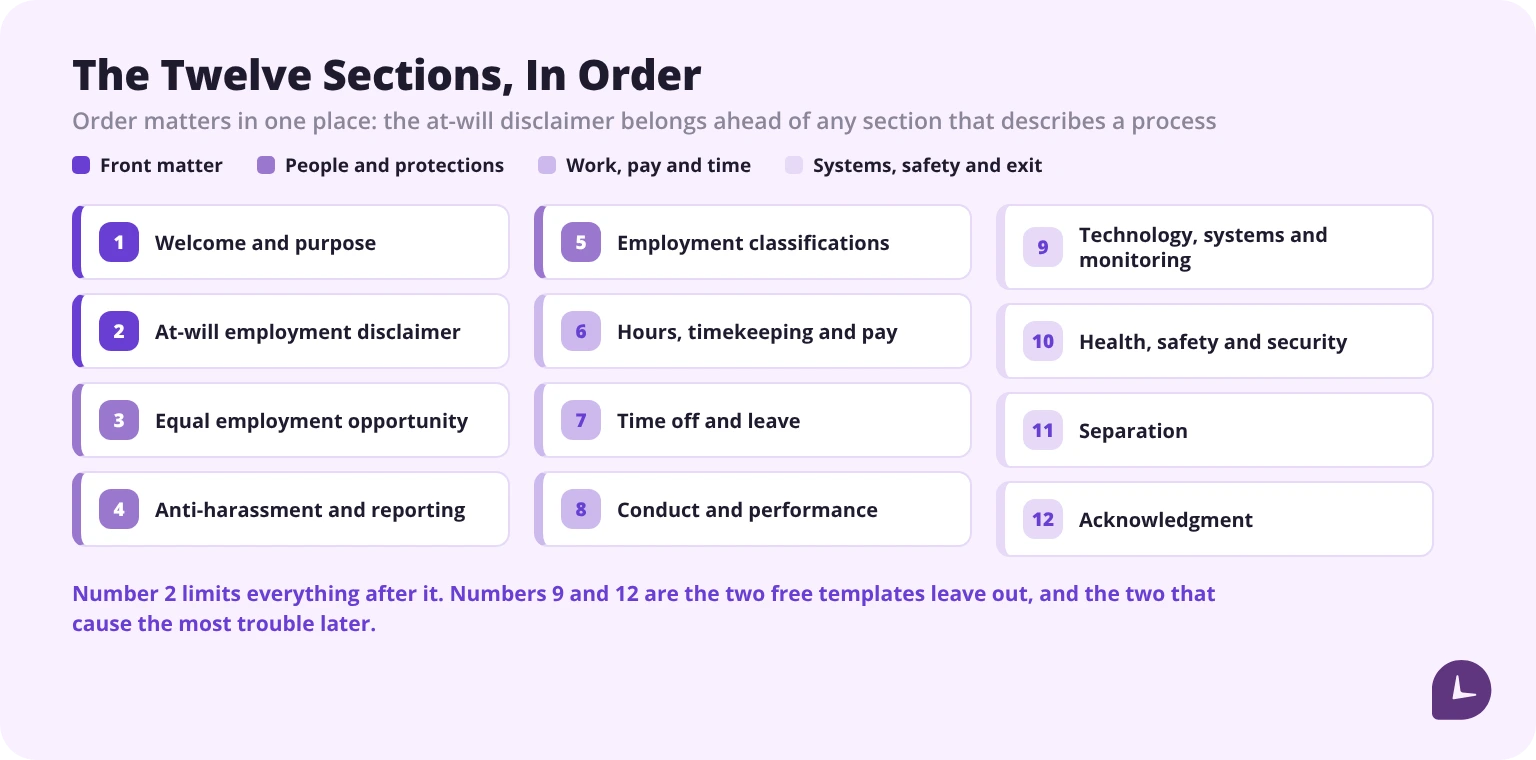
Two of these are routinely missing from free templates and cause the most trouble later: section 9, because employees dispute monitoring they were never told about, and section 12, because without a signed acknowledgment you cannot show anyone was told anything.
The template, section by section
Copy this structure, then replace every bracketed field. Two sections below carry model language because the wording itself matters: the at-will disclaimer and the acknowledgment. Everything else is deliberately a prompt rather than a finished clause, because policy text has to match what you actually do.
1. Welcome and purpose
[Company name] prepared this handbook to describe how we work together and
what you can expect from us. It replaces any earlier handbook or policy
statement. This handbook is a summary of policies and is not an employment
contract or a promise of continued employment. [Company name] may change,
add to or withdraw any policy in it at any time, with or without notice,
except for the at-will provision below, which may be changed only in a
signed writing from [title of authorized officer].
2. At-will employment
Employment with [Company name] is at will. This means you may end your
employment at any time, with or without notice and with or without cause,
and [Company name] may end your employment on the same terms. Nothing in
this handbook, in any policy, in any statement by a manager, or in any
employment practice creates a contract of employment or a promise of
employment for any fixed period. No manager or representative of
[Company name] has authority to change the at-will nature of employment
except [title of authorized officer], and only in a document signed by
that person.
3. Equal employment opportunity — state the commitment, list the protected characteristics covered by the laws that apply to you, name the role to contact, and state that the policy covers hiring, pay, promotion, training, discipline and termination.
4. Anti-harassment and reporting — define what is prohibited, give at least two reporting routes so an employee is never required to report to the person complained of, describe what happens after a report, and state the prohibition on retaliation.
5. Employment classifications — define each classification you actually use, state that classification determines overtime eligibility and benefits, and state that it is determined by duties and pay rather than by job title. Our guide to exempt vs non-exempt employees covers where that line falls.
6. Hours, timekeeping and pay — standard hours, how time is recorded, that all time worked must be recorded, that overtime requires advance approval but will be paid when worked, meal and rest break rules for your states, pay frequency and pay dates, and how to raise a pay discrepancy. Keep the detail in a standalone overtime policy and an attendance policy and summarize here.
7. Time off and leave — accrual or allotment, how to request, approval and notice expectations, holidays observed, sick leave, the statutory leaves that apply to you, and what happens to unused balances on separation. A separate PTO policy carries the mechanics.
8. Conduct and performance — the behavior you expect stated as conduct rather than attitude, the review cycle, and a discipline description that preserves the at-will position. The next section explains why “progressive discipline” language needs care.
9. Technology, systems and monitoring — acceptable use, that company systems and the data on them belong to the company, what is monitored and in what form, that personal accounts are excluded from collection, and who may request a review. This is also where a state notice duty lands: 4 states have general electronic-monitoring notice statutes, and their requirements differ enough that a single paragraph will not satisfy all of them. See employee monitoring laws and the internet usage policy that sits beside this section.
10. Health, safety and security — incident reporting, emergency procedures, visitor and premises access, and any industry-specific requirements.
11. Separation — notice expectations, final pay timing under your state’s rules, return of equipment, and removal of systems access.
12. Acknowledgment — see the dedicated section below.
Why does handbook wording create legal exposure?
Because a handbook rule can be unlawful for what a reasonable employee might think it forbids, regardless of what you meant.
The National Labor Relations Board sets the standard for whether workplace rules unlawfully interfere with employees’ rights under Section 7 of the National Labor Relations Act. In Stericycle, Inc., 372 NLRB No. 113 (2023), decided 2 August 2023, the Board adopted a standard under which a rule is presumptively unlawful
once the General Counsel proves it has a reasonable tendency to chill employees from exercising their Section 7 rights
. The rule is read from the perspective of an employee subject to it and economically dependent on the employer
, ambiguity is construed against the employer, and a rule can be presumptively unlawful even if a contrary, noncoercive interpretation of the rule is also reasonable
. Intent does not help you: the Board says the employer’s intent in maintaining a rule is immaterial
. To rebut the presumption the employer must prove the rule advances a legitimate and substantial business interest
and that it cannot advance that interest with a more narrowly tailored rule
.
That decision overruled Boeing Co., 365 NLRB No. 154 (2017) and LA Specialty Produce Co., 368 NLRB No. 93 (2019) — and the work rules cases relying on them
— and, in the Board’s own words, builds on and revises the standard from
Lutheran Heritage Village-Livonia, 343 NLRB 646 (2004). It did not restore the 2004 test; it took its framework and changed it.
The pattern matters more than the current case.
| Period | Decision | What it asked | Status |
|---|---|---|---|
| 2004 | Lutheran Heritage Village-Livonia, 343 NLRB 646 (2004) | Ambiguous rules read as a reasonable employee would construe them | First statement |
| 2017 | Boeing Co., 365 NLRB No. 154 (2017) | the rule’s potential impact on protected concerted activitybalanced against the employer’s legitimate business justifications for maintaining the rule, with a categorical sort in which certain types of rules were held to be always lawful to maintain | Reversal |
| 2019 | LA Specialty Produce Co., 368 NLRB No. 93 (2019) | Refined Boeing’s categories | Refinement |
| 2023 | Stericycle, Inc., 372 NLRB No. 113 (2023) | Presumptively unlawful if it has a reasonable tendency to chill, rebuttable only by an interest no narrower rule could serve | Reversal |
Board doctrine follows Board composition, and right now that is not an abstraction:
- Stericycle still governs. It has not been overruled, vacated or replaced, and the Regions are still applying it.
- The Board only regained a quorum on 7 January 2026. Its press release of that date records two new Members sworn in and says the Board “now has a quorum to conduct Agency business”. It sits with four Members of five under Chairman Murphy.
- The General Counsel is formally arguing for reversal. GC Memorandum 26-04, 26 August 2026, lists work rules among the priorities and names the vehicle. The docket for that case, Honeywell International Inc., 09-CA-327389, shows an ALJ decision of 10 March 2026 and the proceeding transferred to the Board, with no Board decision yet.
- Two of the four Members have said they would reconsider it. In Tesla, Inc., 375 NLRB No. 63, decided 28 October 2026, the Chairman and one Member said in a footnote that they would be open to reconsidering Stericycle in an appropriate case, while finding it was not at issue there.
So a handbook written to satisfy exactly one of these standards gets re-judged under the next. The durable conclusion is about drafting, not doctrine: broad catch-all rules fail under any employee-protective standard, and narrow rules tied to a stated business reason survive all three.
Rules that repeatedly cause problems, and what to do instead:
| Common wording | The problem | Narrower alternative |
|---|---|---|
| “Do not discuss wages or working conditions” | Directly touches protected activity | Remove it. Confidentiality of company financial data is a separate, specific rule |
| “Be respectful and professional at all times” | A reasonable employee could read it to cover complaints about management | Prohibit specific conduct: threats, slurs, harassment |
| “Do not disparage the company” | Reads onto protected concerted speech | Limit it to false statements made as a company representative |
| “Do not discuss investigations” | Blanket confidentiality is hard to justify | Confidentiality during an open investigation, with a stated reason and an end point |
| “No recording in the workplace” | Broad bans are routinely challenged | Tie it to specific interests: client privacy, trade secrets, named areas |
| “Progressive discipline: step 1, 2, 3” | A mandatory-sounding process undercuts at-will | State that steps may be used or skipped at the company’s discretion |
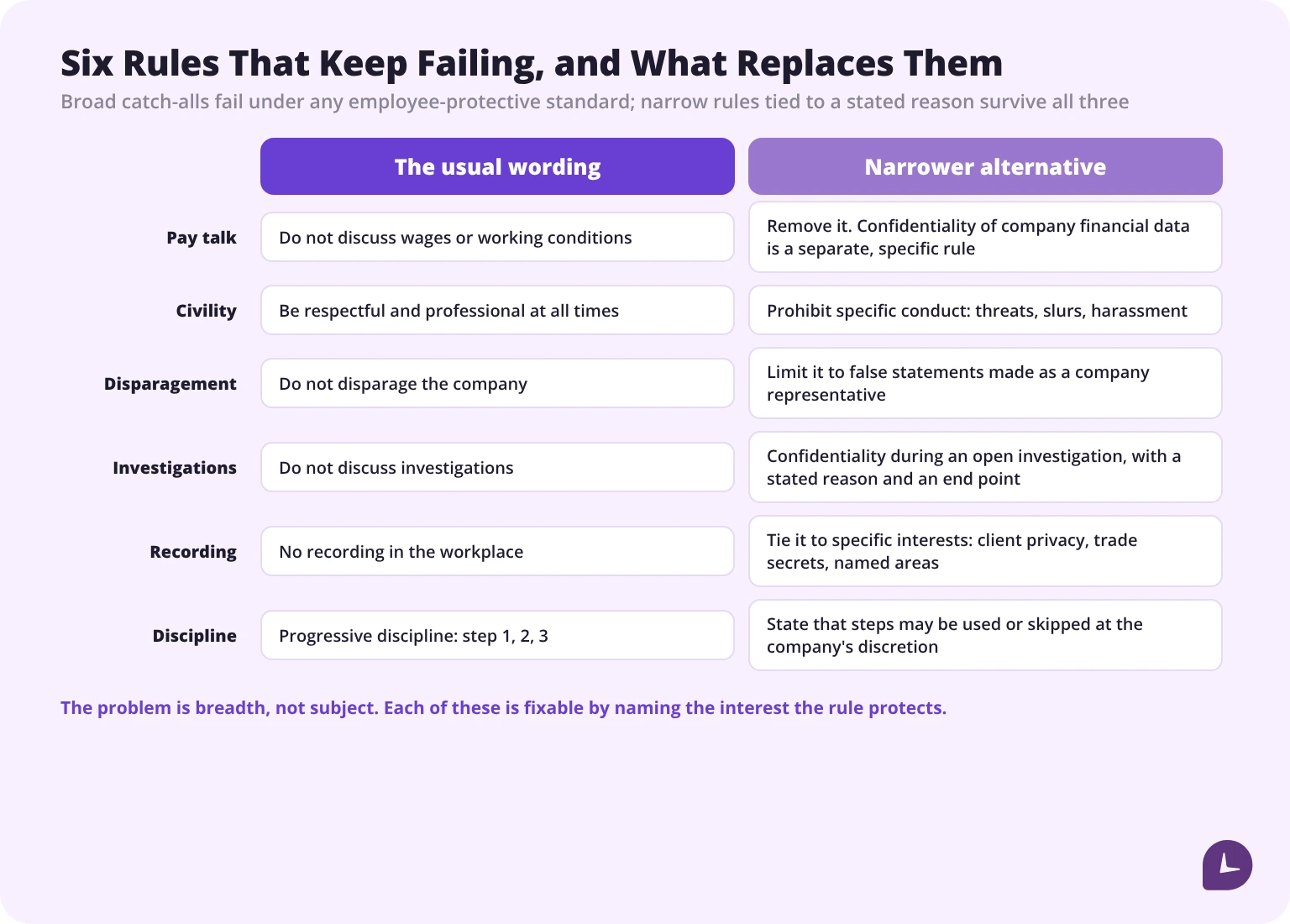
The investigation row needs a word of its own, because it is the one where the law moved and then stopped. Apogee Retail made an investigation-confidentiality rule presumptively lawful in 2019, on the authority of Boeing. Stericycle overruled Boeing and the work rules cases relying on it, and expressly invited briefing on investigative-confidentiality rules without then deciding the question. No Board decision since has returned to it. A rule limited to the duration of an open investigation, with the interest stated, is the defensible version; a blanket one cannot be called lawful.
Each of these should be reviewed by employment counsel against your operations before it ships.
What must the at-will disclaimer say?
4 things, and the 4th is the one templates drop.
- Either party can end employment at any time, with or without cause or notice
- Nothing in the handbook or in any manager’s statement creates a contract or a promise of a fixed term
- The company can change other policies at any time
- The at-will provision itself can be changed only in a signed writing by a named role
Without the last one, the disclaimer can be undercut by whatever a manager said in an interview.
The risk the disclaimer addresses is the handbook being read as a promise. Language describing “permanent” positions, employment “as long as performance is satisfactory”, or a mandatory sequence of disciplinary steps pulls in that direction. The disclaimer is the counterweight, which is why it belongs at number 2, ahead of the conduct and discipline sections at number 8, rather than buried at the back.
One thing to know about the clause itself: there is no current Board decision, press release or General Counsel memorandum on at-will disclaimers that a drafter can point to. An at-will clause is a work rule, so it is judged by the same standard as every other rule in the book. A clause saying at-will status can never be altered by anyone invites exactly the analysis above, because bargaining collectively is one of the ways employees would seek to alter it. Keep the authority to change it with a named officer rather than denying that it can change at all.
What does the acknowledgment page need?
A separate page, signed and retained, that proves the employee received the handbook — not that they agreed to it as a contract.
I acknowledge that I have received a copy of the [Company name] Employee
Handbook dated [date]. I understand that it summarizes [Company name]'s
policies and that it is not an employment contract or a promise of
employment for any period. I understand that my employment is at will, that
either [Company name] or I may end it at any time with or without cause or
notice, and that only [title of authorized officer] may change this, in a
signed writing. I understand that [Company name] may change the policies in
this handbook at any time. I agree to read the handbook and to ask
[role or department] about anything I do not understand.

Employee name: [________]   Signature: [________]   Date: [________]
4 practical rules:
- Keep it detachable. It gets signed, returned and filed separately.
- Date the handbook edition. So you can later show which version someone received.
- Record electronic acknowledgments. In a system that captures identity and timestamp, not in an inbox.
- Re-acknowledge on material revision. Not only at hire.
More detail on the signature page itself: employee handbook acknowledgment.
Which policies get added as you grow?
Some obligations attach to employers above a certain headcount or in particular states, and both the thresholds and the state list change. Rather than carry numbers that may be stale, use this as a review trigger: when any of the following changes, have the handbook reviewed.
| Trigger | What typically needs adding or revising |
|---|---|
| Headcount crosses a statutory threshold | Protected leave entitlements, notice and posting obligations |
| You hire in a new state | Paid sick leave, meal and rest breaks, final pay timing, electronic monitoring notice |
| You hire in a new country | A separate local addendum, not a tweak to the US handbook |
| You begin monitoring systems | The monitoring section, plus any state notice requirement |
| Your industry becomes regulated for you | Recordkeeping, confidentiality and training requirements |
| You start using contractors at scale | Classification language and a separate contractor policy |
Verify the specific thresholds against current federal and state sources before relying on them; they are the part of a handbook most likely to be out of date.
How often should a handbook be updated?
On events, with a calendar review as a backstop. “Annually” is the usual advice and it is not wrong, but a date-driven review misses the changes that actually create exposure.
| Review because | Timing |
|---|---|
| You hired in a new state or country | Before the first hire starts |
| A law or standard your rules depend on changed | Within the quarter |
| You introduced monitoring, a new system or a new benefit | Before it goes live |
| Headcount crossed a statutory threshold | At the crossing |
| Nothing in particular | Once a year, as a backstop |
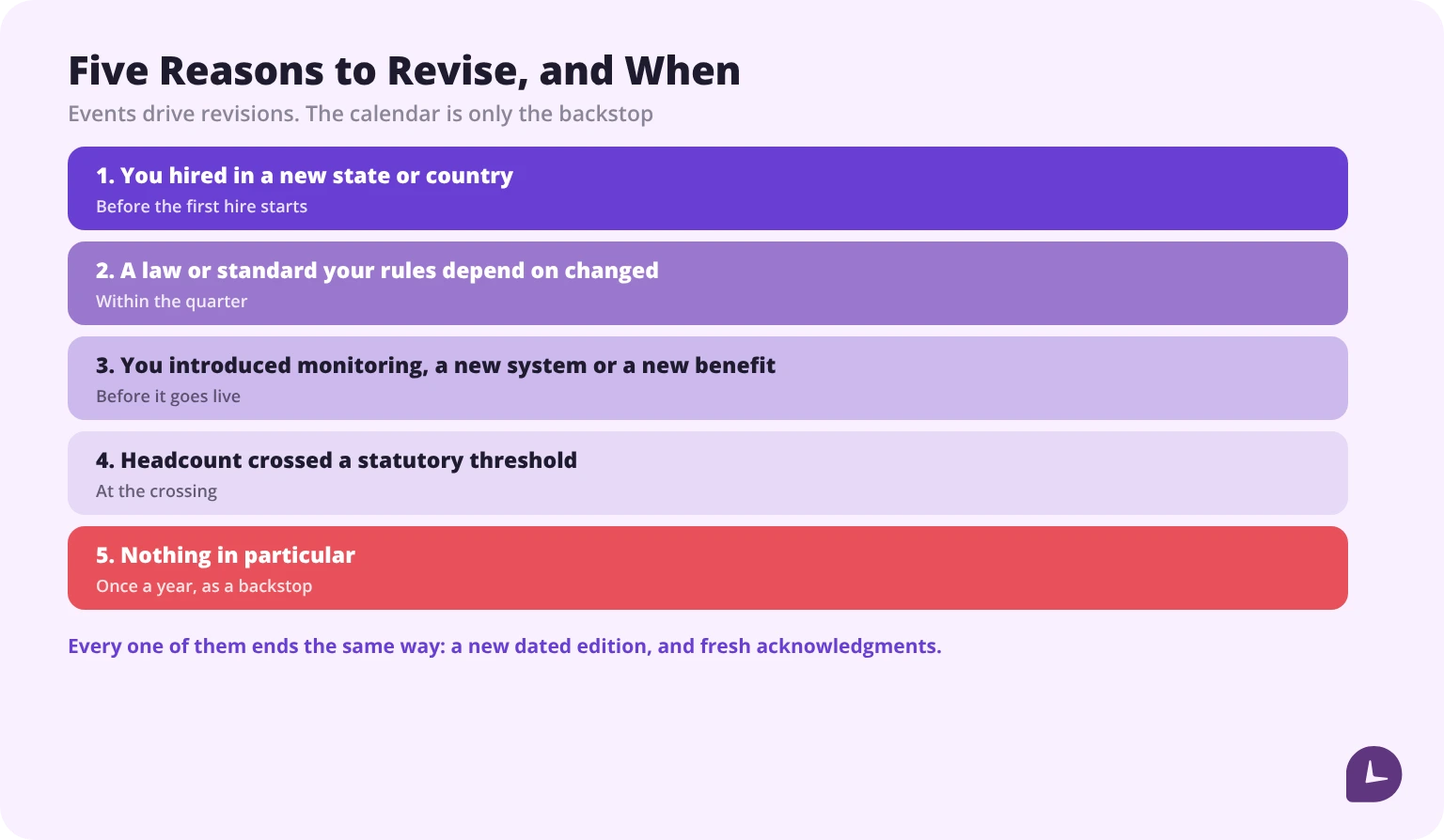
When you revise materially, issue a new dated edition and collect fresh acknowledgments. A handbook nobody re-acknowledged after three years of edits is hard to rely on.
What a template cannot do for you
Three honest limits.
A template cannot make your policies match your practice. The most common handbook failure is not a missing section; it is a section describing something the company does not actually do. A written progressive-discipline sequence that managers skip is worse than no sequence at all.
A template cannot cover your states. Break rules, sick leave, final pay timing and monitoring notice differ by state, and a national template silently assumes none of them apply to you.
A template is not legal review. The wording in the conduct, confidentiality and discipline sections is exactly where the labor-law standard above bites, and that is a review an employment lawyer does against your facts — particularly now, with the standard itself under active challenge.
A hundred-plus policy and form templates, so the sections this handbook summarizes have somewhere to point.
Browse Monitask's HR policy templates
This article provides a handbook structure and model wording for two sections, and summarizes the labor-law standard applied to workplace rules. It is not legal advice. Handbook language has legal effect, the standard for workplace rules has been reversed twice since 2004 and is under active challenge again, and requirements differ by state, headcount and industry. The model wording here is a starting point for review by employment counsel, not a document to adopt as written.
Sources
- Stericycle, Inc., 372 NLRB No. 113 (2023), decided 2 August 2023, case 04-CA-137660. The current standard for evaluating workplace rules. The chill, presumption, business-interest and narrow-tailoring formulations were read on the Board’s own weekly summary of decisions and press release; the perspective and noncoercive-interpretation sentences were read on two independent verbatim reproductions of the slip opinion that agree word for word, because the Board serves its decision PDFs from a host that refuses automated access. The docket styles the 2 August 2023 document an Amended Board Decision, and an Errata was filed on 12 October 2023. Verified 12 November 2026.
- Boeing Co., 365 NLRB No. 154 (2017), decided 14 December 2017, and LA Specialty Produce Co., 368 NLRB No. 93 (2019) — the two decisions Stericycle, Inc. overruled. The Boeing test is quoted from the Board’s own contemporaneous summary. Verified 12 November 2026.
- Lutheran Heritage Village-Livonia, 343 NLRB 646 (2004) — the standard Stericycle, Inc. builds on and revises. Verified 12 November 2026.
- Apogee Retail LLC d/b/a Unique Thrift Store, 368 NLRB No. 144 (2019), decided 17 December 2019, and Banner Estrella Medical Center, 362 NLRB 1108 (2015) — the investigation-confidentiality line, quoted from the Board’s press release. Verified 12 November 2026.
- GC Memorandum 26-04, 26 August 2026, and the Board’s docket for Honeywell International Inc., 09-CA-327389 — the pending challenge to the current standard. The docket was read on nlrb.gov; the memorandum’s text was read on a copy hosted elsewhere, because the Board serves its memoranda from the same blocked host. Verified 12 November 2026.
- Tesla, Inc., 375 NLRB No. 63, decided 28 October 2026, and the Board’s press release of 7 January 2026 recording that it
now has a quorum to conduct Agency business
. Verified 12 November 2026. - National Labor Relations Act, Section 7 — the source of the rights the standard protects.
- Headcount thresholds and state-specific requirements are deliberately not stated numerically, except the count of states with general electronic-monitoring notice statutes, which was verified at source for a companion article. Confirm thresholds against current sources before relying on them.
FAQ
Is an employee handbook legally required?
No federal law requires a handbook as such, but several policies and notices are required of employers depending on size, state and industry, and a handbook is the usual place to put them. The handbook is also how you show an employee was told about a policy — which is why the signed acknowledgment matters more than the document’s length.
Can an employee handbook create a contract?
It can be read that way if it is written that way. That is the reason for an explicit at-will disclaimer stating that the handbook is not a contract, that no manager’s statement changes that, and that only a named officer can alter at-will status in a signed writing. Language promising permanent employment or a mandatory discipline sequence pulls in the opposite direction.
What handbook rules does the NLRB object to?
Rules a reasonable employee could read as restricting protected activity. Under Stericycle, Inc., 372 NLRB No. 113 (2023), a rule with a reasonable tendency to chill employees from exercising their Section 7 rights
is presumptively unlawful, ambiguity is read against the employer, and the employer’s intent is the employer’s intent in maintaining a rule is immaterial
. Broad rules about discussing wages, being “professional at all times” or not disparaging the company are the usual casualties. Note that the standard is under active challenge: the General Counsel is arguing for its reversal in a case now before the Board.
Does the handbook need to say that we monitor computers?
It should, and in 4 states notice is required by statute and carries penalties. Say what is collected, in what form, which systems and devices are covered, and that personal accounts are excluded. The four states’ requirements differ: one treats a conspicuous poster as the notice, one wants an acknowledgment at hire on top of a poster, one offers a choice between daily notice and a one-time acknowledged notice, and one wants a written notice to every employee once a calendar year.
How do I handle multiple states in one handbook?
Keep one core handbook and add state-specific addenda rather than writing to the strictest state everywhere. Addenda are easier to maintain when one state changes, and they avoid applying a rule where it does not belong. Have each addendum reviewed locally.