Independent Contractor vs Employee: The Classification Checklist

The difference comes down to control. An employee works under direction on how, when and where the job is done; an independent contractor is an independent business delivering an agreed result. US classification is assessed through several tests — the IRS three-category framework, the 20 factors from Revenue Ruling 87-41, state ABC tests and the economic reality test — and which applies depends on who is asking and why.
Quick comparison
| Employee | Independent contractor | |
|---|---|---|
| Who directs the method | The company | The worker |
| Set hours | Usually | No |
| Tools and equipment | Provided | Their own |
| Payment | By hour, week or month | By job or project |
| Works for others | Typically not | Yes |
| Can profit or lose on the work | No | Yes |
| Taxes withheld | Yes | No |
| Benefits | Usually | No |
| Relationship | Ongoing, open-ended | Project or term |
Read that as a pattern rather than a scorecard. No row on its own decides anything, which is the single most important thing to understand before working through the factors below.
Boost your business productivity
Track performance and streamline teamwork
Which test applies to you
Four instruments are in circulation, applied by different bodies for different purposes. This is the table most guides on this topic leave out, and it is the one that prevents the most expensive mistake.
| Test | Used by | For what |
|---|---|---|
| IRS three categories | IRS | Federal employment tax classification |
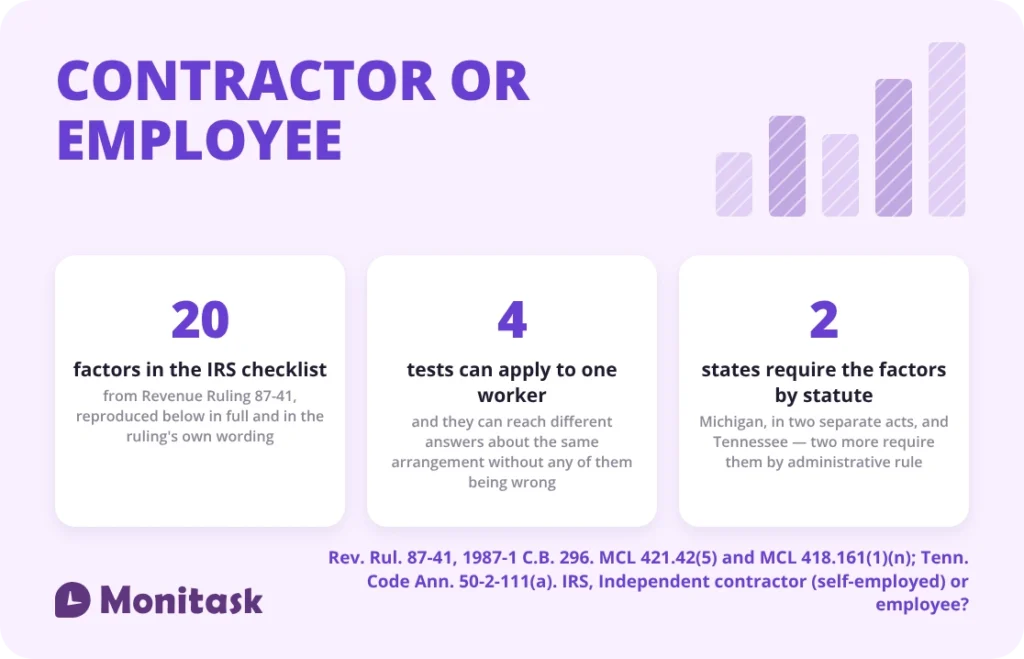
| The 20 factors (Rev. Rul. 87-41) | The IRS historically, and two states by statute | Detailed analysis of the same ground |
| ABC test | Many states | State wage, hour and unemployment law |
| Economic reality test | US Department of Labor | FLSA coverage — minimum wage and overtime |
Why this matters: a worker can be a contractor for one purpose and an employee for another, and both answers can be right. Passing the IRS analysis does not settle a state ABC test, and neither settles FLSA coverage. Check every framework that applies to where the work is performed.
The IRS three-category framework
Current IRS guidance organises classification around three areas, and describes them as categories of evidence rather than as a test to be passed: “Facts that provide evidence of the degree of control and independence fall into three categories:”
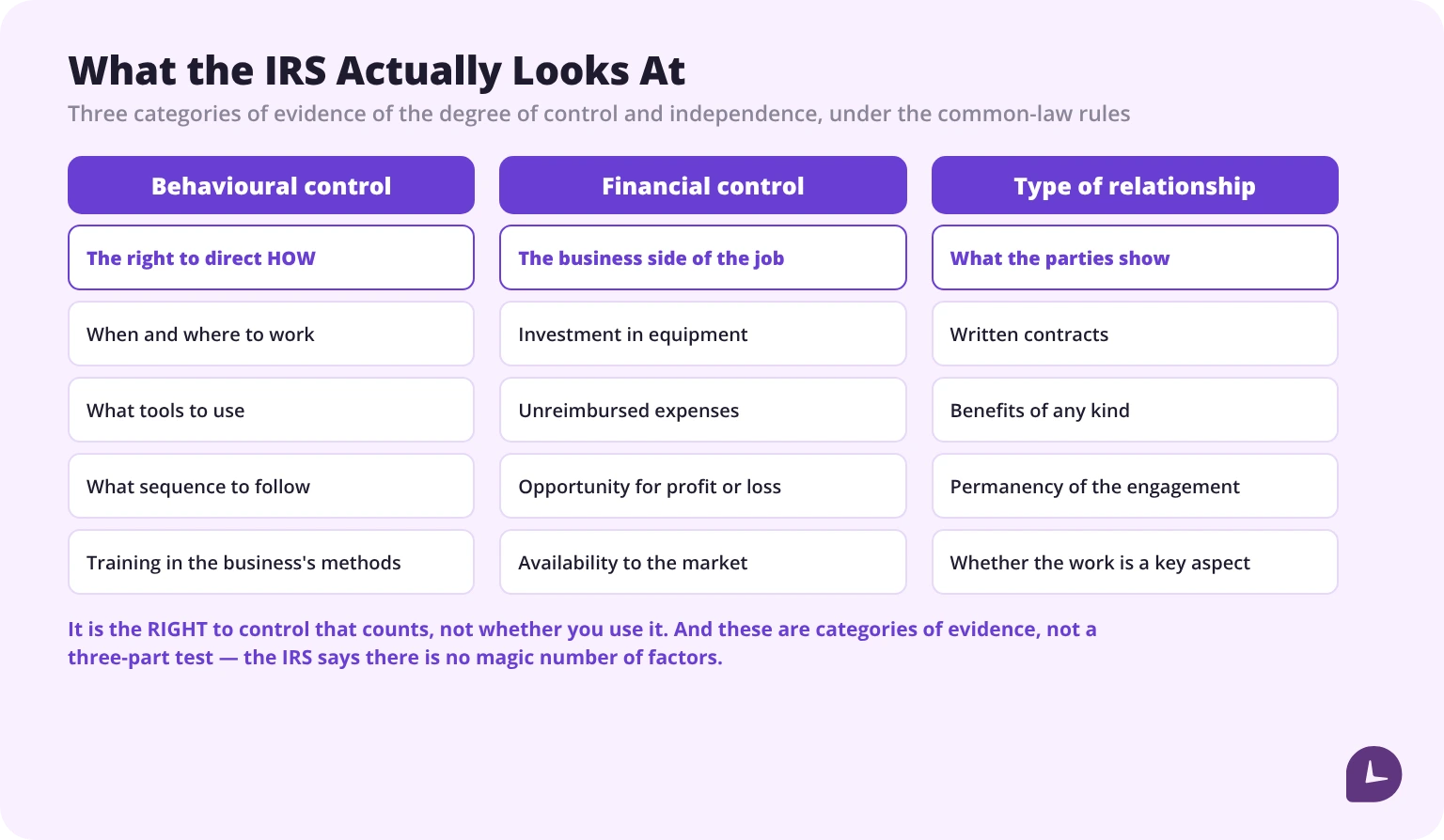
Behavioural control — does the business have the right to direct how the work is done? Instructions about when, where, what tools and what sequence, and training, all point here.
Financial control — does the business direct the financial aspects of the job? Investment in equipment, unreimbursed expenses, opportunity for profit or loss, method of payment, and availability to the market.
Type of relationship — what do the parties’ actions and documents show? Written contracts, benefits, permanency, and whether the services are a key aspect of the business.
The IRS’s own labels are “Behavioral”, “Financial” and “Type of relationship”, and it frames the whole inquiry as the degree of control and independence under the common-law rules, with no single factor controlling.
The principle that applies to all three: it is the right to control that matters, not whether the right is exercised. A business that could direct the method but chooses not to still has the right.
The IRS 20-factor checklist, in full
Twenty questions from Rev. Rul. 87-41, 1987-1 C.B. 296. The headings below are the ruling’s own — several widely-circulated versions abridge them, and in four cases the abridgement changes what the factor asks.
Work through them honestly. The answer you want is not the answer that protects you.
| # | Factor | Points to employee when… |
|---|---|---|
| 1 | Instructions | The worker must comply with instructions about when, where and how to work |
| 2 | Training | The business trains the worker in its own methods |
| 3 | Integration | The services are integrated into business operations and the business depends on them |
| 4 | Services Rendered Personally | The work must be performed by that person specifically |
| 5 | Hiring, Supervising, and Paying Assistants | The business hires, supervises and pays any assistants |
| 6 | Continuing Relationship | The relationship is ongoing rather than project-bound |
| 7 | Set Hours of Work | The business sets the hours |
| 8 | Full Time Required | The worker must devote full time to this business |
| 9 | Doing Work on Employer’s Premises | The work is done on the employer’s premises when it need not be |
| 10 | Order or Sequence Set | The business dictates the order in which tasks are done |
| 11 | Oral or Written Reports | Regular progress reports are required |
| 12 | Payment by Hour, Week, Month | Paid by time rather than by the job |
| 13 | Payment of Business and/or Traveling Expenses | The business pays the worker’s business and travelling expenses |
| 14 | Furnishing of Tools and Materials | The business supplies significant tools and materials |
| 15 | Significant Investment | The worker has no significant investment in the facilities used |
| 16 | Realization of Profit or Loss | The worker cannot realise a profit or loss beyond ordinary pay |
| 17 | Working for More Than One Firm at a Time | The worker serves this business only, rather than several at the same time |
| 18 | Making Service Available to General Public | The worker does not hold themselves out to the general public |
| 19 | Right to Discharge | The business can dismiss the worker at will |
| 20 | Right to Terminate | The worker can quit without contractual liability |
There is no threshold, and no score. The ruling says the twenty factors “are designed only as guides for determining whether an individual is an employee”, and that “the degree of importance of each factor varies depending on the occupation and the factual context in which the services are performed”. The IRS puts it more bluntly in its own audit manual: there is no “magic number” of relevant factors.
This is worth stating plainly because the opposite is widely published, including in places you might trust: that meeting every factor makes someone a contractor and failing any one makes them an employee. That is not a simplification of this test. It is a different test, and it produces confident wrong answers in both directions.
Is the 20-factor test still used?
The honest answer has more layers than most pages give it, and the layers matter.
The ruling has never been withdrawn. Rev. Rul. 87-41, 1987-1 C.B. 296 has not been superseded, modified or obsoleted. Two recent IRS clean-up notices that between them retire 154 pieces of guidance do not touch it.
But current IRS guidance does not use it. Classification on the IRS’s own public page, in Publication 15-A and on Form SS-8 is organised around the three categories above. None of those three mentions the twenty factors or the ruling. The IRS does not even host the ruling’s text any more — Michigan, whose law requires the test, notes on its own site that it had to source its copy elsewhere.
And the IRS has said, in writing, that the list is dated. This is the part usually glossed over. In an information letter from its Office of Chief Counsel (INFO 2004-0087), the Service said the twenty-factor test was difficult to apply, that many of the factors “are no longer relevant”, and that “Rather than listing items of evidence under the twenty factors” it groups evidence into the three categories instead. Its audit manual makes the same point about the passage of time: evidence that was crucial “in 1985” “on which to base a decision about whether a taxpayer retained the right to control a worker” may not carry the same weight now.
So the three categories are not a re-sort of the twenty factors. They replaced them, and the IRS said why.
What the IRS still claims for them is narrow and precise. Its manual says the factors “may still be used for reference purposes” — may still be used for reference purposes — “the primary method is to consider every piece of information in a case that helps to decide the extent to which the taxpayer does or does not retain the right to control the worker.”
Two states require them by name anyway. Michigan does so twice: its Employment Security Act at MCL 421.42(5) requires the agency to determine employment status “20-factor test announced by the internal revenue service of the Unit…”, and its Worker’s Disability Compensation Act at MCL 418.161(1)(n) uses the same formula. Tennessee requires them at Tenn. Code Ann. 50-2-111(a). Two more states — Oklahoma and Ohio — impose a twenty-factor test by administrative rule rather than by statute, and Ohio’s version reproduces the ruling’s language without ever naming it.
The practical position. Use the twenty factors as your working assessment: they turn three abstract categories into specific, answerable questions, which is what you need when you are looking at a real arrangement. Understand that the IRS frames its own analysis in three categories and considers parts of the list stale. And if you operate in Michigan or Tennessee, the list is not optional — it is what the statute tells the agency to apply.
If you also want the practical side of working with contractors rather than classifying them, how to pay independent contractors covers the payment mechanics that factor 12 is about.
The ABC test
Many states apply a stricter standard for state wage, hour and unemployment purposes. A worker is an independent contractor only if all three conditions are met:
A. The worker is free from the control and direction of the hiring entity in performing the work.
B. The work performed is outside the usual course of the hiring entity’s business.
C. The worker is customarily engaged in an independently established trade, occupation or business of the same nature.
Why B is the hard one. A software company engaging a software developer as a contractor fails prong B regardless of how independent the arrangement otherwise is. The work is the company’s usual course of business.
All three must be satisfied. Failing any one means employee status for the purposes that test governs.
How many states use it is not a question with a clean answer, and you should distrust any page that gives you a number. The Department of Labor’s own survey of state unemployment insurance law says only that “Many states provide criteria commonly called the ‘ABC’ test”, and declines to count them — because the test’s purpose varies by state (unemployment insurance, workers’ compensation, wage and hour law, rarely all three), because some states apply only the A and C prongs rather than all three, and because the occupational carve-outs differ sharply between two states that both call theirs an ABC test. Check the version in force in the state where the work is performed, and check what it governs there.
The economic reality test, and which version applies right now
The Department of Labor applies an economic reality analysis for Fair Labor Standards Act purposes — whether minimum wage and overtime apply. It asks, in substance, whether the worker is economically dependent on the business or is genuinely in business for themselves. The factors commonly considered are the degree of control, the opportunity for profit or loss, investment by both parties, the permanence of the relationship, the degree of skill and initiative required, and how integral the work is to the business.
Which version applies is, right now, genuinely unsettled, and most guidance on this is out of date. As at the time of writing the position has three layers:
- The 2024 rule has not been rescinded. It took effect in March 2024 and still governs private lawsuits brought under the FLSA.
- The Department stopped applying it to its own investigations in May 2025. Field Assistance Bulletin No. 2025-1 states that the Wage and Hour Division “WHD will no longer apply the 2024 Rule’s analysis when determining employee versus independent contractor status”, and directs investigators to a seven-factor economic reality analysis from a 2008 fact sheet instead.
- A replacement is proposed but not final. A notice of proposed rulemaking published in February 2026 (91 FR 9932) would rescind the 2024 analysis and restore an earlier test treating control and opportunity for profit as the core factors. Comments closed in April 2026. Five challenges to the 2024 rule are pending, all stayed.
So a business can face two different federal wage-and-hour analyses of the same arrangement depending on who is asking. Any source telling you the 2024 rule is simply “in effect”, or that it has been “rescinded”, is wrong in both directions.
What this does not change is the practical answer. Every version of every test turns on the same two things: the degree of control, and whether the person is genuinely running their own business. An arrangement that comes out clean on the factors below comes out clean under all of them. The tests differ at the margin, and the margin is not where you want to be.
Why state law may differ from federal
The single most common mistake is assuming one determination covers everything.
- A worker can be a contractor for federal tax purposes and an employee under a state ABC test
- A worker can be outside FLSA coverage and still be an employee for state unemployment insurance
- Some states name a specific test in statute; others follow federal analysis
- The governing law is that of the state where the work is performed, not where the business is registered
For a distributed workforce this compounds. A company with contractors in five states may face five different analyses of the same arrangement — and, because the tests serve different purposes, those analyses can disagree without any of them being wrong.
What misclassification costs
The headline numbers are large. FedEx Ground agreed in 2015 to pay $228 million to settle claims by roughly 2,300 drivers in California, covering agreements from 2000 to 2007 — a figure that is gross of fees and covers one state. Exposure in an ordinary case means back employment taxes, unpaid overtime and minimum wage, penalties assessed per worker and per violation, benefit claims, and state unemployment and workers’ compensation liability.
How common is it? Less certain than the round numbers suggest. The Economic Policy Institute’s review puts it at “between 10 and 20 percent of employers misclassify at least one worker as an independent contractor”. A figure of around 30% circulates more widely and does not mean what it is taken to mean: it comes from audits conducted in 2003 and 2004 in Michigan alone, and counts employers who underreported payroll as well as those who misclassified anyone. Audit-based estimates also depend heavily on how a state picks whom to audit, so treat any single figure as an order of magnitude.
What a real case looks like
It is worth reading one, because the reported examples in this category are usually settlements that decided nothing. Santos v. Commissioner, T.C. Memo. 2020-88, is a Tax Court decision on the merits, and it did not go the way the genre usually implies.
The IRS determined that 14 people working for an unincorporated apartment-cleaning business, Campos Cleaning Co., were its owner’s employees for 2008–2010, and asserted $125,799 in federal employment taxes. The taxpayer won. The court held the workers were independent contractors and entered decision for her, so the $125,799 was never a liability — it is what the assessment would have been.
What she did right is the useful part. The court described her role as “more that of a dispatcher, acting as a financial and linguistic bridge or intermediary between her workers and the apartment complexes”. Her workers did not have to take any job she offered, worked at their own pace using their own supplies, were free to hire their own assistants, and were rarely supervised or inspected. On control the opinion is explicit — the right to exercise it is “the ‘crucial test’ in determining the nature of a working relationship” — and equally explicit that “No single factor is dispositive, and all facts and circumstances must be considered.”
Two things to take from it. The first is that the control analysis is decided on what actually happened day to day, not on documents. The second is that the amount was real exposure even though it was never owed: she still had to litigate for the years 2008 to 2010, and the case was filed four years after the first of them. A classification you cannot evidence is expensive before anyone decides whether it was right.
What to do when you are not sure: Form SS-8
You can ask the IRS directly. Form SS-8, “Determination of Worker Status for Purposes of Federal Employment Taxes and Income Tax Withholding” (Rev. December 2023), requests an official determination of a worker’s status.
What to know before filing:
- Either side can file. The instructions say firms and workers both file it “a determination of the status of a worker under the common law rules for purposes of federal employment taxes and income tax withholding”.
- It answers a federal question only. The instructions are explicit: “A Form SS-8 determination may be requested only in order to resolve federal tax matters.” It follows that a determination does not resolve a state ABC test or a state unemployment-insurance question — those have their own decision-makers, and nothing in an SS-8 determination binds them.
- It is not fast. The IRS’s own guidance says “Be aware that it can take at least 6 months to receive an IRS decision”.
- The other party will be contacted. The IRS “the IRS attempts to get information from all parties involved by sending those parties blank Forms SS-8”, and the form itself carries the warning: “If you do not want this information disclosed to other parties, do not file Form SS-8.” If you file, the worker finds out.
- There is no fee.
- Section 530 relief cannot be considered alongside it, because a determination is not an examination of a return. If relief is what you need, this is the wrong instrument.
- The IRS will not rule where worker-classification litigation is pending.
When it is worth it: a category of worker you engage repeatedly, where the arrangement is genuinely borderline and the aggregate exposure is material. For a single short engagement the process costs more than the answer is worth — and a determination binds the IRS only “binding on the IRS if there is no change in the facts or law”.
Section 530 safe harbour
A separate protection worth knowing about, and one most checklists omit entirely.
Under Revenue Act of 1978, Pub. L. 95-600, title V, section 530, 92 Stat. 2885, a business may be relieved of federal employment tax liability for workers it treated as contractors, even where the classification itself was wrong. Three conditions must hold: a reasonable basis for the treatment, substantive consistency — consistent treatment of that class of worker, and reporting consistency — consistent filing of the required returns.
It is a relief provision, not a classification test. The IRS’s own wording is that it “does not determine a worker to be an independent contractor”. It stops the tax being assessed against the business; it does not make the worker a contractor, and it “does not extend to the worker, who may still be liable for the employee share of FICA”.
What counts as a reasonable basis. The statute names three safe harbours, and reliance on any one of them is enough:
- Judicial precedent or rulings — judicial precedent, published rulings, technical advice with respect to the taxpayer, or a letter ruling to the taxpayer. One case is enough. State court decisions and rulings of agencies other than the IRS do not count.
- A prior audit — a past IRS audit in which there was no assessment attributable to the treatment of individuals holding substantially similar positions. For treatment beginning after 1996 the audit must have included an employment tax examination.
- Industry practice — a long-standing recognised practice of a significant segment of the industry in which the individual was engaged.
A business that meets none of the three can still qualify on some other reasonable basis — the requirement is construed liberally in the taxpayer’s favour. But the reliance has to have been real at the time: the statute does not allow a justification constructed afterwards.
The condition that most often defeats relief is not the reasonable basis at all. Section 530(a)(3) bars relief entirely if the business, or a predecessor, has treated any individual holding a substantially similar position as an employee at any time since 1977. If either consistency rule fails, there is no relief even where the reasonable basis requirement is satisfied. One mitigation: similar job titles alone do not make positions substantially similar.
Current IRS procedure also makes this a threshold question — the IRS considers whether section 530 is satisfied before it analyses whether the workers are employees at all. Which means it is worth knowing where you stand on it before a conversation starts, not after.
Conditions are specific and the analysis is fact-dependent. This is a question for counsel, not a checklist.
Re-checking classification over time
No checklist in this category says this, and it is where compliant arrangements go wrong.
Classification is assessed on the facts as they are, not as they were at signing. A relationship that started clearly contractor-side drifts:
- The engagement extends from a project to an ongoing arrangement
- The contractor stops taking other clients
- They start attending regular internal meetings
- Payment shifts from invoice-against-deliverable to a fixed monthly sum
- Someone starts directing their day-to-day method
- They get a company email address and appear on the org chart
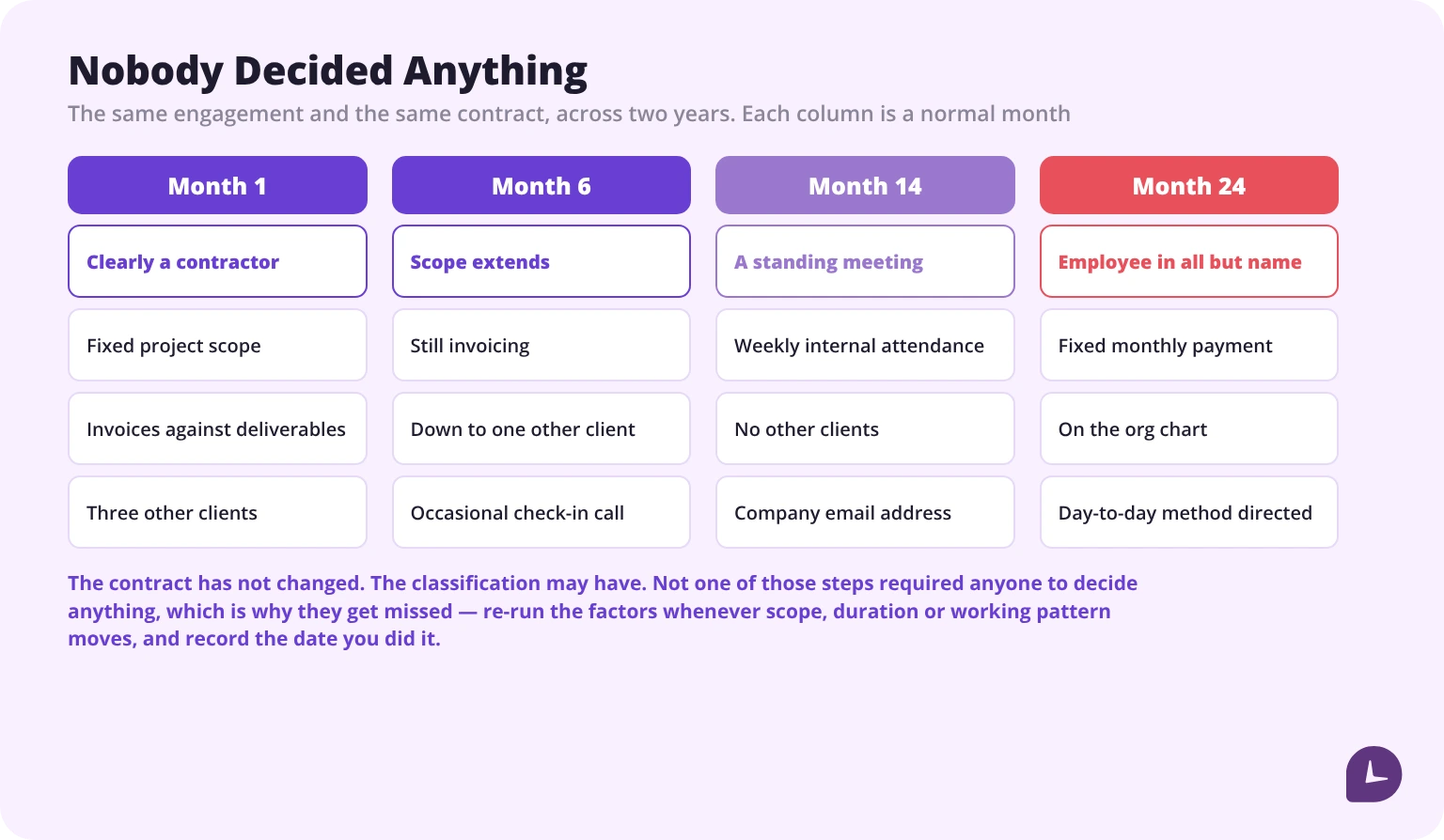
Not one of those changes requires anybody to decide anything. They accumulate, which is why they are missed.
Re-run this checklist whenever scope, duration or working pattern changes materially, and at least annually for long-running engagements. Record the assessment and the date. The record is what demonstrates you took the question seriously, and a contemporaneous file note is worth considerably more than a recollection. There are free company forms and policies if you want a template to keep that record in.
How oversight affects classification
Worth spelling out, because it is where modern arrangements most often go wrong without anyone noticing.
Look at factors 1, 7, 10 and 11 in the checklist above: instructions about how to work, set hours, dictated sequence, required regular reports. Every one of them is about how the work is supervised.
That means the oversight tools you apply to a contractor are classification evidence:
| Practice | Which factor it touches |
|---|---|
| Requiring set working hours | 7 — set hours of work |
| Requiring availability during your business day | 7 |
| Installing monitoring or time-tracking software you administer | 1, 11 |
| Requiring daily status updates | 11 — oral or written reports |
| Dictating which tools must be used | 1, 14 |
| Mandating attendance at internal meetings | 1, 6 |
What stays clearly appropriate: agreeing deliverables and deadlines, reviewing work against acceptance criteria, and receiving invoices with self-reported hours from the contractor’s own records.
A note on our own position. Monitask sells monitoring and time tracking software, built for employees. On a contractor it is classification evidence, and this is the case where we would tell you not to use it. If an engagement genuinely needs that level of oversight, the question the checklist above is asking is whether it should be an employee role.
Monitask is built for employees — and the whole point of this page is working out which one you have.
See what Monitask does, and who it is for
Sources
- Rev. Rul. 87-41, 1987-1 C.B. 296 — the twenty factors
- IRS, Independent contractor (self-employed) or employee? — the three categories of evidence under the common-law rules
- IRS, Publication 15-A, Employer’s Supplemental Tax Guide (2026)
- INFO 2004-0087, IRS Office of Chief Counsel information letter, 8 April 2004 — on why the Service stopped listing evidence under the twenty factors
- IRM 4.23.5.7.1 — on the factors’ continued use for reference, and on the weight of older evidence
- IRS, Form SS-8 (Rev. December 2023) and its instructions (Rev. January 2024); IRS, Completing Form SS-8
- Revenue Act of 1978, section 530, 92 Stat. 2885, printed as a note to 26 U.S.C. 3401; Rev. Proc. 2025-10
- Santos v. Commissioner, T.C. Memo. 2020-88 (No. 27693-14, filed 17 June 2020)
- MCL 421.42(5) and MCL 418.161(1)(n); Tenn. Code Ann. 50-2-111(a)
- US Department of Labor, Field Assistance Bulletin No. 2025-1, and the proposed rule at 91 FR 9932
- Economic Policy Institute, (In)dependent Contractor Misclassification, Briefing Paper #403
If the checklist above came out employee-side, that is a payroll question rather than a monitoring one — and worth answering before anyone else asks it.
See how Monitask tracks employee time
FAQ
What is the IRS 20-factor test?
Twenty questions from Rev. Rul. 87-41, 1987-1 C.B. 296 assessing the degree of control in a working relationship. Each points toward employee or contractor status, and the ruling says they “are designed only as guides for determining whether an individual is an employee”.
Does the IRS still use the 20-factor test?
Not in its own current guidance. The IRS organises classification around three categories — behavioural control, financial control and type of relationship — and has said in an information letter that many of the twenty factors are no longer relevant. The ruling has never been withdrawn, its audit manual says the factors may still be used for reference, and two states require them by statute.
How many of the 20 factors make someone an employee?
There is no threshold and no score. No single factor decides, some do not apply to a given arrangement, and the ruling says the importance of each varies with the occupation. Any source telling you that failing one factor settles it is describing a different test from this one.
What is the ABC test?
A stricter standard used by many states for state wage, hour and unemployment purposes. A worker is a contractor only if all three conditions hold: free from control, performing work outside the hiring entity’s usual course of business, and independently engaged in that trade. Prong B is the one that catches most arrangements.
Can someone be a contractor for tax purposes and an employee for wage law?
Yes, and both answers can be correct. Different tests govern different purposes and they can reach different conclusions about the same arrangement.
Whose law applies to a remote contractor?
Generally the law of the state where the work is physically performed, not where the business is registered. A company with contractors in five states may face five analyses.
What does misclassification cost?
Back employment taxes, unpaid overtime and minimum wage, penalties per worker and per violation, benefit claims, and state unemployment and workers’ compensation liability. It also costs the time and legal fees of defending the classification — in one Tax Court case the business won outright and still litigated three tax years.
How do I get an official determination?
File Form SS-8 with the IRS. Either side can file, it settles federal employment tax classification only, there is no fee, and the IRS says it can take at least six months. The other party is contacted as part of the review.
What is the Section 530 safe harbour?
Relief from federal employment tax liability for a business that treated workers as contractors with a reasonable basis, consistently, and filed the required returns. It does not make the worker a contractor, and it is barred entirely if you have ever treated a substantially similar worker as an employee since 1977.
How often should classification be reviewed?
Whenever scope, duration or working pattern changes materially, and at least annually for long-running engagements. Classification is assessed on current facts, not on the original contract. Record the date you checked.