A payroll check template is a reusable layout for the check and the itemized statement attached to it. Federal law does not require an employer to hand an employee a pay stub at all — 29 CFR part 516 requires records to be kept, not furnished. Whether a statement must be issued, and what it must show, is set by state law. The template below carries every field in the federal recordkeeping list that belongs on a statement, and all nine items in California’s requirement, which is the strictest in the country.
> This is not legal or tax advice. Pay statement requirements differ by state, and some of the rules below apply in California only. Confirm what applies in each state where you have employees before issuing statements. Statutes were checked against primary sources on 22 October 2026.
What is a payroll check template?
A payroll check template is a two-part layout: the negotiable check itself and the itemized statement attached to it, usually as a detachable stub. The check carries the payee, the amount and the date. The pay stub carries the arithmetic behind that amount — hours, rates, gross pay, each deduction, net pay and year-to-date totals.
The stub is the part that matters legally, and it is the part most templates get wrong. A check that clears tells an employee what they were paid. A stub tells them how the figure was reached, which is what a wage statement requirement is for and what an employee needs in order to notice an error. If you are building the figures rather than the layout, how to calculate payroll covers the arithmetic that feeds this document.
Are employers required to give employees a pay stub?
Not under federal law. The Fair Labor Standards Act recordkeeping rules in 29 CFR part 516 require an employer to maintain and preserve payroll records — a duty to keep, not a duty to furnish. There is no general obligation in the part to provide an employee with a statement of wages.
Part 516 does contain three narrow duties to hand something to an employee, and they are worth knowing because the first two catch real employers:
| Provision | What must be given to the employee |
|---|---|
| § 516.2(b)(2)(ii) | A copy of the receipt form for a retroactive wage payment made under Wage and Hour Division supervision |
| § 516.28(a)(3) | Written notice to a tipped employee every time the tip credit per hour changes from the preceding week |
| § 516.31(c) | A Wage and Hour Division handbook supplied to each industrial homeworker |
The tip-credit one is the live risk for a restaurant: “The amount per hour which the employer takes as a tip credit shall be reported to the employee in writing each time it is changed from the amount per hour taken in the preceding week.” That is a written notice duty triggered by a rate change, not by a pay period, and it is easy to miss.
But none of those is a wage statement. So “is a pay stub required?” has no federal answer. It is a state question.
A frame, and a warning about where the state lists come from
State rules differ in kind rather than degree, and they sort roughly into five positions:
| Position | A state that is clearly there | On what authority |
|---|---|---|
| No general statement requirement | Florida | Fla. Stat. ch. 448 imposes no general furnishing duty — but § 448.24(2)(g) requires labor pools to give day laborers an itemized deduction statement, electronically only on written request |
| A statement must be provided or made accessible | Ohio | ORC 4113.14, in force since 9 April 2025: a written or electronic statement, or access to one, on each regular payday |
| Accessible and printable | Washington | WAC 296-126-040(3): electronic delivery is allowed “provided each employee has access to receive and copy it on the payday”, with a written statement required if they cannot |
| Electronic by default, paper on request | Minnesota, Delaware | Minn. Stat. § 181.032(c) obliges paper on 24 hours’ notice, “on an ongoing basis”; 19 Del. C. § 1108(4) lets an employee request a written slip |
| Paper by default, electronic only on consent | Hawaii, Oregon | Hawaii Act 210 (2005) requires “written authorization from the employee”; ORS 652.610(1)(c) requires that the employee “expressly agrees” |
Two caveats on that table, both of which matter more than the table does.
The categories are ours, not an authority’s. A five-bucket classification circulates widely with this topic, usually with a list of states attached and no citation. We could not find any organisation that publishes it, and no government source uses it: the only federal state-by-state table, the Department of Labor’s State Payday Requirements, covers payday frequency and says nothing about statements at all. Every state named above was read from the statute rather than taken from a chart.
The positions overlap. Oregon requires both express consent and the ability to print or store. Washington requires access, copy capability and a paper fallback. Two independent questions are being flattened into one list — is a statement owed at all, and what must electronic delivery satisfy — so treat the five as a way of thinking rather than a partition.
Two states the circulating lists get wrong
Ohio is no longer a no-requirement state. The Pay Stub Protection Act took effect on 9 April 2025 and added ORC 4113.14, which requires each employer to give employees a “written or electronic statement or access to a statement of the employee’s earnings and deductions” for each pay period on the regular paydays, showing names, gross and net wages, the amount and purpose of each addition and deduction, the pay date and period, and — for hourly employees — total hours, the hourly rate and hours in excess of forty in a workweek. An employee who does not receive one may request it in writing, and the employer has ten days. Lists that still place Ohio in the no-requirement column are more than a year and a half out of date.
Oregon is opt-in, not opt-out. ORS 652.610(1)(c) permits an electronic statement only where “The employee expressly agrees to receive the statement in electronic form” and the employee can print or store it at the time of receipt. Paper is the default and there is no general right to demand it, because none is needed. The paper-request provision that gets cited for the opposite reading is ORS 652.610(2)(d), and it applies only to officers and employees paid through the Oregon state payroll system. A private Oregon employer who follows the usual chart and switches everyone to electronic statements without consent is not compliant.
Six large states, from the statute
| State | Citation | What the statement must show | Electronic delivery |
|---|---|---|---|
| California | Cal. Lab. Code § 226 | Nine itemized categories, semimonthly or at each payment of wages | Permitted subject to conditions, by agency interpretation |
| New York | N.Y. Lab. Law § 195(3) | Dates, names, rate or rates and the basis of pay, gross, deductions, allowances, net — plus separate regular and overtime rates and hours for non-exempt employees | The statute is silent, and so is the Department of Labor’s own LS45 guidance |
| Texas | Tex. Lab. Code § 62.003 | A written earnings statement, signed by the employer or its agent: name, rate, total pay, each deduction and its purpose, pay after deductions, hours or units | Not mentioned anywhere in chapter 62. The only alternative format named is a check voucher or bank draft |
| Illinois | 820 ILCS 115/10 | A pay stub each pay period; contents sit in the Act’s definition and the Department of Labor’s rules rather than in § 10 itself | Permitted — and then followed by a 3-year retention duty, 21-day production on request, a format choice for leavers, and an affirmative offer at separation |
| Washington | WAC 296-126-040 | Pay basis, rate or rates, gross wages and all deductions, with the pay period identified by month, day, year and payment date | Permitted if the employee can receive and copy it on the payday, with a written statement required if they cannot |
| Florida | No general requirement | None generally; labor pools owe an itemized deduction statement under § 448.24(2)(g) | n/a generally; for labor pools, only on the worker’s written request |
Texas is worth a second look. Section 62.003(a) requires a “written” earnings statement and § 62.003(c) names only a check voucher or bank draft as an alternative format. Chapter 62 does not mention electronic delivery, and it requires the statement to be signed by the employer or its agent — a requirement that sits awkwardly with an emailed PDF and that almost every summary of Texas law omits.
Illinois shows why “is electronic allowed?” is the wrong question. It is allowed, and § 10 then attaches a three-year retention duty that survives the employment, production within 21 calendar days on request, a format choice for former employees, and an affirmative obligation to offer a year of stubs by the end of a leaver’s final pay period. None of the five positions above captures that.
> What we did not check. Alabama, Arkansas, Georgia, Mississippi and South Dakota appear in the circulating no-requirement list and we did not verify them, so they are not in the table above. Neither are the remaining states. Given that two of the entries we did check turned out to be wrong, treat any state not named here as needing its own check rather than as covered.
A template described as “compliant” without naming a state is promising compliance with a requirement that does not exist federally. The useful question is which state’s rules apply to each employee, and the practical answer for a multi-state employer is to build one statement to the strictest applicable standard rather than maintain several formats.
Which payroll records must an employer keep?
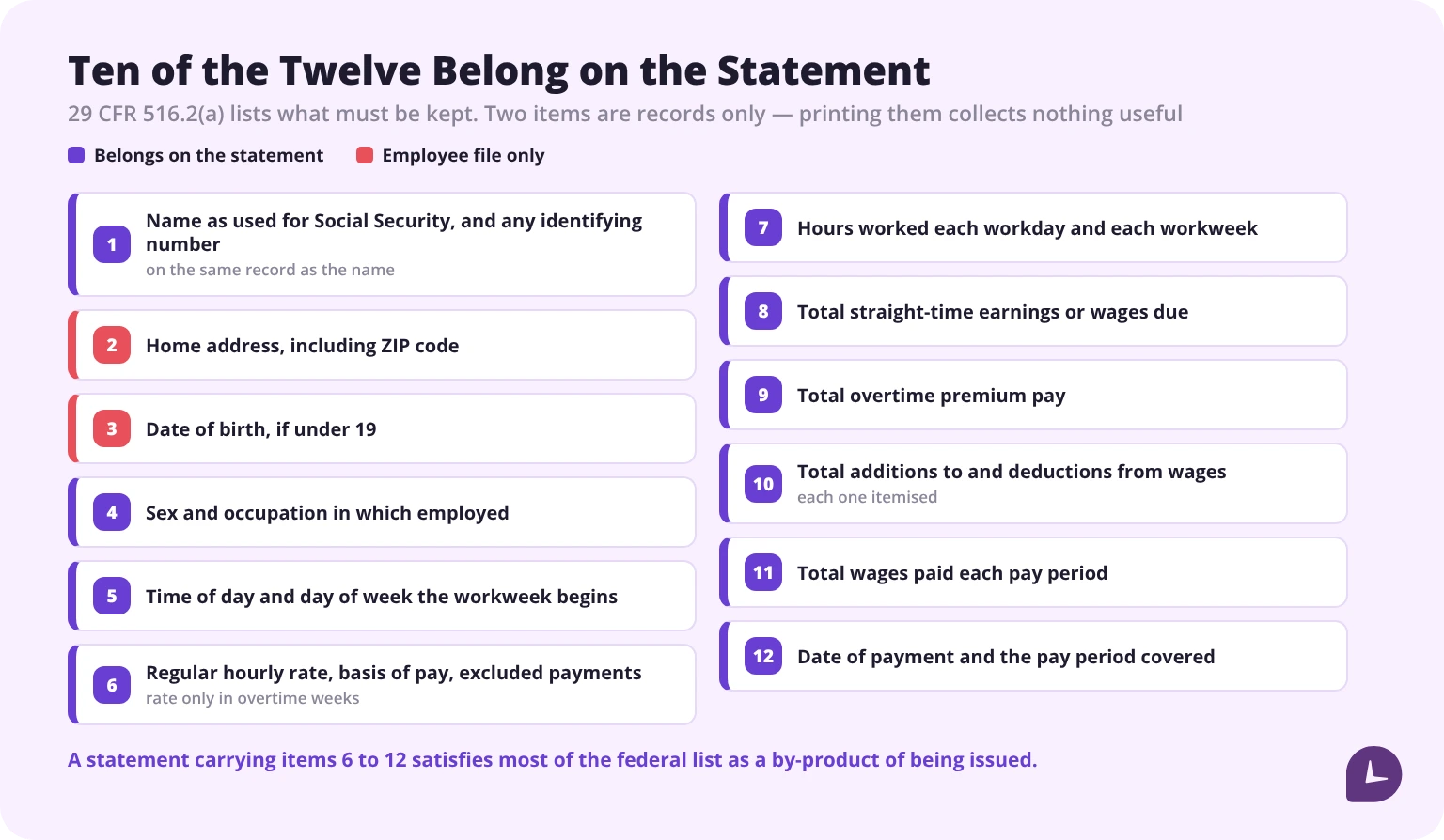
29 CFR § 516.2(a) sets out what must be maintained for each employee covered by the minimum wage and overtime provisions: “Every employer shall maintain and preserve payroll or other records containing the following information and data with respect to each employee to whom section 6 or both sections 6 and 7(a) of the Act apply:” The list is the natural skeleton for a pay stub, because 10 of the twelve items belong on one.
| # | Record required | Belongs on the statement? |
|---|---|---|
| (1) | Name in full, as used for Social Security recordkeeping purposes, and on the same record, the employee’s identifying symbol or number if such is used in place of name on any time, work, or payroll records | Yes |
| (2) | Home address, including zip code | No — file only |
| (3) | Date of birth, if under 19 | No — file only |
| (4) | Sex and occupation in which employed | Yes |
| (5) | Time of day and day of week on which the employee’s workweek begins | Yes |
| (6) | Regular hourly rate of pay for any workweek in which overtime compensation is due; the basis of pay; and payments excluded from the regular rate under section 7(e) | Yes |
| (7) | Hours worked each workday and total hours worked each workweek | Yes |
| (8) | Total daily or weekly straight-time earnings or wages due for hours worked during the workday or workweek, exclusive of premium overtime compensation | Yes |
| (9) | Total premium pay for overtime hours | Yes |
| (10) | Total additions to or deductions from wages paid each pay period including employee purchase orders or wage assignments | Yes |
| (11) | Total wages paid each pay period | Yes |
| (12) | Date of payment and the pay period covered by payment | Yes |
Two of these are records rather than stub fields. Date of birth under (3) and home address under (2) belong in the employee file; printing a date of birth on a statement collects nothing useful and puts personal data into circulation. Everything from (6) through (12) belongs on the stub, and a template that carries all of it satisfies most of the federal recordkeeping list as a by-product of issuing the statement.
Three details in the regulation that paraphrases usually drop, and that change what a template needs:
- Item (6)(i) requires the regular hourly rate only for any workweek in which overtime compensation is due, not every week.
- Item (6)(ii) is not satisfied by naming the basis of pay. The employer must “indicate the monetary amount paid on a per hour, per day, per week, per piece, commission on sales, or other basis”.
- Item (10) expressly includes “employee purchase orders or wage assignments” among the additions and deductions to be totalled, and requires individual records showing “the dates, amounts, and nature” of each.
Exempt white-collar employees are a different case. Under § 516.3, an employer keeps “all the information and data required by § 516.2(a) except paragraphs (a) (6) through (10)”, plus the basis on which wages are paid in enough detail to compute total remuneration for each pay period. So items (6) through (10) — rates, hours, straight-time and overtime earnings — drop out for genuinely exempt staff. Gross wages and the payment date do not.
Tipped employees need four more records under § 516.28(a): a notation identifying each tipped employee, the tips they report, the tip credit claimed per hour, and hours and straight-time earnings split between tipped and non-tipped occupations. The template below has a block for them.
How long must payroll records be kept?
Part 516 sets two periods, and the shorter one applies to the document most employers assume they must keep longest. Both are floors: the regulation says “Each employer shall preserve for at least 3 years:” and, for the two-year group, “Each employer required to maintain records under this part shall preserve for a period of at least 2 years”.
| Citation | Record | Retention | Measured from |
|---|---|---|---|
| § 516.5(a) | Payroll records | At least 3 years | From the last date of entry |
| § 516.5(b) | Certificates, agreements, plans, notices | At least 3 years | From their last effective date |
| § 516.5(c) | Sales and purchase records | At least 3 years | No trigger date stated |
| § 516.6(a)(1) | Basic time and earning cards or sheets | At least 2 years | From the date of last entry |
| § 516.6(a)(2) | Wage rate tables and piece rate schedules | At least 2 years | From their last effective date |
| § 516.6(b) | Order, shipping and billing records | At least 2 years | From the last date of entry |
| § 516.6(c) | Records of additions to or deductions from wages | At least 2 years | No trigger date stated |
| Cal. Lab. Code § 226(a) | Copies of itemized statements and deduction records | At least 3 years | At the place of employment or a central location within California |
Note what this combination produces. The payroll record runs 3 years; the time card the payroll record was built from runs 2. An employer who destroys time cards at the federal minimum spends the 3rd year holding a payroll record with no underlying evidence of the hours behind it. Where the hours are ever disputed — a wage claim, an audit, a back-pay calculation — that 1-year gap falls on the employer, which is why aligning both to the longer period is the ordinary practice.
The regulation is also relaxed about the medium. Section 516.1(a) says “No particular order or form of records is prescribed by the regulations in this part.”, and permits records to be kept “on microfilm or other basic source document of an automatic word or data processing memory” — 1970s phrasing that carries modern electronic recordkeeping — on three conditions: viewing equipment is available, reproductions are clear and identifiable by date or pay period, and transcriptions are made available on request. California says the same thing more plainly: “For purposes of this subdivision, “copy” includes a duplicate of the itemized statement provided to an employee or a computer-generated record that accurately shows all of the information required by this subdivision.”
One deadline that catches employers who have moved records to a service provider. Under § 516.7, “Where the records are maintained at a central recordkeeping office, other than in the place or places of employment, such records shall be made available within 72 hours following notice from the Administrator or a duly authorized and designated representative.” Seventy-two hours is not long if nobody in the building knows who the payroll vendor’s support contact is.
What must a California wage statement show?
California Labor Code § 226(a) requires an employer, “semimonthly or at the time of each payment of wages”, to furnish “an accurate itemized statement in writing” — either as a detachable part of the check, draft or voucher, or separately where wages are paid by personal check or cash. Nine items are required.
| # | Required on the statement |
|---|---|
| (1) | gross wages earned |
| (2) | total hours worked by the employee, except as provided in subdivision (j) |
| (3) | the number of piece-rate units earned and any applicable piece rate if the employee is paid on a piece-rate basis |
| (4) | all deductions, provided that all deductions made on written orders of the employee may be aggregated and shown as one item |
| (5) | net wages earned |
| (6) | the inclusive dates of the period for which the employee is paid |
| (7) | the name of the employee and only the last four digits of their social security number or an employee identification number other than a social security number |
| (8) | the name and address of the legal entity that is the employer and, if the employer is a farm labor contractor, … the name and address of the legal entity that secured the services of the employer |
| (9) | all applicable hourly rates in effect during the pay period and the corresponding number of hours worked at each hourly rate by the employee |
Item (9) is the one that defeats most generic templates. A stub showing a single blended figure does not satisfy it: each rate in effect during the period must appear with the hours worked at that rate. An employee who worked part of a week at a shift differential, or who received a mid-period increase, needs both rates and both hour totals on the face of the statement.
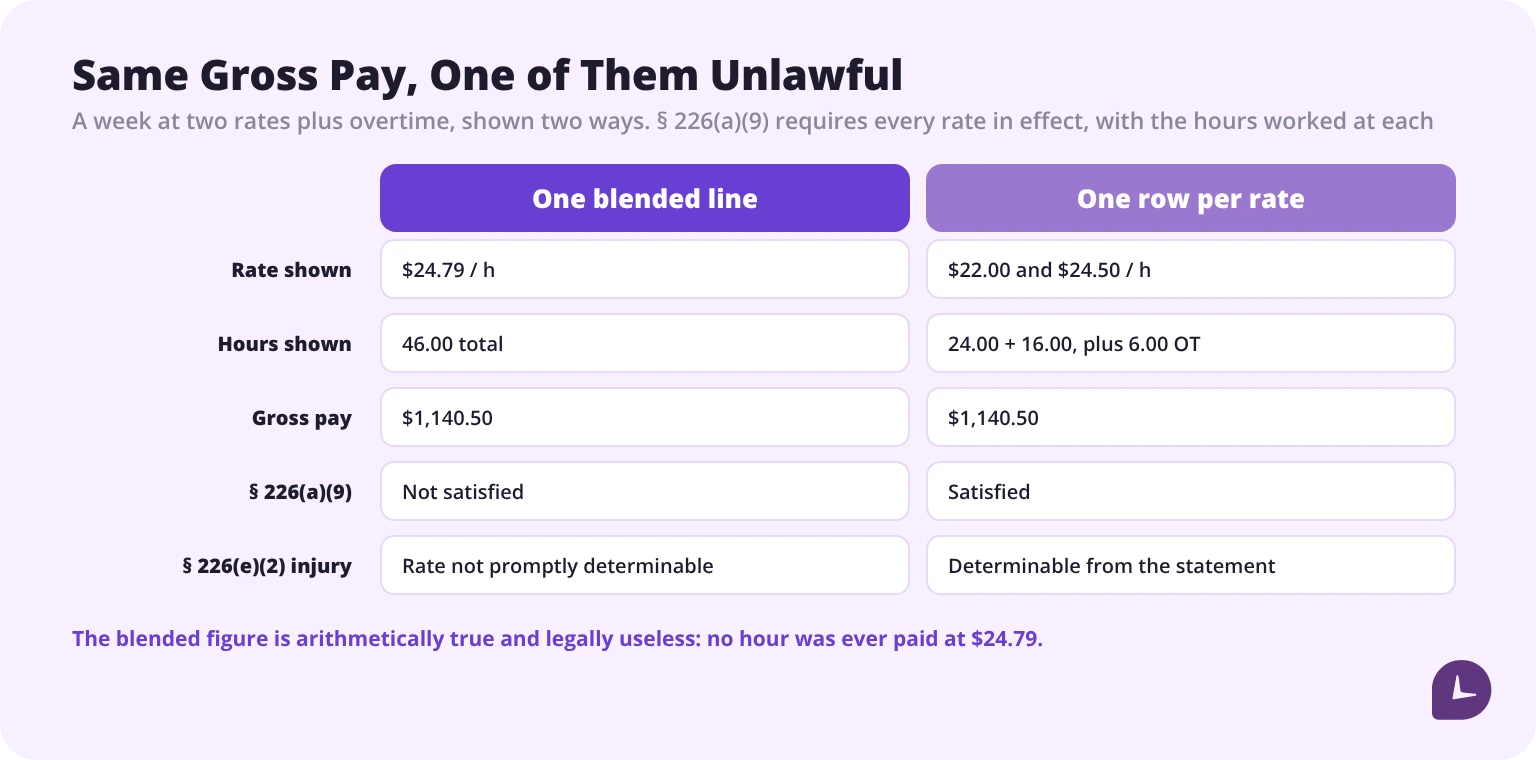
Take a week of 24.00 hours at $22.00, 16.00 at $24.50 and 6.00 hours of overtime at $36.75. Gross pay is $1,140.50 either way. Shown as one line, the statement reports 46.00 hours at $24.79 — a rate at which no hour was actually paid, which appears nowhere in the payroll record, and which satisfies neither (a)(9) nor the standard in (e)(2) discussed below.
Subdivision (a) also requires that “The deductions made from payment of wages shall be recorded in ink or other indelible form, properly dated, showing the month, day, and year, and a copy of the statement and the record of the deductions shall be kept on file by the employer for at least three years at the place of employment or at a central location within the State of California.”
What subdivision (j) actually excuses
Item (2) carries a cross-reference that most summaries print and never explain. Subdivision (j) says an itemized statement “shall not be required to show total hours worked by the employee” in eight listed cases — and only the total hours line. Nothing else on the statement is excused, and the statement itself is still required.
The first case is the one that matters in practice: “The employee’s compensation is solely based on salary and the employee is exempt from payment of overtime under subdivision (a) of Section 515 or any applicable order of the Industrial Welfare Commission.” Both halves are needed. A salaried employee who is not exempt from overtime still needs total hours on the statement, and treating “salaried” as the test on its own is the most common way a template drops a required field.
Inspection: 21 calendar days
Under § 226(b) a current or former employee may inspect or receive a copy of records pertaining to their employment on reasonable request. The employer may take reasonable steps to verify identity and may charge the actual cost of reproduction. Subdivision (c) sets the clock: “An employer who receives a written or oral request to inspect or receive a copy of records pursuant to subdivision (b) pertaining to a current or former employee shall comply with the request as soon as practicable, but no later than 21 calendar days from the date of the request.”
Three points about that deadline. It is triggered by a “written or oral” request, so a conversation starts it. A violation is an infraction, and “Impossibility of performance, not caused by or a result of a violation of law, shall be an affirmative defense for an employer in any action alleging a violation of this subdivision.” And the subdivision ends with a sentence worth acting on before anyone asks: “An employer may designate the person to whom a request under this subdivision will be made.” Name that person in the statement footer and the 21 days start against someone who knows what to do.
Should the stub show a Social Security number?
No — only the last four digits. Section 226(a)(7) requires the employee’s name together with “only the last four digits of their social security number or an employee identification number other than a social security number”. A full number on the statement does not meet that requirement.
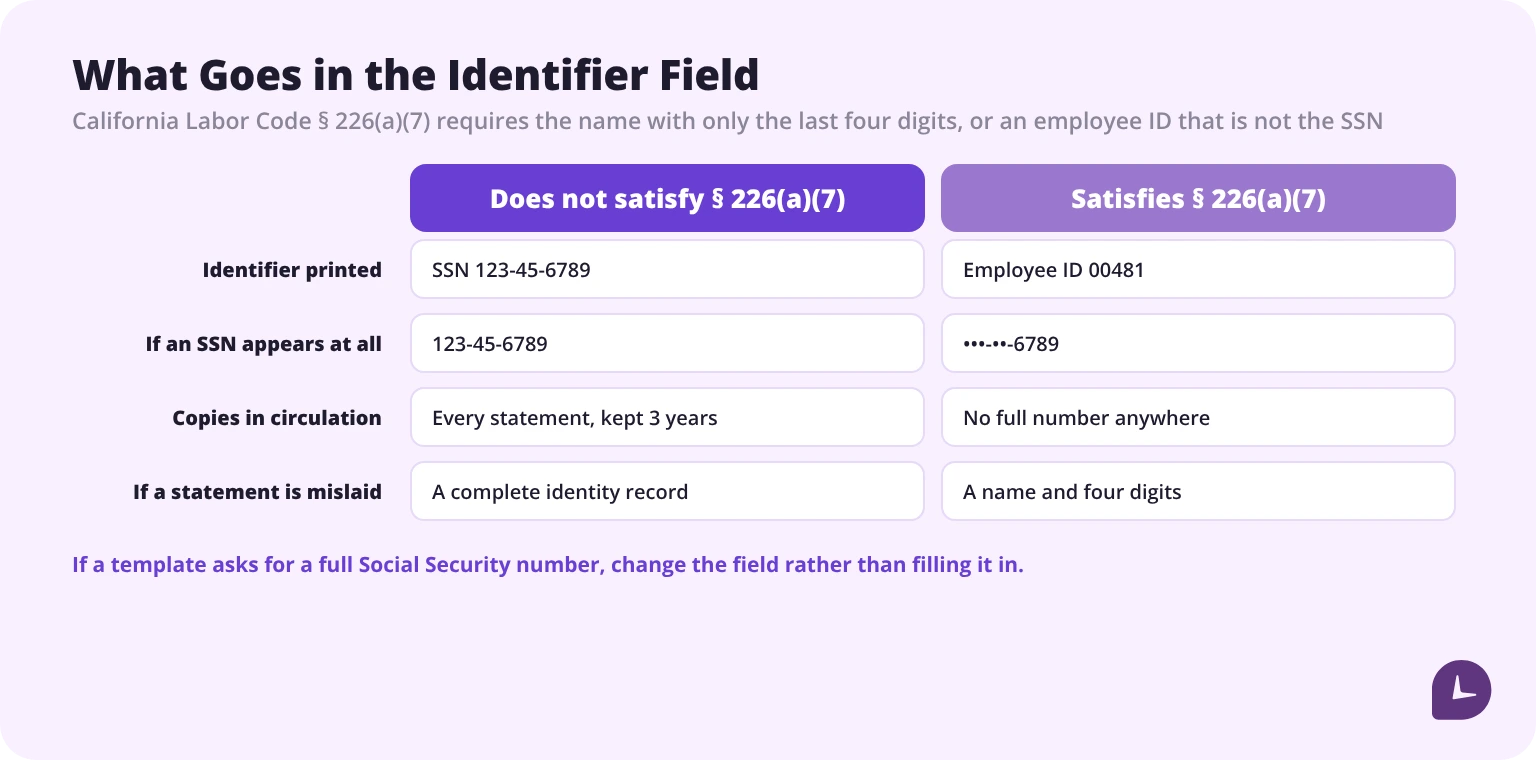
The data-protection argument points the same way, and it applies in every state. A wage statement is printed, handed over or mailed, and then retained for 3 years. A full Social Security number on that document multiplies the number of copies in circulation for no operational benefit — payroll systems identify employees by an internal number, and the last four digits are enough for an employee to confirm the statement is theirs.
The template below uses an employee ID field and a last-four field. If a template asks for a full Social Security number, change the field rather than filling it in.
What do pay stub errors cost?
In California the exposure is set out in § 226(e) and it compounds per pay period, which is what makes a defective template expensive rather than merely untidy.
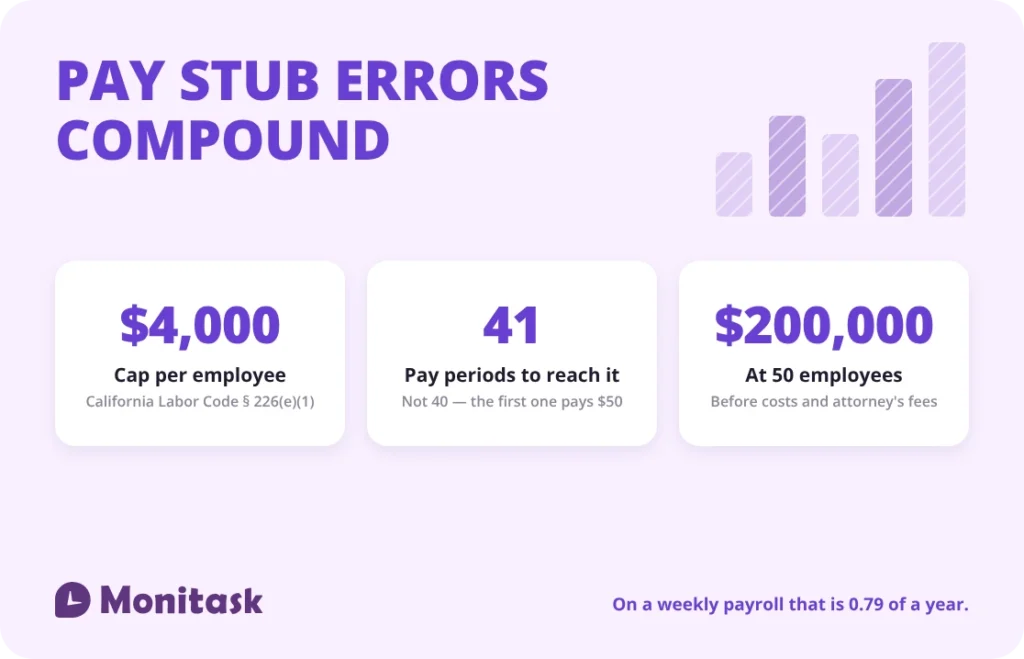
> “An employee suffering injury as a result of a knowing and intentional failure by an employer to comply with subdivision (a) is entitled to recover the greater of all actual damages or fifty dollars ($50) for the initial pay period in which a violation occurs and one hundred dollars ($100) per employee for each violation in a subsequent pay period, not to exceed an aggregate penalty of four thousand dollars ($4,000), and is entitled to an award of costs and reasonable attorney’s fees.”
Read the “greater of” carefully, because it is widely mis-stated. The comparison is between all actual damages and the whole statutory schedule — not actual damages plus the schedule. The schedule itself runs $50 for the initial pay period and $100 per employee for each violation in a subsequent pay period, capped at $4,000 in aggregate for that employee, with costs and reasonable attorney’s fees on top of whichever figure wins.
| Initial pay period | $50.00 |
| Each subsequent pay period | $100.00 |
| Aggregate cap per employee | $4,000.00 |
| Total after 40 pay periods | $3,950.00 — $50.00 short of the cap |
| Pay periods to reach the cap | 41 — one initial plus 40 subsequent |
The off-by-one is worth being careful about, because the schedule never lands exactly on the cap. Solving $50 + $100 × (k − 1) = $4,000 gives k = 40.5. At 40 pay periods the total is $3,950.00; at 41 it would be $4,050.00 and the cap binds.
How long 41 consecutive pay periods takes depends on the pay frequency:
| Pay frequency | Periods per year | Time to reach the cap |
|---|---|---|
| Weekly | 52 | 0.79 years |
| Biweekly | 26 | 1.58 years |
| Semi-monthly | 24 | 1.71 years |
| Monthly | 12 | 3.42 years |
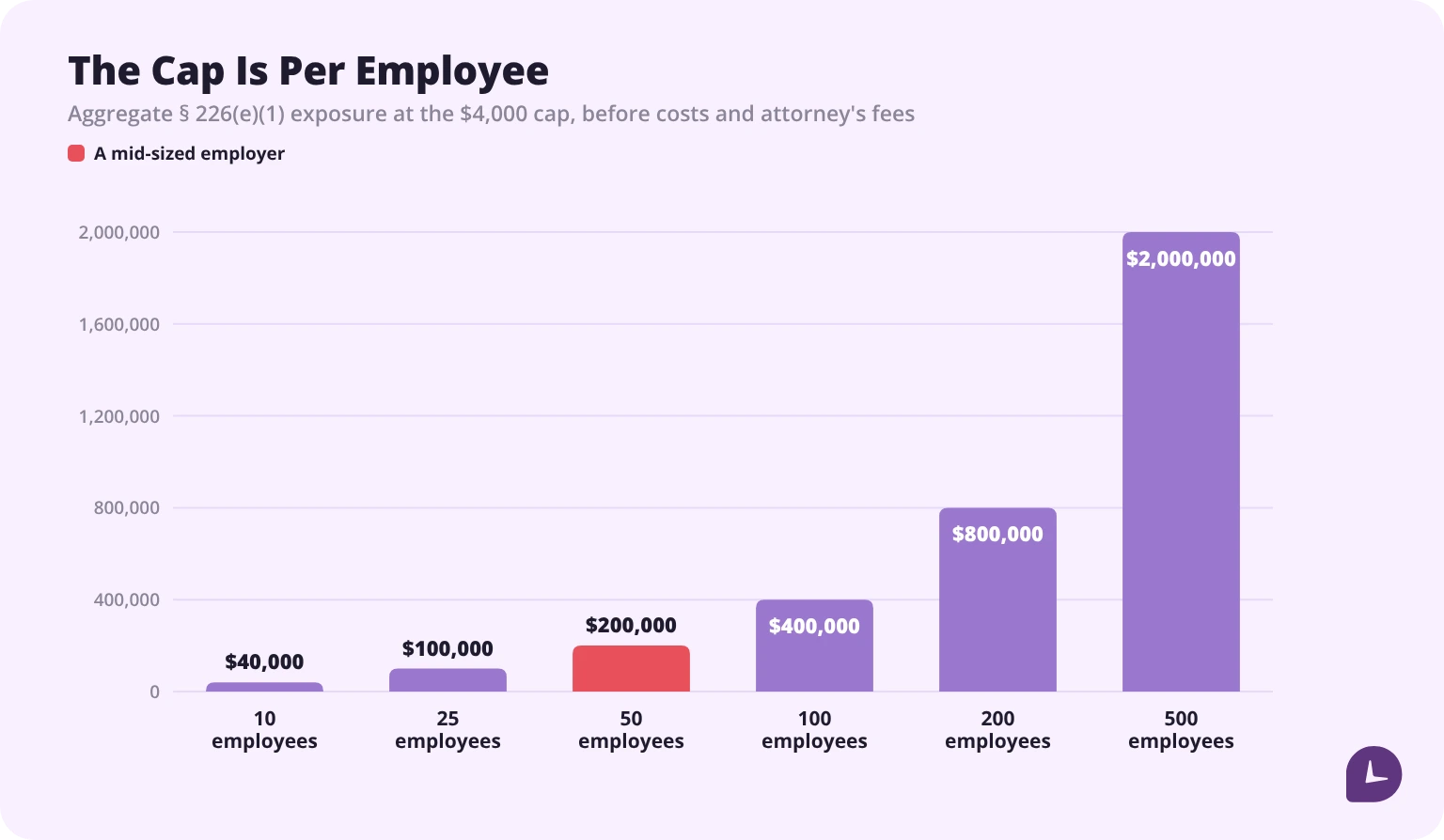
And the cap is per employee, so it scales with headcount:
| Employees | Aggregate exposure at the cap |
|---|---|
| 10 | $40,000.00 |
| 25 | $100,000.00 |
| 50 | $200,000.00 |
| 100 | $400,000.00 |
| 200 | $800,000.00 |
| 500 | $2,000,000.00 |
Two provisions decide which side of this an employer lands on.
Deemed injury, § 226(e)(2). An employee is deemed to suffer injury where no statement is provided at all, or where required information is missing or inaccurate and “the employee cannot promptly and easily determine from the wage statement alone” any of the following:
- The gross or net wages paid, and the information required by items (2) to (4), (6) and (9) of subdivision (a)
- Which deductions the employer made from gross wages to reach net wages
- The name and address of the employer
- The employee’s name and the last four digits of the Social Security number, or an employee identification number other than the SSN
The standard is defined in the statute: “For purposes of this paragraph, “promptly and easily determine” means a reasonable person would be able to readily ascertain the information without reference to other documents or information.” From the wage statement alone is the operative constraint, and it is the sentence that should govern every design decision in a template. An omission cannot be cured by pointing to a portal, a separate schedule or last period’s stub. A statement that requires the reader to divide gross pay by hours to work out a rate fails on its face, and the employee does not then have to prove any further harm.
Safe harbour, § 226(e)(3). A “knowing and intentional failure” “a “knowing and intentional failure” does not include an isolated and unintentional payroll error due to a clerical or inadvertent mistake”. And the factfinder “may consider as a relevant factor whether the employer, prior to an alleged violation, has adopted and is in compliance with a set of policies, procedures, and practices that fully comply with this section”. That second sentence is the practical case for a fixed template over ad-hoc statements: a consistent format turns a format problem into a one-off arithmetic problem, and a one-off arithmetic problem is what the safe harbour covers.
Two more exposures sit beside § 226(e). Section 226(f) adds a $750 penalty, recoverable by the employee or the Labor Commissioner, for missing the 21-day inspection deadline, and § 226(h) lets an employee seek an injunction with costs and attorney’s fees.
Three neighbouring sections are usually left out of the arithmetic entirely, and they are larger than § 226(e):
| Section | What it adds |
|---|---|
| § 226.2(a)(2) | Piece-rate employees need separate line items for compensable rest and recovery periods and for other nonproductive time — hours, rate and gross wages for each |
| § 226.3 | A separate civil penalty of $250 per employee per violation on an initial citation and $1,000 per employee for each violation on a subsequent citation, in addition to any other penalty provided by law |
| § 226.6 | A knowing and intentional violation of § 226 is a misdemeanour: a fine of up to $1,000, imprisonment up to one year, or both |
| § 226(d) and (i) | Employers of domestic workers in a residential dwelling, and state and local government entities, are carved out — though government employers must still use the last four digits or an alternative ID |
Can pay stubs be delivered electronically?
It depends on the state, and the five positions above are the right frame. In a consent state, electronic delivery requires the employee’s agreement and paper remains the default. In a paper-on-request state, electronic is the default and the employee can insist on paper. In an access state, the test is whether the employee can actually reach the information and, where required, copy or print it.
Three conditions make an electronic statement defensible wherever it is permitted, and each one traces to a provision rather than to custom.
| Condition | Why |
|---|---|
| The employee can retrieve it without asking anyone, including after leaving the job, for as long as the retention period runs | Illinois requires exactly this and makes the employer offer a year of stubs at separation; Minnesota requires access for three years |
| It can be printed or stored, in a form showing every required item | Washington conditions electronic delivery on the ability to “receive and copy it on the payday”; Oregon on the ability to print or store at the time of receipt |
| No fee and no employer-owned device stands between the employee and the record | Minnesota’s access rule runs to an employer-owned computer during working hours; a statement an employee cannot open from home is not accessible in any useful sense |
Keeping the employer’s own copy electronically is a separate and easier question. California says so directly: “For purposes of this subdivision, “copy” includes a duplicate of the itemized statement provided to an employee or a computer-generated record that accurately shows all of the information required by this subdivision.” And federally, § 516.1(a) has permitted non-paper records since long before anyone called it electronic.
What fields does this template include?
| Section | Fields |
|---|---|
| Check face | Employer name and address · check number · date · payee name · amount in figures · amount in words · memo · signature line |
| Employer block | Legal entity name · address · phone · employer identification number |
| Employee block | Name · employee ID · last four digits of SSN · department · job title |
| Pay period block | Period start · period end · pay date · check or deposit reference |
| Earnings | Rate description · rate · hours or units · current amount · year to date — one row per rate in effect, plus overtime, double time, piece rate, bonus, commission, holiday and paid time off |
| Taxes withheld | Federal income tax · Social Security · Medicare · state income tax · local tax, current and year to date |
| Other deductions | Pre-tax · post-tax · voluntary · involuntary — each named, with current and year-to-date columns |
| Employer contributions | Named items, shown separately from deductions |
| Tipped employees | Tips reported · tip credit claimed per hour · hours and straight-time earnings split between tipped and non-tipped occupations — the four extra records in 29 CFR 516.28(a) |
| Net pay | Current · year to date · payment method, including a direct deposit reference |
| Leave balances | Accrued · used · available |
| Footer | Statement date · retention note · the named person to contact about the statement |
The earnings block is built as repeating rows rather than a single line, because that is what a multiple-rate requirement needs. Deductions are itemised rather than totalled, with current and year-to-date columns side by side so an employee can check one against the other without arithmetic — which is the “promptly and easily determine” standard restated as a layout rule.
How do you fill in the template?
- Download the format you will actually work in. Use the spreadsheet if you want the totals calculated — the shaded rows carry live SUM formulas — and the PDF or Word version if you are typing or handwriting a small number of checks.
- Make your own copy before entering any employee data, so the file holding personal information is yours and not a shared document.
- Fill the employer block once and save it as your starting file. Legal entity name, not trading name.
- Enter the employee’s ID and the last four digits of the Social Security number. Leave the full number out.
- Enter the pay period start and end dates and the pay date as three separate values.
- Add one earnings row per rate in effect during the period. If a rate changed mid-period, that is two rows, each with its own hours.
- Enter overtime hours and premium separately from straight time.
- Name every deduction. A line labelled “other” is the line an employee will query — and under § 226(a)(4) only deductions made on the employee’s written order may be aggregated.
- Enter year-to-date figures in the second column of every block, not only at the bottom.
- Check that gross pay minus total deductions equals net pay, and that net pay equals the amount on the check face.
- Save a copy and keep it for at least three years — in California, at the place of employment or a central location within the state.
- Keep the underlying timesheets for the same period rather than the shorter two-year federal minimum. Timesheets for payroll covers what that record needs to show.
Monitask records hours as they are worked and exports approved timesheets by employee and project, so the hours and rates going onto a statement come from a reviewable record rather than from memory.
See how time tracking works in Monitask
Payroll check template
Copy the layout below, or download it in the format you need. Replace every bracketed field.
Check face
[LEGAL ENTITY NAME]                                 Check No. [000000]
[STREET ADDRESS]
[CITY, STATE  ZIP]                                  Date  [MM/DD/YYYY]
[PHONE]

Pay to the order of  [EMPLOYEE FULL NAME]           $ [0,000.00]

[AMOUNT IN WORDS] — Dollars

Memo  [PAY PERIOD MM/DD/YYYY – MM/DD/YYYY]          ______________________
                                                    Authorized signature
Employer
FED(1), CA(8). The legal entity name, not a trading name.
| Field | Value |
|---|---|
| Legal entity name | [LEGAL ENTITY NAME] |
| Address | [STREET ADDRESS] |
| City, state, ZIP | [CITY, STATE ZIP] |
| Phone | [PHONE] |
| Employer identification number | [EIN] |
Employee
CA(7). Last four digits only — never the full Social Security number. FED(2) home address and FED(3) date of birth belong in the employee file, not on the statement.
| Field | Value |
|---|---|
| Name | [EMPLOYEE FULL NAME] |
| Employee ID | [EMPLOYEE ID] |
| SSN, last four digits only | [XXXX] |
| Department | [DEPARTMENT] |
| Job title | [JOB TITLE] |
Pay period
CA(6), FED(12). Three separate dates, not a range.
| Field | Value |
|---|---|
| Period start | [MM/DD/YYYY] |
| Period end | [MM/DD/YYYY] |
| Pay date | [MM/DD/YYYY] |
| Check or deposit reference | [000000] |
Earnings
CA(9), FED(6)(7)(8)(9). ONE ROW PER RATE IN EFFECT during the period. A single blended rate does not satisfy CA(9). If a rate changed mid-period, that is two rows, each with its own hours.
| Description | Rate | Hours or units | Current amount | Year to date |
|---|---|---|---|---|
| Regular | [$00.00] | [00.00] | [$0,000.00] | [$00,000.00] |
| Regular — second rate | [$00.00] | [00.00] | [$0,000.00] | [$00,000.00] |
| Overtime premium | [$00.00] | [00.00] | [$0,000.00] | [$00,000.00] |
| Double time | [$00.00] | [00.00] | [$0,000.00] | [$00,000.00] |
| Piece rate | [$00.00] | [000 units] | [$0,000.00] | [$00,000.00] |
| Bonus | — | — | [$0,000.00] | [$00,000.00] |
| Commission | — | — | [$0,000.00] | [$00,000.00] |
| Holiday | [$00.00] | [00.00] | [$0,000.00] | [$00,000.00] |
| Paid time off | [$00.00] | [00.00] | [$0,000.00] | [$00,000.00] |
| GROSS PAY | [00.00] total hours | [$0,000.00] | [$00,000.00] |
Taxes withheld
CA(4), FED(10). Each one named.
| Description | Current amount | Year to date |
|---|---|---|
| Federal income tax | [$000.00] | [$0,000.00] |
| Social Security | [$000.00] | [$0,000.00] |
| Medicare | [$000.00] | [$0,000.00] |
| State income tax — [STATE] | [$000.00] | [$0,000.00] |
| Local tax — [JURISDICTION] | [$000.00] | [$0,000.00] |
| TOTAL TAXES | [$000.00] | [$0,000.00] |
Other deductions
CA(4) allows deductions made on the employee’s written order to be aggregated into one item; everything else is named separately. A line labelled “other” is the line an employee will query.
| Description | Type | Current amount | Year to date |
|---|---|---|---|
| [HEALTH INSURANCE] | Pre-tax | [$000.00] | [$0,000.00] |
| [RETIREMENT PLAN] | Pre-tax | [$000.00] | [$0,000.00] |
| [LIFE INSURANCE] | Post-tax | [$000.00] | [$0,000.00] |
| [UNION DUES] | Post-tax | [$000.00] | [$0,000.00] |
| [WAGE GARNISHMENT] | Involuntary | [$000.00] | [$0,000.00] |
| [ADD FURTHER ITEMS — NAME EACH ONE] | [$000.00] | [$0,000.00] | |
| TOTAL OTHER DEDUCTIONS | [$000.00] | [$0,000.00] |
Employer contributions
Not deducted from pay. Shown separately so they are never mistaken for a deduction.
| Description | Current amount | Year to date |
|---|---|---|
| [EMPLOYER RETIREMENT MATCH] | [$000.00] | [$0,000.00] |
| [EMPLOYER HEALTH CONTRIBUTION] | [$000.00] | [$0,000.00] |
Net pay
CA(1) gross and CA(5) net, FED(11). Net pay must equal the amount on the check face.
| Field | Current amount | Year to date |
|---|---|---|
| Gross pay | [$0,000.00] | [$00,000.00] |
| Less total taxes | [$000.00] | [$0,000.00] |
| Less total other deductions | [$000.00] | [$0,000.00] |
| NET PAY | [$0,000.00] | [$00,000.00] |
| Payment method | [DIRECT DEPOSIT ••••0000 / CHECK No. 000000] |
Tipped employees — only if a tip credit is taken
29 CFR 516.28(a) requires four records beyond 516.2(a) for tipped employees. The tip credit per hour must also be reported to the employee IN WRITING each time it changes from the preceding week, which is a furnishing duty Part 516 does impose.
| Field | Current period | Year to date |
|---|---|---|
| Tips reported by the employee | [$000.00] | [$0,000.00] |
| Tip credit claimed, per hour | [$0.00] | — |
| Hours in the tipped occupation | [00.00] | [000.00] |
| Hours in a non-tipped occupation | [00.00] | [000.00] |
| Straight-time earnings, tipped occupation | [$000.00] | [$0,000.00] |
| Straight-time earnings, non-tipped occupation | [$000.00] | [$0,000.00] |
Leave balances
Not federally required and not in CA 226(a), but required by some local paid-sick-leave ordinances and expected by employees.
| Type | Accrued | Used | Available |
|---|---|---|---|
| [PAID TIME OFF] | [00.00] | [00.00] | [00.00] |
| [SICK LEAVE] | [00.00] | [00.00] | [00.00] |
Statement date [MM/DD/YYYY]. A copy of this statement is retained by the employer. Questions about this statement: [NAME, ROLE, EMAIL, PHONE].
Sources
- 29 CFR Part 516 — Records to Be Kept by Employers; §§ 516.1, 516.2, 516.3, 516.4, 516.5, 516.6, 516.7, 516.28, 516.31. U.S. Department of Labor, Wage and Hour Division. https://www.ecfr.gov/current/title-29/subtitle-B/chapter-V/subchapter-A/part-516
- California Labor Code § 226 — Itemized statements. https://leginfo.legislature.ca.gov/faces/codes_displaySection.xhtml?lawCode=LAB§ionNum=226
- Senate Bill 332 (2023–24), chaptered 13 October 2023 as Stats. 2023, Ch. 866, and the Senate Labor, Public Employment and Retirement Committee analysis. https://leginfo.legislature.ca.gov/faces/billTextClient.xhtml?bill_id=202320240SB332
- California Labor Code §§ 226.2, 226.3, 226.6. https://leginfo.legislature.ca.gov/faces/codesTOCSelected.xhtml?tocCode=LAB
- Fair Labor Standards Act of 1938, as amended, 29 U.S.C. § 201 et seq.. https://www.dol.gov/agencies/whd/flsa
All sources checked 22 October 2026.
FAQ
What has to be on a pay stub?
Federally, nothing has to be on one, because nothing has to be issued. What must be *kept* is listed in 29 CFR § 516.2(a) — twelve items, 10 of which belong on a statement, including hours worked each workday and workweek, the regular hourly rate in overtime weeks, the basis of pay, straight-time earnings, overtime premium, all additions and deductions, total wages paid, and the payment date with its pay period. State requirements apply on top: California Labor Code § 226(a) lists nine items that must appear on the statement itself.
What does California require on a wage statement?
Nine items under Labor Code § 226(a): gross wages earned; total hours worked, except as provided in subdivision (j); piece-rate units and the applicable piece rate; all deductions; net wages earned; the inclusive dates of the pay period; the employee’s name with only the last four digits of their Social Security number or a non-SSN employee ID; the name and address of the legal entity that is the employer; and all applicable hourly rates in effect during the period with the hours worked at each rate.
What does subdivision (j) actually excuse?
Only the total hours line, and only for eight listed categories. The statement is still required and the other eight items still have to appear. The commonest case, (j)(1), needs two things at once: compensation “solely based on salary” **and** exemption from overtime. A salaried employee who is not overtime-exempt still needs total hours shown.
How long do employers have to keep payroll records?
Under 29 CFR § 516.5(a), payroll records required by part 516 must be preserved for at least 3 years from the last date of entry. Under § 516.6(a)(1), basic time and earning cards or sheets are preserved for at least 2 years from the date of last entry, and wage rate tables for two years from their last effective date. In California, § 226(a) requires copies of itemized statements and deduction records to be kept for at least 3 years at the place of employment or a central location within the state. All of these are floors, not fixed terms.
Should time cards be kept as long as payroll records?
The federal minimum is shorter for time cards — 2 years against 3 for payroll records — but keeping both for the longer period avoids holding a payroll record whose underlying hours can no longer be evidenced. Where hours are later disputed in a wage claim or an audit, the missing year falls on the employer.
What is the penalty for an incorrect pay stub in California?
Under Labor Code § 226(e)(1), an employee suffering injury from a knowing and intentional failure may recover the greater of all actual damages or the statutory schedule — $50 for the initial pay period plus $100 per employee for each violation in a subsequent pay period, to an aggregate of $4,000 — plus costs and reasonable attorney’s fees. The schedule reaches the cap at the 41st pay period: after 40 it stands at $3,950.00. That is about 0.79 of a year on a weekly payroll and 1.58 years on a biweekly one. Sections 226.3 and 226.6 add separate civil and criminal exposure on top.
Does an employee have to prove harm from a bad pay stub?
Not always. Under § 226(e)(2) an employee is deemed to suffer injury where no statement is provided, or where required information is missing or inaccurate and the employee cannot promptly and easily determine the key facts from the wage statement alone. The statute defines the standard: a reasonable person must be able to readily ascertain the information “without reference to other documents or information”. A stub that requires the reader to calculate a rate from gross pay and hours fails that test without any further showing of harm.
How soon must an employer provide copies of pay records on request?
In California, as soon as practicable and no later than 21 calendar days after the request, under Labor Code § 226(c) — and the request may be oral. A violation is an infraction, and impossibility of performance not caused by or resulting from a violation of law is an affirmative defence. Under § 226(b) the employer may verify the requester’s identity and charge the actual cost of reproduction, and § 226(f) adds a $750 penalty for missing the deadline. The subdivision also lets the employer designate who receives such requests, which is worth doing before one arrives.