Employee Reference Letter: Template, Three Examples, and What You Should Not Write

A reference letter confirms what someone did and how well they did it, in writing, from the employer. The template and three worked examples are below. The part other guides skip is that the letter creates exposure for the company — which is why many US employers answer reference requests with dates and job title only, and nothing else.
What is a reference letter, and how is it different from a recommendation?
These terms get used interchangeably, including by HR resources that should know better, and the differences change who is liable for what.
| Document | Written by | Addressed to | Content | Exposure |
|---|---|---|---|---|
| Employment reference letter | The employer, on company letterhead | A prospective employer | Dates, role, duties, performance as the company records it | The company’s – it speaks for the organization |
| Letter of recommendation | An individual – a manager, a professor | An employer, school or committee | A personal assessment and endorsement | Mixed; on letterhead it reads as the company’s |
| Character reference | Someone who is not the employer | Varies, often a landlord or court | Personal qualities, not work performance | The individual’s |
| Verification-only reference | HR or payroll | A prospective employer or screener | Dates of employment and job title. Sometimes nothing else | Minimal |
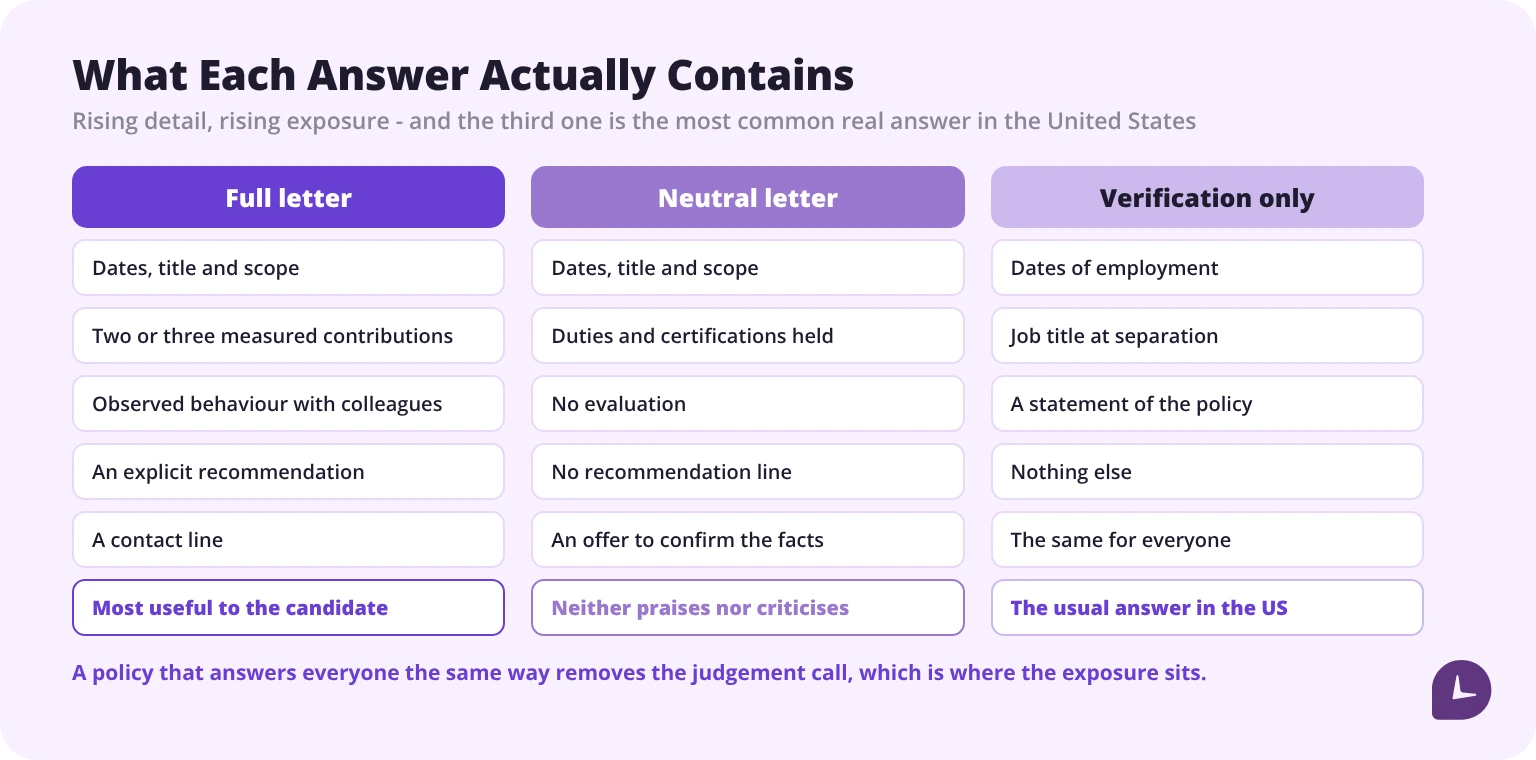
Two practical consequences. Company letterhead converts a personal opinion into a company statement, so a manager writing a warm personal endorsement on headed paper has committed the organization to it. And the fourth row is the most common real-world answer in the United States, which is why a reference check so often produces almost nothing.
What goes in the letter?
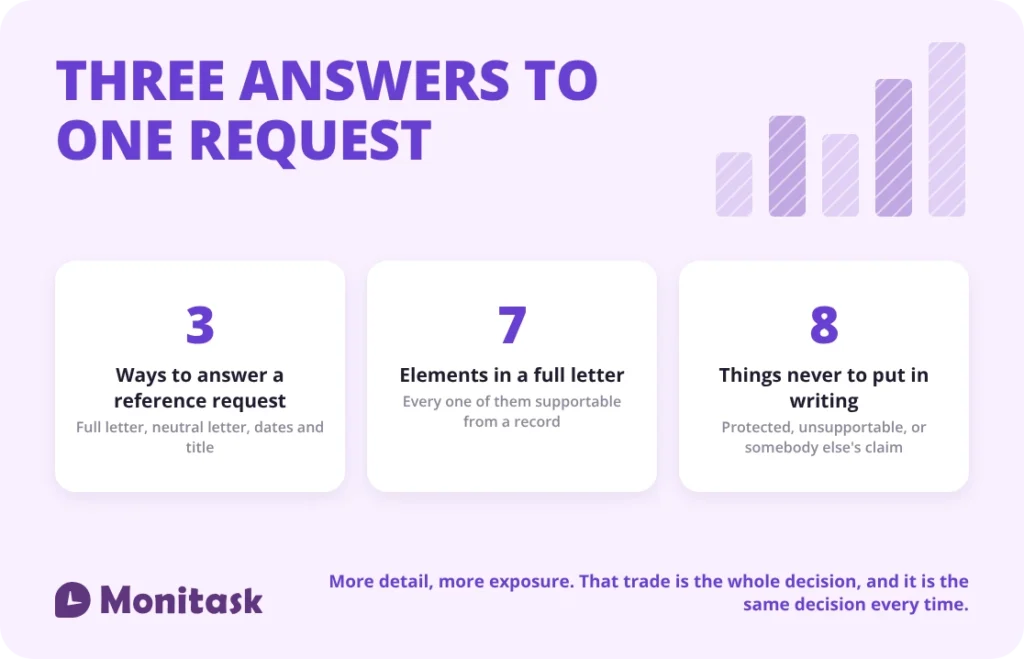
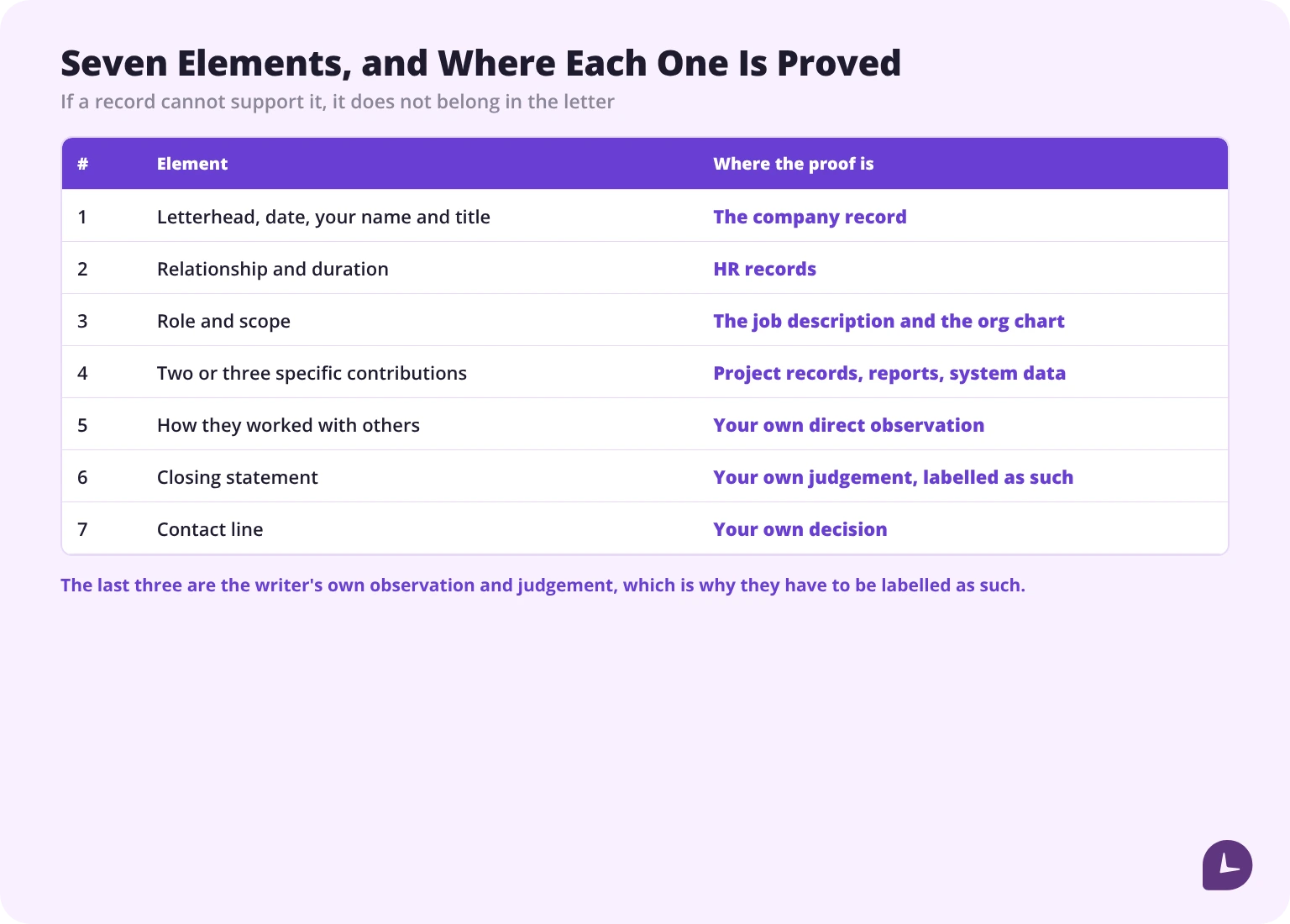
7 elements. Keep every one of them to things the company can show from its own records.
| # | Element | Keep it to |
|---|---|---|
| 1 | Letterhead, date, your name and title | Facts |
| 2 | Relationship and duration | One sentence naming the relationship and the dates it ran between |
| 3 | Role and scope | Job title, team size, budget, territory – numbers you can verify |
| 4 | Two or three specific contributions | Observable outcomes, not adjectives |
| 5 | How they worked with others | Behaviour you witnessed, not personality claims |
| 6 | Closing statement | The level of recommendation you are actually willing to give |
| 7 | Contact line | How and whether you will take follow-up calls |
The rule that holds all 7 together: write what you could support from records or direct observation if asked to explain it later. “Consistently exceeded expectations” is unverifiable. “Met or exceeded quota in seven of eight quarters” is a record.
Template
[Company letterhead]

[Date]

To whom it may concern:

I am writing regarding [employee name], who worked at [company name] as
[job title] from [start date] to [end date]. I was [his/her/their]
[relationship - direct manager, department head] for [duration].

In that role, [name] was responsible for [two or three duties, stated
concretely: scope, systems, team size, budget]. During [his/her/their] time
with us, [name] [two or three specific contributions with figures or
outcomes: delivered X, reduced Y by Z, took on A after B].

[One sentence on how they worked with colleagues or clients, describing
behavior you observed.]

[Closing - choose one and mean it: "I recommend [name] without reservation."
/ "I am glad to confirm [name]'s contribution in this role." / "Please
contact me if you need confirmation of the above."]

[Name], [Title], [Company], [Email or phone]
Every bracket is a field. Nothing in it should be left to a general adjective.
Three examples: strong, neutral, and verification-only
Example 1 — strong, and still defensible
To whom it may concern:

I am writing regarding Dana Whitfield, who worked at Northgate Logistics as
Operations Analyst from 4 March 2023 to 19 September 2026. I was her direct
manager for the full period.

Dana was responsible for shift scheduling across 3 distribution
sites, weekly capacity reporting to the operations director, and the rollout
of our time-tracking system to 140 hourly staff. She led that
rollout from pilot to full deployment in 11 weeks and
trained the site supervisors herself. In her last two years she reduced
unplanned overtime at the Harlow site by a measured 18%,
and her weekly reporting was the source our director used in planning
meetings.

Dana handled supervisor pushback during the rollout by meeting each site team
before go-live rather than after, which is why adoption did not stall.
Colleagues brought her problems before they escalated.

I recommend Dana without reservation, and I am happy to answer questions.

Priya Raman, Operations Director, Northgate Logistics, p.raman@[domain]
Note what makes it safe: every claim is a date, a number, a scope or an observed action. The one evaluative sentence at the end is clearly labeled as the writer’s recommendation.
Example 2 — neutral, when you cannot be enthusiastic
To whom it may concern:

I am writing to confirm that Alex Moreau was employed at Northgate Logistics
as Warehouse Coordinator from 12 June 2024 to 30 April 2026. I was his
supervisor from January 2025.

In that role, Alex coordinated inbound deliveries across two shifts and
maintained the goods-in log. He completed our forklift certification in
September 2024 and held it through his departure.

Please contact me if you require confirmation of dates, title or duties.

Priya Raman, Operations Director, Northgate Logistics, p.raman@[domain]
This letter says nothing negative and makes no endorsement. Experienced recruiters read the absence of a recommendation line as the message, which is the point: you have not misrepresented anything, and you have not written something you would have to defend.
Example 3 — verification-only
To whom it may concern:

In response to your request regarding Jordan Ellis: Mr. Ellis was employed by
Northgate Logistics from 8 January 2024 to 15 August 2026. His job title at
separation was Dispatch Supervisor.

Company policy is to confirm dates of employment and job title only. We do
not provide performance information or comment on the circumstances of
separation.

HR Operations, Northgate Logistics
Short, consistent, and defensible precisely because it is the same for everyone.
What can go wrong legally?
Two risks pull in opposite directions, which is why the safe position is narrow.
Saying too much. An unfavorable statement that is false can support a defamation claim. The Texas Workforce Commission, explaining why reference checks yield so little, states plainly that employers are concerned about being sued for giving unfavorable references
. Its own case in point is a 1984 Texas appellate decision, Frank B. Hall Company v. Buck, 678 S.W.2d 612 (Tex. App.—Houston [14th Dist.] 1984, writ ref’d n.r.e.), where an ex-employee sent a private investigator posing as a prospective employer; the agency records that the jury decided that was defamation and awarded almost $2,000,000 in total damages to the plaintiff
.
Against that, most states protect an employer who answers in good faith, and the protection is usually stronger than employers assume. Texas is the clearest worked example. Section 103.003 of its Labor Code lets an employer disclose information about a current or former employee’s job performance to a prospective employer
on request, and under Texas Labor Code § 103.004 an employer who does so is immune from civil liability for that disclosure
or any damages it causes — unless it is proven by clear and convincing evidence
that the information was known by that employer to be false at the time the disclosure was made
, or that the disclosure was made with malice or in reckless disregard for the truth or falsity of the information disclosed
. The Workforce Commission’s own summary is that the chapter gives employers important protections against defamation lawsuits based upon job references
, as long as the employer does not knowingly report false information
.
Three conditions sit on the front of that immunity, and each one is a drafting instruction:
| Condition | What it means for the letter |
|---|---|
| About job performance | Section 103.003 covers information about a current or former employee’s job performance. Information about something else is outside it |
| To a prospective employer | Not to a landlord, not to a screener acting for someone else, not to anyone who merely asks |
| On request | Volunteering information nobody asked for falls outside the shield entirely |
A fourth point is worth knowing because it cuts the other way from the agency’s shorthand: knowing falsity is not the only thing that forfeits the protection. Malice and reckless disregard do too. What the employee has to produce in Texas, though, is clear and convincing evidence — a higher bar than the ordinary civil standard.
There is also a narrower Texas provision that is frequently mis-cited as the reference statute. Texas Labor Code § 52.031 is headed Blacklisting Offense; Penalty, and its subsection (d) carves an exception out of that criminal prohibition: the section does not stop an employer giving, on application, a written truthful statement of the reason for the discharge
, and that statement may not be used as the cause for a civil or criminal action for libel
. Useful, and much narrower than it sounds — it covers a written statement about a discharge, given on request, and immunises it against libel specifically. It is not the general reference immunity.
Saying too little — and saying it warmly. The mirror risk has a name the Workforce Commission uses: negligent referral. Its instruction is blunt — do not ever give a false or misleading reference
, even if you think you are insulating yourself from a defamation claim or doing the ex-employee a favor
. The classic case is the glowing letter written for someone dismissed for serious misconduct, where the next employer relies on it. A more contested version of the same idea holds that a reference which is accurate but silently omits something material can itself ground a claim; that proposition is live in some states and is not what the Texas guidance says, so treat it as a reason for caution rather than a rule.
The Workforce Commission’s own instruction covers both directions in one line: whatever an employer releases should be factual, in good faith, and non-inflammatory
. Both risks point the same way: verifiable facts, no embellishment, no selective silence dressed up as a recommendation. If you cannot do all three, the verification-only answer is the honest one — and nothing obliges you to do more. Texas Labor Code § 103.005 says in one line that the chapter does not require an employer to provide an employment reference
. An employee termination that was contested, or an open wrongful termination claim, is exactly when that line matters.
Why do so many employers refuse to give references?
Because a standing no-reference policy removes the judgment call from individual managers, and judgment calls are where the exposure sits.
| Approach | What it looks like | Why employers pick it |
|---|---|---|
| Full references, case by case | Manager writes, HR reviews | Keeps goodwill, but every letter is a decision |
| Verification only | HR confirms dates and title | Consistent, minimal exposure, no manager discretion |
| Verification plus eligibility | Dates, title, and whether eligible for rehire | Signals something without stating it |
| Written policy, no exceptions | All requests routed to HR | Removes the risk of one manager going off-script |
The problem a policy solves is not legal subtlety; it is inconsistency. Warm letters for some departing employees and silence for others is itself a pattern someone can point at. If you adopt a policy, apply it to everyone and say so in the letter, as in Example 3.
If your company has one, put it in the handbook and in the manager guidance, not just in HR’s head — the same place you keep the employment termination letter and the employee write-up form, so the whole separation paper trail is written down once.
What should you never put in writing?
8 things, and they come down to 3 reasons rather than 8 separate rules.
| Do not write | Why |
|---|---|
| Health, disability or medical leave | Protected or private |
| Age, family status, religion, national origin, pregnancy | Protected or private |
| Anything about a complaint or investigation | Protected or private |
| Pay history | Protected or private |
| Speculation about why they left | Cannot be supported |
| Characterizations of personality or attitude | Cannot be supported |
| Anything you have not verified from records | Cannot be supported |
| Comparisons to other employees | Creates a second claim |
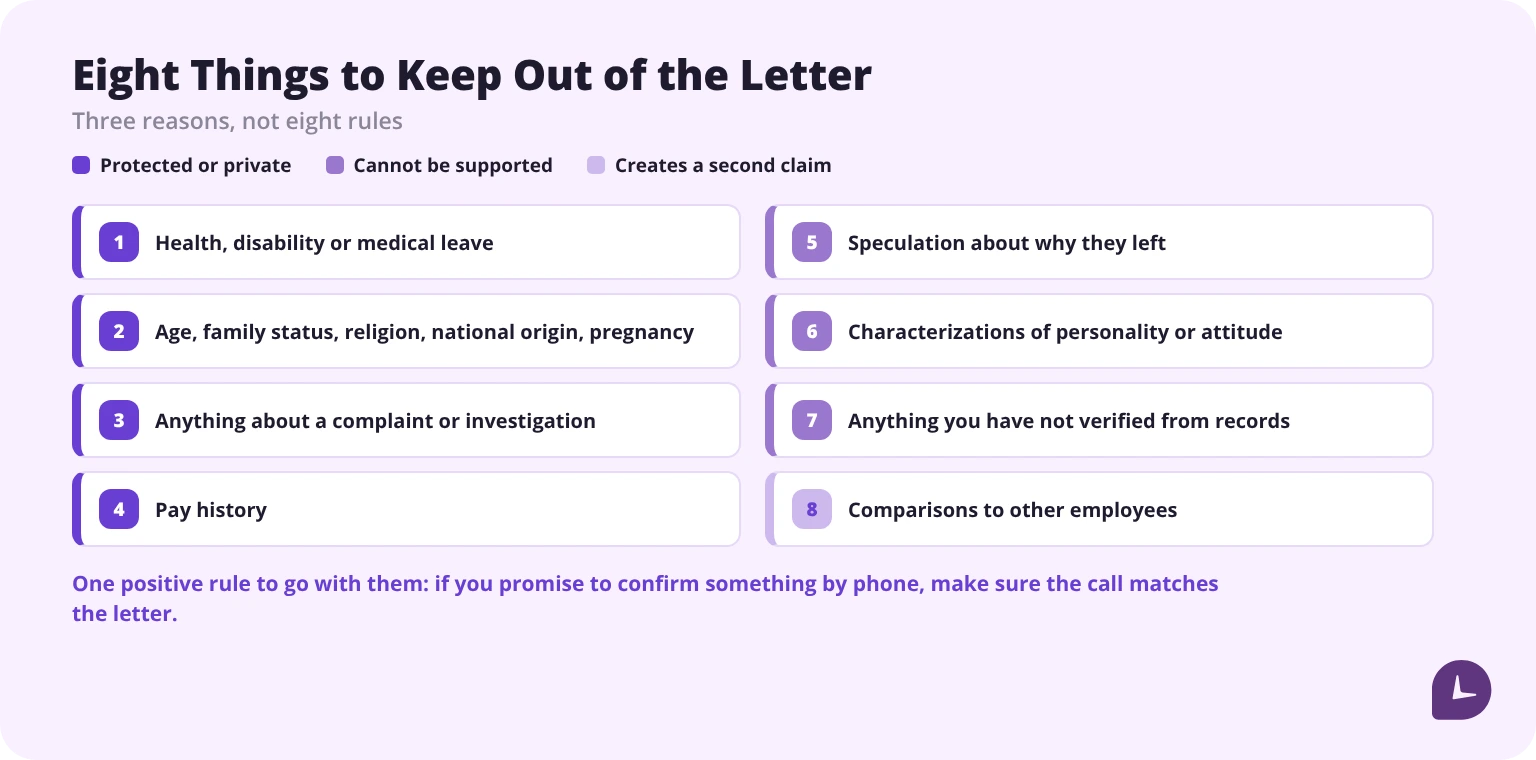
And one positive rule: if you promise to confirm something by phone, make sure what you say on the phone matches the letter. The letter is the record; the call is where people improvise.
What if you cannot write a positive letter?
4 options, in order of how often they are the right answer.
- Decline, politely and promptly. No reasons, no criticism. The most common right answer.
- Offer a verification-only reply. Dates and title, and say it is the policy.
- Write the neutral letter. Facts and duties, no evaluation, no recommendation line.
- Route it to HR. If a policy exists, this is what it is for.
What not to do is write a warm letter you do not mean. That is the combination both risks in the previous section point at: a positive statement you cannot support, and a silence about something material, in the same document.
What a template cannot settle
Three honest limits.
Whether your state’s immunity reaches you. Reference-immunity statutes differ in who they protect, what they protect, and what forfeits the protection. All four of the statutes checked for this article protect a disclosure made on request and withdraw the protection once the employer knew the information was false — but they diverge after that. Texas and Florida make the employee prove it by clear and convincing evidence; Ohio and Colorado on the balance of probabilities. Ohio adds bad faith and deliberate intent to mislead. Colorado goes furthest and reaches an employer who merely should have known, which is a negligence test rather than a knowledge one. Four states, four different answers to the same question.
Whether the facts are actually in your records. The template assumes a company that can produce dates, titles, scope and outcomes on request. If the letter says someone reduced overtime by a measured percentage, somebody has to be able to produce the measurement — which is a records question before it is a drafting one.
Whether your managers will follow it. A policy that routes every request to HR works only if the manager who gets called on a mobile phone knows to say so. The letter is the record; the unscripted call is the exposure.
Dates, titles and hours you can actually produce when a reference request lands, instead of reconstructing them.
Browse Monitask's HR policy and form templates
This article explains how reference letters are typically written in the United States and summarizes the liability that shapes them. It is not legal advice. Defamation law, reference-immunity statutes and the duties that attach to a reference are matters of state law and differ substantially between states. The model wording here is a starting point for review by employment counsel, not a document to adopt as written.
Sources
- Texas Workforce Commission, Texas Guidebook for Employers (subtitled Especially for Texas Employers), “References and Background Checks”. The concern about unfavorable references, the Frank B. Hall case description and award, the Chapter 103 summary, the factual-and-good-faith instruction and the negligent-referral warning, all quoted verbatim. The page carries no revision date. Read at source. Verified 12 November 2026.
- Texas Labor Code § 103.004, Immunity from Civil Liability; Employer Representatives, together with § 103.003 and § 103.005. The immunity, the clear-and-convincing standard, the three preconditions and the absence of any duty to give a reference, quoted verbatim. Verified 12 November 2026.
- Texas Labor Code § 52.031, Blacklisting Offense; Penalty, subsection (d). The discharge-statement exception and its libel immunity, quoted verbatim. Verified 12 November 2026.
- Fla. Stat. § 768.095; Ohio Rev. Code § 4113.71; Colo. Rev. Stat. § 8-2-114. Read on each state’s own legislature site as a sample of how reference-immunity statutes differ. Not a survey. Verified 12 November 2026.
FAQ
Can an employer be sued for a bad reference?
An unfavorable statement that is false can support a defamation claim, which is why many employers answer with dates and title only. Most states protect an employer who discloses in good faith on request, but the protections differ: some lose the protection only on knowing falsity, others also on malice, bad faith or reckless disregard, and at least one reaches an employer who merely knew or reasonably should have known that the information was false
. Check your own state.
Does an employer have to give a reference?
No. Texas puts it in a single sentence: the chapter does not require an employer to provide an employment reference
to or about a current or former employee. A standing policy of confirming dates and title only is lawful and common, and it is easier to defend than case-by-case judgement because it is the same for everyone.
What is a verification-only reference?
A reply confirming dates of employment and job title, with a line saying that is the company’s policy and that it does not provide performance information. It is the most common real answer in the United States. Example 3 above is one.
Should a manager write a reference on company letterhead?
Only if the company means to stand behind it. Letterhead converts a personal opinion into a company statement. A manager who wants to recommend someone personally should do it in their own name and off headed paper, and should expect the recipient to read it as a personal view.
Can I write a reference for someone I had to let go?
You can, and the safest form is the neutral letter: dates, title, duties and certifications, with no evaluation and no recommendation line. What you should not do is write something warmer than the facts support. Giving a false or misleading reference is the mirror-image risk to defamation, and the Texas Workforce Commission’s instruction on it is do not ever give a false or misleading reference
. If you cannot write the neutral letter either, decline, or point the requester to the resignation and separation paperwork route and route the request to HR.