Schedule Adherence: Formula, Targets and What It Actually Measures

The schedule adherence formula
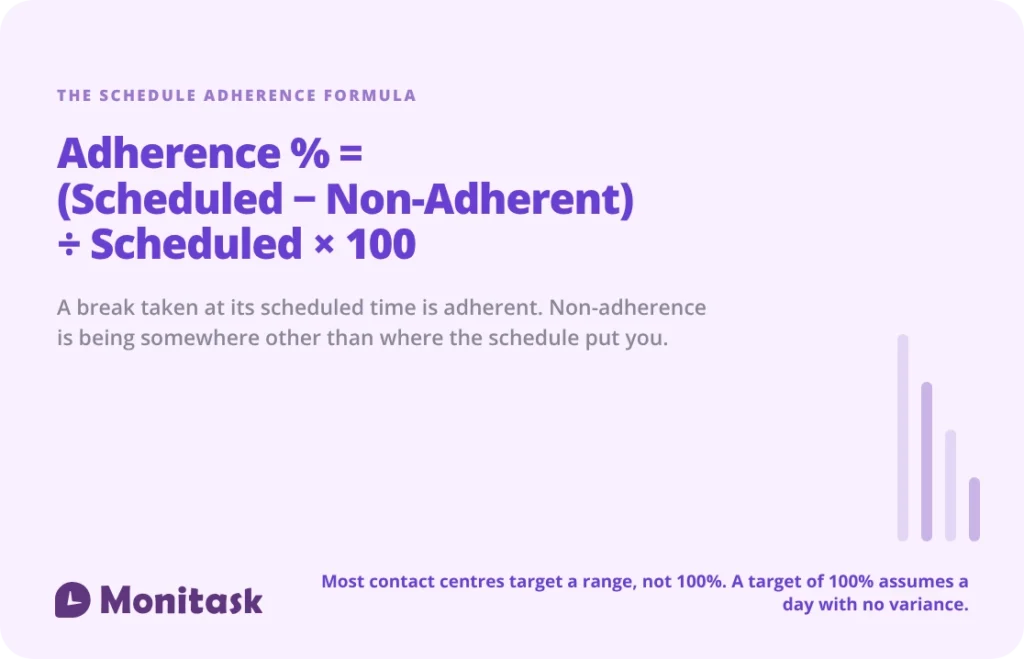
Adherence % = (Scheduled Time − Non-Adherent Time) ÷ Scheduled Time × 100Equivalently, from the other end:
Adherence % = Adherent Time ÷ Scheduled Time × 100Both produce the same answer. Which you use depends on whether it is easier to measure the time spent on schedule or the time spent off it.
What the formula is not. It is not actual hours worked divided by scheduled hours. That calculation is conformance, it is a different metric with a different purpose, and the two get swapped constantly — including in guides that define one and then give the other’s formula. An agent who works a full eight-hour shift but starts an hour late and moves every break has perfect conformance and poor adherence. Telling those apart is the entire reason adherence exists.
Boost your business productivity
Track performance and streamline teamwork
Why published formulas disagree
The arithmetic core is more consistent than you would expect: seven of the main published sources — among them Call Centre Helper, ACXPA, NICE, Klipfolio and RingCentral — give formulas that are algebraically identical, whether written as adherent time over scheduled time or as scheduled minus non-adherent over scheduled.
The disagreement is real, but it is not in the algebra. It is in three specific places, and all three change the number.
1. Sources disagree on what counts as adherent at all. Call Centre Helper, ACXPA and Klipfolio all count scheduled meetings, training and approved breaks as adherent time. TechTarget’s definition narrows the numerator to time “available for calls”, which excludes every one of them. The same agent, the same shift, two materially different scores.
2. Two named vendors publish conformance under the adherence label. Verint’s method ends by telling you to divide actual hours worked by scheduled hours — 38 hours of 40, giving 95% — which is conformance, because it never asks when those hours happened. Verint’s own FAQ on the same page describes adherence correctly, contradicting its method. ROI Call Center Solutions does the same on its blog. If your reporting comes from a tool whose documentation does this, you are measuring the wrong thing under the right name.
3. One glossary subtracts scheduled breaks from adherent time. ROI Call Center Solutions publishes [Call-related Time − (Non-call Time + Breaks)] ÷ Allocated Schedule. It is a single glossary entry rather than a widely-used formula — and the same company’s blog publishes a conventional calculation instead — but it is indexed, and the error it makes is the one worth understanding.
The size of that third error is not small. Take the shift in the worked example below: 480 minutes, with 24 minutes of genuine deviation and 60 minutes of breaks taken exactly on schedule. The standard calculation scores it 95%. Subtracting the scheduled breaks scores the same shift 82.5% — 12.5 points lower, entirely for following the schedule. Against a target floor of 85%, that shift passes on one and fails on the other.
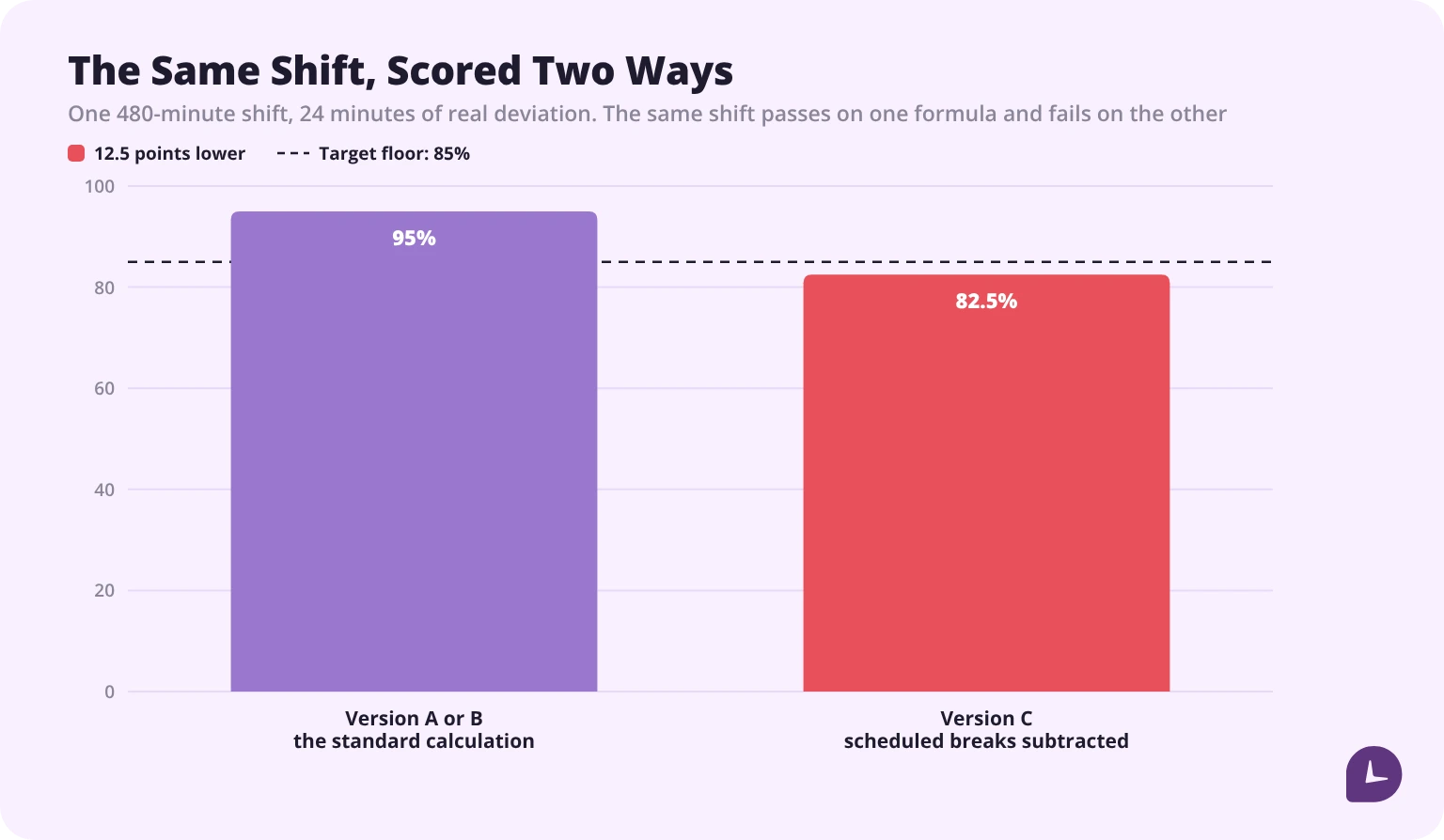
The principle that settles it: adherence measures whether the agent was doing what the schedule said, when the schedule said it. A scheduled break taken on time is adherent — the industry association’s wording is that “being on a scheduled break is perfectly adherent”. So is a scheduled meeting, a scheduled coaching session and scheduled after-call work. Non-adherence is being somewhere other than where the schedule placed you.
So: count adherent time over scheduled time, or scheduled minus non-adherent over scheduled. They are the same calculation. If a tool’s reporting produces adherence figures that look unexpectedly low across the whole team, check what its documentation actually subtracts before drawing conclusions about anyone.
A worked example
An agent is scheduled for an 8-hour shift: 480 minutes. The schedule includes a 30-minute lunch and two 15-minute breaks, all at set times.
During the shift:
- Logs in 6 minutes late
- Returns from lunch 8 minutes late
- Takes an unscheduled 10-minute break
- Everything else follows the schedule
Non-adherent time = 6 + 8 + 10 = 24 minutes
Adherence %       = (480 − 24) ÷ 480 × 100 = 95%
Note what is not counted as deviation: the 30-minute lunch and both 15-minute breaks taken at their scheduled times. They are part of the schedule, and 60 minutes is a lot of time to score against someone for doing what they were told.
For the whole team: sum all agents’ adherent minutes and divide by all scheduled minutes. Averaging individual percentages gives a slightly different and less useful answer when shift lengths differ.
What counts as adherent
The practical question, and the one that causes most disputes.
| Activity | Adherent? |
|---|---|
| Handling calls during on-queue time | ✓ |
| After-call work, scheduled | ✓ |
| Break or lunch at the scheduled time | ✓ |
| Team meeting during its scheduled slot | ✓ |
| Coaching session, scheduled | ✓ |
| Training, scheduled | ✓ |
| A call that overruns into a scheduled break | ✓ — outside the agent’s control |
| Logging in late | ✗ |
| Extending a break beyond its length | ✗ |
| Taking a break at an unscheduled time | ✗ |
| Being off-queue with no assigned activity | ✗ |
| Logging out early | ✗ |
The rule: sanctioned activities carried out during scheduled hours are adherent. The metric is about when, not what.
The exception worth writing into your policy: a call that overruns a break is the agent doing their job. Penalising it teaches agents to cut customers off, which is the opposite of what the metric exists for.
On late logins specifically, decide separately how you round them before you decide how you score them — the 7-minute time clock rule covers the rounding question, which is a payroll matter rather than an adherence one.
Adherence, conformance, occupancy and utilisation
Four metrics that get used interchangeably and measure different things.
| Metric | What it measures | Question it answers |
|---|---|---|
| Adherence | Working the right activity at the right time | Did they follow the schedule? |
| Conformance | Total time worked versus total scheduled, ignoring timing | Did they work the right number of hours? |
| Occupancy | Call handling as a share of available time | How busy were they when available? |
| Utilisation | All productive time as a share of total scheduled time | How much of the paid shift was productive at all? |
Adherence and conformance differ in one way, and it is the one that matters here: an agent who works a full 8 hours but shifts every break and starts an hour late has 100% conformance and poor adherence. For a contact centre, where coverage at specific intervals is the point, adherence is the metric that decides whether the queue was staffed.
Occupancy and utilisation get swapped constantly, and the sources admit it — Call Centre Helper says plainly that “the industry is not fully aligned on these definitions”. The structural difference is the thing to hold on to: occupancy has the narrower numerator, contact handling, over the smaller denominator, the time an agent was logged in and available. Utilisation has the broader numerator, all productive time including meetings and training, over the larger denominator, the whole shift. What is genuinely unsettled is that denominator — scheduled hours, paid hours and shift hours are three different numbers, and sources use all three.
Two neighbouring measures sit outside this set: calculate idle time covers time available but not producing, and the full picture of what else to track is in KPIs and metrics for a call center.
What is a good adherence target?
There is no universal benchmark, and the honest version of that sentence is stronger than it sounds.
What gets published. Call Centre Helper gives the range most often quoted: “Most contact centres consider schedule adherence rates of 85–95% acceptable, although no universal benchmark exists.” It adds that “Anything above 95% is very unlikely unless the contact centre has extremely consistent volume and AHT”. ICMI’s own training material goes to 85–98%. TechTarget and Klipfolio both say 80%. NICE declines to give a figure at all, saying the right target depends on channel, role and how the schedule was built.
None of those numbers comes from a survey. Every one is editorial or vendor assertion. That is unusual enough to say out loud for a metric this widely managed against.
And no one has published what adherence actually is. Not the target — the achieved rate. The major industry surveys ask whether contact centres track adherence and whether they think it matters; none of them reports a median, a distribution, or any figure for what adherence rates really look like. COPC’s 2023 global benchmarking series, with over a thousand respondents, reports that 92% of respondents believe it is important to meet schedule adh. ContactBabel’s 2024 UK guide, with 225 managers and directors, carries no adherence figure at all. A 2024 survey of 500 UK contact centre leaders found that 24% of them track the metric — and reported nothing about what it came out at.
So the industry sets targets, in a range nobody measured, for a metric whose real distribution has never been published.
Which makes your own data the only benchmark worth having. Measure current performance for a month, look at the distribution rather than the average, and set a target slightly above your current median. Then look at what is driving the bottom of that distribution before asking anyone to improve. If you want an external number to start from, Call Centre Helper’s 85–95% is the most commonly cited and the one that comes with its own caveat attached — treat it as a starting point for a conversation, not a standard you are failing.
A target set as a point rather than a range is the version that goes wrong, which is the next section. If you are also running an absence or lateness policy alongside this, keep them separate: an attendance point system answers a different question and mixing the two gives agents two scores for one late arrival.
Why chasing 100% backfires
An adherence target that is too tight produces predictable behaviour, and none of it is what you wanted.
Agents end calls early. The fastest way to be back on queue at the scheduled minute is to wrap up before the customer is finished. Adherence rises; resolution rates and customer satisfaction fall.
Breaks get cut. A two-minute overrun on a break costs adherence. Taking thirteen minutes instead of fifteen protects the number — and, as the next section sets out, in several states that is a compliance problem rather than a management one.
Problems go unreported. An agent whose system is slow will keep working around it rather than go off-queue to report it, because off-queue time costs adherence. You lose the fault report and the time.
The number stops measuring anything. When a metric becomes a target, people optimise for the metric. An adherence figure produced under pressure describes the pressure, not the schedule.
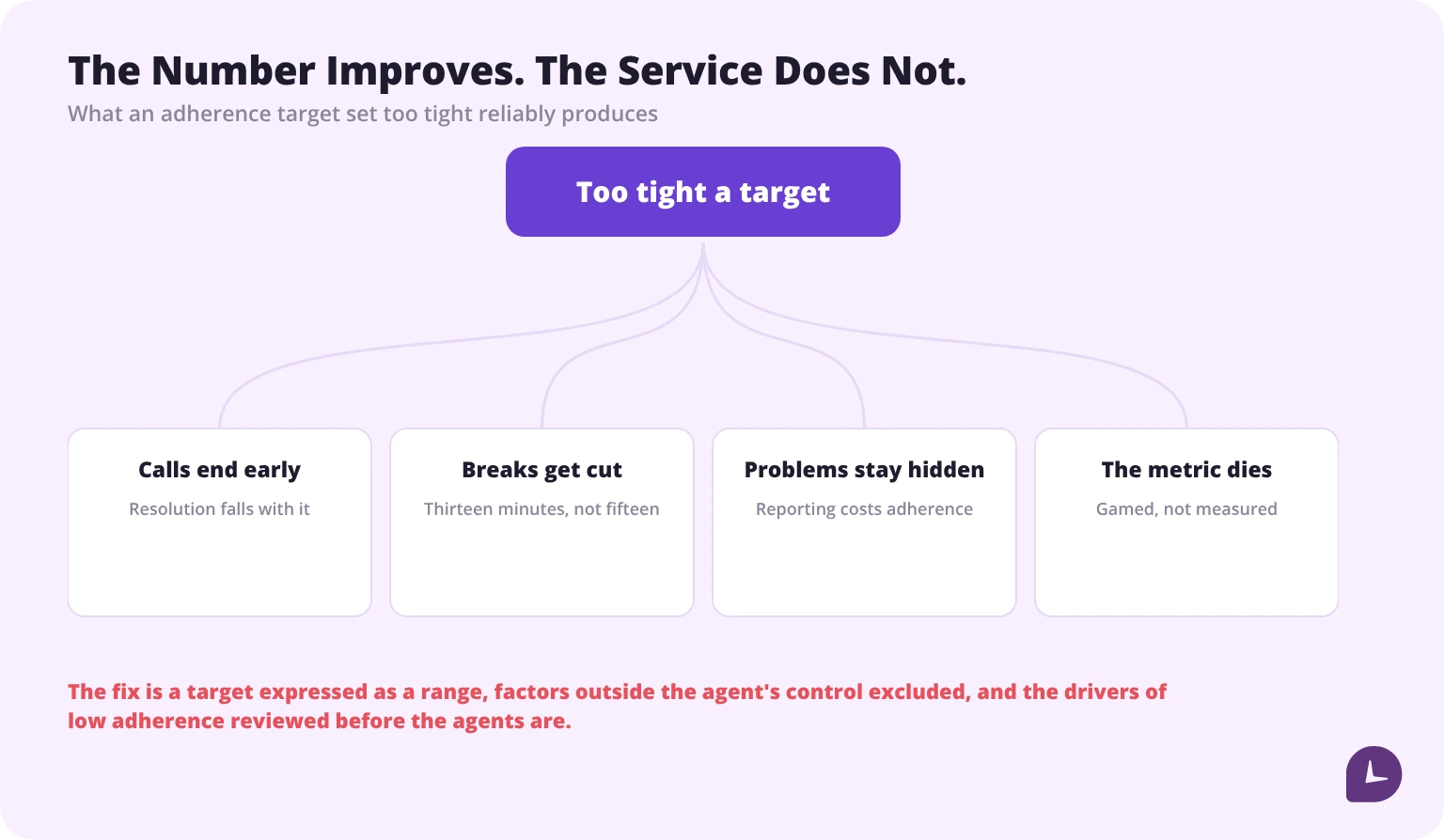
The fix: set the target as a range rather than a point, exclude factors outside the agent’s control, review the drivers of low adherence before the agents, and never make adherence the sole input to a performance review.
When low adherence is a process problem
The most useful reframe in this article.
An agent scheduled for 480 minutes has their computer fail partway through the shift. It is not repaired that day, and they lose three hours. Their adherence comes out at 62.5% — 300 adherent minutes out of 480.
Nothing about that figure describes the agent. It describes an IT failure. Used properly, it is an argument for replacing the equipment.
Before treating low adherence as a performance issue, check the usual process causes:
| Symptom in the data | Likely cause |
|---|---|
| Whole team low at the same interval | Schedule does not match real volume |
| Individual low at shift start | Systems slow to load, login process too long |
| Low across a specific queue | Calls in that queue routinely overrun the forecast |
| Low after breaks specifically | Break rooms too far, or break length unrealistic |
| Sudden drop for one person | Equipment, connectivity, or something outside work |
The order matters: look at the pattern before the person. An adherence figure with no context is a number, not a finding.
Monitask records activity against each person's own schedule, so a shift that went wrong looks different from a person who did.
See how Monitask reports against a schedule
Adherence targets and break entitlements
A section no other guide on this topic includes, and one with compliance attached.
An adherence target penalises break overruns. That creates pressure on agents to shorten breaks, return early, or skip them. Where breaks are a legal entitlement, that pressure is a compliance problem regardless of whether anyone instructed it.
The position in US law. Federal law requires neither meal nor rest breaks — the Department of Labor’s own wording is that “Federal law does not require lunch or coffee breaks”. State law is where the entitlement lives, and it is uneven: 21 states mandate meal breaks for adult private-sector employees, and 7 of those also mandate paid rest periods — California, Colorado, Kentucky, Minnesota, Nevada, Oregon and Washington.
Two footnotes on those numbers, because published counts vary and you will meet other ones. The Department’s rest-period table lists nine states rather than seven, but two of the nine are narrow enough that they do not describe a general entitlement: Illinois covers hotel room attendants only, in a county with a population greater than three million — Cook County hotel housekeepers, and Vermont requires “reasonable opportunities” during work periods to eat and use toilet facilities, not a timed paid break. And three of the 21 meal states apply the rule only to particular industries — Colorado, Maryland, Nebraska — so a stricter count of general-application mandates is 18.
Check your own states rather than a table, including this one. The Department’s tables were last revised in 1 January 2023 and are already out of date: Minnesota rewrote both of its break statutes in its 2025 special session, effective 1 January 2026, and now requires a 30-minute meal break after six consecutive hours and a rest break of at least 15 minutes within every four — with liquidated damages for breaks not allowed. The federal table still shows the old rule.
Why an adherence target is the employer’s problem and not the agent’s. The leading case on this is Californian, and its reasoning is the part worth knowing: an employer “an employer may not undermine a formal policy of providing meal breaks by pressuring employees to perform their duties in ways that omit breaks”. Providing a break on paper is not the test. The employer must relieve the employee of duty and must not “impede or discourage” them from taking it.
There is a limit to that, and it cuts the other way: the same court held an employer is “is not obligated to police meal breaks and ensure no work thereafter is performed”. So the line runs between discouraging a break, which is the employer’s problem, and merely not policing one, which is not. A metric that docks an agent’s score for a two-minute break overrun sits on the wrong side of that line, because it is something the employer built, not something it failed to supervise.
Four safeguards:
- Exclude scheduled breaks from non-adherent time. The same point as the formula section, with legal weight behind it.
- Build slack into the schedule so a break can start a minute late without costing anything.
- Never let an agent choose between adherence and a mandated break. If the policy creates that choice, the policy is wrong, and the choice is evidence.
- Monitor break shortfall separately from adherence. If average break duration is drifting below entitlement, your adherence target is doing it, and you will see that in the break data long before you see it in a claim.
If you are writing this into a policy document, there are free company forms and policies to start from.
This is general information, not legal advice. Break requirements vary by state and change.
Real-time adherence
Real-time adherence, RTA, applies the same calculation live. A supervisor sees who is off-schedule at this moment rather than in a report the following week.
What it is good for: catching a queue about to breach service level, spotting an agent stuck in a system problem, redistributing coverage during an unexpected spike.
What it is not good for: watching individuals. An RTA dashboard used to query every deviation as it happens is surveillance with a workforce-management label, and it produces the same defensive behaviour as an over-tight target.
A practical rule: RTA alerts should be tied to service-level risk, not to individual deviation. If the queue is healthy, a three-minute deviation needs no intervention.
How to track adherence: ACD codes and WFM
Without workforce management software, the practical route is auxiliary codes in your ACD.
Deploy separate codes for at least:
- Available
- After-call work
- Break
- Lunch
- Scheduled time away from the phone — meetings, coaching, training
- Unscheduled unavailable
Without that breakdown, every off-queue minute looks the same, and adherence cannot distinguish a scheduled coaching session from an unexplained absence.
One implementation note: if aux codes are new to the team, explain what they are for before switching them on. Introduced without context, they read as surveillance. Introduced as the thing that stops scheduled meetings counting against people, they read as fairness — which is also what they are.
How to improve adherence without damaging morale
- Fix the schedule first. If adherence is low at the same interval every day, the forecast is wrong, not the agents.
- Show agents their own numbers. People correct what they can see. A weekly personal figure does more than a monthly team review.
- Separate controllable from uncontrollable in the reporting. Overrunning calls and system failures should be visible as such.
- Coach the pattern, not the incident. One late return is noise.
- Build in slack. A schedule with no buffer converts every normal variance into a deviation.
- Never rank agents publicly on adherence. It produces exactly the behaviours described above.
Using adherence outside a contact centre
The metric was built for environments where coverage at specific intervals determines service. That is contact centres, and also:
- Shift-based support desks with defined response windows
- Field service with appointment slots
- Healthcare scheduling where patient appointments depend on staff presence
- Any operation with a forecast-driven roster
Where it does not apply: knowledge work with flexible hours, project-based teams, and anywhere output rather than coverage is the deliverable. In those settings, adherence measures compliance with a schedule that does not need complying with. What you want there is a record of time worked rather than a score for its timing — an attendance sheet does that job without implying a judgement.
Sources
- Call Centre Helper, How Do I Calculate… Schedule Adherence? — the 85–95% range and its no-benchmark caveat
- ICMI, Contact Center Metrics course material — an adherence range of 85-98%
- ACXPA glossary, Adherence and Conformance — the definitions used here, including that a scheduled break is adherent
- WFM Labs, Agent Utilization vs Occupancy, citing Cleveland, Call Center Management on Fast Forward (ICMI Press) and Koole & Mandelbaum (2002) — the occupancy and utilisation distinction
- COPC, Global Benchmarking Series 2023: Contact Center WFM; ContactBabel, UK Contact Centre Decision-Makers’ Guide 2024; Call Centre Helper and MaxContact, 2024 UK Contact Centre KPI Benchmarking Insights Report — the surveys that measure whether adherence is tracked, and do not report what it is
- US Department of Labor, Breaks and Meal Periods, and its state tables on meal periods and rest periods, last revised 1 January 2023
- Minn. Stat. 177.253 and 177.254, as amended in the 2025 First Special Session, effective 1 January 2026
- Brinker Restaurant Corp. v. Superior Court, 53 Cal.4th 1004 (2012)
Monitask tracks time against each person's own schedule, and shows them the same numbers it shows you.
Start a free Monitask trial
FAQ: Schedule Adherence
What is the schedule adherence formula?
`(Scheduled Time − Non-Adherent Time) ÷ Scheduled Time × 100`. Equivalently, adherent time divided by scheduled time, times 100.
Do breaks count against schedule adherence?
Not when taken at the scheduled time. A scheduled break is part of the schedule, so following it is adherence. One published glossary subtracts breaks from adherent time, which on an ordinary shift understates the result by around 12.5 percentage points.
What is a good schedule adherence rate?
85–95% is the most commonly cited range, though ICMI’s training material gives 85-98% and two widely-read reference sources say 80%. None of those figures comes from a survey, and no research body has published what adherence rates actually are. Your own distribution is the better benchmark.
What is the difference between adherence and conformance?
Adherence measures whether the right activity happened at the right time. Conformance measures whether the total hours were worked, regardless of timing. An agent can have full conformance and poor adherence — and some vendor documentation publishes the conformance calculation under the adherence label, so check which one your tool is giving you.
What is the difference between occupancy and utilisation?
Occupancy is contact handling as a share of the time an agent was logged in and available. Utilisation is all productive time — including meetings and training — as a share of the whole shift. The two are frequently swapped, including by vendors.
How do you calculate adherence for a whole team?
Sum all agents’ adherent minutes and divide by all scheduled minutes. Averaging individual percentages distorts the result when shift lengths differ.
Does an overrunning call count as non-adherence?
It should not. A call continuing past a scheduled break is the agent doing their job. Policies that penalise it teach agents to end calls early.
What causes low schedule adherence?
Inaccurate forecasting, slow systems at login, calls that routinely overrun, unrealistic break scheduling, and equipment failures. Check the pattern before treating it as a performance issue — a single failed computer can put one agent’s day at 62.5% without telling you anything about them.
What is real-time adherence?
The same calculation applied live, so supervisors can see who is off-schedule now. It is a standard workforce-management feature, though no standards body defines it. Best used against service-level risk rather than individual deviation.
Can an adherence target create a legal problem?
It can, where breaks are a legal entitlement. 21 states mandate meal breaks and 7 of those also mandate paid rest periods. A target that penalises break overruns is an employer-created pressure to cut them, and the leading case holds that an employer may not undermine a break policy by pressuring employees in ways that omit breaks.
Can schedule adherence be used outside a call centre?
Where coverage at set intervals determines service — support desks, field service, healthcare scheduling. It does not suit flexible or project-based work, where output rather than presence is the deliverable.