Time Tracking for Accountants: Realization, Write-Downs and Busy Season

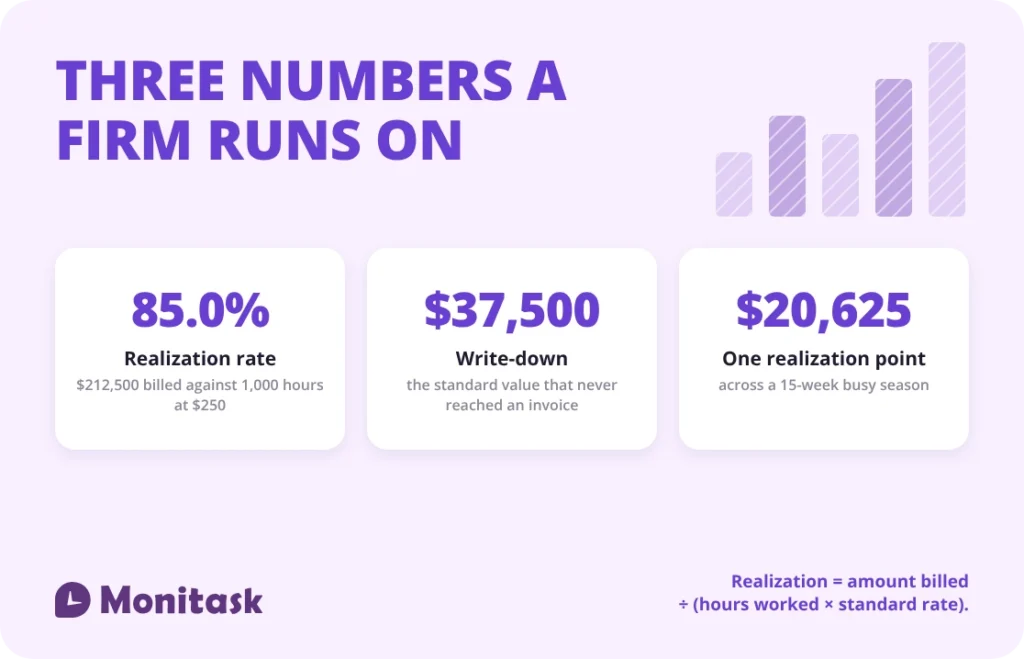
Accounting firms track time to calculate three numbers: realization rate, write-downs and work in progress. Realization is the amount billed divided by the standard value of hours worked. Because hours sit in the denominator, unrecorded time makes realization look higher than it is — a firm capturing 85% of its hours can show 100% realization and conclude it has no pricing problem.
Key takeaways
- Realization rate = amount billed ÷ (hours worked × standard rate). A firm billing $212,500 against 1,000 hours at a $250 standard rate realized 85%.
- Unrecorded hours inflate realization. Drop 150 of those 1,000 hours and the same billing shows 100% realization.
- A write-down happens before the invoice; a write-off happens after. They have different causes and different fixes.
- In a 15-week busy season with ten preparers at 55 chargeable hours a week, one point of realization is worth $20,625.
- Fixed-fee engagements still need hours. Without them there is no effective hourly rate to price the next one from.
Why do accounting firms track time differently?
A general-purpose timer records duration. An accounting firm needs time records that survive a billing decision, a client conversation about a fee, and a year-end WIP valuation. Five requirements follow.
| Requirement | Why a generic timer is not enough |
|---|---|
| Client, engagement and service code on every entry | Realization is computed per client and per service line, not per person |
| Standard rate attached to the person, not the project | Write-downs are measured against standard value, which needs a standard rate |
| Chargeable and non-chargeable separated at entry | The chargeable ratio is meaningless if the split is applied afterwards |
| Unbilled time visible as a balance | Unbilled hours are WIP, and WIP is an asset the firm carries |
| Entries locked after billing | A changed entry on an invoiced engagement breaks the audit trail |
The first requirement is the one most often missed. A timer that records “8 hours, tax work” cannot tell you which client absorbed the write-down.
What is realization rate and how do you calculate it?
Realization rate is the share of the standard value of your time that you actually billed.
Standard value = hours worked × standard hourly rate
Realization rate = amount billed ÷ standard value
A manager works 1,000 hours in a year at a $250 standard rate. Standard value is $250,000. The firm invoiced $212,500 for that work.
| Hours worked | 1,000 |
| Standard rate | $250.00 |
| Standard value | $250,000.00 |
| Amount billed | $212,500.00 |
| Realization rate | 85.0% |
Two related numbers come from the same inputs.
Net effective rate = amount billed ÷ hours worked
That is $212.50 per hour — $37.50 below the standard rate. The effective rate is the number to compare against a target, because it is what the hour actually earned. The standard rate itself is a payroll and pricing decision that sits upstream of all of this; realization only measures what happened to it.
Firms also distinguish billed realization from collected realization. Billed realization uses invoiced amounts. Collected realization uses cash received, which is lower whenever invoices are settled at a discount or written off after the fact.
How do unrecorded hours flatter your realization?
This is the part that reverses the usual argument for tracking time, and it is worth reading twice.
Hours sit in the denominator of the realization formula. Understate them and the denominator shrinks, so realization rises. A firm with poor time capture does not see a problem — it sees an excellent number.
| Hours fully captured | 15% of hours unrecorded | |
|---|---|---|
| Hours worked and recorded | 1,000 | 850 |
| Standard value at $250 | $250,000.00 | $212,500.00 |
| Amount billed | $212,500.00 | $212,500.00 |
| Realization rate | 85.0% | 100.0% |
Nothing changed about the work or the invoice. Only the record changed, and the metric moved fifteen points in the flattering direction.
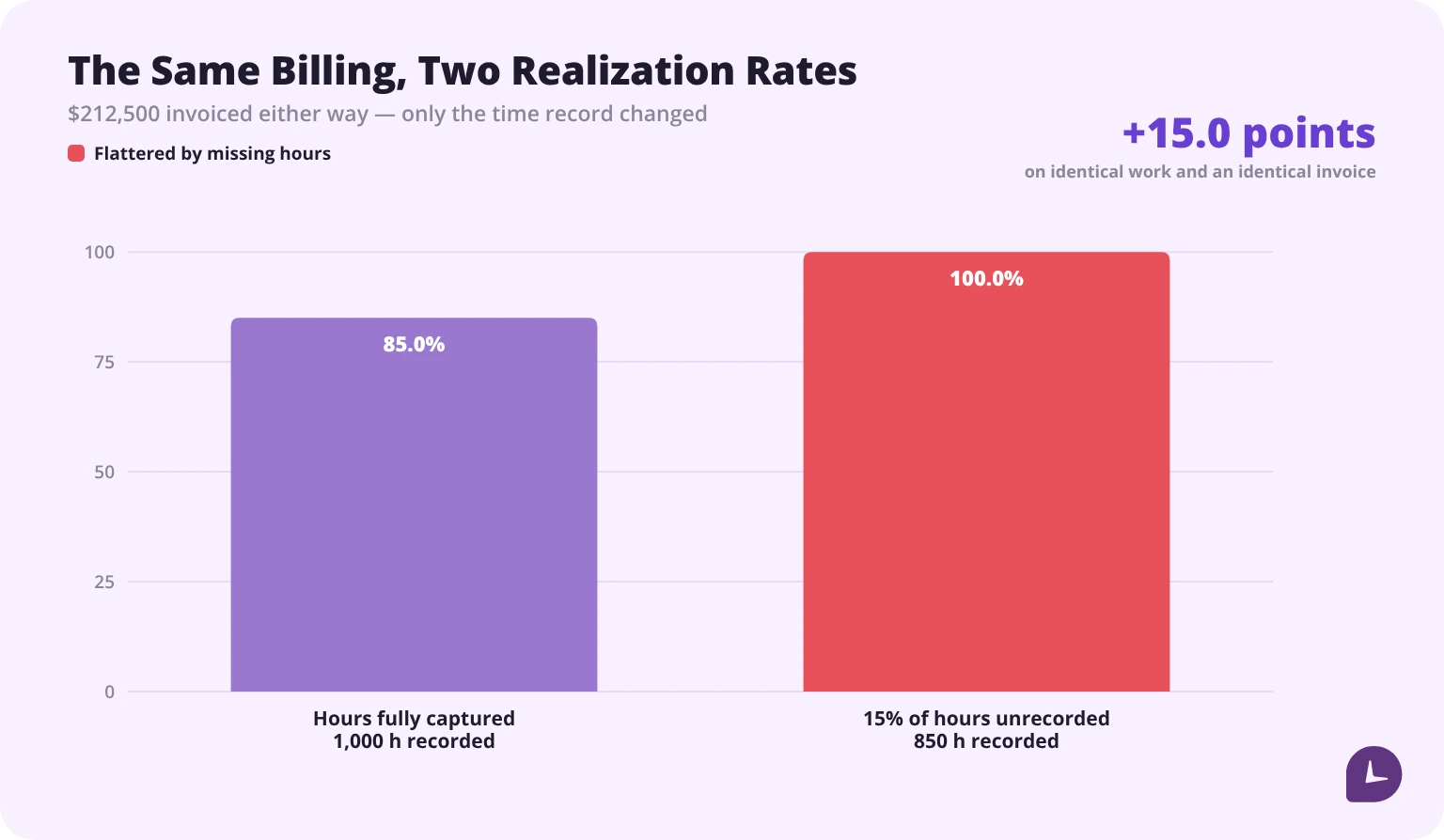
The consequence is not cosmetic. A firm reading 100% realization concludes that its pricing is sound and its staff are efficient. It then builds the next engagement letter on the same understated hour estimate, prices it the same way, and repeats the loss. The firm at 85% knows it has $37,500 of write-down to investigate.
So the case for complete time capture is not “you are losing billable hours.” It is sharper than that: without complete hours, the metric you manage the firm by is wrong in the direction that stops you asking questions.
Write-downs and write-offs: what is the difference?
The two terms are used interchangeably in conversation and mean different things in practice.
| Write-down | Write-off | |
|---|---|---|
| When it happens | Before the invoice is issued | After the invoice is issued |
| What it reduces | Standard value, down to the billed amount | Billed amount, down to the collected amount |
| Typical cause | Scope ran over, work was inefficient, fee was capped | Client dispute, fee concession, bad debt |
| Where it shows | Realization rate | Collected realization |
| Who decides | The engagement partner, at billing | The client, or the firm after the fact |
Write-down = standard value − amount billed
In the example above that is $250,000 minus $212,500, or $37,500.
The distinction matters because the fixes are different. Write-downs are an estimating and scoping problem: the work took more hours than the fee supported. Write-offs are a billing and client-management problem: the invoice went out and was not accepted. A firm that lumps them together treats a pricing failure as a collections failure.
Both need hours by engagement to locate. A firm-wide write-down percentage tells you the total; it does not tell you which service line is doing it.
How do you value work in progress?
Work in progress is time that has been worked and not yet invoiced. For an accounting firm it is an asset, and at period end it has to be valued.
WIP = unbilled hours × standard rate
The valuation question is whether to carry WIP at standard value or at expected realizable value. Carrying it at standard overstates the asset for any engagement you already know will be written down. Carrying it at expected realization — standard value multiplied by the historical realization rate for that service line — is more conservative and more useful for cash forecasting.
Two practical points follow. WIP ageing matters: hours unbilled for ninety days are much less likely to be billed in full than hours unbilled for ten. And WIP is the balance that unrecorded time hides most completely — hours never entered are neither billed nor visible as an asset, so they disappear from the firm’s economics entirely.
How much is one point of realization worth in busy season?
The season concentrates most of the year’s chargeable capacity into about fifteen weeks, which means it also concentrates the cost of every lost point of realization.
A firm with ten preparers working 55 chargeable hours a week across a fifteen-week season:
| Chargeable capacity | 10 × 15 × 55 = 8,250 hours |
| Standard value at $250 | $2,062,500.00 |
| Billed at 85% realization | $1,753,125.00 |
| Value of one realization point | $20,625.00 |
Moving from 85% to 88% across the season is worth $61,875 on exactly the same work and the same headcount.
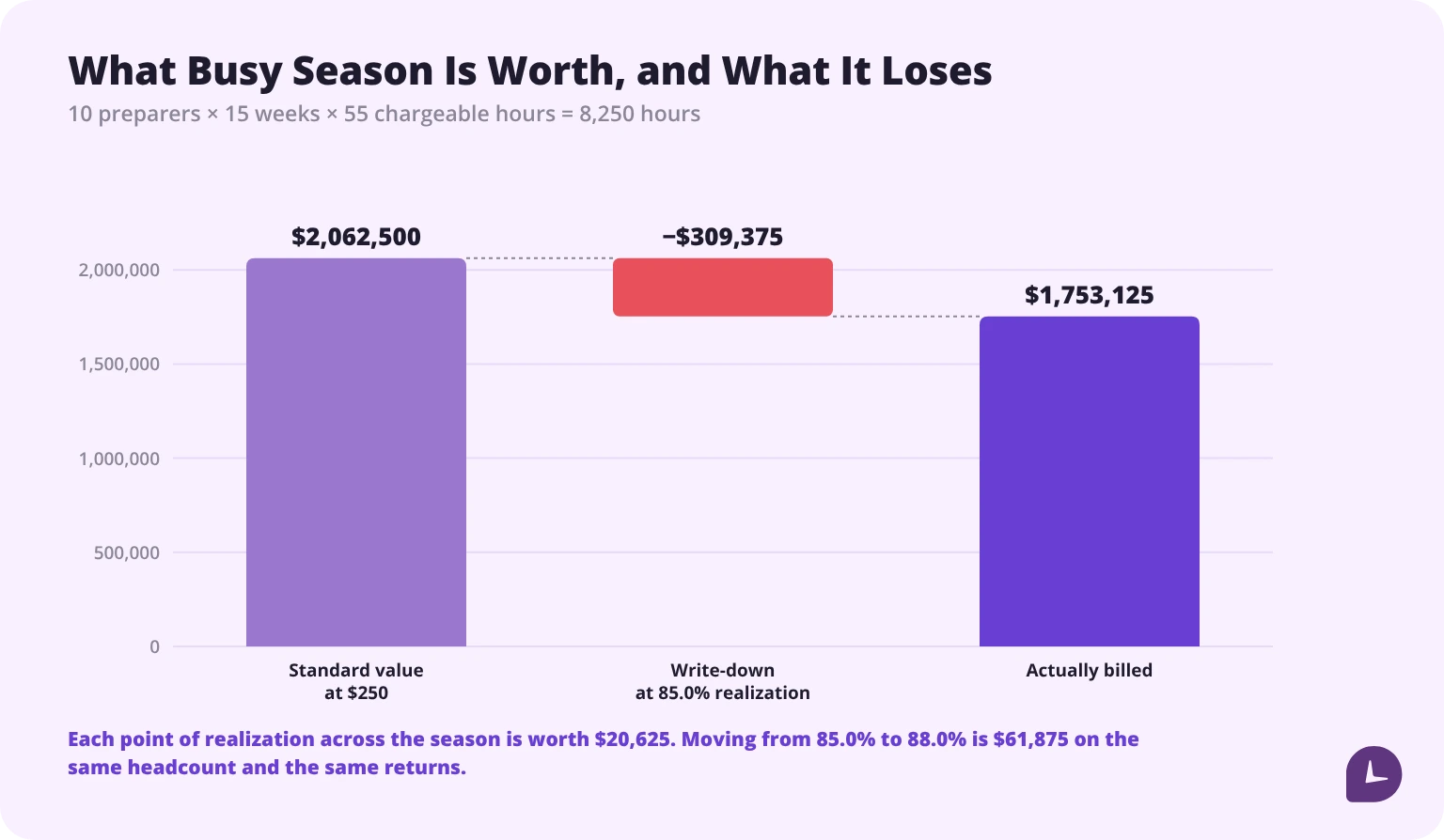
That is the arithmetic behind the seasonal pressure. During the season a firm cannot add capacity, cannot lengthen the deadline and cannot refuse the returns it has already accepted. The only variable left is how much of the time worked ends up on an invoice — which is a time-capture problem, not a staffing one.
Three things protect realization during the season, and all three depend on entries made the same day:
- Same-day entry. Hours reconstructed in April for work done in February lose the detail that justifies them.
- Scope changes logged as they happen. A client who sends a second set of corrected documents has changed the engagement. Recorded at the time, it is a fee conversation; recorded nowhere, it is a write-down.
- Non-chargeable work coded separately. Administrative and review time absorbed into client codes understates the write-down and hides where capacity went.
Why track hours on a fixed-fee engagement?
Fixed-fee and value-based pricing are now common in accounting, and the usual objection follows: the fee is agreed, so why count hours.
Because the fee is fixed and the cost is not.
Effective hourly rate = fixed fee ÷ hours actually spent
A $12,000 engagement delivered in 85 hours earned $141.18 per hour. The same engagement delivered in 140 hours earned $85.71 per hour. The invoice was identical. The economics were not.
Against a $250 standard rate, the first result is already well under standard and the second is a loss the firm will repeat on every comparable engagement until somebody counts the hours.
Hours on fixed-fee work also give you three things no fee schedule can: scope creep visible while it is happening, a price for the next proposal based on what the work took, and a defensible number when a client asks for one more schedule.
None of this requires billing by the hour. It requires knowing what the hour cost.
What is a chargeable hours ratio?
The chargeable hours ratio is the accounting profession’s version of utilization: the share of available time that went to client work.
Chargeable hours ratio = chargeable hours ÷ available hours
| Basis | Formula | Use it when |
|---|---|---|
| Against a standard year | chargeable ÷ 2,080 | Comparing people and years |
| Against hours actually paid | chargeable ÷ paid hours | Measuring a month or a season |
A staff accountant on a standard 2,080-hour year with 1,400 chargeable hours ran a 67.3% ratio. If you need to add the hours up before they reach that calculation, the time card calculator does that part on its own.
Read it next to realization, never on its own. Multiply the two and you get the share of a paid year that reaches a paid invoice: a preparer at 80% chargeable realizing at 70% delivers 56.0%, while one at 65% chargeable realizing at 95% delivers 61.8%. The busier person earns the firm less. The chargeable ratio measures how busy someone was; realization measures whether being busy was worth it. It is the same idea as billable utilization in other professional services, under a different name.
Should accountants use automatic or manual capture?
Two approaches compete, and the trade-off is real rather than marketing.
Manual entry means starting a timer or typing a block of time against a client code. It produces clean, intentional records and depends entirely on discipline. In a busy season, discipline is the first thing to go.
Automatic capture records application and document activity in the background, and the accountant assigns the captured blocks to clients afterwards. Nothing is forgotten, because nothing had to be remembered. Memtime, one of the tools built around this approach, states that it “only records time in the window that is currently in the foreground”, that “all tracking data is stored exclusively on the user’s device – and never on a server”, and that captured activity is “visible only to you”. It offers capture intervals of “any time increment between 1-60 minutes”, including the three- and six-minute increments it names as the ones used by lawyers, accountants and consultants.
The honest comparison:
| Manual entry | Automatic capture | |
|---|---|---|
| Hours lost to forgetting | High, worse under pressure | Low |
| Setup effort | Low | Low, but needs a review habit |
| Privacy posture | Nothing captured that was not entered | Depends entirely on what is recorded and where it is stored |
| Client-facing defensibility | Strong if entered same day | Strong, with a reviewed assignment step |
| Suits | Firms with steady workload | Firms with heavy seasonal peaks |
The decision usually comes down to privacy posture rather than accuracy. Automatic capture in a firm handling client financial data needs a clear answer on what is recorded, where it is stored and who can see it — and that answer has to exist before the tool is rolled out, not after someone asks. Note that the vendor claims above are the vendor’s own; a firm with a professional obligation here should confirm them against the product it actually deploys.
What has to be on a timesheet in an accounting firm?
Every formula in this guide takes hours as its input. The timesheet is where accuracy is either created or lost.
| Requirement | What breaks without it |
|---|---|
| Client and engagement code inside the entry | Realization cannot be computed per client |
| Service line on the entry (tax, audit, advisory, bookkeeping) | Write-downs cannot be traced to a service |
| Standard rate attached to the person | No standard value, so no realization |
| Chargeable flag set at entry | Chargeable ratio becomes a guess |
| Non-chargeable categories defined in advance | Admin and review time lands on client codes |
| Same-day entry | Reconstructed hours round toward whole numbers and lose detail |
| Scope-change code | Extra client work absorbed as a write-down instead of a fee |
| Entry locked after invoicing | WIP and realization stop reconciling |
| Edit history retained | A disputed fee has no evidence behind it |
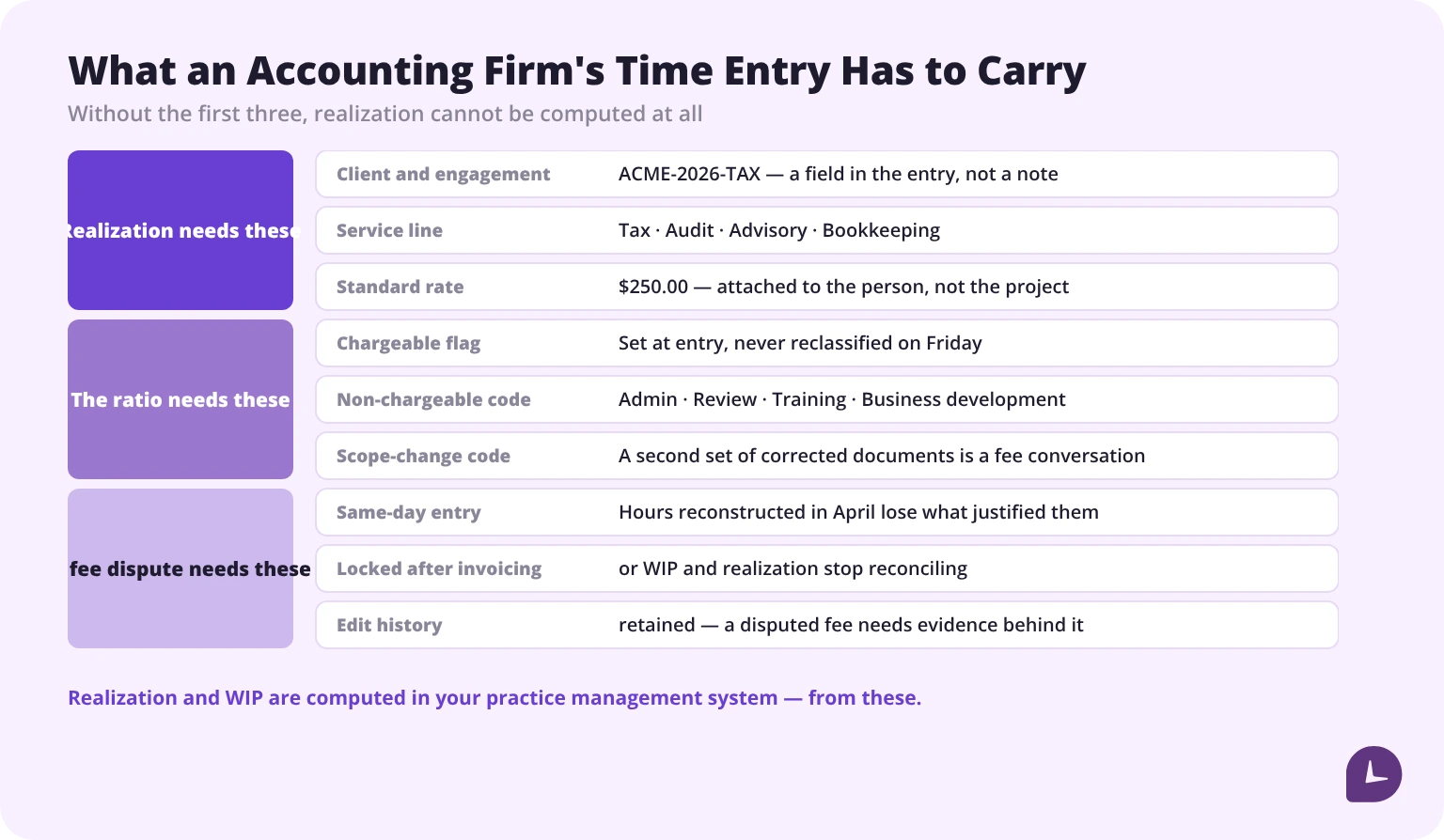
Online timesheets supply complete, dated, coded hours and the trail behind them. They do not compute realization or carry WIP — those live in your practice management or accounting system. What tracking decides is whether the hours feeding those calculations are the hours that were actually worked.
Hours against client and engagement codes as the work happens, with an approval trail and an export for billing.
Try Monitask time tracking for accountants free for 10 days
Hours against client and engagement codes as the work happens, with an approval trail and an export for billing.
Try Monitask time tracking for accountants free for 10 days
FAQ
How do you calculate realization rate?
Multiply hours worked by the standard rate to get standard value, then divide the amount billed by that figure. Billed realization uses invoiced amounts; collected realization uses cash received, which is lower whenever an invoice is settled at a discount or partly written off.
What is the difference between a write-down and a write-off?
A write-down happens before the invoice and reduces standard value to the amount billed, usually because the work took more hours than the fee supported. A write-off happens after the invoice and reduces the billed amount to what was collected, usually from a dispute, a concession or bad debt.
How do unrecorded hours affect realization?
They raise it. Hours are the denominator of the formula, so missing hours shrink standard value and push realization up. A firm recording 850 of 1,000 worked hours shows 100% realization on billing that actually realized 85%, which removes the signal that pricing needs attention.
What is work in progress for an accounting firm?
Work in progress is time worked and not yet invoiced, valued as unbilled hours multiplied by the standard rate. Carrying WIP at expected realizable value — standard value multiplied by the service line’s historical realization — is more conservative than carrying it at standard, and more useful for cash forecasting.
What is a good chargeable hours ratio?
The ratio is chargeable hours divided by available hours, commonly measured against a 2,080-hour year. A staff accountant with 1,400 chargeable hours runs 67.3%. Read it alongside realization, because high chargeable hours on work that realizes poorly earn the firm less than fewer hours at full rate.
Should accountants track time on fixed-fee work?
Yes. Dividing the fee by hours spent gives the effective hourly rate, which is the only way to know whether the fee was adequate. A $12,000 engagement in 85 hours earned $141.18 an hour; the same engagement in 140 hours earned $85.71. Without hours, neither number exists.
How much is realization worth during busy season?
In a fifteen-week season with ten preparers at 55 chargeable hours a week, chargeable capacity is 8,250 hours. At a $250 standard rate that is $2,062,500 of standard value, so each point of realization is worth $20,625. Three points is $61,875 on the same headcount.
Is automatic time capture better than manual entry for accountants?
Automatic capture loses fewer hours, particularly under seasonal pressure, because nothing depends on remembering. Manual entry produces cleaner intentional records and captures nothing beyond what was entered. The deciding factor is usually privacy posture: a firm handling client financial data needs a clear answer on what is recorded and where it is stored.
What should an accounting firm timesheet include?
Client and engagement codes inside the entry, the service line, a standard rate attached to the person, a chargeable flag set at entry, predefined non-chargeable categories, a scope-change code, same-day entry, locking after invoicing, and retained edit history. Without the first three, realization cannot be computed at all.