A job application form has one job: collect enough to make a shortlisting decision, and nothing more. Most compliance problems with application forms are not caused by asking a forbidden question outright — they are caused by asking a reasonable question at the wrong stage. Social Security numbers, dates of birth and criminal history all have a legitimate place in a hiring process. None of them belongs on the initial form.
Key takeaways
- The application stage needs identity, contact details, work history, education, relevant skills, work authorisation and availability. That is close to the whole list.
- Do not collect Social Security numbers on the application. They are needed for a background check, which requires separate written consent, and for tax forms after hire.
- Date of birth reveals age and should not appear. If the role has a minimum age, ask whether the applicant meets it.
- Criminal history and salary history are restricted by state and local law in much of the US. Many jurisdictions prohibit both on an application form.
- Ask about work authorisation, not citizenship.
Get more out of your business.
Start Your 10-Day Trial
The form is one component of a wider recruitment strategy, and it is the component most often inherited rather than designed.
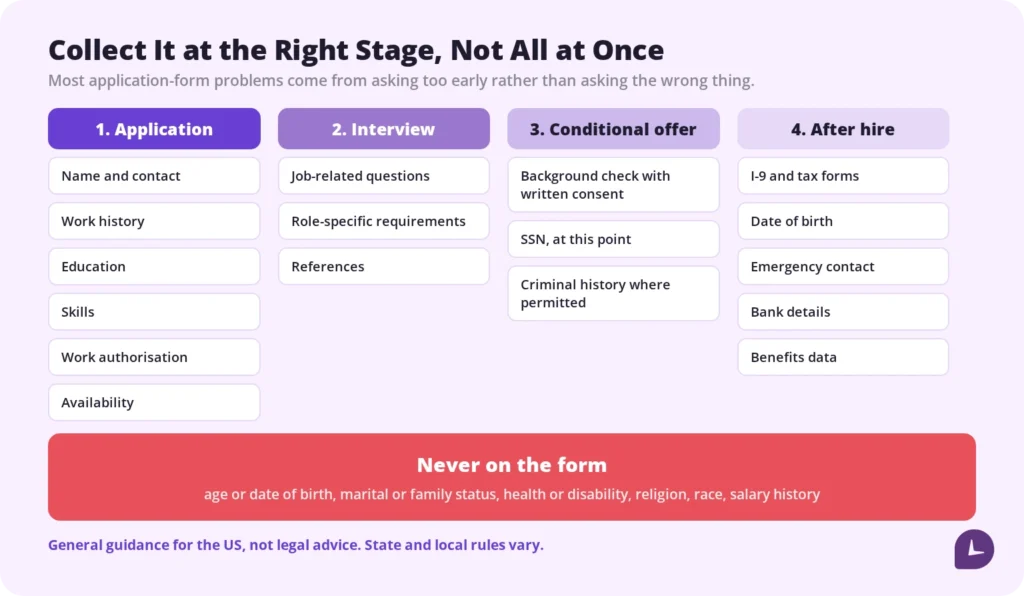
Collect It at the Right Stage
The clearest way to design a compliant form is to think in stages rather than in fields. Each piece of information has a point in the process where it becomes both necessary and appropriate.
Working this way solves most problems automatically. If a field is not needed to decide whether to interview someone, it does not belong on the application.
Boost your business productivity
Track performance and streamline teamwork
What Belongs on the Application Form
| Section | What to ask | Why it belongs here |
|---|---|---|
| Identity and contact | Full legal name, email, phone, general location | Needed to identify and contact the applicant |
| Position | Role applied for, how they heard about it | Routing and sourcing data |
| Work history | Employers, job titles, dates, responsibilities | The core of the shortlisting decision |
| Education | Institutions, qualifications obtained, field of study | Relevant where the role requires it |
| Skills and certifications | Job-relevant skills, licences the role requires | Directly assessable against the requirements |
| Work authorisation | “Are you legally authorised to work in the US?” and whether sponsorship will be required | Lawful phrasing of a legitimate question |
| Availability | Start date, and confirmation they can meet the stated schedule | State the requirement; let them confirm |
| Certification and signature | A statement that the information is accurate, with signature and date | Grounds for action if the application is falsified |
A note on education dates
Ask what qualification was obtained and where, not when it was awarded. Graduation dates reveal age as reliably as a date of birth does, and they add nothing to the assessment.
A note on availability
The safe form of this question states the requirement rather than probing for conflicts. “This role requires weekend shifts — are you able to meet this schedule?” is fine. “Do you have any commitments that would prevent weekend work?” invites answers about childcare, religion and disability, none of which you may consider.
What Must Not Appear on the Form
These are the questions that create liability, grouped by what they reveal. The EEOC is the primary source for the federal position, and a form built around inclusive hiring practice will avoid most of these by design.
| Do not ask | Why | Ask instead, if relevant |
|---|---|---|
| Date of birth, age, graduation year | Reveals age; age discrimination exposure | “Are you at least 18?” where a minimum age applies |
| Social Security number | Not needed to shortlist; creates a data-security liability | Request at background-check stage, with written consent |
| Criminal convictions | Restricted by ban-the-box laws in many states and cities | Where permitted, after a conditional offer |
| Salary history | Prohibited in many states and municipalities | State the pay range for the role instead |
| Citizenship | Reveals national origin | “Are you legally authorised to work in the US?” |
| Health, disability, medical history | Prohibited under the ADA | “Can you perform the essential functions of this role, with or without reasonable accommodation?” |
| Marital status, children, childcare, pregnancy | Reveals family status; disproportionately screens out women | Nothing. It is not job-related |
| Religion, race, national origin | Protected characteristics | Nothing on the form. EEO data, where collected, is separate and voluntary |
| Reason for military discharge | May reveal disability or protected information | Dates and type of service, where relevant |
| Emergency contact | Not needed before hire | Collect after hire |
| Photograph | Reveals race, age, sex and more | Nothing |
The pattern behind the table: if the answer cannot lawfully influence the hiring decision, asking for it creates risk and gains nothing. That reasoning also covers questions this table does not list.
The Social Security Number Question
This deserves its own section because it is the most common mistake on self-built application forms, and it is usually made in good faith.
The reasoning goes: we will need it eventually for payroll, so we may as well collect it now. The problem is what “collect it now” means in practice. If you hire one person in forty, you have gathered thirty-nine Social Security numbers you have no use for, and you are now responsible for protecting all of them. A breach exposing them is a serious incident, and it will be a serious incident caused by data you did not need.
The correct sequence: request the number when you are running a background check, with the applicant’s written authorisation, or after hire for tax and employment eligibility forms. Both points come after you have decided this person is a serious candidate.
Verification and Signature
Two elements that are easy to omit and worth including.
A certification statement — a short paragraph confirming the information provided is accurate and complete — gives you documented grounds to act if an application turns out to be falsified. Without it, resolving a falsification later is considerably harder.
An authorisation to verify — permission to contact listed employers and educational institutions to confirm the details given. Note that this is narrower than authorisation for a background check, which is a separate document with its own requirements.
Data Handling
A form that asks the right questions can still create problems through how the answers are stored. The wider practice of keeping applicant and employee data secure applies here directly.
- Retain applications for the period your jurisdiction requires, then dispose of them securely. Both halves matter: keeping them indefinitely is a liability, and disposing of them too early can leave you unable to defend a claim.
- Limit access to the people who need it for the hiring decision.
- Keep any voluntary EEO data separate from the application itself, so it is not visible to whoever makes the shortlisting decision.
- Store securely. An application form contains enough personal data to matter, even without a Social Security number on it.
Reviewing Your Form
Application forms tend to be inherited rather than designed — copied from a template, from a previous employer, or from whatever the previous HR manager used. Two habits keep them safe.
Review annually with counsel. Ban-the-box and salary history rules are among the fastest-changing areas of US employment law, and they vary by state and city. A form that was compliant three years ago may not be now, and a form that is compliant in one state may not be in another.
Use a role-specific version where it helps. A driving role legitimately needs licence details at some point; a desk role never does. Asking every applicant for everything any role might require is how forms accumulate fields nobody can justify.
If you are building a form from scratch, our free company forms and policies are a reasonable starting point — with the same caveat: have counsel review anything before it goes live in your jurisdiction.
Boost your business productivity. Track performance and streamline teamwork.
Start Your 10-Day Trial
Key Takeaways
Ask what you need to decide whether to interview someone, and nothing else. Everything else has a later stage where it becomes appropriate: background checks after a conditional offer, tax and eligibility forms after hire.
The two most common mistakes are collecting Social Security numbers early and asking for a date of birth. Both are made by employers acting in good faith, and both are straightforward to remove.
> This article is general information about US hiring practice, not legal advice. Requirements vary substantially by state and city, particularly for criminal history and salary history questions, and they change frequently. Have an employment attorney review your application form before use.
Reliable employee tracking software. Clear visibility and insights into how employees work. Even remotely.
Try Monitask free for 10 days
Frequently Asked Questions
Can I ask for a date of birth?
Avoid it. It reveals age and creates age-discrimination exposure. Where a role has a minimum age requirement, ask whether the applicant meets it rather than asking when they were born. The same applies to graduation dates.
Can I ask about criminal history?
It depends on where you are. Ban-the-box laws in many states and cities prohibit the question on an application form, and some require waiting until after a conditional offer. Check the rules for every jurisdiction you hire in.
Can I ask what someone earned previously?
In much of the US, no. Salary history bans apply in a large number of states and municipalities, and some prohibit using the information even if an applicant volunteers it. Publishing the pay range for the role is the safer approach.
How do I ask about work eligibility?
Ask whether the applicant is legally authorised to work in the US, and whether they will require sponsorship now or in the future. Do not ask about citizenship, national origin or immigration status.
How long should we keep applications?
For the period your jurisdiction requires, then dispose of them securely. Both indefinite retention and premature disposal create problems — confirm the applicable period for your location.