Accountability vs Responsibility in the Workplace


Responsibility is the work someone is assigned to do. Accountability is ownership of whether the outcome actually happened. Four people can be responsible for the same project; only one can be accountable for it. Teams that blur the two end up with tasks everybody touched and nobody owned — and the fix is usually one conversation about who answers for the result, not a new process.
Key takeaways
- Responsibility is assigned, describes activity, and can be shared across a team.
- Accountability is accepted, describes ownership of the outcome, and belongs to one person.
- The RACI matrix is the standard way to write this down: many R, exactly one A.
- Only 46% of US employees clearly know what is expected of them at work, down from 56% in 2020 — accountability fails at the expectations stage far more often than at the effort stage.
- Holding someone accountable means agreeing the outcome and the date in advance, not checking on them more often afterwards.
Reliable employee tracking software. Clear visibility and insights into how employees work. Even remotely.
Try Now
The Difference in One Table
Both words describe obligation, which is why they get used interchangeably. They sit at different points in the work: responsibility before the outcome, accountability after it.
| Responsibility | Accountability | |
|---|---|---|
| What it covers | The tasks and duties of a role | The result those tasks were meant to produce |
| How it arrives | Assigned by a manager or job description | Accepted by the person who owns the outcome |
| How many people | Can be shared across a team | One person per outcome |
| When it applies | Before and during the work | After the result is known |
| What it sounds like | “I run the weekly client report” | “The client report going out late is on me” |
| What failure looks like | The task was not done | The result was not delivered, whoever did the task |
| Can it be delegated | Yes | No — you can delegate the work, not the answerability |
The last row is the one that matters in practice. A manager who delegates a project still answers for it. That is the whole distinction, and everything below follows from it.
Boost your business productivity
Track performance and streamline teamwork
What Responsibility Looks Like
Responsibility is the concrete content of a role: the tasks in the job description, the deadlines attached to them, and the standard they are expected to meet. It is descriptive and it is divisible. A launch can have a designer, a copywriter, a developer and a QA engineer all responsible for their part of it, and each of them is doing exactly what responsibility means.
Responsibility is also transferable. When somebody goes on leave, their responsibilities move to a colleague. Nothing about that transfer is unusual, because responsibility attaches to the work rather than to the person.
What Accountability Looks Like
Accountability is ownership of the outcome, including outcomes produced by other people’s work. It is the willingness to answer for a result without redistributing the explanation. When a project slips, the accountable person does not report that the developer was blocked and the designer was out — they report that the project slipped, what is being done, and by when.
Accountability cannot be split. Naming two accountable people for one outcome produces the same result as naming none: each waits for the other to act, and the gap only becomes visible when the deadline passes. This is the most common structural mistake in project ownership and it looks like collaboration right up until it fails.
How RACI Makes the Difference Concrete
The RACI matrix is the standard tool for writing this down, and its central rule is exactly the distinction above: many people can be Responsible, exactly one is Accountable.
| Letter | Role | Rule |
|---|---|---|
| R — Responsible | Does the work | One or more people |
| A — Accountable | Owns the outcome and signs off | Exactly one person |
| C — Consulted | Provides input before the decision | Two-way communication |
| I — Informed | Told once it is decided | One-way communication |
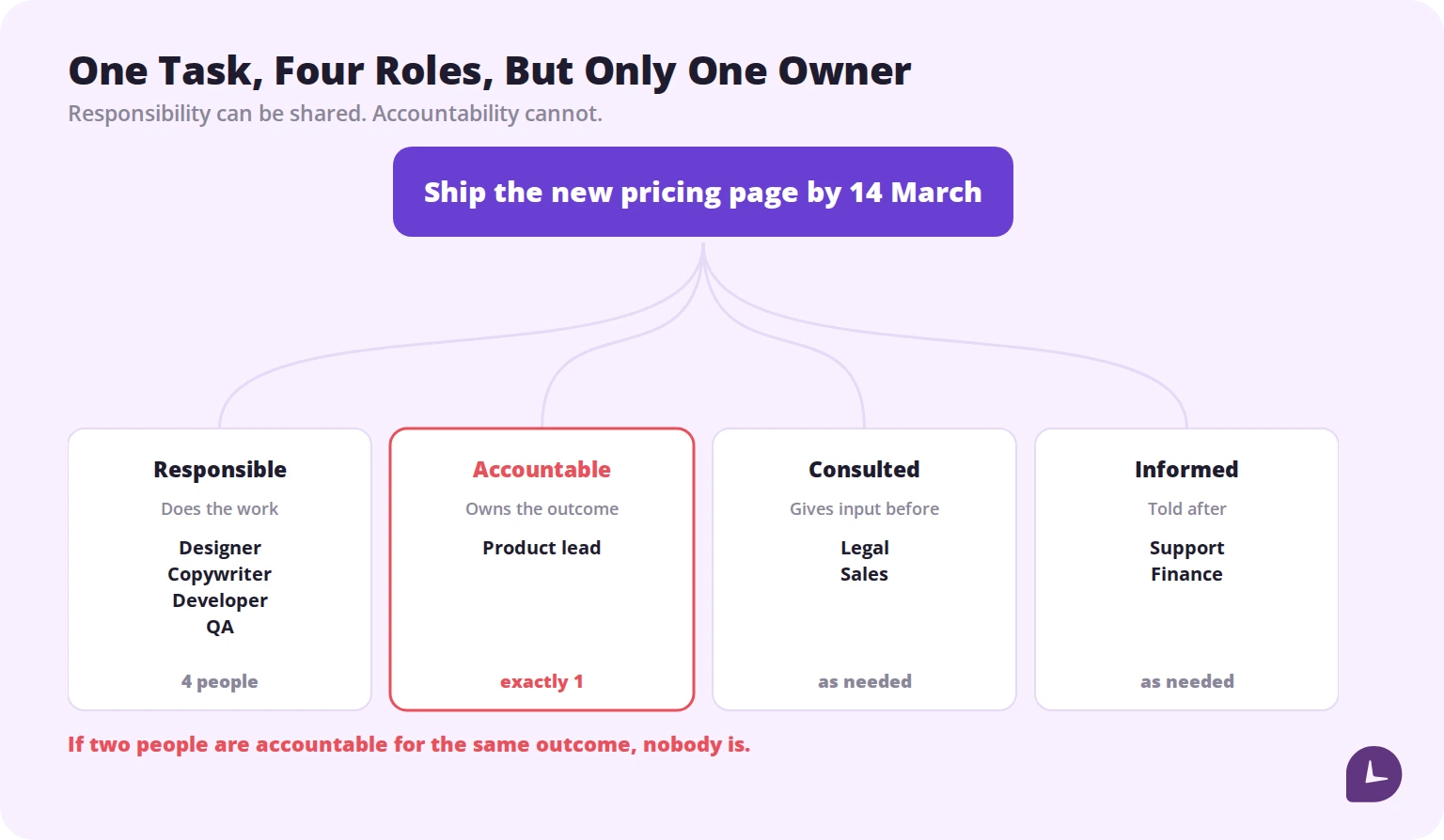
Applied to a real task, it stops being abstract. Take shipping a new pricing page by 14 March. The designer, copywriter, developer and QA engineer are all Responsible — they do the work. The product lead is Accountable — if the page ships late or ships broken, that is the conversation they have. Legal and Sales are Consulted before the copy is finalised. Support and Finance are Informed once the date is confirmed.
Writing this out takes ten minutes per project and removes the two failure modes that cost the most: a task nobody owns, and a task two people assume the other owns. It also settles the question that defining roles clearly is meant to answer.
Why Accountability Usually Fails Before Anyone Starts Working
Managers tend to treat weak accountability as a motivation problem. Gallup research on workplace expectations points somewhere earlier: only 46% of US employees clearly know what is expected of them at work, down from a high of 56% in 2020, and clarity of expectations is one of the strongest predictors of engagement Gallup measures. People cannot own an outcome they were never given in a form they could own.
Three specific gaps produce most of it:
- The outcome was never stated as an outcome. “Look into the reporting issue” is a direction, not a deliverable. “Tell me by Thursday whether we can fix the reporting issue in this sprint” is one.
- The date was implied rather than agreed. A deadline the manager holds and the employee guesses at is not a shared commitment.
- The owner was never named out loud. Assigning work to a team without naming who answers for it distributes the work and dissolves the ownership.
What Weak Accountability Costs
The visible symptom is missed deadlines. The expensive ones are quieter.
- Problems surface late. Without a named owner, bad news travels only when it can no longer be hidden, which is usually after the point where it could have been fixed cheaply.
- Strong performers absorb the slack. Work that nobody owns lands on whoever cares most, which is how reliable people become overloaded and eventually leave.
- Managers compensate with surveillance. Unable to see whether commitments are being met, managers check in more often — which reads as micromanagement and reduces the ownership it was meant to restore.
- Blame replaces analysis. When the owner is unclear after a failure, the discussion becomes who is at fault rather than what broke.
How to Build Accountability Without Micromanaging
The difference between accountability and surveillance is when the agreement happens. Accountability is agreed in advance; surveillance is applied afterwards because nothing was agreed. The practical steps overlap with the broader work of improving accountability across a team.
Agree the outcome, the date and the owner in the same sentence
Every commitment should survive being read back six weeks later by someone who was not in the room. Name the deliverable, the date, and the person who answers for it. If any of the three is missing, you have assigned work rather than ownership.
Make progress visible instead of asking about it
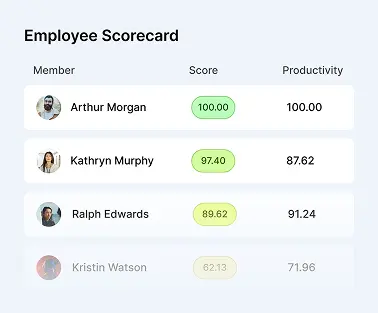
Most check-in meetings exist because the data is not available anywhere else. When status, hours and progress are visible in a shared system, the manager stops asking and the employee stops reporting — and both get the time back. Productivity reporting and time records do this passively, which is the point: the value is in nobody having to chase.
Separate the outcome review from the person
Review what happened against what was agreed, in that order. A conversation that starts with the commitment and works forward is a performance discussion. One that starts with the person and works backward is a character judgement, and people defend themselves against it rather than fixing anything.
Let ownership carry decision rights
Someone accountable for a result who cannot make the decisions that determine it has been given the blame without the authority. This is the fastest way to teach a team that ownership is a trap. If you name an owner, give them the calls that go with it.
Model it upward first
Gallup attributes around 70% of the variance in team engagement to managers. Accountability is learned by observation: a manager who names their own missed commitments before anyone else raises them sets the standard more effectively than any policy document.
Does Accountability Actually Affect Results
The strongest evidence available is indirect and worth stating carefully. Gallup’s Q12 meta-analysis, covering 183,806 business units across 53 industries and 90 countries, found that business units in the top quartile for engagement were 23% more profitable than those in the bottom quartile, with 18% higher sales productivity and 78% lower absenteeism.
Two caveats belong with those numbers. They are median differences between top and bottom quartiles, not guarantees for an individual company, and they describe association rather than proven causation. What they support is a narrower claim: clarity of expectations and ownership travel with the conditions that produce better business outcomes.
Maximize productivity of your business.
Start Your 10-Day Trial
Key Takeaways
Responsibility is what someone was asked to do. Accountability is who answers for whether it happened. Write both down — the RACI matrix takes ten minutes and prevents the two failures that cost the most.
The practical prerequisite is visibility. Ownership only works when both sides can see what was committed and what actually happened, without one of them having to ask. Monitask records hours, activity and project time automatically, so progress is a shared fact rather than a status meeting. Try it on a 10-day free trial, no card required.
Reliable employee tracking software. Clear visibility and insights into how employees work. Even remotely.
Try Monitask free for 10 days
FAQ: Accountability and Responsibility in the Workplace
Can more than one person be accountable for the same outcome?
No, and naming two produces the same effect as naming none — each assumes the other is acting. Multiple people can be responsible for the work that produces the outcome, but one person answers for the result.
What comes first, responsibility or accountability?
Responsibility comes first, since it describes work that is assigned before the outcome exists. Accountability applies to the result and is settled once the outcome is known, though the ownership is agreed at the start.
What does RACI stand for?
Responsible, Accountable, Consulted, Informed. It is a matrix for recording who does the work, who owns the result, who is asked for input beforehand, and who is told afterwards. The defining rule is one Accountable person per task.
What causes a lack of accountability at work?
Usually unclear expectations rather than unwilling people. If the outcome was never stated as a deliverable, the date was never agreed, or the owner was never named, there was nothing concrete to own in the first place.
How do I hold someone accountable without micromanaging?
Agree the outcome, the date and the owner in advance, then make progress visible in a shared system rather than asking for status updates. Check-in frequency is what people experience as micromanagement; a shared source of truth removes the need for it.