
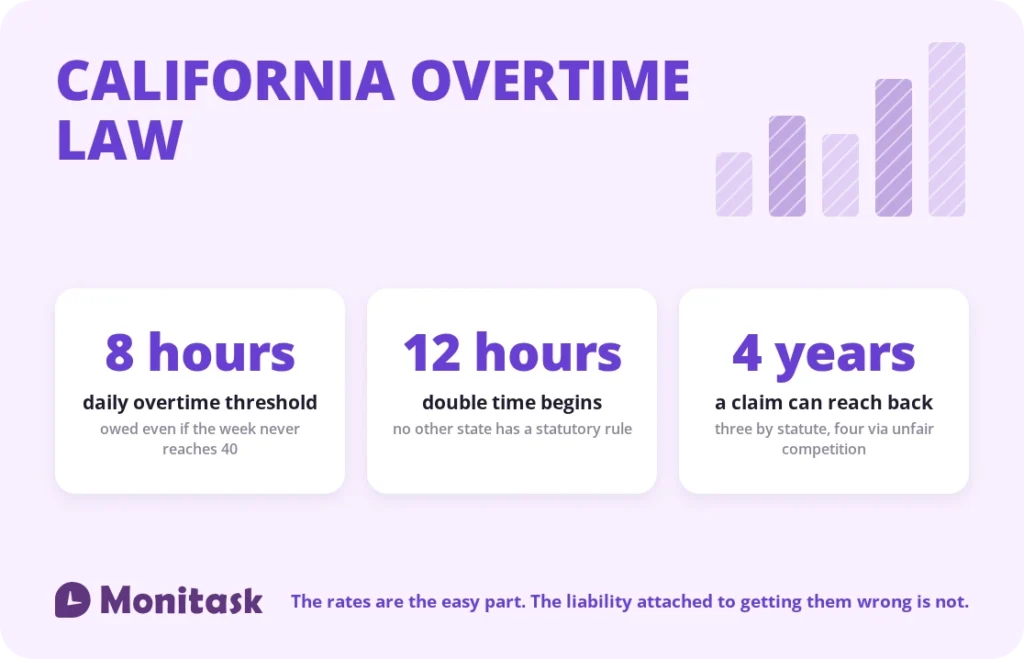
California overtime runs on the workday, not just the workweek. Cross eight hours in a single day and overtime is owed even if the week never reaches 40. Cross twelve and double time begins. California is the only state with a statutory double-time rule.
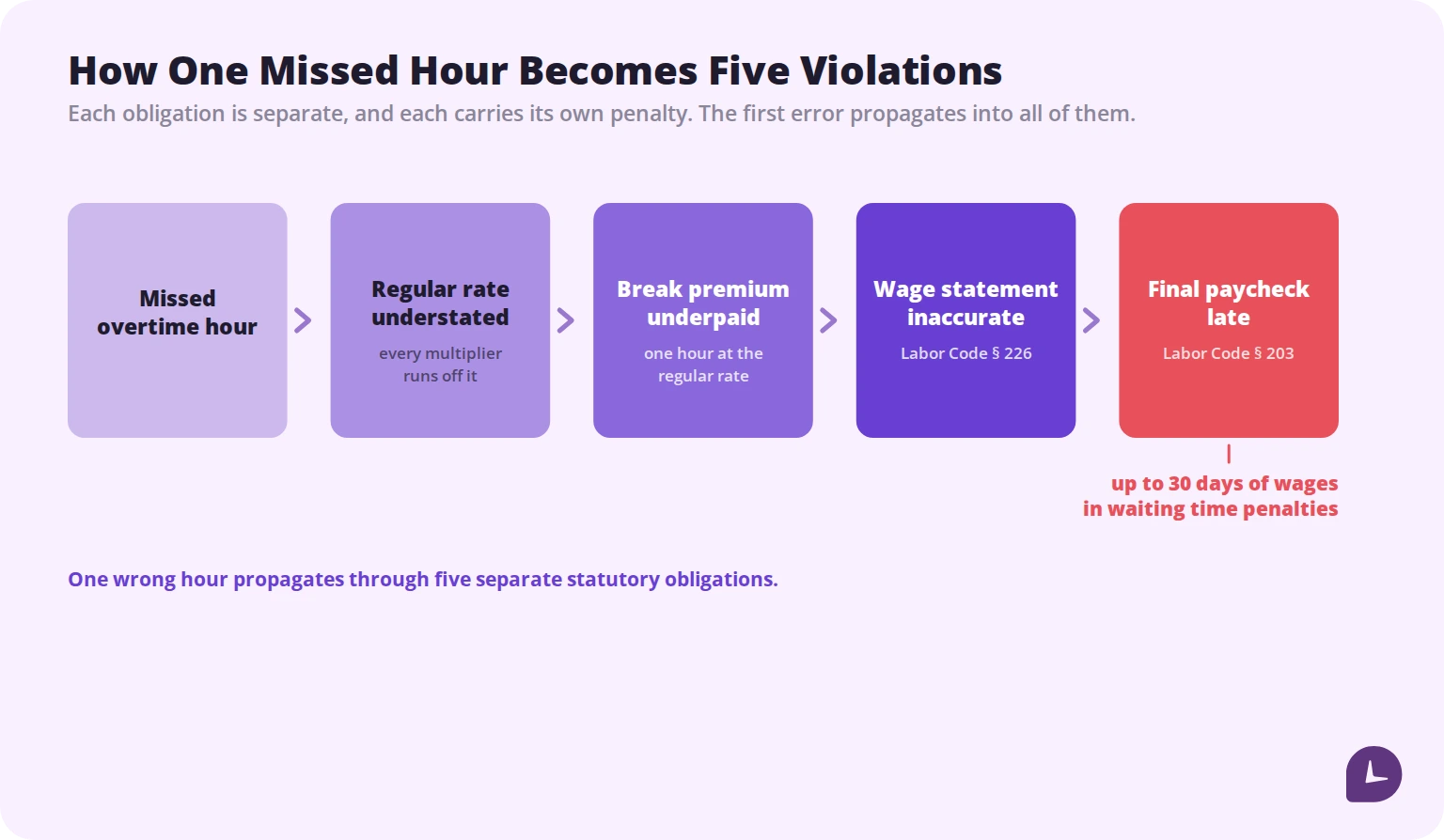
Most guides stop once the rates are explained. That is the wrong place to stop, because in California the underpayment is rarely the expensive part. A missed overtime hour changes the regular rate, which changes the break premium, which is itself wages, which makes the wage statement inaccurate and the final paycheck late. A $132 shortfall on one week can carry $5,280 in waiting time penalties behind it.
This guide covers the rates, the calculation traps, and the chain that turns a payroll error into a claim.
Quick answer
| Situation | Rate |
|---|---|
| Over 8 hours in a workday, up to 12 | 1.5× regular rate |
| Over 12 hours in a workday | 2× regular rate |
| Over 40 hours in a workweek | 1.5× regular rate |
| First 8 hours on the 7th consecutive day of a workweek | 1.5× regular rate |
| Over 8 hours on the 7th consecutive day | 2× regular rate |
| Weekends, nights and holidays as such | No premium required |
| Missed meal or rest break | 1 hour of pay at the regular rate |
Governing law: California Labor Code § 510 and the Industrial Welfare Commission wage orders, with the Department of Industrial Relations enforcement FAQ as the working reference.
The rates
At the 2026 California minimum wage of $16.90 an hour, the statutory multipliers work out to:
| Rate | At state minimum |
|---|---|
| Straight time | $16.90 |
| Time and a half | $25.35 |
| Double time | $33.80 |
Above minimum wage, every multiplier runs off the employee’s regular rate, not their base hourly wage. That distinction is where most of the money is lost, and it is covered below.
Three things California does not require, which employers frequently assume it does: premium pay for weekend work, premium pay for night shifts, and premium pay for public holidays. None of those trigger overtime by themselves. Only hours do.
Daily and weekly overtime are not added together
The single most common calculation error is double-counting.
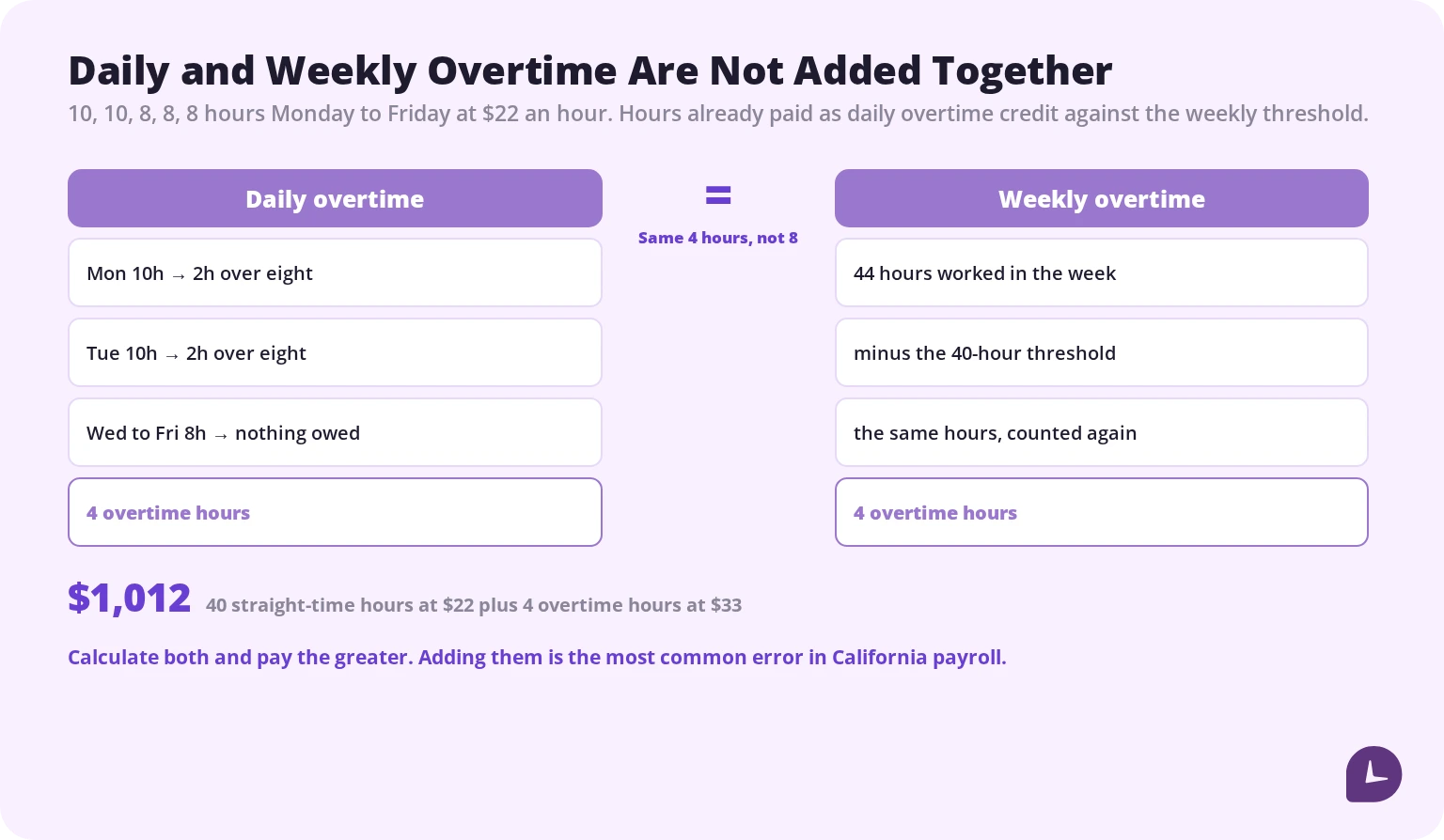
An employee works 10, 10, 8, 8, 8 across Monday to Friday at $22 an hour. That is 44 hours.
- Daily overtime: 2 hours on Monday and 2 on Tuesday, 4 hours at $33.
- Weekly overtime: 44 − 40 = 4 hours.
These are not eight overtime hours. They are the same four. Hours already paid as daily overtime credit against the weekly threshold. The correct total is 40 straight-time hours at $880 plus 4 overtime hours at $132, or $1,012.
The rule is to calculate both and pay the greater, not the sum.
Note also what this means in reverse. Four ten-hour days total 40 hours, so nothing is owed under federal law. In California, each of those days generates two hours of daily overtime, for eight overtime hours in a week that never crossed 40. Our overtime calculator has a California mode that models this.
The seventh consecutive day rule
Work seven consecutive days in a single workweek and the seventh day is paid differently regardless of hours:
- First 8 hours: 1.5×
- Beyond 8 hours: 2×
Two details that decide most disputes about this rule.
It is measured within the workweek, not on a rolling seven-day window. An employee who works the last three days of one workweek and the first four of the next has worked seven consecutive calendar days without triggering the rule in either workweek.
The employer defines the workweek, but must define it in advance and keep it fixed. Shifting the workweek boundary to avoid the seventh-day premium is not permitted, and a workweek that moves is evidence in itself.
Who is exempt in California
California’s exemption test is stricter than the federal one on both halves.
Salary threshold. An exempt employee must earn at least twice the state minimum wage for full-time work. At the 2026 minimum of $16.90, that is $70,304 a year, or $1,352 a week. This figure moves every January with the minimum wage.
Duties test. The role must be primarily engaged in exempt work, and California interprets “primarily” quantitatively: more than 50% of actual working time. The federal standard asks about the employee’s primary duty qualitatively. A California supervisor who spends 60% of their shift doing the same work as the team they supervise is non-exempt even with the title and the salary.
Computer software professionals have their own higher threshold, set at $58.85 an hour or $122,573.13 annually for 2026 and adjusted each autumn.
The practical consequence: a salaried manager paid $68,000 in California is non-exempt regardless of title, and every nine-hour day owes an hour of overtime. If your exempt salaries were last reviewed before 2024, the threshold has climbed faster than most raise cycles and that is the first thing to re-check.
The regular rate, and the Alvarado divisor
Overtime is calculated on the regular rate, which includes non-discretionary bonuses, commissions and shift differentials. Excluded: true gifts, genuinely discretionary bonuses and expense reimbursements.
California then applies a divisor that differs from the federal method, and getting this backwards underpays every overtime hour in every bonus week.
For a flat-sum bonus — one that does not increase with hours worked, such as a promised attendance bonus — the California Supreme Court held in Alvarado v. Dart Container that the bonus is divided by the employee’s non-overtime hours only, not by total hours.
Worked example. A technician earns $20 an hour, works 45 hours, and receives a promised $200 attendance bonus.
| Method | Divisor | Bonus rate | Extra owed per OT hour |
|---|---|---|---|
| California (Alvarado) | 40 non-overtime hours | $5.00 | $7.50 |
| Federal | 45 total hours | $4.44 | $2.22 |
The California method owes more than three times as much on the bonus component. Production bonuses that scale with hours worked use a different divisor, and discretionary bonuses stay out of the rate entirely.
Boost your business productivity
Track performance and streamline teamwork
Alternative workweek schedules
Four ten-hour days without daily overtime is possible in California, but only through a formally adopted alternative workweek schedule. The requirements are procedural and strict:
- A written proposal disclosed to the affected work unit
- A secret ballot election approved by two-thirds of affected employees
- Results reported to the Department of Industrial Relations within 30 days
Run four ten-hour days without those steps and hours nine and ten of every shift are overtime, every day.
On a validly adopted 4/10, time and a half begins past the scheduled 10 hours, double time still applies past 12, and weekly overtime past 40 is unchanged.
This is the single most common source of accidental liability among California employers who think they have a compressed schedule and in fact have an unadopted one. Our daily schedule template covers the scheduling mechanics.
Industry and role exceptions
| Category | How overtime differs |
|---|---|
| Healthcare under a valid alternative workweek | Up to 12 hours a day without daily overtime; double time beyond 12 |
| Agricultural workers | Phased thresholds; smaller employers reached 8 hours a day and 40 a week by 2025 |
| Live-in household employees | Daily overtime generally applies past 6 hours in a day or 30 in a week |
| Camp counsellors | No daily overtime; weekly overtime after 54 hours or six workdays |
| Personal attendants | Overtime after 40 hours or six days; no daily threshold |
| Resident managers in small care homes | Weekly threshold only |
Each sits under a specific IWC wage order. Identify which wage order covers your industry before applying any general rule, because the wage order governs.
This section covers ground that the top-ranking guides to California overtime almost entirely omit, and it is where the larger exposure sits.
Under Labor Code § 226.7, an employer that fails to provide a compliant meal or rest period owes the employee one additional hour of pay for each workday the break was not provided. Meal and rest premiums are separate, so a single day can generate two.
The statute says that hour is paid at the employee’s “regular rate of compensation.” Employers read that as base hourly rate for years. In Ferra v. Loews Hollywood Hotel (2021), the California Supreme Court held unanimously that “regular rate of compensation” is synonymous with the “regular rate of pay” used for overtime, so non-discretionary bonuses and commissions must be folded in. The decision applies retroactively.
The arithmetic is small and the multiplier is not. An employee at $20 an hour with a $200 non-discretionary bonus in a 40-hour week has a regular rate of $25. Paying break premiums at $20 underpays by $5 per premium. Across a workforce and a four-year claim window, that $5 is the entire case.
Then Naranjo v. Spectrum Security Services (2022) closed the loop: those premiums are wages. Which means they must appear on the itemised wage statement required by Labor Code § 226, and they must be included in the final paycheck. Unpaid or misstated, they trigger the derivative penalties under §§ 226 and 203. Prejudgment interest on unpaid premiums runs at 7%.
Why the timekeeping record decides the case
Donohue v. AMN Services (2021) is the decision that connects all of this to the time clock.
The California Supreme Court held two things. Employers may not round time punches for meal periods; the actual punch times govern. And time records showing a short, late or missed meal period raise a rebuttable presumption that the break was not provided, shifting the burden to the employer to show it was.
Both halves matter operationally.
Rounding that is permissible for general timekeeping is not permissible for meal periods. A system configured to round to the nearest quarter hour will turn a 29-minute lunch into a compliant 30-minute one on paper, and that is precisely the record the presumption operates on.
And because the presumption arises from the records themselves, the timekeeping system stops being an administrative tool and becomes the primary evidence. Accurate punch-level records that show compliant breaks defeat the presumption. Reconstructed or rounded records create it. Our guide to the 7-minute rule for payroll covers where rounding is and is not defensible.
How a small error becomes a large claim
Take the warehouse lead from earlier, at $22 an hour, underpaid by $132 in a single week.
Waiting time penalties, § 203. If a departing employee’s final paycheck is short, the employee continues earning a full day’s wages for each day it is late, up to 30 days. At eight hours a day, that is $5,280 on a $132 shortfall. A good-faith dispute about what is owed can defeat the penalty; not knowing about the daily rule is not a good-faith dispute.
Wage statement penalties, § 226. An inaccurate itemised statement carries its own penalties per employee per pay period, subject to caps.
Interest. 10% annually on unpaid wages, 7% on unpaid break premiums.
Liquidated damages equal to the unpaid amount are available in minimum wage cases.
PAGA. The Private Attorneys General Act lets an employee bring claims for civil penalties on behalf of themselves and other aggrieved employees. It is the mechanism that converts a per-employee error into an aggregate one, and it is the reason California wage-and-hour exposure behaves differently from other states.
How far back it reaches. Three years for statutory wage claims, extended to four through California’s unfair competition law. Ferra applying retroactively means break premium recalculations reach back across that window.
The practical conclusion: overtime errors are cheapest on the day you find them, and the cost of finding them late is not proportional to the error.
Is California overtime taxed?
Yes, all of it, at the state level. The “no tax on overtime” people have heard about is a federal deduction and it is narrower than the name suggests.
The federal layer. For tax years 2025 through 2028, the premium portion of qualified overtime is deductible up to $12,500, or $25,000 for joint filers, phasing out above $150,000 of modified adjusted gross income. Two limits matter here. Only the premium counts, so on a $30 overtime rate built from a $20 base, the deductible amount is $10, not $30. And the deduction covers overtime required by the federal FLSA, which is weekly-over-40 overtime.
California’s daily overtime is required by state law, not the FLSA. The premium on a ten-hour day inside a 38-hour week generally does not qualify. A California payroll’s “qualified overtime” figure can be far smaller than its total overtime figure.
The state layer. California has not conformed to the federal provision, so every overtime dollar remains subject to California income tax and withholding. A conformity bill was introduced in 2026 and stalled over its revenue cost.
Payroll taxes apply regardless. The deduction is income-tax-only; Social Security and Medicare come out of every overtime dollar.
Employer reporting. From tax year 2026, qualified overtime compensation must be reported separately in Box 12 of Form W-2 under code TT, which means payroll has to distinguish FLSA-qualified premium from state-only premium.
Employers can require overtime. California permits mandatory overtime, and an employee who refuses a lawful assignment can generally be disciplined. The limits are one day of rest in seven, no retaliation, and every hour paid at the correct premium.
Unauthorised overtime must still be paid. If a non-exempt employee works the hours, the hours are owed, whether or not anyone approved them. A policy requiring pre-approval is enforceable as a disciplinary matter and unenforceable as a reason to withhold pay.
Overtime rights cannot be waived. An agreement in which an employee gives up statutory overtime is unenforceable, however it is documented.
Common mistakes
Applying federal rules. Four ten-hour days is 40 hours and zero federal overtime. In California it is eight overtime hours.
Adding daily and weekly overtime together. They credit against each other.
Calculating premiums on the base rate. The regular rate includes non-discretionary bonuses and commissions.
Using the federal divisor for flat-sum bonuses. Alvarado requires dividing by non-overtime hours.
Paying break premiums at base rate. Ferra requires the regular rate, retroactively.
Omitting break premiums from wage statements. Naranjo makes them wages, with derivative penalties attached.
Rounding meal period punches. Donohue prohibits it and turns the records into a presumption against you.
Running a 4/10 without the election. No secret ballot, no alternative workweek, and every shift owes two hours.
Assuming a title or a salary creates exemption. California requires over 50% of actual time in exempt duties plus $70,304.
This article is general information, not legal advice. California wage and hour law is fact-specific and the thresholds change annually. Confirm your position with qualified California counsel.
How Monitask helps
California overtime is calculated from the workday, and break compliance is presumed from the record. That makes punch-level accuracy a legal position rather than an administrative preference.
Monitask records hours as they happen. Employees clock in when they start and clock out when they stop, so nothing runs in the background without their knowledge.

- Hours recorded by day, not just by week, which is the unit daily overtime and double time are calculated from.
- Actual punch times rather than rounded ones, which is what Donohue requires for meal periods.
- Contemporaneous records that answer the rebuttable presumption instead of creating it.
- Retained history covering the three- and four-year windows a California claim can reach back across.
See how it works: Monitask online timesheets.
Sources
- California Labor Code § 510 — daily and weekly overtime thresholds and the seventh-day rule.
- California Labor Code § 226.7 — one additional hour of pay for a non-compliant meal or rest period.
- California Department of Industrial Relations, Overtime FAQ — the state’s enforcement guidance.
- California Department of Industrial Relations, Minimum Wage FAQ — the 2026 minimum wage and the exempt salary threshold derived from it.
- Alvarado v. Dart Container Corp. (2018) — flat-sum bonuses divided by non-overtime hours.
- Ferra v. Loews Hollywood Hotel, LLC (2021) — break premiums payable at the regular rate of compensation, applied retroactively.
- Donohue v. AMN Services, LLC (2021) — no rounding of meal period punches; time records raise a rebuttable presumption of violation.
- Naranjo v. Spectrum Security Services, Inc. (2022) — break premiums are wages for §§ 226 and 203 purposes, with 7% prejudgment interest.
- Internal Revenue Service, No Tax on Overtime deduction — caps, phase-out and FLSA-only scope.
Related reading
- Overtime Calculator
- 5 Simple Steps to Correctly Calculate Overtime Pay
- The 7-Minute Rule for Payroll
- How Many Hours in a Month?
- Daily Schedule Template
- Attendance Sheet Template
- Small Business Time Tracking
FAQ
When does double time start in California?
After 12 hours in a single workday, and after 8 hours on the seventh consecutive day of a workweek. California is the only state with a statutory double-time rule.
Do I get overtime for working over 8 hours a day in California?
Yes, if you are non-exempt. Daily overtime applies regardless of the weekly total, so a ten-hour day earns two overtime hours even in a 38-hour week.
Are daily and weekly overtime added together?
No. Hours already paid as daily overtime credit against the 40-hour weekly threshold. Calculate both and pay the greater, not the sum.
What is the seventh day rule in California?
Working seven consecutive days within a single workweek makes the first 8 hours of the seventh day payable at 1.5× and any hours beyond 8 at 2×. It is measured within the defined workweek, not on a rolling seven-day window.
What is the salary threshold for exempt employees in California in 2026?
$70,304 a year, or $1,352 a week, being twice the 2026 state minimum wage of $16.90 for full-time work. Computer software professionals have a higher threshold of $58.85 an hour or $122,573.13 annually.
Does a bonus affect California overtime pay?
Yes. Non-discretionary bonuses go into the regular rate. For a flat-sum bonus, *Alvarado v. Dart Container* requires dividing by non-overtime hours rather than total hours, which produces a higher rate than the federal method.
Can I work four ten-hour days in California without overtime?
Only under a formally adopted alternative workweek schedule, which requires a written proposal, a secret ballot approved by two-thirds of the affected work unit, and results filed with the DIR within 30 days.
What happens if an employer misses a meal break in California?
The employer owes one additional hour of pay at the regular rate for that workday. Under *Ferra* that rate includes non-discretionary bonuses, and under *Naranjo* the premium is wages that must appear on the wage statement.
Can my employer round my lunch punches?
No. *Donohue v. AMN Services* prohibits rounding meal period time punches, and records showing short or late meals create a rebuttable presumption that a compliant break was not provided.
Is overtime tax free in California?
No. California taxes all overtime. A temporary federal deduction covers the premium portion of FLSA-required overtime up to $12,500, but California’s daily overtime is required by state law rather than the FLSA and generally does not qualify.
How far back can a California overtime claim go?
Three years for statutory wage claims, extended to four through California’s unfair competition law.