Contingent Workforce Management: The Numbers, the Models, and the Legal Line

Contingent workforce management is the practice of sourcing, contracting, paying and overseeing workers who are not on your payroll. In July 2023, 4.3% of US workers — 6.9 million people — held contingent jobs, and 11.9 million were independent contractors. The hard part is not logistics. It is that the way you direct these workers is evidence of whether they are yours.
What is a contingent workforce, and how big is it?
A contingent workforce is the part of your labor supply that is engaged on a non-permanent basis: independent contractors, temporary agency staff, on-call workers, consultants, and workers supplied by contract firms.
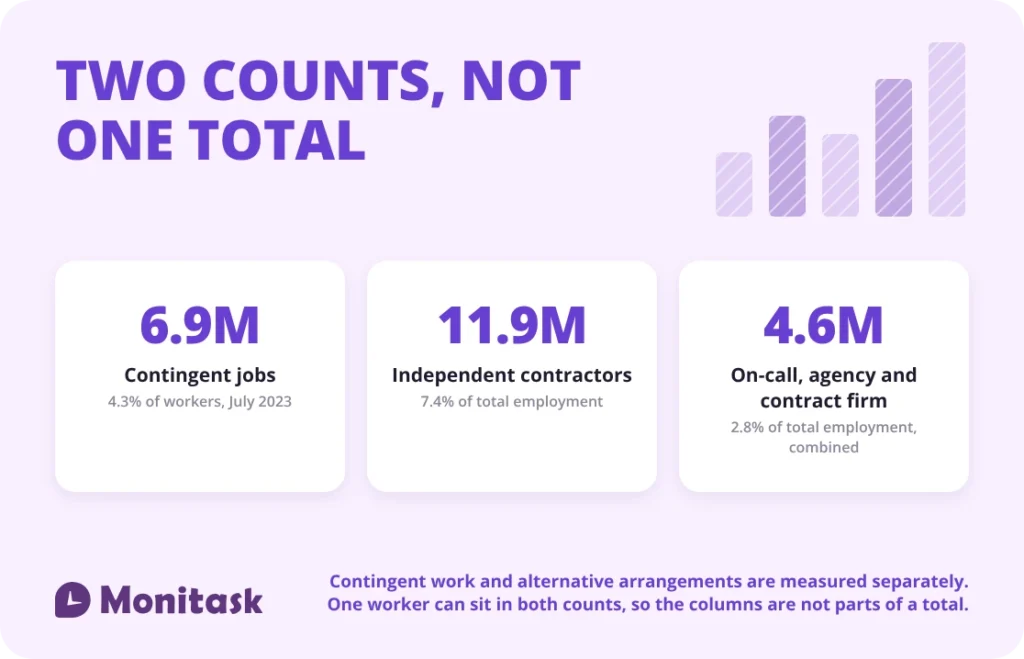
The only official US measurement is the Bureau of Labor Statistics’ Contingent and Alternative Employment Arrangements survey. Its most recent release, USDL-24-2267, came out on 8 November 2024 and covers July 2023. It puts 4.3 percent of workers — 6.9 million people — in contingent jobs on their sole or main job.
The same release counts the alternative arrangements separately:
| Arrangement | Workers | Share of total employment |
|---|---|---|
| Independent contractors | 11.9 million | 7.4% |
| On-call workers | 2.8 million | 1.7% |
| Temporary help agency workers | 945,000 | 0.6% |
| Workers provided by contract firms | 862,000 | 0.5% |
These are two different measurements, and adding them together produces a number that means nothing. BLS is explicit that contingent work is a separate concept from alternative employment arrangements
: one describes an expectation — the worker does not expect the job to last — and the other describes a form of engagement. A worker can be in a contingent job and in an alternative arrangement at the same time, but this is not automatically the case
. A salaried employee on a two-month project is contingent but not in an alternative arrangement; a long-term independent contractor with steady work is the reverse. The release never publishes a combined figure, and neither should you.
Against the previous wave — release USDL-18-0942, published 7 June 2018, covering May 2017, when 3.8 percent of workers, 5.9 million people, held contingent jobs and there were 10.6 million independent contractors at 6.9 percent of total employment:
| Measure | May 2017 | July 2023 | Change |
|---|---|---|---|
| Contingent workers | 5.9m (3.8%) | 6.9m (4.3%) | +1.0m, +0.5 points |
| Independent contractors | 10.6m (6.9%) | 11.9m (7.4%) | +1.3m, +0.5 points |
Read that table with the caveat BLS attaches to it. The 2023 release says in terms that its data is not strictly comparable
with earlier years, because the July 2023 supplement questions were modified from questions used in earlier years
and the supplement was collected in July rather than in May. There is a second discontinuity the releases do not put side by side: in 2018 BLS published three estimates of contingency and used the widest for its headline — Estimate 3 is the broadest definition of contingent work
— while the 2023 release publishes a single contingent rate and no alternatives.
So the honest reading is narrow. Both measures sit about half a point of total employment higher than they did six years earlier, on surveys that are not strictly comparable. That is a long way from the transformation described in vendor surveys, which are typically forward-looking intentions rather than counts.
One caveat worth stating plainly: July 2023 is the most recent official data available, which makes it over three years old at the time of writing. There is no newer government count, and none is on the BLS release schedule.
What is contingent workforce management?
It is the set of processes that govern non-payroll labor: deciding when to use it, sourcing and contracting suppliers, setting and controlling rates, onboarding and offboarding, approving hours and invoices, and keeping classification defensible. Where the workers are also remote, it overlaps heavily with remote contractor management.
In practice it sits across four functions, which is why it tends to be done badly:
| Function | What it owns |
|---|---|
| Procurement | Supplier contracts, rate cards, competitive sourcing |
| HR | Policy, onboarding, access, conduct, offboarding |
| Legal | Classification, contract terms, co-employment exposure |
| Finance | Budget, accruals, invoice approval, cost allocation |
When no single owner exists, the predictable failures are duplicate suppliers at different rates for the same skill, contractors who retain system access months after their engagement ends, and no reliable count of how many non-employees are working at any moment.
Who counts as contingent, and who does not?
The categories are not interchangeable, and the differences determine who is liable for what.
| Type | Engaged through | Paid by | Who sets the hours |
|---|---|---|---|
| Independent contractor | Direct contract with you | You, on invoice, and reported on Form 1099 | The contractor, in principle |
| Temporary agency worker | Staffing agency | The agency | Usually you, in practice |
| Contract firm worker | A firm delivering a service | The firm | The firm |
| On-call worker | Usually your own payroll | You | You, as needed |
| Consultant | Statement of work | You, on invoice or milestone | The consultant |
Two of these deserve attention. On-call workers are frequently your employees, not outside labor — BLS counts 2.8 million of them, and they appear in the alternative-arrangements table because of how they are scheduled, not because they sit outside payroll. And workers provided by contract firms are the firm’s workers delivering an outcome; the moment you start directing them individually, that distinction begins to erode.
How is worker status actually decided?
Not by the contract’s title, and not by what either side calls the arrangement. Two tests do most of the work in the United States, and both turn on control.
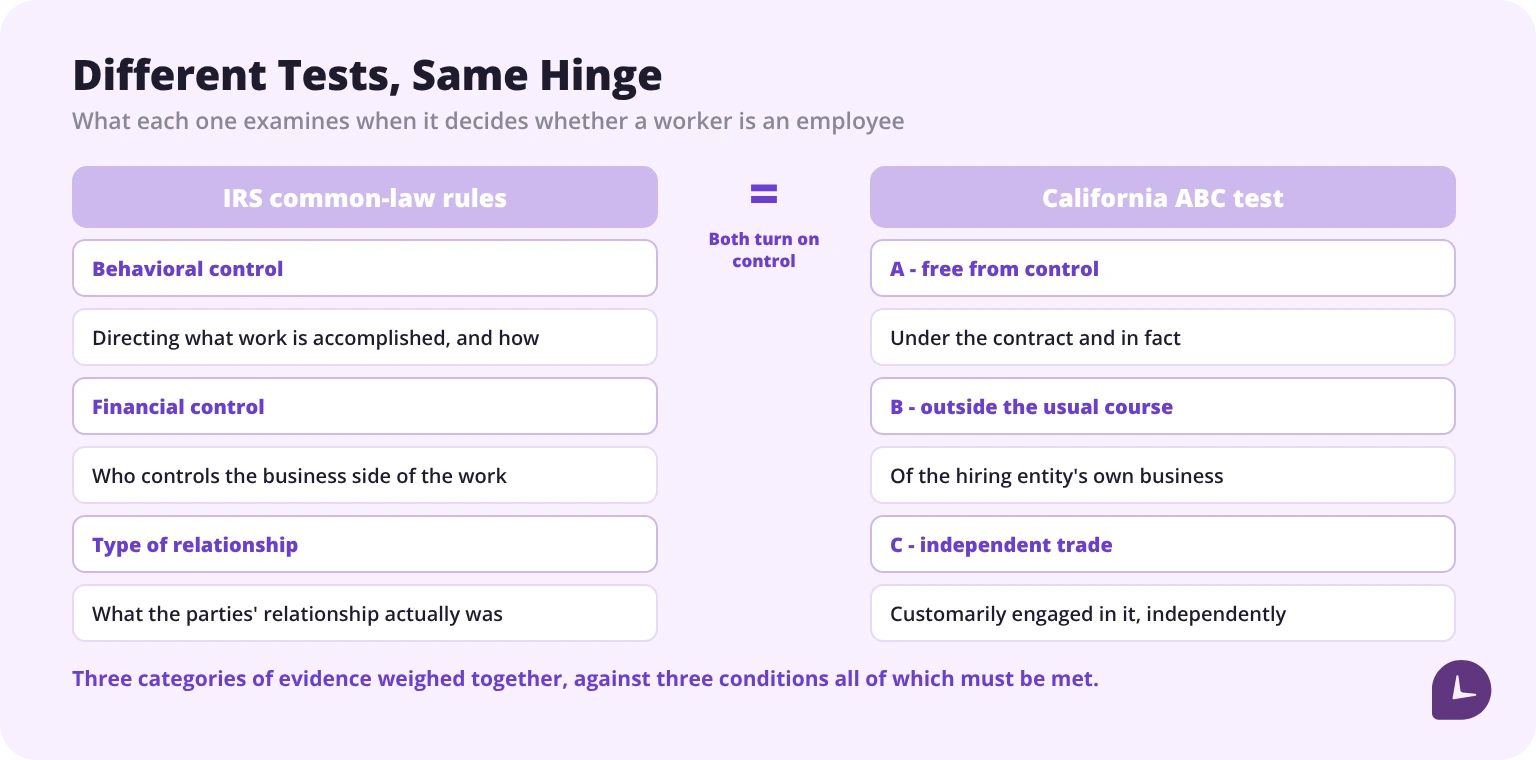
The federal tax test. The IRS applies common-law rules. Its guidance states that the usual common law rules are applicable
and that you should consider all evidence of the degree of control and independence in this relationship
. That evidence falls into three categories:
| Category | What it examines |
|---|---|
| Behavioral control | Whether the business has a right to direct and control what work is accomplished |
| Financial control | Whether the business controls the financial and business aspects of the work |
| Relationship of the parties | What kind of relationship the parties actually had |
The IRS is equally explicit that this does not reduce to a tally. Its own guidance says there is no one factor that settles it and no set number of factors that makes someone an employee, and that the keys are to look at the entire relationship and at the extent of the right to direct and control the worker. There is no threshold score, which is why a job classification decision has to be documented rather than calculated.
A stricter state test. California applies the ABC test, codified at California Labor Code § 2775(b)(1). A hiring entity must satisfy all three conditions, and failing any one of them makes the worker an employee:
| The condition | |
|---|---|
| A | The person is free from the control and direction of the hiring entityin connection with the performance of the work, both under the contract for the performance of the work and in fact |
| B | The person performs work that is outside the usual course of the hiring entity’s business |
| C | The person is customarily engaged in an independently established trade, occupation, or businessof the same nature as the work performed |
The ABC test is California law rather than a national standard: by its own terms it applies for the purposes of the Labor Code, the Unemployment Insurance Code and the wage orders of the Industrial Welfare Commission. Nine sections of exemptions sit behind it, at §§ 2776 to 2784, covering business-to-business contracting, fifteen categories of professional services and ten named occupations; where an exemption applies, status is decided under the older Borello factors instead. Other states apply their own tests.
The citation is worth getting right, because it has moved. AB 5 (2019) enacted the ABC test as Labor Code § 2750.3; AB 2257 (Stats. 2020, ch. 38) repealed that section outright and re-enacted the test at § 2775, effective 4 September 2020. A compliance page still citing § 2750.3 is citing law that has not existed since then.
And federally? Unsettled, in a specific way worth naming rather than hand-waving at. The Department of Labor’s 2024 independent-contractor regulation, 29 CFR part 795, is still on the books, and the Department’s own enforcement bulletin says it remains in effect for purposes of private litigation
while the Wage and Hour Division has stopped applying it in its own investigations. The Department published a proposed rescission on 27 February 2026, whose comment period closed on 28 April 2026 with no final rule. Nothing has been struck down; the rule simply runs on two tracks at once, which is why a classification decided on the strength of the current federal regulation alone may not look the same next year.
For the detailed criteria and a worked comparison, see our independent contractor vs employee checklist.
Does tracking a contractor’s hours put their status at risk?
It can, and the part that matters is not the one most guides warn about.
Start with what the tests actually examine. The IRS’s behavioral-control category asks whether the business has a right to direct and control what work is accomplished
, and the agency’s published list of employee-type instructions covers when, where, and how to work
, what tools to use, what order or sequence to follow, and who may do the work. California’s condition (A) requires the worker to be free from control and direction both under the contract for the performance of the work and in fact
. That last phrase is the one that does the work. California’s labor regulator reads it to catch control exercised either as a matter of contract or in actual practice
, and says a hiring entity cannot unilaterally determine a worker’s status simply by assigning the worker the label
of independent contractor. A clean contract is necessary and it is not sufficient.
But the IRS also tells against the simplest version of this worry. Its plain-language guidance for workers states that instructions about time and place may be less important than directions on how the work is performed
. So a contractor who agrees to be available between nine and five has not thereby become an employee, and an article that treats a timesheet as a classification problem is overstating it.
What does carry weight is the second half — direction of the method. A monitoring setup designed for employees, pointed at a contractor, produces a documented record of exactly that: screenshots of how the work was done, activity scores against a standard you set, approval that turns on presence rather than on output. That is evidence about the details and means of performance, which is the heart of both tests.
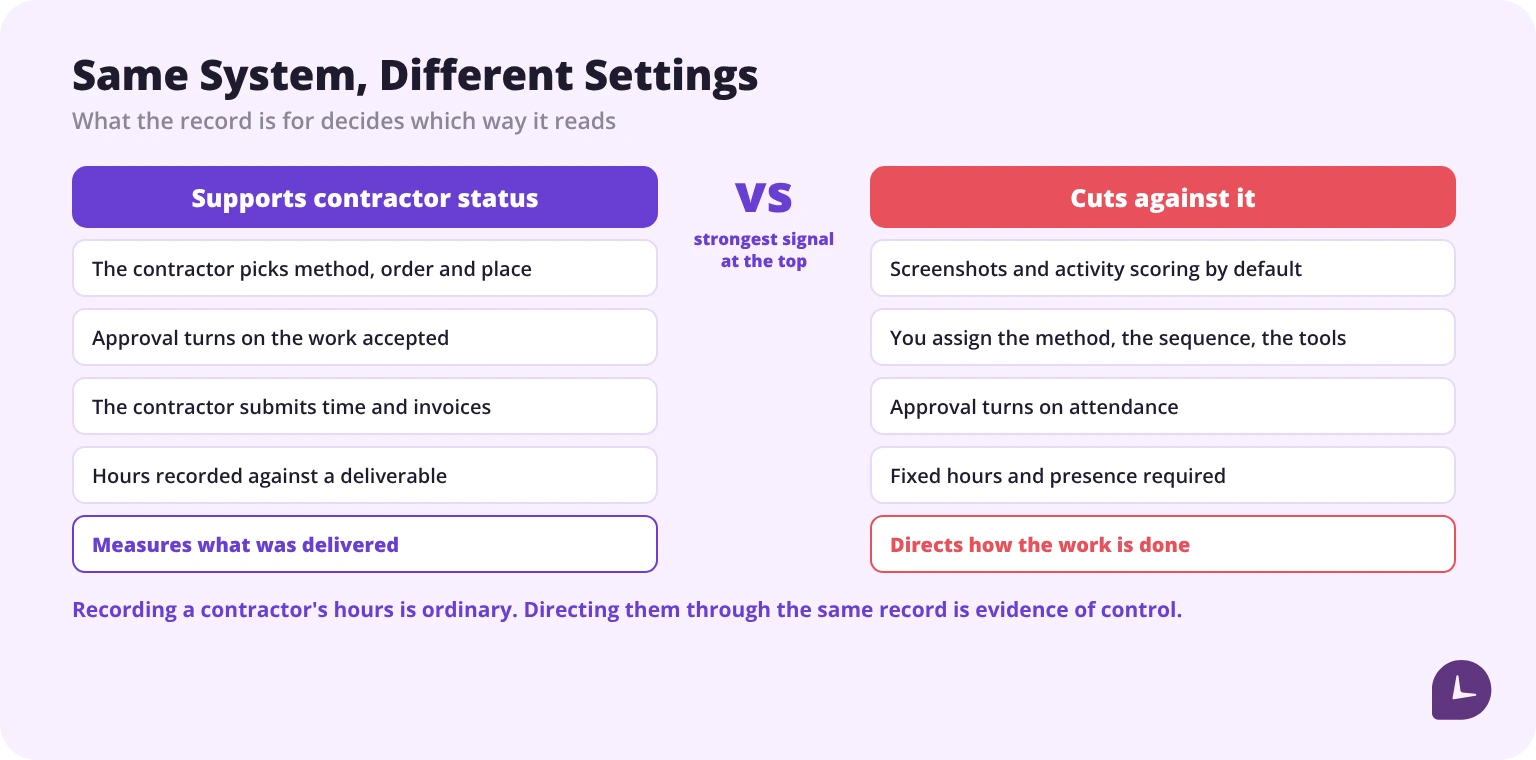
In practice the distinction looks like this, strongest signal first:
| Supports contractor status | Cuts against it |
|---|---|
| The contractor chooses method, sequence and place | You assign the method, the sequence and the tools |
| Approval turns on the work accepted | Screenshots and activity scoring applied by default |
| The contractor submits their own time and invoices | Approval turns on attendance |
| Hours recorded against a deliverable or statement of work | Fixed working hours and required presence |
| Agreed deadlines and milestones | Real-time supervision of how the work is done |
None of this means you cannot record a contractor’s hours. Hours are how most contractors bill, and you need defensible records for invoice approval, project costing and audit — the same records that govern how to pay independent contractors without creating a dispute later. The question is what the record is for: measuring what was delivered and billed, or directing how someone works. The first is procurement hygiene; the second is an argument that they are your employee.
The practical rule: use the same system for your employees and your contractors if you like, but not the same settings. That is the difference between contractor time tracking and employee monitoring, and it is a configuration decision rather than a software decision.
What is co-employment?
Co-employment is the situation where a worker is engaged through one organization — typically a staffing agency — while another organization directs their day-to-day work. It is the standard arrangement for agency labor, and in itself it is not a problem; it is how the model functions.
The exposure arises when the second organization behaves enough like an employer that it may be treated as one for some purpose — wage and hour obligations, discrimination claims, collective bargaining, benefits eligibility. Different agencies and statutes assess this differently, and the controlling standards have changed repeatedly in recent years, so a current rule stated here would likely be out of date by the time you act on it.
What does not change is the nature of the inquiry: it looks at the facts of the relationship rather than its paperwork. Practical measures that reduce exposure without changing what the agency worker actually does:
- Direct the work through the agency’s supervisor rather than yours, where the model allows
- Keep performance management, discipline and pay decisions with the agency
- Avoid extending employee benefits, employee handbooks and internal performance cycles to agency staff
- Set engagement end dates and honour them, rather than letting an assignment run for years
- Keep agency workers out of systems and communications that assume employment
Any decision here should be reviewed by employment counsel against your own facts and the states you operate in.
How do VMS and MSP models differ?
Both terms appear constantly in this field and are routinely used as if they were the same thing. They are not.
| VMS (vendor management system) | MSP (managed service provider) | |
|---|---|---|
| What it is | Software | An outsourced service |
| Who operates it | Your team | A third-party provider |
| Typical scope | Requisitions, supplier submissions, rates, timesheets, invoices, reporting | Running the whole program: supplier management, sourcing, compliance, often on top of a VMS |
| What stays with you | All decisions and program management | Governance, budget, final approvals |
| Fits when | You have the internal capacity and want control and visibility | Volume is high or spread across countries and you lack the team |
| Main risk | A system nobody owns becomes a system nobody uses | Distance from your own supplier relationships and data |
They are frequently combined: an MSP running a program on a VMS platform. For a small program — a few dozen contractors with a handful of suppliers — both are usually premature, and the real need is a single system of record for hours and approvals plus a written policy.
What should a contingent workforce policy contain?
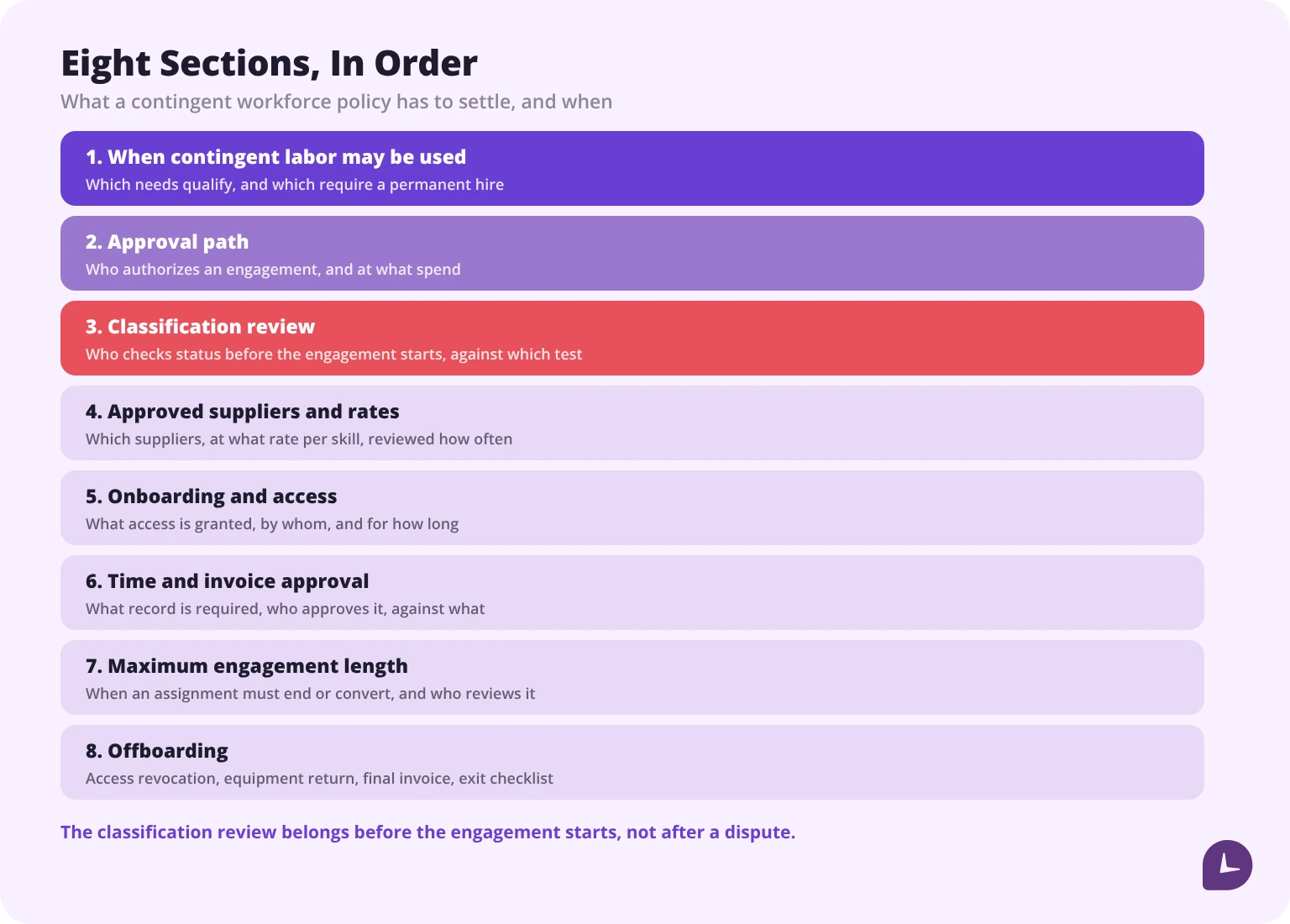
Eight sections cover what matters. Anything shorter leaves the decisions to whoever is hiring that week.
| Section | The question it settles |
|---|---|
| When contingent labor may be used | Which needs qualify, and which require a permanent hire |
| Approval path | Who authorizes an engagement, and at what spend |
| Classification review | Who checks status before the engagement starts, against which test |
| Approved suppliers and rates | Which suppliers, at what rate per skill, reviewed how often |
| Onboarding and access | What access is granted, by whom, and for how long |
| Time and invoice approval | What record is required, who approves it, against what |
| Maximum engagement length | When an assignment must end or convert, and who reviews it |
| Offboarding | Access revocation, equipment return, final invoice, exit checklist |
The two most often missing are the classification review before the engagement starts, and a maximum engagement length. Those are the two that turn a contractor arrangement into a dispute years later.
What the data does not tell you
Three limits worth stating.
The official count is a snapshot of a reference month. BLS measured July 2023 and published 16 months later. It tells you the scale of the phenomenon, not whether your own mix is growing.
Vendor surveys measure intentions, not behavior. Figures of the form “65% of companies plan to increase contingent labor” describe what respondents said they expected to do. They are not counts, and they are frequently quoted without a date attached.
Classification cannot be settled by a rule of thumb. Both tests weigh the whole relationship, and neither produces a score. A worker can satisfy some factors and fail on the ones that matter in their jurisdiction.
One system of record for contingent hours, with per-worker settings so a contractor's record proves delivery instead of documenting control.
See how Monitask handles agency and contract labor
This article explains how contingent workforce arrangements are measured and which legal tests apply to worker status. It is not legal or tax advice, and it does not tell you how any particular worker should be classified — that depends on facts specific to the engagement and the jurisdiction. The federal and state standards governing joint employment and independent-contractor status have changed repeatedly in recent years. Consult employment counsel for your own situation; the IRS and the U.S. Department of Labor publish current guidance.
Sources
- U.S. Bureau of Labor Statistics, Contingent and Alternative Employment Arrangements — July 2023, release USDL-24-2267, published 8 November 2024. All July 2023 figures and the comparability caveat read at source. Verified 12 November 2026.
- U.S. Bureau of Labor Statistics, Contingent and Alternative Employment Arrangements — May 2017, release USDL-18-0942, published 7 June 2018. The May 2017 figures and the three-estimate framework read at source. Verified 12 November 2026.
- Internal Revenue Service, Topic no. 762, Independent contractor vs. employee. The common-law rules and the three categories of evidence quoted verbatim. Verified 12 November 2026.
- Internal Revenue Service, Independent contractor (self-employed) or employee? The whole-relationship rule and the absence of a set number of factors quoted verbatim. Verified 12 November 2026.
- Internal Revenue Service, Publication 15-A, Employer’s Supplemental Tax Guide (for use in 2026), and Publication 1779, Independent Contractor or Employee. The instruction list and the time-and-place qualification quoted verbatim. Verified 12 November 2026.
- California Labor Code § 2775(b)(1). The ABC test’s three conditions quoted verbatim. The official California legislative site blocks automated access, so the text was read on two independent mirrors that agree word for word and corroborated against the Department of Industrial Relations’ own guidance. Verified 12 November 2026.
FAQ
How many contingent workers are there in the US?
In July 2023, 4.3% of workers — 6.9 million people — held contingent jobs on their sole or main job, according to BLS release USDL-24-2267. Separately, the same survey counted 11.9 million independent contractors, 2.8 million on-call workers, 945,000 temporary help agency workers and 862,000 workers provided by contract firms. It is the most recent official count; the survey has not been run since.
Is a contingent worker the same as an independent contractor?
No. “Contingent” means the worker does not expect the job to last. “Independent contractor” is a form of engagement and a tax status. BLS measures the two as separate concepts and never combines them, so the counts should not be added: someone can be both, or neither.
What is the difference between a VMS and an MSP?
A VMS is software your own team runs to manage requisitions, suppliers, rates, timesheets and invoices. An MSP is a third party that runs the program for you, often using a VMS. They are complementary rather than alternatives, and a small program usually needs neither.
Can tracking hours make a contractor look like an employee?
Recording hours for billing is ordinary and does not, by itself, change anyone’s status — the IRS says instructions about time and place may matter less than directions on how the work is performed. What carries weight is direction of the method: screenshots, activity scoring against a standard you set, and approval that turns on presence rather than output. California’s ABC test asks whether the worker is free from control both under the contract for the performance of the work and in fact
, which is where an employee-grade monitoring configuration becomes a problem.
What is co-employment?
It is the situation where a worker is employed by one organization, usually a staffing agency, while another directs their daily work. It is normal for agency labor. The risk is that the directing organization may be treated as an employer for some purposes, which turns on the facts of the relationship rather than the contract, and is assessed differently by different agencies.