FTE Meaning: What Full-Time Equivalent Is, and the Two Ways to Calculate It

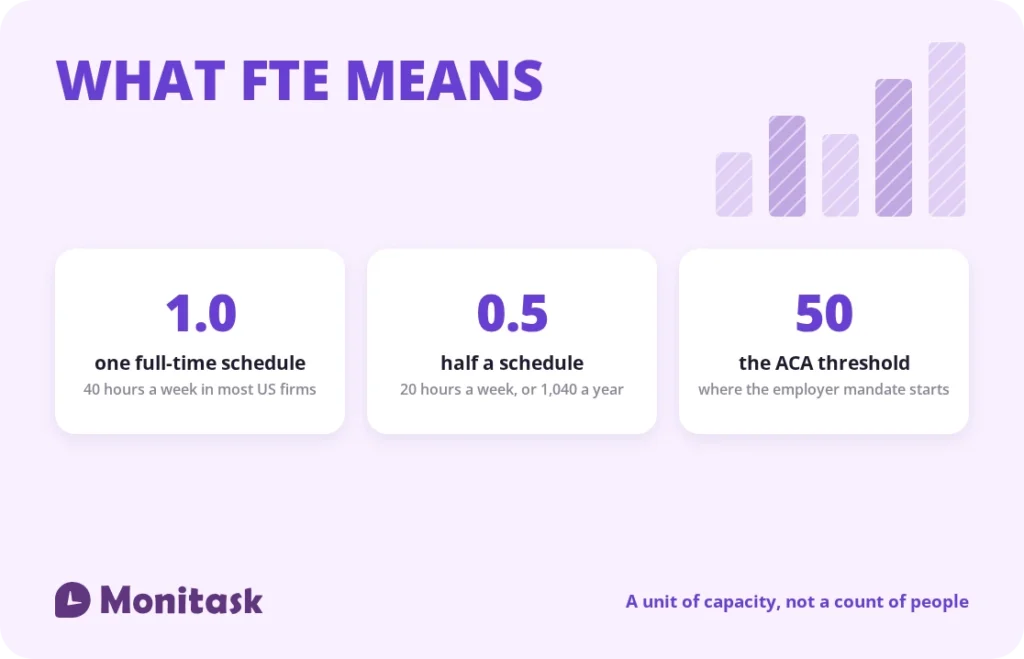
FTE stands for full-time equivalent. It is a unit of work capacity: 1.0 FTE is one person working a full-time schedule, and everything else is expressed as a fraction of that. Two people at 20 hours a week each come to 1.0 FTE in a company where full-time means 40.
The formula is one line:
FTE = total hours worked ÷ full-time hours for the same period
What complicates it is that the United States has two separate definitions in active use. The HR and finance definition is whatever your company treats as full-time, usually 40 hours. The Affordable Care Act definition is fixed at 30 hours a week, uses a different divisor, and decides whether you owe employees health coverage. Mixing them up is how businesses discover they crossed a compliance threshold a year after it happened.
FTE calculator
Convert hours into full-time equivalents. The HR figure and the ACA figure use different rules, so both are here.
Estimate for planning only. ALE status also depends on controlled group rules, seasonal worker exceptions and a twelve-month average. Not legal or tax advice.
Quick answer
| FTE stands for | Full-time equivalent |
| What it measures | Work capacity, expressed in full-time schedules |
| Formula | Total hours ÷ full-time hours for the period |
| 1.0 FTE | One full-time schedule, typically 40 hours a week or 2,080 a year |
| 0.5 FTE | Half a schedule, 20 hours a week |
| ACA full-time | 30 hours a week or 130 hours a month |
| ACA employer threshold | 50 full-time and full-time-equivalent employees |
What 0.5, 0.6 and 0.8 FTE mean in hours
The fraction only means something once you know the full-time baseline it is measured against.
| FTE | Hours per week (40-hour standard) | Hours per year | Hours per week (37.5-hour standard) |
|---|---|---|---|
| 1.0 | 40 | 2,080 | 37.5 |
| 0.9 | 36 | 1,872 | 33.75 |
| 0.8 | 32 | 1,664 | 30 |
| 0.75 | 30 | 1,560 | 28.1 |
| 0.6 | 24 | 1,248 | 22.5 |
| 0.5 | 20 | 1,040 | 18.75 |
| 0.4 | 16 | 832 | 15 |
| 0.25 | 10 | 520 | 9.4 |
Note the row worth flagging: 0.75 FTE on a 40-hour standard is 30 hours a week, which is full-time under the ACA. A role your organisation treats as three-quarters time is a full-time employee for health coverage purposes. That single mismatch causes more compliance surprises than any other part of this topic.
Annual figures use 2,080 hours, the standard 52 × 40 convention. Actual available hours are lower once holidays and leave come out, which our guide to work days in a year works through.
How to calculate FTE
For one person: divide their weekly hours by the full-time week.
30 ÷ 40 = 0.75 FTE
For a team: convert everyone, then add up.
Eight full-time staff plus five part-timers at 22 hours each:
- Full-time: 8 × 1.0 = 8.0
- Part-time: (5 × 22) ÷ 40 = 110 ÷ 40 = 2.75
- Total: 10.75 FTE
From annual hours: divide total hours worked by 2,080.
A team logging 109,000 hours in a year works out to 109,000 ÷ 2,080 = 52.4 FTE.
The annual method is the more honest one for planning, because it captures leave, unfilled vacancies and mid-year joiners that a snapshot of contracted hours misses.
FTE is not headcount
Headcount counts people. FTE counts capacity. They diverge as soon as anyone works less than full-time, and the gap decides whether a plan is realistic.
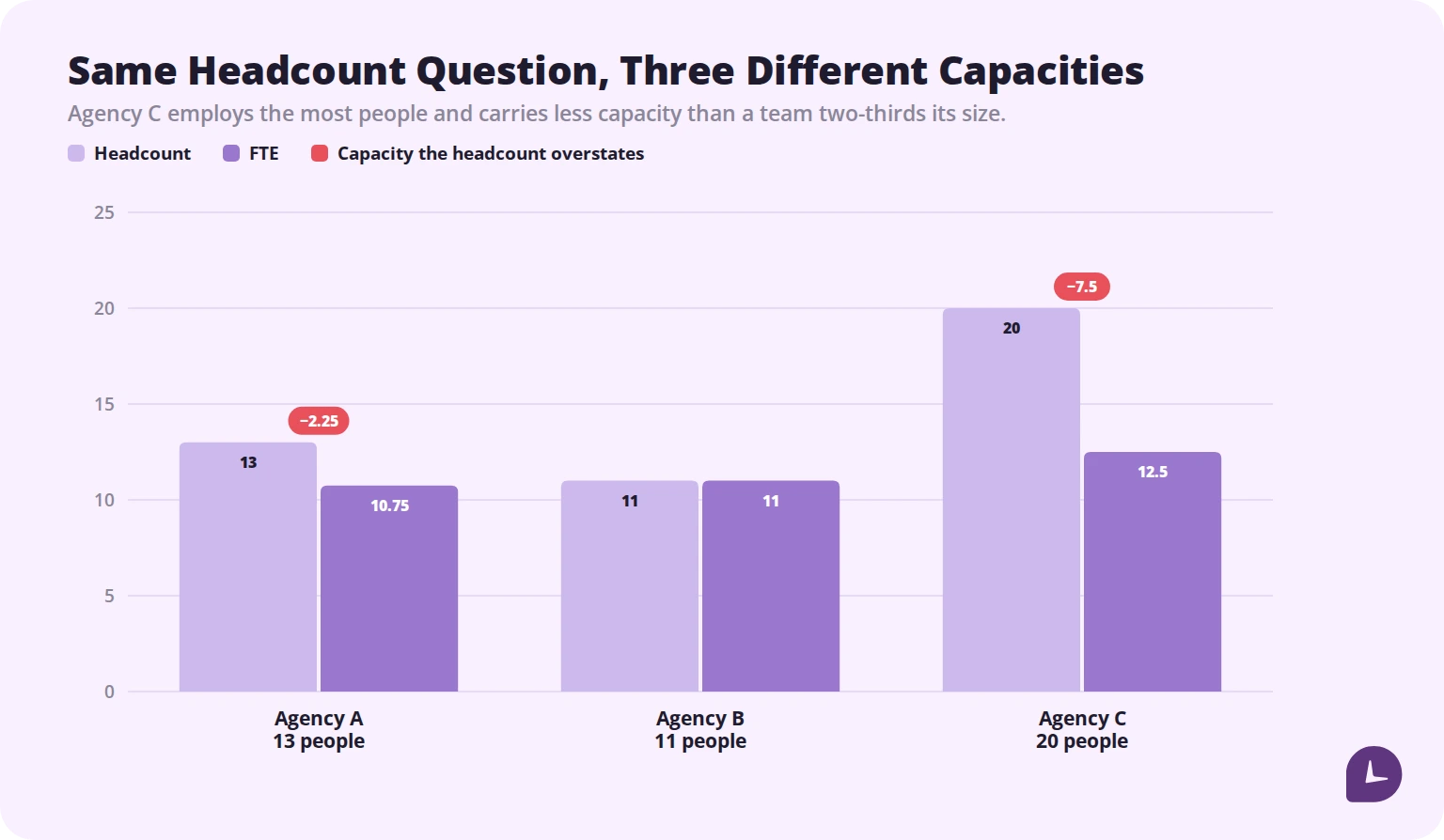
Thirteen people at 10.75 FTE and eleven people at 11.0 FTE are the same organisation on a payroll report and different organisations on a capacity plan. Budget against headcount and you overstate what the team can deliver. Report headcount to investors and you understate efficiency.
Use headcount for questions about people: retention, engagement, management span. Use FTE for questions about work: capacity, cost per unit of output, revenue per employee.
The ACA definition is a different calculation
This is where general FTE guidance stops being sufficient, because the Affordable Care Act does not use your company’s definition of full-time.
Under IRS rules, a full-time employee is anyone averaging at least 30 hours of service per week, or 130 hours in a calendar month. Employers with 50 or more full-time and full-time-equivalent employees are Applicable Large Employers and are subject to the employer shared responsibility provisions.
The FTE part of that count works differently from the HR calculation. The IRS method for each month is:
- Count the full-time employees, those at 30+ hours a week or 130+ a month.
- Add together the hours of every non-full-time employee, counting no more than 120 hours per person.
- Divide that total by 120.
- Add the two figures together.
Then average the twelve monthly totals. If the result reaches 50, you are an ALE for the following calendar year. So 2026 figures decide 2027 status.
Three details that catch people out:
The divisor is 120, not 130 and not 173. It is a fixed statutory number, unrelated to any real month’s hours.
Hours are capped per person. Anyone above 120 hours in the month is either full-time already or contributes only 120 to the pool.
Related companies are combined. Businesses under common ownership are generally treated as a single employer for the threshold, so three companies of 20 can be one ALE of 60.
Full-time equivalents count toward the threshold but do not themselves become eligible for coverage. The FTE figure decides whether the mandate applies; it does not decide who gets offered a plan.
Worked example: crossing the 50 threshold
An employer has 40 full-time employees and 20 part-timers averaging 60 hours a month each.
- Full-time: 40
- Part-time hours: 20 × 60 = 1,200
- Full-time equivalents: 1,200 ÷ 120 = 10
- Monthly total: 50
Forty employees on the payroll are treated as full-time, yet the business is an Applicable Large Employer. Nobody was hired, no schedule changed, and the mandate applies.
This is the IRS’s own worked example, and it is the reason a business should run this calculation before it feels large rather than after.
Boost your business productivity
Track performance and streamline teamwork
Where FTE gets used
Workforce planning. Capacity is expressed in FTE because that is the unit that maps to output. Hiring “two people” means nothing until you know whether they are 2.0 FTE or 1.2.
Budgeting. Labour cost per FTE is comparable across teams and periods. Cost per head is not, because it moves whenever the part-time mix changes.
Benchmarking. Revenue per FTE is the standard efficiency metric. Revenue per employee flatters companies that use part-time labour.
Grant and government reporting. Research funders and public agencies typically ask for effort in FTE, often as person-years.
Compliance thresholds. Beyond the ACA, various federal and state obligations use employee counts, and each specifies its own counting method. Never assume one threshold’s definition transfers to another.
When your full-time week is not 40 hours
Forty hours is the US convention, not a rule. Professional services firms often run 37.5 after unpaid lunch. Some European operations use 35.
Whatever the number, apply it consistently. An employee working 30 hours is 0.75 FTE on a 40-hour standard and 0.8 FTE on a 37.5-hour standard. Same person, same schedule, different figure. Document the baseline alongside every FTE number you publish, because the number is meaningless without it.
For compressed and rotating patterns the weekly figure can mislead. A 9/80 schedule delivers 80 hours a fortnight, which is 1.0 FTE averaged across the cycle but not in either individual week. Calculate these over the full rotation.
FTE for partial years and projects
FTE also expresses time as well as intensity, which matters for anyone reporting effort.
A full-time employee working six months of the year is 0.5 FTE for that year. Someone spending 30% of their time on a project is 0.3 FTE on it. UNESCO uses exactly this framing for research staff, treating one FTE as one person-year.
For project costing this is usually more useful than headcount. A project needing 480 hours over three months is 0.92 FTE, which tells you it needs one dedicated person rather than a share of several.
Common mistakes
Treating FTE and headcount as interchangeable. They answer different questions and will differ in any organisation with part-time staff.
Using the company’s full-time definition for ACA counting. The ACA uses 30 hours a week and a divisor of 120. Your internal standard is irrelevant to that calculation.
Forgetting the 120-hour cap. Including a part-timer’s full 150 hours inflates the count.
Ignoring aggregation rules. Commonly owned businesses are generally counted together for the ALE threshold.
Publishing an FTE figure without the baseline. 0.8 FTE means 32 hours or 30 hours depending on a fact the reader cannot see.
Assuming 0.75 FTE is part-time everywhere. At 30 hours a week it is full-time under the ACA.
Calculating from contracted hours rather than worked hours. Contracted hours describe intent. Capacity planning needs the hours actually delivered.
How Monitask helps
Every FTE calculation depends on an hours figure. If that figure comes from contracts rather than records, the result describes what was planned, not what happened.
Monitask records hours as they happen. Employees clock in when they start and clock out when they stop, so nothing runs in the background without their knowledge.

- Actual hours by person give an FTE figure based on delivered capacity rather than contracted intent.
- Monthly totals support the ACA calculation, which is run month by month and needs hours of service per employee.
- Project time tracking produces the fractional FTE figures that project costing and grant reporting ask for.
- Reports show how the part-time share of capacity moves over the year, which is what shifts an employer toward a compliance threshold.
See how it works: Monitask time tracking software.
Sources
- Internal Revenue Service, Determining if an employer is an applicable large employer — the 30-hour and 130-hour definitions, the 120-hour divisor and cap, and the worked example reproduced above.
- Internal Revenue Service, Publication 5208 — ALE determination in summary form.
- UNESCO Institute for Statistics, Full-time equivalent of R&D personnel — FTE as one person-year, and fractional effort on activities.
Related reading
- How Many Work Days in a Year?
- How Many Hours in a Month?
- Part-Time, Full-Time or Hourly: How to Decide When Hiring
- Understanding and Calculating Your Labor Costs
- The Importance of Proper Workforce Utilization
- Six Key Steps for Effective Strategic Workforce Planning
FAQ
How do you calculate FTE?
Divide total hours worked by the full-time hours for the same period. An employee at 30 hours a week against a 40-hour standard is 0.75 FTE.
What is 0.8 FTE in hours?
32 hours a week against a 40-hour standard, or 1,664 hours a year. Against a 37.5-hour standard it is 30 hours a week.
What is 0.6 FTE?
24 hours a week on a 40-hour standard, which is 1,248 hours a year.
What is 0.5 FTE?
Half a full-time schedule: 20 hours a week, or 1,040 hours a year on a 40-hour standard.
Is 0.75 FTE full-time?
Not by most companies’ definitions, but at 30 hours a week it is full-time under the Affordable Care Act, which sets the line at 30 hours or 130 hours a month.
What is the difference between FTE and headcount?
Headcount counts people; FTE counts capacity. Thirteen employees where five work part-time might be 10.75 FTE.
How is FTE calculated for the ACA?
Add the hours of all non-full-time employees for the month, counting no more than 120 per person, and divide by 120. Add that to the count of full-time employees, then average across twelve months.
How many FTE make an employer an ALE?
Fifty. An employer averaging 50 or more full-time and full-time-equivalent employees in a calendar year is an Applicable Large Employer for the following year.
How many hours is 1 FTE per year?
2,080 on the standard 52 Г— 40 convention. Actual available hours are lower once holidays and leave are deducted.
Can FTE be more than 1.0?
Not for an individual in standard usage; someone working 50 hours is still 1.0 FTE with 10 hours of overtime. Team and department totals are routinely well above 1.0.