How to Be Proactive at Work

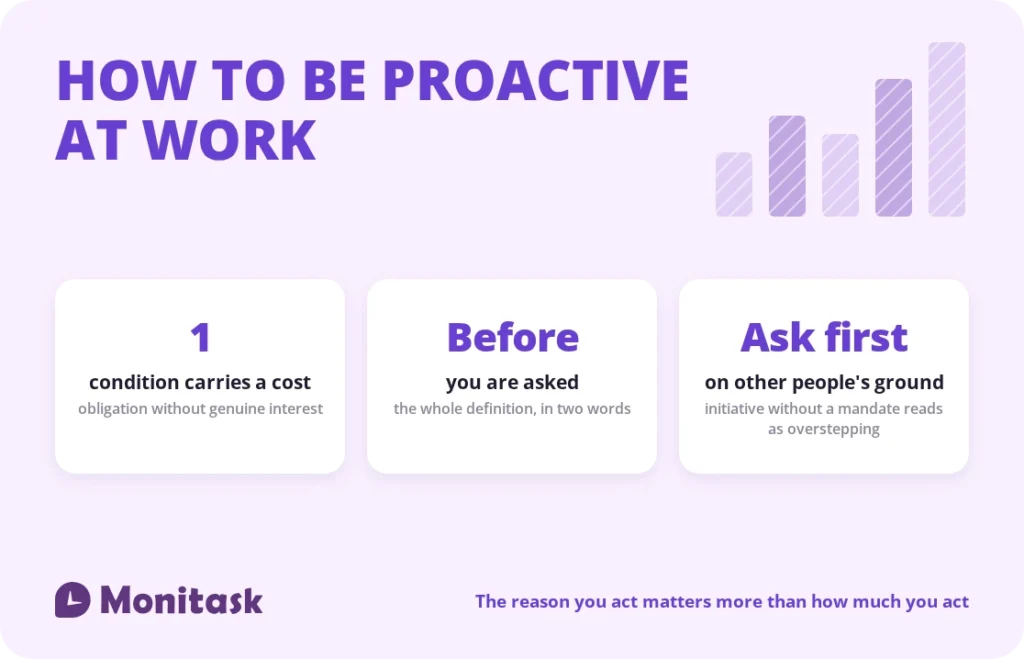
Being proactive means acting before you are asked: spotting the problem, flagging the risk, fixing the process nobody has complained about yet. It is consistently rewarded, and most advice on it stops there. The part usually left out is that proactivity has a cost, and whether you pay it depends less on how much you do than on why you are doing it. Twelve habits below, grouped by what they actually change, and then the honest version of the trade-off.
Key takeaways
- Proactive behaviour splits into three kinds: anticipating, initiating, and improving. Most people are naturally good at one.
- The habits that matter most are unglamorous — flagging problems early and asking questions before you are stuck.
- Research links proactivity to job strain in one specific condition: when it is driven by obligation without any genuine interest in the work.
- Initiative that ignores timing, framing or relationships is read as overstepping rather than ownership.
- Start with one habit. Twelve at once is the reactive way to become proactive.
Reliable employee tracking software. Clear visibility and insights into how employees work. Even remotely.
Try Now
Three Kinds of Proactive Behaviour
Grouping helps, because the twelve habits below are not variations of one thing.
- Anticipating — seeing what is coming and preparing for it. Risk-spotting, contingency planning, early warnings.
- Initiating — starting things nobody assigned. Volunteering, proposing, asking.
- Improving — making the existing work better. Fixing processes, closing gaps, removing friction.
Most people are naturally strong in one and weak in the others. Anticipators plan well and rarely propose. Initiators start things and do not always finish them. Improvers optimise the current job and miss the shift coming. Knowing which one you are tells you which section below to read twice.
Boost your business productivity
Track performance and streamline teamwork
Anticipating: Seeing It Before It Arrives
1. Flag problems while they are still small
The single highest-value proactive habit, and the least impressive-looking. Saying on Tuesday that a deadline is at risk costs one uncomfortable message. Saying it on Friday costs the team a week.
The mechanism: when you notice the sinking feeling that something will not land, that is the signal. Send the message then, while it feels premature. The instinct to wait until you are certain is the instinct that produces late news.
2. Ask questions before you are stuck
Confusion at the start is cheap. Confusion after three days of work is expensive, because you now have to undo the work as well as resolve the confusion.
Before starting anything unfamiliar, confirm three things in writing: what done looks like, when it is needed, and who decides. Most rework traces back to one of those three never being explicit.
3. Run a pre-mortem on anything that matters
Before the project starts, ask: it is three months from now and this failed — what happened? The question is more productive than “what are the risks”, because it assumes the failure and works backwards, which surfaces the things people are reluctant to name in a planning meeting.
Write down the top three answers and what you would do about each. That is a contingency plan, and it takes twenty minutes.
4. Watch what is changing outside your team
You cannot anticipate a shift you have not noticed. Give it thirty minutes a week: what customers are asking for that they were not last quarter, what competitors have shipped, what tools your function is starting to use. The purpose is not to be well-read. It is to be the person who says “this is coming” before it arrives.
Initiating: Starting Things Nobody Assigned
5. Volunteer selectively, not reflexively
Raising your hand builds a reputation quickly, and raising it for everything builds the wrong one. Volunteer for work that is visible, unfamiliar, or blocked — those three categories teach you something or make you valuable. Volunteering for work that is merely unwanted teaches you nothing and makes you the person who absorbs it.
6. Bring the option, not the problem
“This is not working” is a report. “This is not working, here are two options, I would pick the second” is a contribution. The difference costs you fifteen minutes of thinking and changes how the message lands entirely.
This is also the habit that most reliably gets someone included in decisions they were not previously part of.
7. Ask for feedback in a form people can answer
“Any feedback?” reliably produces “you’re doing great”. Ask something narrower: what is one thing I could do differently in these meetings? What would make this report more useful to you? Specific questions get specific answers, and the answers arrive months before an annual review would have delivered them.
8. Build relationships before you need them
Not networking — knowing what other teams are working on. Twenty minutes with someone from another function once a fortnight tells you where the dependencies and the friction are, which is most of what anticipating requires. It also means that when you need something, you are asking a person rather than an inbox.
Improving: Making the Existing Work Better
9. Fix the thing you do twice
Any task you have done manually more than twice is a candidate. Copying data between two tools, rebuilding the same report, re-explaining the same thing to each new person. Document it, then either automate it or write it down once so nobody has to ask again.
These improvements are unglamorous and compound, which is the opposite profile from most visible work. Deciding which ones to tackle first is the same problem as prioritising any other task.
10. Protect your own attention deliberately
Proactive work needs uninterrupted time, and uninterrupted time does not occur naturally. Identify the hours when you think best, block them, and defend them. Techniques like time blocking or the Pomodoro technique help, but the technique matters less than the decision to treat those hours as unavailable.
11. Plan tomorrow before today ends
Three priorities, written down, before you log off. It takes five minutes and removes the first hour of tomorrow, which is otherwise spent deciding what to do while feeling behind.
12. Review the week, not the day
Fifteen minutes on Friday: what worked, what did not, what changes next week. Daily review produces noise. Weekly review is where you notice you have spent three weeks on something that stopped mattering.
Boost your business productivity.
Start Your 10-Day Trial
The Part Most Advice Leaves Out
Everything above is worth doing. It is also worth knowing that proactivity is not free, because advice that pretends otherwise sends people toward overload.
When proactivity costs you
The research finding worth knowing: proactive behaviour was linked to higher job strain under one specific condition — when people were acting out of pressure and obligation without any genuine interest in the work. Where interest was present, the same amount of proactive behaviour showed no strain effect.
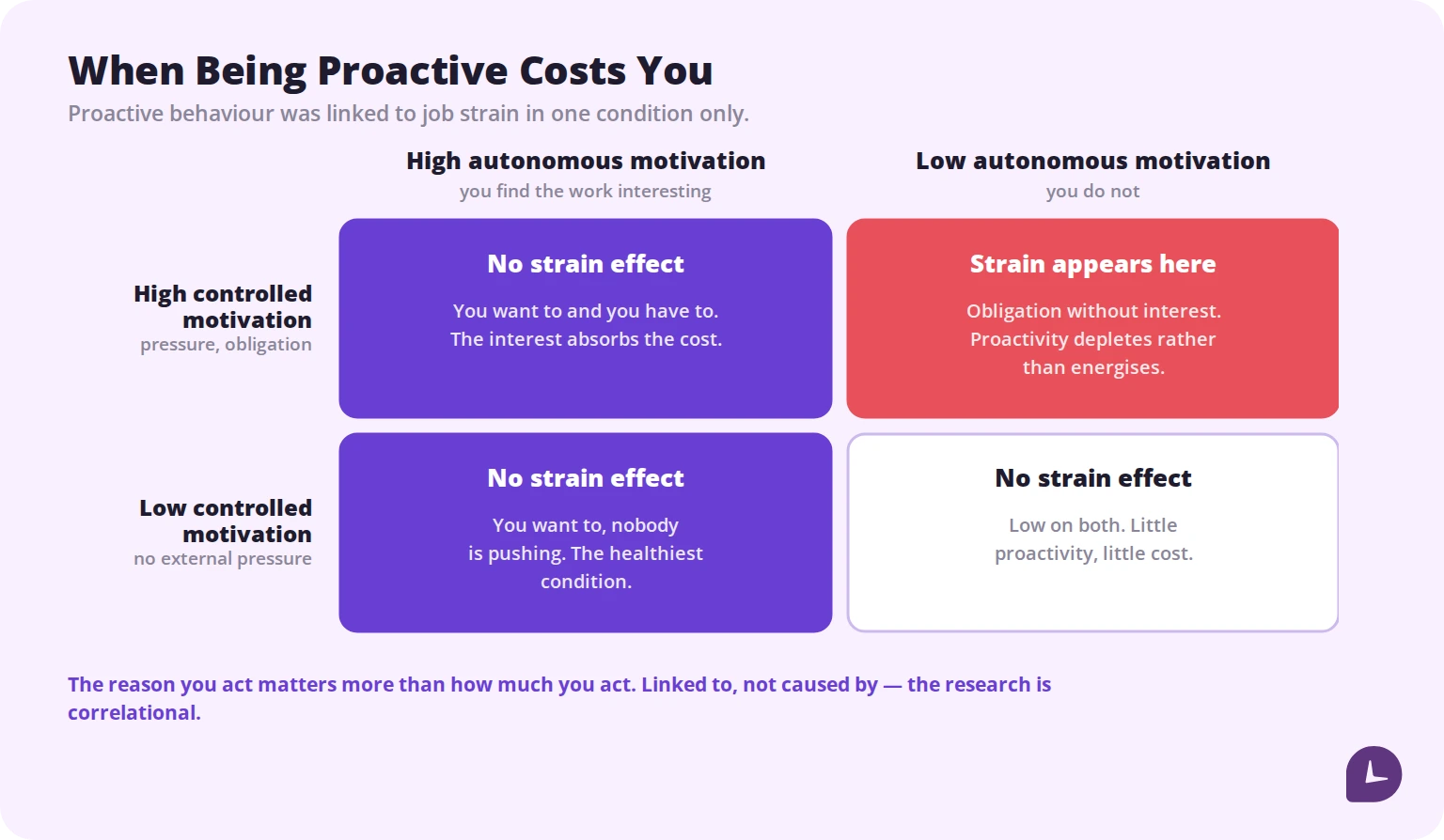
The practical translation is a question to ask yourself: am I doing this because it is interesting and worth doing, or because I am afraid of what happens if I do not? Both produce the same visible behaviour. Only one is sustainable.
A related finding is worth sitting with: proactive skill-building driven by financial fear was associated with burnout, and the effect was strongest among people who were most concerned with how their efforts were perceived. Proactivity performed for an audience is more depleting than the same work done for its own sake — one of the routes to burnout that looks like dedication from the outside.
When proactivity backfires
Initiative is not judged on its own merits. Whether it reads as ownership or as overstepping depends on timing, framing, and whether you have the standing to raise it. The same suggestion lands differently depending on who makes it and when — which is really a question of who owns the outcome.
Three ways it goes wrong in practice: taking charge of something that was already owned by someone who did not know you were doing it; raising a concern in a forum where it embarrasses whoever is responsible; and persisting after a decision has been made, which stops being initiative and becomes something else.
The fix is not to do less. It is to check two things before acting: does someone already own this, and is this the right room for it.
How to be proactive without taking on more work
The question in the FAQ of most articles on this topic, usually answered evasively. The honest answer: some proactive behaviour adds work and some removes it, and you can choose.
Anticipating and improving generally reduce total work — early warnings prevent rework, fixed processes save repeated effort. Initiating generally adds it. If your workload is already at the limit, start with the first two categories and leave volunteering until there is room.
Where to Start
Twelve habits is a list to choose from, not a programme. Pick one, ideally from the kind of proactivity you are naturally weakest at, and run it for a month until it stops requiring attention. If you are not sure which kind that is, the self-management assessment covers the same ground from the other direction.
If you want a single recommendation: flag problems while they are still small. It costs almost nothing, it is the behaviour colleagues and managers notice most reliably, and unlike most items on this list it makes your week easier rather than fuller.
Key Takeaways
Proactivity is three different behaviours — anticipating, initiating, improving — and they have different costs. The ones that reduce your workload are worth building first. The ones that add to it are worth building deliberately, when there is capacity.
And check the motive occasionally. The same proactive week feels different depending on whether it came from interest or from fear, and only one of those is repeatable.
Seeing where your hours actually go makes the first two categories easier: you cannot protect focus time you have never measured, or fix the repeated task you have not noticed repeating. Monitask records it automatically. Try it on a 10-day free trial, no card required.
Reliable employee tracking software. Clear visibility and insights into how employees work. Even remotely.
Try Monitask free for 10 days
FAQ: How to Be Proactive at Work
Does being proactive mean taking on more work?
Only one of the three kinds does. Anticipating and improving usually reduce total workload by preventing rework and repeated effort. Initiating — volunteering, proposing new things — adds to it. If you are already at capacity, start with the first two.
Can being too proactive be a problem?
Yes, in two ways. Initiative that ignores existing ownership or the right forum reads as overstepping. And proactivity driven by pressure rather than interest has been linked to strain and burnout, particularly when it is performed for recognition.
How do I start being proactive if I am already overwhelmed?
Pick the habit that removes work rather than adding it. Flagging problems early is the strongest candidate: it costs one message and prevents days of rework.
How do I show initiative without overstepping?
Check whether someone already owns the thing, raise it in a forum where it does not embarrass whoever is responsible, and commit once a decision is made rather than continuing to argue it.
Is proactivity different when working remotely?
The behaviours are the same but the visibility changes. Nobody notices you are stuck, and nothing surfaces by accident, so flagging early and asking questions in writing matter considerably more than they do in an office.