How to Call Out of Work: What to Say, When to Say It, and What You’re Owed

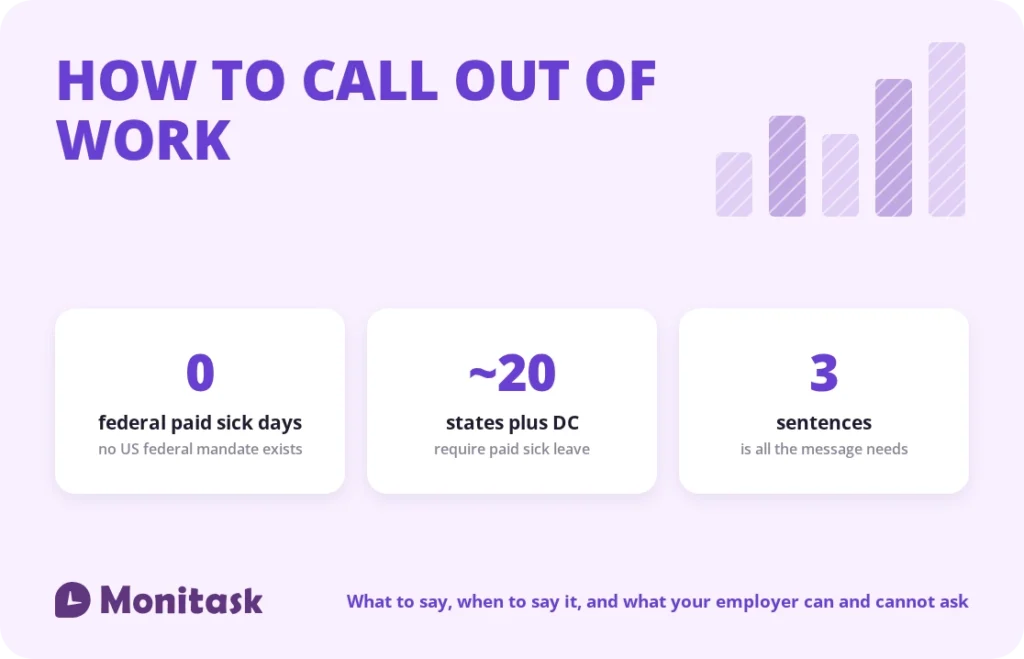
Calling out of work takes three sentences: you are not able to work, roughly how long you expect to be out, and anything urgent that needs handing over. You do not owe your employer a symptom list, and you do not need to apologise.
What most articles on this leave out is the half that actually matters. The United States has no federal paid sick leave requirement for private-sector workers. Around twenty states and the District of Columbia have their own, and in several of them your employer cannot demand a doctor’s note for a short absence or make you find your own cover. Whether your day off is paid, and what you can be asked to justify, depends almost entirely on where you work.
What to say
Three elements, nothing more.
- That you cannot work today. Not that you are “feeling a bit off” and might try to come in later. Ambiguity leaves your manager unable to plan.
- How long you expect to be out. Even a rough estimate. “Today” or “today and probably tomorrow” is enough.
- What is urgent. The one meeting that needs moving, the one handover that cannot wait.
Leave out symptoms, apologies and justification. A manager needs to know whether to fill your shift, not what your temperature is.
When to send it
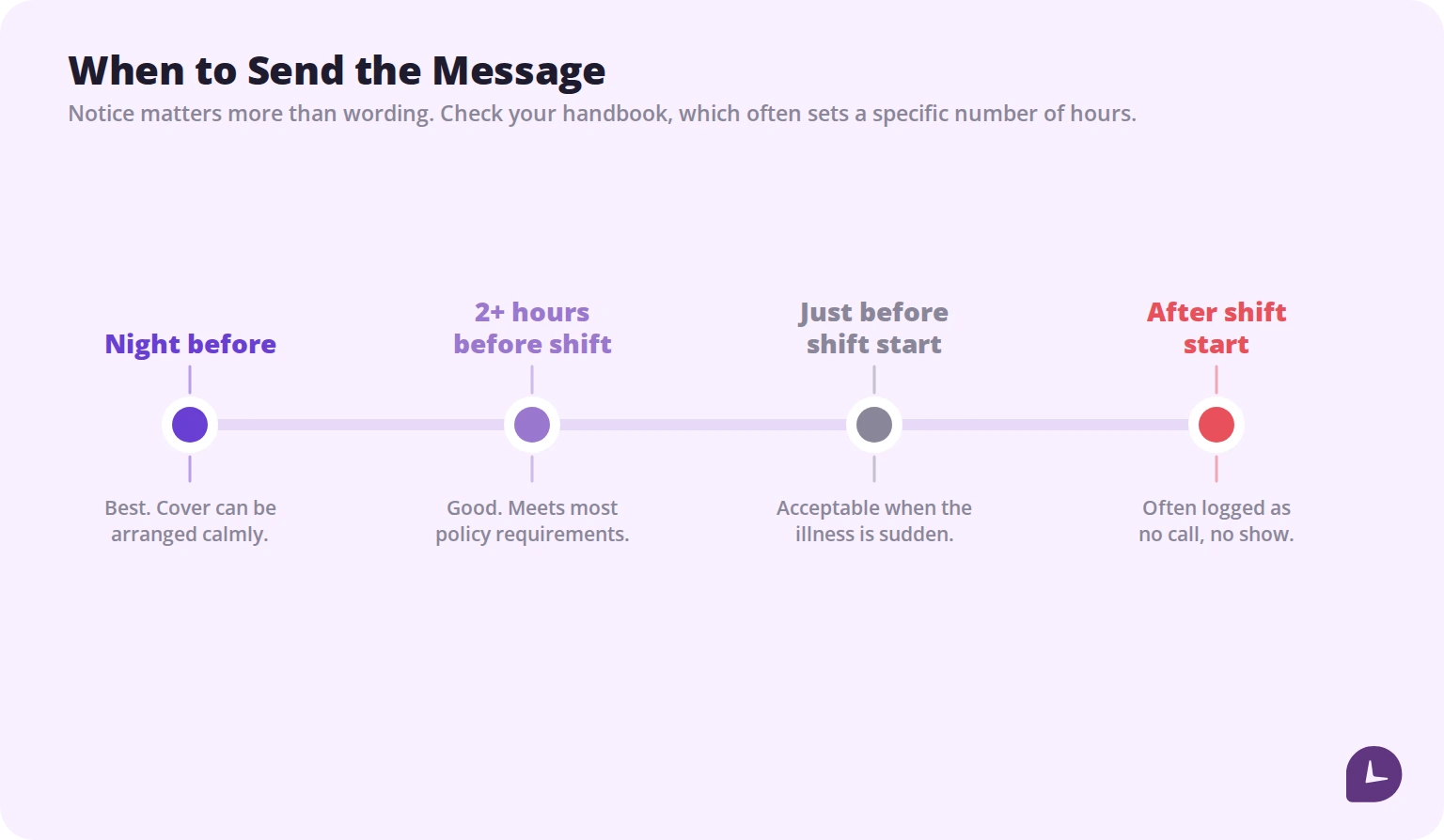
Notice matters more than wording. A message at 6am for a 9am start gives a manager three hours to rearrange. The same message at 9:15 gives them nothing, and in many workplaces it is logged as a no call, no show regardless of the reason.
If you know the night before, say so the night before. It costs you nothing and it is the single thing managers most consistently say they value.
Check your handbook for the specific rule. Many employers require notice a set number of hours before shift start, often one or two, and shift-based workplaces tend to require more.
Which channel to use
Use the method your workplace actually uses. If your manager communicates by text, text is fine. If the policy says phone, call.
Two rules hold everywhere. Tell your manager directly rather than asking a colleague to pass it on. And if you leave a voicemail or send a message outside working hours, follow up so you know it was received.
If your employer has a time-off system, log the absence there as well as messaging your manager. The message informs a person; the system creates the record that payroll and HR work from.
Message templates
Standard sick day, text or chat
> Hi [name] — I’m unwell and won’t be able to work today. I’ll keep you posted if I need tomorrow as well. The [client call] at 2 is the only thing that needs moving; I’ve flagged it to [colleague].
> Subject: Sick day — [your name], [date]
>
> Hi [name],
> I’m not well enough to work today and will be taking a sick day. I expect to be back tomorrow and will let you know by this evening if that changes. [Colleague] has what they need for the [deliverable]; nothing else is time-critical.
Multi-day absence
> Hi [name] — I saw a doctor this morning and I’ll need the rest of the week off. I’ll send an update on Thursday. Happy to hand over the [project] properly once I’m a bit more with it.
Mental health day
> Hi [name] — I’m not well and won’t be working today. I’ll be back tomorrow.
That last one is deliberately identical to a physical illness message. In most states with paid sick leave, mental health is a qualifying reason, and you are not required to distinguish.
Family care
> Hi [name] — [family member] is unwell and I need to be with them today. I won’t be online. I’ll let you know tonight about tomorrow.
Emergency
> Hi [name] — family emergency, I can’t come in today. I’ll update you when I know more.
What you do not have to explain
You do not need to name a diagnosis. You do not need to describe symptoms. You do not need to justify why this illness is serious enough.
Managers generally should not be asking either. Under the Americans with Disabilities Act, employers are limited in the medical inquiries they can make of employees, and a request for a diagnosis in response to a one-day absence is well outside normal practice.
Two practical notes. Whatever you say should be true, because being caught in a fabricated reason is a conduct issue rather than an attendance one. And if you have called out, stay off social media for the day; a beach photo posted from a sick day has ended employment before.
Are you paid for the day?
This is where geography decides everything.
There is no federal paid sick leave law covering private-sector employees in the US. Whether you are paid depends on state law, local ordinance, or your employer’s own policy.
Around twenty states plus the District of Columbia now mandate paid sick leave. Published counts vary between roughly 17 and 22 depending on the source, for three reasons worth understanding:
- Some counts include DC as a state, others list it separately.
- Some include jurisdictions where only certain cities are covered, such as Pennsylvania.
- Missouri’s voter-approved law was repealed effective August 28, 2025, so older articles still counting it are out of date.
Most of these laws share the same mechanics: leave accrues at one hour for every 30 hours worked, with an annual usage cap commonly between 24 and 72 hours depending on the state and employer size.
Three states, Illinois, Maine and Nevada, have gone further and require paid leave usable for any reason. In those states you do not have to be sick, and you do not have to explain.
The rule that catches remote workers out: sick leave law follows where you work, not where the company is based. A Texas company with an employee working from California owes California sick leave.
Check your own state rather than assuming. This is general information, not legal advice, and the details vary considerably.
What your employer can and cannot require
Several state laws restrict what employers may demand for a short absence. The specifics vary, but three patterns recur.
Doctor’s notes for short absences are often restricted. California’s labour commissioner has taken the position that requiring documentation for an absence of three days or fewer is generally an unreasonable burden. A policy demanding a note for a single sick day can itself be a violation in some states, even where the employee happens to have one.
You usually cannot be required to find your own replacement. Several state sick leave laws expressly prohibit conditioning leave on the employee arranging cover. If your workplace insists you find someone to take your shift before you can call out, that practice is worth checking against your state’s law.
Retaliation is prohibited. State sick leave laws generally bar employers from disciplining, demoting or firing an employee for using protected leave, and many treat the use of leave as an event that cannot count against an attendance policy.
Where a workplace runs an attendance point system, protected sick leave generally cannot generate points. Systems that assign points regardless of the reason are a common source of claims.
When it is more than a day: FMLA
For a serious health condition, or to care for a family member with one, the Family and Medical Leave Act provides up to 12 weeks of unpaid, job-protected leave in a 12-month period.
FMLA does not make the leave paid. What it protects is your job and your health coverage while you are away.
It is not universal. It applies to employers with 50 or more employees within 75 miles, and to employees who have worked there at least 12 months and at least 1,250 hours in the preceding year.
On notice: if the need is foreseeable, such as a scheduled procedure, 30 days’ notice is expected. If it is not foreseeable, notice must be given as soon as practicable.
Separately, if an ongoing condition affects your ability to work, leave can sometimes be a reasonable accommodation under the ADA even where FMLA does not apply.
Boost your business productivity
Track performance and streamline teamwork
No call, no show
Failing to notify at all is a different category from calling out. Most employers treat a no call, no show as a disciplinary matter rather than an attendance one, and many policies treat two or three consecutive instances as job abandonment.
If something genuinely prevented you from making contact, say so as soon as you can and be specific about what happened. A late explanation is far better than none.
The reverse is worth knowing too: a message sent after your shift began may still be recorded as a no call, no show under some policies, even though you did make contact. Read the handbook before you need it.
Calling out for reasons other than illness
Sick leave in most states now covers more than your own illness. Common qualifying reasons include:
- Caring for a sick family member
- Medical and dental appointments, including preventive care
- Mental health needs
- Safe time relating to domestic violence, sexual assault or stalking
- In some states, bereavement, school closures or public health emergencies
Oregon added blood donation as a qualifying reason effective January 1, 2026. California added certain court-related purposes for crime victims from the same date.
For anything not covered by sick leave, such as a personal errand or a family event, ask for PTO in advance rather than calling out on the day. Different category, different conversation.
Common mistakes
Waiting to see how you feel. A 9:30 message helps nobody. Decide early.
Over-explaining. Detail invites follow-up questions you are not obliged to answer.
Asking a colleague to pass it on. Tell your manager directly.
Promising to be online anyway. If you are well enough to work, you are at work. If you are not, working badly through the day helps no one and slows recovery.
Assuming an unpaid day is normal. In around twenty states it may well not be.
Only messaging, never logging. The system record is what payroll uses.
For employers
An absence policy is easier to apply than to improvise. A few things make the difference:
Write the notice requirement down. How much notice, to whom, by what method. Most disputes come from unwritten expectations.
Do not require a note for short absences without checking state law. In several states that requirement is itself a violation.
Separate protected leave from attendance points. Sick leave used lawfully generally cannot count against an employee.
Track absences in a system, not in a manager’s inbox. Patterns are invisible when the record is scattered across text messages, and the record itself is what you rely on if a decision is ever challenged. Our guides to creating an attendance policy and managing absenteeism cover the rest.
Monitask records attendance as it happens, so absences and hours land in one place instead of being pieced together from texts at month end. See Monitask attendance tracking.
Sources
- US Department of Labor, Family and Medical Leave Act — 12 weeks of unpaid job-protected leave, eligibility and notice requirements.
- US Department of Labor, Wages and the Fair Labor Standards Act — confirmation that federal law sets no paid sick leave requirement for private employers.
- State paid sick leave statutes, which vary by jurisdiction. Missouri’s law was repealed effective August 28, 2025; Oregon and California expanded qualifying reasons effective January 1, 2026.
Related reading
- Creating an Employee Attendance Policy
- Attendance Point System: A Strategy for Managing Employee Absences
- What Is Absenteeism? How to Manage Absenteeism at Work
- Request Time Off
- The Ultimate Guide to Paid Time Off Policies
- Attendance Sheet Template
FAQ
What is a good excuse to call out of work?
Illness, caring for a sick family member, a medical appointment, a mental health need, or a family emergency are all standard reasons. In Illinois, Maine and Nevada, state law requires paid leave usable for any reason at all.
Do I have to say why I'm calling out?
You should say you are unwell or dealing with a family matter, but you do not need to give a diagnosis or describe symptoms.
How much notice do I need to give?
As much as possible. Many policies require one to two hours before shift start; shift-based workplaces often require more. Check your handbook, because a message sent after your shift begins can be recorded as a no call, no show.
Is it better to call, text or email?
Whichever your workplace normally uses. Tell your manager directly rather than asking a colleague to relay it.
Can my employer require a doctor's note for one day off?
Sometimes, but several states restrict it. California’s labour commissioner has treated requiring documentation for absences of three days or fewer as generally an unreasonable burden.
Can my employer make me find someone to cover my shift?
Several state sick leave laws expressly prohibit conditioning leave on the employee arranging their own replacement. Check your state.
Will I be paid for a sick day?
Only if state or local law requires it, or your employer’s policy provides it. There is no federal paid sick leave mandate for private-sector workers in the US.
Can I be fired for calling out sick?
Using legally protected sick leave is generally shielded from retaliation. Absences outside that protection may be treated under an attendance policy, and a no call, no show is usually a separate disciplinary matter.
Can I take a mental health day?
In most states with paid sick leave, mental health is a qualifying reason. You do not need to specify that the reason is mental rather than physical.