Swing Shift Hours: Schedules, Pay and How to Adjust

A swing shift covers the hours between the day and night shifts — typically starting somewhere between 2 and 4 in the afternoon and ending around midnight. It is also called the second shift or the afternoon shift. The exact hours vary by employer, and so does whether you rotate onto other shifts or stay on this one permanently.
If you have just been assigned to one, the questions that matter are practical: what pattern will my week follow, will I be paid extra, and what actually helps with sleep and seeing people. This guide answers those.
Key takeaways
- Most swing shifts run roughly 3 PM to 11 PM or 4 PM to midnight, eight hours plus a break.
- Whether you rotate matters more than the hours themselves. A fixed swing shift and a rotating one are very different jobs.
- Extra pay for evening hours is common but not legally required in the US. Check your offer or contract rather than assuming.
- The hardest part is usually not sleep, it is that your free hours do not overlap with anyone else’s.
- Overtime is calculated on hours worked in a week, not on which hours of the day you worked them.
What Hours Is a Swing Shift?
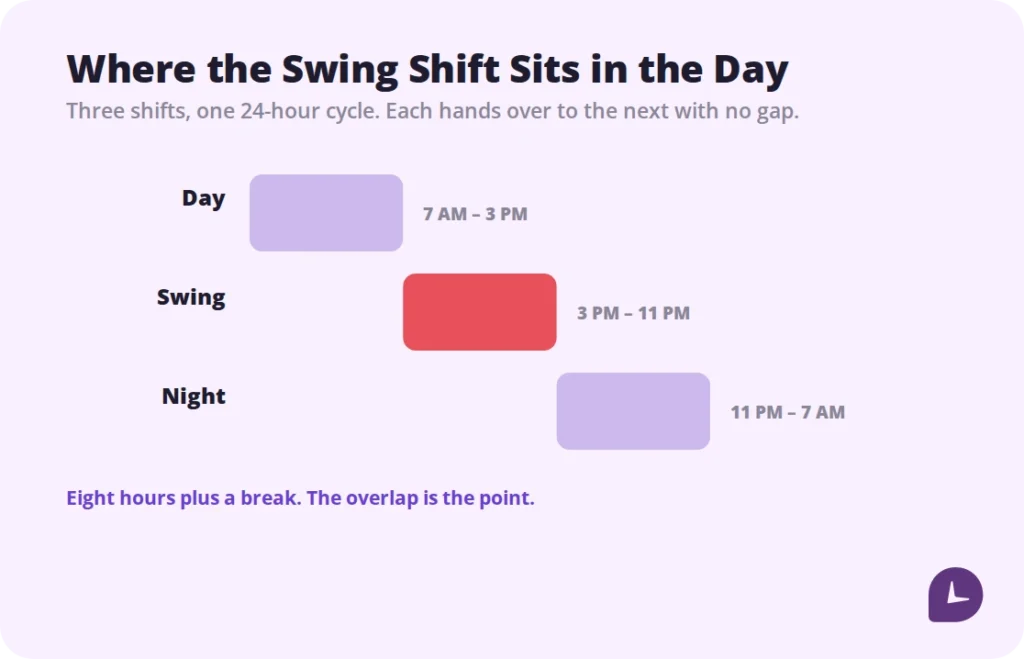
Most swing shifts start between 2 and 4 PM and finish between 11 PM and 1 AM — eight hours of work plus an unpaid break. The shift is designed to overlap briefly with the day shift at the start and the night shift at the end, so handovers happen without a gap in coverage.
| Shift | Typical hours | Also called |
|---|---|---|
| Day | 7 AM – 3 PM or 9 AM – 5 PM | First shift |
| Swing | 3 PM – 11 PM or 4 PM – 12 AM | Second shift, afternoon shift |
| Night | 11 PM – 7 AM | Third shift, graveyard shift |
The overlap is the reason swing shifts exist. In continuous operations — manufacturing, hospitals, logistics, support centres, security — the line cannot stop while one team leaves and another arrives.
Boost your business productivity
Track performance and streamline teamwork
The Part That Matters More Than the Hours: Do You Rotate?
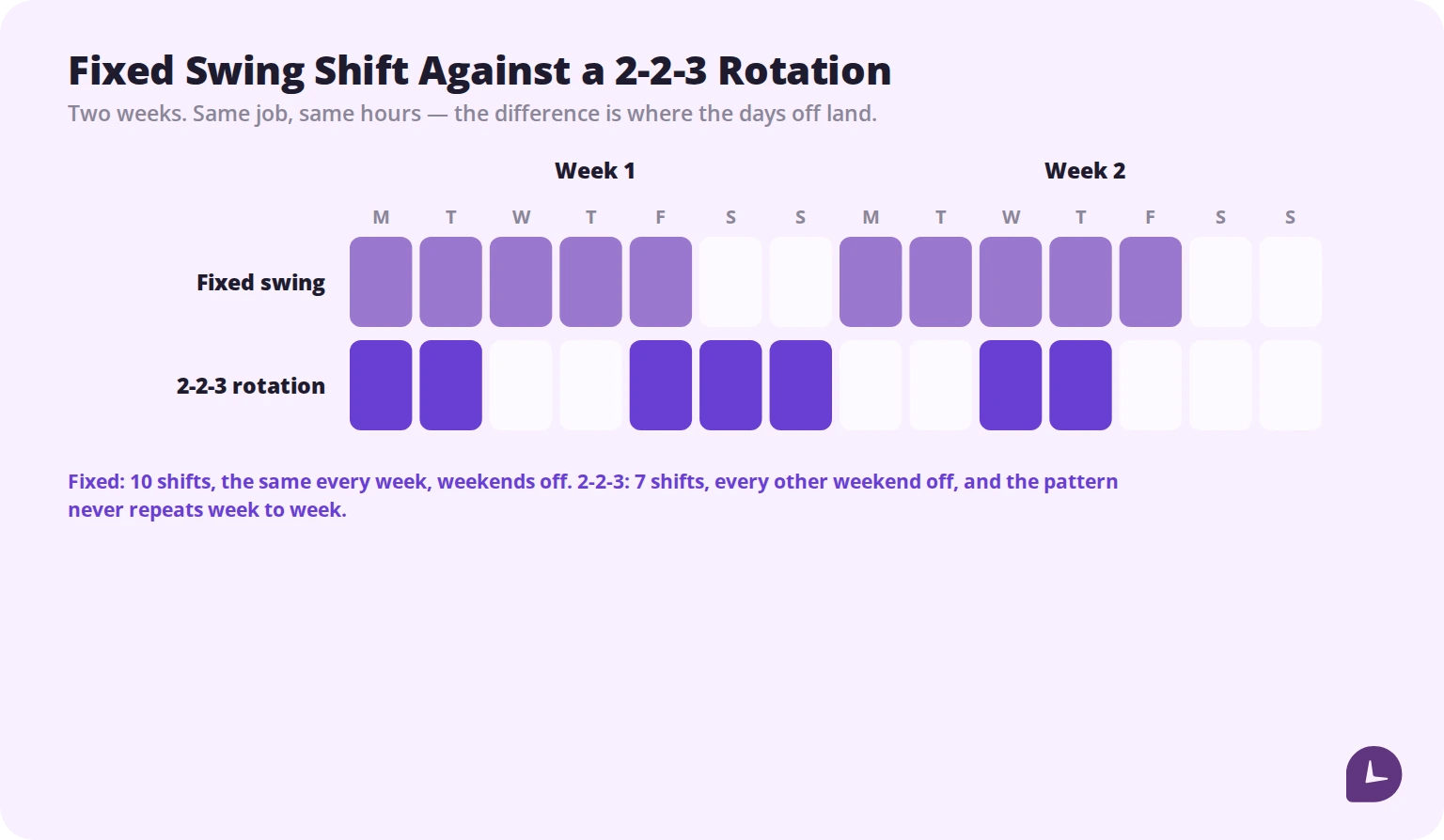
Whether your swing shift is fixed or part of a rotation changes almost everything about it. A fixed swing shift is a stable, if unusual, routine you can build a life around. A rotating schedule means your body and your calendar reset every few days.
| Pattern | How it runs | Days off | What it means for you |
|---|---|---|---|
| Fixed swing | Same evening hours every working day | Usually weekends or fixed days | Most predictable. Sleep settles within weeks |
| 2-2-3 (Panama) | 2 on, 2 off, 3 on, then reversed | Alternating, includes every other weekend | Long weekends every fortnight; the 3-day stretch is heavy |
| 4 on, 4 off | Four shifts, then four days off | Rotating through the week | Long recovery blocks, but days off drift across the week |
| Weekly rotation | A week of days, a week of swings, a week of nights | Varies with the cycle | Hardest on sleep; the body never fully adapts |
| Split coverage | Swing shift only on peak days | Irregular | Least predictable; hardest to plan around |
If you are being offered a role, this is the question to ask before the pay one. “Is this shift fixed or rotating, and if rotating, what is the cycle?” The answer tells you more about the job than the hourly rate does.
Do You Get Paid More for a Swing Shift?
Often, but not always — and in the United States it is not required. Federal law sets rules about minimum wage and overtime, not about which hours of the day are more valuable. A premium for evening or night hours, usually called a shift differential, is something an employer offers voluntarily or agrees to in a collective bargaining agreement.
That has two practical consequences. If the job posting does not mention a differential, do not assume there is one — ask before accepting. And if there is one, get it in writing, because a verbal promise about a premium is the kind of thing that changes quietly.
Where differentials do exist, they usually take one of two forms: a percentage added to the base hourly rate, or a flat amount per hour worked on the shift. Percentages are more common in larger organisations, flat amounts in smaller ones. Night shifts typically carry a higher differential than swing shifts, which is worth knowing if a rotation moves you between them.
On overtime: the calculation is based on hours worked in the workweek, not on which hours of the day they fell. Working until midnight does not by itself create overtime. Some states apply their own daily rules on top of the federal weekly one, so where you work matters. If you are working out what a year on this schedule adds up to, how many work hours are in a year covers the arithmetic.
> This article is general information, not legal advice. Pay rules vary by state, by industry and by contract. For your own situation, check your employment agreement and, if something looks wrong, speak to your state labour office or an employment attorney.
Get more out of your business.
Start Your 10-Day Trial
What Actually Gets Hard
The common assumption is that sleep is the problem. For most people on a fixed swing shift, sleep settles within a few weeks. What does not settle is that your free time and everyone else’s do not overlap.
- Mornings are yours, evenings are not. Appointments, errands and daytime tasks get easier. Dinners, evening events, children’s bedtimes and anything social after 6 PM get harder.
- Weekends may not be weekends. On rotating patterns, days off move through the week. A Tuesday and Wednesday off is real rest, but nobody else is free.
- Winding down takes longer than you think. Finishing at midnight does not mean sleeping at midnight. Most people need an hour or more before sleep is possible, which pushes bedtime toward 2 AM.
- Meals drift. Eating a main meal at 9 PM and then again after the shift is how the schedule quietly changes your habits.
- Rotation is the hard version. Moving between shifts every week means the body never settles into one pattern. If you have a choice between a fixed swing shift and a rotating one, the fixed one is easier by a wide margin — and it is worth knowing signs you are working too much when the rotation is heavy.
What Helps
- Keep the same sleep window on days off. The single most useful habit, and the hardest. Shifting back to a daytime schedule on your days off means re-adjusting every week.
- Control light deliberately. Bright light early in your waking hours, dim light in the hour before sleep. Blackout curtains matter more than they sound like they do.
- Give yourself a wind-down hour. Going straight from the end of a shift to bed rarely works. Plan the hour rather than losing it.
- Eat your main meal before the shift, not after it. A large meal at 1 AM makes sleep harder.
- Schedule the people, do not wait for gaps. Put family and friends into your days off in advance. On this schedule, unplanned social time does not happen, so planning your day in blocks is worth applying to days off as much as to work.
- Talk to a clinician if it is not settling. Persistent trouble sleeping after a few weeks on a stable schedule is worth a proper conversation rather than another article.
If You Are Scheduling Swing Shifts
A few things make the difference between a shift people stay on and one with constant turnover.
- Publish the rota well in advance and stop changing it. Short notice is the single most common complaint about shift work, ahead of the hours themselves. Accurate attendance tracking is what makes a published rota hold.
- Prefer fixed shifts to rotation where the operation allows it. Where rotation is unavoidable, rotate forward — days to swings to nights — rather than backwards.
- Leave real gaps between shifts. A late finish followed by an early start is a rota problem, not a personal resilience problem.
- Be explicit about the differential, in the offer and on the payslip. Ambiguity about premium pay does more damage than a modest premium.
- Keep the attendance record accurate and visible. Shift work generates disputes about hours more than any other schedule, and both sides should be able to see the same record. Clock-in and clock-out tracking produces that automatically, with the same view for the employee and the manager.
Key Takeaways
A swing shift usually runs from mid-afternoon to around midnight. Before the hours, find out whether it is fixed or rotating — that decides how liveable it is. Extra pay is common but not guaranteed by law in the US, so ask and get it in writing. And the real difficulty is rarely sleep; it is that your free hours do not line up with anyone else’s, which is a scheduling problem you can plan around once you name it.
Reliable employee tracking software. Clear visibility and insights into how employees work. Even remotely.
Try Monitask free for 10 days
Frequently Asked Questions
Is a swing shift the same as a second shift?
Yes. Swing shift, second shift and afternoon shift all describe the same block of hours between the day and night shifts. “Swing” is more common where schedules rotate, “second shift” in continuous manufacturing, but they refer to the same part of the day.
Do swing shifts pay more?
Often, but it is not required by US federal law. A premium for evening hours — a shift differential — is offered voluntarily by employers or agreed in a collective bargaining agreement. It is usually either a percentage on top of the base rate or a flat amount per hour, and night shifts generally carry a higher premium than swing shifts. If a posting does not mention one, ask before accepting.
Does working a swing shift create overtime?
Not by itself. Overtime under federal rules is based on hours worked in the workweek, not on which hours of the day they were worked. Finishing at midnight does not trigger it. Some states apply daily overtime rules in addition, so the answer depends on where you work.
Which is harder, a swing shift or a night shift?
Night shifts are generally harder on sleep, because they require being awake through the hours the body most strongly wants to sleep. A fixed swing shift is the more liveable of the two for most people. A rotation that moves you between both is harder than either one on its own.
How long does it take to adjust to a swing shift?
For a fixed schedule, most people find sleep settles within two to four weeks, provided the sleep window stays roughly the same on days off. Rotating schedules do not produce the same adjustment, because the pattern changes before the body adapts to it. If it is not settling after a stable month, that is worth discussing with a clinician.
What jobs commonly use swing shifts?
Manufacturing, healthcare, logistics and warehousing, hospitality, retail with extended hours, security, emergency services, and support or operations teams covering multiple time zones. The common factor is an operation that cannot stop at the end of a standard business day.
Can I ask to move off a swing shift?
Usually yes, though whether it is granted depends on coverage rather than on how reasonable the request is. Ask early, ask in writing, and be specific about which shift you want instead. If the reason relates to health or caring responsibilities, say so — that may change which policies apply.