

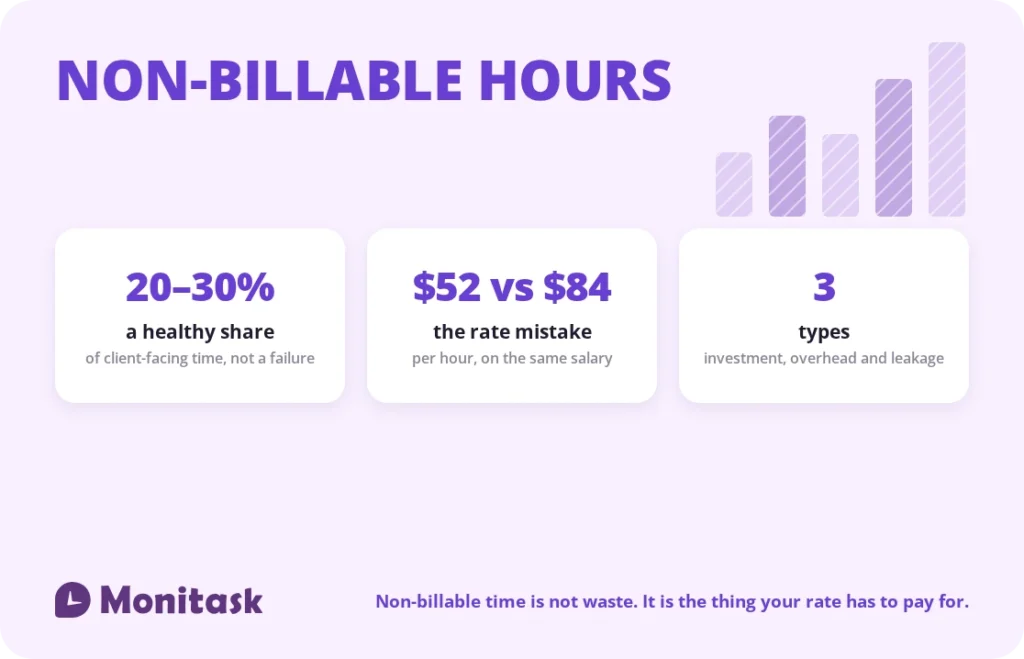

Non-billable hours are hours worked that cannot be charged to a client: internal meetings, admin, training, business development, proposals, and project overruns you chose not to invoice.
Every guide to this subject treats non-billable time as a problem to minimise. That framing causes two expensive errors. It leads firms to price as though non-billable time does not exist, which understates the break-even rate by around 60%. And it leads them to squeeze the non-billable work that generates next year’s revenue.
Non-billable hours come in three kinds, and only one of them should be reduced to zero.
Quick answer
| Question | Answer |
|---|---|
| What is non-billable time? | Hours worked that cannot be charged to a client |
| What is a healthy share? | 20–30% for client-facing roles |
| Typical utilisation | 55–65% at most firms; 70–80% at the best-run ones |
| Should it be zero? | No. Business development and training are non-billable and produce future revenue |
| Biggest hidden cost | Pricing off total hours instead of billable hours |
| What to track | Non-billable by category, not as a single number |
What counts as non-billable
The line has to be defined and written down, because ambiguity guarantees inconsistent logging and a utilisation number nobody can act on.
Usually billable: production work, client meetings, client calls and email, revisions inside scope, research specific to the engagement, travel where the contract allows it.
Usually non-billable: internal meetings, admin and timesheets, training and professional development, business development and pitching, proposal writing, recruitment, internal projects, tool setup, and overruns beyond agreed scope.
Genuinely contested, and worth deciding explicitly:
- Project management time. Billable in some contracts, absorbed in others. Decide per engagement rather than per firm.
- Onboarding a new client. Real work, often unbilled, and it is what makes the first month of any retainer unprofitable.
- Revisions past the agreed number. The most common form of silent non-billable time.
- Travel. Billable, billable at half rate, or not billable, depending on the contract. Write it in.
- Rework caused by your own error. Almost always non-billable, and worth tracking separately because it is a quality signal rather than an overhead one.
The test that works: could you defend this line on an invoice to this client? If yes it is billable, whether or not you choose to charge it.
The three types
This is the distinction the rest of the article depends on, and it is the one missing from every guide on the subject.
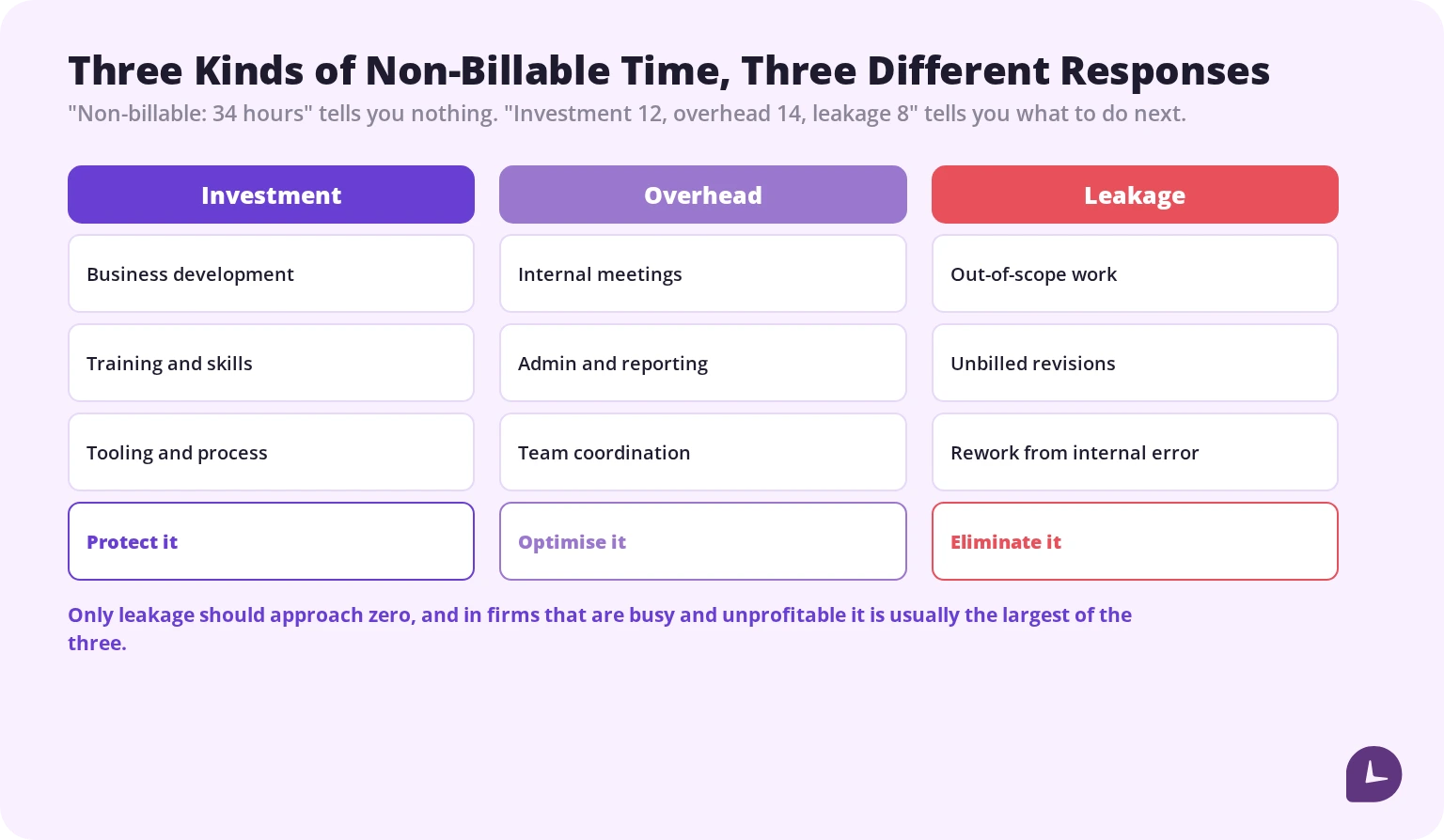
Investment. Business development, proposals, training, internal tooling, process improvement, thought leadership. Non-billable today, revenue-generating later. Reducing this is how a firm quietly stops growing — the pipeline dries up twelve months after the cut, by which point nobody connects the two.
Overhead. Internal meetings, admin, timesheets, reporting, recruitment. Necessary, and it should be as small as it can be without breaking. Optimise; do not eliminate.
Leakage. Out-of-scope work delivered for free, unbilled revisions, rework from internal error, time lost to unclear briefs, work on projects that were never properly scoped. This is the only category that should approach zero, and it is usually the largest of the three in firms that are busy and unprofitable.
Tracking “non-billable: 34 hours” tells you nothing. Tracking “investment 12, overhead 14, leakage 8” tells you exactly what to do next.
How much non-billable time is normal
Benchmarks vary by discipline, but the range is consistent.
| Measure | Typical | Well-run |
|---|---|---|
| Billable utilisation | 55–65% | 70–80% |
| Non-billable share, client-facing roles | 35–45% | 20–30% |
| Billable hours per month, full-time | 110–130 | 125–140 |
| Billable hours per year | 1,100–1,300 | 1,300–1,500 |
Two cautions on reading these.
Above 80% is a warning, not a win. A team at 90% utilisation has no capacity for business development, training or absorbing a problem. It looks maximally efficient and it is maximally fragile: the pipeline stops being fed while everyone is busy, and the plateau arrives a year later.
The figures are per role. A senior partner at 40% utilisation may be doing exactly the right job if the other 60% is winning work. A production designer at 40% has a problem. A single firm-wide target guarantees one of those two is being measured wrongly.
The pricing mistake
Here is the arithmetic that almost no article on non-billable time performs, and it is where the money actually is.
Take an employee on an $85,000 salary. With a 28% burden for payroll taxes, insurance and benefits, the true cost is $108,800. After holidays and typical leave they have roughly 1,840 available hours.
The intuitive rate calculation divides cost by available hours, or worse by 2,080:
$108,800 ÷ 2,080 = $52.31 an hour
That number is fiction, because they will not spend 2,080 hours on billable work. At a realistic 70% utilisation, they produce 1,288 billable hours, and every dollar of their cost has to be recovered across those hours alone:
$108,800 ÷ 1,288 = $84.47 an hour
The naive figure understates break-even by 61%. Price off it and you are losing money on every hour sold while the timesheets look full.
Sensitivity to utilisation is severe:
| Utilisation | Billable hours | Break-even rate |
|---|---|---|
| 60% | 1,104 | $98.55 |
| 70% | 1,288 | $84.47 |
| 80% | 1,472 | $73.91 |
A ten-point swing in utilisation moves break-even by roughly $12 an hour on one person. Across a team, that is the difference between a profitable year and a confusing one.
And break-even is not a price. Layer firm overhead — rent, software, non-billable support staff — and a target margin on top:
$84.47 ÷ (1 − 0.35 overhead − 0.25 margin) ≈ $211 an hour
Those numbers are illustrative and your overhead and margin will differ. The structure does not: the rate must recover 100% of the cost across the fraction of hours that are billable. Firms that price off total hours are not slightly optimistic; they are systematically underpriced by roughly the size of their non-billable share.
Utilisation, and how it gets gamed
Utilisation is billable hours divided by available hours. Two things about it are worth knowing before you set a target.
The denominator decides the answer. Available hours should be worked hours minus holidays and approved leave, which lands around 1,840 a year. Using contracted hours instead produces a number built on a guess, and a target set against a guessed denominator is theatre.
The metric is trivially gamed. If people stop recording non-billable time, utilisation approaches 100% by arithmetic. This is the predictable consequence of managing people on the number without tracking the other side of it, and the result is a firm that looks fully utilised, cannot explain where its capacity went, and prices off a fiction.
The protection is to track total utilisation alongside billable utilisation. Someone at 70% billable and 95% total is fully occupied doing necessary non-billable work. Someone at 70% billable and 72% total has genuinely idle capacity. Those are different problems and the billable number alone cannot distinguish them.
Realisation: the hours you billed but did not collect
Utilisation measures whether time went to billable work. It says nothing about whether that work turned into money.
Realisation rate = revenue collected ÷ (billable hours × standard rate)
500 hours at a standard $150 rate is $75,000 of potential. If you collected $63,000, realisation is 84%.
The gap is made of discounts, write-offs, fixed-fee overruns and hours a client refused. Functionally those are non-billable hours wearing a billable label, and they are invisible in the utilisation number. A firm can hit 78% utilisation and lose money if realisation is 70%.
Track both. High utilisation with low realisation means the problem is in scoping and pricing rather than in how the team spends its time, and no amount of pushing people to bill more will fix it.
Where the leakage actually is
Five places, in the order they usually turn out to be the largest.
Scope creep. Small requests, each individually reasonable, none of which triggered a change order. This is almost always the biggest single category and the least visible, because no one entry is large enough to notice.
Unbilled revisions. The contract said three rounds. The project had six. Nobody wanted the conversation.
Rework from internal error. Track this separately. It is a quality problem being paid for out of margin, and averaging it into general overhead hides it permanently.
Unclear briefs. Hours spent working out what the client wants. Real work, frequently non-billable, and usually fixable by paying more attention at the start of an engagement rather than absorbing it later.
Unscoped onboarding. New client setup, access, tooling, discovery. Real and predictable, which means it can be priced rather than absorbed.
The common thread is that all five are decided at contract time and paid for at delivery time. Leakage is a scoping problem that presents as a utilisation problem.
How to reduce it without breaking the firm
Measure by category first. A single non-billable number is not actionable. Split into investment, overhead and leakage before touching anything.
Attack leakage, not the total. It is the only one of the three where the target is zero.
Price the predictable parts. Onboarding, project management and a realistic revision count are known costs. Put them in the proposal instead of absorbing them.
Use change orders for scope. Not to be difficult, but because the alternative is delivering the change for free and calling it non-billable.
Cut meetings before cutting training. Overhead first, investment last.
Protect investment time explicitly. If business development is nobody’s scheduled time, it is nobody’s time. Book it.
Never set a utilisation target without tracking total hours. The target will be met by under-recording, and you will have made your own data worse.
Setting targets by role
One firm-wide number produces one useful measurement and several misleading ones.
| Role | Typical billable target | Why |
|---|---|---|
| Junior production | 80–85% | Little BD or management responsibility |
| Senior production | 70–80% | Some mentoring and scoping |
| Project or account management | 50–70% | Depends whether PM time is billable |
| Discipline lead | 40–60% | Significant BD, review and mentoring |
| Partner or director | 20–40% | Primarily sales, strategy and oversight |
Set the target from the role’s actual job. A firm that expects 80% from everyone is either not doing business development or is doing it in evenings, and both show up eventually.
Common mistakes
Pricing off total hours. Understates break-even by roughly the non-billable share.
Treating all non-billable time as waste. Investment time builds next year’s revenue.
Tracking non-billable as one number. Not actionable without categories.
Chasing utilisation above 80%. No capacity for pipeline, training or problems.
Setting a firm-wide target. Different roles have structurally different billable capacity.
Managing on utilisation without tracking total hours. Guarantees under-recording and destroys the data.
Ignoring realisation. Utilisation can be excellent while the money does not arrive.
Absorbing scope creep silently. It is a scoping decision, not an overhead.
Boost your business productivity
Track performance and streamline teamwork
How Monitask helps
Every number in this guide requires the same input: all hours worked, tagged by client and by activity. Firms that track only billable time have the numerator and are guessing at the denominator, which makes utilisation, break-even rate and leakage all unknowable.
Monitask records time as it is spent. Employees clock in when they start and clock out when they stop, so nothing runs in the background without their knowledge.

- Billable and non-billable hours together, which is the only way the denominator stops being a guess.
- Time by project and task lets non-billable be split into categories rather than reported as one figure.
- Recorded rather than reconstructed hours, so the 5–10% of time typically lost to end-of-week memory does not quietly become non-billable.
- Historical data by client and project type shows which engagements consistently overrun, which is the scoping information that fixes leakage at the proposal stage.
See how it works: Monitask online timesheets.
Sources
- Scoro, Billable Utilization: Formula, Benchmarks & How to Increase It — non-billable time for client-facing roles ideally no more than 20–25%.
- Clockify, Billable Hours vs. Non-Billable Hours — observed billable utilisation of 57–77% against an ideal of 70–80% for professional services, and the plateau risk at high utilisation.
- Laya, Utilization vs. Realization Rate — most agencies at 55–65% utilisation, best-run at 70–80% with realisation above 85%; available hours of roughly 1,800–1,900 a year.
- Rate calculations above use an $85,000 salary, a 28% burden, 1,840 available hours, and illustrative overhead and margin assumptions.
Related reading
- The Importance of Proper Workforce Utilization
- Understanding and Calculating Your Labor Costs
- How Many Hours Worked in a Year?
- Project Planning
- Budgeting Projects With Remote Employees
- How to Make Sure You’re Not Being Cheated: Billable Hours and How to Record Them
- Timesheets for Payroll
FAQ
What counts as non-billable time?
Internal meetings, admin and timesheets, training, recruitment, business development, proposal writing, internal projects, and any client work delivered beyond agreed scope. The test is whether you could defend the line on an invoice.
How much non-billable time is acceptable?
Around 20–30% for client-facing roles. Most firms run higher, at 35–45%. The figure should differ by role rather than being set once for the whole firm.
Should non-billable hours be zero?
No. Business development, training and process improvement are non-billable and generate future revenue. Only leakage — out-of-scope work, unbilled revisions and rework — should approach zero.
How do non-billable hours affect pricing?
Directly. Cost has to be recovered across billable hours only. An employee costing $108,800 with 1,288 billable hours breaks even at $84.47 an hour, not the $52.31 that dividing by 2,080 suggests.
What is a good utilisation rate?
55–65% is typical and 70–80% is well-run. Above 80% usually means no capacity for pipeline, training or absorbing problems.
Why does utilisation go up when people stop logging non-billable time?
Because the metric is billable hours divided by available hours. If non-billable time is not recorded, the number rises by arithmetic rather than by improvement, which is why targets should never be set without tracking total hours.
What is the difference between utilisation and realisation?
Utilisation measures whether time went to billable work. Realisation measures how much of that billed time was actually collected, after discounts, write-offs and fixed-fee overruns.
Should project management time be billable?
It depends on the contract. Decide per engagement and state it in the proposal, because leaving it undefined is one of the most common sources of silent non-billable time.
How do you reduce non-billable hours?
Split the total into investment, overhead and leakage. Attack leakage through scoping and change orders, optimise overhead, and protect investment. Reducing the headline number without that split usually cuts the wrong category.